A thorough motion investigation and analysis was conducted again for the original Stern-Gerlach Experiment(SGE). The analysis is still based on the assumption that the atom passing the SG apparatus is a micromagnet due to the spin of its electron, the atoms in the source beam are with an orientation distribution of its angular momentum vectors, while the spin micromagnet is in the precession induced by an inhomogeneous magnetic field. It is the precession that keeps the silver beam with narrower orientation distribution of its angular momentum vectors after passing through the inhomogeneous magnetic field. The motion relativity was introduced in the SGE between the SG apparatus and the silver source beam, which interpreted all the detection phenomena in the multi-stage SGE. The research provided a new and convincing interpretation to the SGE with full satisfaction based on the classical physics without any mysterious or counter intuitive concepts introduced compared to quantum physics.
The Stern-Gerlach Experiment(SGE) is a fundamental experiment in quantum mechanics that has significant impacts on our understanding of the quantum realm. The experiment was first conducted by Otto Stern and Walther Gerlach 1, 2 in 1922, and its results played a crucial role in shaping the development of modern quantum theory. Here are some of the key profound impacts of the SGE on quantum mechanics.
Incompatibility with classical physics 3: The experiment's results were inconsistent with the prediction by classical physics, which highlighted the need for a new theoretical framework to describe the behavior of particles at the atomic and subatomic levels. Quantum mechanics was developed as this new framework, which successfully explained the SGE results and many other phenomena observed in the quantum world.
Quantization of angular momentum 4, 5: The SGE demonstrated that the angular momentum of certain quantum systems is quantized. When passing silver atoms through an inhomogeneous magnetic field, the beam of atoms split into discrete bands on the detector screen. This behavior indicated that the angular momentum of the atoms can only take certain discrete values, rather than any arbitrary value as predicted by classical mechanics.
Evidence for quantized spin 6, 7, 8: The SGE provided direct evidence for the quantization of spin angular momentum in quantum systems. The splitting of the silver atom beam was explained by the intrinsic magnetic moment associated with the electron spin. This result led to the understanding that particles, such as electrons and other elementary particles, possess an intrinsic property called "spin" which has no classical analog.
Introduction of quantum superposition 9, 10: Before the SGE, the idea of quantum superposition was not well-established. This experiment demonstrated that particles could exist in a superposition of different states, with each state corresponding to a different outcome of the measurement. This concept became a cornerstone of quantum mechanics, and it has since been extensively studied and applied in various quantum technologies, such as quantum computing and quantum cryptography.
Basis for wave function collapse 11, 12: The SGE played a crucial role in the development of the concept of wave function collapse. The discrete outcomes observed in the experiment indicated that upon measurement, the quantum system collapses into one of the allowed states corresponding to the quantized angular momentum. This is a fundamental aspect of quantum mechanics that distinguishes it from classical physics.
Foundation for quantum measurement theory 13, 14: The SGE raised important questions about the nature of measurement in quantum mechanics. It sparked discussions about the role of the observer, the measurement process, and the relationship between the observer and the observed system. These debates contributed to the development of quantum measurement theory, which is essential for understanding how quantum systems interact with classical measuring devices.
In the decade that followed, scientists showed using similar techniques, that the nuclei of some atoms also have quantized angular momentum. It is the interaction of this nuclear angular momentum with the spin of the electron that is responsible for the hyperfine structure of the spectroscopic lines 15.
In the 1930s, Isidor Rabi 16 and his colleagues proved that the magnetic moment could be forced to change from one state to the other by using a varying magnetic field. The series of extended SGE experiments culminated in 1937 when they discovered that state transitions could be induced using time varying fields or RF fields. Actually Rabi oscillation is the working mechanism for the Magnetic Resonance Imaging equipment found in hospitals.
Norman F. Ramsey 17 modified the Rabi apparatus later on to increase the interaction time with the magnetic field. The extreme sensitivity due to the frequency of the radiation makes this very useful for keeping accurate time, and it is widely used today in atomic clocks.
In the early sixties, Ramsey and Daniel Kleppner 18 applied a Stern–Gerlach system to produce a beam of polarized hydrogen as the source of energy for the hydrogen maser, which is still one of the most popular frequency standards.
In summary, the SGE had profound impacts on quantum mechanics. It seemed the experiment provided direct experimental evidence for the quantization of angular momentum and the spin of quantum particles, and it triggered the need for a new theoretical framework to describe the behavior of particles at the quantum level. It played a vital role in the development of quantum theory, while led to the incredible new concepts such as quantum superposition, wave function collapse, and quantum measurement theory which was correlated directly to Heisenberg’s Uncertainty Principle, the foundation of modern quantum mechanics.
However, the linkage between the SGE results and quantum superposition, and wave function collapse was challenged by Michael Devereux’s research 19 and Hsu’s work 20 with some sound experiment evidence from energy exchange perspective while the quantum particles passing through the SG magnetic field.
P. Alstrom 21 and J. Porter 22 solved the paradox in the classical interpretation of SGE by taking into account the torque on the magnetic moment which caused the precession and produced a rapid precession of the magnetic moment around the magnetic field direction, causing the transverse force to average out and thus giving the discrete bands instead of continuous line as described by current textbook results.
Furthermore in our recently work 23 we proved that the famous Heisenberg’s equality is nothing to do with measurement theory or measurement accuracy, and the Uncertainty Principle is totally wrong from both mathematical and physical perspective. Therefore, we strongly believe that the SGE results are worth of some thorough investigation and a new interpretation.

The Stern-Gerlach Experiment(SGE) conducted in 1922, is considered as a canonical experiment leading us to the development of quantum mechanics. Its apparatus is schematically illustrated as Figure 1. An effusive beam of silver atoms, produced by heating silver metal in an oven, was collimated by a pair of slits, passed along the sharp pole piece of the magnet creating an inhomogeneous magnetic field, and was detected as two discrete mouth-shaped bands on a detection screen, condenser plate attached behind the magnet.
According to the current analysis and interpretation by many textbooks, if we treat the silver beams as randomly oriented microscopic magnets induced by the spin of the electrons, they will feel the magnetic field when passing through it, and the resulting torque will tend to orient the magnets along the magnetic field just like a compass needle follows the direction of Earth’s magnetic field. Actually the inhomogeneity of the magnetic field will induce a net force as the opposing forces of the field on each of the two poles. The induced force will be proportional to the strength of the field at the location of the pole. The initial orientation of the particle’s magnetic moment will therefore completely determine the magnitude of the net force and the resulting acceleration will produce a deflection of the trajectory.
The location of the impact of the particles on a screen behind the magnet will therefore be indicative of the original orientation of the microscopic magnets. Randomly oriented magnets would only lead to a continuous distribution of impacts along the direction of the magnetic field. In contrast to the analysis based on the classical physics, only two discrete mouth-shaped bands were detected in the SGE, but not a continuous trace. The result seemingly implied that only two original orientations were present instead of a random and continuous distribution of orientations.
The multi-stage SGE is illustrated as Figure 2. x and z name the directions of the (inhomogeneous) magnetic field, with the x-z-plane being orthogonal to the particle beam. The rectangles containing S-G denote the SG apparatuses. The black squares denote the blocker to prevent a given output. Each of the S-G systems with a blocker allows only particles with one of two states to enter the next S-G apparatus in the sequence 24, 25.

Experiment 1
The top illustration showed that when a second, identical, S-G apparatus was placed at the exit of the first apparatus, only z+ was seen in the output of the second apparatus. This result was expected since all electrons of silver atoms at this point were expected to have z+ spin, as only the z+ beam from the first apparatus entered the second apparatus.
Experiment 2
The middle system showed what happened when a different S-G apparatus was placed at the exit of the z+ beam resulting of the first apparatus, the second apparatus measuring the deflection of the beams on the x axis instead of the z axis. The second apparatus produced x+ and x- outputs. Classically we expected to have one beam with the x+ and z+ characterization, and another with the x- and z+ characterization.
Experiment 3
The bottom system contradicted our expectation. The output of the third apparatus which measured the deflection on the z axis again showed an output of both z+ and z-. Since the input to the second S-G apparatus consisted only of z+, it could be inferred that a S-G apparatus must be altering the states of the particles that passed through it. This result could be interpreted to exhibit the uncertainty principle: since the angular momentum could not be measured on two perpendicular directions at the same time, the measurement of the angular momentum on the x direction destroyed the previous determination of the angular momentum in the z direction. That was why the third apparatus measured renewed z+ and z- beams, it seemed the x measurement really made a clean state of the z+ output.
2.2. New interpretation of SGE by Classical PhysicsSince P. Alstrom and J. Porter explained why the SGE result only shewed discrete bands instead of continuous line by classical physics, we will focus on the interpretation of multi-stage SGE results. Before our interpretation, we will make some assumptions as below:
1. The microscopic magnets are resulted from the spin of the electrons in silver atoms.
2. The Lorentz force will not be taken into consideration, because silver atom is electrically neutral.
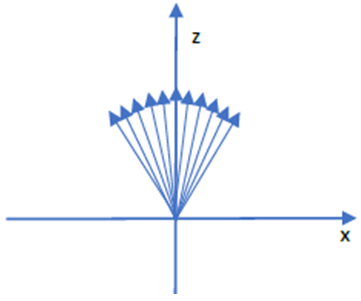
3. The microscopic magnets of silver beam are randomly oriented as Figure 3 on xoz plane, because the source of the silver beam is from silver vapor, the angle between the angular momentum vector and x axis is 𝛼.
4. The magnetic field lines are not parallel to z axis, there is some direction distribution for the inhomogeneous magnetic field above and below x axis, illustrated as Figure 4.

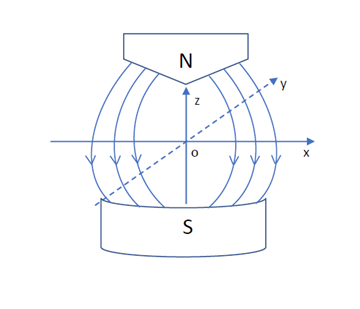

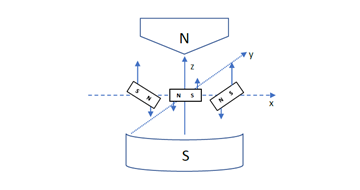
Now let’s consider the silver atom as a micro spinning ball behaving as a rotating electromagnet with its north and south poles along the rotation axis, described as Figure 5. According to L. Susskind’s analysis 26 of symmetry and conservation relation, the strength of the magnetic dipole is proportional to the rate of rotation, or to the angular momentum (L). Once the micro spinning ball entering a magnetic field (B), it will gain some energy due to the alignment between L and B.
The alignment energy is proportional to the cosine of the angle between two vectors and to the product of their magnitudes, or to the sine of the angle(𝛼) between the L vector and the x axis and the product of two vectors’ magnitudes as Equation 1. Herewith we use H for energy as the Hamiltonian of the system.
 Eq. 1
Eq. 1
If we take the magnetic field to be along the z axis so that H will be proportional to the z component of L, then the energy of alignment will change the form as Equation 2, ω as the angular frequency.
 Eq. 2
Eq. 2
Apparently if without the magnetic field, the system will be rotationally symmetric in the sense that the energy does not change if the micro ball spins to its rotation axis. But with the magnetic field, there is something to rotate relative to. Therefore, the rotational symmetry is ruined. Equation 1 and 2 represent the rotational asymmetry. The angular momentum is no longer conserved—no symmetry, no conservation. That means the direction of the spin will change with time.
The spin micro ball is a magnet, like a compass needle, the intuition and many textbooks suggest that the angular momentum will swing toward the direction of B, like a pendulum. Actually the spin is very fast, and the micromagnet is exerted a net torque by the inhomogeneous magnetic field. The torque induces the precession of the angular momentum exactly like a gyroscope around the magnetic field.
In order to clearly understand the precession, let’s use the Poisson Bracket formulation of mechanics to work out the equations of motion for the vector L. According to the definition of Poisson Bracket(PB), the time derivative of any quantity is the PB of that quantity with the Hamiltonian. Applying this rule to the components of L gives:

Or using Equation 2

Finally based on the PB definition and further deduction by Susskind, we can get
 Eq. 3
Eq. 3
It is obvious that the z component of the angular momentum does not change during its precession, which immediately precludes the idea that the rotating axis swings like a pendulum. The Equation 3 is exactly the motion equation of the vector of angular momentum on the xoy plane rotating uniformly about the origin with angular frequency ω to the magnetic field. In other words, the angle(𝛼) between the vector L and xoy plane will not change during the precession to the magnetic field when moving along y axis direction.
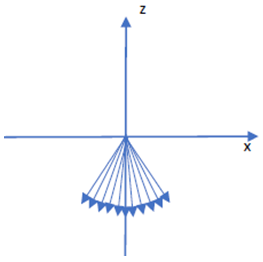
Now let’s review the image of the micromagnet in precession on the detection screen. Since the magnet is in precession, and the distance between the entrance point of the magnetic field and the detection screen is fixed, the image must be some projection of the vector of the angular momentum on the xoz plane when arriving at the detection screen. Unless it is at the initial phase or half-period phase when the spin atom hits the screen, otherwise the angle  between the vector projected on xoz plane and the x axis must be larger than 𝛼, or the angle between the vector projected on xoz plane between z axis (magnetic field direction) must be less than π⁄2 -a. Therefore, from statistics point of view, in general all the silver beam with randomly oriented magnets, its orientation distribution range (original range [0-π]) above x axis, after passing through the inhomogeneous magnetic field, is converged less than π. The schematic description of the silver beam entering magnetic field and the typical magnet orientation on detect screen for spin-up atoms are illustrated as Figure 6, and Figure 7.
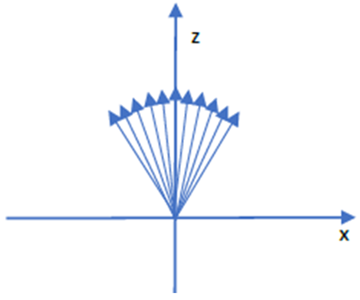
While the schematic description of the silver beam entering magnetic field and the typical magnet orientation on detect screen for spin-down atoms are illustrated as Figure 8, and Figure 9. As to the magnet with initial orientation with 𝛼 = 0, it shall be detected on screen at the corners of the mouth-shaped bands.
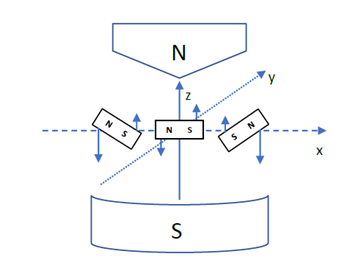


For Experiment 1, it is apparent that after tier-1 SGE apparatus, the silver beam with spin-up micromagnets keeps its up direction but with narrower orientation distribution, the image after tier-2 SGE apparatus is absolutely with z+ characterization, because the source orientation is only with up direction, and the down direction is blocked.
For Experiment 2, after tier-1 SGE apparatus, the tier-2 SGE apparatus is rotated π⁄2 at counter-clock direction. It is equivalent to keep the SGE apparatus with original setting, but to rotate the orientation of the source magnets with π⁄2 at counter-clock direction as described as Figure 10.
It is obvious that half of the orientation of the source magnets is above the z axis(spin-up), while half of the orientation of the source magnets is below the z axis(spin-down). Of course, statistically the final image on the detection screen is with both x+ and x- characterization.
For Experiment 3, after tier-2 SGE apparatus, the tier-3 SGE apparatus is rotated π⁄2 at clockwise direction, it is equivalent to rotate orientation of the source magnets(spin-up, only with x+ characterization) with π⁄2 at clockwise direction. Therefore, the final image on the detection screen is with both z+ and z- characterization again.
Based on the SGE results and our motion analysis, it is apparent that SG apparatus has two specific effects on the passing silver beam: 1. To split silver beam to two discrete bands according to the original different spin characterization of each atom’s electron; 2. To converge the orientation distribution of angular momentum vectors of the electrons in the source beam to a narrower range.
P. Alstrom and J. Porter successfully interpreted the SGE results of discrete bands instead of continuous line along z axis direction as the result of transverse effect of the inhomogeneous magnetic field according to classical physics. Combined with the precession of the silver atoms induced by the inhomogeneous magnetic field, we attributed the SGE results of discrete bands to the combination of transverse effect perpendicular to the magnetic field and the precession of each atom in the beam, which clearly elucidated the reasons why in multi-stage SGE we always got the image on the detection screen with both spin-up and spin-down characterization, even though source beam was with only spin-up direction when next tier SG apparatus was rotated π⁄2. The result is the indicative of the source beam when passing through the inhomogeneous magnetic field. The final image of discrete bands is the collection of the precession of each individual atom in the silver beam.
The attribution of final SGE results to randomly oriented atoms in source beam by classical physics is more straight forward and intuitive than interpretation of one atom with superposition of both spin-up and spin-down characterization, or one atom with linear combination of different spin features in quantum physics. Actually the final SGE result is the statistic result, the collective contribution of the precession of each atom.
For the SGE result, the SG apparatus triggered the wave collapse of the spin states from the combination of both spin-up and spin-down to only spin-up or spin-down state. The wave collapse came from the assumption of superposition of the states of spin characterization of each individual atom according to quantum mechanics. While according to our interpretation by classical physics, the testing result was determined by the source beam with random distribution of the angular momentum.
Because we could not obtain the original parameters, such as the magnetic field, the distance between the entrance of SG apparatus and the detection screen, the flying speed of the silver beam, the initial physical parameters of the silver beam, otherwise, we could calculate the angular frequency of precession and the precession time from the entrance to the screen, to estimate the extension of the converging effect to support our classical deterministic conclusion.
It is obvious that if the assumption of superposition and the interpretation of quantum mechanics were applied to the collective atoms in the silver beam instead of individual silver atom to describe the spin-state of the silver beam, it would be equivalent to the interpretation by classical physicals as statistic results of the whole silver beam.
In the multi-stage SGE, the test result of spin state with both spin-up and spin-down characterization after the next tier SG apparatus was rotated π⁄2, was explained as Uncertainty Principle, or we couldn’t test the spin state at both x and z axis directions at same time, or the later testing of spin state at z direction destroyed the previous testing result at x direction according to quantum mechanics. Based on our motion analysis according to classical physics, the later testing result after a precession was determined by the source beam with random distribution of the angular momentum vectors, because the motion is relative between the source beam and SG apparatus. The direction change of SG apparatus is equivalent to the orientation change of the source beam. It seems the interpretation as uncertainty principle is a far-fetched reasoning process without thorough investigation of the motion details.
Based on classical assumption that silver atom is a micromagnet due to its electron’s spin characterization in the source silver beam and the thorough investigation and analysis of the precession induced by the inhomogeneous magnetic field, we applied Susskind’s theoretical relation of symmetry and conservation to the SGE interpretation. We concluded that the observed results in SGE, the discrete mouth-shaped bands were the combination effects of transverse effect of the magnetic field and the precession of atoms in the silver beam, and the angular momentum vectors of the atoms struck on the detection screen were still randomly oriented, but with narrower distribution range compared to the atoms in source beam. Our interpretation can explain both the phenomena in the original SGE, and the observed results in the multi-stage SGE with classical physics. We can avoid the mysterious concepts of state superposition, wave function collapse, later testing destroying the previous quantum states in quantum physics. We strongly believe the SGE results are nothing to do with the uncertainty principle, classical physis can fully interpret the SGE results with satisfaction better than quantum mechanics.
| [1] | W. Gerlach; O. Stern, “Der Experimentelle Nachweis der Richtungsquantelung im Magnetfeld”. Z. Physik(in German), 9: p349-352(1922). | ||
| In article | View Article | ||
| [2] | W. Gerlach; O. Stern, “Das Magnetische Moment des Silberatoms”. Z. Physik(in German), 9: p353-355(1922). | ||
| In article | View Article | ||
| [3] | A. Einstein; P. Ehrenfest, “Quantentheoretische Bemerkungen zum Experiment Von Stern und Gerlach”. Z. Physik(in German), 11: p31-34(1922). | ||
| In article | View Article | ||
| [4] | A. Sommerfeld, “Zur Quantentheorie der Spektrallinien”. Ann. Phys(in German), (Leipzig) 51, p125-167 (1916). | ||
| In article | View Article | ||
| [5] | B. Friedrich; D. Herschbach, “Stern and Gerlach: How a bad Cigar Helped Reorient Atomic Physics”. Phys. Today. 56(12): p53-59(2003). | ||
| In article | View Article | ||
| [6] | T.E. Philipps; J.B. Taylor, “The Magnetic Moment of the Hydrogen Atom”. Phys. Rev. 29(2): 309(1927). | ||
| In article | View Article | ||
| [7] | F. Weinert, “Wrong Theory-Right Experiment: The Significance of the Stern-Gerlach Experiments”. Stud. Hist. Phil. Mod. Phys. 26(1): p75-86(1995). | ||
| In article | View Article | ||
| [8] | G.H. Rutherford; R. Grobe, “Comment on “Stern-Gerlach Effecy for Electron Beams””. Phys. Rev. Lett. 81: 4772(1998). | ||
| In article | View Article | ||
| [9] | G. Potel; F. Barranco; S. Cruz-Barrios; J. Gomz-Camacho, “Quantum mechanical description of Stern-Gerlach experiment”. Phys. Rev. A. 71, 052106(2005). | ||
| In article | View Article | ||
| [10] | D. Home; A.K. Pan; M.M. Ali; A.S. Majumdar, “Aspects of nonideal Stern-Gerlach experiment and testable ramifications”. J. Phys. A: Math. Theor. 40(46), 13975(2007). | ||
| In article | View Article | ||
| [11] | S.H. Patil, “Quantum Mechanical Description of Stern-Gerlach Experiment”. Eur. J. Phys. 19(1): 25(1998). | ||
| In article | View Article | ||
| [12] | D. Castelvecchi, “The Stern-Gerlach Experiment at 100”. Nat. Rev. Phys. 4: p140-142(2022). | ||
| In article | View Article | ||
| [13] | David Bohm, Quantum Theory. New York: Prentice-Hall. pp. 326–330(1951). | ||
| In article | |||
| [14] | Robert Eisberg, Fundamentals of Modern Physics. New York: John Wiley & Sons. ISBN 0-471-23463-X. c1961. | ||
| In article | |||
| [15] | David J. Griffiths, Introduction to Quantum Mechanics. Pearson Prentice Hall, ISBN 0-13-111892-7. c2005. | ||
| In article | |||
| [16] | I.I. Rabi, "Space Quantization in a Gyrating Magnetic Field". Phys. Rev. 51(8): p652–654(1937). | ||
| In article | View Article | ||
| [17] | N.F. Ramsey, "A Molecular Beam Resonance Method with Separated Oscillating Fields". Phys. Rev. 78(6): p695-699(1950). | ||
| In article | View Article | ||
| [18] | D. Kleppner; H.M. Goldenberg; N.F. Ramsey, "The Atomic Hydrogen Maser". Phys. Rev. 126(2): 603(1962). | ||
| In article | View Article | ||
| [19] | M. Devereux, “Reduction of the Atomic Wavefunction in the Stern-Gerlach Magnetic Field”. Can. J. Phys. https://mc06.manuscriptcentral.com/cjp-pubs. | ||
| In article | |||
| [20] | B.C. Hsu, M. Berrondo, J.F.S. Van Huele. “Stern-Gerlach Dynamics with Quantum Propagators”. Phys. Rev. A, 83(1), 012109 (2011). | ||
| In article | View Article | ||
| [21] | P. Alstrom; P. Hjorth; R. Mattuck, “Paradox in the classical treatment of Stern-Gerlach Experiment”. Am. J. Phys. 50(8): p697-698(1982). | ||
| In article | View Article | ||
| [22] | J. Porter; R.F. Pettifer; D.R. Leadley, “Direct demonstration of the transverse Stern-Gerlach effect”. Am. J. Phys. 71(11): p1103-1108(2003). | ||
| In article | View Article | ||
| [23] | Zhonglin BO, “Reinvestigation of Heisenberg’s Uncertainty Principle and a New Deduction of Schrodinger Equation-Spinvector Motion II” International Journal of Physics, 11(2): p81-87(2023). | ||
| In article | View Article | ||
| [24] | R. Frisch; E. Segrè, “Uber die einstellung der richtungsquantelung II” Z. Physik(in German). 80: p610-616(1933). | ||
| In article | View Article | ||
| [25] | J.J. Sakurai, Modern quantum mechanics. Addison-Wesley. ISBN 0-201-53929-2. c1985. | ||
| In article | |||
| [26] | L. Susskind; G. Hrabovsky, Classical Mechanics: The Theoretical Minimum. Penguin Books. ISBN: 978-0-141-99406-2. c2013. | ||
| In article | |||
Published with license by Science and Education Publishing, Copyright © 2023 Zhonglin BO
 This work is licensed under a Creative Commons Attribution 4.0 International License. To view a copy of this license, visit
http://creativecommons.org/licenses/by/4.0/
This work is licensed under a Creative Commons Attribution 4.0 International License. To view a copy of this license, visit
http://creativecommons.org/licenses/by/4.0/
| [1] | W. Gerlach; O. Stern, “Der Experimentelle Nachweis der Richtungsquantelung im Magnetfeld”. Z. Physik(in German), 9: p349-352(1922). | ||
| In article | View Article | ||
| [2] | W. Gerlach; O. Stern, “Das Magnetische Moment des Silberatoms”. Z. Physik(in German), 9: p353-355(1922). | ||
| In article | View Article | ||
| [3] | A. Einstein; P. Ehrenfest, “Quantentheoretische Bemerkungen zum Experiment Von Stern und Gerlach”. Z. Physik(in German), 11: p31-34(1922). | ||
| In article | View Article | ||
| [4] | A. Sommerfeld, “Zur Quantentheorie der Spektrallinien”. Ann. Phys(in German), (Leipzig) 51, p125-167 (1916). | ||
| In article | View Article | ||
| [5] | B. Friedrich; D. Herschbach, “Stern and Gerlach: How a bad Cigar Helped Reorient Atomic Physics”. Phys. Today. 56(12): p53-59(2003). | ||
| In article | View Article | ||
| [6] | T.E. Philipps; J.B. Taylor, “The Magnetic Moment of the Hydrogen Atom”. Phys. Rev. 29(2): 309(1927). | ||
| In article | View Article | ||
| [7] | F. Weinert, “Wrong Theory-Right Experiment: The Significance of the Stern-Gerlach Experiments”. Stud. Hist. Phil. Mod. Phys. 26(1): p75-86(1995). | ||
| In article | View Article | ||
| [8] | G.H. Rutherford; R. Grobe, “Comment on “Stern-Gerlach Effecy for Electron Beams””. Phys. Rev. Lett. 81: 4772(1998). | ||
| In article | View Article | ||
| [9] | G. Potel; F. Barranco; S. Cruz-Barrios; J. Gomz-Camacho, “Quantum mechanical description of Stern-Gerlach experiment”. Phys. Rev. A. 71, 052106(2005). | ||
| In article | View Article | ||
| [10] | D. Home; A.K. Pan; M.M. Ali; A.S. Majumdar, “Aspects of nonideal Stern-Gerlach experiment and testable ramifications”. J. Phys. A: Math. Theor. 40(46), 13975(2007). | ||
| In article | View Article | ||
| [11] | S.H. Patil, “Quantum Mechanical Description of Stern-Gerlach Experiment”. Eur. J. Phys. 19(1): 25(1998). | ||
| In article | View Article | ||
| [12] | D. Castelvecchi, “The Stern-Gerlach Experiment at 100”. Nat. Rev. Phys. 4: p140-142(2022). | ||
| In article | View Article | ||
| [13] | David Bohm, Quantum Theory. New York: Prentice-Hall. pp. 326–330(1951). | ||
| In article | |||
| [14] | Robert Eisberg, Fundamentals of Modern Physics. New York: John Wiley & Sons. ISBN 0-471-23463-X. c1961. | ||
| In article | |||
| [15] | David J. Griffiths, Introduction to Quantum Mechanics. Pearson Prentice Hall, ISBN 0-13-111892-7. c2005. | ||
| In article | |||
| [16] | I.I. Rabi, "Space Quantization in a Gyrating Magnetic Field". Phys. Rev. 51(8): p652–654(1937). | ||
| In article | View Article | ||
| [17] | N.F. Ramsey, "A Molecular Beam Resonance Method with Separated Oscillating Fields". Phys. Rev. 78(6): p695-699(1950). | ||
| In article | View Article | ||
| [18] | D. Kleppner; H.M. Goldenberg; N.F. Ramsey, "The Atomic Hydrogen Maser". Phys. Rev. 126(2): 603(1962). | ||
| In article | View Article | ||
| [19] | M. Devereux, “Reduction of the Atomic Wavefunction in the Stern-Gerlach Magnetic Field”. Can. J. Phys. https://mc06.manuscriptcentral.com/cjp-pubs. | ||
| In article | |||
| [20] | B.C. Hsu, M. Berrondo, J.F.S. Van Huele. “Stern-Gerlach Dynamics with Quantum Propagators”. Phys. Rev. A, 83(1), 012109 (2011). | ||
| In article | View Article | ||
| [21] | P. Alstrom; P. Hjorth; R. Mattuck, “Paradox in the classical treatment of Stern-Gerlach Experiment”. Am. J. Phys. 50(8): p697-698(1982). | ||
| In article | View Article | ||
| [22] | J. Porter; R.F. Pettifer; D.R. Leadley, “Direct demonstration of the transverse Stern-Gerlach effect”. Am. J. Phys. 71(11): p1103-1108(2003). | ||
| In article | View Article | ||
| [23] | Zhonglin BO, “Reinvestigation of Heisenberg’s Uncertainty Principle and a New Deduction of Schrodinger Equation-Spinvector Motion II” International Journal of Physics, 11(2): p81-87(2023). | ||
| In article | View Article | ||
| [24] | R. Frisch; E. Segrè, “Uber die einstellung der richtungsquantelung II” Z. Physik(in German). 80: p610-616(1933). | ||
| In article | View Article | ||
| [25] | J.J. Sakurai, Modern quantum mechanics. Addison-Wesley. ISBN 0-201-53929-2. c1985. | ||
| In article | |||
| [26] | L. Susskind; G. Hrabovsky, Classical Mechanics: The Theoretical Minimum. Penguin Books. ISBN: 978-0-141-99406-2. c2013. | ||
| In article | |||