Dissipative light bullets can be considered as (3+1) D spatiotemporal dynamics of stable optical solitons in the three spatial dimensions, in addition to localization in the temporal domain. They share many common characteristics with other multi-dimensional phenomena and their study remain an open challenge. Here, we report semi-rotating and rotating light bullets from pulsating dynamic when a suitable ansatz function is chosen. Using the complex cubic-quintic Ginzburg-Landau equation model and thanks to a variational method known as the collective variable approach, we can observe stable pulsating light bullet. The influence of the initial conditions leading to an asymmetric rotating light bullet in the transverse plane, are investigated.
In nonlinear dissipative medium, the combined interplay between gain, loss, spectral filtering, dispersion, diffraction, and nonlinearity creates a light bullet which is confined in the three spatial dimensions and localized in the temporal domain 1. The confinement and localization result mainly from a balance between dispersive and nonlinear conservative effects on the one hand and between nonlinear gain and nonlinear loss on the other hand 2. These double balances are strongly coupled, providing unique properties to light bullets 3, 4. Light bullet is a localized structure in dissipative systems considered in nonequilibrium thermodynamics 5.
Unveiling the dynamics of (3+1) D spatiotemporal solitons gained great interest for delivering high-capacity information and exploring multi-dimensional nonlinear dynamics that widely exist in physics, chemistry, biology and materials science 6, 7.
The (3+1) D spatiotemporal dissipative solitons are not simply extensions of a spatiotemporal optical field that have been studied for a long time in Hamiltonian systems. These dissipative systems are not isolated, but are kept in contact with an external source to promote energy transfer. It assumes that there are not only energy losses but also energy supply 1.
Light bullets can exist for any sign of chromatic dispersion 8 and have extended regions of stability. The existence of stable light bullets with complicated shapes was demonstrated using numerical simulations in a dissipative medium described by the (3+1) D complex cubicquintic Ginzburg-Landau equation (3D CGLE) 8, 9, 10. Recently, theoretical models have been developed for understanding the generation of (3+1) D spatiotemporal dispersions and strong nonlinear interactions 11. The numerical simulations and theoretical challenges give rise to allow experimental observations and potential applications of these optical structures. In fact, advances in understanding of multimode linear telecommunications systems, computing, algorithms, and modeling multidimensional control of light-light and light-matter interactions create a strong foundation to address these challenges 12. Recent investigations have focused in nonlinear photonic crystals, in particular on the fabrication, characterization and application of (3+1) D structures with properties and functionalities that are either difficult or virtually impossible to achieve with lower dimensional structures 13. An experimental framework for real-time observation, however, is yet to be demonstrated 14, whereas the time-averaged measurements of (3+1) D solitons have recently been demonstrated by sampling the laser beam profiles 15 and manipulating the pump power 16.
Progress towards the search for (3+1) D spatiotemporal solitons or light bullets requires specific conceptual, analytical, numerical and experimental advances which pass through an appropriate physical model and the synthesis of an adequate material for the generation and propagation of spatiotemporal solitons 17. Advances in both theoretical and experimental directions are needed, but in this work we tackle the first of the two challenges. We present a semianalytical results that are based on the complex cubic-quintic Ginzburg-Landau equation (3D CGLE) model, which includes both spatial diffraction and temporal dispersion. This 3D CGLE model is useful to describe spatiotemporal dynamics and a vast variety of nonlinear phenomena in a variety of nonlinear dissipative systems 18, such as interactions observed in passively mode-locked laser cavities or transmission lines 18, 19. The (3+1) D complex cubic-quintic Ginzburg-Landau equation admits stationary and pulsating solutions 1, 9, 20, 21, although all of them have been found numerically in specific regions of the equation parameters 19. With the semianalytical methods 21, 22, 23, 24, the domains of existence of stationary and pulsating solutions have also been studied extensively. Furthermore, there are no exact analytical soliton of 3D CGLE in our knowledge. Consequently, we can expect that the only way of finding light bullets is an entirely numerical procedure or semi-analytical methods.
That being said, numerical simulations of the 3D CGLE for a given set of parameters and a given initial condition is tedious and time consuming with the standard computers 8. As the 3D CGLE has different type of solutions (unstable, stationary, pulsating,...), the task becomes more tedious when we explore the regions of existence for light bullets as well as the unveiling of their complex dynamics. Like that, the study of the light bullet remains a very hard problem to tackle in its generality and requires enormous computer power. To overcome this complication, semi-analytical methods based on various physical backgrounds can be useful to perceive 3D CGLE solutions more efficiently and envisage their parameters domains of interest. Recently, thanks to a variational method known as the collective variable approach, we highlighted a rich variety of solutions of (3+1) D spatiotemporal solitons that include stationary, pulsating 21, 22 and a new type of breathing solutions 25. One of the precious advantages of this collective variable method is that it makes it easy to make more complex dynamics evident.
However, only full computations can assert or cancel the dynamics found in such a way. In the present study, using the collective variable approach and a suitable trial function, we find a rich variety of pulsating light bullet.
In our semi-analytical study, we consider the propagation of light bullets in a system described by an extended complex cubic-quintic Ginzburg-Landau equation model. This model has been used successfully in a number of studies to provide a wide range of physical phenomena in dissipative systems observed in passively mode-locked laser cavities or transmission lines. It includes cubic and quintic nonlinearities of dispersive and dissipative types, and transverse diffraction effects, to take into account theoretical and numerical grounds for the development of “dissipative light bullet” experiments. The propagation equation reads 2, 5:
 | (1) |
Equation (1) is written in normalized form. The coefficients  ,
, 
 ,
,  ,
,  ,
,  and
and  are real constants. The physical meaning of each term depends on the real problem that must be examined.
  represents the optical envelope and is a complex function of four real variables
 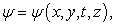 where
where  is the retarded time in the frame moving with the pulse,
  is the propagation distance, and
  and
and  are the two transverse coordinates. The left-hand-side of equation (1) contains the conservative terms, namely
  denotes the dispersion propagation regime, being anomalous when
  and normal
 represents the Kerr nonlinearity coefficient and
  which represents, if negative, the saturation coefficient of the Kerr nonlinearity. Dissipative terms are written on the right-hand-side of equation (1). The meaning of the corresponding parameters is the following:
  is the coefficients for linear loss (if negative),
  represents the nonlinear gain (if positive),
  denotes the spectral filtering (if positive) and
  is the saturation of the nonlinear gain (if negative).
By observing, equation (1) is nothing but a natural extension of the one-dimensional CGLE, and admits a variety of localized solutions, from stationary to pulsating, as well as period-doubling bifurcation 25. As the 3D CGLE has several parameters that define the existence of stable solutions, the task seems extremely difficult for a given set of parameters and an initial condition.
One of the possibilities to overcome this complexity, is to resort to a semi-analytical approach.
The aim of this method is to reduce an infinite-dimensional to an ordinary differential equation (ODE), which can be solved numerically with relative ease. The semianalytical approach is based on a trial function theory with a finite number of parameters, as a result, the resulting dynamical system controls the evolution of parameters such as the light bullet amplitude, width, and chirp. In practice, the principle of the semi-analytical approach technique consists to associate collective variables 26 with the pulse’s parameters of interest for which equations of motion may be derived. The objective being to simplify the characterization of a light bullet by using a lowdimensional equivalent mechanical system based on a finite number of degrees of freedom. Each degree of freedom can then be represented by a coordinate called collective variable (CV). It’s an effective tool for a significant reduction in the number of used variables for the description of the soliton dynamics. In 27 using the same technique we carried out the dynamical behavior of pulsating solitons in the two-dimensional Complex Swift-Hohenberg equation. The basic principle consists in decomposing the optical field  in the following way 26, 28:
 | (2) |
where f, the trial function is a function of the CVs. The trial function is a simple analytic function that has amplitude and phase profile, is chosen according to the propagation equation and, at best, the configuration of the optical pulse. The component  is a residual field that represents all other excitations in the system (noise, radiation, dressing field, etc.). The option of precise form of the trial function which introduces the collective variables in the theory is crucial for obtaining solutions with the desired properties, especially when approximations are made.
Here according to our previous study 21, and in order to describe rotating dynamics, we choose the following Gaussian ansatz function:
 | (3) |
where  ,
, 
 ,
,  ,
,  ,
,  ,
,  ,
,  ,
,  and
and  represent the collective variables:
  stands for the light bullet amplitude,
  ,
,  and
and  are related to the temporal and the transverse widths along x and y axis respectively.
 , and
, and  are respectively the temporal and the transverse chirp parameters, and
  is the global phase that evolves along with propagation.
 | (4) |
The parameters s1 and s2, which we shall call rotating parameters, are introduced in the trial function (Eq. 3) to tie the transverse widths in order to have rotating dynamics. The choice of trial function is the first step for the collective variable approach. The second step of characterization would be to carry out a variational analysis neglecting the residual field  , this approximation is called the bare approximation 26. As is the case in most practical studies, one can consider the fact that the pulse propagation can be completely characterized by the ansatz function (
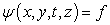 ) by neglecting the residual field
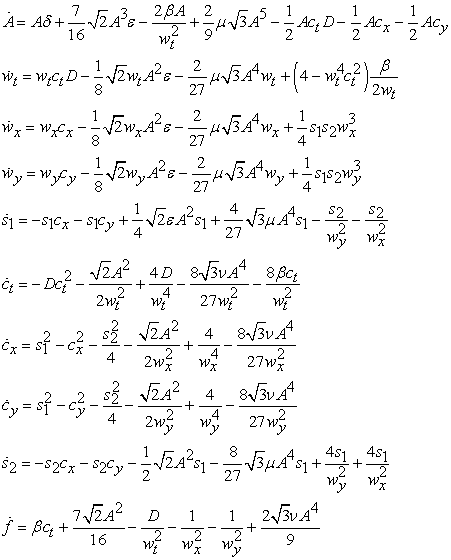
Using the bare approximation to the 3D CGLE, as in our previous studies (see all the details in 21, 22, 26, 27, 29) we get the ten collective variables that evolve according to the following set of ten coupled ordinary differential equations. This variational equations give us the first idea on the dynamic of the light bullet without having to know the exact pulse field 
The equations (Eq. 4) are usually functions of time that evolve subject to the constraints of the system and finally converge to a fixed point or a limit cycle. One of the major benefit of the semi-analytical approach lies in the fact that the pulse propagation can be completely characterized without having to solve the exact equation (Eq. 1) 3D CGLE. For example, in 30, 31 applying this method we investigated the phenomenon of dissipative soliton resonance found earlier using numerical simulations and confirmed by the method of moments. The second major benefit of the semianalytical analysis is that it gives a detailed qualitative picture of the role and mode of action of each term of the 3D CGLE. It helps to see clearly the influence of each equation (Eq. 1) parameters on the various physical parameters of the light bullet. We notice that the evolution of the amplitude is dominated by the linear loss ( ), the nonlinear gain (
 ) and its saturation (
 ), as well as that the terms of spectral filtering (
 ) and dispersion term (
 ). It appears distinctly that the Kerr nonlinearity coefficient (
 ) does not act explicitly on the amplitude. The progression of temporal parameters namely the temporal width (
 ) and chirp (
 ) are deeply affected by the dispersion term and the spectral filtering. Nonetheless, the nonlinear gain and its saturation, and the saturation coefficient of the Kerr act differently on these temporal parameters. The temporal widths are impacted only by the nonlinear gain and its saturation, and the transverse chirp parameters by the saturation coefficient of the Kerr. We point out that rotating parameters
  and
and  act only on the spatial magnitude (
 ,
,  ,
,  and
and  ) and none of the soliton’s parameters are influenced by
  , the global phase. The rotating parameters
  and
and  , absolutely necessary in this present study are influenced by the nonlinear gain (
 ) and its saturation (
 ).
).
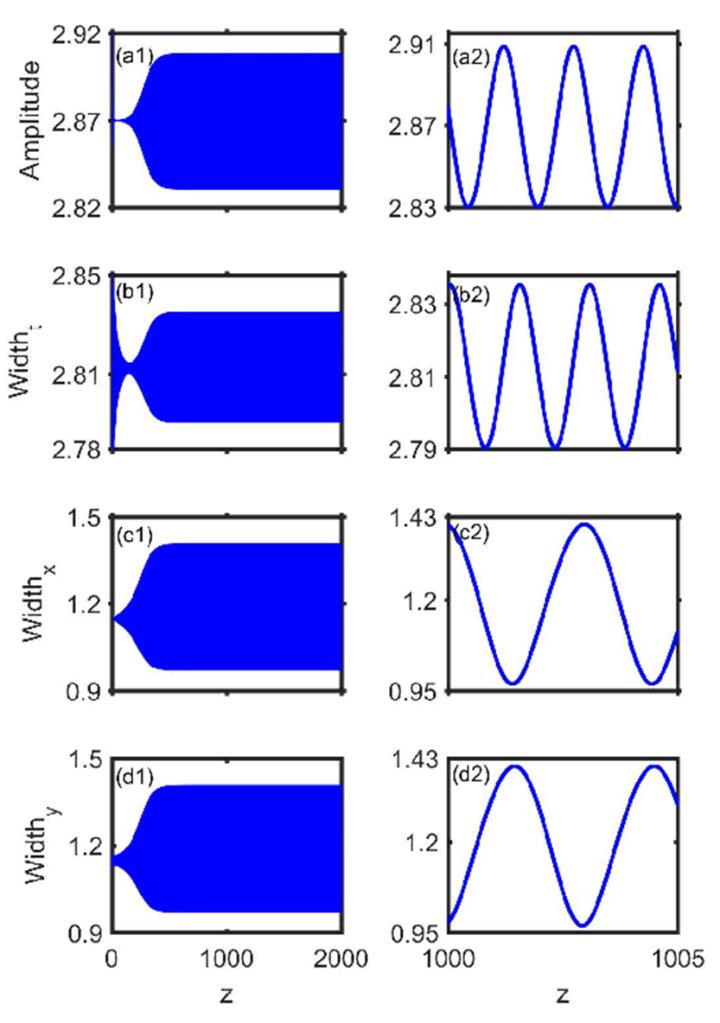
The 3D CGLE admits stationary and pulsating solutions in the parameter space of the (3+1) D complex cubic-quintic Ginzburg-Landau equation. In 21 we predicted approximately the domains of existence of stable light bullets using Gaussian trial function which admits asymmetric pulse shapes in the transverse plane (x,y). A major goal of our study is to provide a quick pulsating light bullet solution in the parameter space of the (3+1) D CGLE using the trial function with rotating parameters (Eq. 3). The stable solutions correspond to the stable fixed points of the system, obtained from the ordinary differential equations (Eq. 4). The unstable fixed points can be divided in two categories corresponding to the limit-cycle attractor and the unstable solutions. The dynamic of the pulse in the limit-cycle attractor area matches to the pulsating solutions of the (3+1) D complex cubic-quintic Ginzburg-Landau equation. The pulsating solutions possess inherent stability the same way as stationary stable solutions do. In our quest to find pulsating light bullets of the (3+1) D CGLE, we fixed the values of the following parameters β=0.1, γ=1, μ=-0.1, δ=-0.4, ν=-0.0 and varied the two remaining parameters (D and ε), according to our previous study 21. To carry out our simulations, we chose the following initial condition: A=2.8697, wt=2.8117, wx=1.1473, wy= 1.1473,  ,
,  ,
,  ,
,  and
and  corresponding to to a fixed point and affected by a slight perturbation corresponding to the photon noise in the system. Thus, for each pair of
  values, the use of the Newton-Raphson method helps to know if it corresponds to a limit-cycle. An illustration of the evolution of pulsating light bullet is presented in Figure 1 for the following values of the parameters
  and
and  The behaviour of pulsating solutions are general feature of most nonlinear dissipative systems and can be attributed of limit-cycle attractor.
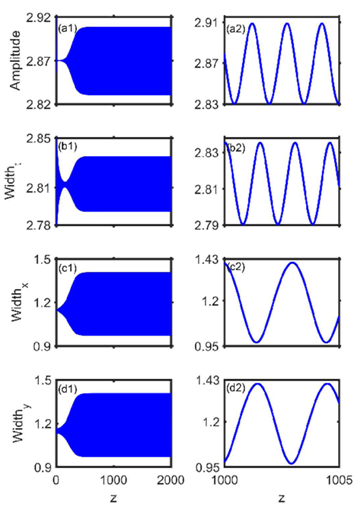
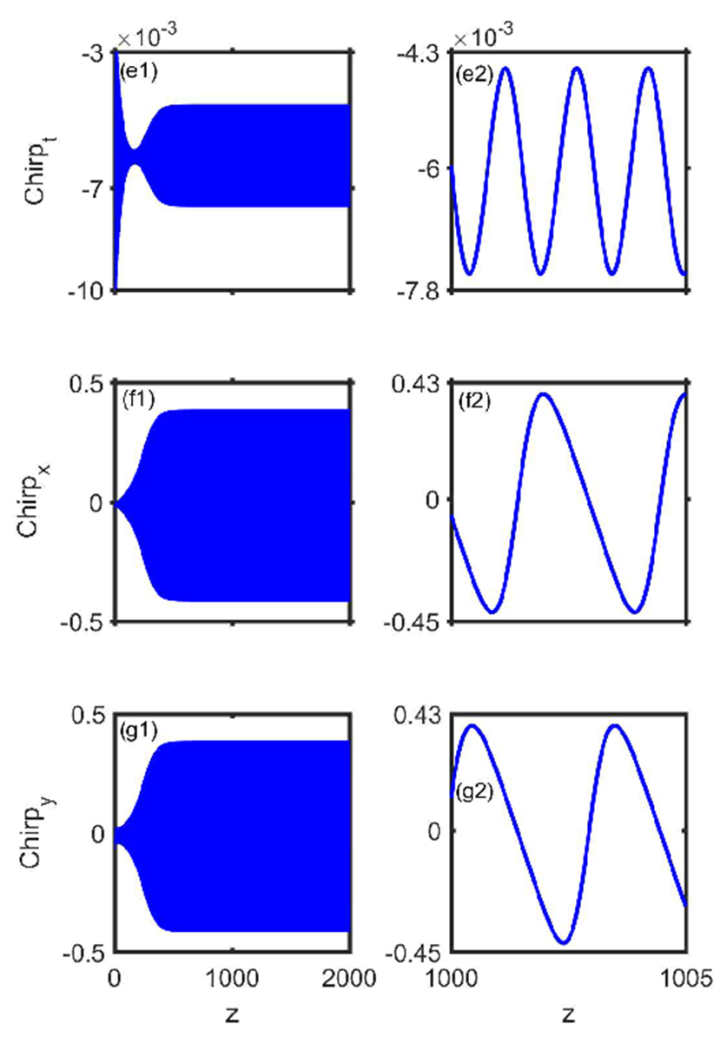
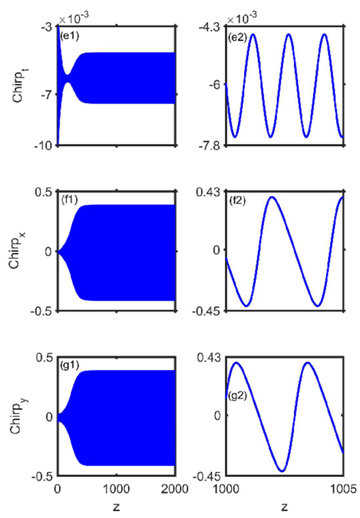
The dynamic of this pulsating light bullet starts with small oscillations right after the initial condition. These oscillations in the z direction gradually develop in amplitude (a1), temporal width (b1), and spatial widths (c1) and (d1), and become stationary at  The enlarged views of oscillations (a2)-(d2) show a nearly permanent harmonic evolution of the parameters that run between two fixed values. One can clearly notice that the x and y oscillations are out of phase and have the same amplitude. Likewise, the temporal width quickly evolves with respect to the spatial width. The light bullet periodically plays out of phase consecutive contractions in the x and y directions, while keeping almost constant its peak amplitude. The temporal and spatial chirps oscillations can be seen from the evolution plot in the Figure 2. They qualitatively describe the same dynamics as the temporal and spatial widths, characteristic of the pulsating light bullet.
This pulsating act has comparatively the same dynamics that we pointed out numerically in our previous studies 25, 27. Likewise, in 32, 33 the authors experimentally investigated the dynamical diversity of pulsating solitons from single-soliton to multi-soliton in a fiber laser.
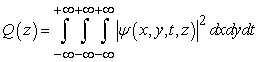
One of the useful parameters which can help to control the dynamic of the pulse in dissipative systems is the total energy  given by the three dimensional integral over
  ,
,  and
and  :
:
 | (5) |
For dissipative systems, this quantity evolves according to the state of solutions; it can be stationary, pulsating or tend towards infinity.
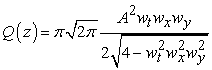
Thereby, the total energy  quantitatively and qualitatively provides the main information about the dynamic of the light bullet. Moreover an obvious advantage of the collective variable approach also lies in the fact that it helps to express the total energy with respect to the light bullet’s parameters. In this way, we can easily reveal the total energy as a function of light bullet’s parameters, like this:
 | (6) |
The above expression shows that the light bullet energy  strongly depends on its amplitude
  , temporal
  and spatial widths
  ,
,  . The choice of the trial function is therefore very essential as it controls quantitatively and qualitatively the behaviour of the light bullet.
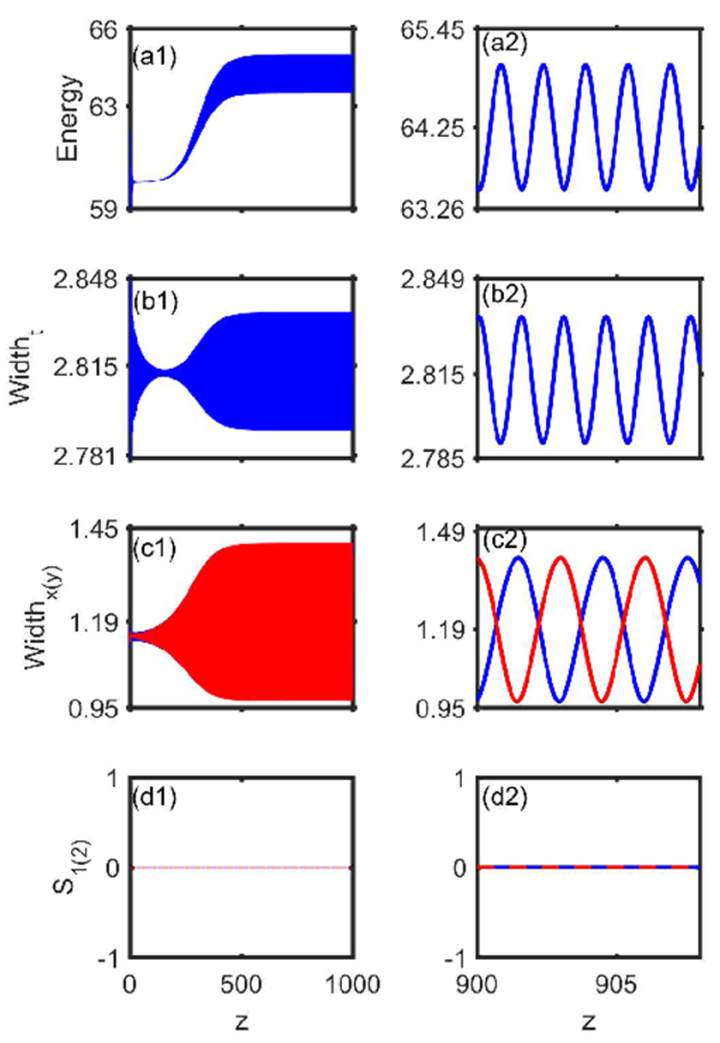
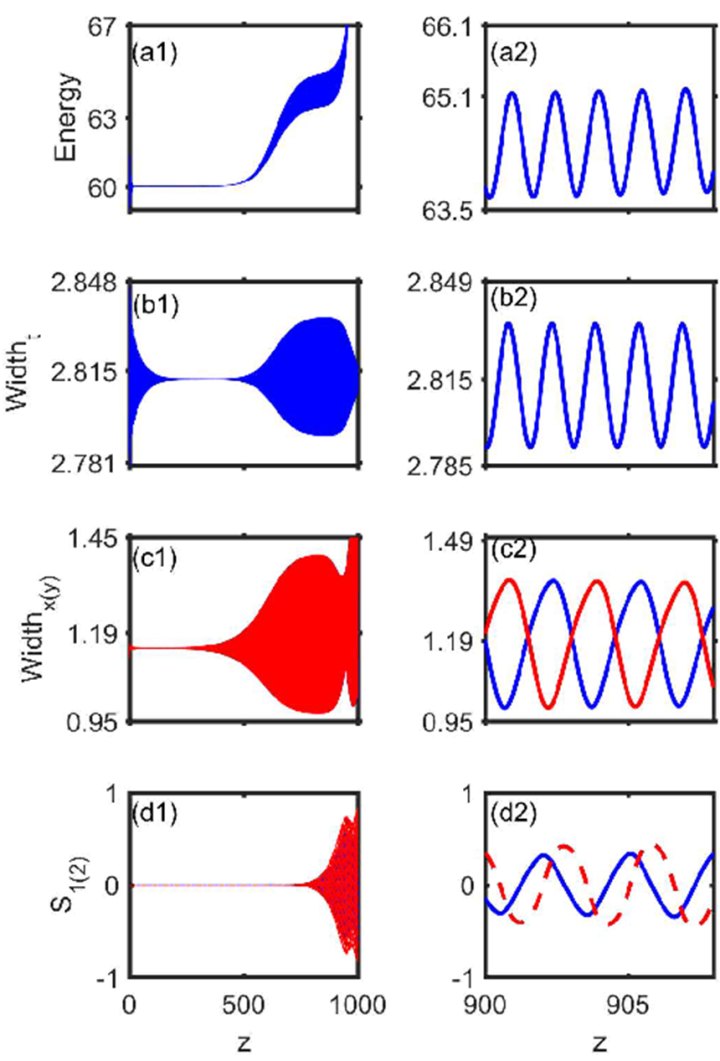
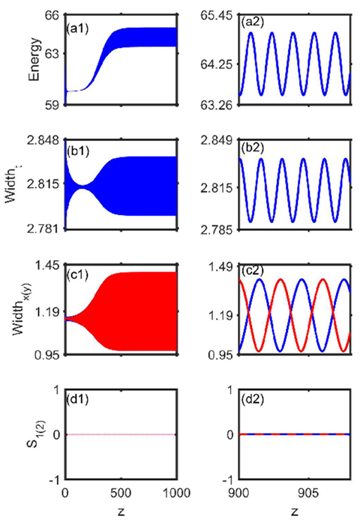
The rotating parameters  and
and  evolution (d), the total energy
  (a), temporal width
  (b), and radially asymmetric pulsations
  and
and  (c) obtained with the use of the collective variable approach and the trial function for the following values of the parameters


 and
and  are presented in Figure 3.
Small oscillations appear right after starting the evolution and become stationary at  The (a2)−(d2) represent a close-up view of the oscillations. We note the total energy
  oscillates between two fixed values, with the same number of periods as the temporal width
  However, the rotating parameters
  and
and  remain constant (fixed at zero) throughout the propagation.
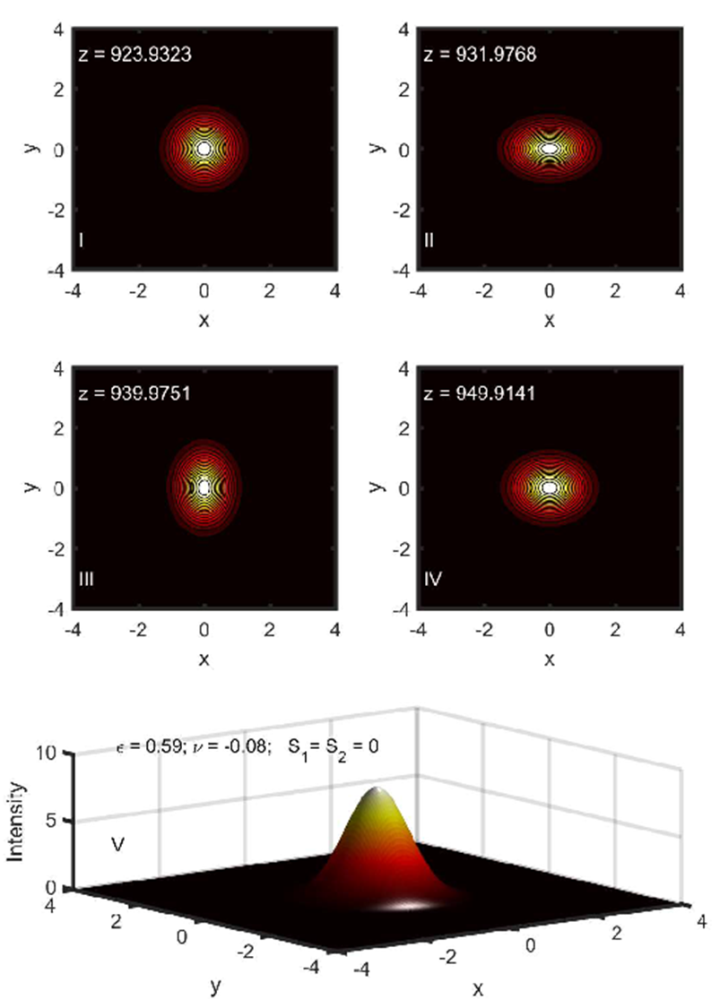
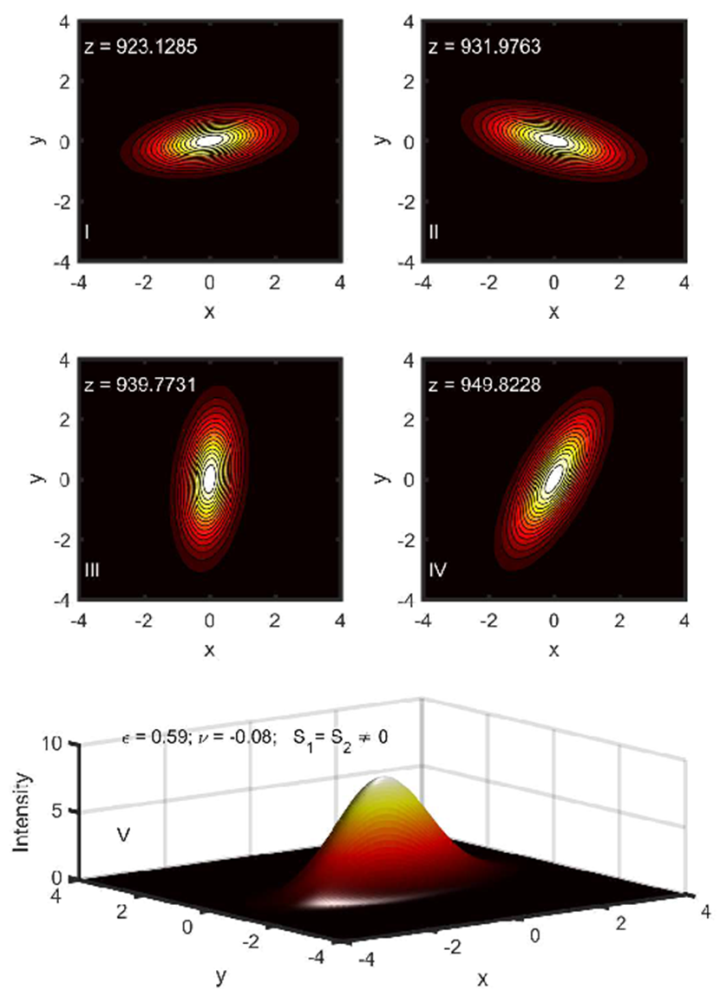
We can remark that the radial width ( and
and  ) oscillations are out of phase and have the same amplitude. It appears that the radial widths oscillate slowly while the amplitude of the light bullet oscillates quickly. This points out periodic out of phase consecutive contractions of the light bullet in the x and y directions as shown in the Figure 4. It follows an oscillating and semi-rotating motion of the light bullet - antisymmetric mode inflation-deflation. The transition from position I corresponding at the distance 923.9323 to the position IV corresponding at the distance 949.9141 is done according to three distinct dynamics: the light bullet plays pulsating motion, stretches along the x axis (in position II) and along the y axis (in position III) and a semi-rotating motion. The semi-rotating dynamic takes place between positions I and IV, without the light bullet making a complete rotation, because the radial widths (
 and
and  ) are not linked, while

When keeping all the parameters corresponding to the Figure 3 constant and varying slightly  and
and 
 but
but  , the overall dynamic of the light bullet changes.
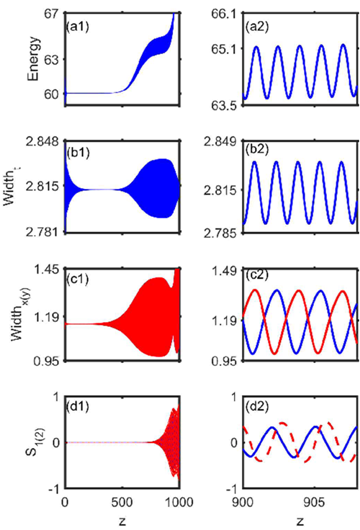
The stable pulsating light bullet becomes unstable and quickly undergoes a collapse. Before the collapse we witness a transitory phase during which the light bullet oscillates while turning on itself, that we call pulsating rotating light bullet. As shown in Figure 5, the (a2)−(d2) represent a close-up view of oscillations. As illustrated in Figure 5, which represents the same situation as in Figure 3, except the parameters  and
and  which have been modified for
 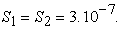 The dynamic of the light bullet begins with a stationary phase up to a distance
  Subsequently, the total energy increases and the light bullet switches dynamics with quasi-stable oscillations and finally collapses. Prior to the collapse, the parameters
  and
and  also begin to oscillate, and hence bind the radial widths, which drives the impulse into a quasi-stable rotating motion over a short distance. The pulsating rotating dynamic comes from the change of the parameters
  and
and  . Note that the collapse is characterized by a crumbling of the temporal width (b1) while the radial widths increase (c1) as well as the total energy (a1). During the pulsating phase,
  and
and  remain fixed at 0 and the radial widths are out of phase with periods oscillation less than that of the temporal width. To clearly highlight the rotating motion, we are interested in the dynamics in the (x, y) plane, this situation is summarized in Figure 6. One can notice that the light bullet occupies different positions at specific distances.

From position I to position IV, it performs a rotation in the (x,y) plane. During the rotating, it also plays pulsating, we are therefore seeing a pulsating rotating light bullet.
We have demonstrated efficient and quick approximate solutions in a dissipative medium described by the (3+1) D complex cubic-quintic Ginzburg-Landau equation. Using a semianalytical method known as the collective variable approach, we predict semi-rotating and rotating pulsating light bullet when a suitable trial function is chosen. The validity of this study is based on the choice of the trial function and comparison with limited number of direct calculations is required. Nevertheless, the collective variable approach is incomparably quicker than direct numerical computations. As well, this approach helps to reveal elementary types of pulsating light bullet: asymmetric inflating-deflating and pulsation-rotation. The simplicity of the method is related to arbitrary choice of ansatz function which helps to find specific solutions. Of course, these must be at the final stage confirmed, complemented or invalidated by numerical studies. Pulsating rotating light bullet needs to be confirmed experimentally, and no doubt they will have potential applications to parallel pre-processing and dynamical routing of optical data, and also in various fields in physics, biology and chemistry where there are also pulsating.
| [1] | N. Akhmediev, J. M. Soto-Crespo, and P. Grelu, Chaos 17, 037112 (2007). | ||
| In article | View Article PubMed | ||
| [2] | N. Akhmediev and A. Ankiewicz, Dissipative Solitons (Springer, Heidelberg, 2005). | ||
| In article | View Article | ||
| [3] | G. Nicolis and I. Prigogine, Self Organization in Nonequilibrium Systems—From dissipative structures to order through fluctuations (Wiley, New York, 1977). | ||
| In article | |||
| [4] | N. Akhmediev and A. Ankiewicz, Dissipative Solitons: From Optics to Biology and Medicine in Springer Lecture Notes in Physics (Springer, Heidelberg, 2008), Vol. 751. | ||
| In article | |||
| [5] | G. Nicolis and I. Prigogine, Self Organization in Nonequilibrium Systems—From Dissipative Structures to Order Through Fluctuations (Wiley, New York, 1977). | ||
| In article | |||
| [6] | Mosk, A. P., Lagendijk, A., Lerosey, G. Fink, M. Controlling waves in space and time for imaging and focusing in complex media. Nat. Photon 6, 283-292 (2012). | ||
| In article | View Article | ||
| [7] | Wright, L. G., Renninger, W. H., Christodoulides, D. N. Wise, F.W. Spatiotemporal dynamics of multimode optical solitons. Opt. Express 23, 3492-3506 (2015). | ||
| In article | View Article PubMed | ||
| [8] | J. M. Soto-Crespo, P. Grelu, and N. Akhmediev, Opt. Express 14, 4013 (2006). | ||
| In article | View Article PubMed | ||
| [9] | P. Grelu, J. M. Soto-Crespo, and N. Akhmediev, Opt. Express 13, 9352 (2005). | ||
| In article | View Article PubMed | ||
| [10] | William H. Renninger and Frank W. Wise, Spatiotemporal soliton laser, Optica 1, 101-104 (2014). | ||
| In article | View Article | ||
| [11] | Wright, L. G. et al. Mechanisms of spatiotemporal mode-locking. Nat. Phys 16, 565-570 (2020). | ||
| In article | View Article | ||
| [12] | Logan G. Wright, William H. Renninger, Demetri N. Christodoulides, and Frank W. Wise, Nonlinear multimode photonics: nonlinear optics with many degrees of freedom, Optica 9, 824-841 (2022). | ||
| In article | View Article | ||
| [13] | Yong Zhang, Yan Sheng, Shining Zhu, Min Xiao, and Wieslaw Krolikowski, Nonlinear photonic crystals: from 2D to 3D, Optica 8, 372-381 (2021). | ||
| In article | View Article | ||
| [14] | Yuankai Guo, Xiaoxiao Wen, Wei Lin, Wenlong Wang, Xiaoming Wei, Zhongmin Yang. Real-time multispeckle spectral-temporal measurement unveils the complexity of spatiotemporal solitons. Nature Communications 12:1, 67. (2021). | ||
| In article | View Article PubMed | ||
| [15] | Qin, H., Xiao, X., Wang, P. Yang, C. Observation of soliton molecules in a spatiotemporal mode-locked multimode fiber laser. Opt. Lett. 43, 1982-1985 (2018). | ||
| In article | View Article PubMed | ||
| [16] | Wu, H. et al. Pulses with switchable wavelengths and hysteresis in an all-fiber spatio-temporal mode-locked laser. Appl. Phys. Express 13, 022008 (2020). | ||
| In article | View Article | ||
| [17] | A. Kamagate Propagation des solitons spatio-temporels dans des milieux dissipatifs, (Éditions universitaires européennes, ISBN-10: 3841726658, 2018). | ||
| In article | |||
| [18] | Aranson, I. S. and Kramer, L. “The world of the complex Ginzburg-Landau equation”, Rev. Mod. Phys. 74, 99. February (2002). | ||
| In article | View Article | ||
| [19] | J. M. Soto-Crespo, N. Akhmediev, and V. V. Afanasjev, J. Opt. Soc. Am. B 13, 1439 (1996). | ||
| In article | View Article | ||
| [20] | Akhmediev, N., Soto-Crespo, J. M. and Town, G. “Pulsating solitons, chaotic solitons, period doubling, and pulse coexistence in mode-locked lasers: Complex Ginzburg-Landau equation approach,” Phys. Rev. E, 63, 056602. April (2001). | ||
| In article | View Article PubMed | ||
| [21] | A. Kamagate, Ph. Grelu, P. Tchofo-Dinda, J. M. Soto-Crespo and N. Akhmediev, PHYSICAL REVIEW E 79, 026609 (2009). | ||
| In article | View Article PubMed | ||
| [22] | Asseu, O., Diby, A., Yoboué, P. and Kamagaté, A. (2016) Spatio-Temporal Pulsating Dissipative Solitons through Collective Variable Methods. Journal of Applied Mathematics and Physics, 4, 1032-1041. | ||
| In article | View Article | ||
| [23] | A. I. Maimistov, JETP 77, 727 (1993). | ||
| In article | View Article | ||
| [24] | E. N. Tsoy, A. Ankiewicz, and N. Akhmediev, Phys. Rev. E 73, 036621 (2006). | ||
| In article | View Article PubMed | ||
| [25] | A. Kamagaté, S. Chouli, and P. C. Bakala, “Bifurcation and Stability Analysis of Pulsating Solitons.” International Journal of Physics, vol. 6, no. 5 (2018). | ||
| In article | |||
| [26] | Tchofo-Dinda, P., Moubissi, A.B. and Nakkeeran, K. “Collective Variable Theory for Optical Solitons in Fibers,” Physical Review E, 64. (2001). | ||
| In article | View Article PubMed | ||
| [27] | Kamagaté, A. and Moubissi, A.-B. Pulsating Solitons in the Two-Dimensional Complex Swift-Hohenberg Equation. Journal of Applied Mathematics and Physics, 6, 2127-2141 (2018). | ||
| In article | View Article | ||
| [28] | R. Boesch, P. Stancioff, and C. R. Willis, Phys. Rev. B 38, 6713 (1988). | ||
| In article | View Article PubMed | ||
| [29] | Kamagaté, A., Tehini, R., Bamba, A. Higher-order Spectral Filtering Effects on the Evolution of Stationary Dissipative Solitons. Physical Science International Journal, 22(4), 1-11 (2019). | ||
| In article | View Article | ||
| [30] | Kamagaté, A., Konaté, A., Soro, P.A. and Asseu, O. Effects of Dissipative Terms on Dissipative Soliton Resonance Curve. Optics and Photonics Journal , 7, 57-66 (2017). | ||
| In article | View Article | ||
| [31] | Aladji Kamagaté, Penetjiligué Adama Soro and Adama Konaté. Dissipative Soliton Resonance Curve under Influence of Nonlinear Gain. IOSR Journal of Applied Physics (IOSR-JAP), vol. 9, no. 5, 2017, pp. 59-65. | ||
| In article | |||
| [32] | Hong-Jie Chen, Yan-Jie Tan, Jin-Gan Long, Wei-Cheng Chen, Wei-Yi Hong, Hu Cui, Ai-Ping Luo, Zhi-Chao Luo, and Wen-Cheng Xu, “Dynamical diversity of pulsating solitons in a fiber laser,” Opt. Express 27, 28507-28522 (2019). | ||
| In article | View Article PubMed | ||
| [33] | Jie Chen, Xin Zhao, Ting Li, Jianjun Yang, Jiansheng Liu, and Zheng Zheng, “Generation and observation of ultrafast spectro-temporal dynamics of different pulsating solitons from a fiber laser,” Opt. Express 28, 14127-14133 (2020). | ||
| In article | View Article PubMed | ||
Published with license by Science and Education Publishing, Copyright © 2023 Aladji Kamagate, Aliou Bamba and Penetjiligue Adama Soro
 This work is licensed under a Creative Commons Attribution 4.0 International License. To view a copy of this license, visit
http://creativecommons.org/licenses/by/4.0/
This work is licensed under a Creative Commons Attribution 4.0 International License. To view a copy of this license, visit
http://creativecommons.org/licenses/by/4.0/
| [1] | N. Akhmediev, J. M. Soto-Crespo, and P. Grelu, Chaos 17, 037112 (2007). | ||
| In article | View Article PubMed | ||
| [2] | N. Akhmediev and A. Ankiewicz, Dissipative Solitons (Springer, Heidelberg, 2005). | ||
| In article | View Article | ||
| [3] | G. Nicolis and I. Prigogine, Self Organization in Nonequilibrium Systems—From dissipative structures to order through fluctuations (Wiley, New York, 1977). | ||
| In article | |||
| [4] | N. Akhmediev and A. Ankiewicz, Dissipative Solitons: From Optics to Biology and Medicine in Springer Lecture Notes in Physics (Springer, Heidelberg, 2008), Vol. 751. | ||
| In article | |||
| [5] | G. Nicolis and I. Prigogine, Self Organization in Nonequilibrium Systems—From Dissipative Structures to Order Through Fluctuations (Wiley, New York, 1977). | ||
| In article | |||
| [6] | Mosk, A. P., Lagendijk, A., Lerosey, G. Fink, M. Controlling waves in space and time for imaging and focusing in complex media. Nat. Photon 6, 283-292 (2012). | ||
| In article | View Article | ||
| [7] | Wright, L. G., Renninger, W. H., Christodoulides, D. N. Wise, F.W. Spatiotemporal dynamics of multimode optical solitons. Opt. Express 23, 3492-3506 (2015). | ||
| In article | View Article PubMed | ||
| [8] | J. M. Soto-Crespo, P. Grelu, and N. Akhmediev, Opt. Express 14, 4013 (2006). | ||
| In article | View Article PubMed | ||
| [9] | P. Grelu, J. M. Soto-Crespo, and N. Akhmediev, Opt. Express 13, 9352 (2005). | ||
| In article | View Article PubMed | ||
| [10] | William H. Renninger and Frank W. Wise, Spatiotemporal soliton laser, Optica 1, 101-104 (2014). | ||
| In article | View Article | ||
| [11] | Wright, L. G. et al. Mechanisms of spatiotemporal mode-locking. Nat. Phys 16, 565-570 (2020). | ||
| In article | View Article | ||
| [12] | Logan G. Wright, William H. Renninger, Demetri N. Christodoulides, and Frank W. Wise, Nonlinear multimode photonics: nonlinear optics with many degrees of freedom, Optica 9, 824-841 (2022). | ||
| In article | View Article | ||
| [13] | Yong Zhang, Yan Sheng, Shining Zhu, Min Xiao, and Wieslaw Krolikowski, Nonlinear photonic crystals: from 2D to 3D, Optica 8, 372-381 (2021). | ||
| In article | View Article | ||
| [14] | Yuankai Guo, Xiaoxiao Wen, Wei Lin, Wenlong Wang, Xiaoming Wei, Zhongmin Yang. Real-time multispeckle spectral-temporal measurement unveils the complexity of spatiotemporal solitons. Nature Communications 12:1, 67. (2021). | ||
| In article | View Article PubMed | ||
| [15] | Qin, H., Xiao, X., Wang, P. Yang, C. Observation of soliton molecules in a spatiotemporal mode-locked multimode fiber laser. Opt. Lett. 43, 1982-1985 (2018). | ||
| In article | View Article PubMed | ||
| [16] | Wu, H. et al. Pulses with switchable wavelengths and hysteresis in an all-fiber spatio-temporal mode-locked laser. Appl. Phys. Express 13, 022008 (2020). | ||
| In article | View Article | ||
| [17] | A. Kamagate Propagation des solitons spatio-temporels dans des milieux dissipatifs, (Éditions universitaires européennes, ISBN-10: 3841726658, 2018). | ||
| In article | |||
| [18] | Aranson, I. S. and Kramer, L. “The world of the complex Ginzburg-Landau equation”, Rev. Mod. Phys. 74, 99. February (2002). | ||
| In article | View Article | ||
| [19] | J. M. Soto-Crespo, N. Akhmediev, and V. V. Afanasjev, J. Opt. Soc. Am. B 13, 1439 (1996). | ||
| In article | View Article | ||
| [20] | Akhmediev, N., Soto-Crespo, J. M. and Town, G. “Pulsating solitons, chaotic solitons, period doubling, and pulse coexistence in mode-locked lasers: Complex Ginzburg-Landau equation approach,” Phys. Rev. E, 63, 056602. April (2001). | ||
| In article | View Article PubMed | ||
| [21] | A. Kamagate, Ph. Grelu, P. Tchofo-Dinda, J. M. Soto-Crespo and N. Akhmediev, PHYSICAL REVIEW E 79, 026609 (2009). | ||
| In article | View Article PubMed | ||
| [22] | Asseu, O., Diby, A., Yoboué, P. and Kamagaté, A. (2016) Spatio-Temporal Pulsating Dissipative Solitons through Collective Variable Methods. Journal of Applied Mathematics and Physics, 4, 1032-1041. | ||
| In article | View Article | ||
| [23] | A. I. Maimistov, JETP 77, 727 (1993). | ||
| In article | View Article | ||
| [24] | E. N. Tsoy, A. Ankiewicz, and N. Akhmediev, Phys. Rev. E 73, 036621 (2006). | ||
| In article | View Article PubMed | ||
| [25] | A. Kamagaté, S. Chouli, and P. C. Bakala, “Bifurcation and Stability Analysis of Pulsating Solitons.” International Journal of Physics, vol. 6, no. 5 (2018). | ||
| In article | |||
| [26] | Tchofo-Dinda, P., Moubissi, A.B. and Nakkeeran, K. “Collective Variable Theory for Optical Solitons in Fibers,” Physical Review E, 64. (2001). | ||
| In article | View Article PubMed | ||
| [27] | Kamagaté, A. and Moubissi, A.-B. Pulsating Solitons in the Two-Dimensional Complex Swift-Hohenberg Equation. Journal of Applied Mathematics and Physics, 6, 2127-2141 (2018). | ||
| In article | View Article | ||
| [28] | R. Boesch, P. Stancioff, and C. R. Willis, Phys. Rev. B 38, 6713 (1988). | ||
| In article | View Article PubMed | ||
| [29] | Kamagaté, A., Tehini, R., Bamba, A. Higher-order Spectral Filtering Effects on the Evolution of Stationary Dissipative Solitons. Physical Science International Journal, 22(4), 1-11 (2019). | ||
| In article | View Article | ||
| [30] | Kamagaté, A., Konaté, A., Soro, P.A. and Asseu, O. Effects of Dissipative Terms on Dissipative Soliton Resonance Curve. Optics and Photonics Journal , 7, 57-66 (2017). | ||
| In article | View Article | ||
| [31] | Aladji Kamagaté, Penetjiligué Adama Soro and Adama Konaté. Dissipative Soliton Resonance Curve under Influence of Nonlinear Gain. IOSR Journal of Applied Physics (IOSR-JAP), vol. 9, no. 5, 2017, pp. 59-65. | ||
| In article | |||
| [32] | Hong-Jie Chen, Yan-Jie Tan, Jin-Gan Long, Wei-Cheng Chen, Wei-Yi Hong, Hu Cui, Ai-Ping Luo, Zhi-Chao Luo, and Wen-Cheng Xu, “Dynamical diversity of pulsating solitons in a fiber laser,” Opt. Express 27, 28507-28522 (2019). | ||
| In article | View Article PubMed | ||
| [33] | Jie Chen, Xin Zhao, Ting Li, Jianjun Yang, Jiansheng Liu, and Zheng Zheng, “Generation and observation of ultrafast spectro-temporal dynamics of different pulsating solitons from a fiber laser,” Opt. Express 28, 14127-14133 (2020). | ||
| In article | View Article PubMed | ||