The aim of this study was to evaluate the dimensional accuracy of three copying techniques for a master denture and recommend a suggested method for complete denture duplication. The method advocated in this study was to reproduce copies of dentures with three duplicating techniques. The first method used in this study constricted replicas of master denture using full acrylic method (A) acrylic bases and acrylic teeth. The second method replicated the master denture using acrylic baseplates and wax teeth. The last method (C) was a full wax teeth and baseplate. The master set was constructed to include measuring points which were established by grinding holes into the original complete maxillary denture. Three measuring methods were used; articulator, digital calipers and an Alma denture gauge, to investigate the dimensional accuracy of the copied dentures compared with the master denture. The results demonstrate that none of the methods accurately replicated the master denture. The highest dimensional change was observed in method B (-0.27 %). The most accurate method duplicated the master denture was method A. With the limitation of this study, it was concluded that method A (full acrylic) is suggested to be used for copying a previous successful complete denture. Method B can be used when improvements in the fitting, occlusal surfaces and the vertical dimension is required.
A copy denture is useful way of providing a replacement of previously successful dentures. Minor changes in the tooth positioning and the polished surfaces might result in numerous problems for the patients in helping them to adapt to their new dentures. 1 These problems can be solved by a duplicating technique. This technique is used for many purposes, including; copying previous successful dentures, improving fitting and occlusal surfaces and the vertical dimension while maintaining the shape. 2 The copy technique has been widely received by patients as it accurately duplicates these features. 3 In elderly patients, a copy denture is a useful technique especially in cases where a change in adaptation might be a problem. 4 Copy dentures are used to provide a spare set of dentures, replace dentures with pale appearance, old and/ or worn dentures, produce new dentures with improvements and produce temporary dentures that can be modified gradually if the patient’s ability to adapt to new dentures is in doubt. 5
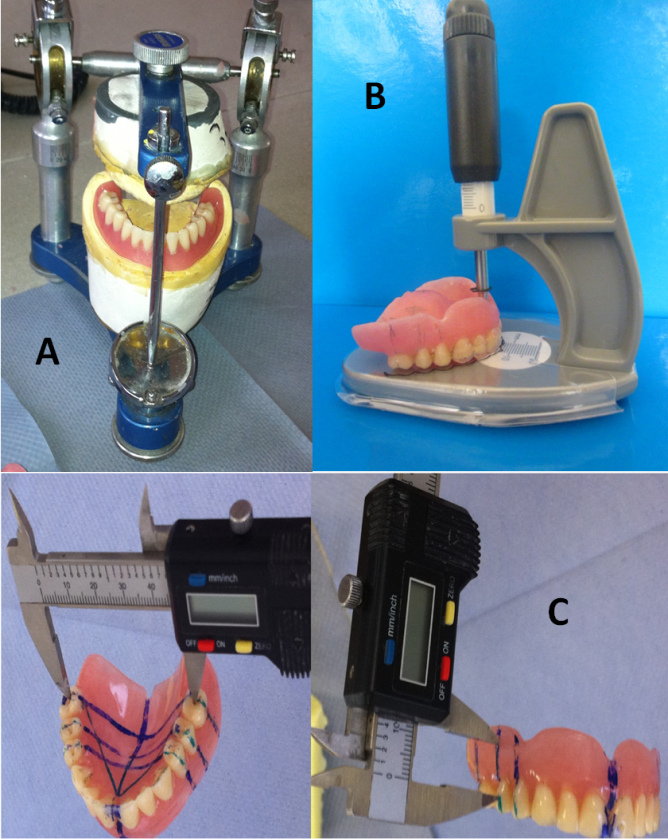
The objective of this study was to evaluate the dimensional accuracy of three copying techniques for a master denture and recommend a suggested method for complete denture duplication. Three duplication methods were selected as shown in (Table.1). Three measuring methods were used (articulator, digital calipers and an Alma denture gauge) as shown in (Figure 1).
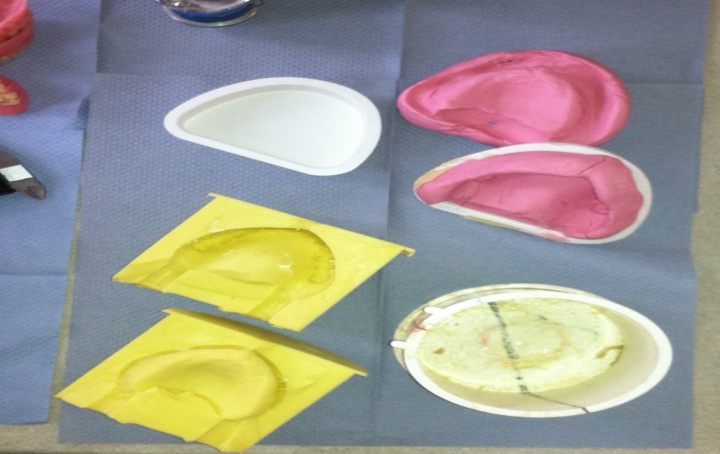
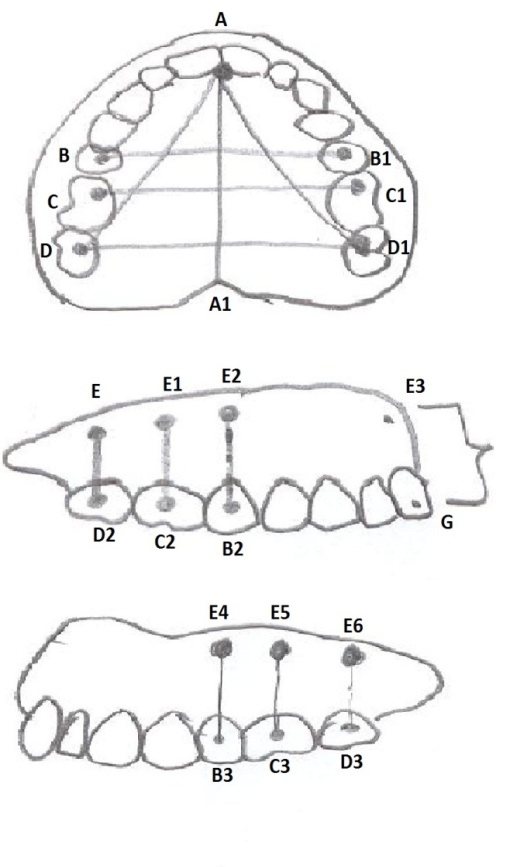
An original (master) complete maxillary denture was duplicated by the three duplicating methods. The replicas of the master denture were made from cold cure acrylic bases (C&J Rapid Repair Polymer,Chaperlin & Jacobs,Surrey, England) and cold cure dentine acrylic teeth (Medway, cold cure dentine, Medway Dental, Surrey, England). Silicone and lab putty molds were used in this technique (Figure 2). Three replicas were made for each of the three methods. The master denture was constructed with a number of referencing points from which measurements were produced (Figure 3). These were situated in positions that would provide the greatest distances on the denture to enable ease of measuring. For example a 5% change will be more easily measured across a greater distance. The dimension (A-A1) measures the largest distance in the vertical plain. The dimensions (B, C, D - B1, C1, D1) measure the greatest distances across the occlusal surface horizontally. The dimension (A- D, D1) measures the greatest distance from the anterior aspect of the denture to the molars. From the lateral aspect of the denture the dimensions (E, E1, E2 – D2, C2, B2) were established as they gave a reasonable distance in the vertical plane. Likewise for the dimensions (E4, E5, E6 – B3 , C3 ,D3). Finally the dimension (E3 – G) was chosen to assess the anterior aspect of the denture. The referencing points were created by drilling holes into the master complete maxillary denture with a fine rose head burr in a dental laboratory hand piece. The referencing points were positioned so that each copied denture could be measured ten times each in thirteen dimensions by digital calipers. The advantage of drilling holes is that they give more accurate measuring points as the digital calipers can return to these fixed points at any time. An Alam denture gauge was used to define denture tooth position. The replicas were then returned to the articulator to be checked with the opposing complete lower denture (Figure 1).

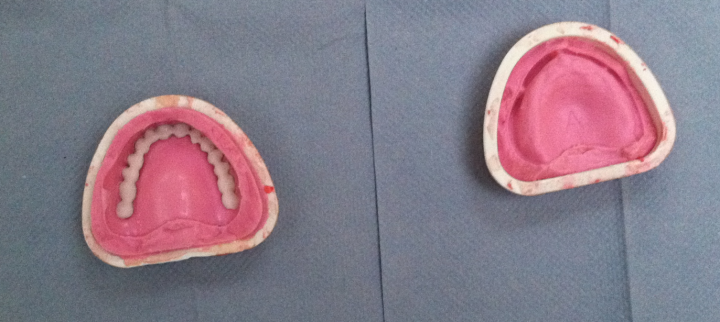
The original denture teeth were duplicated in a silicon mold (Finosil addition-curing silicon deuplicating materal mexing 1:1, Fino GmbH, Mangelsfeld, Germany) by using cold cured dentine acrylic teeth, to transfer all features which were made on the master denture teeth (occlusal, labial, buccul surfaces of the teeth). The same technique was used for all the copied dentures to ensure the measuring points start and end at the same fixed point. Two different mold materials were selected, lab putty for method (A) and (B) due to the rigidity of the material and a silicon mold for methods (B) and (C) (Figure 2).
In method (A) full acrylic, a plastic box slightly larger than the master denture was chosen as a container (Figure 2) into which a lab putty material was placed to record the external surfaces of the dentures. One half of the box was filled with lab putty and the denture was pressed into it until the external surfaces of the dentures were completely covered. Then the material was allowed to set and all the excess trimmed away. Petroleum jelly (Vaseline) was used as a separating media. The second mix of lab putty was mixed and filled into the other half of the box and the fitting surface, so that the entire denture was invested and the two flat edges of the box were attached together allowing the material to set. The mold was dismantled and the denture removed by opening the mold in two halves. Finally, two holes were created in the posterior aspect of the mold to allow pouring of the acrylic.


Manufacturing teeth:
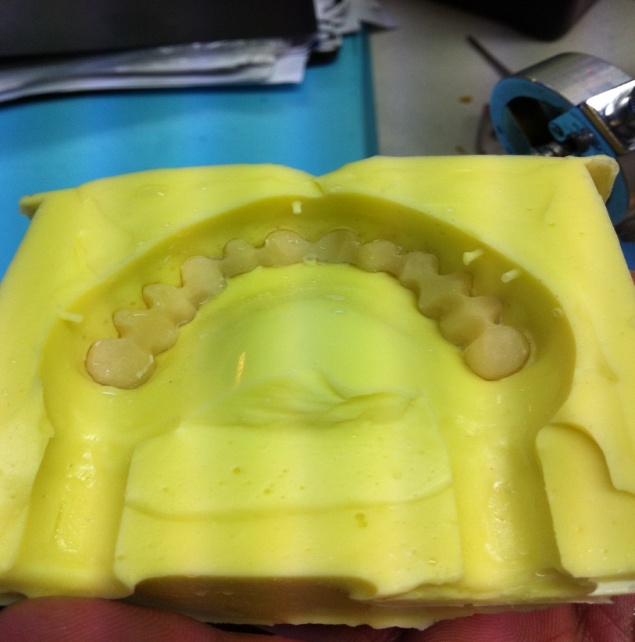
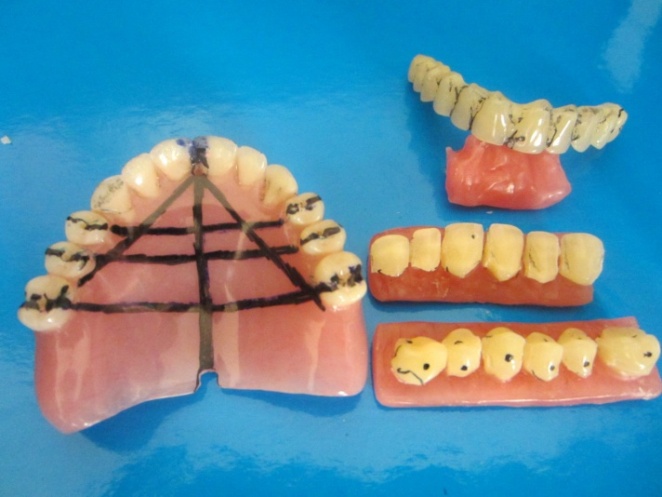
The monomer (C&J Rapid Repair Monomer ,Chaperlin & Jacobs,Surrey,England) was flooded into the impression of the teeth in the silicon mold (Figure 4). Then tooth-colored acrylic resin polymer was poured over the monomer until the impression of the teeth was completely filled. After the tooth acrylic resin was cured, the mold was opened and the horseshoe of teeth was removed from the mold. Any excess gingival acrylic was then trimmed away so that the necks of the teeth were level with the gingival margin. The arch was returned to the lab putty mold for method (A) to be carried out (Figure 5). Alternatively, in methods (B) and (C) the teeth were separated and trimmed (Figure 6).


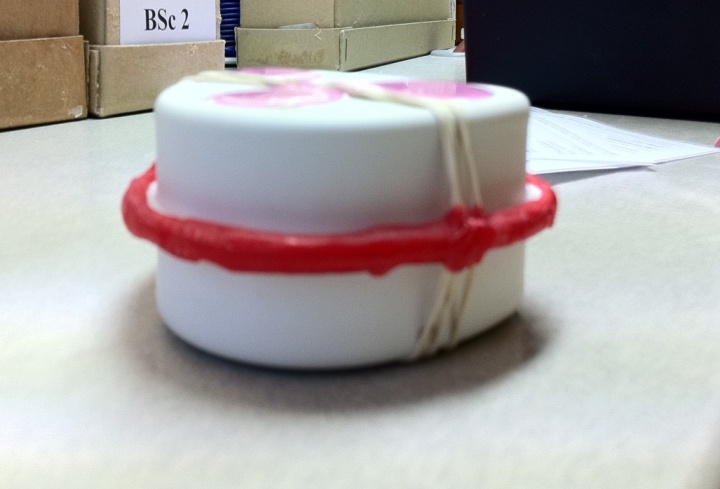
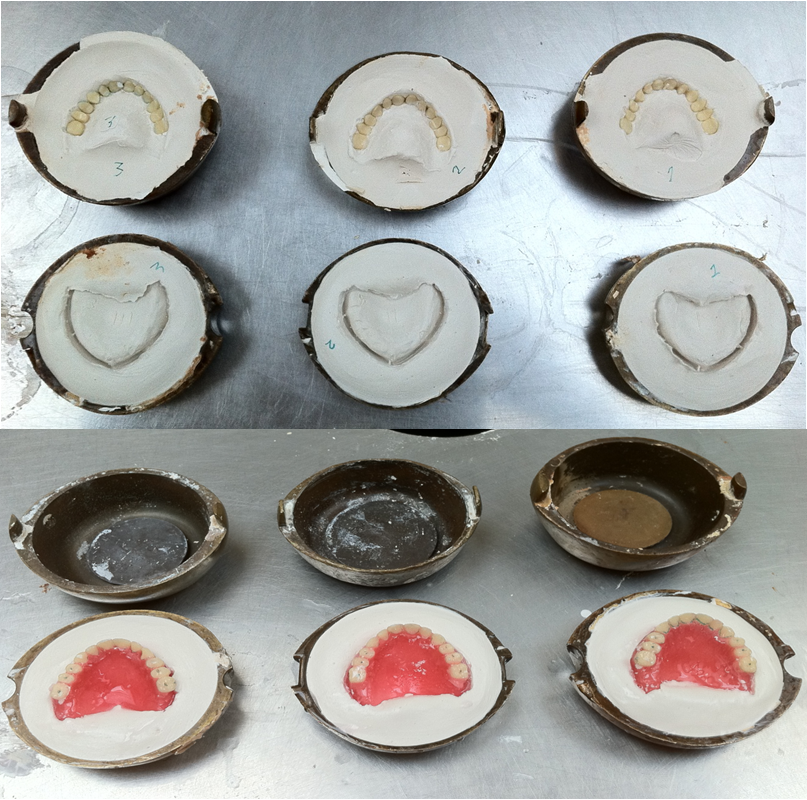
The portions of the lab putty mold were reassembled and held together with rubber bands (Figure 7) and a fluid mix of a pink cold cure acrylic was poured into one of the holes until the mold was filled to form the denture base. Then the mold was placed in a hydro flask at a pressure of 20 psi at a temperature of 40°C for 20 minutes. The mold was opened and the replicas were removed and returned to the articulator to check the vertical dimension and the lateral movements. The same technique was applied to the rest of the copies in this method. The final copy dentures were then measured.


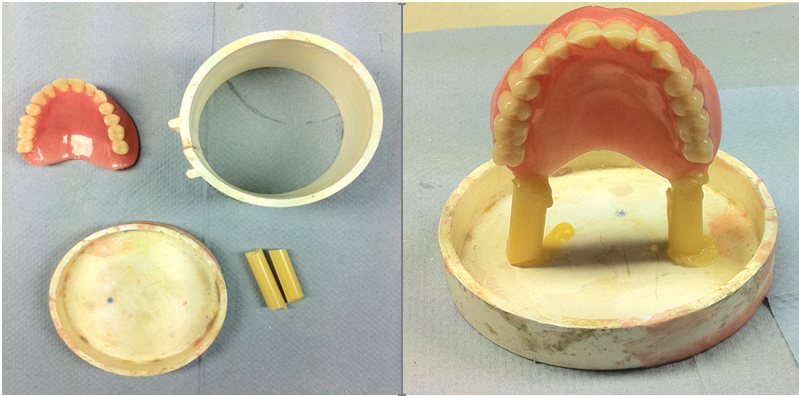
In methods (B) and (C), pieces of sticky wax were attached to the posterior aspects of the maxillary master denture to form sprue holes keeping the wax uniformly spaced from the fitting surface (Figure 8). The denture was placed in a plastic ring and then filled with silicon so that the material covered the denture up to the end of the sprues. The plastic ring container was constructed with a reference point so that an accurate incision could be made in the silicon mold. After the silicon was set, the mold was dismantled and the denture removed by cutting the mold in two halves using a sharp knife. The portions of the mold were reassembled and returned back into the container.
In method (B) acrylic baseplate wax teeth, cold cure acrylic resin was mixed and poured into one of the holes in the lap putty mold to form both denture baseplate and teeth. The additional sprue allows for the air to escape. The mold was then placed in a hydro flask at a pressure of 20 psi at a temperature of 40°C for 20 minutes. After the resin was cured, the teeth were trimmed away, the acrylic baseplate was returned to the silicon mold and the molten wax was poured into the impression of the teeth. The wax was then hardened at room temperature. The mold was opened and the assemblies were removed. The wax teeth and acrylic baseplate replicas were then returned to the articulator and the wax teeth were replaced with the cold cure acrylic teeth which were produced in the silicon mold. After the replicas were cured using the common flasking and packing procedure 11 (Figure 9). The copy dentures were returned to the articulator and adjusted if required. The final copy dentures were then measured (Table 4).

Full wax replicas teeth and baseplate, were used for method (C). Molten wax was poured into one of the sprue holes until the silicon mold was filled. When the wax was hardened, the mold was opened and the full wax replicas were removed. The replicas were then returned to the same articulator. The wax teeth were replaced with the cold cure acrylic teeth and the replicas were then measured at this stage (Table 6) trail. After the replicas were cured using the common flasking and packing procedure. Next the copy dentures were returned to the articulator and adjusted if necessary. The final copy dentures were then measured (Table 5).
The measurements made on the master denture are shown on (Table.2). Tables three to five show the percentage dimensional changes of the copies in percentage when compared to the master denture, whereas (Table 6) show the dimensional changes of the replicas at the try in stage when the full wax (method C) was used. The results demonstrate that none of the methods accurately replicated the master denture. The highest dimensional change was observed in (method B) which was (-0.27 %). The most accurate method duplicated the master denture was method (A).
Table 3 list the results of method A (full acrylic) duplicating technique compared with the master denture. It can be seen that the mean percentage change in dimensions of the method A was (0.02 %), copying technique using full acrylic proved more accuracy and less dimensional changes. Table 4 demonstrate that copies made using acrylic base and wax teeth have the highest dimensional change which was (-0.27 %). The change in dimension in method B was observed to be shrinkage. Method (C) (full wax) showed a mean change in dimension of (0.03 %) as shown in (Table 5).
It can be seen from (tables. 3-5) that all duplicate dentures made by the three different methods showed shrinkage and expansion in dimensions compared to the master denture. The maximum shrinkage and expansion change observed in any dimension was (-0.54%), (-3.16%), (-0.31%) shrinkage, and (0.75%) , (3.48%) and (0.74%) for methods A, B and C sequentially. However copying the master denture using method (B) acrylic baseplate-wax teeth showed the highest change when compared with methods (A) and (C) full acrylic and full wax. These finding is in agreement with those previously reported by Polyzois, Dr. Odont and Demetriou. 2
Finally there was a possibility that the use of wax may reduce the accuracy of the copy denture, due to the high coefficient of thermal expansion of this material. 6 In order to investigate this point, the dimensional of replicas was measured at the trial stage and after processing the final copy dentures, compared with master denture, the results are shown on (Tables 5 and 6). The mean percentage change in dimensions of the method (C) trail stage was (0.04%) and (0.03 %) for final copies. The three replicas made by method (C) (full wax) showed shrinkage of (0.01%) in dimensions after processing.
Due to major outstanding advantages of the digital calipers, a digital caliper was chosen instead of the traditional caliper types. The measurement is read in a single step, namely, the digits can be read very fast and it can be zero-setting at any position for incremental measurements, and metric measurements are displayed to within 0.05 mm. An articulator with opposing lower complete denture was used to check occlusion, vertical dimension and literal movements. The use of an Alma gauge was tried but rejected as a measurement technique using to the manufacturer instruction due to insufficient accuracy as a result of movement at the incisive papilla.
Method A (full acrylic) usually used for cases when a patient is satisfied with the existing dentures often request copy dentures, or patients that have recently had new dentures and are pleased with the appearance, and wish to have a spare set that look identical. 9 Copy denture used for these purposes can be constructed easily and quickly by using this method. Further development of this method is required.
Methods (B) (acrylic baseplate wax teeth), and (C) (full wax) were mainly used to reproduce previous successful dentures with improvements on fitting surfaces, occlusal surfaces and the vertical dimension while maintaining the shape. [3-5] 3 7, 11 Preference using acrylic baseplate instead of wax baseplate for the try in stage, because it does not warp while in the mouth and it forms a rigid close fitting. 6 Kippax and Watson, tried to assess how accurately same set of complete denture can be copied by several dental laboratories. Method B acrylic baseplate-wax teeth were required to duplicate the master denture in a silicon mold. None of the final copy denture were considered an accurate copy of the master denture, concluded that dental technicians require further training in this important technique. 1
With the limitation of this study, it was concluded that method A (full acrylic), had the highest accuracy to the master denture and therefore it is suggested to be used for copying a previously successful complete denture. Method B (acrylic baseplate) had lowest accuracy compared to the other two methods. The accuracy of method C (full wax) was in the middle. Because in method A no improvements in the fitting, occlusal surfaces and the vertical dimension can be made since it is made of full acrylic, method B is suggested to be used for this purpose.
| [1] | Kippax A, Watson CJ, Basker RM, Pentland JE. How well complete dentures copied? Br Dent J. 1998 Aug 8; 185 (3): 129-133. | ||
| In article | View Article PubMed | ||
| [2] | Polyzois GL, Odont DDS, Stavrakis GA, Demetriou PP. Dimensional accuracy of duplicate dentures prepared by different methods. J Prosthet Dent. 1986 Apr; 55: 513-517. | ||
| In article | View Article PubMed | ||
| [3] | Cooper JS, Watkinson AC. Duplication of full dentures. Br Dent J. 1976 Dec 7; 141: 344-348. | ||
| In article | View Article PubMed | ||
| [4] | Johnson T, Patrick David G, Stokes Christopher W, Wildgoose David G, Wood Duncan J. Basics of dental technology a step by step approach. Oxford: Wiley-Blackwell; 2011. | ||
| In article | |||
| [5] | Heath JR, Basker RM. The dimensional variability of duplicate dentures produced in an alginate investment. Br Dent J. 1978 Feb 21; 144: 111-114. | ||
| In article | View Article PubMed | ||
| [6] | Duthie N, Lyon FF, Sturrock KC, Yemm R. A copying technique for replacement of complete dentures. Br Dent J. 1978 Apr 18; 144: 248-252. | ||
| In article | View Article PubMed | ||
| [7] | Heath JR, Davenport JC. A modification of copy denture technique. Br Dent J. 1982 Oct 19; 153: 300-302. | ||
| In article | View Article PubMed | ||
| [8] | Heath JR, Johnson A. The versatility of the copy denture technique. Br Dent J. 1981 Apr 7; 150: 189-193. | ||
| In article | View Article PubMed | ||
| [9] | Davenport JC, Heath JR. The copy denture technique. Br Dent J. 1983 Sep 10; 155: 162-163. | ||
| In article | View Article PubMed | ||
| [10] | Stafford GD, Huggett R. The use of duplicate dentures in complete denture construction. Dent Practit. 1971 Dec; 22(4): 119-121. | ||
| In article | |||
| [11] | Lee Singer I. The “zipper” technique for duplicating dentures: Final impression, replica dentures, and a complete denture splint. J Prosthet Dent. 1975 May; 33(5): 582-590. | ||
| In article | View Article PubMed | ||
| [12] | Burnside dental studio. C:\Users\Sony\Desktop\copy dentures\online reading\Copy dentures UK Duplicate dental plate cost Spare false teeth Vanity dentures Copy denture technique Duplicate denture technique NHS Private.htm. | ||
| In article | |||
| [13] | Soo S, Cheng AC. Complete denture copy technique—A practical application. Singapore Dent J. 2014; 35: 65–70. | ||
| In article | View Article PubMed | ||
| [14] | Khalikar Sa, Patil Vm, Dange Sp, Mahale Km. An innovative technique to duplicate denture with intact fitting surfaces and restoring lost vertical dimensions: a case report. Int j curr res. 2021; 13: 17334–17338. | ||
| In article | |||
Published with license by Science and Education Publishing, Copyright © 2023 Ali S. Alzahrani and Ammar S. Alshamrani
 This work is licensed under a Creative Commons Attribution 4.0 International License. To view a copy of this license, visit
http://creativecommons.org/licenses/by/4.0/
This work is licensed under a Creative Commons Attribution 4.0 International License. To view a copy of this license, visit
http://creativecommons.org/licenses/by/4.0/
| [1] | Kippax A, Watson CJ, Basker RM, Pentland JE. How well complete dentures copied? Br Dent J. 1998 Aug 8; 185 (3): 129-133. | ||
| In article | View Article PubMed | ||
| [2] | Polyzois GL, Odont DDS, Stavrakis GA, Demetriou PP. Dimensional accuracy of duplicate dentures prepared by different methods. J Prosthet Dent. 1986 Apr; 55: 513-517. | ||
| In article | View Article PubMed | ||
| [3] | Cooper JS, Watkinson AC. Duplication of full dentures. Br Dent J. 1976 Dec 7; 141: 344-348. | ||
| In article | View Article PubMed | ||
| [4] | Johnson T, Patrick David G, Stokes Christopher W, Wildgoose David G, Wood Duncan J. Basics of dental technology a step by step approach. Oxford: Wiley-Blackwell; 2011. | ||
| In article | |||
| [5] | Heath JR, Basker RM. The dimensional variability of duplicate dentures produced in an alginate investment. Br Dent J. 1978 Feb 21; 144: 111-114. | ||
| In article | View Article PubMed | ||
| [6] | Duthie N, Lyon FF, Sturrock KC, Yemm R. A copying technique for replacement of complete dentures. Br Dent J. 1978 Apr 18; 144: 248-252. | ||
| In article | View Article PubMed | ||
| [7] | Heath JR, Davenport JC. A modification of copy denture technique. Br Dent J. 1982 Oct 19; 153: 300-302. | ||
| In article | View Article PubMed | ||
| [8] | Heath JR, Johnson A. The versatility of the copy denture technique. Br Dent J. 1981 Apr 7; 150: 189-193. | ||
| In article | View Article PubMed | ||
| [9] | Davenport JC, Heath JR. The copy denture technique. Br Dent J. 1983 Sep 10; 155: 162-163. | ||
| In article | View Article PubMed | ||
| [10] | Stafford GD, Huggett R. The use of duplicate dentures in complete denture construction. Dent Practit. 1971 Dec; 22(4): 119-121. | ||
| In article | |||
| [11] | Lee Singer I. The “zipper” technique for duplicating dentures: Final impression, replica dentures, and a complete denture splint. J Prosthet Dent. 1975 May; 33(5): 582-590. | ||
| In article | View Article PubMed | ||
| [12] | Burnside dental studio. C:\Users\Sony\Desktop\copy dentures\online reading\Copy dentures UK Duplicate dental plate cost Spare false teeth Vanity dentures Copy denture technique Duplicate denture technique NHS Private.htm. | ||
| In article | |||
| [13] | Soo S, Cheng AC. Complete denture copy technique—A practical application. Singapore Dent J. 2014; 35: 65–70. | ||
| In article | View Article PubMed | ||
| [14] | Khalikar Sa, Patil Vm, Dange Sp, Mahale Km. An innovative technique to duplicate denture with intact fitting surfaces and restoring lost vertical dimensions: a case report. Int j curr res. 2021; 13: 17334–17338. | ||
| In article | |||