This study aimed to compare the colour changes of resin-infiltrated white spot lesions after exposure to artificial saliva and oral rinses (Oral-B Pro-Expert, Listerine and Colgate Plax) at different time intervals (24 h, 72 h and 7 d). The premolar teeth were selected and sectioned into two halves. The artificial white spot lesions were created and resin-infiltration procedure was performed to seal the pores. The specimens immersed in the control subgroup showed an insignificant colour change (∆E) after 72 h. While significant differences in colour change among the experimental groups across time intervals (p<0.001), oral rinse groups (p<0.001), and the interaction between timeline and groups (p<0.001). All resin-infiltrated specimens showed colour differences after immersion in oral rinses with visually perceptible change. Although, Colgate Plax and Oral B oral rinses demonstrated the highest and lowest colour change, respectively in the initial 24 h. However, at 72 h and 7 d time-points, Listerine oral rinse demonstrated the highest colour change, while the lowest values were observed in Oral-B oral rinse. The use of Listerine should therefore be cautiously advised in resin-infiltrated cavities.
Subsurface enamel porosity caused by carious demineralization on the tooth's flat surfaces is known as a white spot lesion (WSL). It emerges as an opaque milky white area. 1 Simplistically, WSL is the loss of enamel minerals while the lesion's surface is still mostly intact. 2
The WSLs develop swiftly however the onset of clinical symptoms might not be noticeable up to two weeks following the start of biofilm production. 3, 4, 5 In WSL, the surface appears undamaged however beneath the affected surface porous lesion is present. 5 In WSL, light is mostly diffused inside the lesion, hence the active lesion appears chalky and opaque. 6 Dispersion at the interfaces of materials with various refractive indices (RIs) such as enamel/apatite (RI 1.62-1.65), water (1.33), apatite (RI 1.62-1.65), or air (1.00), is what causes scattering. 6, 7 As the RI of water is more similar to that of enamel than that of air, an early lesion must be dried before it can be seen visually. 8 Apart from drying, WSL scattering is largely hooked on the enamel's mineral content. 9
Historically, the treatment options for these lesions included prevention, remineralization to preserve the lesion surface and tooth structure, or restoration and replacement of the affected lesion. 10 However, few investigators believed that the former preventive option is very subjective and requires high patient compliance, while others believe that the surgical intervention will compromise the tooth’s strength and hence require more frequent replacement. 11
Resin infiltration has recently been promoted as a noninvasive technique that might successfully inhibit caries from progressing. Such an approach requires the resin to penetrate and fill the WSL pore. The main goal is to fill the lesion body's pores with a low-viscosity light-curing resin by capillary action. Thereby preventing the further spread of bacteria and, consequently, the progression of the caries lesion. By placing resin infiltrate on WSLs, a barrier can be established within the caries lesion that reinforces the enamel structure and prevents or delays cavitation and surface disruption. 12, 13 The best part is that resin infiltration does not require any anaesthesia or removal of anatomical tooth structure. 14
While resin infiltration was initially created to halt proximal caries lesions, it also had a positive impact on the aesthetics of anterior teeth when treating white spot lesions (WSLs) on these teeth. The low-viscosity resin infiltrated the enamel porosities, which allowed for a change in the light's refractive index and an improved final appearance of the tooth. It has been demonstrated that the infiltrant resin can conceal WSLs because its refractive index (1.51) is comparable to that of hydroxyapatite. 8, 15, 16
Oral rinses are commonly used during the interim periods involving oral surgical treatments to reduce plaque formation and improve gingival and periodontal health. This is because of their anti-inflammatory, antiseptic, and analgesic properties. 17 Additionally, home care products with chemical antimicrobials can reduce gingivitis. Clinical studies have shown that mouthwashes containing triclosan/copolymer dentifrices and essential oils have advantages in terms of antiplaque and antigingivitis properties. 18
To the greatest of our understanding, no study has ever examined the impact of marketed mouthwashes on resin-infiltrating substances (ICON). Extrinsic colourants from oral rinses can adversely impact the infiltrant's resin matrix's colour sensitivity, making it more susceptible to colour change. Due to these concerns, resin infiltrant properties are of great relevance to avoid future esthetic problems. Therefore, the purpose of this in-vitro study was to compare the colour changes of resin-infiltrated white spot lesions after exposure to artificial saliva and commercially available coloured oral rinses such as Oral B, Listerine and Colgate Plax at different time intervals (24 h, 72 h and 7 d). It was predicted that no change in colour of resin-infiltrated WSLs of the teeth exposed to artificial saliva and coloured oral rinses would be observed at different time intervals.
The study proposal was submitted (Registration no. FPGRP/43830009/328) to the research centre of Riyadh Elm University and, the Institutional review board issued the formal approval for conducting the study RC/IRB/2019/256. Table 1 displays the materials employed in this investigation.
2.1. Development of Artificial WSLIn this experimental study, 30 extracted human sound premolar teeth extracted for orthodontic reasons were selected. The teeth were sectioned longitudinally into two halves to obtain 60 specimens using a cutting machine (Isomet 4000 micro saw, Buehler, USA). The specimens were subjected to a demineralizing solution listed in Table 1 for four days to generate white spot lesions. Following this, all 60 specimens were implanted using an auto-polymerizing acrylic resin.
Following demineralization, the specimens were assigned to three categories depending on the mouthwash used, and each group was further subdivided into two subgroups, namely the control group, which included 10 specimens immersed in artificial saliva and 10 specimens immersed in the corresponding mouthwash.
2.2. ICON Infiltration TreatmentFirstly, the demineralized enamel surface underwent a 2 min treatment with a 15% hydrochloric acid gel called Icon-Etch, followed by rinsing with water and air-drying for 30 s. Next, Icon-Dry was applied for 30 s, followed by additional air-drying. The demineralized surface was then treated twice with a low-viscosity resin infiltrant known as Icon-Infiltrant, applied for 3 min and 1 min respectively, to fill the enamel pores. Both applications were subjected to light curing for 40 s using the apparatus specified in Table 1. To remove any excess resin, the resin-infiltrated teeth were polished with aluminum oxide abrasive sheets (4000 grit, FEPA-P; Struers) for 20 s.
After polishing all the teeth, the baseline colour shade (T0) was recorded by Labscan XE scanning spectrocolorimeter (Hunter Associates Laboratory, Reston, VA, USA) attached with a universal software V4.10 (Hunter Associates Laboratory). Following that, teeth with resin-infiltrated WSLs were subjected to different coloured mouth rinses, as shown in Table 1, and color alteration was documented after 1 d, 3 d, and 7 d.
2.4. Statistical AnalysisThe normality of the data was checked initially. At various intervals, descriptive statistics of mean and standard deviation values were obtained for the color coordinates L*, a*, and b*. Colour differences at time points were obtained by using ∆E*= [(L*1-L*2)2 + (a*1-a*2)2 + (b*1-b*2)2]1/2. Color differences across groups were analyzed using one-way and two-way ANOVA testing, followed by Tukey's multiple comparison tests. A paired t-test was used to compare the two variables. A p-value less than 0.05 was regarded as significant. SPSS ver. 25 (IBM Corp., New York, NY) was used for all analyses.
Table 2 presents the mean and standard deviation color coordinates values of the control groups at baseline and 72 h. The changes in color coordinates (L*, a*, and b*). None of the study group showed statistically significant difference in the ∆E value at 72 h.
Table 3 displays the descriptive statistics of mean, standard deviation, minimum, and maximum values of L, a, and b coordinates among the study groups at different time intervals. The L, a, and b values for samples soaked in Oral-B mouthwash at baseline (70.16±3.74, -2.08±0.78, 4.13±2.32), 24 h (60.46±1.54, -3.05±0.76, 2.26±2.67), 72 h (62.95±2.59, -2.27±0.92, 3.14±2.52), and 7 d (65.72±3.03, -2.39±0.83, 3.33±1.98) were reported. Samples immersed in Listerine mouthwash showed L, a, and b values at baseline (72.15±4.34, -2.11±.69, 3.67±4.19), 24 h (61.03±2.33, -3.83±.58, 0.01±3.72), 72 h (62.11±2.23, -4.32 ±1.42, -2.72±3.87), and 7 d (80.52±3.12, -4.73±2.19, 1.04± 5.15). Similarly, samples soaked in Colgate Plax mouthwash showed L, a, and b values at baseline (73.53±3.41, -2.56±0.75, 2.89±5.15), 24 h (60.47±1.78, -3.72±0.52, -.17± 2.68), 72 h (61.72±2.02, -2.83±.64, 0.79±2.14), and 7 d (66.10±3.14, -2.79±0.80, 1.85±2.76).
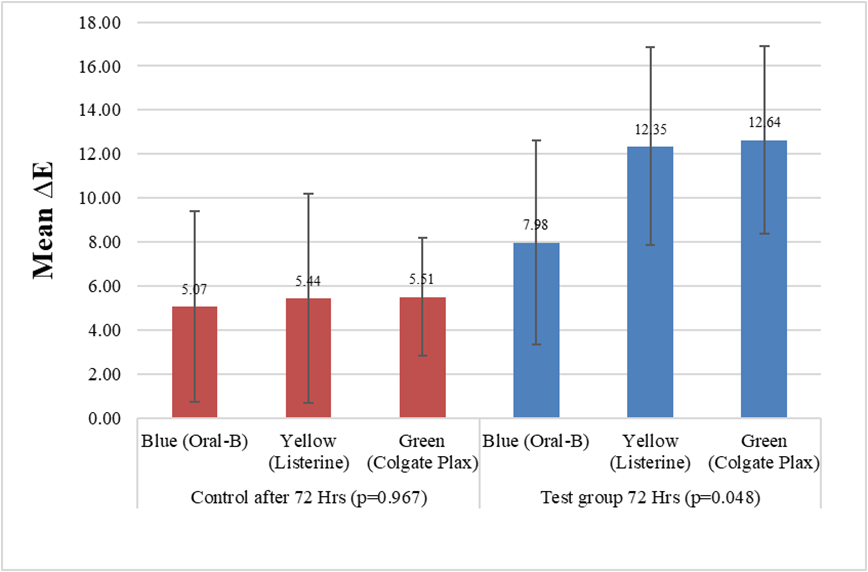
The mean and standard deviation colour change (∆E) of 5.07±4.35, 5.44± 4.76, and 5.51±2.67 were observed for Oral-B, Listerine, and Colgate Plax, respectively when samples were immersed in artificial saliva. An evaluation of mean colour change by One-Way ANOVA did not show any significant differences (F=0.034, p=0.967). While samples immersed in the test group showed a statistically significant difference in colour change (∆E) (p=0.048). The details are presented in Figure 1.
Table 4 demonstrates univariate analysis indicated significant differences in color change values across different time intervals (p<0.001), oral rinse groups (p<0.001), and the interaction between timeline and groups (p<0.001).

The mean colour change of samples at 24 h (12.08 ± 4.52) and 72 h (10.99±4.83) did not show any significant difference (t=2.024, p=0.052). While the mean colour change of samples at 24 h (12.08 ± 4.52) and 7 d (8.34±4.36) showed a significant difference (t=3.876, p=0.001). Similarly, a mean colour change at 72 h (10.99±4.83) and 7 d (8.34±4.36) demonstrated a significant difference (t=3.150, p=0.004). The details are in Table 5.
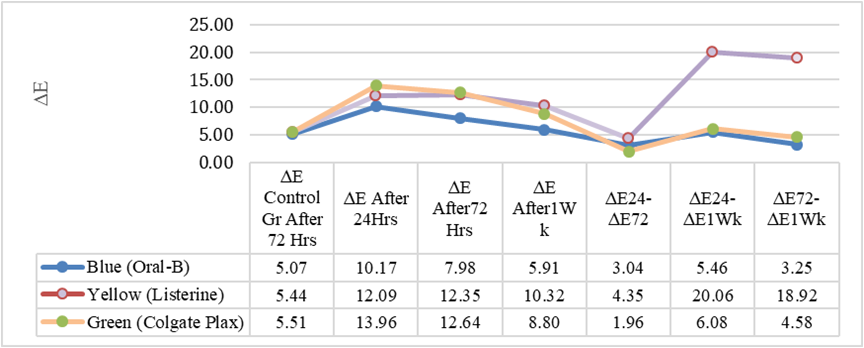
The paired sample t-test comparison of the study groups at different time points suggests that no significant difference was observed among the study groups in control at 72 h and among the study groups at 24 h. However, a significant difference was observed among the study groups at 72 h (F=3.405, p=0.048). Similarly, a significant difference was observed at 7 d (p<0.05). The details are in Figure 2.

The present study demonstrated that white spot lesions infiltrated with ICON are susceptible to staining when exposed to various colored mouth rinses considered in this study. Moreover, the study also found variations in ∆E values in different treatment subgroups over some time. Hence the null hypothesis of no change in color has been rejected.
The absence of studies on resin infiltrant’s color stability in the presence of oral rinses has made direct comparison difficult. Hence, the resin infiltrant's color stability is compared with the composite resins after soaking in different colored oral rinses. This color shift seen in the resin-infiltrated specimen might be attributed to the reality that acrylic materials are susceptible to pigmentation even after acceptable polymerization and polishing. The resin formulation's composite structure, including the filler size and the type of photo-initiator directly impacts its staining susceptibility. Moreover, the chemical formulation of individual mouth rinses could have played an essential role in the specimen's staining. 19
The resins infiltrated control (range 5.07 – 5.51) subgroups showed ∆E value higher than 3.3 units. These findings are similar to the previous studies conducted on the nano-hybrid composite in which (∆E>3.3) clinically unacceptable color change was observed. 19, 20 In this study, specimens in the control subgroup (artificial saliva) were measured at baseline and after 72 hours of immersion in artificial saliva. A color change value (∆E) was recorded with no significant difference across all the control subgroups. It could be due to the infiltrant's post-polymerization reaction. 21
Resins infiltrated treatment (range 7.98 – 12.64) subgroups on exposure to blue (Oral-B), yellow (Listerine), and green (Colgate Plax) colored oral rinses showed ∆E value well above the 3.3 units, representing an unacceptable color change in the treatment subgroups. This finding is in line with the study on the nano-hybrid composite. 22, 23, 24
Treatment subgroups of blue (Oral-B), Listerine, and Colgate Plax resulted in clinically perceivable color changes after 24 h, 72 h, and 7 d. However, a statistically significant difference in color change value of the specimen was observed only after 72 hours after exposure to various oral rinses. After 24 h and 72 h immersion in green color (Colgate Plax) resulted in the highest color change values. However, at 7 d highest color change value was observed with yellow (Listerine) mouthwash. While color change value (∆E) remained lowest with Oral B (Blue). The length of time a specimen is immersed in a test solution can affect its level of color change. 25 This study examined immersion periods of 24 h, 72 h, and 7 d. Therefore, this study's results cannot be used to speculate on color changes in longer or shorter periods. Additionally, comparing results from different immersion durations would be inaccurate, as color change levels vary over time.
Previous research has indicated that low pH and alcohol concentration in solutions may harm the surface integrity of resins, leading to discoloration. 26 This study found a statistically significant difference in color change values among the blue (Oral-B), yellow (Listerine), and green (Colgate Plax) alcohol-free mouth rinses, with a ∆E value above 3.3 units, which is visually noticeable.
Although the alcohol percentage (21.6%) and pH value (3.5) of Listerine have been reported to be relatively high, the color stability of resin materials was not influenced by this factor, and there was no substantial difference among the mouth rinses evaluated. Mouth rinses containing a high concentration of alcohol may soften the composite resin substance. Ethanol, in particular, softens BIS-GMA-based polymers. Others have shown that both alcohol-containing and alcohol-free mouth rinses might affect resin-restorative materials. 27
The consequence of staining solutions on color changes of resins may be material-dependent, and a restorative material's staining sensitivity may be related to its resin matrix or filler type. 27 According to the current study results, although only a single resin infiltrant brand was used, statistically significant differences in color change values were observed after immersion in various types of oral rinses after 72 h only. However, no such difference was evident at 24 h and 7 d of immersion.
Here it is notable that the degree of conversion after polymerization also plays a substantial role in the physical attributes of resins. It is proven that a low degree of conversion may result in higher solubility 28 and more water sorption, 29 resulting in higher staining potential. However, it was made sure that the infiltrant material used in this study was polymerized by following the manufacturer's recommendation with a calibrated high-power curing device to overcome this problem.
Moreover, the inclusion of TEGDMA (Triethylene glycol dimethacrylate) in the ICON composition can be ascribed to the alterations seen in the color resin penetrated specimens. Since it may go deep into the lesion, TEGDMA is an essential component of resin icon infiltration. 30 Because of its greater lesion penetration coefficient, resin mostly composed of TEGDMA is the preferred choice. 8 However, TEGDMA has the highest water sorption rate, resulting in resin discolouration. 31 Consequently, immersion in mouthwashes, caused Icon to become more discolored by imbibing the additional colorant from the mouthwash.
Moreover, discoloration may be associated with the amount of water sorption, since water serves as a carrier for colors to permeate deeply into the acrylic matrix. As a result, staining sensitivity correlated with water sorption rate 24. Some research has advocated polishing the specimens to lessen the coloring impact to offset this effect 8. However, the polishing could cause needless enamel wear instigated by abrasion. 32
The staining potentials of several oral rinses for dental hard and soft tissues have been previously documented. 33 The staining capabilities of the oral rinses have also been examined on a variety of resin composites. Gürdal et al. showed that the consequences of oral rinses on colour stability are identical to those of distilled water. 34 Similarly, Lee et al. discovered that, while being visually imperceptible, oral rinses alter color stability. 35 The specimens examined in the present study demonstrated noticeable discoloration following immersion for varying periods of time. It is possible that the aqueous element present in the oral rinses could have influenced both the alteration in color and the changes in microhardness. 36 There were no significant differences between the oral rinses and distilled water except for Oral-B.
The limitations of this study include the selection of teeth having different mineral content, which may affect white spot lesions. Oral rinses’ influence may vary on infiltrant materials in clinical scenarios due to a variety of characteristics that cannot be mimicked in vitro. The color stability of resin composites may be affected by saliva, salivary pellicle, meals, and drinks. Further, in vivo research is needed to establish the staining capability of various oral rinses. The staining potential of resin-infiltrated teeth inside the oral environment may be influenced by oral temperature and duration of exposure to colored oral rinses.
The present study demonstrated that white spot lesions infiltrated with ICON are susceptible to staining when exposed to various colored mouth rinses. Moreover, the study also found variations in ∆E values in different treatment subgroups over some time. Hence the null hypothesis of no change in color has been rejected.
At 24 h time interval, Colgate Plax demonstrated the highest color change while the lowest was observed in Oral B Pro-Expert. Whereas, after 24 hours, 72 hours and 1 week Yellow (Listerine) oral rinse showed the highest color change, and the lowest values were observed with the Blue (Oral B) oral rinse. Therefore, the immersion of resin-infiltrated specimens in different oral rinses over different time intervals may exert detrimental effects on the color stability of the material. Future research should look at the impact of saliva, food colours, water, dental structure, or ions from the oral cavity, as well as the influence of infiltrator penetration depth on the color stability of resin infiltration during extended periods of immersion in oral rinses.
This research did not receive any external fund.
Research experiments conducted in this article with animals or humans were approved by the Ethical Committee and responsible authorities of our research organization(s) following all guidelines, regulations, legal, and ethical standards as required for humans or animals.
There are no conflicts to declare.
| [1] | SUNDARARAJ, D., VENKATACHALAPATHY, S., TANDON, A. & PEREIRA, A. 2015. Critical evaluation of incidence and prevalence of white spot lesions during fixed orthodontic appliance treatment: A meta-analysis. Journal of International Society of Preventive & Community Dentistry, 5(6), pp.433-439. | ||
| In article | View Article PubMed | ||
| [2] | SADIKOGLU, I. S. 2020. White Spot Lesions: Recent Detection and Treatment Methods. Cyprus Journal of Medical Sciences, 5(3), pp.260-267. | ||
| In article | View Article | ||
| [3] | ROBERTS, W. E., MANGUM, J. E. & SCHNEIDER, P. M. 2022. Pathophysiology of demineralization, Part II: enamel white spots, cavitated caries, and bone infection. Current Osteoporosis Reports, 20(1), pp.106-119. | ||
| In article | View Article PubMed | ||
| [4] | YI, J., WEIR, M. D., MELO, M. A., LI, T., LYNCH, C. D., OATES, T. W., DAI, Q., ZHAO, Z. & XU, H. H. 2019. Novel rechargeable nano-CaF2 orthodontic cement with high levels of long-term fluoride release. Journal of Dentistry, 90, pp.103214. | ||
| In article | View Article PubMed | ||
| [5] | MAO, B., XIE, Y., YANG, H., YU, C., MA, P., YOU, Z., TSAUO, C., CHEN, Y., CHENG, L. & HAN, Q. 2021. Casein phosphopeptide-amorphous calcium phosphate modified glass ionomer cement attenuates demineralization and modulates biofilm composition in dental caries. Dental Materials Journal, 40(1), pp.84-93. | ||
| In article | View Article PubMed | ||
| [6] | KIDD, E. & FEJERSKOV, O. 2004. What constitutes dental caries? Histopathology of carious enamel and dentin related to the action of cariogenic biofilms. Journal of dental research, 83(1_suppl), pp.35-38. | ||
| In article | View Article PubMed | ||
| [7] | MENG, Z., YAO, X. S., YAO, H., LIANG, Y., LIU, T., LI, Y., WANG, G. & LAN, S. 2009. Measurement of the refractive index of human teeth by optical coherence tomography. Journal of biomedical optics, 14(3), pp.034010-034010-4. | ||
| In article | View Article PubMed | ||
| [8] | PARIS, S., SCHWENDICKE, F., KELTSCH, J., DÖRFER, C. & MEYER-LUECKEL, H. 2013. Masking of white spot lesions by resin infiltration in vitro. Journal of dentistry, 41, pp.e28-e34. | ||
| In article | View Article PubMed | ||
| [9] | ABDELLATIF, A., SHALAN, H. & ELSEBAAI, A. 2016. Effects of resin application on white spot lesions (laboratory study). J. Clin. Pediatr. Dent, 46, pp.120-126. | ||
| In article | |||
| [10] | FEJERSKOV, O. 2004. Changing paradigms in concepts on dental caries: consequences for oral health care. Caries research, 38(3), pp.182-191. | ||
| In article | View Article PubMed | ||
| [11] | DORRI, M., DUNNE, S. M., WALSH, T. & SCHWENDICKE, F. 2015. Micro-invasive interventions for managing proximal dental decay in primary and permanent teeth. Cochrane Database of Systematic Reviews, (11). | ||
| In article | View Article PubMed | ||
| [12] | ALQAHTANI, S., ABUSAQ, A., ALGHAMDI, M., SHOKAIR, N. & ALBOUNNI, R. 2022. Colour stability of resin infiltrated white spot lesion after exposure to stain-causing drinks. Saudi journal of biological sciences, 29(2), pp.1079-1084. | ||
| In article | View Article PubMed | ||
| [13] | ARSLAN, S. & KAPLAN, M. H. 2020. The effect of resin infiltration on the progression of proximal caries lesions: a randomized clinical trial. Medical Principles and Practice, 29(3), pp.238-243. | ||
| In article | View Article PubMed | ||
| [14] | KUGEL, G., ARSENAULT, P. & PAPAS, A. 2009. Treatment modalities for caries management, including a new resin infiltration system. Compendium of continuing education in dentistry (Jamesburg, NJ: 1995), 30, pp.1-10; quiz 11. | ||
| In article | |||
| [15] | MEYER-LUECKEL, H. & PARIS, S. 2010. Infiltration of natural caries lesions with experimental resins differing in penetration coefficients and ethanol addition. Caries research, 44(4), pp.408-414. | ||
| In article | View Article PubMed | ||
| [16] | TORRES, C. R. G., BORGES, A. B., TORRES, L. M. S., GOMES, I. S. & DE OLIVEIRA, R. S. 2011. Effect of caries infiltration technique and fluoride therapy on the colour masking of white spot lesions. Journal of dentistry, 39(3), pp.202-207. | ||
| In article | View Article PubMed | ||
| [17] | KHAN, A. A., SIDDIQUI, A. Z., MOHSIN, S. F. & AL-KHERAIF, A. A. 2015. Influence of mouth rinses on the surface hardness of dental resin nano-composite. Pakistan journal of medical sciences, 31(6), pp.1485. | ||
| In article | View Article | ||
| [18] | TELES, R. P. & TELES, F. R. F. 2009. Antimicrobial agents used in the control of periodontal biofilms: effective adjuncts to mechanical plaque control? Brazilian Oral Research, 23, pp.39-48. | ||
| In article | View Article PubMed | ||
| [19] | ELEMBABY, A. E. S. 2014. The effects of mouth rinses on the color stability of resin-based restorative materials. Journal of Esthetic and Restorative Dentistry, 26(4), pp.264-271. | ||
| In article | View Article PubMed | ||
| [20] | ROJA, R. S., SRIMAN, N., PRABHAKAR, V., MINU, K., SUBHA, A. & AMBALAVANAN, P. 2019. Comparative evaluation of color stability of three composite resins in mouthrinse: An in vitro study. Journal of Conservative Dentistry: JCD, 22(2), pp.175. | ||
| In article | View Article PubMed | ||
| [21] | SABATINI, C., CAMPILLO, M. & AREF, J. 2012. Color stability of ten resin-based restorative materials. Journal of Esthetic and Restorative Dentistry, 24(3), pp.185-199. | ||
| In article | View Article PubMed | ||
| [22] | SILVA, T. M. D., SALES, A. L. L. S., PUCCI, C. R., BORGES, A. B. & TORRES, C. R. G. 2017. The combined effect of food-simulating solutions, brushing and staining on color stability of composite resins. Acta Biomaterialia Odontologica Scandinavica, 3(1), pp.1-7. | ||
| In article | View Article PubMed | ||
| [23] | FURUSE, A. Y., NETO, C. F., DE FREITAS GUIMARÃES, G. M., TERRABUIO, B. R., RIZZANTE, F. A. P. & WANG, L. 2020. Color evaluation of white spot lesions treated with resin infiltration after water or grape juice storage. Brazilian Journal of Oral Sciences, 19, pp.e201674-e201674. | ||
| In article | View Article | ||
| [24] | CECI, M., RATTALINO, D., VIOLA, M., BELTRAMI, R., CHIESA, M., COLOMBO, M. & POGGIO, C. 2017. Resin infiltrant for non-cavitated caries lesions: evaluation of color stability. Journal of clinical and experimental dentistry, 9(2), pp.e231. | ||
| In article | View Article PubMed | ||
| [25] | CELIK, A., COBAN, E. & ÜLKER, H. 2021. Effects of mouthwashes on color stability and surface roughness of three different resin-based composites. Nigerian Journal of Clinical Practice, 24(4), pp.555-560. | ||
| In article | |||
| [26] | KHAN, A. A., SIDDIQUI, A. Z., AL-KHERAIF, A. A., ZAHID, A. & DIVAKAR, D. D. 2015. Effect of different pH solvents on micro-hardness and surface topography of dental nano-composite: An in vitro analysis. Pakistan journal of medical sciences, 31(4), pp.854. | ||
| In article | View Article PubMed | ||
| [27] | CELIK, C., YUZUGULLU, B., ERKUT, S. & YAMANEL, K. 2008. Effects of mouth rinses on color stability of resin composites. European journal of dentistry, 2(04), pp.247-253. | ||
| In article | View Article PubMed | ||
| [28] | KHAN, A. A., ZAFAR, M. S., ALI A GHUBAYRI, A., ALMUFAREH, N. A., BINOBAID, A., ESKANDRANI, R. M. & AL-KHERAIF, A. A. 2022. Polymerisation of restorative dental composites: influence on physical, mechanical and chemical properties at various setting depths. Materials Technology, 37(12), pp.2056-2062. | ||
| In article | View Article | ||
| [29] | CADENARO, M., ANTONIOLLI, F., SAURO, S., TAY, F. R., DI LENARDA, R., PRATI, C., BIASOTTO, M., CONTARDO, L. & BRESCHI, L. 2005. Degree of conversion and permeability of dental adhesives. European journal of oral sciences, 113(6), pp.525-530. | ||
| In article | View Article PubMed | ||
| [30] | SIDERIDOU, I., TSERKI, V. & PAPANASTASIOU, G. 2003. Study of water sorption, solubility and modulus of elasticity of light-cured dimethacrylate-based dental resins. Biomaterials, 24(4), pp.655-665. | ||
| In article | View Article PubMed | ||
| [31] | KHAN, A. A., ALKHUREIF, A. A., MOHAMED, B. A. & BAUTISTA, L. S. 2020. Enhanced mechanical properties are possible with urethane dimethacrylate-based experimental restorative dental composite. Materials Research Express, 7(10), pp.105307. | ||
| In article | View Article | ||
| [32] | ARAÚJO, G., NAUFEL, F., ALONSO, R., LIMA, D. & PUPPIN-RONTANI, R. 2015. Influence of staining solution and bleaching on color stability of resin used for caries infiltration. Operative dentistry, 40(6), pp.E250-E256. | ||
| In article | View Article PubMed | ||
| [33] | SHEEN, S. & ADDY, M. 2003. An in vitro evaluation of the availability of cetylpyridinium chloride and chlorhexidine in some commercially available mouthrinse products. British dental journal, 194(4), pp.207-210. | ||
| In article | View Article PubMed | ||
| [34] | GÜRDAL, P., AKDENIZ, B. G. & HAKAN SEN, B. 2002. The effects of mouthrinses on microhardness and colour stability of aesthetic restorative materials. Journal of oral rehabilitation, 29(9), pp.895-901. | ||
| In article | View Article PubMed | ||
| [35] | LEE, Y., EL ZAWAHRY, M., NOAMAN, K. & POWERS, J. 2000. Effect of mouthwash and accelerated aging on the color stability of esthetic restorative materials. American journal of dentistry, 13(3), pp.159-161. | ||
| In article | |||
| [36] | HAMDY, T. M., ABDELNABI, A., OTHMAN, M. S., BAYOUMI, R. E. & ABDELRAOUF, R. M. 2023. Effect of Different Mouthwashes on the Surface Microhardness and Color Stability of Dental Nanohybrid Resin Composite. Polymers, 15(4), pp.815. | ||
| In article | View Article PubMed | ||
Published with license by Science and Education Publishing, Copyright © 2023 Mohammed Al Ghamdi, Nada Shokair, Saleh Al Qahtani, Abdulrahman Abusaq and Roula Albounni
 This work is licensed under a Creative Commons Attribution 4.0 International License. To view a copy of this license, visit
http://creativecommons.org/licenses/by/4.0/
This work is licensed under a Creative Commons Attribution 4.0 International License. To view a copy of this license, visit
http://creativecommons.org/licenses/by/4.0/
| [1] | SUNDARARAJ, D., VENKATACHALAPATHY, S., TANDON, A. & PEREIRA, A. 2015. Critical evaluation of incidence and prevalence of white spot lesions during fixed orthodontic appliance treatment: A meta-analysis. Journal of International Society of Preventive & Community Dentistry, 5(6), pp.433-439. | ||
| In article | View Article PubMed | ||
| [2] | SADIKOGLU, I. S. 2020. White Spot Lesions: Recent Detection and Treatment Methods. Cyprus Journal of Medical Sciences, 5(3), pp.260-267. | ||
| In article | View Article | ||
| [3] | ROBERTS, W. E., MANGUM, J. E. & SCHNEIDER, P. M. 2022. Pathophysiology of demineralization, Part II: enamel white spots, cavitated caries, and bone infection. Current Osteoporosis Reports, 20(1), pp.106-119. | ||
| In article | View Article PubMed | ||
| [4] | YI, J., WEIR, M. D., MELO, M. A., LI, T., LYNCH, C. D., OATES, T. W., DAI, Q., ZHAO, Z. & XU, H. H. 2019. Novel rechargeable nano-CaF2 orthodontic cement with high levels of long-term fluoride release. Journal of Dentistry, 90, pp.103214. | ||
| In article | View Article PubMed | ||
| [5] | MAO, B., XIE, Y., YANG, H., YU, C., MA, P., YOU, Z., TSAUO, C., CHEN, Y., CHENG, L. & HAN, Q. 2021. Casein phosphopeptide-amorphous calcium phosphate modified glass ionomer cement attenuates demineralization and modulates biofilm composition in dental caries. Dental Materials Journal, 40(1), pp.84-93. | ||
| In article | View Article PubMed | ||
| [6] | KIDD, E. & FEJERSKOV, O. 2004. What constitutes dental caries? Histopathology of carious enamel and dentin related to the action of cariogenic biofilms. Journal of dental research, 83(1_suppl), pp.35-38. | ||
| In article | View Article PubMed | ||
| [7] | MENG, Z., YAO, X. S., YAO, H., LIANG, Y., LIU, T., LI, Y., WANG, G. & LAN, S. 2009. Measurement of the refractive index of human teeth by optical coherence tomography. Journal of biomedical optics, 14(3), pp.034010-034010-4. | ||
| In article | View Article PubMed | ||
| [8] | PARIS, S., SCHWENDICKE, F., KELTSCH, J., DÖRFER, C. & MEYER-LUECKEL, H. 2013. Masking of white spot lesions by resin infiltration in vitro. Journal of dentistry, 41, pp.e28-e34. | ||
| In article | View Article PubMed | ||
| [9] | ABDELLATIF, A., SHALAN, H. & ELSEBAAI, A. 2016. Effects of resin application on white spot lesions (laboratory study). J. Clin. Pediatr. Dent, 46, pp.120-126. | ||
| In article | |||
| [10] | FEJERSKOV, O. 2004. Changing paradigms in concepts on dental caries: consequences for oral health care. Caries research, 38(3), pp.182-191. | ||
| In article | View Article PubMed | ||
| [11] | DORRI, M., DUNNE, S. M., WALSH, T. & SCHWENDICKE, F. 2015. Micro-invasive interventions for managing proximal dental decay in primary and permanent teeth. Cochrane Database of Systematic Reviews, (11). | ||
| In article | View Article PubMed | ||
| [12] | ALQAHTANI, S., ABUSAQ, A., ALGHAMDI, M., SHOKAIR, N. & ALBOUNNI, R. 2022. Colour stability of resin infiltrated white spot lesion after exposure to stain-causing drinks. Saudi journal of biological sciences, 29(2), pp.1079-1084. | ||
| In article | View Article PubMed | ||
| [13] | ARSLAN, S. & KAPLAN, M. H. 2020. The effect of resin infiltration on the progression of proximal caries lesions: a randomized clinical trial. Medical Principles and Practice, 29(3), pp.238-243. | ||
| In article | View Article PubMed | ||
| [14] | KUGEL, G., ARSENAULT, P. & PAPAS, A. 2009. Treatment modalities for caries management, including a new resin infiltration system. Compendium of continuing education in dentistry (Jamesburg, NJ: 1995), 30, pp.1-10; quiz 11. | ||
| In article | |||
| [15] | MEYER-LUECKEL, H. & PARIS, S. 2010. Infiltration of natural caries lesions with experimental resins differing in penetration coefficients and ethanol addition. Caries research, 44(4), pp.408-414. | ||
| In article | View Article PubMed | ||
| [16] | TORRES, C. R. G., BORGES, A. B., TORRES, L. M. S., GOMES, I. S. & DE OLIVEIRA, R. S. 2011. Effect of caries infiltration technique and fluoride therapy on the colour masking of white spot lesions. Journal of dentistry, 39(3), pp.202-207. | ||
| In article | View Article PubMed | ||
| [17] | KHAN, A. A., SIDDIQUI, A. Z., MOHSIN, S. F. & AL-KHERAIF, A. A. 2015. Influence of mouth rinses on the surface hardness of dental resin nano-composite. Pakistan journal of medical sciences, 31(6), pp.1485. | ||
| In article | View Article | ||
| [18] | TELES, R. P. & TELES, F. R. F. 2009. Antimicrobial agents used in the control of periodontal biofilms: effective adjuncts to mechanical plaque control? Brazilian Oral Research, 23, pp.39-48. | ||
| In article | View Article PubMed | ||
| [19] | ELEMBABY, A. E. S. 2014. The effects of mouth rinses on the color stability of resin-based restorative materials. Journal of Esthetic and Restorative Dentistry, 26(4), pp.264-271. | ||
| In article | View Article PubMed | ||
| [20] | ROJA, R. S., SRIMAN, N., PRABHAKAR, V., MINU, K., SUBHA, A. & AMBALAVANAN, P. 2019. Comparative evaluation of color stability of three composite resins in mouthrinse: An in vitro study. Journal of Conservative Dentistry: JCD, 22(2), pp.175. | ||
| In article | View Article PubMed | ||
| [21] | SABATINI, C., CAMPILLO, M. & AREF, J. 2012. Color stability of ten resin-based restorative materials. Journal of Esthetic and Restorative Dentistry, 24(3), pp.185-199. | ||
| In article | View Article PubMed | ||
| [22] | SILVA, T. M. D., SALES, A. L. L. S., PUCCI, C. R., BORGES, A. B. & TORRES, C. R. G. 2017. The combined effect of food-simulating solutions, brushing and staining on color stability of composite resins. Acta Biomaterialia Odontologica Scandinavica, 3(1), pp.1-7. | ||
| In article | View Article PubMed | ||
| [23] | FURUSE, A. Y., NETO, C. F., DE FREITAS GUIMARÃES, G. M., TERRABUIO, B. R., RIZZANTE, F. A. P. & WANG, L. 2020. Color evaluation of white spot lesions treated with resin infiltration after water or grape juice storage. Brazilian Journal of Oral Sciences, 19, pp.e201674-e201674. | ||
| In article | View Article | ||
| [24] | CECI, M., RATTALINO, D., VIOLA, M., BELTRAMI, R., CHIESA, M., COLOMBO, M. & POGGIO, C. 2017. Resin infiltrant for non-cavitated caries lesions: evaluation of color stability. Journal of clinical and experimental dentistry, 9(2), pp.e231. | ||
| In article | View Article PubMed | ||
| [25] | CELIK, A., COBAN, E. & ÜLKER, H. 2021. Effects of mouthwashes on color stability and surface roughness of three different resin-based composites. Nigerian Journal of Clinical Practice, 24(4), pp.555-560. | ||
| In article | |||
| [26] | KHAN, A. A., SIDDIQUI, A. Z., AL-KHERAIF, A. A., ZAHID, A. & DIVAKAR, D. D. 2015. Effect of different pH solvents on micro-hardness and surface topography of dental nano-composite: An in vitro analysis. Pakistan journal of medical sciences, 31(4), pp.854. | ||
| In article | View Article PubMed | ||
| [27] | CELIK, C., YUZUGULLU, B., ERKUT, S. & YAMANEL, K. 2008. Effects of mouth rinses on color stability of resin composites. European journal of dentistry, 2(04), pp.247-253. | ||
| In article | View Article PubMed | ||
| [28] | KHAN, A. A., ZAFAR, M. S., ALI A GHUBAYRI, A., ALMUFAREH, N. A., BINOBAID, A., ESKANDRANI, R. M. & AL-KHERAIF, A. A. 2022. Polymerisation of restorative dental composites: influence on physical, mechanical and chemical properties at various setting depths. Materials Technology, 37(12), pp.2056-2062. | ||
| In article | View Article | ||
| [29] | CADENARO, M., ANTONIOLLI, F., SAURO, S., TAY, F. R., DI LENARDA, R., PRATI, C., BIASOTTO, M., CONTARDO, L. & BRESCHI, L. 2005. Degree of conversion and permeability of dental adhesives. European journal of oral sciences, 113(6), pp.525-530. | ||
| In article | View Article PubMed | ||
| [30] | SIDERIDOU, I., TSERKI, V. & PAPANASTASIOU, G. 2003. Study of water sorption, solubility and modulus of elasticity of light-cured dimethacrylate-based dental resins. Biomaterials, 24(4), pp.655-665. | ||
| In article | View Article PubMed | ||
| [31] | KHAN, A. A., ALKHUREIF, A. A., MOHAMED, B. A. & BAUTISTA, L. S. 2020. Enhanced mechanical properties are possible with urethane dimethacrylate-based experimental restorative dental composite. Materials Research Express, 7(10), pp.105307. | ||
| In article | View Article | ||
| [32] | ARAÚJO, G., NAUFEL, F., ALONSO, R., LIMA, D. & PUPPIN-RONTANI, R. 2015. Influence of staining solution and bleaching on color stability of resin used for caries infiltration. Operative dentistry, 40(6), pp.E250-E256. | ||
| In article | View Article PubMed | ||
| [33] | SHEEN, S. & ADDY, M. 2003. An in vitro evaluation of the availability of cetylpyridinium chloride and chlorhexidine in some commercially available mouthrinse products. British dental journal, 194(4), pp.207-210. | ||
| In article | View Article PubMed | ||
| [34] | GÜRDAL, P., AKDENIZ, B. G. & HAKAN SEN, B. 2002. The effects of mouthrinses on microhardness and colour stability of aesthetic restorative materials. Journal of oral rehabilitation, 29(9), pp.895-901. | ||
| In article | View Article PubMed | ||
| [35] | LEE, Y., EL ZAWAHRY, M., NOAMAN, K. & POWERS, J. 2000. Effect of mouthwash and accelerated aging on the color stability of esthetic restorative materials. American journal of dentistry, 13(3), pp.159-161. | ||
| In article | |||
| [36] | HAMDY, T. M., ABDELNABI, A., OTHMAN, M. S., BAYOUMI, R. E. & ABDELRAOUF, R. M. 2023. Effect of Different Mouthwashes on the Surface Microhardness and Color Stability of Dental Nanohybrid Resin Composite. Polymers, 15(4), pp.815. | ||
| In article | View Article PubMed | ||