 OPEN ACCESS
  PEER-REVIEWED
Lipocalin-2: a New Regulator of Non-Pathogen-Associated Neuroinflammation
Manoj Banjara
Abstract
Lipocalin is a family of small molecules transporting extracellular proteins. Lipocalin-2 (LCN2) is a member of the family that sequesters iron-bound bacterial siderophores. The well-accepted function of LCN2 protein is its anti-bacterial behavior, however, its role in iron regulation, cellular migration, death and morphology modulation have been speculated. Several reports have correlated the presence of LCN2 in the infected, injured and stressed brain, and its effect in neuronal and non-neuronal cell types in the central nervous system. This article reviews studies that demonstrated mechanisms and functions of LCN2 expression in inflammed brain (acute and chronic), particularly in non-pathogen-associated neuroinflammation. This review predicts that LCN2 can be an attractive target to reduce mortality and morbidity associated with uncontrollable neuroinflammation.
At a glance: Figures
Keywords: Lipocalin-2, neuroinflammation, PAMPs, DAMPs
International Journal of Clinical and Experimental Neurology, 2014 2 (1),
pp 8-15.
DOI: 10.12691/ijcen-2-1-3
Received August 28, 2014; Revised September 10, 2014; Accepted September 18, 2014
Copyright © 2013 Science and Education Publishing. All Rights Reserved.Cite this article:
- Banjara, Manoj. "Lipocalin-2: a New Regulator of Non-Pathogen-Associated Neuroinflammation." International Journal of Clinical and Experimental Neurology 2.1 (2014): 8-15.
- Banjara, M. (2014). Lipocalin-2: a New Regulator of Non-Pathogen-Associated Neuroinflammation. International Journal of Clinical and Experimental Neurology, 2(1), 8-15.
- Banjara, Manoj. "Lipocalin-2: a New Regulator of Non-Pathogen-Associated Neuroinflammation." International Journal of Clinical and Experimental Neurology 2, no. 1 (2014): 8-15.
| Import into BibTeX | Import into EndNote | Import into RefMan | Import into RefWorks |
1. Introduction
Central nervous system (CNS) inflammation, so called neuroinflammation, occurred by proinflammatory mediators either recruited from the peripheral systems or produced locally within the CNS. Numerous reports illustrated the release of LCN2 during neuroinflammation along with various other inflammatory factors such as cytokines and chemokines. LCN2, also known as neutrophil gelatinase associated lipocalin (NGAL), siderocalin, uterocalin or oncogene 24p3 is a member of small molecule transporting protein, lipocalin. It is a 25 kDa-secreted glycoprotein whose synthesis is provoked in a wide variety of (patho) physiological conditions (Bong et al. 2004; Hirsch et al. 2007; Lee et al. 2005; Venkatesha et al. 2006; Woo et al. 2007; Yang et al. 2002). Even though significant work has been done to elucidate the function of LCN2, it is not yet well studied in brain. However, several reports demonstrated the induction of LCN2 mRNA and protein in brain upon lipopolysaccharide (LPS) administration (Ip et al. 2011; Zamanian et al. 2012). Expression of LCN2 is also confirmed during non-pathogen-associated neuroinflammatory diseases and animal models like stroke (MacManus et al. 2004; Zamanian et al. 2012), epilepsy (Chia et al. 2011), cortical stab wound injury (Lee et al. 2011), psychological stress (Mucha et al. 2011), and Alzheimer’s disease (Naude et al. 2012). The expression of this antibacterial protein in the conditions mentioned above where there is no pathogen invasion is the basis for this review. A clear understanding of LCN2 signaling within CNS will potentially reveal a new drug target for the reduction of morbidity and mortality associated with neuroinflammatory disorders and brain trauma.
2. Neuroinflammation and LCN2
Brain has been considered as an immune-privileged site because of the presence of highly restricted and tightly controlled blood brain barrier (BBB). However, more current studies confirmed peripheral immune access to the CNS in response to variety of insults (Rivest 2009). Infections, toxins, trauma and other stimuli are efficient in inducing immune system with in the CNS (Crutcher et al. 2006; Popovich and Longbrake 2008).
Neuroinflammation is a broad term used to describe immune responses of CNS, which is characterized as the activation and recruitment of astrocytes and microglia at the location of injury or infection in brain tissue. This process is facilitated by cytokines and chemokines (Streit 2006). Besides bacterial or viral infection, physical damage of cells and tissues can stimulate inflammatory cells to release pro-inflammatory cytokines like interleukin (IL)-6, IL-1 and tumor necrosis factor α (TNF-α) (Basu et al. 2004; Gehrmann et al. 1995).
Acute neuroinflammation is an immediate and early response to the injurious agents (Streit 2006), in which CNS injury sites immediately accumulate notable microglia and astrocytes. Also, the destruction of blood brain barrier in acute neuroinflammation leads to the activation and infiltration of peripheral immune cells in the brain (Sroga et al. 2003). It is basically considered as a defensive response that triggers repair of the damaged site and very unlikely to be detrimental to neuronal survival (Streit 2006).
Chronic neuroinflammation is the persistent inflammatory response after an initial injury or insult. It has also been characterized as the infiltration of mononuclear cells (macrophages, lymphocytes, plasma cells), where as acute neuroinflammation is described as the intrusion of polymorphonuclear cells (neutrophils) (Frank-Cannon et al. 2009). The long-term activation of microglia might results in increased oxidative and nitrosative stress damaging healthy cells and tissue (Tansey et al. 2007). Thus, the study of chronic neuroinflammation is more relevant in understanding neurodegenerative diseases (Streit et al. 2004). The sustained release of inflammatory mediators activates additional resident inflammatory cells in the brain, stimulating their proliferation, resulting further release of inflammatory components (Rivest 2009). Since there is uncontrolled inflammation, chronic neuroinflammation is considered to be detrimental to nervous tissue. Hence, the beneficial or harmful outcomes of neuroinflammation potentially rely on the duration of inflammatory response.
Prions disease, human immunodeficiency virus (HIV) and rabies are pathogen invaded CNS diseases (Streit et al. 2004). During infection, pathogen-associated molecular patterns (PAMPs) are recognized by the receptors that are present in resident inflammatory cells of CNS. Lipopolysaccharides (gram negative bacteria) (Poltorak et al. 1998), lipoteichoic acid (gram positive bacteria) (Schwandner et al. 1999), zymosan (fungi) (Sato et al. 2003) and single/double-stranded RNA (virus) (Alexopoulou et al. 2001; Heil et al. 2004) are some well-characterized PAMPs. Pattern-recognition receptors (PRRs) like toll-like receptors (TLRs), receptor for advanced glycation end products (RAGE), NOD-like receptors (NLRs) and scavenger receptors (SRs) recognize PAMPs and damage-associated-molecular patterns (DAMPs) (Frank-Cannon et al. 2009). Foreign brain infections are almost always fatal. Thus, the concept of neuroinflammation is more relevant in the context of understanding non-pathogen-associated neuroinflammation, in which endogenous modified molecules stimulate inflammatory reactions. Inflammatory reactions occur in disease conditions like stroke, epilepsy and Alzheimer’s in the absence of microbial or toxin invasion. It has been believed that the cells dying by necrosis releases molecules that have potential to trigger inflammatory responses (Iyer et al. 2009; Zhang et al. 2012). In addition to the activation of inflammatory cells and release of various inflammatory factors, lipocalin-2 is a protein released during sterile neuroinflammation (Chia et al. 2011; Lee et al. 2011; MacManus et al. 2004; Mucha et al. 2011; Naude et al. 2012; Zamanian et al. 2012).
LCN2 is a secreted protein induced in a wide variety of physiological and pathological conditions such as reproductive biology (Lee et al. 2005), apoptosis (Bong et al. 2004), renal physiology (Hirsch et al. 2007), angiogenesis (Venkatesha et al. 2006), inflammation (Woo et al. 2007) and organogenesis (Yang et al. 2002). Human LCN2 was first known in neutrophil granules, which was complexed with monomeric form of matrix metalloproteinase-9 (MMP-9), hence, named neutrophil gelatinase-associated lipocalin (NGAL) (Triebel et al. 1992). Also, monomeric (25 kDa) and dimeric (50 kDa) form of LCN2 has been identified (Axelsson et al. 1995). Human LCN2 is nearly 98% identical to chimpanzee, however, only 63% and 62% similarity to rat and mouse LCN2 respectively (Chakraborty et al. 2012). Despite of limited sequence identity, there are short stretches of hydrophobic amino acid residues conserved between homologues. These short stretches are thought to be responsible for the binding to ligands (e.g. siderophores) (Chakraborty et al. 2012). Coles et al. revealed that LCN2 has an N-terminal 310-helix, followed by eight anti-parallel β-strands connected by loops, one α-helix and one C-terminal β-strand (Coles et al. 1999). Multiple studies demonstrated the induction in LCN2 expression upon bacterial invasion and the major function of LCN2 is as a bacteriostatic protein that competes with bacteria for iron-bound bacterial siderophores (Berger et al. 2010; Flo et al. 2004). Interestingly, it only binds to iron complexed with siderophores but not to free iron (Goetz et al. 2002).
Even though undetectable under physiological conditions, systemic LPS injection stimulates the expression of LCN2 mRNA and protein in brain (Ip et al. 2011). Its expression has been observed in the brain of west nile virus (WNV) encephalitis disease model (Nocon et al. 2014). Additionally, reports have shown the induction of LCN2 during sterile neuroinflammatory conditions where there is no microbe or toxin. The LCN2 has been stimulated in various animal models of neuroinflammation and neurodegenerative human brains (Chia et al. 2011; MacManus et al. 2004; Mucha et al. 2011; Naude et al. 2012; Zamanian et al. 2012). Plasma LCN2 protein level has been raised in human ischemic stroke (Pekar et al. 2013), mild cognitive impairment patients (Choi et al. 2011), and transient middle cerebral artery occlusion model of mouse ischemia (Wang et al. 2013b). LPS administration induced LCN2 expression as early as 4 hr in brain (Ip et al. 2011). In addition, LCN2 expression has been upregulated maximum at 1 day (Middle Cerebral Artery Occlusion model of stroke (Zamanian et al. 2012)) and 3 day (kainic acid evoked neurotoxicity model (Chia et al. 2011)) suggesting LCN2 as acute phase neuroinflammatory protein. However, stimulated LCN2 in Alzheimer’s patient (Naude et al. 2012) raise doubts on our prediction. Moreover, the mechanism(s) of induction and function(s) in non-pathogen-associated neuroinflammatory conditions are still unsolved mystery. LCN2 expression mechanism(s) and proposed function(s) in sterile neuroinflammatory conditions are discussed in greater detail.
3. LCN2 Expression Mechanisms
Multiple reports indicated the expression of LCN2 upon exposure to various molecules such as LPS (Sunil et al. 2007), IL-1β (Jayaraman et al. 2005), TNF-α and IL-6 (Liu et al. 2003) in several cell types like adipocytes (Kratchmarova et al. 2002; Tan et al. 2009), endothelial cells (Liu and Nilsen-Hamilton 1995), epithelial cells (Cowland et al. 2003) and macrophages (Meheus et al. 1993; Sunil et al. 2007).
Most of the LCN2 expression mechanism studies were performed using LPS and some well characterized cytokines as its stimulator. In an in vitro model of obesity and type 2 diabetes mellitus (T2DM), LCN2 expression in adipocytes is induced by immune cells released cytokines interferon gamma (INFγ) and TNFα via signal transducer and activator of transcription 1 (STAT1) and nuclear factor-kappa B (NF-κB) transcription factors respectively (Zhao and Stephens 2013). Additionally, in this model, NF-κB and STAT1 binding sites were identified in LCN2 promoter via in silico and in vitro approaches (Zhao and Stephens 2013). However, in pancreatic islet β cells (RINm5F -β), INFγ induced LCN2 expression is independent to NF-κB and STAT1 activation (Chang et al. 2013). On the other hand, IL-1β triggered LCN2 expression is via the activation of NF-κB in RINm5F -β cells (Chang et al. 2013). Other studies using IL-17 and IL-1β inflammation stimulators predicted the activation of activator protein-1 (AP-1) and CCAAT-enhancer-binding protein delta (C/EBPδ) transcription factors for LCN2 expression (Cowland et al. 2003; Shen et al. 2006). A recent report recognized the involvement of interleukin-1 receptor associated kinase-1 (IRAK-1), an intracellular signaling component of toll-like receptor 4 (TLR4) for the expression of LCN2 via AP-1 (transient expression) and C/EBPδ (persistent expression) transcription factors (Glaros et al. 2012).
Some studies were also carried out to understand LCN2 expression mechanisms in whole brain and individual brain cells. In CNS, LCN2 expression has been elevated in microglia, astrocytes, endothelial cells and choroid plexus upon LPS insult (Ip et al. 2011; Lee et al. 2007; Lee et al. 2009), however, LCN2 signaling pathways study has not yet been carried out.
LCN2 level has been elevated in sterile neuroinflammatory models like epilepsy, stroke and traumatic brain injury (Chia et al. 2011; MacManus et al. 2004; Mucha et al. 2011; Zamanian et al. 2012). In mouse seizure models, DAMPs like HSP70, HSP27 (Lively and Brown 2008) and HMGB1 (Maroso et al. 2010) were highly upregulated. In addition to above well-characterized immune alarmins, endogenous peroxiredoxin family proteins (Shichita et al. 2012) were enormously elevated in stroke model (Schulze et al. 2013; Shichita et al. 2012). Moreover, traumatic brain injury depicted raised HMGB1 in the brain (Okuma et al. 2012). In such inflammatory models, receptors known to recognize DAMPs such as TLRs (generally TLR2 and TLR4) (Brea et al. 2011; Shichita et al. 2012; Wang et al. 2011; Zurolo et al. 2011), RAGE (Iori et al. 2013; Zurolo et al. 2011) and NLRs (Savage et al. 2012) are highly activated. Furthermore, LCN2 expression has been induced in Alzheimer’s patients (Naude et al. 2012). In vitro, astrocytes upregulated LCN2 expression upon exposure to amyloid-beta (Aβ) (Mesquita et al. 2013). Reduction in Aβ mediated brain disorder by RAGE-specific inhibitor in a mouse model of Alzheimer’s disease supports our prediction (Deane et al. 2012). Since the synthesis of cytokines like IL-1β (Clausen et al. 2008; Luheshi et al. 2011; Zhang et al. 2010) and TNF-α (Ashhab et al. 2013; Clausen et al. 2008) are increased in non-pathogen-associated inflammation, possibility of LCN2 stimulation by such cytokines cannot be refuted.
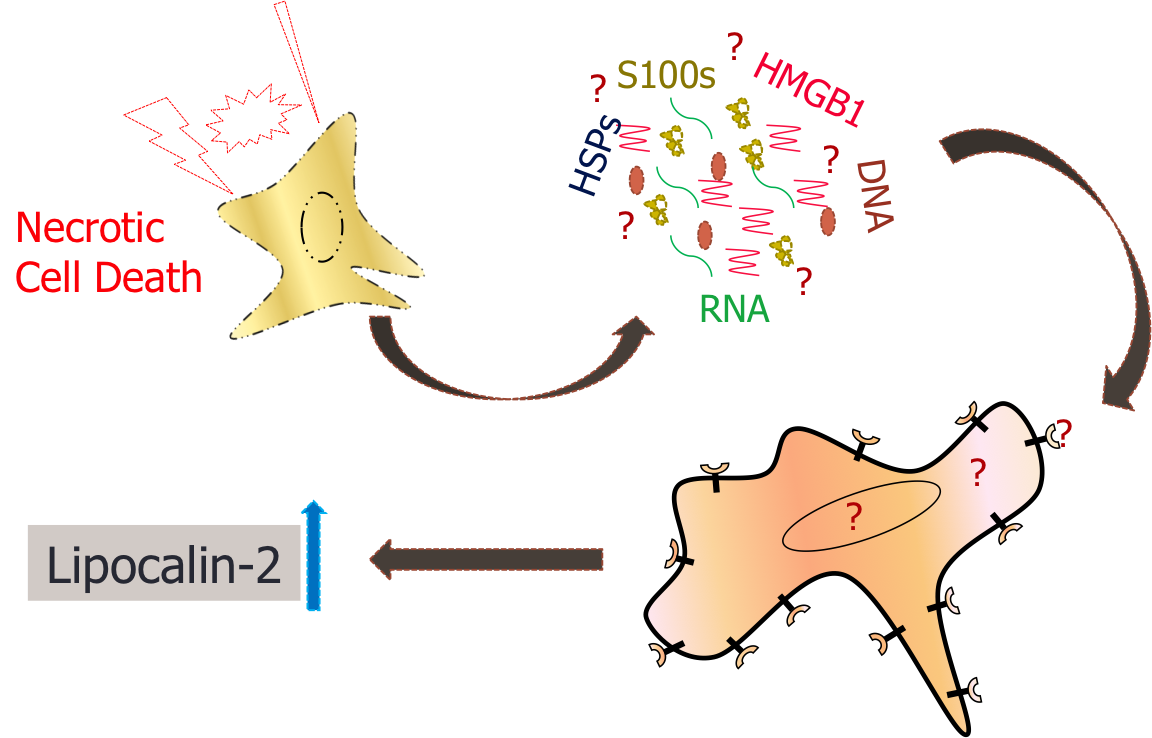
A possible hypothesis of LCN2 induction during inflammatory neurological disorders is that dying necrotic neurons releases DAMPs that stimulate inflammatory reactions including the elevation in LCN2 level (Figure 1). More over, probably LCN2 induction is due to non-specific structural alterations of necrotic proteins such as exposed hydrophobic segments “hyppos” (Seong and Matzinger 2004). Receptors like TLRs (He et al. 2009; Park et al. 2006; Sandri et al. 2008; Vogl et al. 2007), RAGE (Bierhaus et al. 2005; van Beijnum et al. 2008) does not follow the classical (1:1) ligand receptor relationship, since these receptors sense multiple molecules (PAMPs and DAMPs) to induce downstream signaling. Interestingly, such PAMPs and DAMPs are structurally and sequentially diverse. Further more, some well characterized DAMPs like HMGB1, HSPs were sensed by multiple receptors like TLR2, TLR4, RAGE (Asea 2008; Park et al. 2006; Park et al. 2004; Zurolo et al. 2011). Taken together, LCN2 regulation in astrocytes is potentially primed by multiple altered structures of numerous proteins.


 PowerPoint Slide
 Larger image(png format)

LCN2 has been upregulated upon pathogen invasion, neurodegeneration, and brain damage. However, there is debate on role of LCN2 in such conditions. Some of the predicted functions of LCN2 in brain are discussed below.
3.2. LCN2 in Brain Iron RegulationDeposition of iron was measured in several neuroinflammatory diseases like Alzheimer’s (Wang et al. 2013a), multiple sclerosis (Haacke et al. 2009), Parkinson’s (Wallis et al. 2008), epilepsy (Pico and Gall 1994), traumatic brain injury (Raz et al. 2011), stroke (Danielisova et al. 2002), and hemorrhage (Chen et al. 2011). The iron homeostasis pathway has been disturbed in such inflammatory conditions. In addition, elevation of LCN2 in brain inflammatory diseases and animal models predicts the role of LCN2 in brain iron management.
There are myriads of reports suggesting the function of LCN2 in iron homeostasis. It has been demonstrated that the regulation of intracellular iron content is responsible for apoptosis in wide variety of cell types (Devireddy et al. 2005; Kooncumchoo et al. 2006; Oudit et al. 2004; Velez-Pardo et al. 1997). Conversely, a recent study questioned the proposed role of LCN2 to induce apoptosis. Also, this report doubt anticipated mammalian siderophore’s association with LCN2 and iron (Correnti et al. 2012). Although there is controversy on the mechanism of iron handling by LCN2, association of LCN2 with iron in inflamed organs including brain has been widely accepted (Chia et al. 2011; Mucha et al. 2011; Srinivasan et al. 2012).
Regulation of iron responsive genes and iron-regulatory proteins such as transferrin (Tf), transferrin receptor (TfR), H-ferritin, ferroportin, lactoferrin, natural resistance-associated macrophage protein-1 (Nramp1) and divalent metal transporter-1 (DMT1) has not been well studied in inflamed brain. Systemic LPS administration has no effect on the expression of TfR-1 (Ip et al. 2011). However, another report suggests the decrease in TfR but increase in H-ferritin expression in Neuro-2a and BV-2 cell lines by LPS (Reis et al. 2006). One separate paper demonstrates the induction in expression of iron regulatory hormone hepcidin in the cortex and substantia nigra in rat brain upon LPS administration (Wang et al. 2008). Even though Marianee Wessling-Resnick’s review does not specifically discuss about neuroinflammation, it points out the modulation of iron-regulatory gene/protein expression during inflammatory responses (Wessling-Resnick 2010). In light of the above observations, it is possible that LCN2 regulates iron homeostasis in inflamed brain, but not in normal physiology. An extensive study of transporters, receptors, and other effectors of iron in inflamed brain and specific brain cells is the first step required to understand iron homeostasis during neuroinflammation.
It has been clearly demonstrated that bacteria and fungi utilize siderophores to acquire iron from their hosts (Fernandez-Pol 1978; Jones et al. 1980). If lipocalin-2 has role in brain iron homeostasis, there must be siderophore binding both LCN2 and iron (Goetz et al. 2002). Since siderophores are required for LCN2 to regulate iron sequestration, it is important to understand their association. Gentisic acid, also called 2,5-dihydrobenzoic acid (2,5-DHBA) has been considered as a mammalian siderophore (Devireddy et al. 2010), whose proposed role was questioned recently (Correnti et al. 2012). However, there might be LCN2 binding mammalian siderophore(s) to regulate iron.
The Tf-TfR system has major role in iron uptake across the blood brain barrier (BBB), while there is possibility of some extent of iron transport by Tf homologues such as lactoferrin or melanotransferrin (Mills et al. 2010). Additionally, there is controversy regarding the expression of Fe2+ transporting divalent metal transporter-1 (DMT1) in brain vascular endothelial cells (BVEC) (Burdo et al. 2001; Siddappa et al. 2002). Although it is not free from controversy, astrocytes do not express TfR (Dringen et al. 2007; Qian et al. 1999). Also, reports depict the expression of DMT1 on neurons, but not on astrocytes (Mills et al. 2010). A comparison of plasma to cerebrospinal fluid (CSF)/interstitial fluid (ISF) solutions revealed the lower concentrations of Tf and higher concentrations of citrate and ascorbate (Bradbury 1997), suggesting the existence of LCN2 and/or LCN2 like iron sequestering proteins for brain iron homeostasis.
LCN2 expression by brain iron overload (Dong et al. 2013) is probably due to the release of DAMPs following neurotoxicity. As a protective mechanism, the LCN2 released by cells like astrocytes then perhaps regulate iron to reduce further damage. Thus, a scrutinize study of mechanisms and functions of LCN2 expression need to be carried out.
3.3. LCN2 in Cell Migration and Phenotypic PolarizationSince LCN2 secretion is provoked during inflammation, it was described as a cytokine (Ni et al. 2013). Even though we do not have enough evidences to categorize it as a pro- or anti- inflammatory molecule, it perhaps can act as a chemokine or cytokine. The function of LCN2 for cell migration and invasion has been demonstrated in various in vitro models (Bauer et al. 2008; Kim et al. 2011; Yang et al. 2009). In the Boyden chamber assay, conditioned media from LCN2-treated astrocytes boosted glial and neuronal migration (Kim et al. 2011). Lee et al. demonstrated up-regulation of CXCL10 in astrocytes upon LCN2 treatment is critical for the migration of astrocytes to injury sites in the neuroinflammation or injury models (Lee et al. 2011). Therefore, LCN2 expressed by astrocytes could induce cells (neurons, astrocytes or microglia) migration, suggesting its role as a cell migration regulator in the CNS. However, detailed experimentation is yet to be performed.
Recent reports described LCN2 as a protein amplifying M1 polarization of activated microglia (Jang et al. 2013b) and functional polarization of astrocytes (Jang et al. 2013a). These reports describe LCN2 as an essential factor for the polarization of microglia and astrocytes to expression proinflammatory cytokines; IL-12, IL-23, TNF-α, IL-1β, iNOS, and CXCL10 (Jang et al. 2013a; Jang et al. 2013b). These studies are suggesting LCN2 as a molecule worsening the inflammation, which is contradictory to another study (Macco et al. 2013). These conflicting reports demand further study for clarification.
3.4. LCN2 in Brain RemodelingIn human, lipocalin-2 forms a heterodimer with matrix metalloproteinase-9 (MMP-9) and stabilizes its activity (Kubben et al. 2007; Provatopoulou et al. 2009; Yan et al. 2001). Reports have shown the critical role of LCN2: MMP-9 complex in cancer progression, invasion and metastasis (Kubben et al. 2007; Provatopoulou et al. 2009; Yan et al. 2001). However, the association of LCN2 and MMP-9 has not been studied in brain. LCN2 is one of the most highly upregulated transcript detected by microarray analysis in the hippocampus and amygdala after acute restraint induced psychological stress (Mucha et al. 2011; Skrzypiec et al. 2013). Mucha et al. and group speculated that the stimulated expression of LCN2 following psychological stress is responsible to induce spine density and proportion of mushroom spines in hippocampus and amygdala (Mucha et al. 2011; Skrzypiec et al. 2013). A separate report advises the role of MMP-9 in changing dendritic spine morphology (Michaluk et al. 2011). Together these reports suggest the possibility of LCN2: MMP-9 dimerization in inflamed brain where synaptic remodeling is common (Sloviter et al. 2006). Hence, further study could reveal the underlying role of LCN2 in brain remodeling.
3.5. LCN2 in Cell Survival/DeathJang et al. described LCN2 as important functional phenotypes regulator of activated astrocytes and microglia (Jang et al. 2013a; Jang et al. 2013b). LPS induced astrocytes and microglia to secrete LCN2 that promotes the polarization of these cells to release proinflammatory molecules suggesting LCN2 as an inducer of inflammation (Jang et al. 2013a; Jang et al. 2013b). Since the over-activation of inflammatory response could be detrimental, LCN2 may have negative effect on brain. Also, activated astrocytes released LCN2 is described as an inducer of neuronal apoptosis (Bi et al. 2013). However, these reports imply that LCN2 can be therapeutically targeted to modulate astrocyte and microglia phenotypes and their consequences.
On the other hand, LCN2 is considered as a protective factor against oxidative stress because of its ability to induce antioxidant genes like, heme oxygenase (HO-1) and superoxide dismutase (SOD1, SOD2) (Bahmani et al. 2010). A recent report demonstrated acquired resistance in astrocytes to iron-dependent oxidative stress due to proinflammatory activation (Macco et al. 2013). Since LCN2 is thought to play role in iron homeostasis and it is one excessively expressed gene upon LPS insult, LCN2 is potentially protective against iron toxicity. Furthermore, early expression of LCN2 in MCAO (Zamanian et al. 2012) and kainate-induced neurotoxicity models (Chia et al. 2011) describe LCN2 as an acute phase protein having potential to be neuroprotective (Streit 2006). However, based on the data available it would be too early to conclude whether LCN2 is beneficial or detrimental for brain.
4. Summary and Implications
We are starting to realize and understand the diversity and complexity of LCN2 actions in the brain. Since LCN2 is induced upon infection or cell/tissue injury, it should be expected that LCN2 would exert distinct role in acute and chronic neuroinflammatory diseases. Higher level of LCN2 expression than most pro-inflammatory mediators during non-pathogen-associated neuroinflammatory models suggests that it acts more importantly in sterile inflammatory conditions than pathogen infection. Accordingly, studies predicted role of LCN2 in brain iron homeostasis in inflamed brain. It sounds valid, since there is dysregulation of iron (and iron-regulating genes) and up-regulation of LCN2 in acute and chronic brain inflammation. Also, because LCN2 has been already characterized as a protein controlling iron transport. Additionally, LCN2 has part in brain remodeling, cell migration, and phenotypic polarization. We believe that the careful study and understanding of LCN2 in animal models and human patients will be a milestone to design new therapeutic approaches to ameliorate pathophysiological complications of neuroinflammation, particularly non-pathogen-associated neuroinflammation.
Conflict of Interest
The author declares no conflict of interest.
Acknowledgements
I thank my Ph.D. advisor Dr. James Stoll for his guidance, motivation, and suggestions.
References
| [1] | Alexopoulou L, Holt AC, Medzhitov R, Flavell RA (2001) Recognition of double-stranded RNA and activation of NF-kappaB by Toll-like receptor 3. Nature. 413: 732-738. | ||
 In article In article | CrossRef | ||
| [2] | Asea A (2008) Heat shock proteins and toll-like receptors. Handb Exp Pharmacol: 111-127. | ||
| In article | |||
| [3] | Ashhab MU, Omran A, Kong H, Gan N, He F, Peng J, Yin F (2013) Expressions of tumor necrosis factor alpha and microRNA-155 in immature rat model of status epilepticus and children with mesial temporal lobe epilepsy. J Mol Neurosci. 51: 950-958. | ||
| In article | CrossRef | ||
| [4] | Axelsson L, Bergenfeldt M, Ohlsson K (1995) Studies of the release and turnover of a human neutrophil lipocalin. Scand J Clin Lab Invest. 55: 577-588. | ||
| In article | CrossRef | ||
| [5] | Bahmani P, Halabian R, Rouhbakhsh M, Roushandeh AM, Masroori N, Ebrahimi M, Samadikuchaksaraei A, Shokrgozar MA, Roudkenar MH (2010) Neutrophil gelatinase-associated lipocalin induces the expression of heme oxygenase-1 and superoxide dismutase 1, 2. Cell Stress Chaperones. 15: 395-403. | ||
| In article | CrossRef | ||
| [6] | Basu A, Krady JK, Levison SW (2004) Interleukin-1: a master regulator of neuroinflammation. J Neurosci Res. 78: 151-156. | ||
| In article | CrossRef | ||
| [7] | Bauer M, Eickhoff JC, Gould MN, Mundhenke C, Maass N, Friedl A (2008) Neutrophil gelatinase-associated lipocalin (NGAL) is a predictor of poor prognosis in human primary breast cancer. Breast Cancer Res Treat. 108: 389-397. | ||
| In article | CrossRef | ||
| [8] | Berger T, Cheung CC, Elia AJ, Mak TW (2010) Disruption of the Lcn2 gene in mice suppresses primary mammary tumor formation but does not decrease lung metastasis. Proc Natl Acad Sci U S A. 107: 2995-3000. | ||
| In article | CrossRef | ||
| [9] | Bi F, Huang C, Tong J, Qiu G, Huang B, Wu Q, Li F, Xu Z, Bowser R, Xia XG, Zhou H (2013) Reactive astrocytes secrete lcn2 to promote neuron death. Proc Natl Acad Sci U S A. 110: 4069-4074. | ||
| In article | CrossRef | ||
| [10] | Bierhaus A, Humpert PM, Morcos M, Wendt T, Chavakis T, Arnold B, Stern DM, Nawroth PP (2005) Understanding RAGE, the receptor for advanced glycation end products. J Mol Med (Berl). 83: 876-886. | ||
| In article | CrossRef | ||
| [11] | Bong JJ, Seol MB, Kim HH, Han O, Back K, Baik M (2004) The 24p3 gene is induced during involution of the mammary gland and induces apoptosis of mammary epithelial cells. Mol Cells. 17: 29-34. | ||
| In article | |||
| [12] | Bradbury MW (1997) Transport of iron in the blood-brain-cerebrospinal fluid system. J Neurochem. 69: 443-454. | ||
| In article | CrossRef | ||
| [13] | Brea D, Blanco M, Ramos-Cabrer P, Moldes O, Arias S, Perez-Mato M, Leira R, Sobrino T, Castillo J (2011) Toll-like receptors 2 and 4 in ischemic stroke: outcome and therapeutic values. J Cereb Blood Flow Metab. 31: 1424-1431. | ||
| In article | CrossRef | ||
| [14] | Burdo JR, Menzies SL, Simpson IA, Garrick LM, Garrick MD, Dolan KG, Haile DJ, Beard JL, Connor JR (2001) Distribution of divalent metal transporter 1 and metal transport protein 1 in the normal and Belgrade rat. J Neurosci Res. 66: 1198-1207. | ||
| In article | CrossRef | ||
| [15] | Chakraborty S, Kaur S, Guha S, Batra SK (2012) The multifaceted roles of neutrophil gelatinase associated lipocalin (NGAL) in inflammation and cancer. Biochim Biophys Acta. 1826: 129-169. | ||
| In article | |||
| [16] | Chang SY, Kim DB, Ko SH, Jo YH, Kim MJ (2013) Induction mechanism of lipocalin-2 expression by co-stimulation with interleukin-1beta and interferon-gamma in RINm5F beta-cells. Biochem Biophys Res Commun. 434: 577-583. | ||
| In article | CrossRef | ||
| [17] | Chen Z, Gao C, Hua Y, Keep RF, Muraszko K, Xi G (2011) Role of iron in brain injury after intraventricular hemorrhage. Stroke. 42: 465-470. | ||
| In article | CrossRef | ||
| [18] | Chia WJ, Dawe GS, Ong WY (2011) Expression and localization of the iron-siderophore binding protein lipocalin 2 in the normal rat brain and after kainate-induced excitotoxicity. Neurochem Int. 59: 591-599. | ||
| In article | CrossRef | ||
| [19] | Choi J, Lee HW, Suk K (2011) Increased plasma levels of lipocalin 2 in mild cognitive impairment. J Neurol Sci. 305: 28-33. | ||
| In article | CrossRef | ||
| [20] | Clausen BH, Lambertsen KL, Babcock AA, Holm TH, Dagnaes-Hansen F, Finsen B (2008) Interleukin-1beta and tumor necrosis factor-alpha are expressed by different subsets of microglia and macrophages after ischemic stroke in mice. J Neuroinflammation. 5: 46. | ||
| In article | CrossRef | ||
| [21] | Coles M, Diercks T, Muehlenweg B, Bartsch S, Zolzer V, Tschesche H, Kessler H (1999) The solution structure and dynamics of human neutrophil gelatinase-associated lipocalin. J Mol Biol. 289: 139-157. | ||
| In article | CrossRef | ||
| [22] | Correnti C, Richardson V, Sia AK, Bandaranayake AD, Ruiz M, Suryo Rahmanto Y, Kovacevic Z, Clifton MC, Holmes MA, Kaiser BK, Barasch J, Raymond KN, Richardson DR, Strong RK (2012) Siderocalin/Lcn2/NGAL/24p3 Does Not Drive Apoptosis Through Gentisic Acid Mediated Iron Withdrawal in Hematopoietic Cell Lines. PLoS One. 7: e43696. | ||
| In article | CrossRef | ||
| [23] | Cowland JB, Sorensen OE, Sehested M, Borregaard N (2003) Neutrophil gelatinase-associated lipocalin is up-regulated in human epithelial cells by IL-1 beta, but not by TNF-alpha. J Immunol. 171: 6630-6639. | ||
| In article | CrossRef | ||
| [24] | Crutcher KA, Gendelman HE, Kipnis J, Perez-Polo JR, Perry VH, Popovich PG, Weaver LC (2006) Debate: "is increasing neuroinflammation beneficial for neural repair?". J Neuroimmune Pharmacol. 1: 195-211. | ||
| In article | CrossRef | ||
| [25] | Danielisova V, Gottlieb M, Burda J (2002) Iron deposition after transient forebrain ischemia in rat brain. Neurochem Res. 27: 237-242. | ||
| In article | CrossRef | ||
| [26] | Deane R, Singh I, Sagare AP, Bell RD, Ross NT, LaRue B, Love R, Perry S, Paquette N, Deane RJ, Thiyagarajan M, Zarcone T, Fritz G, Friedman AE, Miller BL, Zlokovic BV (2012) A multimodal RAGE-specific inhibitor reduces amyloid beta-mediated brain disorder in a mouse model of Alzheimer disease. J Clin Invest. 122: 1377-1392. | ||
| In article | CrossRef | ||
| [27] | Devireddy LR, Gazin C, Zhu X, Green MR (2005) A cell-surface receptor for lipocalin 24p3 selectively mediates apoptosis and iron uptake. Cell. 123: 1293-1305. | ||
| In article | CrossRef | ||
| [28] | Devireddy LR, Hart DO, Goetz DH, Green MR (2010) A mammalian siderophore synthesized by an enzyme with a bacterial homolog involved in enterobactin production. Cell. 141: 1006-1017. | ||
| In article | CrossRef | ||
| [29] | Dong M, Xi G, Keep RF, Hua Y (2013) Role of iron in brain lipocalin 2 upregulation after intracerebral hemorrhage in rats. Brain Res. 1505: 86-92. | ||
| In article | CrossRef | ||
| [30] | Dringen R, Bishop GM, Koeppe M, Dang TN, Robinson SR (2007) The pivotal role of astrocytes in the metabolism of iron in the brain. Neurochem Res. 32: 1884-1890. | ||
| In article | CrossRef | ||
| [31] | Fernandez-Pol JA (1978) Isolation and characterization of a siderophore-like growth factor from mutants of SV40-transformed cells adapted to picolinic acid. Cell. 14: 489-499. | ||
| In article | CrossRef | ||
| [32] | Flo TH, Smith KD, Sato S, Rodriguez DJ, Holmes MA, Strong RK, Akira S, Aderem A (2004) Lipocalin 2 mediates an innate immune response to bacterial infection by sequestrating iron. Nature. 432: 917-921. | ||
| In article | CrossRef | ||
| [33] | Frank-Cannon TC, Alto LT, McAlpine FE, Tansey MG (2009) Does neuroinflammation fan the flame in neurodegenerative diseases? Mol Neurodegener. 4: 47. | ||
| In article | CrossRef | ||
| [34] | Gehrmann J, Matsumoto Y, Kreutzberg GW (1995) Microglia: intrinsic immuneffector cell of the brain. Brain Res Brain Res Rev. 20: 269-287. | ||
| In article | CrossRef | ||
| [35] | Glaros T, Fu Y, Xing J, Li L (2012) Molecular mechanism underlying persistent induction of LCN2 by lipopolysaccharide in kidney fibroblasts. PLoS One. 7: e34633. | ||
| In article | CrossRef | ||
| [36] | Goetz DH, Holmes MA, Borregaard N, Bluhm ME, Raymond KN, Strong RK (2002) The neutrophil lipocalin NGAL is a bacteriostatic agent that interferes with siderophore-mediated iron acquisition. Mol Cell. 10: 1033-1043. | ||
| In article | CrossRef | ||
| [37] | Haacke EM, Makki M, Ge Y, Maheshwari M, Sehgal V, Hu J, Selvan M, Wu Z, Latif Z, Xuan Y, Khan O, Garbern J, Grossman RI (2009) Characterizing iron deposition in multiple sclerosis lesions using susceptibility weighted imaging. J Magn Reson Imaging. 29: 537-544. | ||
| In article | CrossRef | ||
| [38] | He RL, Zhou J, Hanson CZ, Chen J, Cheng N, Ye RD (2009) Serum amyloid A induces G-CSF expression and neutrophilia via Toll-like receptor 2. Blood. 113: 429-437. | ||
| In article | CrossRef | ||
| [39] | Heil F, Hemmi H, Hochrein H, Ampenberger F, Kirschning C, Akira S, Lipford G, Wagner H, Bauer S (2004) Species-specific recognition of single-stranded RNA via toll-like receptor 7 and 8. Science. 303: 1526-1529. | ||
| In article | CrossRef | ||
| [40] | Hirsch R, Dent C, Pfriem H, Allen J, Beekman RH, 3rd, Ma Q, Dastrala S, Bennett M, Mitsnefes M, Devarajan P (2007) NGAL is an early predictive biomarker of contrast-induced nephropathy in children. Pediatr Nephrol. 22: 2089-2095. | ||
| In article | CrossRef | ||
| [41] | Iori V, Maroso M, Rizzi M, Iyer AM, Vertemara R, Carli M, Agresti A, Antonelli A, Bianchi ME, Aronica E, Ravizza T, Vezzani A (2013) Receptor for Advanced Glycation Endproducts is upregulated in temporal lobe epilepsy and contributes to experimental seizures. Neurobiol Dis. 58: 102-114. | ||
| In article | CrossRef | ||
| [42] | Ip JP, Nocon AL, Hofer MJ, Lim SL, Muller M, Campbell IL (2011) Lipocalin 2 in the central nervous system host response to systemic lipopolysaccharide administration. J Neuroinflammation. 8: 124. | ||
| In article | CrossRef | ||
| [43] | Iyer SS, Pulskens WP, Sadler JJ, Butter LM, Teske GJ, Ulland TK, Eisenbarth SC, Florquin S, Flavell RA, Leemans JC, Sutterwala FS (2009) Necrotic cells trigger a sterile inflammatory response through the Nlrp3 inflammasome. Proc Natl Acad Sci U S A. 106: 20388-20393. | ||
| In article | CrossRef | ||
| [44] | Jang E, Kim JH, Lee S, Kim JH, Seo JW, Jin M, Lee MG, Jang IS, Lee WH, Suk K (2013a) Phenotypic polarization of activated astrocytes: the critical role of lipocalin-2 in the classical inflammatory activation of astrocytes. J Immunol. 191: 5204-5219. | ||
| In article | CrossRef | ||
| [45] | Jang E, Lee S, Kim JH, Kim JH, Seo JW, Lee WH, Mori K, Nakao K, Suk K (2013b) Secreted protein lipocalin-2 promotes microglial M1 polarization. FASEB J. 27: 1176-1190. | ||
| In article | CrossRef | ||
| [46] | Jayaraman A, Roberts KA, Yoon J, Yarmush DM, Duan X, Lee K, Yarmush ML (2005) Identification of neutrophil gelatinase-associated lipocalin (NGAL) as a discriminatory marker of the hepatocyte-secreted protein response to IL-1beta: a proteomic analysis. Biotechnol Bioeng. 91: 502-515. | ||
| In article | CrossRef | ||
| [47] | Jones RL, Peterson CM, Grady RW, Cerami A (1980) Low molecular weight iron-binding factor from mammalian tissue that potentiates bacterial growth. J Exp Med. 151: 418-428. | ||
| In article | CrossRef | ||
| [48] | Kim H, Lee S, Park HC, Lee WH, Lee MS, Suk K (2011) Modulation of glial and neuronal migration by lipocalin-2 in zebrafish. Immune Netw. 11: 342-347. | ||
| In article | CrossRef | ||
| [49] | Kooncumchoo P, Sharma S, Porter J, Govitrapong P, Ebadi M (2006) Coenzyme Q(10) provides neuroprotection in iron-induced apoptosis in dopaminergic neurons. J Mol Neurosci. 28: 125-141. | ||
| In article | CrossRef | ||
| [50] | Kratchmarova I, Kalume DE, Blagoev B, Scherer PE, Podtelejnikov AV, Molina H, Bickel PE, Andersen JS, Fernandez MM, Bunkenborg J, Roepstorff P, Kristiansen K, Lodish HF, Mann M, Pandey A (2002) A proteomic approach for identification of secreted proteins during the differentiation of 3T3-L1 preadipocytes to adipocytes. Mol Cell Proteomics. 1: 213-222. | ||
| In article | CrossRef | ||
| [51] | Kubben FJ, Sier CF, Hawinkels LJ, Tschesche H, van Duijn W, Zuidwijk K, van der Reijden JJ, Hanemaaijer R, Griffioen G, Lamers CB, Verspaget HW (2007) Clinical evidence for a protective role of lipocalin-2 against MMP-9 autodegradation and the impact for gastric cancer. Eur J Cancer. 43: 1869-1876. | ||
| In article | CrossRef | ||
| [52] | Lee S, Kim JH, Kim JH, Seo JW, Han HS, Lee WH, Mori K, Nakao K, Barasch J, Suk K (2011) Lipocalin-2 Is a chemokine inducer in the central nervous system: role of chemokine ligand 10 (CXCL10) in lipocalin-2-induced cell migration. J Biol Chem. 286: 43855-43870. | ||
| In article | CrossRef | ||
| [53] | Lee S, Lee J, Kim S, Park JY, Lee WH, Mori K, Kim SH, Kim IK, Suk K (2007) A dual role of lipocalin 2 in the apoptosis and deramification of activated microglia. J Immunol. 179: 3231-3241. | ||
| In article | CrossRef | ||
| [54] | Lee S, Park JY, Lee WH, Kim H, Park HC, Mori K, Suk K (2009) Lipocalin-2 is an autocrine mediator of reactive astrocytosis. J Neurosci. 29: 234-249. | ||
| In article | CrossRef | ||
| [55] | Lee YC, Elangovan N, Tzeng WF, Chu ST (2005) Mouse uterine 24p3 protein as a suppressor of sperm acrosome reaction. Mol Biol Rep. 32: 237-245. | ||
| In article | CrossRef | ||
| [56] | Liu Q, Nilsen-Hamilton M (1995) Identification of a new acute phase protein. J Biol Chem. 270: 22565-22570. | ||
| In article | CrossRef | ||
| [57] | Liu QS, Nilsen-Hamilton M, Xiong SD (2003) Synergistic regulation of the acute phase protein SIP24/24p3 by glucocorticoid and pro-inflammatory cytokines. Sheng li xue bao : [Acta physiologica Sinica]. 55: 525-529. | ||
| In article | |||
| [58] | Lively S, Brown IR (2008) Extracellular matrix protein SC1/hevin in the hippocampus following pilocarpine-induced status epilepticus. J Neurochem. 107: 1335-1346. | ||
| In article | CrossRef | ||
| [59] | Luheshi NM, Kovacs KJ, Lopez-Castejon G, Brough D, Denes A (2011) Interleukin-1alpha expression precedes IL-1beta after ischemic brain injury and is localised to areas of focal neuronal loss and penumbral tissues. J Neuroinflammation. 8: 186. | ||
| In article | CrossRef | ||
| [60] | Macco R, Pelizzoni I, Consonni A, Vitali I, Giacalone G, Martinelli Boneschi F, Codazzi F, Grohovaz F, Zacchetti D (2013) Astrocytes acquire resistance to iron-dependent oxidative stress upon proinflammatory activation. J Neuroinflammation. 10: 130. | ||
| In article | CrossRef | ||
| [61] | MacManus JP, Graber T, Luebbert C, Preston E, Rasquinha I, Smith B, Webster J (2004) Translation-state analysis of gene expression in mouse brain after focal ischemia. J Cereb Blood Flow Metab. 24: 657-667. | ||
| In article | CrossRef | ||
| [62] | Maroso M, Balosso S, Ravizza T, Liu J, Aronica E, Iyer AM, Rossetti C, Molteni M, Casalgrandi M, Manfredi AA, Bianchi ME, Vezzani A (2010) Toll-like receptor 4 and high-mobility group box-1 are involved in ictogenesis and can be targeted to reduce seizures. Nat Med. 16: 413-419. | ||
| In article | CrossRef | ||
| [63] | Meheus LA, Fransen LM, Raymackers JG, Blockx HA, Van Beeumen JJ, Van Bun SM, Van de Voorde A (1993) Identification by microsequencing of lipopolysaccharide-induced proteins secreted by mouse macrophages. J Immunol. 151: 1535-1547. | ||
| In article | |||
| [64] | Mesquita SD, Ferreira AC, Falcao AM, Sousa JC, Oliveira TG, Correia-Neves M, Sousa N, Marques F, Palha JA (2013) Lipocalin 2 produced in response to amyloid beta. Paper presented at the Society for Neuroscience, San Diego, CA, Sunday, Nov 10, 2013 | ||
| In article | |||
| [65] | Michaluk P, Wawrzyniak M, Alot P, Szczot M, Wyrembek P, Mercik K, Medvedev N, Wilczek E, De Roo M, Zuschratter W, Muller D, Wilczynski GM, Mozrzymas JW, Stewart MG, Kaczmarek L, Wlodarczyk J (2011) Influence of matrix metalloproteinase MMP-9 on dendritic spine morphology. J Cell Sci. 124: 3369-3380. | ||
| In article | CrossRef | ||
| [66] | Mills E, Dong XP, Wang F, Xu H (2010) Mechanisms of brain iron transport: insight into neurodegeneration and CNS disorders. Future Med Chem. 2: 51-64. | ||
| In article | CrossRef | ||
| [67] | Mucha M, Skrzypiec AE, Schiavon E, Attwood BK, Kucerova E, Pawlak R (2011) Lipocalin-2 controls neuronal excitability and anxiety by regulating dendritic spine formation and maturation. Proc Natl Acad Sci U S A. 108: 18436-18441. | ||
| In article | CrossRef | ||
| [68] | Naude PJ, Nyakas C, Eiden LE, Ait-Ali D, van der Heide R, Engelborghs S, Luiten PG, De Deyn PP, den Boer JA, Eisel UL (2012) Lipocalin 2: novel component of proinflammatory signaling in Alzheimer's disease. FASEB J. 26: 2811-2823. | ||
| In article | CrossRef | ||
| [69] | Ni J, Ma X, Zhou M, Pan X, Tang J, Hao Y, Lu Z, Gao M, Bao Y, Jia W (2013) Serum lipocalin-2 levels positively correlate with coronary artery disease and metabolic syndrome. Cardiovasc Diabetol. 12: 176. | ||
| In article | CrossRef | ||
| [70] | Nocon AL, Ip JP, Terry R, Lim SL, Getts DR, Muller M, Hofer MJ, King NJ, Campbell IL (2014) The bacteriostatic protein lipocalin 2 is induced in the central nervous system of mice with west Nile virus encephalitis. J Virol. 88: 679-689. | ||
| In article | CrossRef | ||
| [71] | Okuma Y, Liu K, Wake H, Zhang J, Maruo T, Date I, Yoshino T, Ohtsuka A, Otani N, Tomura S, Shima K, Yamamoto Y, Yamamoto H, Takahashi HK, Mori S, Nishibori M (2012) Anti-high mobility group box-1 antibody therapy for traumatic brain injury. Ann Neurol. 72: 373-384. | ||
| In article | CrossRef | ||
| [72] | Oudit GY, Trivieri MG, Khaper N, Husain T, Wilson GJ, Liu P, Sole MJ, Backx PH (2004) Taurine supplementation reduces oxidative stress and improves cardiovascular function in an iron-overload murine model. Circulation. 109: 1877-1885. | ||
| In article | CrossRef | ||
| [73] | Park JS, Gamboni-Robertson F, He Q, Svetkauskaite D, Kim JY, Strassheim D, Sohn JW, Yamada S, Maruyama I, Banerjee A, Ishizaka A, Abraham E (2006) High mobility group box 1 protein interacts with multiple Toll-like receptors. Am J Physiol Cell Physiol. 290: C917-924. | ||
| In article | CrossRef | ||
| [74] | Park JS, Svetkauskaite D, He Q, Kim JY, Strassheim D, Ishizaka A, Abraham E (2004) Involvement of toll-like receptors 2 and 4 in cellular activation by high mobility group box 1 protein. J Biol Chem. 279: 7370-7377. | ||
| In article | CrossRef | ||
| [75] | Pekar T, Stojakovic T, Haas J, Simmet NE, Scharnagl H, Gattringer T, Fazekas F, Storch MK, Seifert-Held T (2013) Plasma neutrophil gelatinase-associated lipocalin and functional outcome in ischemic stroke. J Neurol Sci. 333: e171. | ||
| In article | CrossRef | ||
| [76] | Pico RM, Gall CM (1994) Hippocampal epileptogenesis produced by electrolytic iron deposition in the rat dentate gyrus. Epilepsy Res. 19: 27-36. | ||
| In article | CrossRef | ||
| [77] | Poltorak A, He X, Smirnova I, Liu MY, Van Huffel C, Du X, Birdwell D, Alejos E, Silva M, Galanos C, Freudenberg M, Ricciardi-Castagnoli P, Layton B, Beutler B (1998) Defective LPS signaling in C3H/HeJ and C57BL/10ScCr mice: mutations in Tlr4 gene. Science. 282: 2085-2088. | ||
| In article | CrossRef | ||
| [78] | Popovich PG, Longbrake EE (2008) Can the immune system be harnessed to repair the CNS? Nat Rev Neurosci. 9: 481-493. | ||
| In article | CrossRef | ||
| [79] | Provatopoulou X, Gounaris A, Kalogera E, Zagouri F, Flessas I, Goussetis E, Nonni A, Papassotiriou I, Zografos G (2009) Circulating levels of matrix metalloproteinase-9 (MMP-9), neutrophil gelatinase-associated lipocalin (NGAL) and their complex MMP-9/NGAL in breast cancer disease. BMC Cancer. 9: 390. | ||
| In article | CrossRef | ||
| [80] | Qian ZM, To Y, Tang PL, Feng YM (1999) Transferrin receptors on the plasma membrane of cultured rat astrocytes. Exp Brain Res. 129: 473-476. | ||
| In article | CrossRef | ||
| [81] | Raz E, Jensen JH, Ge Y, Babb JS, Miles L, Reaume J, Grossman RI, Inglese M (2011) Brain iron quantification in mild traumatic brain injury: a magnetic field correlation study. AJNR Am J Neuroradiol. 32: 1851-1856. | ||
| In article | CrossRef | ||
| [82] | Reis K, Halldin J, Fernaeus S, Pettersson C, Land T (2006) NADPH oxidase inhibitor diphenyliodonium abolishes lipopolysaccharide-induced down-regulation of transferrin receptor expression in N2a and BV-2 cells. J Neurosci Res. 84: 1047-1052. | ||
| In article | CrossRef | ||
| [83] | Rivest S (2009) Regulation of innate immune responses in the brain. Nat Rev Immunol. 9: 429-439. | ||
| In article | CrossRef | ||
| [84] | Sandri S, Rodriguez D, Gomes E, Monteiro HP, Russo M, Campa A (2008) Is serum amyloid A an endogenous TLR4 agonist? J Leukoc Biol. 83: 1174-1180. | ||
| In article | CrossRef | ||
| [85] | Sato M, Sano H, Iwaki D, Kudo K, Konishi M, Takahashi H, Takahashi T, Imaizumi H, Asai Y, Kuroki Y (2003) Direct binding of Toll-like receptor 2 to zymosan, and zymosan-induced NF-kappa B activation and TNF-alpha secretion are down-regulated by lung collectin surfactant protein A. J Immunol. 171: 417-425. | ||
| In article | CrossRef | ||
| [86] | Savage CD, Lopez-Castejon G, Denes A, Brough D (2012) NLRP3-Inflammasome Activating DAMPs Stimulate an Inflammatory Response in Glia in the Absence of Priming Which Contributes to Brain Inflammation after Injury. Front Immunol. 3: 288. | ||
| In article | CrossRef | ||
| [87] | Schulze J, Zierath D, Tanzi P, Cain K, Shibata D, Dressel A, Becker K (2013) Severe stroke induces long-lasting alterations of high-mobility group box 1. Stroke. 44: 246-248. | ||
| In article | CrossRef | ||
| [88] | Schwandner R, Dziarski R, Wesche H, Rothe M, Kirschning CJ (1999) Peptidoglycan- and lipoteichoic acid-induced cell activation is mediated by toll-like receptor 2. J Biol Chem. 274: 17406-17409. | ||
| In article | CrossRef | ||
| [89] | Seong SY, Matzinger P (2004) Hydrophobicity: an ancient damage-associated molecular pattern that initiates innate immune responses. Nat Rev Immunol. 4: 469-478. | ||
| In article | CrossRef | ||
| [90] | Shen F, Hu Z, Goswami J, Gaffen SL (2006) Identification of common transcriptional regulatory elements in interleukin-17 target genes. J Biol Chem. 281: 24138-24148. | ||
| In article | CrossRef | ||
| [91] | Shichita T, Hasegawa E, Kimura A, Morita R, Sakaguchi R, Takada I, Sekiya T, Ooboshi H, Kitazono T, Yanagawa T, Ishii T, Takahashi H, Mori S, Nishibori M, Kuroda K, Akira S, Miyake K, Yoshimura A (2012) Peroxiredoxin family proteins are key initiators of post-ischemic inflammation in the brain. Nat Med. 18: 911-917. | ||
| In article | CrossRef | ||
| [92] | Siddappa AJ, Rao RB, Wobken JD, Leibold EA, Connor JR, Georgieff MK (2002) Developmental changes in the expression of iron regulatory proteins and iron transport proteins in the perinatal rat brain. J Neurosci Res. 68: 761-775. | ||
| In article | CrossRef | ||
| [93] | Skrzypiec AE, Shah RS, Schiavon E, Baker E, Skene N, Pawlak R, Mucha M (2013) Stress-induced lipocalin-2 controls dendritic spine formation and neuronal activity in the amygdala. PLoS One. 8: e61046. | ||
| In article | CrossRef | ||
| [94] | Sloviter RS, Zappone CA, Harvey BD, Frotscher M (2006) Kainic acid-induced recurrent mossy fiber innervation of dentate gyrus inhibitory interneurons: possible anatomical substrate of granule cell hyper-inhibition in chronically epileptic rats. J Comp Neurol. 494: 944-960. | ||
| In article | CrossRef | ||
| [95] | Srinivasan G, Aitken JD, Zhang B, Carvalho FA, Chassaing B, Shashidharamurthy R, Borregaard N, Jones DP, Gewirtz AT, Vijay-Kumar M (2012) Lipocalin 2 deficiency dysregulates iron homeostasis and exacerbates endotoxin-induced sepsis. J Immunol. 189: 1911-1919. | ||
| In article | CrossRef | ||
| [96] | Sroga JM, Jones TB, Kigerl KA, McGaughy VM, Popovich PG (2003) Rats and mice exhibit distinct inflammatory reactions after spinal cord injury. J Comp Neurol. 462: 223-240. | ||
| In article | CrossRef | ||
| [97] | Streit WJ (2006) Microglial senescence: does the brain's immune system have an expiration date? Trends Neurosci. 29: 506-510. | ||
| In article | CrossRef | ||
| [98] | Streit WJ, Mrak RE, Griffin WS (2004) Microglia and neuroinflammation: a pathological perspective. J Neuroinflammation. 1: 14. | ||
| In article | CrossRef | ||
| [99] | Sunil VR, Patel KJ, Nilsen-Hamilton M, Heck DE, Laskin JD, Laskin DL (2007) Acute endotoxemia is associated with upregulation of lipocalin 24p3/Lcn2 in lung and liver. Exp Mol Pathol. 83: 177-187. | ||
| In article | CrossRef | ||
| [100] | Tan BK, Adya R, Shan X, Syed F, Lewandowski KC, O'Hare JP, Randeva HS (2009) Ex vivo and in vivo regulation of lipocalin-2, a novel adipokine, by insulin. Diabetes Care. 32: 129-131. | ||
| In article | CrossRef | ||
| [101] | Tansey MG, McCoy MK, Frank-Cannon TC (2007) Neuroinflammatory mechanisms in Parkinson's disease: potential environmental triggers, pathways, and targets for early therapeutic intervention. Exp Neurol. 208: 1-25. | ||
| In article | CrossRef | ||
| [102] | Triebel S, Blaser J, Reinke H, Tschesche H (1992) A 25 kDa alpha 2-microglobulin-related protein is a component of the 125 kDa form of human gelatinase. FEBS Lett. 314: 386-388. | ||
| In article | CrossRef | ||
| [103] | van Beijnum JR, Buurman WA, Griffioen AW (2008) Convergence and amplification of toll-like receptor (TLR) and receptor for advanced glycation end products (RAGE) signaling pathways via high mobility group B1 (HMGB1). Angiogenesis. 11: 91-99. | ||
| In article | CrossRef | ||
| [104] | Velez-Pardo C, Jimenez Del Rio M, Verschueren H, Ebinger G, Vauquelin G (1997) Dopamine and iron induce apoptosis in PC12 cells. Pharmacol Toxicol. 80: 76-84. | ||
| In article | CrossRef | ||
| [105] | Venkatesha S, Hanai J, Seth P, Karumanchi SA, Sukhatme VP (2006) Lipocalin 2 antagonizes the proangiogenic action of ras in transformed cells. Mol Cancer Res. 4: 821-829. | ||
| In article | CrossRef | ||
| [106] | Vogl T, Tenbrock K, Ludwig S, Leukert N, Ehrhardt C, van Zoelen MA, Nacken W, Foell D, van der Poll T, Sorg C, Roth J (2007) Mrp8 and Mrp14 are endogenous activators of Toll-like receptor 4, promoting lethal, endotoxin-induced shock. Nat Med. 13: 1042-1049. | ||
| In article | CrossRef | ||
| [107] | Wallis LI, Paley MN, Graham JM, Grunewald RA, Wignall EL, Joy HM, Griffiths PD (2008) MRI assessment of basal ganglia iron deposition in Parkinson's disease. J Magn Reson Imaging. 28: 1061-1067. | ||
| In article | CrossRef | ||
| [108] | Wang D, Zhu D, Wei XE, Li YH, Li WB (2013a) Using susceptibility-weighted images to quantify iron deposition differences in amnestic mild cognitive impairment and Alzheimer's disease. Neurol India. 61: 26-34. | ||
| In article | CrossRef | ||
| [109] | Wang G, Weng Y-C, X.Han, Chou W-H (2013b) Lipocalin 2 is a detrimental factor induced after stroke-reperfusion injury. Paper presented at the Society for Neuroscience, San Diego, Sunday, Nov 10, 2013 | ||
| In article | |||
| [110] | Wang Q, Du F, Qian ZM, Ge XH, Zhu L, Yung WH, Yang L, Ke Y (2008) Lipopolysaccharide induces a significant increase in expression of iron regulatory hormone hepcidin in the cortex and substantia nigra in rat brain. Endocrinology. 149: 3920-3925. | ||
| In article | CrossRef | ||
| [111] | Wang YC, Lin S, Yang QW (2011) Toll-like receptors in cerebral ischemic inflammatory injury. J Neuroinflammation. 8: 134. | ||
| In article | CrossRef | ||
| [112] | Wessling-Resnick M (2010) Iron homeostasis and the inflammatory response. Annu Rev Nutr. 30: 105-122. | ||
| In article | CrossRef | ||
| [113] | Woo JS, Kim KM, Kang JS, Zodpe P, Chae SW, Hwang SJ, Lee HM (2007) Expression of neutrophil gelatinase-associated lipocalin in human salivary glands. Ann Otol Rhinol Laryngol. 116: 599-603. | ||
| In article | |||
| [114] | Yan L, Borregaard N, Kjeldsen L, Moses MA (2001) The high molecular weight urinary matrix metalloproteinase (MMP) activity is a complex of gelatinase B/MMP-9 and neutrophil gelatinase-associated lipocalin (NGAL). Modulation of MMP-9 activity by NGAL. J Biol Chem. 276: 37258-37265. | ||
| In article | CrossRef | ||
| [115] | Yang J, Bielenberg DR, Rodig SJ, Doiron R, Clifton MC, Kung AL, Strong RK, Zurakowski D, Moses MA (2009) Lipocalin 2 promotes breast cancer progression. Proc Natl Acad Sci U S A. 106: 3913-3918. | ||
| In article | CrossRef | ||
| [116] | Yang J, Goetz D, Li JY, Wang W, Mori K, Setlik D, Du T, Erdjument-Bromage H, Tempst P, Strong R, Barasch J (2002) An iron delivery pathway mediated by a lipocalin. Mol Cell. 10: 1045-1056. | ||
| In article | CrossRef | ||
| [117] | Zamanian JL, Xu L, Foo LC, Nouri N, Zhou L, Giffard RG, Barres BA (2012) Genomic analysis of reactive astrogliosis. J Neurosci. 32: 6391-6410. | ||
| In article | CrossRef | ||
| [118] | Zhang JG, Czabotar PE, Policheni AN, Caminschi I, Wan SS, Kitsoulis S, Tullett KM, Robin AY, Brammananth R, van Delft MF, Lu J, O'Reilly LA, Josefsson EC, Kile BT, Chin WJ, Mintern JD, Olshina MA, Wong W, Baum J, Wright MD, Huang DC, Mohandas N, Coppel RL, Colman PM, Nicola NA, Shortman K, Lahoud MH (2012) The dendritic cell receptor Clec9A binds damaged cells via exposed actin filaments. Immunity. 36: 646-657. | ||
| In article | CrossRef | ||
| [119] | Zhang SJ, Li XW, Wang Y, Wei D, Jiang W (2010) [Expression of IL-1 mRNA in the dentate gyrus of adult rats following lithium-pilocarione-induced seizures]. Xi Bao Yu Fen Zi Mian Yi Xue Za Zhi. 26: 288-290. | ||
| In article | |||
| [120] | Zhao P, Stephens JM (2013) STAT1, NF-kappaB and ERKs play a role in the induction of lipocalin-2 expression in adipocytes. Mol Metab. 2: 161-170. | ||
| In article | CrossRef | ||
| [121] | Zurolo E, Iyer A, Maroso M, Carbonell C, Anink JJ, Ravizza T, Fluiter K, Spliet WG, van Rijen PC, Vezzani A, Aronica E (2011) Activation of Toll-like receptor, RAGE and HMGB1 signalling in malformations of cortical development. Brain. 134: 1015-1032. | ||
| In article | CrossRef | ||

 CiteULike
 Mendeley
 StumbleUpon
 Delicious
 Facebook
 Twitter
 LinkedIn
 Print
Print