This study provides a synthetic analysis of the current state and the future changes in the rainfall annual cycle over the Senegal river basin (SRB) using observed data from the SIEREM (Système d’Informations Environnementales sur les Ressources en Eau et leur Modélisation) database, and 29 CMIP5 (Climate Model Intercomparison Project 5) simulations. The output of the models are bias-corrected using the observational data as a reference. This process revealed the added value of the bias correction that has reduced considerably the biases in the amplitude of the rainfall annual cycle. With the corrected simulations, future changes (by 2050 and 2100) in the seasonal variation of rainfall are analyzed under two scenarios (RCP4.5 and RCP8.5), and over each of the 7 sub-basins (SB) of the SRB. A decrease of about 20% in rainfall amount over the first phase of the monsoon season (May-August) is expected under the scenario RCP8.5, leading to a displacement of the monsoon peak from August to September. This change is shown to affect the least humid SBs (SB 3-7).
The climate of the Senegal river basin (SRB) fluctuates widely. Several studies have shown that the basin is subject to strong climatic variations with alternating dry and wet periods 1, 2, 3, 4. The SRB and its tributaries successively cross regions subject to different climates (Guinean, Sudanese and Sahelian).
Climatic deterioration, pollution, growing demand from agriculture, and other competing uses are increasing pressure on water resources 5, 6. The impact of climate change on surface runoff is closely related to the impact on precipitation. Because, even though the relationship is non-linear, less rain means much less flow 7. Sea-level rise also leads to higher conditions at the estuary's coastal water level boundaries and leads to increase the salinity 8, which can have significant environmental and socio-economic consequences.
According to the review of the socio-economic, political, and environmental context published in August 2015 by IED-PRESA (Innovation Environnement Développement - Promouvoir la Résilience des Economies en zones Semi-Arides), the temperature could rise to 3°C by 2031-2050 and 8.5°C by 2081-2100 in Senegal, if we consider the A1B greenhouse gas emissions scenario. Whatever the model considered, we can expect a significant increase in temperatures in the coming years, especially during the traditionally hottest months 9.
Thus, knowing that the response of rainfall to this increase in temperature will differ in amplitude from one region to another, this article aims to analyze, on the scale of each of the 7 sub-basins of the SRB, the current and future changes in rainfall annual cycle. The analysis is based on climatological data collected from several stations homogeneously distributed throughout the basin. The paper is organized as follows. In the second section, we present the data and the methodology. The third section is dedicated to the results, finally, the fourth one is for the conclusion and discussion.
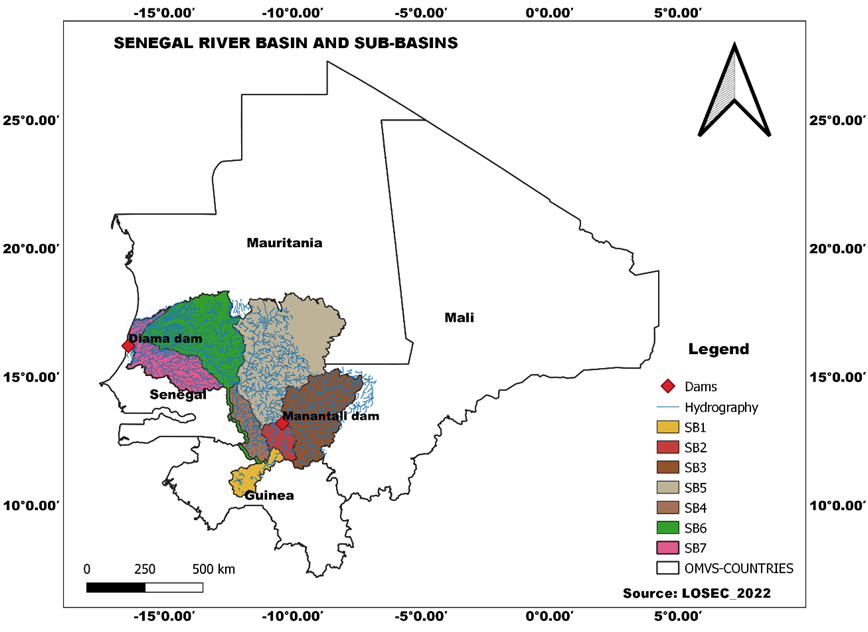
Following the hydrography of the SRB, a sub-basin approach has been implemented. The SRB is thus divided into 7 sub-basins (SB), to which is added the final part of the Senegal river between Diama and the ocean (Figure 1):
- SB1: The upstream Bafing to the Manantali dam;
- SB2: The downstream Bafing, from the Manantali dam to Bafoulabé, namely the confluence with the Bakoye, from which the SRB starts;
- SB3: From Bakoye to Bafoulabé (the confluence with the Bafing, from which the SRB starts);
- SB4: From Falémé to the confluence with the SRB;
- SB5: Senegal upstream from Bafoulabé to Bakel;
- SB6: The medium Senegal from Bakel to Podor;
- SB7: The Senegal downstream from Podor to the Diama dam.
Rainfall in-situ data from the SIEREM (Système d’Informations Environnementales sur les Ressources en Eau et leur Modélisation, http://www.hydrosciences.fr/sierem/) database are used. To test the reliability of these data, their consistency and quality are verified before the calculation of the monthly averages. When the daily value is greater than or equal to 2 mm, no correction is applied. Otherwise, if they are a lot of missing data (over several months for instance), the data for that year are deleted and replaced by "NaN". For some monthly time series, gaps in the driest months (December, January, and February) are filled with 0s.
Subsequently, for each sub-basin, a few stations that are homogeneously distributed have been selected:
• In SB1, 10 rainfall stations have been identified. However, for all the criteria mentioned above, only 2 (Dalaba and Sagabari) stations have been used.
• In the SB2, 5 stations have been identified, 3 of which had very little data (Dombia, Mahina, and Manantali). A focus is made particularly on the Kassama stations upstream and Bafoulabé at the outlet of the Bafing catchment area.
• In the SB3, 23 rainfall stations have been identified, but 4 (Diema, Faladye, Kita, and Oualia in the northern part of the Bakoye basin) have been considered.
• In the SB4, 14 stations have been identified and 3 (Guéné-Gore upstream of the basin, Gourbassi in the middle, and finally Kidira at the outlet, just before the confluence with the Senegal River) have been selected throughout the Falémé basin.
• In the SB5, 40 stations have been identified and 5 (Kiffa and Nioro du Sahel, Kayes, Bakel, and Diamou) representative stations for each tributary have been selected.
• In the SB6, 42 stations have been identified. But given the similarity of the basin from upstream to downstream, 3 stations (M'Bout, in the north, in the Mauritanian part; Matam, in the center of the river; and Boghé, downstream) have been selected.
• Finally, in the SB7, 16 stations have been identified, and among them, 3 stations (Linguère, Podor, and Saint-Louis Aéro) have been selected.
3.2. Climate ModelsClimate models are known to be subject to uncertainties related to chaotic processes inherent in the atmosphere and surface/atmosphere interactions. Therefore, instead of focusing on a single simulation that provides a single view of the evolution of the atmosphere, a Multi-Model-Mean (MMM) including several simulations (or members) is used. The MMM is based on 29 global climate simulations (ACCESS1-0, ACCESS1-3, bcc-csm1-1, bcc-csm1-1-m, BNU-ESM, CMCC-CMS, CanESM2, CMCC-CESM, CMCC-CM, CSIRO-Mk3-6-0, CNRM-CM5, GFDL-CM3, HadGEM2-AO, IPSL-CM5A-LR, MIROC-ESM, MPI-ESM-LR, MRI-ESM1, GFDL-ESM2G, HadGEM2-CC, IPSL-CM5A-MR, MIROC-ESM-CHEM, MPI-ESM-MR, NorESM1-M, inmcm4, GFDL-ESM2M, HadGEM2-ES, IPSL-CM5B-LR, MIROC5, MRI-CGCM3) Climate Model Intercomparison Project 5 (CMIP5, 10). It provides a probabilistic view that takes into account the uncertainties associated with the models.
For the projections, two greenhouse gas concentration scenarios (RCP4.5 and RCP8.5) from the Intergovernmental Panel on Climate Change (IPCC; https://www.ipcc.ch/) are used as two socio-economic scenarios. They correspond to radiative forcing of +4.5 and +8.5 W/sqm by 2100, leading to a global temperature increase of more than 2 and 4°C, respectively.
3.3. The bias CorrectionIn this study, the same correction method as 11 has been used. The simulated data for each station is obtained using the weighted bilinear interpolation method and the correction is applied to each station and to each time step (month i, year j of the reference period, year k of the period to which the correction is made). The corrected precipitation time series are constructed by combining the time series observed over the reference period with those simulated according to the following formula:
 | (1) |
where  is the average value of the series observed over the reference period,
  is the standard deviation of the series observed over the reference period, and
  is the difference between the precipitation representative of the reference period and the climate over the correction period. It is calculated using the following formula:
 | (2) |
where  is the simulated monthly value,
  is the average of the simulated series over the reference period,
  is the standard deviation of the simulated series over the reference period.
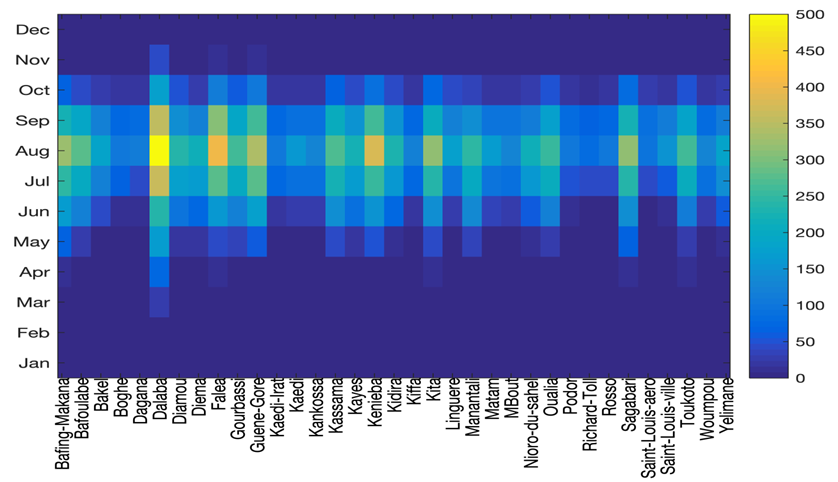
Figure 2 presents the rainfall annual cycles at 22 selected stations. These are the monthly averages of precipitation over the 12 months of the year at each station during the period 1975-2004. Figure 2 shows the different phases of the rainy season. The rainfall annual cycle is well represented in all selected stations. Rainfall averages from May to September with a maximum recorded in August.

Figure 2 also highlights the strong spatial distribution of rainfall in the SRB. For example, alongside stations in the South such as Dalaba, rainfall amount is very high with monthly totals averaging over 400 mm in August, whereas, there are stations (especially in the North such as Podor), where the maximum totals in August do not even reach 200 mm. For Dalaba, more than 200 mm is already observed in May. These stations’ data appear overall realistic. The climate in the SRB is marked by a strong rainfall gradient from semi-arid areas in the north to wetlands in the south, in the Fouta Djallon region where the river originates.
As mentioned in the previous sections, the MMM of the 29 CMIP5 simulations for precipitation has been used to minimize uncertainties. Overall averages of the rainfall climate series projected by the 29 climate models under the RCP4.5 and RCP8.5 greenhouse gas emission scenarios have been also produced. Furthermore, given the reliability problem associated with precipitation simulated by coupled climate models at the regional scale, it is recommended that bias correction be applied before using them for impact studies 12.
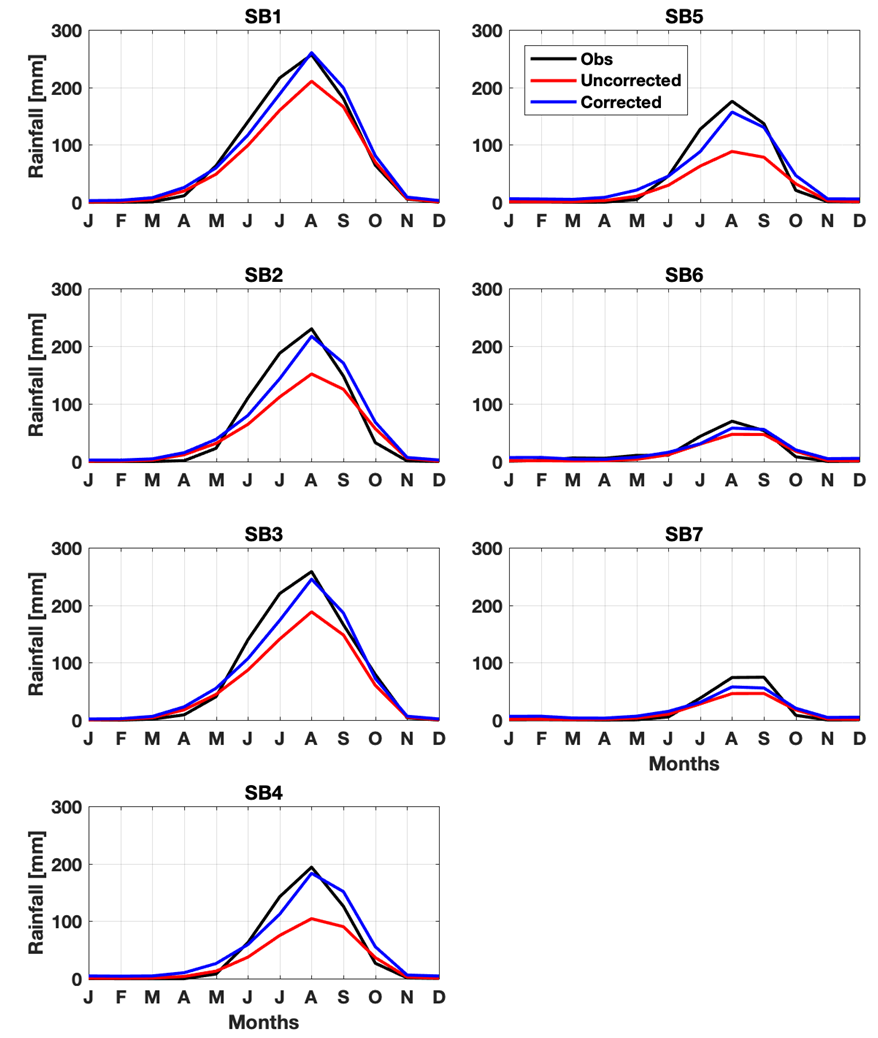
The correction has been first applied to the historical simulations (Figure 3). One can note that, without correction, even though that the simulated precipitations clearly reproduce the annual cycle, their appear very underestimated, compared to the observations, with biases that can go from 20 to 50 mm in August. Whereas with the correction, these biases are substantially reduced on all 7 sub-basins.
We subsequently applied the same correction to future projections (2011-2100). A monthly database of simulations of corrected precipitation projections (2011 to 2100) at the scale of the stations used in this study has been prepared for possible impact studies in this region.

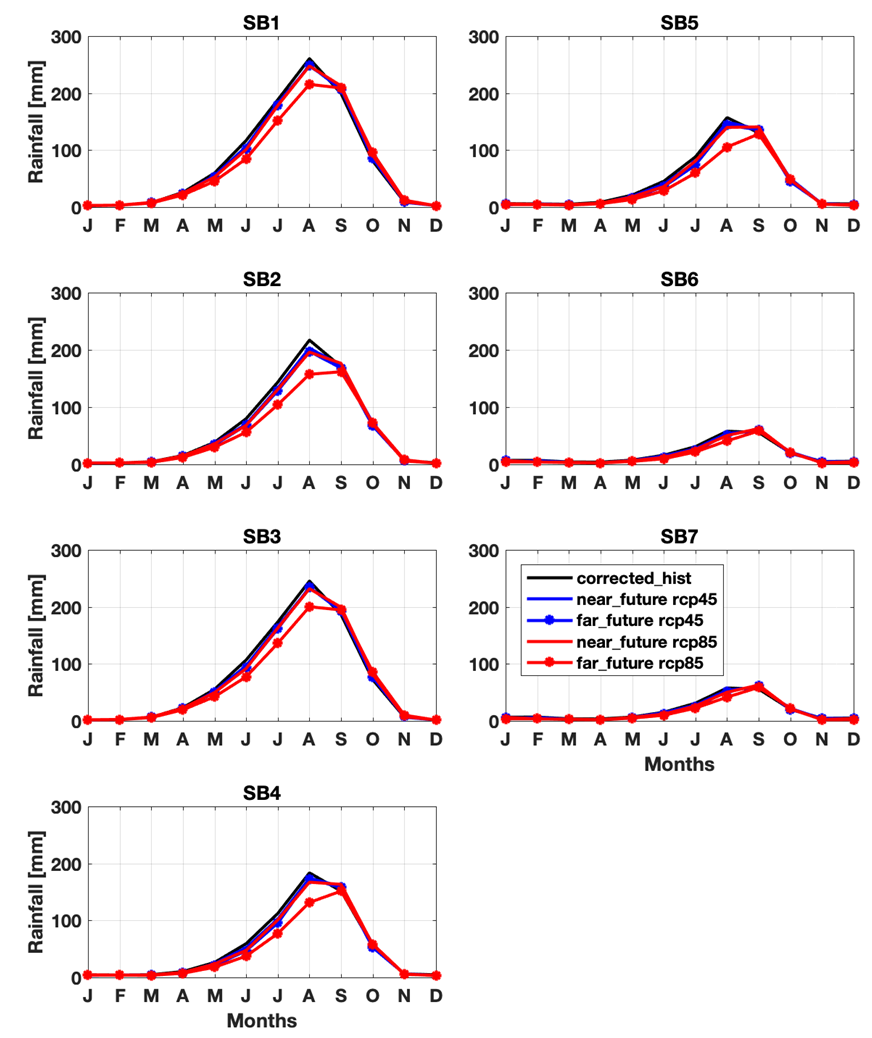
For an overview of the impact of climate change (CC) on rainfall in the SRB, we compared over each sub-basin, and with the scenarios RCP4.5 and RCP8.5, the annual cycle over the periods 2021-2050, and 2071-2100 to those over the reference period 1975-2004 (Figure 4). The results show that in contrast with temperatures where CC effects are felt very soon before 2050 (not shown), with rainfall until 2050, no considerable changes are found between scenarios RCP4.5 and RCP8.5 is observed. After 2050, while the annual cycle from the RCP4.5 remains almost unchanged, that from the RCP8.5 displays much more less amplitude during the pre-, and mature-monsoon phases (from May to August). These changes lead to the shift of the peak of the monsoon season from August to September, and they are more pronounced in SB3-7.

The strong discrepancy noted in these northern SBs (Sudan-Sahelian areas) can, be considered as a consequence of CC on rainfall annual cycle. The CC therefore, leads to a decrease in rainfall intensity during the monsoon's installation and maturation phases.
Using rainfall observation data and Climate Model Intercomparison Project 5 (CMIP5) climate simulations, current and future trends in the rainfall annual cycle in the Senegal River Basin (SRB) have been analyzed. The period 1975-2004 has been chosen as the reference period. It is a period that corresponds to a series of alternating droughts (1975-1990) and relative recovery (1990-2004). Over this period, and with in-situ observations, 29 CMIP5 climate models have been assessed and corrected. After corrections, the changes to the 2050 (2021-2050) and 2100 (2070-2099) time horizons have been analyzed based on the RCP4.5 and RCP8.5 scenarios.
Analyses show that climate change (CC) will significantly impact the rainfall annual cycle over the SRB. And this impact will be much greater after 2050. After 2050, a decrease of about 20% in rainfall intensity over the first phase of the monsoon season (May-August) is noted with the scenario RCP8.5, compared to less than 10% with scenario 4.5. This will cause the monsoon peak to shift from August to September and the least humid SBs (SB 3-7) will be the most affected by this change. Thus, based on the probabilistic relationship established between rainfall and inflows, this 10 to 20% decrease in rainfall could lead to an average decrease of 40% in inflows. Inhabitants of the Bakoye basin (SB3) would be the most affected with decreases of up to 80% by 2100. This situation that will then prevail will be quite catastrophic.
These results show that it is also possible to imagine a very pessimistic scenario for the SRB, as mentioned in the Senegal National Adaptation Plan, in which a significant decrease in rainfall, in the order of 20-30%, is considered throughout Senegal.
The authors are grateful to the OMVS (Organisation pour la Mise en Valeur du fleuve Sénégal), the NERC/DFID Future Climate for Africa programme under the AMMA-2050 project (Grant NE/M020428/1), and to the reviewers whose remarks and critics contribute to the amelioration of the quality of this paper.
The authors declare no conflicts of interest regarding the publication of this paper.
| [1] | BODIAN, A., DACOSTA, H. and DEZETTER A. (2011). Caractérisation spatio-temporelle du régime pluviométrique du haut bassin du fleuve Sénégal dans un contexte de variabilité climatique Physio-Géo. Géographie physique et environnement, pp. 107-124. | ||
| In article | View Article | ||
| [2] | FAYE, C., SOW, A.A. and NDONG, J.B. (2015). Étude des sècheresses pluviométriques et hydrologiques en Afrique tropicale: caractérisation et cartographie de la sècheresse par indices dans le haut bassin du fleuve Sénégal. Physio-Géo - Géographie Physique et Environnement., 9, 17-35. | ||
| In article | View Article PubMed | ||
| [3] | MBAYE, M.L., HAGEMANN, S., HAENSLER, A., STACKE, T., GAYE, A.T. and AFOUDA, A. (2015). Assessment of Climate Change Impact on Water Resources in the Upper Senegal Basin (West Africa), Am. J. Clim. Change, 4, 77-93. | ||
| In article | |||
| [4] | BODIAN, A., DEZETTER, A., DIOP, L., DEME, A., DJAMAN, K. and DIOP, A. (2018). Future climate change impacts on streamflows of two main West Africa river Basins: Senegal and Gambia. Hydrology 5 (1), 21. | ||
| In article | View Article | ||
| [5] | BRATH, A., MONTANARI, A. and MORETTI, G. (2006). Assessing the effect on flood frequency of land use change via hydrological simulation (with uncertainty) J. Hydrol., 324, pp. 141-153. | ||
| In article | |||
| [6] | ELMER, F., HOYMANN, J., DÜTHMANN, D., VOROGUSHYN, S. and KREIBICH, H. (2012). Drivers of flood risk change in residential areas Nat. Hazards Earth Syst. Sci., 12, pp. 1641-1657. | ||
| In article | View Article | ||
| [7] | NEIMAN, P.J., RALPH, F.M., WHITE, A.B., KINGSMILL, D.E. and PERSSON, P.O.G (2002). The statistical relationship between upslope flow and rainfall in California's coastal mountains: Observations during CALJET. Monthly Weather Review, 130(6), 1468-1492. | ||
| In article | View Article | ||
| [8] | MIKHAILOV, V.N., ISUPOYA, M.V. (2008). Hypersalinization of river estuaries in West Africa. Water Resour. 35,367-385. | ||
| In article | View Article PubMed | ||
| [9] | MBAYE, M.L., SYLLA, M.B. and TALL, M. (2019). Impacts of 1.5 and 2.0°C Global Warming on Water Balance Components over Senegal in West Africa. Atmosphere 2019, 10, 712. | ||
| In article | View Article | ||
| [10] | TAYLOR, K.E., STOUFFER, R.J. and MEEHL, G.A. (2012). An Overview of Cmip 5 and the Experiment Design, B. Am. Meteorol. Soc., 93, 485-498. | ||
| In article | View Article | ||
| [11] | ARDOIN-BARDIN, S., DEZETTER, A., SERVAT, E., MAHE, G., PARTUREL, J.E., DIEULIN, C., and L. Casenave (2005). Évaluation des impacts du changement climatique sur les ressources en eau d’Afrique de l’Ouest et Centrale. AISH Scientific Assembly: Symposium S6: Regional Hydrological Impacts of Climatic Change: Hydroclimatic Variability, 7., Foz do Iguaçu (BRA), 2005/04. | ||
| In article | |||
| [12] | CASENAVE, L. (2004). Hydro-climatic variability, comparison of results from some Global Circulation Models applied for western Africa, Master’s thesis, Chalmers University, February 2004, 56p. | ||
| In article | View Article | ||
Published with license by Science and Education Publishing, Copyright © 2022 Moussa Diakhaté, Mamadou Lamine Mbaye, Ibrahima Camara and Mamadou Baïlo Barry
 This work is licensed under a Creative Commons Attribution 4.0 International License. To view a copy of this license, visit
http://creativecommons.org/licenses/by/4.0/
This work is licensed under a Creative Commons Attribution 4.0 International License. To view a copy of this license, visit
http://creativecommons.org/licenses/by/4.0/
| [1] | BODIAN, A., DACOSTA, H. and DEZETTER A. (2011). Caractérisation spatio-temporelle du régime pluviométrique du haut bassin du fleuve Sénégal dans un contexte de variabilité climatique Physio-Géo. Géographie physique et environnement, pp. 107-124. | ||
| In article | View Article | ||
| [2] | FAYE, C., SOW, A.A. and NDONG, J.B. (2015). Étude des sècheresses pluviométriques et hydrologiques en Afrique tropicale: caractérisation et cartographie de la sècheresse par indices dans le haut bassin du fleuve Sénégal. Physio-Géo - Géographie Physique et Environnement., 9, 17-35. | ||
| In article | View Article PubMed | ||
| [3] | MBAYE, M.L., HAGEMANN, S., HAENSLER, A., STACKE, T., GAYE, A.T. and AFOUDA, A. (2015). Assessment of Climate Change Impact on Water Resources in the Upper Senegal Basin (West Africa), Am. J. Clim. Change, 4, 77-93. | ||
| In article | |||
| [4] | BODIAN, A., DEZETTER, A., DIOP, L., DEME, A., DJAMAN, K. and DIOP, A. (2018). Future climate change impacts on streamflows of two main West Africa river Basins: Senegal and Gambia. Hydrology 5 (1), 21. | ||
| In article | View Article | ||
| [5] | BRATH, A., MONTANARI, A. and MORETTI, G. (2006). Assessing the effect on flood frequency of land use change via hydrological simulation (with uncertainty) J. Hydrol., 324, pp. 141-153. | ||
| In article | |||
| [6] | ELMER, F., HOYMANN, J., DÜTHMANN, D., VOROGUSHYN, S. and KREIBICH, H. (2012). Drivers of flood risk change in residential areas Nat. Hazards Earth Syst. Sci., 12, pp. 1641-1657. | ||
| In article | View Article | ||
| [7] | NEIMAN, P.J., RALPH, F.M., WHITE, A.B., KINGSMILL, D.E. and PERSSON, P.O.G (2002). The statistical relationship between upslope flow and rainfall in California's coastal mountains: Observations during CALJET. Monthly Weather Review, 130(6), 1468-1492. | ||
| In article | View Article | ||
| [8] | MIKHAILOV, V.N., ISUPOYA, M.V. (2008). Hypersalinization of river estuaries in West Africa. Water Resour. 35,367-385. | ||
| In article | View Article PubMed | ||
| [9] | MBAYE, M.L., SYLLA, M.B. and TALL, M. (2019). Impacts of 1.5 and 2.0°C Global Warming on Water Balance Components over Senegal in West Africa. Atmosphere 2019, 10, 712. | ||
| In article | View Article | ||
| [10] | TAYLOR, K.E., STOUFFER, R.J. and MEEHL, G.A. (2012). An Overview of Cmip 5 and the Experiment Design, B. Am. Meteorol. Soc., 93, 485-498. | ||
| In article | View Article | ||
| [11] | ARDOIN-BARDIN, S., DEZETTER, A., SERVAT, E., MAHE, G., PARTUREL, J.E., DIEULIN, C., and L. Casenave (2005). Évaluation des impacts du changement climatique sur les ressources en eau d’Afrique de l’Ouest et Centrale. AISH Scientific Assembly: Symposium S6: Regional Hydrological Impacts of Climatic Change: Hydroclimatic Variability, 7., Foz do Iguaçu (BRA), 2005/04. | ||
| In article | |||
| [12] | CASENAVE, L. (2004). Hydro-climatic variability, comparison of results from some Global Circulation Models applied for western Africa, Master’s thesis, Chalmers University, February 2004, 56p. | ||
| In article | View Article | ||