The increasingly intertwined world of technology and science and in the context of scientific and technological development, we are challenged to create an education system that can contribute to the production of human resources capable of helping to build a knowledge-conscious social and economic order in accordance with human needs of the 21st century. Furthermore, formal education at all levels, faces the great challenge of preparing students for the forthcoming era of a new revolution. This research is aimed to assess the Pre-service teachers’ competencies in exploring the 21st century world. Employing an adopted questionnaire in a descriptive type of research, the respondents’ competencies in exploring the 21st century world were determined and evaluated. Results showed that BEED III respondents’ skills are habitually improved however BEED IV continuously enhanced their skills. Furthermore, sex have an impact on the 21st century skills of the respondents. Moreover, age and ethnic affiliation of third year group have an impact however ethnic affiliation of fourth year group have an influence on the skills of the respondents. Likewise, the 21st century skills of the junior and fourth year group is significantly related to their socio- demographic profile. Implications to theory, practice and policy, since junior respondents are still on the process of developing their skills, training on enhancement skills is necessary. Identify opportunities in teacher exchange programs for the development of world-class teacher. Social constructivism for learning is used in the development of the Flipped Learning teaching model and social development for learning takes place within some socio-cultural setting.
The increasingly intertwined world of technology and science and in the context of scientific and technological development, we are challenged to create an education system that can contribute to the production of human resources capable of helping to build a knowledge-conscious social and economic order in accordance with human needs of the 21st century 1. In line with Wijaya's research, Sudjimat and Nyoto who explained that one of the real challenges of the impact of the globalization era is education should be able to produce human resources that have complete competence, known as 21st century competencies 2.
Durkheim 3 asserts that the education system works as a “methodological socialization of the younger generation.” Education in the twenty-first century is expected to prepare learners to address the challenges of the rapid pace of economic, social, environmental, and technological change being experienced in the world. Afandi and Sajidan explained that the quality of the quality learning process and assessment must be in line with the 21st century teacher competence 4.
Teacher education institutions thus need to foster competencies, skills, values and practices such as critical thinking, creativity, communication, respect for diversity, adaptability, entrepreneurship and innovation in the training and supervision of upcoming teachers. As noted by Education for All 5, teacher education is a critical factor in the achievement of Education for All (EFA) which emphasizes the acquisition of the ‘transversal competencies’ or ‘twenty-first century skills’ also referred to as ‘non-cognitive skills’ and ‘non-academic skills. Schools are now situated in rapidly changing contexts of multiculturalism, higher levels of moral pluralism than ever before, and yet increasing individuality, which raises questions of authenticity and hence relevance of the trainings based on own historical experiences 6
The role and task of the teacher to provide a learning environment that enables the development of the potential of students in order to obtain knowledge and attributes of higher-level thinking should be the core in classroom learning 7.
In addition to the knowledge, the students gain relevant skills for optimum functioning in the 21st century (21st century skills); teaching is adapted to the diversity of the students, breaks down barriers between the school and the outside world, while making maximum, yet enlightened, use of technology to promote the teaching processes, both at the pedagogical level and at the pedagogical management level. The 21st century teacher is highly collaborative, a lifelong learner, is accountable for results and is information, media and technology literate.
The OECD also maps the 16 skills needed in the 21st century that are divided into three groups, namely basic literacy, competence, and character quality 8. Zubaidah also provides a map of 21st century skills to the world of work that requires personal skills (having initiative, tenacity, responsibility, risk taking, and creative), social skills (working in teams, having networks, having empathy and compassion), and learning skills (managing, organizing, metacognitive skills, and not easily discouraged or changing perspectives in the face of failure) 9.
World professionals through the projection of 21st Century skills have long conceptualized, identified, defined, predicted and described the skills that can withstand the demands of globalization in changing times. One of the reference frameworks of 21st century skills that the world's most adapted worlds belong to is the US-based Partnership for 21st Century Learning (P21) which translates into (1) life and career skills, (2) learning and innovation skills and (3) information media and technology skills. 21st Century skills are not taught individually but are integrated with various disciplines 10. Various countries have actualized 21st century skills into their country's education system. One of the secondary education syllabus guides in Singapore, known as the Education and Career Guidance (ECG) Syllabus Secondary, this guide provides an illustration that students with secondary productive age in the country really need to increase awareness of the skills, knowledge and attitudes needed to make a successful transition from school to further study and work 11. This allows students to examine and identify their skills and talents and students will be encouraged to explore various educational opportunities and career paths (life career skills) 11.
The US-based Framework for 21st Century Skills Partnership for 21st Century Learning (P21) describes Life and Career skills or 21st Century LCS into several dimensions, including; (a) Flexibility and Adaptability, (b) Initiative and Self-Direction, (c) Social and Cross-Cultural Interaction, (d) Productivity and Accountability and (e) Leadership and Responsibility 12. Broadly speaking, learning materials are integrated into two parts, namely the theory delivered in the classroom, and the practice carried out in the workshop. If viewed from the relationship of how far the consistency of education units in actualizing the learning process in productive subjects according to the rules of the 21st century. Hence, the study emphasized on the Pre- Service teachers’ competencies in exploring the 21st century world.
This Descriptive Research design was used in this study. This research design fits best in studies which aim is to describe the nature of situations while the study has been done and afforded by the respondents. It described the level of 21st century skills and socio-demographic profile. The variable was analyzed in relation to selected variables such as year level, sex, age, civil status, and ethnic affiliation. With this method the level of 21st century skills and socio-demographic profile was determined.
This research was conducted at the College of Teacher Education of Quirino State University, Diffun Campus, School Year 2015-2016. A total of 112 respondents were determined using the software G-Power. The respondents were the Bachelor of Elementary Education (BEEd) students. Stratified sampling was used.
Data were inputted into the Statistical Package for Social Science (SPSS) program for accuracy on the statistical computations. The tables generated from the program were then be analyzed and interpreted which served as basis in coming up with the conclusions and recommendations.
For the purpose of analyzing the result of the research, the following statistics will be used: G-Power; Frequency counts and percentages; Mean; t-test; F- test or Analysis of Variance (ANOVA).
The respondents’ 21st century skills on global education. It can be said that BEED III frequently used the skills while BEED IV constantly used the skills for global education. It could be concluded that the BEED III respondents’ skills are habitually improve however BEED IV continuously improve their skills.
Furthermore, it was claimed that developing the capacity of pre-service teachers as well as their competency for inclusive practices is challenging 13.
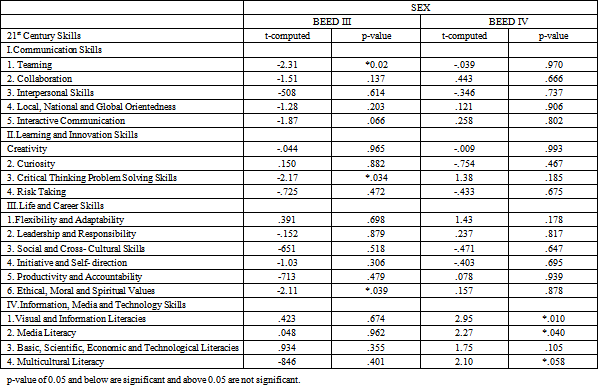
Results in the foregoing table shows that the respondents’ 21st century skills on education by profile. It can be thought that sex have an impact on teaming, critical thinking problem solving, skills for living in the world: ethical, moral and spiritual values are essential skills for the junior group. Nevertheless, visual and information, media and multicultural literacy are also necessary skills for senior group. Critically analyzes and evaluates information derived from various sources and collaborates and interrelates with others from all walks of life 14, 15, 16.
Corollary to the foregoing results is the notion that “STEM education is an interdisciplinary education model that helps students apply scientific, technological, technical and mathematical knowledge to solve some practical problems in a specific context” 17
Some researchers describe the fresh students as “digital natives”, “millennial students” 18, 19 Pupils intermingle and associate 24/7 with other learners with the help of social media. Many young learners prefer to study though the web and are accountable for their learning activities. They also prefer to use electronic devices for the sake of education 19, 20, 21.
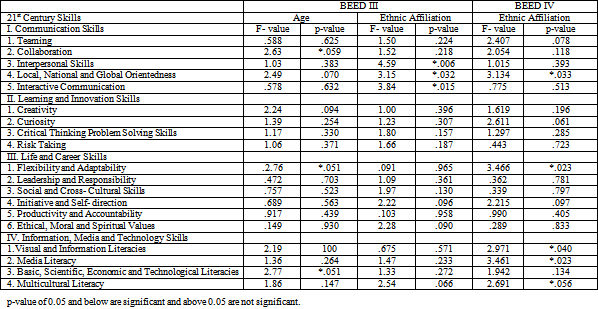
The foregoing table shows the respondents’ 21st century skills for education by profile. It can be believed that age and ethnic affiliation of third year group have an impact on collaboration, interpersonal, local, national and global orienteers, interactive communication, flexibility and adaptability, basic, scientific, economic and technological literacies. However ethnic affiliation of fourth year group has an influence on local, national and global orienteers, flexibility and adaptability, visual and information, media and multicultural literacy. As postulated in the learning theories, use appropriate technology to: communicate, solve problems, access, manage, integrate, evaluate, design and create information to improve learning in all subject areas and acquire lifelong knowledge and skills in the 21st century 22, 23, 24.
Aptly, it was claimed that supervision is a strategy in which professional support is offered to the teacher trainee; it is incumbent upon the supervisors to support and make the student teachers realize the whole exercise of supervision is to support them in their efforts to acquire pedagogical skills 25
Implicitly, the supervision process should offer both the student teacher and the supervisor the opportunity to work together to improve learners’ performance through enhancing the pedagogical skills and competencies of the student teacher 25, 26
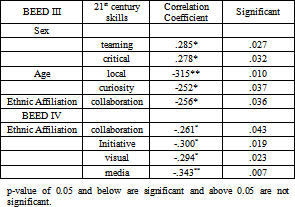
Results in the foregoing table show that there is substantial implication between level of 21st century skills and socio- demographic profile between junior and fourth year group for education.
The 21st century teacher and learner is highly collaborative, a lifelong learner, is accountable for results and is information, media and technology literate 14, 15, 16.
The integration of these online facilities creates a technology-based instruction as a way of enriching the educative process to be more integrative through synchronous and asynchronous e-learning modalities 25, 26.
Based on the results of the study, the following are drawn:
1. BEED III respondents’ skills are habitually improved however BEED IV continuously enhanced their skills.
2. Sex have an impact on the 21st century skills of the respondents.
3. Age and ethnic affiliation of third year group have an impact however ethnic affiliation of fourth year group have an influence on the skills of the respondents.
4. The 21st century skills of the junior and fourth year group is significantly related to their socio- demographic profile.
Implications to Theory and Practice
The results and conclusions of this study yield the following important implications for theory, practice and policy.
1. Since junior respondents are still on the process of developing their skills, it is strongly recommended that training on enhancement skills be proposed.
2. Identify opportunities in teacher exchange programs for the development of world-class teacher
3. Multicultural diversity to address the global standards for education set by United Nations.
4. Expand early childhood care education.
5. Provide educational access to all types of learners all over the world.
6. 21st century teacher is highly collaborative.
7. National boarders are opened.
8. Increase fluency in foreign language.
9. Offers new curricular dimensions
10. Contemporary curricula.
11. Social constructivism for learning are used in the development of the Flipped Learning teaching model.
12. Social development for learning takes place within some socio-cultural setting.
| [1] | Badan Standar Nasional Pendidikan, Paradigma Pendidikan Lembar Peluang dan Tantangan Pendidikan Abad XXI, Jakarta. 2010 No. 20. | ||
| In article | |||
| [2] | Wijaya, Etistika, Y., Sudjimat, Dwi, A., Nyoto, Amat. 2016. “Transformasi Pendidikan Abad-21 Sebagai Tuntutan Pengembangan Sumber Daya Manusia di Era. | ||
| In article | |||
| [3] | Durkheim, E. Education and sociology (S. Fox, trans.). New York: Free Press. 1956. | ||
| In article | |||
| [4] | Afandi dan Sajidan. “Stimulasi Keterampilan BerpikirTingkat Tinggi”. Surakarta: UNS Press, 2017. | ||
| In article | |||
| [5] | Education for All. Education for All Global Monitoring Report 2008: Education for all by 2015. Will we make it? Oxford University Press, 2007. | ||
| In article | |||
| [6] | Kjellin, M. S., Månsson, N., & Vestman, O. K. “Values in Student Teachers' Educational Practice.” Research in Higher Education Journal, 4(1). 2009. | ||
| In article | |||
| [7] | Afandi dan Sajidan. “Stimulasi Keterampilan Berpikir Tingkat Tinggi”. Surakarta: UNS Press, 2017. | ||
| In article | |||
| [8] | OECD. Skills Matter: Further Results from the Survey of Adult Skills, OECD Skills Studies, OECD Publishing, Paris, 2016. | ||
| In article | |||
| [9] | Zubaidah, S. “Keterampilan Abad ke-21: Keterampilan Yang Diajarkan Melalui Pembelajaran.” Tantangan Biologi Dan Pendidikan Biologi Abad-21. Proseeding Research Gate. 2. Malang, 2016. | ||
| In article | |||
| [10] | Saavedra, A., & Opfer, V. “Teaching and Learning 21st Century Skills: Lesson from the Learning Science. A Global Cities Education Network Report”. New York: Asia Society. 2012, 12. | ||
| In article | |||
| [11] | Education and Career Guidance (ECG). Education and Career Guidance (ECG) Syllabus Secondary Implementation starting with 2014 Secondary Cohort (All levels). Singapore: Ministry of Education, Singapore, 2014, 1. | ||
| In article | |||
| [12] | Trilling, B., & Fadel, C. “21st Century Skills: Learning For Life In Our Times.” Edited by Calif, Bass Jossey-, Wiley John and Sons. San Francisco, 2009. | ||
| In article | |||
| [13] | Specht, J. (2016a). “Pre-service teachers and the meaning of inclusion.” Journal of Research in Special Educational Needs, 2016, 16, 894-895. | ||
| In article | View Article | ||
| [14] | Bilbao, Purita P. et, al, The Teaching Profession, Lorimar Publishing Inc., 2010. | ||
| In article | |||
| [15] | Corpuz, Brenda B., The Teaching Profession, Lorimar Publishing Inc., 2010. | ||
| In article | |||
| [16] | Salandanan, Gloria G., The Teaching Profession, Lorimar Publishing Inc., 2010. | ||
| In article | |||
| [17] | Nguyen Van Bien, Tuong Duy Hai (co-editor), Tran Minh Duc, Nguyen Van Hanh, Chu Cam Tho, Nguyen Van Thuan, Doan Van Thuc, Tran Ba Trinh (2019), STEM Education in secondary schools, Houses Vietnam Education Publishing House, Hanoi. | ||
| In article | |||
| [18] | Dede, C. (2005). Planning for neo-millennial learning styles. EDUCAUSE Quarterly, 28 (1), 7-12. | ||
| In article | |||
| [19] | Ubachs, G., Konings, L., & Brown, M. (Eds.) (2017). The Envisioning Report for Empowering Universities. Maastricht, NL: EADTU. | ||
| In article | |||
| [20] | Guri-Rosenblit, S. (2018). E-Teaching in Higher Education: An Essential Prerequisite for E-Learning. Journal of New Approaches in Educational Research, 7(2), PP. 93-97. | ||
| In article | View Article | ||
| [21] | Pappas, C. (2017). Eight best practices to create learner-centered eLearning courses. E-Learning Industry. https://elearningindustry.com/millenial-learning-needs-3-reasons-not-ignore. | ||
| In article | |||
| [22] | Beach, D. M., & Reinhartz, J. Supervisory leadership: focus on instruction. Boston: Allyn and Bacon. 2000. | ||
| In article | |||
| [23] | Deppeler, J., Loreman, T., & Smith, R. “Teaching and learning for all.” In J. Deppeler, T. Loreman, R. Smith, & L. Florian. (Eds.), Inclusive pedagogy across the curriculum. International perspectives on inclusive education. 2015, 7, pp. 1-10). London: Emerald Group Publishing. | ||
| In article | View Article | ||
| [24] | Paliokosta, P & Blandford, S. “Inclusion in school: a experience?” 2010. | ||
| In article | |||
| [25] | Bautista, R.G. (2013). The reciprocal determinism of online scaffolding in sustaining a community of inquiry in Physics. Journal of Technology and Science Education (JOTSE), 3(2), 89-97. | ||
| In article | View Article | ||
| [26] | Rodrigo, M.M.T. (2013). Information and communication technology use in Philippine public and private schools. Ateneo de Manila University. http://curry.ateneo.net/didith/2001ICTUse.pdf. | ||
| In article | |||
Published with license by Science and Education Publishing, Copyright © 2021 Eleanor G. Garingan
 This work is licensed under a Creative Commons Attribution 4.0 International License. To view a copy of this license, visit
http://creativecommons.org/licenses/by/4.0/
This work is licensed under a Creative Commons Attribution 4.0 International License. To view a copy of this license, visit
http://creativecommons.org/licenses/by/4.0/
| [1] | Badan Standar Nasional Pendidikan, Paradigma Pendidikan Lembar Peluang dan Tantangan Pendidikan Abad XXI, Jakarta. 2010 No. 20. | ||
| In article | |||
| [2] | Wijaya, Etistika, Y., Sudjimat, Dwi, A., Nyoto, Amat. 2016. “Transformasi Pendidikan Abad-21 Sebagai Tuntutan Pengembangan Sumber Daya Manusia di Era. | ||
| In article | |||
| [3] | Durkheim, E. Education and sociology (S. Fox, trans.). New York: Free Press. 1956. | ||
| In article | |||
| [4] | Afandi dan Sajidan. “Stimulasi Keterampilan BerpikirTingkat Tinggi”. Surakarta: UNS Press, 2017. | ||
| In article | |||
| [5] | Education for All. Education for All Global Monitoring Report 2008: Education for all by 2015. Will we make it? Oxford University Press, 2007. | ||
| In article | |||
| [6] | Kjellin, M. S., Månsson, N., & Vestman, O. K. “Values in Student Teachers' Educational Practice.” Research in Higher Education Journal, 4(1). 2009. | ||
| In article | |||
| [7] | Afandi dan Sajidan. “Stimulasi Keterampilan Berpikir Tingkat Tinggi”. Surakarta: UNS Press, 2017. | ||
| In article | |||
| [8] | OECD. Skills Matter: Further Results from the Survey of Adult Skills, OECD Skills Studies, OECD Publishing, Paris, 2016. | ||
| In article | |||
| [9] | Zubaidah, S. “Keterampilan Abad ke-21: Keterampilan Yang Diajarkan Melalui Pembelajaran.” Tantangan Biologi Dan Pendidikan Biologi Abad-21. Proseeding Research Gate. 2. Malang, 2016. | ||
| In article | |||
| [10] | Saavedra, A., & Opfer, V. “Teaching and Learning 21st Century Skills: Lesson from the Learning Science. A Global Cities Education Network Report”. New York: Asia Society. 2012, 12. | ||
| In article | |||
| [11] | Education and Career Guidance (ECG). Education and Career Guidance (ECG) Syllabus Secondary Implementation starting with 2014 Secondary Cohort (All levels). Singapore: Ministry of Education, Singapore, 2014, 1. | ||
| In article | |||
| [12] | Trilling, B., & Fadel, C. “21st Century Skills: Learning For Life In Our Times.” Edited by Calif, Bass Jossey-, Wiley John and Sons. San Francisco, 2009. | ||
| In article | |||
| [13] | Specht, J. (2016a). “Pre-service teachers and the meaning of inclusion.” Journal of Research in Special Educational Needs, 2016, 16, 894-895. | ||
| In article | View Article | ||
| [14] | Bilbao, Purita P. et, al, The Teaching Profession, Lorimar Publishing Inc., 2010. | ||
| In article | |||
| [15] | Corpuz, Brenda B., The Teaching Profession, Lorimar Publishing Inc., 2010. | ||
| In article | |||
| [16] | Salandanan, Gloria G., The Teaching Profession, Lorimar Publishing Inc., 2010. | ||
| In article | |||
| [17] | Nguyen Van Bien, Tuong Duy Hai (co-editor), Tran Minh Duc, Nguyen Van Hanh, Chu Cam Tho, Nguyen Van Thuan, Doan Van Thuc, Tran Ba Trinh (2019), STEM Education in secondary schools, Houses Vietnam Education Publishing House, Hanoi. | ||
| In article | |||
| [18] | Dede, C. (2005). Planning for neo-millennial learning styles. EDUCAUSE Quarterly, 28 (1), 7-12. | ||
| In article | |||
| [19] | Ubachs, G., Konings, L., & Brown, M. (Eds.) (2017). The Envisioning Report for Empowering Universities. Maastricht, NL: EADTU. | ||
| In article | |||
| [20] | Guri-Rosenblit, S. (2018). E-Teaching in Higher Education: An Essential Prerequisite for E-Learning. Journal of New Approaches in Educational Research, 7(2), PP. 93-97. | ||
| In article | View Article | ||
| [21] | Pappas, C. (2017). Eight best practices to create learner-centered eLearning courses. E-Learning Industry. https://elearningindustry.com/millenial-learning-needs-3-reasons-not-ignore. | ||
| In article | |||
| [22] | Beach, D. M., & Reinhartz, J. Supervisory leadership: focus on instruction. Boston: Allyn and Bacon. 2000. | ||
| In article | |||
| [23] | Deppeler, J., Loreman, T., & Smith, R. “Teaching and learning for all.” In J. Deppeler, T. Loreman, R. Smith, & L. Florian. (Eds.), Inclusive pedagogy across the curriculum. International perspectives on inclusive education. 2015, 7, pp. 1-10). London: Emerald Group Publishing. | ||
| In article | View Article | ||
| [24] | Paliokosta, P & Blandford, S. “Inclusion in school: a experience?” 2010. | ||
| In article | |||
| [25] | Bautista, R.G. (2013). The reciprocal determinism of online scaffolding in sustaining a community of inquiry in Physics. Journal of Technology and Science Education (JOTSE), 3(2), 89-97. | ||
| In article | View Article | ||
| [26] | Rodrigo, M.M.T. (2013). Information and communication technology use in Philippine public and private schools. Ateneo de Manila University. http://curry.ateneo.net/didith/2001ICTUse.pdf. | ||
| In article | |||