The article has analyzed the importance of productive health education and its goals, contents, methods and forms of this education for students of high schools. The authors have employed a survey to investigate the current situation of productive health education for high school students in the Norther Central of Vietnam. Data collected from the research have been analyzed statistically, thus are highly reliable, which creates a solid foundation for these following suggestions and recommendations: (1) increase the awareness of teachers, students and relevant stakeholders about the significance of productive health education for students at high school; (2) Renovating the content, methods, and forms of productive health education to meet the requirements in terms of psychology and personalities of high school students and specific conditions of each school; (3) Fostering the competence of teachers at high schools, especially the capacity of teaching productive health education; (4) Increasing investment into facilities and productive health education programs at high schools) to improve the effectiveness of reproductive health education for high school students in today's context.
Globalization and international integration have brought many opportunities and challenges for many countries, including Vietnam, especially in terms of culture, morality and lifestyle. In addition to many positive features that need to be learned, many harmful exotic cultures have been invading during the cultural assimilation, which has had a great impact on young people, especially students at high school. This has led to many teenagers and adolescences, including high school students, following a way of life in which monetary value plays the most important role. Consequently, there is an increase in the rate of abortion among female students, the rate of complications caused by pregnancy, and the rate of infection of sexually transmitted diseases, including HIV / AIDS. High school students are an age group that is undergoing strong physical and psychological changes. This is a very important period of an individual's life. The period marks an important milestone in the social development when students move out from the family to socialize with their groups of the same age, and develop new skills, prepare to become adults, lead responsible life.
Over the past years, reproductive health education for adolescents in general and high school students in particular has attracted the attention of the education sector and of socio-political organizations. However, due to the rapid development of modern society such as the 4.0 technology revolution, the trend of globalization and international integration, reproductive health education for students still remain many shortcomings. Many adolescent reproductive health issues remain unresolved, which becomes a challenge to the country's sustainable development, such as: the increasing rate of students' unwanted pregnancies, abortions and pre-married sexual intercourse. In particular, the population quality is still problematic issue which has significantly affected the quality of human resources needed for national development and international integration. Statistics of the General Department of Population and Family Planning in Vietnam in recent years show that early sex, unsafe sex, unwanted pregnancy and unsafe abortion, risk of sexually transmitted diseases and HIV infection among adolescents and young people tends to increase, especially in remote and isolated areas 5. This situation shows that gaps exist in the provision of reproductive health care and information to adolescents and adolescents, and many drawbacks exist in policies and programs on sex education and health education at high schools.
In this situation, reproductive health education has become extremely important and necessary. It becomes an urgent problem that society and educators need to pay attention to research and solve. That is the needs of adolescents and also the needs of modern society. Students in high schools, especially upper secondary schools, need to systematically access reproductive health education with a variety of goals and content, methods and forms in consistence with their characteristics. If this task is fulfilled, schools will be able to create solid conditions to implement the goal of the national population policies, and the goal that students will receive a holistic education at schools.
Reproductive health plays a significant role in personal wellbeing in general. According to WHO: Reproductive health is a state of complete physical, mental and social well-being and not merely the absence of disease or infirmity, in all matters relating to the reproductive system and to its functions and processes 8. According to who, reproductive health is one of human rights. People regardless of races have the right to access comprehensive reproductive health system, to be provided with information and services so that they are free to choose information and services ensure their well-being 8.
The International Conference on Population and Development (ICPD) in Cairo (Egypt) in 1994: "Sexual and mental health is considered the physical, mental and social well-being of all the features that relates to the functioning of the fertility system rather than the disease or disability of that machine. This means that everyone, male as well as female, has the right to receive information and enjoy safe and effective family planning services of their choice; to access to health care services, to ensure that a woman will undergo safe pregnancy and childbirth, which give couples the best chance of having a healthy baby" 9.
According to the Education Dictionary: "Education is a human-oriented activity through a system of impact and measures aimed at passing on knowledge and experience, skills and lifestyle training, fostering the necessary thoughts and ethics for the subject, helping to form and develop the capacity and qualities, personality in accordance with the purpose and objectives of preparing the subjects to participate in production labor and social life." [ 3, p.105]
From the above concept of education, it is possible to understand that fertility education for high school students is a purpose-based, planned process to help students have the right awareness of sexual health, thereby having the right attitude and behavior to achieve healthy state, in all aspects related to the fertility system, functions and processes of reproduction.
2.2. The Importance of Reproductive Health Education for High School Students in Today's ContextReproductive health education is one of the most important contents and tasks of comprehensive education of human personality in schools in general, especially in high school. High school students are in the middle and late stage of their adolescent period, they face many challenges and pressures, from education, to the perception of responsibility of an independent individual. Through productive health education, educational forces help children raise awareness, improve their capacity to make healthy, positive choices, have good coping skills with stimulation, attractiveness from negative pressures in life.
Productive health education for high school students is an urgent issue in the current context. This comes from the following reasons:
- Satisfy the requirement to equip students with skills to cope with the negative effects of globalization and the market economy
Globalization and international integration have brought many opportunities and challenges for many countries, including Vietnam, especially in terms of culture, morality and lifestyle. In addition to the civilized and positive features which needs to take after, the negative and unhealthy cultural elements are intruding, and having a great impact on young people, especially students in high school age. This has led to many youngsters today, including high school students, to turn to debauchery lifestyle. Consequently, this leads to the increase in abortion rates among young women, maternity accidents, sexually transmitted diseases, including HIV/AIDS increased. The current situation is many girls are at early puberty period but are not fully equipped with knowledge and understanding of productive health, so they do not know how to protect themselves agaisnt innate stimuli, or being sexually assaulted, abused by rapists.
- Help high school students have the skills to protect themselves, actively prevent harms from unsafe intercourses.
High school students are the age group in which they have not fully developed their personalities, they are sometime impertinent, receptive to new things, including positive and negative sides. They are desire to conquer, discover new things, including sexual discovery. They like to assert themselves, are subject to being easily exploited, provoked and manipulated by charlatans. On the other hand, because they are still lack of knowledge on reproductive health, especially self-protection skills, so they are easily affected trends of society, money-driven, and debauchery lifestyles. This is considered one of the causes of undesirable pregnancy at this age while not having adequate understanding of productive health. The lack of knowledge about adolescent productive health leads to some children contracting severe complications from abortion such as bleeding, inflammation, complications and even infertility. These are physical and mental pains. Not to mention, incompetence in knowledge of productive health is also the cause of infectious diseases such as inflammation, syphilis and HIV/AIDS.
High school students' reproductive health is directly related to the future of their race, to their development in both the present and the future. If reproductive health education for high school students is implemented properly, it will contribute to forming healthy behaviors, helping them to protect themselves, preserve and protect their health, thereby improving the quality of the nation's race.
- Meeting the requirements of socio-economic development and requirements for future human resources of the country
The quality of human resources is the decisive factor for the development of each country, in which teenagers are the future human resources of the country. The education of the youth generation is a vital issue in each country. Therefore, reproductive health for high school students has a close relationship with the country's future social development, qualifications and human resources. The Vietnam Population and Reproductive Health Strategy for the period 2011-2020 has clearly stated the point of view: “Financing the population and reproductive health care is a sustainable and effective investment which have a direct benefit on economic, social and environmental aspects” 4.
Thus, reproductive health education for high school students is a very important and urgent issue in the current context. To improve the effectiveness of reproductive health education for students at this age, it is necessary to have the right and appropriate content, method and form.
2.3. Reproductive Health Education For High School StudentsAccording to UNFPA, 10 the content of reproductive health education for adolescents in general and high school students in particular includes:
- Adolescent health: It is the body transformation, the signs and psychological development of the children such as: developing endocrine glands, developing chest, increasing height, changing voice, and the completion of reproductive organs ...
- Reproductive rights: Each child has the right to meet teachers, health staff members or communicators to receive information about reproductive health issues. They can go to a medical clinics or counseling center to inquire about reproductive health services. They have the right to be provided with safe medical examination and treatment, ensure their privacy which suit their needs and abilities.
- Pregnancy and prevention of unwanted pregnancies: Children need to be provided with knowledge and information about the mechanism of pregnancy, knowledge about the harmful effects of unwanted pregnancy and childbirth at teenage. From there, it is necessary to provide them with knowledge about safe sexual behaviors so that they have skills and responsibilities to prevent unwanted pregnancy.
- Contraceptive methods and the consequences of abortion: Abortion has a negative impact on the physical and psychological health of the children. Abortion will lead to many risks such as: perforation of the uterus, blood infection, infertility ..., even death. In the case of an unwanted pregnancy, forced abortion, it is necessary to advise the child to go to safe places such as a hospital, a child or mother protection service center or a maternity ward, where medical staff is specialized, and medical facilities are well-equipted.
- Prevention of genital infections and sexually transmitted diseases, the consequences of sexually transmitted diseases: Providing these knowledge helps children know how to avoid having sex, and to prevent sexual-transmitted diseases.
- Information, propaganda, sexual education, reproductive health consulting services, parent responsibility through mass media channels.
In addition, those who work in reproductive health education for high school students such as schools, families, counselors ... need to share with them problems about friendship and love. Reproductive health education must provide them with knowledge, understanding and skills to maintain their pure feelings with the opposite sex, not be attracted to sexual feelings, and take responsibility with their life and their friends.
2.4. Reproductive Health Education Methods and Forms for High School StudentsReproductive health education for high school students not only provides information and imparts knowledge but also educates them on developing their personality. Therefore, in parallel with the usual education measures, reproductive health education also requires a combination of education on personality, ethics and skill development. This requires teachers and managers to grasp the psychology of teenagers, their level of awareness, and their accessibility of educational content about reproductive health. Some commonly used methods in reproductive health education for high school students such as:
- Group of methods of forming consciousness and personal feelings: conversation, explanation, conversation. For example, the method of illustration combined with Q&A, and illustrations... from that, help students understand the knowledge of reproductive health and form the right attitudes and behaviors in conducting their activities, and how to behave in social relationships.
- Group of methods of organizing practical activities to form social behavior experiences for students: assigning, practicing, training. For example, educational methods through community intervention, fertility contests, theatricalization forms,...
- Group of methods to stimulate and regulate the behavior of students: emulation, example, reward. For example, the method of example, persuasion by exemplary, by the standard behavior of family members, teachers, friends or influential figures for their age.
Since the International Conference on Population and Development held in Cairo Egypt in 1994, 10 adolescent reproductive health particularly emphasized in the primary education program in high school by integrating it into the relevant subjects such as Biology, Geography, Citizen Education, Philology and extracurriculum activities 2. Each form has its own advantages in reproductive health education for students.
- Through the main subjects in the school
This type of education is considered favorable in helping children understand the knowledge in a full, systematic way. Currently, the contents of reproductive health education for high school students are integrated into 4 subjects: Biology, Geography, Citizen Education, Philology of the main curriculum. However, the effectiveness of implementing this integrated education method is not high due to the overload of the main subjects, the teachers themselves lack knowledge and skills and are not really open when talking about reproductive health issues.
- Through soft skills education for students: Soft skills education helps them behave confidently, proactively and improve their communication to solve their problems. This type of education also helps student maintain a healthy mental state which is expressed in the adaptable and positive behavior of everyday life.
- Through extracurriculum activities
The content of productive health education is very rich and diverse, containing many sensitive and delicate topics; therefore, it is difficult to present and exchange in a specific and clear way in the classroom environment. For these topics, it is necessary to have an appropriate environment and context for students to trust, express their understandings, views and concerns about relevant productive health issues. Therefore, productive health education for students through extracurricular activities is an effective, practical form of education, suitable for the psychology of teenagers. Extracurricular activities on sexual health can be organized in high school, depending on each topic, each student, size, scope of organization such as talks, competitions, club activities, direct counseling and community counseling ...- Guide students to search and exploit information about productive health through the Internet and other media
Currently, with the explosion of information and communication technology, the amount of knowledge and information about sexual health that students can receive is very tremendous, both positive and negative. Due to the immaturity, students like to explore themselves in discovering new things, especially issues related to gender, sex ... Therefore, educators should instruct students how to exploit, seek positive information about sexual health from this source, and know how to avoid harmful cultural flows affecting their perceptions and behaviors of sexual health. This is also considered an important form of productive health education for high school students in the context of the explosion of information and communication technology today.
2.5. Assessment of the Status of Productive Health Education for Students in High SchoolsIn order to understand the situation of productive health education for students in high schools, we conducted a survey of managers, teachers and students representing mountainous areas, regions and cities of the North Central region of Vietnam. The results are as follows:
- Survey results on the necessity of productive health education
We conducted a survey of high school students in rural, city and mountainous areas about the necessity of productive health education, the results of which are as follows:
The above results showed that students in all three areas had a rating of ≥ 67%, regarded fertility education is essential for themselves (Specifically, rural areas accounted for 67.5%, cities-towns 68.9%, mountainous areas: 67.0%). Meanwhile, the rating that productive health education is unnecessary is very low. Specifically, in rural areas 5.1% of students surveyed considered productive health education unnecessary, towns and cities only accounted for 0.7%, mountainous areas accounted 2.3%.
When surveying the reasons for why students considered productive health education necessary, most of them clearly see the benefits of the program (92,6%). For example, it helps students improve knowledge and skills about sexual health care, know how to behave when the body experience psychological changes at teenage, help them prevent the risks of affecting their own development. 74 out of 100 participants stated that they do not have the demand. Second, many student consider productive health education is one of the important factors affecting the physical, mental and future: 74.2% of the poll is in need, 25.8% of the poll is not in need. Meanwhile, not many students agreed upon the idea that productive health education is necessary just because it is a compulsory subject at school (8.4%), a majority (91,6%) of students agreed that the reasons come from their intrinsic need. Thus, the majority of students appreciate the need for reproductive health education because it is really useful for them, not just because it is a compulsory education program. They all recognize their own needs, and understand the role of reproductive health education.
When surveying the reasons why high school students consider reproductive health education necessary and crucial, we have obtained the following data:
Table 2 shows that: the majority of students believe that reproductive health education aims to: Help students improve their knowledge and skills in reproductive health care, know how to respond to psycho-physiological changes at high school age. Reproductive health education helps students to prevent the risk of affecting their own development (with 92.6% of the poll reporting yes); 7.4% reporting no). For the belief that reproductive health is one of the important factors affecting the physical, mental and future health: 74.2% of the poll reporting yes, 25.8% reporting no. Meanwhile, the rate of high school students saying that compulsoriness is the main factor for their need of reproductive health education maintains at low level, accounting for 8.4%. Thus, the majority of high school students highly appreciate the necessity of reproductive health education activities because it is really useful for them, not because of compulsory education. They all recognize their own needs, and understand the role of reproductive health education.
- Results of the survey on high school students' knowledge about reproductive health
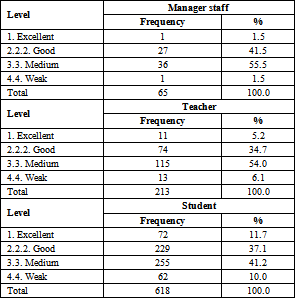
The results of the survey on students' understanding of reproductive health in Table 3 show that, majority of students having an average level of understanding about reproductive health education, 55.4% (educational managers' assessment), 54% (teachers 'assessment), 41.2% (students' assessment). Students having a good level of understanding accounts for 41.5% (managers' assessment) and 34.7% (teachers' assessment). Meanwhile, the good level of understanding accounts for 1.5% in the management staff and 5.2% in the teachers group. For students who self-assessed themselves, a poor level of understanding was 11.7%, most of them only achieving an average level of 41.2%. The above data indicate that students' general understanding of reproductive health remains low.
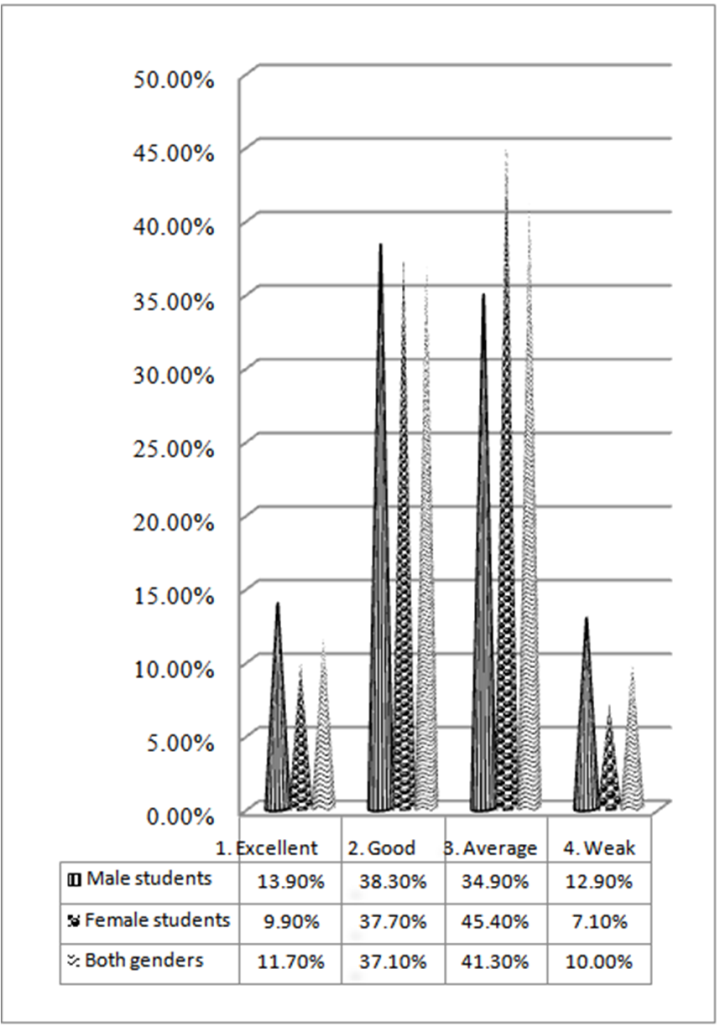
On that basis, we also survey students' understanding of reproductive health according to genders. The results show that the there is a significant gap between the two classes of students. In particular:
The data show that the level of excellent and good understanding among male students is much higher than that of girls, among males: 13.9% at excellent level, 38.3% at good level, while 9.9% of females are at excellent level, 37.7% of good level. Thus, male students have a better understanding of reproductive health than female students. This situation may also be due to the fact that male students are more open to reproductive health issues, they do not have much psychological problems as female students, so they can look up information, exchange, and share with friends about issues related to gender and reproductive health.
- Results of the survey on students' attitudes towards reproductive health issues
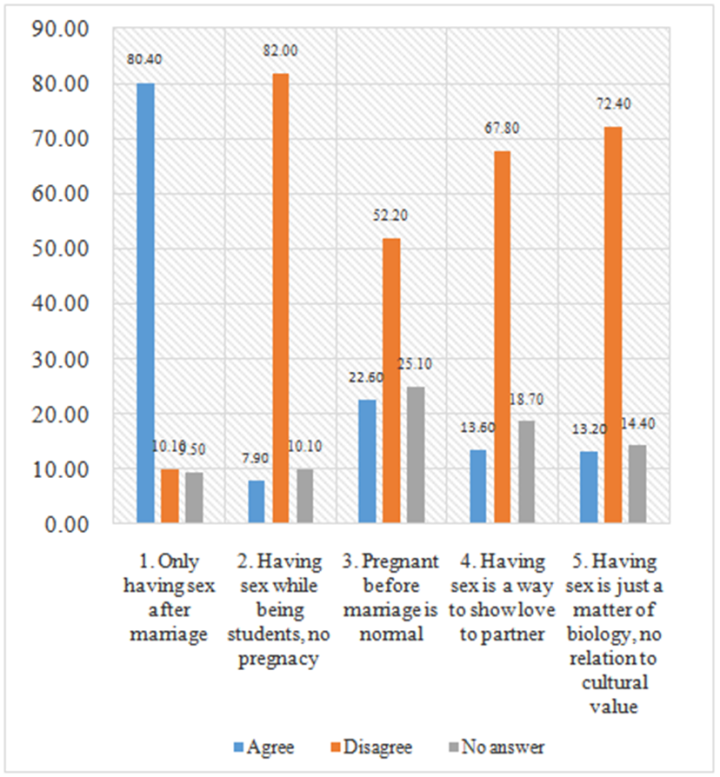
Survey results on high school students' attitudes towards reproductive health issues are shown in the following Figure:
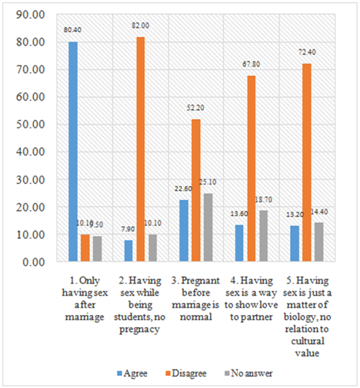
Survey results in Figure 2 show that high school students have very specific attitudes about reproductive health issues. The manifestation is that their attitudes toward reproductive health issues are very clear to sexual relations, the relationship between sex and love, between sex and marriage. Regarding sexual issues, 72.4% of students surveyed disagree with the opinion Sex is merely a matter of instinct, having children is not related to psychological, cultural or ethical factors, and up to 82% of students disagree that It is possible to have sex at the student's age but not to get pregnant. Regarding the relationship between sex and love, 67.8% of students disagree with the opinion Sex is to show your love for their loved ones. Third, for the relationship between sex and marriage, husband and wife, the survey showed, most of the respondents agree that Only having sex after having married, accounting for 80.4%, but the number of students who agree with the idea that Pregnancy before marriage is normal, which accounts for a large proportion (22.6%). The cause behind this situation stems from the traditional beliefs, attitudes, and norms of each regions. The place of research is the North Central Vietnam whose economic condition pertains many difficulties. Majority of students of the North Central Region live in the rural and mountainous areas and are influenced by their local norms, regulations which are less open and quite dogmatic than the cities, regarding sexual matter.
On the basis of the content for reproductive health education for high school students, we investigate a survey asking educational managers, teachers and students about the level of implementing this program in the curriculum. The results are as follows:
According to managers and teachers, the contents regularly educated for children are Sex education and sexual health care for adolescents, accounting for 67.3%, and Prevention of infectious diseases. genital tract, sexually transmitted diseases, including HIV / AIDS, ... accounting for 61.8%. At the same time, the content: Sexual crime and prevention of sex crimes, Information Education - Communication and counseling, family planning services, unwanted contraception also has a level of education 52.7%. Other issues related to motherhood, responsibilities of the parent, and prevention of infertility are less mentioned. Thus, the content used is basically suitable for the ages of high school students, and basically consistent with the content of the reproductive health education program of this age.
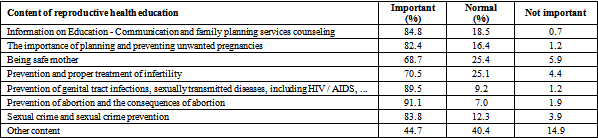
We also surveyed students on the importance of reproductive health education content. The results are shown in Table 5:
The above results show teachers and students highly appreciate the importance of the content of reproductive health education for them today. Specifically, the content of abortion prevention and abortion consequences has the highest level: 91.1%, followed by prevention of sexually transmitted infections, sexually transmitted diseases, including HIV / AIDS, ... accounting for 89.5%, followed by other content.
When asking about the method used by managers and teachers using reproductive health education for high school students, we obtained the following data (Table 6).
Survey of teachers by location on methods of using reproductive health education for high school students shows that the method of conversation and exchange between teachers - students is most used in all 3 rurals, towns and mountainous areas (90.9 % in rural areas, 70.5% in towns, 67.5% in mountainous areas); followed by the method of using games and clubs (63.6% in rural areas, 68.4% in towns, 51.9% in mountainous areas), using presentation methods of teachers (69.7% in rural areas, 41.1% in towns, 28.6% in mountainous areas). Thus, the survey results by location are similar to the general survey results of managers and teachers.
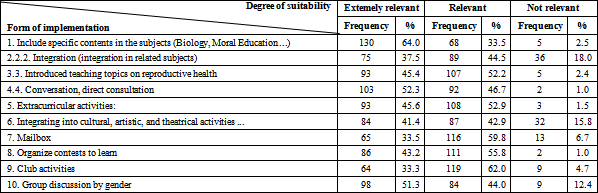
According to the survey results of teachers about the compatibility between the content and the form of reproductive health education for high school students, it shows that the ways that teachers evaluate to be suitable with quite high frequency are: Include separate content in the subject (Biology, civic education ...), (64.%); Direct talking and consultation (52.3%); Extracurricular activities (45.6%); Put into teaching topics on reproductive health (45.4%); Integration (in relevant disciplines) and Integrating into cultural, artistic, theatrical and gender-based group discussions are not considered appropriate with the higher frequency than other activities (frequency ratio is: 18% integration, integration of activities ... 15.8%, Group discussion by gender is 12.4%).
Results of the survey of students' opinion showed that the appropriate forms of reproductive health education were Integrating in specific content in the subject (Biology, Citizen Education ...), accounting for 48.9% and Direct Talking and Consultation ( 45.4%), Integrated (integrated in related subjects) (44.6%).
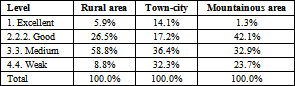
Results of survey of high schools about facilities, conditions to ensure reproductive health education for high school students are shown in the following table:
Surveying teachers by location about the current situation of reproductive health education for students, we obtained the results that, in addition to the common ground in all three areas, most of the data concentred around the average: rural: 58.8%, town - city: 36.4%, mountainous area 32.9%. The opinion for good level maintains at low level (rural area: 5.9%; city: 14.1%; mountainous region: 1.3%).
With the above results, it allows the research to state that the facilities and conditions to ensure reproductive health education for high school students today are not high, not meeting the current reproductive health education needs of teachers as well as of the students. Therefore, it is necessary to have investment and support policies in order to further improve facilities and conditions for high schools.
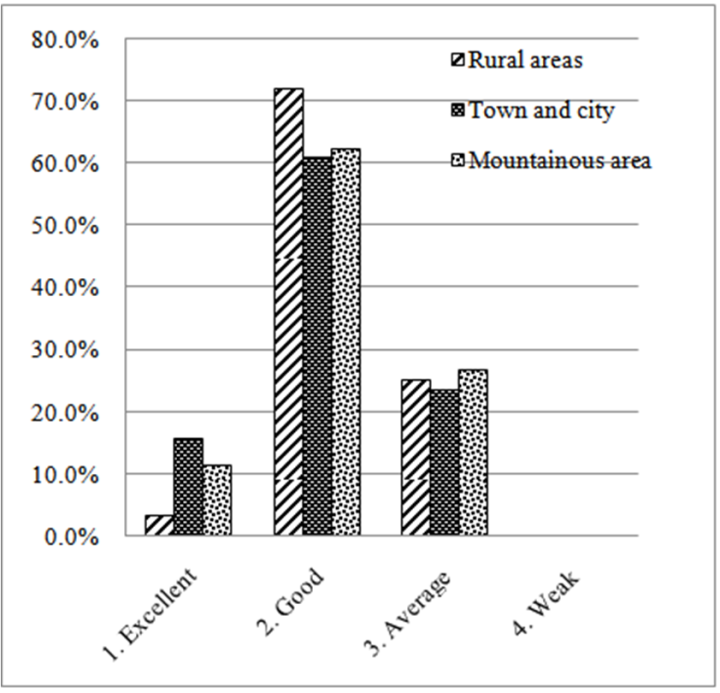
To assess the current situation of reproductive health education results in high schools in the North Central region, we also use survey sheets to evaluate the level of good, fair, average, and weak results for teachers in all three areas of rural, town-city and mountainous areas. Survey results are shown in the following Figure:
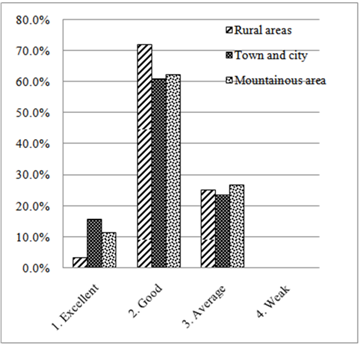
Accordingly, the highest rating in all three areas is fair and average. In rural areas: "fair" accounts for 71.9%, "average" 25%; in the city-town level of fair assessment accounts for 60.80%, "average" 23.5%; and in mountainous areas: 62%, average 26.6%. The highest level of fair assessment in all three areas was only 15.7% in town-city. While the average level in all three areas is quite high, equivalent to 25%. This shows that the results of reproductive health education for students at present are not effective. The reasons for the inefficiency lie in the improper understanding and partisan perception of many members of administrative staff, teachers and students about productive health education. They take the issues lightly, feel that this kind of program is not necessary. In addition to that, the methods of conducting productive health education, in many cases, have failed to meet the expectation and be conducive to students’ personalities. Besides, the lack of facilities and fund is also a contributive factors. On the other hand, the results in graph 4 also show that there is no big difference in the level of effectiveness evaluation in all three surveyed areas.
Reproductive health education for high school students plays an important role, contributing to improving the quality of human resources in the future of the country. The research results show that administrators, teachers, and students are correctly aware of the need for reproductive health education for high school students. However, the knowledge of students about reproductive health is still limited, the content, methods, forms, facilities, and funding for reproductive health education in high schools still have many shortcomings. The results of reproductive health education for students are not high. To improve the effectiveness of reproductive health education for high school students, we would like to propose the following recommendations:
• Raising awareness for administrators, teachers and educational forces about the necessity and importance of reproductive health education for high school students.
• Renovating the content, methods, and diversifying forms of reproductive health education to suit the characteristics of students, of each locality and of each school.
• Fostering and improving the capacity of reproductive health education for the contingent of high school teachers and administrators.
• To increase investment in material foundations and funding for reproductive health education activities in high schools.
| [1] | Nguyen Quoc Anh, Danielr Weitraud, Nguyen Thi My Huong, Meredith Caplan Adolescent Reproductive Health, Labor - Social Publishing House, 2005. | ||
| In article | |||
| [2] | Ministry of Education and Training, UNFPA, Test Questions and Evaluation on Population Education and Reproductive Health, Materials for High Schools (Grades 11, 12), Biology, Citizenship and Geography , Hanoi 1999. | ||
| In article | |||
| [3] | Bui Hien, Nguyen Van Giao, Nguyen Huu Quynh, Vu Van Tao, Educational dictionay, Bach Khoa Publishing House, Hanoi 2001, 105. | ||
| In article | |||
| [4] | Prime Minister of the Socialist Republic of Vietnam, Vietnam Population and Reproductive Health Strategy for the period 2011-2020, Ha noi 2020. | ||
| In article | |||
| [5] | General Department of Population and Family Planning (Ministry of Health of Vietnam), Abortion / abortion rate and menstrual regulation by urban / rural residence, 2007-2017, http://gopfp.gov vn / so-lieu. | ||
| In article | |||
| [6] | Cynthia B. Lloyd, The role of schools in npomoting sexual and reproductive health among adolesents in developing countries, WHO Social determinants of sexual and reproductive health, Informing future research and programme implementation 2010. | ||
| In article | |||
| [7] | Melody Morton Ninomiya, Sexual health education Newfoundland and Labrodor school junior high school teacher’ experiences, coverage of topics, comfort levels and views about professional prestice, The Canadian Journal of human sexcuality, Vol 19, 2010. | ||
| In article | |||
| [8] | WHO, Inter-agency Field Manual on Reproductive Health in Humanitarian Settings, 1997. | ||
| In article | |||
| [9] | WHO, Sexual health and its linkages to reproductive health an openrational approach, Geneva, 2017. | ||
| In article | |||
| [10] | UNFPA, International Conference on Population and Development (ICPD) Cairo, Egypt, on 5–13 September 1994. | ||
| In article | |||
Published with license by Science and Education Publishing, Copyright © 2021 Nguyen Thi Huong, Nguyen Thi Hong Hoa and Nguyen Thi Quynh Anh
 This work is licensed under a Creative Commons Attribution 4.0 International License. To view a copy of this license, visit
http://creativecommons.org/licenses/by/4.0/
This work is licensed under a Creative Commons Attribution 4.0 International License. To view a copy of this license, visit
http://creativecommons.org/licenses/by/4.0/
| [1] | Nguyen Quoc Anh, Danielr Weitraud, Nguyen Thi My Huong, Meredith Caplan Adolescent Reproductive Health, Labor - Social Publishing House, 2005. | ||
| In article | |||
| [2] | Ministry of Education and Training, UNFPA, Test Questions and Evaluation on Population Education and Reproductive Health, Materials for High Schools (Grades 11, 12), Biology, Citizenship and Geography , Hanoi 1999. | ||
| In article | |||
| [3] | Bui Hien, Nguyen Van Giao, Nguyen Huu Quynh, Vu Van Tao, Educational dictionay, Bach Khoa Publishing House, Hanoi 2001, 105. | ||
| In article | |||
| [4] | Prime Minister of the Socialist Republic of Vietnam, Vietnam Population and Reproductive Health Strategy for the period 2011-2020, Ha noi 2020. | ||
| In article | |||
| [5] | General Department of Population and Family Planning (Ministry of Health of Vietnam), Abortion / abortion rate and menstrual regulation by urban / rural residence, 2007-2017, http://gopfp.gov vn / so-lieu. | ||
| In article | |||
| [6] | Cynthia B. Lloyd, The role of schools in npomoting sexual and reproductive health among adolesents in developing countries, WHO Social determinants of sexual and reproductive health, Informing future research and programme implementation 2010. | ||
| In article | |||
| [7] | Melody Morton Ninomiya, Sexual health education Newfoundland and Labrodor school junior high school teacher’ experiences, coverage of topics, comfort levels and views about professional prestice, The Canadian Journal of human sexcuality, Vol 19, 2010. | ||
| In article | |||
| [8] | WHO, Inter-agency Field Manual on Reproductive Health in Humanitarian Settings, 1997. | ||
| In article | |||
| [9] | WHO, Sexual health and its linkages to reproductive health an openrational approach, Geneva, 2017. | ||
| In article | |||
| [10] | UNFPA, International Conference on Population and Development (ICPD) Cairo, Egypt, on 5–13 September 1994. | ||
| In article | |||