This paper is an exploratory study of the trajectory of university education in Nigeria from the colonial to post-colonial era. Universities in Nigeria started as Federal Government institutions until the 1979 Constitution gave the State Governments powers to establish universities. This opened the floodgate for establishment of more public universities in Nigeria. The approach adopted by the Federal Government in establishing universities in the 40s and 70s could be described as conservative and methodical. A strategy of special relationship that allows older universities to midwife newly established ones to ensure quality assurance. However, state universities created after 1979 took off without being nurtured by older universities. Since these universities are public universities, moderate tuition fees were charged. In fact Federal Universities are tuition free. There was the problem of access and this led to the licensing of private universities by the Federal Government. Unlike public universities in Nigeria, private universities charged exorbitant fees that are beyond the reach of an average student. Therefore problem of access remains unabated. With the downturn in the nation’s economy, public universities became grossly underfunded. Coping strategies adopted by these public universities include floating of juicy academic programmes to shore up their internally generated revenue. This led to non-compliance of public universities with admission quota, leading to over enrolment. With gross underfunding and over enrolment quality assurance is constrained. The paper suggested ways of addressing these precarious challenges confronting these public universities in Nigeria.
In Nigeria agitations by the nationalists compelled the colonial administration to develop a positive attitude towards university education. These agitations led to the organisation of various Conferences and Committees such as the West African Governors Conference, the Asquith Commission of 1943 and the Walter Elliot Commission that looked into the feasibility of university education in the colonies. The Walter Elliot Commission is perhaps considered the most significant in the development of Higher Education in Nigeria as it recommended the establishment of a University College in Ibadan as an affiliate of the University of London. Therefore, the first university institution in Nigeria started in 1948 through the initiative of the colonial administration.
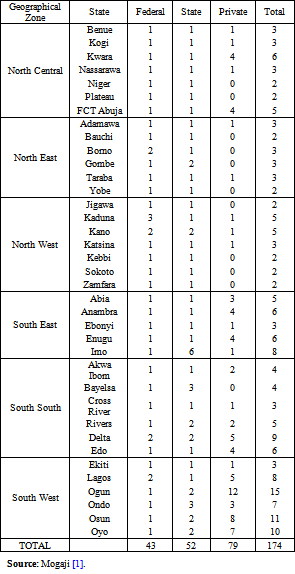
Starting with the University College Ibadan established through a special relationship with the University of London, with strict adherence to conservative approach to higher education development, there has been a rapid proliferation of universities in Nigeria. As at 2020, there are 43 Federal Universities, 52 State Universities and 80 private Universities in Nigeria. These universities can be classified using different criteria. When criterion of ownership is used, there are two categories, namely; public and private universities. Public universities are government owned and could be ether Federal or State Universities. These universities are controlled by government and fully funded. Private Universities can be categorized into two, that is, Faith based university and individually owned universities. Mogaji 1 classified Private Universities in Nigerian as follows: Christian Faith Based (Covenant University); Islamic Faith University (Al-Hikmah University); Individually owned university (Igbinedion University); Company Owned University (Skyline University) and Community Owned (Western Delta University).
When type is used as criterion for classification, three categories of universities exist in Nigeria. These are conventional; specialized and distance learning universities. Conventional universities also known as traditional universities offer academic programmes in arts, humanities, social sciences, science and allied programmes. Specialized universities are those dedicated for certain programmes. Examples include University of Agriculture, University of Education, University of Technology and Open and Distance Learning University. When the period of establishment is used as basis for classification, there are first generation and second generation universities. First generation is a terminology for the six Federal Universities established between 1948 and 1975 while second generation universities are those seven Federal Universities established during the Third National Development Plan (1975-1980).
The following issues will be the focus of this article: origin of university education in Nigeria; the influence of 1979 Constitution on university education; imperatives for the emergence of private universities and threats to quality of university education in Nigeria.
The Federal Ministry of Education in 1959 set up the Ashby Commission to examine the needs of Nigeria in the area of Post-Secondary School Certificate in Higher Education from 1960-1980. The Commission recommended the establishment of the University of Lagos, Ahmadu Bello University in Zaria and the upgrading of the University College of Ibadan into an autonomous University of Ibadan. The National Universities Commission (NUC), which came into existence in 1962, was also part of the recommendation of the Commission. Since constitutional provision at independence granted autonomy to the regional governments over their educational development, each region was challenged to establish its own university. For example, the Eastern Regional Government established the University of Nigeria at Nsukka in 1960 and the Western Regional Government followed suit with the establishment of the University of Ife (now Obafemi Awolowo University) in 1962.
Aminu 2 observed that the Supreme Military Council of General Yakubu Gowon, comprising the then State Military Governors, decided in 1972 to transfer Higher Education from the Concurrent Legislative List of the Constitution to the Exclusive one. The two regional Universities of Ahmadu Bello and Ife were untouched, but no new ones would be established by any State. He added further that the University of Nigerian Nsukka was voluntarily handed over to the Federal Government on the 1st of April, 1973. In addition, the University of Benin, a degree awarding Institute of Technology of the then Midwest State Government, was elevated to a state University in 1972 after the Supreme Military Council ruling. It was voluntarily and precipitately handed over to the Federal Government on the 1st of April, 1975. The immediate takeover of the Ahmadu Bello University and the University of Ife on the 27th of August 1975 put an end to State Government participation in the Universities in the military era. This brought the number of public universities in Nigeria as at this period stood to six. These six Federal universities constitute what is now referred to as the first-generation universities.
The foregoing indicates that while the Constitution of Nigeria under a democratically elected government at independence in 1960 put Higher Education under Concurrent Legislative List, the Military Administration that took over from the democratically elected Government in 1966 decided to place Higher Education under Exclusive Legislative List. Therefore, the Regional Universities of Ife and Ahmadu Bello were forcefully taken over through the centralization policy of the Military Government. This perhaps was in line with the Military tradition of central command structure. Aminu 2 opined that complete centralization would not have been allowed in a civilian regime and that is a sign of things to come. This singular action of the military government marked a watershed in the management of university education in Nigeria.
In September 1975, the Federal Government announced the creation of seven new universities to be located at Jos, Calabar, Maiduguri, Sokoto, Ilorin, Port Harcourt and Kano. Ilorin, Kano Port Harcourt were initially established as University Colleges, under special relationship with the older first generation Universities at Ibadan, Zaria and Lagos respectively. According to Ukeje 3 this was therefore a return to the old British Tradition of special relationships. Actually, Jos and Calabar have been in existence since 1972 but as campuses of University of Ibadan and University of Nigeria Nsukka respectively. Within the 1977/78 academic session the three Universities Colleges were converted to fully fledged Universities. In 1974, the Federal Military Government further strengthened its absolute control of the Nigerian university system through the transformation of the NUC from an advisory body to that of a statutory body with function to regulate and control the operations of universities in Nigeria 3. A striking feature of these seven universities is their take off as affiliates of existing Federal Universities before becoming autonomous universities.
In June 1980, the Federal Government announced the establishment of seven Universities of Technology for seven states of States of Bauchi, Benue, Gongola, Imo, Niger, Ogun and Ondo that had no Federal Universities then. By this action, every one of the 21 states of the federation had at least one Federal University. In October 1984 four of the Federal Universities of Technology at Bauchi, Yola, Makurdi and Abeokuta were merged with existing Universities at Zaria, Maiduguri, Jos and Lagos respectively. Later in the year 1988 the four universities were demerged into independent Universities with those of Makurdi and Abeokuta converted into specialized Universities of Agriculture. The establishment of these additional specialized universities coincided with the Fourth National Development Plan. Also established were the University of Abuja and the National Open University with the latter proscribed and reestablished.
A cursory look at the emergence of these Federal Universities revealed attempts to nurture the newly established universities by affiliating them with the older ones in order to ensure quality. However, political consideration rather than need must have informed the decision of the Federal Government. For instance, Ukeje 3 opined that the emergence of these universities had political implication when viewed against the geographical spread that ensures that every one of the 21 states had a university, despite the justification for their existence by the Government. With an end to military administration that ushered in a civil administration in 1979, another phase started in the development of university education in Nigeria. While the Unity Party of Nigeria had free education as part of its electioneering campaign, the National Party of Nigeria was emphatic on quality education.
The proliferation of universities during the Second Republic glaringly revealed the influence of politics on education during this period. The civilian administration that came into existence in 1979 operated a Constitution that placed education on Concurrent Legislative List, which implies that states have autonomous power on matters pertaining to education. Based on this, a number of state universities were established between 1979 and 1983.
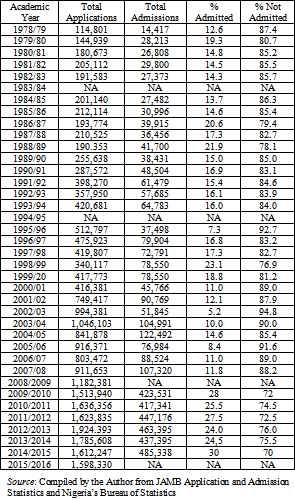
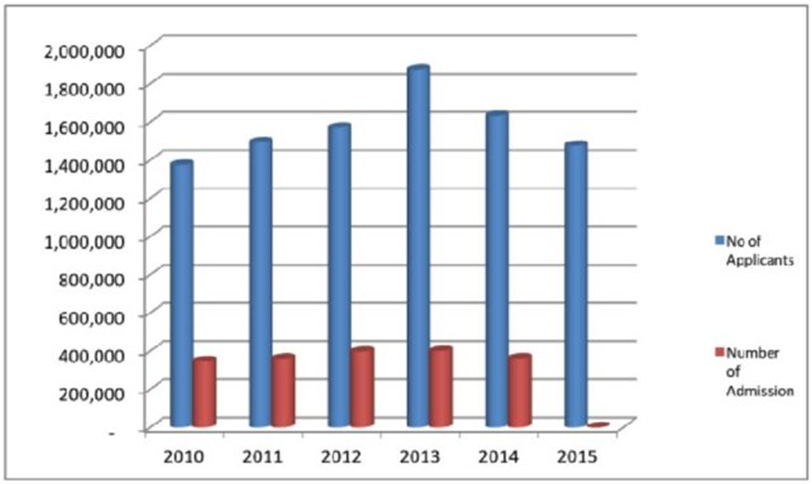
In order to fulfill its electioneering campaign promises of the Unity Party of Nigeria that controlled the Southwest geo political zone of Nigeria, three out of the four states in the zone, that is, Lagos, Ondo and Ogun established their universities after October 1, 1979. Thus between 1980 and 1990 not less than eight states Universities were established. Oyo State followed suit with the creation of Ladoke Akintola University of Technology jointly owned with Osun State while the latter established a multi campus university in 2007. With the creation of Ekiti State from Ondo State, two additional universities emerged, that is, University of Ado-Ekiti and Ondo State University. Other states have also established their universities and there is hardly any state in Nigeria today without its own university. Other state universities that were created around that period include: Bendel State University (now Ambrose Alli University) Ekpoma; Anambra State University of Technology, Enugu; Imo State University, Owerri; Rivers State University of Science and Technology, Port Harcourt; Cross River State University, Uyo. Presently, there are fifty state universities in Nigeria. The inability of public universities that dominated the university education terrain to cope with demand for admission must have informed the decision of the Federal Government to liberalize ownership of universities in Nigeria. For instance, from 2010 to 2015, out of 11,703,709 applicants only 2,674,485 were admitted. Data from Nigeria’s National Bureau of Statistics and the Joint and Matriculation Board shows that between 2010 and 2015, of the 10 million applicants that sought entry in Nigerian tertiary institutions only 26% gained admission.
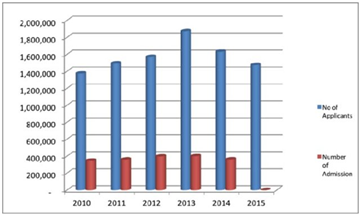
This was the situation in Nigeria such that the admission crisis became more critical after 2001. The access rate had fallen by 2002 to less than 13 percent 4. Based on this fact, the expansion of access through the establishment of Private Universities became one of the most reasonable policy options 5. According to Aluede et al 6, of the number of candidates applying for admission every year in Nigeria, only about 5.2 percent to 15.3 percent get admitted every year, meaning that about 84.7 percent to 94.8 percent of the candidates seeking admission never get admitted. The first attempt at establishing a private university was that of Chief Ukaegbu University in Imo State which was outlawed by the Supreme Court in 1979. The emergence of private provision of higher education in Nigeria came with the inauguration of a democratic system of government under President Olusegun Obasanjo in 1999. The National Universities Commission was empowered to receive applications, examine and validate the facilities of serious applicants of private Universities across the country. And so, in 1999, three private universities emerged namely, Igbinedion University, Okada, Edo State; Babcock University, Ileshan Remo, Ogun State and Madonna University, Okija, Anambra State. In 2001, Bowen University, Iwo, Oyo State was established while Covenant University, Ota, Ogun State was established in 2002. As of now, there are 80 private universities in Nigeria and some are still under consideration for licensing by the National Universities Commission.
Table 2 reveals that Kaduna State has the highest number of Federal Universities (Ahmadu Bello University, Nigerian Defence Academy and Air Force Institute of Technology) the latter having being founded in 2018. In addition Imo State has the highest number of state owned universities with six universities while Ogun State has the highest number of private universities. The table also indicates the disparity in the distribution of universities between the northern part of the country and the southern part.
Although the rationale for proliferation of universities in Nigeria is to ensure access to university education, it has deleterious influence on quality of university education. This is because the systematic and conservative strategies adopted at inception of universities in Nigeria have given way to the deregulation of university education. Thus the policy of having newly established universities serving tutelage under older universities in early late 40s and 70s was jettisoned. This will no doubt affect the quality of university education, as newly established universities were denied the opportunity to learn the nitty gritty of university administration. Awe 7 observed that a significant difference exists between first generation and third generation universities in their extent of compliance with quality assurance measures. The first generation universities performed better. In that same study, Federal Universities were observed to perform better than State Universities on their extent of compliance with quality assurance measures. This is to be expected as the Federal Government is more buoyant than State Governments.
Unlike private universities that are expensive and not affordable for most students, there is a lot of pressure on public universities because they are relatively cheap. In Federal universities, tuition is free while state universities do not charge economic fee. The pressure experienced by public universities is manifested in form of bloated students’ population that existing facilities cannot cope with.
The historical background of Nigerian universities makes absolute dependence on government for their financial requirements inevitable. For instance available data indicate 90% of the personnel expenses were paid through grants by the federal government 29. The down turn in the nation’s economy towards the end of 1979 indicates that the government could no longer cope with the cost of financing education and by the middle of the 1980’s, there were pressures on the country to take drastic measures to turn the economy around. Therefore the government was compelled by the International Monetary Fund to adopt the Structural Adjustment Programme (SAP). The fallout of this measure included the devaluation of naira with its attendant inflationary effect. Ogunade and Alani 8 remarked that inflation accounted for the huge increase in educational expenditure with no remarkable influence in educational services. They further observed that there was grumbling about funding of education with its attendant sit- ins and strikes by educational personnel and that whereas every naira invested in education in 1990 had a purchasing value of 34kobo, by 1994 the value had declined to 0.80 kobo. The quality of education in this type of situation can better be imagined.
The genesis of financial crisis in Nigerian public universities emanated from the restrictions placed on public universities from charging economic fees as against what obtained at inception of universities in Nigeria. For instance, Aminu 9 observed that before 1975, Government had nothing to do with fixing fees and charges for the Universities. Government provides scholarships for their students while others sponsor theirs. He added that: by first abolishing fees and pegging boarding and lodging facilities in most of our educational institutions, Governments have lost enormous sources of revenue for education. More importantly they have lost the participatory spirit of the students and his people in his (the student’s) education. It is doubtful if any civilian government in this country would wish to face the commotion that could follow any attempt to reintroduce tuition fees or to increase charges in our educational institutions. Anao 10 remarked that some sections of the Universities Autonomous Bill before the National Assembly explicitly outlaw the charging of fees and that outlawing of fees would be tantamount to binding a person’s hand and legs and asking him to run, the consequences will be catastrophic.
The Committee of the Vice Chancellors (CVC) of the Nigerian Federal universities in a communiqué issued at the end of their regular meeting in 2001 indicated that the university system is in crisis due to under funding and that beginning from 2001, the universities have received only 40% of what is required to pay salaries monthly. Consequently, universities have been unable to pay salaries as at when due. This development was said to have exhausted their reserves and some borrowed money from financial institutions in order to sustain payments of emoluments while only 30% of the 2001 capital grants had been received by the universities and the fallout is that many projects are stalled, abandoned or put on hold.
Babalola 11 described the dilemma of universities in Nigeria thus:
• There is less money to spend on teaching, research and community services.
• Universities complain of underfunding while government accuses the universities of inefficient utilisation of available resources.
• The donors argue that public spending on universities should be reduced.
• At the same time there is a growing resistance by students to various attempts to introduce user charges at the university level.
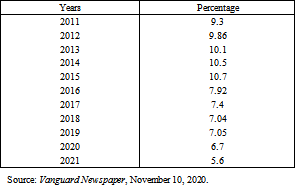
Okebukola 12 indicated that most vice chancellors hinged the restoration of quality in the system to the ability of government to pay all salaries in full including those of pensioners in addition to direct teaching and research costs. The NUC 13 reported that 30% of state universities are starved of funds with acute shortage of grants for payment of staff salaries thus compelling the authorities to augment through revenue sources that are unhealthy for the academic life of the institutions. Aina 14 observed that inadequate funding of universities has, no doubt, had calamitous effect on teaching and research and universities have been forced to embark on income generating projects in order to source for funds. Table 4 is a summary of the budgetary allocation to education from 2011 to 2021. These figures are grossly inadequate when compared with UNESCO Benchmark for Developing Countries fixed at 26%.
Attempts at survival prompted the universities to react differently to the decline in funding situation. Babalola 11 in a study reported that at the University of Ibadan, when the income level reduced by 9% the student-teacher ratio increased by 14%, while at the University of Ilorin, a reduction in income level by 52% translated to an increase of 170% in student-teacher ratio between 1980 and 1986. Okunamiri 15 reported that, most Federal universities resorted to taking punitive measures as a way of surviving the incidence of financial predicament they found themselves in by reducing their admission quota for 1983/84 session. On the contrary state universities admitted more students particularly those who were denied admission into Federal universities so as to boost their internally generated revenue.
Therefore, the urge for survival made public universities exceed their carrying capacity, which invariably leads to over enrolment. Carrying capacity according to NUC 16 is the maximum number of students that the human and material resources available in the university can support for quality delivery of education on that programme. It is added that if a university enrolls just to the point of its carrying (or less) for a programme, chances are that the quality of products from that programmes will be assured, if no collateral distortions such as strikes come to bear at some point during the course of training. In the opinion of the NUC, the balance between quantity and quality is established through a policy of not exceeding enrolment carrying capacity.
Some of the factors responsible for over enrolment can be summarized thus:
• Undue pressure on university administrators by parents, university staff, friends and agents of the proprietor who desire admission for candidates who are unable to get in on merit. This is typified by Nigerian politicians with promises to vice chancellors to influence the approval of their budgetary allocation when presented before the National Assembly.
• Lack of sanctions on universities who exceed their admission quota tends to perpetuate over enrolment.
• The desire to generate more funds from internal sources through fee-paying programmes such as pre degree, sandwich and diploma programmes. In most cases the number admitted into such programmes doubles regular admission.
It is worrisome that despite the observed shortcomings in the Nigerian universities, the enrolment figure has been on the upward trend. Adeyemi and Igbineweka 30 identified overcrowding in Nigerian universities as one of the numerous sources of disciplinary problems that make the classrooms non-conducive for meaningful learning. For instance, the 1990’s enrolment in the Federal universities alone that was 147,121 increased to 275,515 in 1998. The total number of students enrolled in all Nigerian universities in 2002 was well over 526,780 12. This phenomenal increase in enrolment figure without corresponding increase in the provision of necessary resources could constitute a dangerous trend on the quality of education both at the State and Federal levels. Ramon-Yusuf 17 observed that the phenomenal expansion in the Nigerian university system, which occurred without commensurate increase in the level of funding, had some untoward effect on the quality of academic programmes taught in the universities.
The Ogundeko Commission of Enquiry inaugurated by the National Universities Commission (NUC) to look into the financial management of Federal Universities revealed the decadent state of the Federal Universities. The Report observed the following deficiencies:
• That the teaching facilities lag behind the rate of growth in students' population and expansion in academic activities,
• Libraries lack sufficient books and research materials, laboratories and lecture theatres were inadequate to the extent that students are cramped into the former and in many cases,
• With respect to lecture rooms, there were occasions when students stand on the corridors to listen to lectures going on inside crowded lecture rooms.
• It was also observed that two or more academic staff share offices meant for one, while in at least one older university, there were academic staff without offices even to share 18.
Almost three decades after the Report of the Commission, the Presidential Visitation Panels on the operations of all Federal universities between 1990 and 2003, reported that academic and physical facilities at the universities were in deplorable states with insufficient lecture theatres/halls, laboratories and so on 19. The situation is not different in the state universities. The NUC 20 observed that the Kogi State University lacked teachers/lecturers in the right quality and quantity in addition to gross deficiency in resources for effective teaching and learning in classrooms, laboratories workshop and library, and that some subjects were taught and evaluated in a sub-standard manner. It was added that prevailing situation in the University would lead to the production of poor quality (half-baked) graduates that will impair socio-economic development of Nigeria and project a dim image from Nigerian universities to the global community.
Adedipe 21 reported that the Lagos State University was decaying and that the school needed urgent financial and managerial help. He observed that the university exceeded its enrolment capacity for internal students by 17,297 in 2004 and by 31,789 for students in its five-affiliate campuses. He added that registered part-time undergraduates students in 2005 were 29,515, full-time student population was 16,724; sub-degree student population was put at 7,445 while post-graduate student population in 2004 was 8,681. In addition, the Faculty of Engineering lacked the equipment, workshop and facilities that could enhance teaching and learning and came last out of the 26 universities offering courses in engineering in the country in the last NUC's rating.
Also, the NUC 22 released the list of Nigeria's ten overcrowded universities as follows: Olabisi Onabanjo University, Ago Iwoye topped the list with excess enrolment of 24,628, Ambrose Ali University, Ekpoma by 20,226; University of Nigeria, Nsukka, 18,996; Lagos State University, Ojoo, 15,749; Nnamdi Azikwe University, 15,088; Usman Dan Fodio University, 14,186; Delta State University, 13,998; University of Abuja, 11,817, Federal University of Technology, Owerri, 10,541; River State University of Science and Technology, 10,771. Overcrowding has therefore become a common feature in the universities, not only in the classroom's but also in the laboratories: a development that hinders meaningful technological advancement in Nigerian universities.
This situation is of great concern when viewed against the background that Nigeria once served as the hub of university education in the West Africa sub-region. Borishade 23 and Obasi 24 attested to the quality of Nigerian universities in the 60's and greater part of the 70’s’. Obasi 24 observed that the learning environment, the quality of learning as well as the quality of the products of the universities, were all considered good enough within the constraints of a developing nation. NUC 25 observed that glaring evidence of possible rot in the universities includes the complaints from the labour market on the poor quality of graduates who have to be exposed to another period of in-house training by their employers to make up for the deficiency in their skills.
The financial constraint experienced in Nigerian public universities has also impacted negatively on staffing situation. Despite the crucial role of academic staff in teaching-learning activities, they are in short supply in Nigerian universities partly due underfunding and brain drain. Okebukola 4 reported an overall shortfall of 52% for academic staff in Federal universities. This implies that the Federal University System carried just about half its load of academic staff based on the NUC Guidelines. This situation has been attributed to the inability of universities to recruit additional academic staff because of fund implication they could hardly bear.
Saint, Hartnett and Strassner 26 reported that between 1997 and 1999, the number of academic staff declined by 12% even as enrolment expanded by 13%. Long term brain drain, combined with insufficient output from national postgraduate programmes in the face of rising enrolments, has left the Federal university system with only 48% of estimated staffing needs filled. Staffing scarcity is most acute in engineering, science and business disciplines. Shortfalls are estimated at 73% in engineering, 62% in medicine, 58% in administration and 53% in sciences. In contrast, no staffing shortages exist in the disciplinary areas of arts and education.
Another observable problem in Nigerian universities is the structural imbalance in the distribution of academic staff. It was observed that most first generation universities have adequate staff compliment at the professorial level while the general trend was a bottom heavy staff structure. For example, in the case of Lecturer 1 and below, the observed figure for the first generation universities was 58.4% as against recommended figure of 45%. In the case of state universities, they were all reported to be bottom heavy and that over 70% of state universities have their academic staff being Lecturer 1 category or lower and that in some departments the head is a Lecturer Grade II, (NUC Monday Memo, January 9, 2006).
The NUC 13 reported that only 16,856 out of the 72,704 workers in the federal university system were academic staff. Of the 16,856 serving academic staff, 10,646 representing 60 percent were junior academic staff while only 12% were full professors. This is at variance with minimum academic standards requirement that 25 percent of lecturers in the universities should be full professors. In addition, the NUC calculations on teacher/student ratio show that the system requires about 21,912 teachers, thus leaving a deficit of 5,056 teachers in Nigerian federal universities. Sule Kano 27 noted that Nigeria requires about 47,000 lecturers in its university system; it has only a total of 16,000 to cater for a total student population of about 1.5 million, while the University of Harvard has 9000 students to 11,000 lecturers. He added that only adequate budgetary provision for university education in Nigeria could resolve the crisis facing the university system.
The shortage of academic staff Persistent strike actions by the academic staff have become a regular feature of Nigerian universities. The reasons for these strike actions range from poor working environment to poor remuneration as well as inadequate funding of the universities. The implication of these regular strike actions on the quality of academic programmes as well as the quality of the output from the system is a source of concern. FME 28 reported that in the past 10 years Nigerian universities have witnessed 28 months of closure without commensurate make up of lost time, thereby contributing to the high level of half-baked graduates from our universities. This figure does not take into consideration subsequent strike actions the latest being the one that commenced in March 27, 2007 and lasted for another three months until it was called off in June. It must also be observed that Academic Staff Union of Universities in Nigeria embarked on strike action since March 20, 2020 and up till now the strike action has not been called off. Part of the demand of the lecturers include failure on the part of the Government to honour an Agreement with Government since 2009 as well as the decision of the Government to migrate the payment platform for thir salaries to that used for civil servants. It is on record that between 1999 and 2020, Nigerian university lecturers have embarked on strike actions for fifteen times.
Shortage of academic staff has led to a situation where academic staff carry extra work load, which led to demand for earned allowance, Earned allowance is the monetary compensation for extra load accruing to lecturers which is one of the issues for contestations in the current strike that commenced on March 23, 2020. Management of various public universities has adopted different strategies for meeting staffing criteria during accreditation. This includes recruitment of adjunct staff and situational staff that are given allowances for the period of accreditation alone. Another strategy entails lateral conversion of non-academic staff with Master’s degree to academic staff. Thus inadequate funding has not only led to over enrolment in Nigerian public universities, it has also impacted negatively on the quality and quantity of academic staff.
The paper indicates that from historical perspective, public universities dominated university education landscape until the year 2000. It is observed that from conservative and meticulous planning that characterized emergence of universities in late 40s and greater part of 70s, university education has become deregulated through the involvement of private individual and religious organisations. Government policy on university education vacillates between the centralization policy of the military due to its unitary command structure and democratic approach of the civilian administration. This inconsistent policy has been compounded by down turn in the nation’s economy that adversely affected the funding of public universities. Undue politicization of universities system has not only denied public universities the autonomy that is germane to the realization of their objectives, but impoverished them. The tuition free policy and prevention of public universities from charging economic fees without adequate funding have denied them access to funding that is crucial for their survival. In their quest for survival, public universities embarked on unorthodox measures to shore up their internally generated revenue. All these measures among others have conspired against quality in public universities in Nigeria. University education requires both systemic and institutional overhauling if Nigeria is to be a country to reckon with in knowledge economy.
Based on the observable challenges confronting public universities in Nigeria, the following recommendations are made:
1. Government as sole proprietor of public universities must ensure their adequate funding.
2. Educational system in Nigeria must be restructured to place greater emphasis on Vocational and Technical Education to reduce pressure on public universities.
3. The introduction of Higher School Certificate courses to serve as a stop gap to lessen pressure on public universities.
4. Adequate provision of ICT infrastructure to facilitate virtual learning to eliminate traditional face to face instructional delivery that characterizes public universities.
5. Improved autonomy for public universities to charge economic fees like their counterparts in private universities.
6. Creation of additional distance learning universities due to its capacity to accommodate high students’ enrolment figure.
7. Management of public universities to adopt strategies to shore up their internally generated revenue.
8. Governments to reintroduce scholarships and Students Loan Scheme as it were in the 80s.
9. Scrapping of all agencies that impinge on university autonomy thereby freeing the fund that is expended on maintaining their huge bureaucracy.
10. Government to hands off from ownership of universities and limit their involvement to provision of grants.
11. Overhauling of staffing situation that is positively skewed in favour of non-teaching staff.
12. Addressing the issue of over unionization of public universities to facilitate industrial harmony in public universities.
| [1] | Mogaji, E. (2019). Types and Location of Nigerian Universities. Research Agenda Working Papers. Volume 2019. No 7. pp 92-103. | ||
| In article | View Article | ||
| [2] | Aminu, J. (1986). Quality and Stress in Nigerian Education, Northern Nigerian Publishing Company. | ||
| In article | |||
| [3] | Ukeje, B.O. (1992). "Nigerian Education: Unity within Diversity, the old within the New". In: Ipaye B. (Ed.) Education in Nigeria, Past, Present and Future, Macmillan Nigeria Publisher Limited. | ||
| In article | |||
| [4] | Okebukola, P. (2002). Report on the Performance of the Federal University System in 2002, National Universities Commission. | ||
| In article | |||
| [5] | Obasi, I.N. (2005). Welcoming the seven private Universities: Higher Education this Week. Daily Trust, June 9. | ||
| In article | |||
| [6] | Aluede, O., Idogho, P.O., & Imonike, J.S. (2012). Increasing Access to University Education in Nigeria: Present Challenges and suggestions for the Future. The African Symposium. African Educational Research Network, USA. 12(1). | ||
| In article | |||
| [7] | Awe, A.B. (2009). Quality Assurance of Current Academic Programmes in South West Nigerian Universities, Unpublished Ph.D Thesis, University of Ado Ekiti, Nigeria | ||
| In article | |||
| [8] | Ogunade, A.O and Alani A.A. (1998). Financing Education in Nigeria: Theory and Practice, Kinsbond Investment Limited. | ||
| In article | |||
| [9] | Aminu, J. (1987). "Resources for Higher Education: Number, Costs and Common Sense, Guest of Honour's Address": In Resources Management in the University System, Proceedings of the NUC/CVC/BC International Seminar. November: 9-11 | ||
| In article | |||
| [10] | Anao, A. (2002). Interview with The Guardian, Tuesday, September 3. | ||
| In article | |||
| [11] | Babalola, J.B. (2001). "University Funding, Responses and Performance under a Declining Economy in Nigeria", Educational Planning and Policy Unit, Department of Educational Management, University of Ibadan, Research and Seminar Series. | ||
| In article | |||
| [12] | Okebukola, P (2002). The Status of University Education in Nigeria: A Report presented to the National Summit on Higher Education, Abuja: March11-16. | ||
| In article | |||
| [13] | NUC (2006). "Academic and Non Academic Staff Strength of the Federal University System", NUC Monday Memo, February 20. | ||
| In article | |||
| [14] | Aina.O.I. (2007). "Alternative Modes of Financing Higher Education in Nigeria and Implications for University Governance": In Babalola, J.B and Emunemu, B.O (eds.) Issues in Higher Education: Research Evidence from Sub-Saharan Africa, Revised Edition, Bolabay Publications. | ||
| In article | |||
| [15] | Okunamiri, P.O (2002). Resourcing and Guidelines for Educational Finance in Tertiary Institutions in Nigeria, Fasmen Communications. | ||
| In article | |||
| [16] | NUC (2005). Accreditation status of undergraduate programmes in Nigerian universities, Monday Memo, May, 4(20). | ||
| In article | |||
| [17] | Ramon-Yusuf, S. (2003). "The Role of the National Universities Commission in Quality Assurance in Nigerian Universities", National Universities Commission Monograph Series, 1 (9). | ||
| In article | |||
| [18] | Ogundeko Commission Report (1978) on Financial Management in Federal Universities submitted to the National Universities Commission. | ||
| In article | |||
| [19] | NUC (2006): How did Nigerian University System Fare in 2005? Most Stable and Most Productive in Twelve Years, Monday Memo, January, 5(1). | ||
| In article | |||
| [20] | NUC (2005). Curbing over enrolment in Nigerian universities, Monday Memo, September, 4(37). | ||
| In article | |||
| [21] | Adedipe, N. (2005). Report of the Chairman, Strategic Planning Committee for Lagos State University, presented at the Stakeholders Forum, Ojo, Lagos. | ||
| In article | |||
| [22] | NUC (2005). Purported rejection of state universities graduates by employers of labour, Monday Memo, November, 4(45). | ||
| In article | |||
| [23] | Borishade, B. (2002). Towards a New Vision and Mission for Higher Education in Nigeria, Keynote Address presented at the National Summit on Higher Education, Federal Ministry of Education, | ||
| In article | |||
| [24] | Obasi, I.N. (2004). "The State of Higher Education in Nigeria: A Critical Note", The Nigerian Social Scientist, September 7(2), pp 39-41. | ||
| In article | |||
| [25] | NUC (2005). The choice and balance between quality and quantity in Nigerian university system: Admission quota for 2005/2006, Monday Memo, May, 4(21) | ||
| In article | |||
| [26] | Saint, W; Harnett, T.A and Strassner, E. (2003). Higher Education in Nigeria: A status Report, Higher Education Policy, 259-281 | ||
| In article | View Article | ||
| [27] | Sule-Kano, A. (2007). The Punch, Tuesday, December 25, p1. | ||
| In article | |||
| [28] | FME (2003). Education Sector Status Report. Abuja: Federal Ministry of Education | ||
| In article | |||
| [29] | Ogbogu, O.C (2011). Modes of Funding Nigeria universities and the implications on performance. A paper presented at the 2011 Barcelona European Academic Conference, Spain. | ||
| In article | |||
| [30] | Adeyemi, J.K., & Igbineweka, V.O, (2000). Sitting space utilisation in Nigeria Universities: A case study of the University of Benin. Journal of Teacher Education and Teaching, 4(1), 12-23. | ||
| In article | |||
Published with license by Science and Education Publishing, Copyright © 2020 Bolupe Abayomi Awe
 This work is licensed under a Creative Commons Attribution 4.0 International License. To view a copy of this license, visit
http://creativecommons.org/licenses/by/4.0/
This work is licensed under a Creative Commons Attribution 4.0 International License. To view a copy of this license, visit
http://creativecommons.org/licenses/by/4.0/
| [1] | Mogaji, E. (2019). Types and Location of Nigerian Universities. Research Agenda Working Papers. Volume 2019. No 7. pp 92-103. | ||
| In article | View Article | ||
| [2] | Aminu, J. (1986). Quality and Stress in Nigerian Education, Northern Nigerian Publishing Company. | ||
| In article | |||
| [3] | Ukeje, B.O. (1992). "Nigerian Education: Unity within Diversity, the old within the New". In: Ipaye B. (Ed.) Education in Nigeria, Past, Present and Future, Macmillan Nigeria Publisher Limited. | ||
| In article | |||
| [4] | Okebukola, P. (2002). Report on the Performance of the Federal University System in 2002, National Universities Commission. | ||
| In article | |||
| [5] | Obasi, I.N. (2005). Welcoming the seven private Universities: Higher Education this Week. Daily Trust, June 9. | ||
| In article | |||
| [6] | Aluede, O., Idogho, P.O., & Imonike, J.S. (2012). Increasing Access to University Education in Nigeria: Present Challenges and suggestions for the Future. The African Symposium. African Educational Research Network, USA. 12(1). | ||
| In article | |||
| [7] | Awe, A.B. (2009). Quality Assurance of Current Academic Programmes in South West Nigerian Universities, Unpublished Ph.D Thesis, University of Ado Ekiti, Nigeria | ||
| In article | |||
| [8] | Ogunade, A.O and Alani A.A. (1998). Financing Education in Nigeria: Theory and Practice, Kinsbond Investment Limited. | ||
| In article | |||
| [9] | Aminu, J. (1987). "Resources for Higher Education: Number, Costs and Common Sense, Guest of Honour's Address": In Resources Management in the University System, Proceedings of the NUC/CVC/BC International Seminar. November: 9-11 | ||
| In article | |||
| [10] | Anao, A. (2002). Interview with The Guardian, Tuesday, September 3. | ||
| In article | |||
| [11] | Babalola, J.B. (2001). "University Funding, Responses and Performance under a Declining Economy in Nigeria", Educational Planning and Policy Unit, Department of Educational Management, University of Ibadan, Research and Seminar Series. | ||
| In article | |||
| [12] | Okebukola, P (2002). The Status of University Education in Nigeria: A Report presented to the National Summit on Higher Education, Abuja: March11-16. | ||
| In article | |||
| [13] | NUC (2006). "Academic and Non Academic Staff Strength of the Federal University System", NUC Monday Memo, February 20. | ||
| In article | |||
| [14] | Aina.O.I. (2007). "Alternative Modes of Financing Higher Education in Nigeria and Implications for University Governance": In Babalola, J.B and Emunemu, B.O (eds.) Issues in Higher Education: Research Evidence from Sub-Saharan Africa, Revised Edition, Bolabay Publications. | ||
| In article | |||
| [15] | Okunamiri, P.O (2002). Resourcing and Guidelines for Educational Finance in Tertiary Institutions in Nigeria, Fasmen Communications. | ||
| In article | |||
| [16] | NUC (2005). Accreditation status of undergraduate programmes in Nigerian universities, Monday Memo, May, 4(20). | ||
| In article | |||
| [17] | Ramon-Yusuf, S. (2003). "The Role of the National Universities Commission in Quality Assurance in Nigerian Universities", National Universities Commission Monograph Series, 1 (9). | ||
| In article | |||
| [18] | Ogundeko Commission Report (1978) on Financial Management in Federal Universities submitted to the National Universities Commission. | ||
| In article | |||
| [19] | NUC (2006): How did Nigerian University System Fare in 2005? Most Stable and Most Productive in Twelve Years, Monday Memo, January, 5(1). | ||
| In article | |||
| [20] | NUC (2005). Curbing over enrolment in Nigerian universities, Monday Memo, September, 4(37). | ||
| In article | |||
| [21] | Adedipe, N. (2005). Report of the Chairman, Strategic Planning Committee for Lagos State University, presented at the Stakeholders Forum, Ojo, Lagos. | ||
| In article | |||
| [22] | NUC (2005). Purported rejection of state universities graduates by employers of labour, Monday Memo, November, 4(45). | ||
| In article | |||
| [23] | Borishade, B. (2002). Towards a New Vision and Mission for Higher Education in Nigeria, Keynote Address presented at the National Summit on Higher Education, Federal Ministry of Education, | ||
| In article | |||
| [24] | Obasi, I.N. (2004). "The State of Higher Education in Nigeria: A Critical Note", The Nigerian Social Scientist, September 7(2), pp 39-41. | ||
| In article | |||
| [25] | NUC (2005). The choice and balance between quality and quantity in Nigerian university system: Admission quota for 2005/2006, Monday Memo, May, 4(21) | ||
| In article | |||
| [26] | Saint, W; Harnett, T.A and Strassner, E. (2003). Higher Education in Nigeria: A status Report, Higher Education Policy, 259-281 | ||
| In article | View Article | ||
| [27] | Sule-Kano, A. (2007). The Punch, Tuesday, December 25, p1. | ||
| In article | |||
| [28] | FME (2003). Education Sector Status Report. Abuja: Federal Ministry of Education | ||
| In article | |||
| [29] | Ogbogu, O.C (2011). Modes of Funding Nigeria universities and the implications on performance. A paper presented at the 2011 Barcelona European Academic Conference, Spain. | ||
| In article | |||
| [30] | Adeyemi, J.K., & Igbineweka, V.O, (2000). Sitting space utilisation in Nigeria Universities: A case study of the University of Benin. Journal of Teacher Education and Teaching, 4(1), 12-23. | ||
| In article | |||