This descriptive study examined knowledge and perceptions of AI automation in journalism among student-journalists at St. Rita’s College of Balingasag (N = 170). Using a validated researcher-administered questionnaire adapted from prior work, respondents who actively contribute to campus publications reported their primary media exposure, familiarity with AI technologies, and attitudes toward automation. Data were collected via online forms and summarized with frequencies, means, and standard deviations. Results show students are predominantly engaged with online platforms (118 of 170, 69.4%), with television (23.5%), print (5.3%) and radio (1.8%) trailing. Overall, AI knowledge was moderate but uncertain (overall mean = 2.24 on a 1–3 scale; “not sure”), while perceptions were similarly ambivalent (mean = 2.22). Students agreed most strongly that AI organizes data and speeds up production (item means = 2.49) and that AI creates demand for new technical skills (mean = 2.39), yet they remained unsure about AI’s reliability and its effects on journalistic quality and jobs. The findings indicate a gap between high digital exposure and limited institutional preparation: journalism programs should integrate targeted AI literacy, hands-on training in AI-assisted reporting, and ethics modules, alongside faculty upskilling and newsroom partnerships, to equip future journalists to use automation responsibly.
Artificial Intelligence (AI) represents the ability of computers and machines to simulate intelligent behavior and perform tasks typically requiring human intelligence, such as logical reasoning, learning, and problem-solving. AI is fundamentally based on the concept that "machines will do and think like humans more in the future" and operates through pattern matching methods that describe objects, events, or processes using qualitative features and logical relationships.
Artificial Intelligence (AI) is transforming journalism by enhancing efficiency and capabilities across various aspects of news production. AI technologies are being applied in automated reporting, content creation, transcription, translation, data analysis, fact-checking, and content personalization 1. Recent studies indicate that student-journalists' knowledge of AI technology is evolving but still limited. While 66.7% of students in one study demonstrated high AI knowledge 2 universities generally do not address AI content deeply in journalism curricula 3. The finding that journalism curricula often lack in-depth AI content suggests a critical gap in preparing student-journalists for the increasingly AI-driven media landscape, highlighting the need for curriculum updates to better align with technological advancements. Recent studies have explored perceptions of automated journalism among journalists, students, and news readers. Journalists generally view automation as an improvement over manual reporting practices and believe it will become more common, potentially increasing the depth and immediacy of information 4.
Recent studies have explored the impact of AI on journalism education and practice. AI has transformed newsrooms and classrooms, enhancing efficiency in news production and distribution 5. Journalism students benefit from AI in preparing assignments and presentations, while practitioners use it for script writing and research 5. However, AI-generated content still requires human review and verification 6.
Recent studies highlight the growing impact of AI on journalism education and practice. AI is reshaping both classroom learning and newsroom operations, with benefits for students in assignment preparation and practitioners in various production stages 5. However, universities often lack specific AI-related content in their curricula, and educators may not possess the necessary competencies to teach AI applications in journalism 3.
On the other hand, deep-seated concerns are ethical anxieties. Students express significant worry about AI amplifying bias and discrimination if trained on flawed datasets, potentially perpetuating societal inequalities. Concerns about the loss of human judgment, empathy, and contextual understanding in news reporting are central, alongside fears about transparency, accountability for errors made by AI systems, and the erosion of public trust in automated content. Many students perceive a fundamental tension between the efficiency goals of AI and the normative ideals of journalism, such as serving democracy and upholding truth.
Furthermore, students' perceptions are not monolithic and are influenced by factors like prior exposure to technology, specialization, and the extent and nature of AI integration within their specific curriculum. Understanding this specific cohort is vital, as they represent the future workforce navigating an increasingly automated media ecosystem. Their preparedness – encompassing not just technical skills but also critical ethical reasoning about AI's implications – will significantly shape how journalism adapts and upholds its societal role in the digital age.
This study aims to assess the knowledge and perception/reception of AI automation in journalism practice among higher education students in St. Rita’s College of Balingasag. Specifically, it seeks to examine how awareness and attitudes vary across different media platforms, including television, radio, print, and online journalism. The study will evaluate journalism students' level of familiarity with AI technologies—such as automated news writing, data-driven reporting, and AI-assisted editing—and explore their perceptions regarding the benefits, challenges, and ethical implications of automation in the field. Additionally, this research will analyze whether students view AI as a transformative tool that enhances journalistic efficiency or as a potential threat to traditional reporting roles. By capturing these dimensions, the study aims to provide a comprehensive understanding of how future journalists perceive and adapt to AI-driven changes in media practice.
Research Questions
1. What is the distribution of journalism students' exposure to AI automation across different media platforms (Television, Radio, Print, Online)?
2. How knowledgeable are journalism students about AI Technology?
3. What are journalism students’ general perceptions (trust, usefulness, concerns) toward AI automation in journalism?
In this study, descriptive research design is utilized. Descriptive research design is a fundamental approach in observational studies that aims to describe and characterize a population or phenomenon without manipulating variables or testing causal hypotheses 7. In this study, descriptive research design will be used to describe the Knowledge and Perception/Reception of AI Automation in Journalism Practice among Higher Education Student-journalism of St. Rita’s College of Balingasag.
2.2. Setting and ParticipantsThe study is conducted at St. Rita’s College of Balingasag Inc. - a private higher education institution in the Philippines. The participants consisted of students who actively contributed to campus journalism—writing for either Filipino or English in the higher education school publication.
2.3. Research InstrumentThe study adopted a researcher-administered questionnaire originally used by 8 in their study “Artificial Intelligence: Knowledge, Perceptions and Reception of Automation in Journalism Practice in Kaduna State.” The original instrument was organised around three core dimensions that mirror the study’s objectives: (1) Distribution of Medium, (2) Knowledge of AI technology (nine items), and (3) Perceptions of automated journalism. Responses to the attitudinal items were recorded on a three-point Likert scale (Agree / Not sure / Disagree) and summarised using descriptive statistics (frequencies, means and standard deviations). The Distribution by Medium item (Television; Radio; Print; On-line) was used in the original study to contextualize results by sector.
2.4. Data Gathering ProcedureThe study will use a validated survey questionnaire with three sections - preferred media platforms, knowledge of AI technologies in journalism, and perceptions of AI automation. The questionnaire will be distributed through online forms, ensuring voluntary participation and confidentiality. Data will be collected over one week, then reviewed, cleaned, and encoded. Descriptive statistics, including frequency, percentage, mean, and standard deviation, will be used to analyze the results in line with the study’s objectives.
2.5. Statistical AnalysisThe measures of central tendency will be utilized for analyzing the collected data. This includes mean, frequency, and standard deviation. For part 1, frequency and percentage distributions will be used to determine the distribution of journalism media that student-journalists’ uses. For part 2, mean and standard deviation is used to measure the student-journalists’ level of knowledge of AI Technology. For part 3, mean and standard deviation will be derived to assess student-journalists' perception of automation journalism.
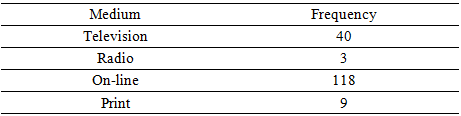
In Table 1, the data show that student-journalists are most engaged with online platforms (118), followed by television (40), while radio (3) and print (9) are minimally used. This reflects the global shift toward digital-first journalism, where AI tools are predominantly integrated into online environments to enable rapid news production and personalized content delivery 1, 5. Traditional media’s limited AI adoption is often due to structural and financial constraints 6, The higher education student-journalists at St. Rita’s College of Balingasag who actively contribute to campus publications—mirror emerging trends in journalism education, as they are significantly more exposed to online journalism than to traditional media, positioning them to engage most with AI-driven innovations in digital newsrooms.
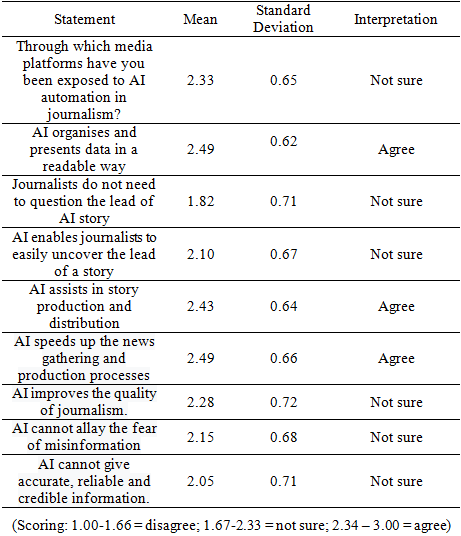
3.2. How Knowledgeable Are Journalism Students About AI Technology ?In Table 2, with an overall mean of 2.24 (“Not sure”), findings suggest partial literacy among student-journalists: they recognize AI’s functional benefits, such as organizing data (2.49), assisting production (2.43), and expediting processes (2.49), but remain uncertain about its reliability, accuracy, and ability to improve journalistic quality. This aligns with literature indicating that journalism curricula often lack comprehensive AI training, leaving students familiar with basic applications but uninformed about deeper technical and ethical dimensions 2, 3. St. Rita’s College of Balingasag higher education student-journalists likely encounter AI informally—through social media algorithms or automated content tools—yet lack structured educational exposure, underscoring a gap between experiential familiarity and critical understanding essential for journalism practice.
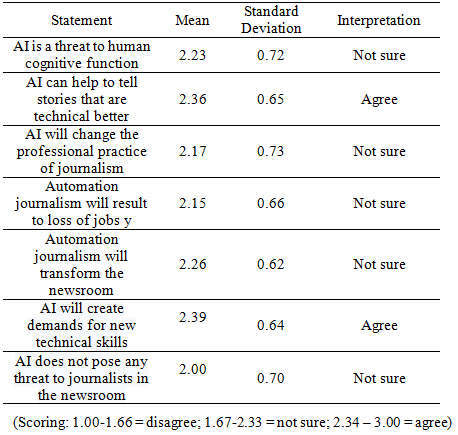
3.3. What Are Journalism Students’ General Perceptions (Trust, Usefulness, Concerns) Toward AI Automation in Journalism?In Table 3, overall mean of 2.22 (“Not sure”) reflects ambivalence: students agree that AI enhances technical storytelling (2.36) and necessitates new skills (2.39), but they are uncertain about its broader implications, including job loss, newsroom transformation, and ethical risks. Research shows similar mixed sentiments globally, where AI is perceived as both a transformative tool and a potential threat to professional norms, amplifying concerns over bias, misinformation, and diminished human judgment 4, 6, 5. As future journalists trained in a context with limited AI curriculum integration, participants embody a transitional cohort—optimistic about AI’s utility yet grappling with unresolved anxieties about its impact on journalism’s democratic and ethical foundations.
The findings depict student-journalists as highly immersed in online platforms where AI thrives, yet possessing only partial knowledge and ambivalent perceptions of AI’s role in journalism. St. Rita’s College of Balingasag student- journalists’ exposure positions them to engage directly with AI-driven innovations, but their limited structured training restricts their ability to critically assess and ethically navigate these technologies. These results echo global observations that emerging journalists are simultaneously the most digitally connected and the least institutionally prepared to confront AI’s complexities 1, 3, 5. Addressing these gaps through comprehensive curriculum integration will be essential to equipping this generation with the technical skills and ethical frameworks needed to sustain journalism’s credibility and societal function in an AI-driven era.
• Student-journalists predominantly engage with online platforms (118), followed by television (40), while radio (3) and print (9) are minimally used.
• Reflects the global shift toward digital-first journalism, where AI tools are most integrated.
• Traditional media’s limited AI adoption is due to structural and financial constraints
4.2. Knowledge of AI Technology• Partial AI literacy (mean = 2.24, "Not sure"): Students recognize AI’s functional benefits but are uncertain about its reliability, accuracy, and quality enhancement.
• Curriculum gaps in AI training leave students with informal exposure but lack critical understanding
4.3. Perceptions of AI• Ambivalent attitudes (mean = 2.22, "Not sure"), students acknowledge AI’s utility in storytelling (2.36) and skill demands (2.39) but worry about job displacement, ethical risks, and loss of human judgment.
• Mirrors global tensions—AI is seen as both a tool for innovation and a threat to journalistic norms.
The findings of this study indicate an urgent need for journalism programs to build AI literacy across the curriculum, combining practical tool skills with critical reflection on limits, bias, and ethics. Programs should teach hands-on competencies (e.g., prompt design, data-journalism methods, verification workflows) while simultaneously embedding modules that train students to evaluate model outputs, identify algorithmic bias, and apply ethical judgement to automated reporting 9.
To implement this, curricula can follow an “AI-across-the-curriculum” approach that integrates short, discipline-relevant AI units into existing courses (data journalism, news writing, media law) rather than relying solely on an isolated elective. This distributed model increases exposure, supports transfer of skills, and reduces the resource burden of creating entirely new degree tracks. 10. Faculty capacity building is essential: targeted professional development, peer communities of practice, and small applied research projects enable instructors to translate evolving industry tools into safe classroom assignments and assessments. Evidence shows that teacher development and scaffolded classroom use of generative tools improve students’ critical engagement with AI outputs and support more reliable learning outcomes 9. Finally, curricular reforms should foreground experience-based learning: supervised newsroom partnerships, internships, and project-based assessments (graded portfolios of AI-augmented reporting) help align teaching with newsroom workflows and ethical editorial practice. Such practice-focused learning both prepares graduates for contemporary newsroom roles and creates safer contexts for students to learn how and when to use automation responsibly 11.
This study concludes that while student-journalists at St. Rita's College of Balingasag demonstrate strong engagement with digital platforms where AI tools are prevalent, they exhibit only partial understanding and ambivalent perceptions of AI's role in journalism, recognizing its efficiency benefits but remaining uncertain about its reliability, ethical implications, and potential job impacts. This concern mirrors the risks posed by AI-generated deepfakes, where susceptibility to deception varies across demographic and ideological groups, as shown by 12, highlighting that technological proficiency alone is insufficient; critical evaluation, ethical reasoning, and institutional preparation are essential to safeguard truth and trust in an AI-mediated information landscape. These findings reveal a critical gap between students' digital immersion and their institutional preparation for AI-driven journalism, mirroring global challenges in journalism education. To address this, journalism programs must urgently integrate comprehensive AI training that combines technical skills with ethical reasoning, emphasizing human-AI collaboration and localized perspectives, while fostering faculty development and industry partnerships to ensure curricula remain relevant. By bridging these gaps, institutions can empower future journalists to harness AI's potential responsibly, maintaining journalism's core values of accuracy and public trust in an increasingly automated media landscape.
| [1] | Banafi, W. (2024). A review of the role of artificial intelligence in journalism. Edelweiss Applied Science and Technology, 8(6), 3951-3961. | ||
| In article | View Article | ||
| [2] | Setyanto, D., Jufri, M.T., & Laksmini, P. (2025). Analisis Pengetahuan Mahasiswa Mengenai Kecerdasan Buatan Berdasarkan Karakteristik Individu. Jurnal Teknik Informatika dan Teknologi Informasi. | ||
| In article | View Article | ||
| [3] | Sivira Camacaro, R. (2025). La formación universitaria de periodistas en el contexto de la Inteligencia Artificial: una revisión sistematizada. Doxa Comunicación, (40). | ||
| In article | View Article | ||
| [4] | Guanah, J. S., Agbanu, V. N., & Obi, I. (2020). Artificial intelligence and journalism practice in Nigeria: Perception of journalists in Benin City, Edo State. International review of humanities Studies, 5(2), 16. | ||
| In article | View Article | ||
| [5] | Anwar, S., Khan, S. R., Nasir, T., & Azeema, N. (2025). The AI revolution in media, redefining journalism education and professional practice from classroom to newsroom in Pakistan. Annual Methodological Archive Research Review, 3(4), 340-354. | ||
| In article | View Article | ||
| [6] | Chen, J. (2025). The Transformation of Journalism in the Era of Artificial Intelligence and Practitioners Perspectives on Human-Machine Interaction. Communications in Humanities Research. | ||
| In article | View Article | ||
| [7] | Aggarwal, R., & Ranganathan, P. (2019). Study designs: Part 2–descriptive studies. Perspectives in clinical research, 10(1), 34-36. | ||
| In article | View Article PubMed | ||
| [8] | David, A. M., Momodu, H. M., & Markson, T. A. O. M. K. (2022). CHAPTER TWENTY TWO ARTIFICIAL INTELLIGENCE: KNOWLEDGE, PERCEPTIONS AND RECEPTION OF AUTOMATION IN JOURNALISM PRACTICE IN KADUNA STATE. Discourses on Communication and Media Studies in Contemporary Society, 171. | ||
| In article | |||
| [9] | Tzirides, A. O. O., Zapata, G., Kastania, N. P., Saini, A. K., Castro, V., Ismael, S. A., ... & Kalantzis, M. (2024). Combining human and artificial intelligence for enhanced AI literacy in higher education. Computers and Education Open, 6, 100184. | ||
| In article | View Article | ||
| [10] | Southworth, J., Migliaccio, K., Glover, J., Glover, J. N., Reed, D., McCarty, C., ... & Thomas, A. (2023). Developing a model for AI Across the curriculum: Transforming the higher education landscape via innovation in AI literacy. Computers and Education: Artificial Intelligence, 4, 100127. | ||
| In article | View Article | ||
| [11] | Dodds, T., Zamith, R., & Lewis, S. C. (2025). The AI turn in journalism: Disruption, adaptation, and democratic futures. Journalism, 14648849251343518. | ||
| In article | View Article | ||
| [12] | Tidler, Z. R., Pereira, T., Lumacad, G., & Catrambone, R. (2022). Assessing Deepfake Video Detection Ability Using Unsupervised Machine Learning. In Proceedings of the Annual Meeting of the Cognitive Science Society (Vol. 44, No. 44). | ||
| In article | |||
| [13] | Amisha, 1,; Malik, Paras1; Pathania, Monika1; Rathaur, Vyas Kumar2. Overview of artificial intelligence in medicine. Journal of Family Medicine and Primary Care 8(7):p 2328-2331, July 2019. | ||
| In article | View Article PubMed | ||
| [14] | Garg, P.K. (2021). Overview of Artificial Intelligence. Artificial Intelligence. | ||
| In article | View Article | ||
Published with license by Science and Education Publishing, Copyright © 2026 Marene A. Baslao and Godilla K. Abejaron
 This work is licensed under a Creative Commons Attribution 4.0 International License. To view a copy of this license, visit
http://creativecommons.org/licenses/by/4.0/
This work is licensed under a Creative Commons Attribution 4.0 International License. To view a copy of this license, visit
http://creativecommons.org/licenses/by/4.0/
| [1] | Banafi, W. (2024). A review of the role of artificial intelligence in journalism. Edelweiss Applied Science and Technology, 8(6), 3951-3961. | ||
| In article | View Article | ||
| [2] | Setyanto, D., Jufri, M.T., & Laksmini, P. (2025). Analisis Pengetahuan Mahasiswa Mengenai Kecerdasan Buatan Berdasarkan Karakteristik Individu. Jurnal Teknik Informatika dan Teknologi Informasi. | ||
| In article | View Article | ||
| [3] | Sivira Camacaro, R. (2025). La formación universitaria de periodistas en el contexto de la Inteligencia Artificial: una revisión sistematizada. Doxa Comunicación, (40). | ||
| In article | View Article | ||
| [4] | Guanah, J. S., Agbanu, V. N., & Obi, I. (2020). Artificial intelligence and journalism practice in Nigeria: Perception of journalists in Benin City, Edo State. International review of humanities Studies, 5(2), 16. | ||
| In article | View Article | ||
| [5] | Anwar, S., Khan, S. R., Nasir, T., & Azeema, N. (2025). The AI revolution in media, redefining journalism education and professional practice from classroom to newsroom in Pakistan. Annual Methodological Archive Research Review, 3(4), 340-354. | ||
| In article | View Article | ||
| [6] | Chen, J. (2025). The Transformation of Journalism in the Era of Artificial Intelligence and Practitioners Perspectives on Human-Machine Interaction. Communications in Humanities Research. | ||
| In article | View Article | ||
| [7] | Aggarwal, R., & Ranganathan, P. (2019). Study designs: Part 2–descriptive studies. Perspectives in clinical research, 10(1), 34-36. | ||
| In article | View Article PubMed | ||
| [8] | David, A. M., Momodu, H. M., & Markson, T. A. O. M. K. (2022). CHAPTER TWENTY TWO ARTIFICIAL INTELLIGENCE: KNOWLEDGE, PERCEPTIONS AND RECEPTION OF AUTOMATION IN JOURNALISM PRACTICE IN KADUNA STATE. Discourses on Communication and Media Studies in Contemporary Society, 171. | ||
| In article | |||
| [9] | Tzirides, A. O. O., Zapata, G., Kastania, N. P., Saini, A. K., Castro, V., Ismael, S. A., ... & Kalantzis, M. (2024). Combining human and artificial intelligence for enhanced AI literacy in higher education. Computers and Education Open, 6, 100184. | ||
| In article | View Article | ||
| [10] | Southworth, J., Migliaccio, K., Glover, J., Glover, J. N., Reed, D., McCarty, C., ... & Thomas, A. (2023). Developing a model for AI Across the curriculum: Transforming the higher education landscape via innovation in AI literacy. Computers and Education: Artificial Intelligence, 4, 100127. | ||
| In article | View Article | ||
| [11] | Dodds, T., Zamith, R., & Lewis, S. C. (2025). The AI turn in journalism: Disruption, adaptation, and democratic futures. Journalism, 14648849251343518. | ||
| In article | View Article | ||
| [12] | Tidler, Z. R., Pereira, T., Lumacad, G., & Catrambone, R. (2022). Assessing Deepfake Video Detection Ability Using Unsupervised Machine Learning. In Proceedings of the Annual Meeting of the Cognitive Science Society (Vol. 44, No. 44). | ||
| In article | |||
| [13] | Amisha, 1,; Malik, Paras1; Pathania, Monika1; Rathaur, Vyas Kumar2. Overview of artificial intelligence in medicine. Journal of Family Medicine and Primary Care 8(7):p 2328-2331, July 2019. | ||
| In article | View Article PubMed | ||
| [14] | Garg, P.K. (2021). Overview of Artificial Intelligence. Artificial Intelligence. | ||
| In article | View Article | ||