This research strategizes first personal pronouns as symbolic writing identities in soliciting author voices through EFL students’ writing. It sets curricular and pedagogical steps to create an ‘I Write’ position through autobiographical projects. It is anticipated a transfer of such writing agency authorized by the singular first-person lexicon to argumentative writing context. A comparative analysis of the autobiographical writing projects and the argumentative essays has calculated the self-position by lexical options between ‘We’ and ‘I’. The result reveals that students interchangeably use plural and singular personal pronouns for writing positions and voices. It shows that such interchangeability appearing as lexical act meanwhile illuminates the writers’ reluctance to claim independent thinking that is necessary for English writing. This suggests writing pedagogy should aim at the issue of such interchangeability between the singular and plural forms of the personal pronouns in order to leverage an ‘I Write’ authorial identity for academic voices.
It has long been a curriculum and pedagogy effort to cultivate students’ English writing proficiency in higher education, especially in the context of English as a Foreign Language (EFL) 1, 2, 3, 4 5, 6, 7. To understand the complexity of developing student writing competence in the EFL context, research literature on university student writing and its teaching has come up with an overarching and agreeable approach, that is to evoke student creative and critical academic skills through building a writing identity accountable for writing act 3, 5 8, 9. The writing identity is understood a kind of agency that brings out a distinct voice from writers 10. A clear and strong writing voice usually comes from a conscious and practiced writing self 4. Yet, developing student writing roles and voices through pedagogy and curriculum needs to deal with a few contextual factors different from their peers who use English as their native language 7.
The first is to consider the EFL students’ previous writing experience. Illuminated by Zhao 7, the EFL students’ previous writing is merely with writing in their first language. Upon their entry to university, they had almost zero writing experience in English 11. The proficiency established through their learning of English as a foreign language does not come from writing itself. That is to say, their English writing has to start from scratch, yet, their English capacity is usually sufficient for basic writing, and for them to be prepared for academic writing in their university studies.
The second is for pedagogy to wrestle for the EFL students’ independent and critical thinking, which is often interfered by the writing in their native language, such as Chinese, Japanese, or Arabic etc. 12, 13, 14, 15. The writing instruction needs to recontextualize and build students’ rhetorical and cultural habitus in English for a new writing identity 3 12, 14. Such recontextualization from language learning and transformation of their first-language writing to meaningful writing in another language meanwhile points to a necessary relocation of the writing self. Thus, the writer presence and the writing roles could follow the culture of written English discourse in order to produce original and meaningful content with English rhetorical conventions and though patterns.
The third contextual factor that effects on students’ English writing also lies in the settings of instructions, where the expatriate instructors of English-speakers and the local scholars are both active in the field of writing instructions. Usually, it is those who knows both the students’ native languages and cultures that could delve into the deep-rooted barriers and gaps for the learning of writing 6 16, 17. The instruction is supposed to deal with the cultural and ideological issues in cultivating student writing identity that works not only in English language, but also in the English traditions of written discourse in different contexts. For instance, Zhao, Fei and Lin 6 have activated pedagogical agency to generate cultural and conceptual leaps for the transition and transformation between the writer presence as “We”, a pronoun rooted in the Chinese EFL students’ background culture and rhetorical tradition. They advocated auto/biographical strategies for students to study from their home cultural self to perform a writer’s independent thinking with a clear viewpoint signified by the lexical use of “I”, demanded by the English discourse traditions. Reported in their research, they claimed (i.d.):
“Once this conceptual awareness has been achieved, the individual viewpoint can be elicited and articulated in student writing of narrative accounts. Biographical narrative accounts of personal experience are found to have a creative and self-actualizing force in forming the individual’s identity, using his/her original voice for writing.”
When the writing person is relocated in a new language and discourse system, the actual writing relies not only on the lexical representation but also a new way of being a writer. The writing self thus needs to be reconstructed and identified.
The enduring issue of relocation of the writer self across languages and cultures for writing, no doubt needs more purposeful pedagogical interventions in order to help student writers realize the writing roles with authorial voices. This demands both curriculum and pedagogy’s active plans to relocate the writing person in a position that can produce meaningful texts through their own voices beyond their native language and culture. The authorial positions and voices have thus become the locus of research for writing identities in recent decade 5, 18. At the same time, the set-up of various writing courses can be important opportunities for university students to socialize into the academic environment and engage with intellectual activities, through taking an active role and performing with authorial voices in the context of writing for academic purposes 5, 7.
This research on writing identity and authorial voice thus intertwines with curricular and pedagogical practice in the EFL context. It continues to reveal the complicity in soliciting and sustaining the authorial voice from student writers. The research question of this paper explores how writing pedagogy helps student writers initiate authorial identities through purposeful autobiographical projects and sustains to build stronger argumentative voices?
We focus on a research project of purposeful pedagogical steps in dealing with the writing identity and voice issues at the macro-contextual level as writing cross-languages and cultures. At the micro-contextual level, we will analyze the student writer’s actual rhetorical act of authorial roles exercised in their essays throughout a writing course in a Chinese university. An autobiographical strategy is adopted to forefront the author’s lexical presence as ‘I’ and familiar topics for argumentative writing projects are implemented for potential sustainable reinforcement of the authorial voice.
Writing is regarded “a reflexive project of the self” 3, 10 19, 20. The writing identity as part of the foundation for writing contributes critically to all writing products. The act of writing is conducted through how the writing person positions him/herself in the writing space. Consequently, the products of writing provide an open venue to research about how the writing person acts with the author presence through his/her voice 21. Writer identity plays an active role in creating discourse thus becomes a critical object for analysis.
2.1. The Centrality of Identity as Agency for WritingIvanić’s research 10 on writer identity as writing agency via writer presence within the academic text, uncovers that native English academic writers often perform the writing role and realize their writing identity through a three-dimensional writing act in validating their academic voice and authority. She claims that the authorial writing self plays various writing roles, manifested as namely: “the autobiographical self”, where the writer is relying on his/her authentic experience or personal voice to make transparent the origin of their beliefs and values that influence and shape their writing. It builds credibility with traces accountable for originality of the text. The second role the writer identity plays is “the discoursal self”, where the writer comes to the forefront to make clear the generic, rhetorical and stylistic choices for organizational devices in making the discourse, thereby acting as the “architect” of the writing and also as a “guide” for readers 20. The third dimension of the writing identity plays out the writer’s “authorial self”. It is a role that the writer intrudes into a text and claims responsibility for its worth and contributions to the field 5.
Matsuda 8 asserts that Ivanić’s 10 research on these dimensions of writer identity constitute “possibilities for selfhood” that writers draw on their socially available identity and discursive resources for writing. As such, the writer’s social self and personal identity have various roles to play for the quality and authority of the written discourse. Identity as the writer’s self-presence of writing is thus a crucial constituent of the credibility and agency of writing and authority of the written discourse 3, 8.
2.2. Multiple Voices in EFL WritingIvanić’s research has built an important framework for the understanding of the complex identity matters for academic purposes. This view of multiple dimensions on author identity elicited from native-English-speaking writers’ academic work, functions as an important base for the study on how the self of writers act as writing agency and how to solicit such a role of agency for writing tasks in the EFL context. However, the author self and authorial voice based on the writer’s selfhood and writing tasks presented in English academic writing acted by English native speakers does not automatically exist with EFL writers, particularly with the beginning writers.
Another frequently used a reference, for example, is Fan’s personal writing experience 13. He recorded his journey of mastering English composition which illustrated how his identity was adapted from his Chinese home culture to the new English writing system, that involves developing a new cultural schema of self-conception and presentation. This exemplar transformation of the writing self across cultures and languages is in fact a redefinition and social repositioning of the learner and writer in the English lexical system. The successful reformation of the writing self is critical for meaning making in writing in another language 3, 9. This is because the English ideological and linguistic system to be adopted by the EFL students has a different cultural and social framework that requires a depth understanding, and personal inclusion of a new social self, linking rhetorical act to conceptual forms, such as “individualism”, “idealism” and the connotation of the personal pronoun “I” for an English authoring position 5, 17. This may pose major pedagogical difficulties in directing students to acquire a new writing identity through the rhetorical act.
The seemingly lexical issue with the personal pronoun ‘I’ draws writing scholars’ energy to cultivate student writing self and agency through critical pedagogy in the EFL contexts. With conscious effort, Yang 16, Zhao, Fei and Lin 6 have been activating autobiographical projects to solicit writing agency for English compositions. They have implemented autobiographical writing tasks to lay out the foundation for student writers to exhibit authorial presence by becoming natural for using the lexical ‘I’ to signify the writer presence in the text. According to Yang’s analysis 16, there are two elements of ‘I’ identity generated by autobiographical writing which are conceptualized as “English-writing-mediated-identities” and the “writer identity”. Yang’s 16 analytical distinction sees the former an identity based upon conclusions student writers have made about themselves as the subject of writing also as a societal person. It is the writing subject and content the student writers find about themselves, such as immigrants, computer geeks, or book lovers and so on. The latter, however, is a personal identity EFL writers manifest or demonstrate themselves as writers in English, this aspect of writer identity acts as the writing agent, the actual person who draws resources of the subject to write the text.
The autobiographical writing generates dual identities with the first personal pronoun ‘I’ that has several peculiar characteristics and enduring force for identity awareness and agency of writing 14, 16 22. The notion of English-writing-mediated-identity ‘I’, as a person to be written, and the ‘I’ as a writing person who writes, multiply the writer self in different positions, constructed through writing ideas and the writing person via the content and context of the writing. Thus, the authoring self takes upon a “double existence” persona via the “voices” generated in the autobiographical text 22.
That is to say, through engaging in autobiographical writing tasks, the writer is creating several layers of him/herself within the textual media which poses a strong individual identity that is upright for writing. The dual identity and prescribed voicing mechanism made and recorded within the autobiographical text constrains the writer to writing with a position of ‘I’. A new layer of the reflective self who generates a new and personally aware ‘voice’ as the writer self could be created in such conscious act of text production 22.
The autobiographical text is therefore recognized as a unique and fertile place for raising self-awareness through meta-conversational reflections and introspections within an authoring environment. Such an authoring project embeds and enhances the presence of self for inclusion within English writing, thus functioning as a foundation for English writing proficiencies 13, 16. Autobiographical approach can be strategically applied to laying down the base of self as a writing agent and self-knowledge as writing resources, where the personal pronoun ‘I’ is recognizable for writing.
2.3. The Ideological Gap Distinguished Through Micro-lexical ChoicesHowever, the culturally, and mostly, ideologically acquired EFL students’ default identity “We” carries a value system comfortable within their home culture turns out to be indirect self-presentation in English writing. Reflected by the lexical choice of the personal pronoun, may weaken the writing voice of originality 5 12, 23. As Hyland’s study 5 revealed, Hong Kong university students’ final-year-research reports an insufficiency in the use of the “authorial self” signified by the first-person pronoun ‘I’ in their writing tasks, thus it deteriorates the overall quality, originality and authority of their writing. Specifically, he uncovers that in the single-authored theses that were examined, plural forms of the pronoun “We” were in more common usage than the singular self-mention word “I”. It manifests a vague and weak writing identity through the options of rhetoric at the level of micro-linguistic acts of personal pronouns 5 24, 25. Such deny of an authentic writing self due to cultural constraint thus declines the sense of ownership of writing, because it indicates a missing frame of critical and original thinking for writing as independent and original author act 23.
The conflicting voices of different norms and models of writing identities cross cultures often make EFL student writers feel uncomfortable with the subjectivity and assertiveness, an indicator of authority that the singular first personal pronoun ‘I’ brings up, and instead they seek the stylistic distance and withdraw to a ‘comfort zone’ that the meaning of plural ‘We’ allows 5. Using the term ‘We’ reduces their sense of personal intrusion, while not completely eliminating their writer responsibility from the text 5, 8 25. This linguistic distancing with the lexical choice of “We” exposes the culturally embedded “ideological gap” from the writing authority and proficiency that the singular pronoun “I” stands in English writing 5, 15 25, 26.
2.4. The Conceptual Leap Through Pedagogical AgencyThe ideological gap exhibited by linguistic choices marks the stability of most EFL students’ home ideology or resistance to the English writing ideology 25. English writing needs further curricular and pedagogical bridging for EFL student writers to perform necessarily as an individual that is accountable for English cultural and lexical agreements and conventions 9 14, 25. Yet, this typology of gap appeared in ideological and lexical options serves as the major barrier that distinguishes between the two predominant ideologies and cultures of EFL students’ native cultures and English culture, of different values reflected in the use of different personal pronouns in writing. Student writers need conscious transformation and disaffiliation of their native cultural identity through the lexical realization signified by the word ‘I’, aligning its ideological value system to be accountable for the originality of the writing ideas. As Yang 16 advises, when the EFL writer writes, he/she needs to imagine him/herself as a writer working out their ideological positions through having a dialogue with themselves as ‘We’ and “the others” word ‘I’, the English writing person. With this word, the student recontextualizes the writing self for the English “discourse function,” serving as the ideological change for “ideological becoming” of an English writer. In this becoming, the student writers come and hold the writing position and acting critically for producing original texts and essays in English.
This “ideological becoming” to be an English author accepts the different ideology of “others” and is achieved through “struggle”, in which the writer strives to write beyond their native ideological constraints 16. This cultural adapting process critically affirms and negotiates with others’ verbal approaches and values, and then embeds this new learning into the writing for communication with the target language audience 13.
Zhao, Fei and Lin 6, see also Gui, 23 sensed the potential in their research, to turn this ideological gap distinguished by self-identity positions in writing into a new curricular and pedagogical advance. As discussed earlier, this line of research relied on autobiographical strategies for the ‘I’ write foundation when English writing is learned in the EFL context. They further suggest that researchers convert this gap into a “developmental zone” for learning . Critical EFL writing pedagogy can assist EFL student writers to make “the conceptual leap” in understanding the difference between the group and the individual cultural identities, and the conventions of writing between the first language and the foreign language. The conceptual leap requires a deep understanding of the ideological implications and meanings of the lexical choices, e.g. the use of first person pronouns of ‘We’ and ‘I’. The leap from one to the other demands the pedagogical strategy in scaffolding the cultural shift to make a writer in the target language, by repositioning the students’ writing self from the default use of ‘We’ to the individual and ontological assumption of ‘I’ for writing 13, 22. Thus, the student writer’s “ontological capacity” is expanded 14, and it leverages “possibilities for an enhanced range of identity options in the future” for writing between languages and cultures 16, 20.
The above review has recognized the centrality of writer identity and voice as agency for effective writing across languages and cultures, which involves not only lexical but ideological transitions and transformations of the self who writes across languages and cultures. The literature suggests ways for both pedagogical and lexical agencies for realizations of an English writing identity for authorial voices. In order to leverage and arrive at the ‘I Write’ position of authors among EFL students, as mentioned earlier, autobiographical writing has been meaningful first steps 6, 16.
This paper continues with the venture of positioning student writers for the ‘I Write’ voice and identity, cultivated through key writing skills, e.g. explicating writer roles and making strong writer presence through autobiographical exercises for more argumentative purposes. In what follows, we are to analyze the autobiographical essays and argumentative essays produced by students from an English course.
Our research is applied to and based on a writing course designated for freshman students in a Chinese university. The course is to build EFL students’ English writing for communication skills through the creation of students’ ideas 6 14, 27. The course is also bridging the undergraduate students for academic writing afterwards. The purpose is to develop student original ideas and their own voices through written communication. The course lasts for 16 weeks of a semester for each academic year, with two contact hours per week. The curriculum includes three main writing projects as part of the course content arranged, namely: a student self-introduction; a personal statement for applications; and, an argumentative essay with a topic on Chinese educational issues.
The first half of the course has incorporated ideas of autobiographical writing and topics of personal experience as a pedagogical tool, for students to exercise English writing as a means of familiarizing the self in order to become comfortable with the use of writing subject ‘I’ and self-knowledge for original ideas when writing other topics 7. The autobiographical genre is implemented as a strategy to solicit writing materials and details over which students have authority. Yang 16 defines autobiographical writing as “writing about any aspects of one’s own life”, while Zhao 7 conceptualizes such selection for writing tasks as topic familiarity for rich topic knowledge with deep understanding. Yang 16 has acknowledged that “autobiographical” and “argumentative” writings are of different genres, yet both can be meaningful for academic purposes. In this course, with the autobiographical writing projects as first few steps, we also planned an argumentative writing project for students to choose a topic focus and elaborate on a Chinese social and cultural issue of education with a viewpoint, which is the major assignment for the course assessment.
In this writing course, rhetorical practices and discourse structures are arranged progressively in the curriculum design and pedagogical considerations. From studying the logic of words, how sentences work with the one-paragraph essay, to synthesizing a main idea, a personal statement for applications, and to writing the argument essay for the third project, the course tries to strike a balance act on both content and format matters with basic writing knowledge. Relevant writing support materials were handed out to the students as references and examples. All the assignments from the three projects have produced three versions of drafts, e.g. the first draft, and then the second and the third drafts revised to feedback comments as part of the course’s built-in formative assessment. This research reports the analysis of the first personal pronouns as indication of the author identity and presence over the autobiographical project to the argumentative project. The contrastive outcomes play a critical part to observe the pedagogical effect on cultivating students’ writing agency.
3.2. The Analytical FrameworkOur analysis of students written essays is based on the analytical framework established for evaluation on the writing voice by Shavelson et al. 28. They have proposed a typology of seven features critical to discerning self–presence as writing “identity” constructs in English writing highlighted by the lexical presence of self-references. The functions of the writing self are described by Shavelson et al. 28 to have seven characteristics, namely: “organized, multifaceted, hierarchical, stable, developmental, evaluative, differentiable”.
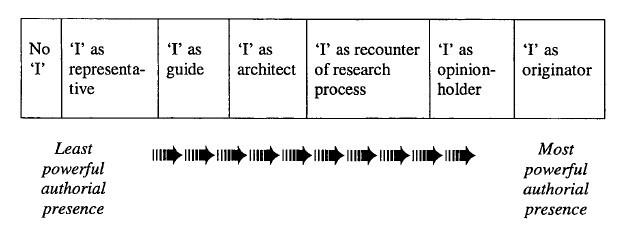
These seven characteristics are further connected with the configuration of writer identity performance created by Tang and John (1999) in a table, listing seven roles that the first-person pronoun ‘I’ played within tasks in English writing (see Figure 1). These roles are ranked hierarchically from the least to the most powerful authorial presence, which is used to see how the student writers integrate the linguistic form of the personal pronoun ‘I’ as the authoring self to organize and present their ideas and voices.

We applied this analytical scheme to analyze how the student writer acts as the writing self in performing the role of a writer through their signification and use of personal pronouns. It enables researchers to operate a clear investigation on identity acts by numeric accounting for the net number of ‘I’ and ‘We’ categories of currencies in the writing assignments. This, in the study, is accompanied by a qualitative interpretation to assess a sense of authorship and the process of the student’s aligning with the intellectually encouraged character in the context of English writing and the academic environment.
We created three normalized formulas illustrated below to produce evidence for us to observe and analyze the identity transfer as mediated by the particular curriculum and teaching. The quantized analysis was first to account for key words of the individual pronoun ‘I’ and the collective pronoun ‘We’. This is illustrated in the following Formulas 1 and 2 in quantizing the normalized frequency of the nominative first personal pronouns:
Formula 1:
 |
Formula 2:
 |
With the numbers derived from ‘I%’ and ‘We%’, a new net percentage is produced through
Formula 3:
 |
The calculated percentage of the lexicons ‘I’ and ‘We’ is further presented as ‘I%’ and ‘We%’, which means the frequency the words ‘I’ and ‘We’ appear in the writing texts regardless of the length. The occurrence is calculated by the number of ‘I’ and ‘We’ in analysis and is normalized by dividing it via the total number of words in essays through Formula 1 and 2, to show an objective frequency ‘I%’ and ‘We%’ that appears without the influence brought by the length of the essay.
For instance, the 2rd version of self-introduction by No. 10 student, the total number of the words in the essay is 157, and there are 4 ‘I’s and 3 ‘We’s occurred in the essay. Thus, the percentage of the frequency signified by the word ‘I’ is 2.55%, i.e. ‘I%’ = 4/157 = 2.55%.
In the same way of calculation, the frequency signified by the word ‘We’ is 1.91%, i.e. ‘We%’ = 3/157, with the result being 1.91%.
With the numbers derived from ‘I%’ and ‘We%’, a new net percentage is produced through ‘I%-We%’. This formula makes it obvious to discern the direct degree of the writing self-reference with these two first personal pronouns, including the ‘I’ being the written subject in autobiographical writing. In the above case, the new percentage is derived through the following calculation:
 |
That is to say, the result of percentage through the calculation by the formula ‘I%-We%’ is 0.64%. It is a positive number. This can be interpreted and means that the writing identity signified by the word ‘I’ rises above the ‘We’ identity category in general; while on the other hand, if the result calculated through ‘I%-We%’ comes out as a negative number, it means the reverse case, i.e. the group identity over performs the individual category, which signs a weak and vague writer role, as the writer him/herself is hiding away for the writing task in the single authored essay.
Besides the quantized analysis of frequencies of personal pronouns, a detailed qualitative text analysis was also conducted. The qualitative analysis of the students’ narrative accounts offers a rich background and process of their learning to write in English. It helps us to see how the writer’s self-identity activated in the self-writing projects is transferable to produce argument in non-autobiographical writing tasks, which uncovers the complex learning process in mediating students’ identity for writing 13, 16, 17.
This analytical tool is applied to analyzing a database with students’ writing materials and products which provides a baseline for this research. 27 students’ written texts produced through the course were collected and filed for analysis. The writing products were then classified and coded under different writing projects and different writers, which were put into a table to form an integrated writing material database. The self-introduction was coded as ‘SF’, personal statement ‘PS’ and cultural topics for writing ‘CW’. Both ‘SF’ and ‘PS’ data refers extensively to the participant’s life and contains a strong involvement of story telling as autobiographical writing. We further coded these two writing assignments as ‘Self-Writing’ thereafter. All the participants were anonymous and numbered randomly from No. 1 to No. 27, the three versions of each assignment were coded as V1, V2 and V3. But the correspondence between the participants and their assigned numbers were fixed for the whole research process and with different version numbers for analysis.
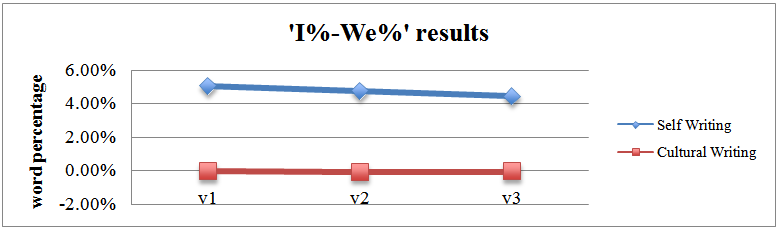
The analysis with statistic and interpretative methods of the collected texts from assignments over the semester, not only ratifies the persistent identity issue emphasized through the lexical options, but also shows the complex nature of self-conception as signs of authorial agency in the context of EFL writing. We found the analytical formula tool educed by the analytical framework produced fruitful results. The quantized overall finding of ‘I%-We%’ in self-writing texts comes out as nearly 5%, positive, while the ‘I%-We%’ is close to 0 in argumentative writing, which means the ‘I%’ equals ‘We%’, as shown in Figure 2. This is consistent with our qualitative examinations.
The analysis shows that the general overall result calculated through the formula of ‘I%-We%’ from the self-writing projects was positive, that is to say, in the self-writing tasks, the number of the word ‘I’ occurrences outperforms that of the word ‘We’, given the nature of the writing task is based on their personal narratives and self-stories. No doubt, this calculation includes the ‘I’s occurred as the topic of the self-writing, which means the number of ‘I’s is valid for the dual or double self-mentioning as a writer and as the topic representation in autobiographical writing 16, 22.
The result also finds that there is still a high frequency of usage with the first plural pronoun ‘We’ as identity category and position in the self-writing tasks, in this case, in the writing projects of self-introduction and personal statement. According to the frequency analysis of self-writing, the average usage of self-mention ‘I’ as both the person who writes and as the self to be written about, is approximately 5% more than self-mention ‘We’ positive, as shown in Figure 2 below by the upper line. This result suggests that the purposeful autobiographical approach to an ‘I Write’ agency for essay writing does produce some positive writer presence.
The overall pedagogical aim is to transfer that authority facilitated through self-writing tools to argumentative writing, both being important writing genres for academic purposes.
The analysis of the final writing project shows that, the total ‘I%-We%’ result of the argumentative writing texts from the cultural writing (CW) project, with three versions calculated, is nearly 0. This means that the number of the individual pronoun ‘I’ is nearly equal to that of the collective and plural pronoun ‘We’ (as shown by the lower line in Figure 2).
12 of the 27 students’ cultural writing tasks, showed that the total ‘I%-We%’ emerged as negative numbers and the lowest ‘I%-We%’ figure reached to -1.28% (Student No. 25, CW.V.1).
The qualitative analysis of all the assignments shows that the first personal pronouns, both singular and plural forms in self-writing are prevailingly of “English-writing-mediated identity” 16, referring to i.e. the self as the subject and topic of writing in self-writing, as reflected in the following sentences:
“My name is XXX. I am from XX Foreign Languages School and now I am a student of Zhejiang University (No. 17, SF. V.1).”
The ‘I’ in the text refers to the self as the written topic. This is intertwined with the writing self as a writer. Within the autobiographical project, English-writing-mediated identity markers embedded in the topic of self-introduction and personal statement, are also overlapping with exchangeable use of ‘We’ and ‘I’. For examples:
“In 2015, I participated in the exchange program and went to England. During these two weeks, I walked into the English classroom, carried out interactive learning. We did have a happy two-week time there with students from all over the world.” (No.19, PS. V.1)

“I’m also an adaptable person. There is always something new and sometimes we are not able to change it.” (No.13, SF.V. 2)
“I never reject problems that confront me, always making my every endeavor to tackle them. From my point of view, life is inevitably filled with obstacles, from which we cannot escape.” (No.16, SF. V.1)
The narrative of personal experience is usually led and claimed by the lexis ‘I’. Yet, the narrative excerpts also find an obvious switch of the linguistic code from ‘I’ to ‘We’ position, which could be understood as the autobiographical writing projects does provide a space for the student to come to terms with lexical self of ‘I’, but often feeling uncomfortable with the distinct it evokes and then interchange back to a definitional vagueness that ‘We’ can tolerate. This does include the occasion when the writing self is in a social context when and where ‘I’ is switchable to ‘We’. Despite such occasions, the switch of linguistic code does affect the consistency of the discourse cohesion where the English writing demands a higher level of consistency for the writing identity.
In the none-autobiographical writing project of argumentative writing, the individual first-person pronoun takes up about half of the total first personal pronouns in the final assignment. Instead of engaging in the process of applying word ‘I’ as writer reference, and taking the authoring role independently and clearly that is required for argumentative writing, the student writer often found it easier to directly resort to the pronoun ‘We’, as was also revealed through our after-class discussions with students about their personal choices. Students often regarded it a comfort zone with the ‘We’ position when asked why, and when it was reminded of who the other people were in the ‘We’ for writing. They became aware that the use of ‘I’ would be better appropriate. The interchangeable use of these two personal pronouns was also found in the final assignment as argumentative writing about a Chinese education issue:
“We think the only thing we should do is sticking to encouraging the creative people to do creativity things. We are not losing creativity and I believe the suppression [of it] is also temporary.” (No. 23, CW.V.1)
“From the reasons that I give above, we can safely draw the conclusion that high pressure that students are suffering indeed claims responsibility for the lost of creativity. The situation that we are facing today calls out for a change.” (No. 26, CW.V.3.)
“From what I have mentioned above, we can reasonably draw a conclusion.” (No. 23, CW.V.3)
The act that the student writer usually as single author of their assignment positions themselves in ‘We’ and ‘I’ categories interchangeably shows, to some degree, that the continuum with group ideology or position is still one of the major factors that undermines the originality and authority of their writing with clarity of stances and differentiable voices, which is fatally disclaim for originality in the academic context when the authorial agency and self is assigned in the ‘We’ position as an individual task. It is especially the case when it comes to voice the claim of findings and make arguments with research outcomes later they have to write in research papers 5.
The ‘I Write’ position for authorial voice is a critical stance for English writing 8. The result of the total analysis demonstrated through Figure 2 with the final calculation by the formula of ‘I%-We%’ is:
 |
The transfer of the writing agency nurtured by the autobiographical writing to argumentative writing by analysis, finds the result of interchangeable use of ‘We’ and ‘I’ positions in all the single authored writing assignments. The interchangeability meanwhile suggests some instability of student writers’ holding for the authorial writing position purposefully cultivated through the autobiographical pedagogy, which fundamentally undermines the unity strength of the writing products when they transfer to the argumentative writing task.
While in the self-writing task, the frequency of ‘I%-We%’ is:
 |
It shows ‘I%’ positively outperforms that of ‘We%’ by 5%, meaning that autobiographical writing projects as pedagogical strategy has some effect in setting an ‘I Write’ position as first steps for writing agency.
5% of ‘I%-We%’ from the autobiographical writing projects is contrastively higher than 0 from that of the argumentative writing project. The persistent issue of writer identity and writing agency is contiguously requesting pedagogical and curricular solutions 7.
The analysis reveals that the self-introduction and personal statement writing tasks produced a high ‘I%-We%’ average of between 4-5%, leveraged by the nature of the writing tasks of self-writing with an autobiographical genre, such as the subject in self-introduction and personal statement writing is with unavoidable claim of the ‘I’ cosmos. Pedagogical guidance and support material handed out in the class made the students consider their role in writing, and in some cases, several re-wrote or re-constructed their writing products as one-paragraph essays and a full length of personal statement for real life applications. And the student’s consciousness of self also changed and fluctuated with the pedagogical intervention. Within the self-writing projects, with some surprise, we found the second draft of the self-introduction had the lowest ‘I%-We%’ average, having dropped from 5.5% to 4.5%. The feedback sometimes reminded the student writer to clarify the voice with the pronoun ‘We’ with a question of “who is speaking here?”
The ‘I%-We%’ average of the third draft rose back to 5%. With the personal statement, the first draft has ‘I%-We%’ average of 4.8%, whereas the second draft has the highest ‘I%-We%’ average of 5%, but the third draft lowest at 4%. We find our emphasis on cultural adaptation to an individual stand-view-point sometimes on contrary results in students’ group consciousness.
When writing unavoidably in terms of ‘I’ position, they still put forward their belief in collectivity in explicit statement. That may explain why there is slight drop of ‘I%-We%’ average in revisions under instructional stimulation. This can be sensed through their clear praise of the group unity in excerpts from the self-writing tasks:
“The honor of the team is more significant than personal glory, I must abandon individualism.” (No. 3, PS.V.2)
“I should be a nice and responsible person for the society.” (No. 5, PS. V1)
This sense of collective credit in their cultural or ideological default may be turned into the adoption of plural pronoun ‘We’ category when they write. That may result in the ‘I%-We%’ drop in revision drafts of self-writing when they are reminded of the writing task they are encouraged for independent and original thinking. Slight resistance was reflected in the analysis in the drop of the ‘I%-We%’ results. The biggest drop is between self-writing and argumentative writing, which is less about resistance against creative and independent thinking, but more about their lack of experience in English writing which demands a strong authorial voice for various claims 7, 16 believe that the writer identity and authority is cultivatable through pedagogical and curricular strategies to resolve ideological withhold or resistance. In addition to autobiographical strategies, topic familiarity for authorial voice is experimented with accountable effect 7.
In the current analysis, the ‘I%-We%’ average in argumentative writing nearly decreased to ‘0’ (see also Figure 2). Though the rise of presence of ‘I’ lexical agency in self-writing texts dropped in argumentative writing texts, the authorial identity signified by the word ‘I’ still made an increased presence in this research and course acts. In compare with Gui’s 23 research result, she found the personal pronoun ‘I’ was mostly missing from Chinese university EFL students’ English essays, while our research has strived some breakthrough, the writer existence ‘I%’ has been positive, though calculation of ‘I%-We%’ of the final essay is near zero.
Thus, it would not be difficult to draw the answer to our research question on investigating how writing pedagogy helps student writers initiate authorial identities through purposeful autobiographical projects and sustains to build stronger argumentative voices?
Given the deep-rooted problem of the writing identity issue in the EFL context, when we centralized the issue directly as a curricular strategy, we meanwhile find the right pedagogical tool of autobiographical projects and careful selection of topics that students do hold authority with sufficiency and depth of understanding. Our result shows an improved student sense of authorial role and writer voice, compared to the analysis provided by Hyland’s research 5 and Gui’s longitudinal study 23. Hyland concludes that plural forms of pronoun ‘We’ are much more in common usage than the singular self-mention of ‘I’ in university students’ English writing in Hong Kong. While the evidence from our finding shows the ‘I’ and ‘We’ are now equally present in our participants’ academic genre of argumentation essays.
The research result also indicates an overall improvement in the students’ confidence to credit the originality of their ideas for the content and skills in shaping the essay structure, through playing the increased authorial writing role. The final draft of the final essay produced through this research on the writing course exhibits a discernible structure of introduction, body paragraphs and conclusion compared to their first essay for the first assignment. Most student writers can make original arguments with sensible authority for topics concern their learning cultures and lives with a strong claim of authorial voice demonstrable via the titles of their essays, e.g.:
The Negativity of Mathematical Olympiad Training
Standard Answers Limit Students' Thinking
…
Most importantly, we noted that some of our students are able to write with original voices remarked by sentences starting with signs of “I think...” and “I want to...” in their final paper, and heard in their discussion and negotiation about their writing ideas in tutorials. Emergence of a standpoint and clear voice and thus with authoritative commitment to their ideas and the evaluation of them with an ‘I Write’ stance, as shown in the following remarks from their assignments:
“I would like to raise a question first-- what do students study for?” (No.15, CW. V.3)
“Chinese education still needs reform. These three goals I listed are not difficult to achieve.” (No. 24, CW. V.2)
It is reasonable to explain the result that the curriculum and pedagogy strategized to create the authorial voice makes difference in EFL students’ writing with explicit authorial performance and strong arguments.
In searching the answer to the question how instruction helps student writers initiate and sustain authorial voices through purposeful autobiographical projects to argumentative writing, this paper is committed to developing a sense of author identity of ‘I Write’ stance for writing through autobiographical projects. The transfer to various writing tasks, such as argumentative writing has demanded a more stable writer identity and authorial voice for critical and independent thinking with meaningful and professional writing. We have regarded writing identity with an authorial voice as the foundation and goal for research and pedagogy of English writing in higher education, because it brings about multiple solutions for entailing various writing skills of both original thinking and lexical appropriation that is akin to academic intellectuality.
We believe writing pedagogy should tackle the problems concerning the presence of the writing self, especially encouraging student writers to learn to claim authorship within their written discourse in various writing tasks 5, 7, 20. Steps could be set up to critically work with students in disaffiliating with the default representative identity originated from their native language and ideology 5, 23, in order for them to move on to the forefront with the first-person pronoun ‘I’ in voicing a different writing role. Of course, this is more than a lexical choice between the personal pronouns ‘I’ and ‘We’, but an identity lesson with ideological openness 6. As Canagarajah 15 has recognized:
“Language choice can also index the author’s reshaping of identity, subjectivity, and role, providing additional layers to voice at the microtextual level.”
We understand that authorial voice and identity, as a form of power for English writing, is a multi-layered entity, as is the writing itself. Hence, for teaching to help student writers work out a clear and authentic writing voice more accountable for various roles of writing with an authorial identity becomes the new goal for writing pedagogy. In this sense, EFL writing should at its best engage in scaffolding conceptions of self-identity of writers so as to develop student agency as an experiential and reflective author in addition to any other skills in their learning of English writing for academic purposes.
| [1] | Atkinson, D. (2003). L2 Writing in the Post-process Era: Introduction, Journal of Second Language Writing, 12(1), 3-15. | ||
| In article | View Article | ||
| [2] | Kabuto, B. (2010). Bilingual Writing as an Act of Identity: Sign-making in Multiple Scripts. Bilingual Research Journal, 33(2), 130-149. | ||
| In article | View Article | ||
| [3] | Cimasko, T. and Shin, D. (2017) Multimoda Resemiotization and Authorial Agency in an L2 Writing Classroom. Written Communication, 34 (4), 387–413. | ||
| In article | View Article | ||
| [4] | Elbow, P. (2007), Voice in Writing Again. Embracing Contraries. College English, 70/2, 168-188. | ||
| In article | View Article | ||
| [5] | Hyland, K. (2002). Authority and Invisibility: Authorial Identity in Academic Writing. Journal of Pragmatics, 34, 1091-1112. | ||
| In article | View Article | ||
| [6] | Zhao, H. Q., Fei, Y., and Lin, X. (2013). Teaching for Identities, Writing between the ‘We’ and ‘I’ Paradigm. Educational Research for Policy and Practice, 12(2),133-148. | ||
| In article | View Article | ||
| [7] | Zhao, H. Q. (2024), Strike a Balance Act on Topic Familiarity and Critical Thinking Skills for Curriculum of First-Year Writing. International Journal of Arts, Humanities and Social Science, 5(1). | ||
| In article | View Article | ||
| [8] | Matsuda, P. K. (2005), Identity in Written Discourse. Annual Review of Applied Linguistics, 35, 140-159. | ||
| In article | View Article | ||
| [9] | Lammers, J. and Marsh, V. (2018), “A Writer More than …a Child: a Longitudinal Study Examining Adolescent Writer Identity. Written Communication, 35 (1), 89-114. | ||
| In article | View Article | ||
| [10] | Ivanić, R. (1998). Writing and Identity: The Discoursal Construction of Identity in Academic Writing. Amsterdam: John Benjamins Publishing company. | ||
| In article | View Article | ||
| [11] | Ikuta, M., Okamoto, M., Shibata, N. (2022). A Semester-long Study of Second Language Writing Development and the Effects of Topic Familiarity and Difficulty. Nagoya JALT Journal, 3(1), 41–57. | ||
| In article | View Article | ||
| [12] | Kaplan, R. B. (1966). Cultural Thought Patterns in Inter-cultural Education. Language Learning, 11(1), 1-20. | ||
| In article | View Article | ||
| [13] | Fan, S. (1989). The Classroom and The Wider Culture: Identity as a Key to Learning English Composition. College Composition and Communication, 40(4), 459-466. | ||
| In article | View Article | ||
| [14] | Zhao, H. Q., and Coombs, S. (2012). Intercultural Teaching and Learning Strategies for Global Citizens: A Chinese EFL Perspective. Teaching in Higher Education, 17(3), 245-257. | ||
| In article | View Article | ||
| [15] | Canagarajah, S. (2015). Clarifying The Relationship between Translingual Practice and L2 Writing: Addressing Learner Identities. Applied Linguistics Review, 6(4), 415-440. | ||
| In article | View Article | ||
| [16] | Yang, S. Z. (2013). Autobiographical Writing and Identity in EFL Education. New York: Routledge. | ||
| In article | View Article | ||
| [17] | Matsuda, P. K. (2001), Voice in Japanese Written Discourse Implications for second Language Writing. Journal of Second Language Writing, 10, 35-53. | ||
| In article | View Article | ||
| [18] | McEwan, M. (2017). The Essay as a Lens on Transition to the University: Student and Staff Perceptions of Essay Writing. International Journal of Teaching and Learning in Higher Education, 29 (3), 511-523. | ||
| In article | |||
| [19] | Fitzgerald, T. K. (1993). Metaphors of Identity: A Culture-Communication Dialogue. New York: Albany State University of New York Press. | ||
| In article | |||
| [20] | Tang, R., and Suganthi, J. (1999). The “I” in Identity: Exploring Writer Identity in Student Academic Writing through the First Person Pronoun. English for Special Purpose, 18, 23-39. | ||
| In article | View Article | ||
| [21] | Dayter, D. (2016). Discursive Self in Microblogging, Speech Act, Stories and Self-praise. John Benjamins Publishing Company. | ||
| In article | View Article | ||
| [22] | Denzin, R. (1989). Interpreting Biography. Longdon: Sage. | ||
| In article | View Article | ||
| [23] | Gui, L. (2009). Critical Pedagogy in EFL College Writing Instruction in China: An Untested Feasibility. Hangzhou: Zhejiang University Press. | ||
| In article | |||
| [24] | Huang, J., and Brown, K. (2009). Cultural Affecting Chinese ESL Students' Academic Learning. Education, 129(4), 643-650. | ||
| In article | |||
| [25] | Ige, B. (2010). Identity and Language Choice: ‘We Equals I’. Journal of Pragmatics, 42, 3047–3054. | ||
| In article | View Article | ||
| [26] | Crossley, S., Kyle, K.; Allen, L.; Guo, L. and McNamara, D. (2014). Linguistic Microfeatures to Predict L2 Writing Proficiency: A Case Study in Automated Writing Evaluation. Journal of Writing Assessment, 7(1), 1-19. | ||
| In article | |||
| [27] | Zhao, H. Q. (2019), Pedagogy of Creative Writing. Chongqing: Southwest Teachers’ University Press. | ||
| In article | |||
| [28] | Shavelson, R. J., Hubner, J. J., and Stanton, G. C. (1976). Self-concept: Validation of Construct Interpretations. Review of Educational Research, 46(3), 407-441. | ||
| In article | View Article | ||
Published with license by Science and Education Publishing, Copyright © 2024 Hongqin Zhao, Xinye Zhang and Yaqian Lee
 This work is licensed under a Creative Commons Attribution 4.0 International License. To view a copy of this license, visit
http://creativecommons.org/licenses/by/4.0/
This work is licensed under a Creative Commons Attribution 4.0 International License. To view a copy of this license, visit
http://creativecommons.org/licenses/by/4.0/
| [1] | Atkinson, D. (2003). L2 Writing in the Post-process Era: Introduction, Journal of Second Language Writing, 12(1), 3-15. | ||
| In article | View Article | ||
| [2] | Kabuto, B. (2010). Bilingual Writing as an Act of Identity: Sign-making in Multiple Scripts. Bilingual Research Journal, 33(2), 130-149. | ||
| In article | View Article | ||
| [3] | Cimasko, T. and Shin, D. (2017) Multimoda Resemiotization and Authorial Agency in an L2 Writing Classroom. Written Communication, 34 (4), 387–413. | ||
| In article | View Article | ||
| [4] | Elbow, P. (2007), Voice in Writing Again. Embracing Contraries. College English, 70/2, 168-188. | ||
| In article | View Article | ||
| [5] | Hyland, K. (2002). Authority and Invisibility: Authorial Identity in Academic Writing. Journal of Pragmatics, 34, 1091-1112. | ||
| In article | View Article | ||
| [6] | Zhao, H. Q., Fei, Y., and Lin, X. (2013). Teaching for Identities, Writing between the ‘We’ and ‘I’ Paradigm. Educational Research for Policy and Practice, 12(2),133-148. | ||
| In article | View Article | ||
| [7] | Zhao, H. Q. (2024), Strike a Balance Act on Topic Familiarity and Critical Thinking Skills for Curriculum of First-Year Writing. International Journal of Arts, Humanities and Social Science, 5(1). | ||
| In article | View Article | ||
| [8] | Matsuda, P. K. (2005), Identity in Written Discourse. Annual Review of Applied Linguistics, 35, 140-159. | ||
| In article | View Article | ||
| [9] | Lammers, J. and Marsh, V. (2018), “A Writer More than …a Child: a Longitudinal Study Examining Adolescent Writer Identity. Written Communication, 35 (1), 89-114. | ||
| In article | View Article | ||
| [10] | Ivanić, R. (1998). Writing and Identity: The Discoursal Construction of Identity in Academic Writing. Amsterdam: John Benjamins Publishing company. | ||
| In article | View Article | ||
| [11] | Ikuta, M., Okamoto, M., Shibata, N. (2022). A Semester-long Study of Second Language Writing Development and the Effects of Topic Familiarity and Difficulty. Nagoya JALT Journal, 3(1), 41–57. | ||
| In article | View Article | ||
| [12] | Kaplan, R. B. (1966). Cultural Thought Patterns in Inter-cultural Education. Language Learning, 11(1), 1-20. | ||
| In article | View Article | ||
| [13] | Fan, S. (1989). The Classroom and The Wider Culture: Identity as a Key to Learning English Composition. College Composition and Communication, 40(4), 459-466. | ||
| In article | View Article | ||
| [14] | Zhao, H. Q., and Coombs, S. (2012). Intercultural Teaching and Learning Strategies for Global Citizens: A Chinese EFL Perspective. Teaching in Higher Education, 17(3), 245-257. | ||
| In article | View Article | ||
| [15] | Canagarajah, S. (2015). Clarifying The Relationship between Translingual Practice and L2 Writing: Addressing Learner Identities. Applied Linguistics Review, 6(4), 415-440. | ||
| In article | View Article | ||
| [16] | Yang, S. Z. (2013). Autobiographical Writing and Identity in EFL Education. New York: Routledge. | ||
| In article | View Article | ||
| [17] | Matsuda, P. K. (2001), Voice in Japanese Written Discourse Implications for second Language Writing. Journal of Second Language Writing, 10, 35-53. | ||
| In article | View Article | ||
| [18] | McEwan, M. (2017). The Essay as a Lens on Transition to the University: Student and Staff Perceptions of Essay Writing. International Journal of Teaching and Learning in Higher Education, 29 (3), 511-523. | ||
| In article | |||
| [19] | Fitzgerald, T. K. (1993). Metaphors of Identity: A Culture-Communication Dialogue. New York: Albany State University of New York Press. | ||
| In article | |||
| [20] | Tang, R., and Suganthi, J. (1999). The “I” in Identity: Exploring Writer Identity in Student Academic Writing through the First Person Pronoun. English for Special Purpose, 18, 23-39. | ||
| In article | View Article | ||
| [21] | Dayter, D. (2016). Discursive Self in Microblogging, Speech Act, Stories and Self-praise. John Benjamins Publishing Company. | ||
| In article | View Article | ||
| [22] | Denzin, R. (1989). Interpreting Biography. Longdon: Sage. | ||
| In article | View Article | ||
| [23] | Gui, L. (2009). Critical Pedagogy in EFL College Writing Instruction in China: An Untested Feasibility. Hangzhou: Zhejiang University Press. | ||
| In article | |||
| [24] | Huang, J., and Brown, K. (2009). Cultural Affecting Chinese ESL Students' Academic Learning. Education, 129(4), 643-650. | ||
| In article | |||
| [25] | Ige, B. (2010). Identity and Language Choice: ‘We Equals I’. Journal of Pragmatics, 42, 3047–3054. | ||
| In article | View Article | ||
| [26] | Crossley, S., Kyle, K.; Allen, L.; Guo, L. and McNamara, D. (2014). Linguistic Microfeatures to Predict L2 Writing Proficiency: A Case Study in Automated Writing Evaluation. Journal of Writing Assessment, 7(1), 1-19. | ||
| In article | |||
| [27] | Zhao, H. Q. (2019), Pedagogy of Creative Writing. Chongqing: Southwest Teachers’ University Press. | ||
| In article | |||
| [28] | Shavelson, R. J., Hubner, J. J., and Stanton, G. C. (1976). Self-concept: Validation of Construct Interpretations. Review of Educational Research, 46(3), 407-441. | ||
| In article | View Article | ||