This study primarily assessed students' achievement in mathematics using a mobile educational application to help them learn and adapt to changes in education. The study involved selected Grade 9 students at a public high school in Nueva Vizcaya, Philippines. This study used a quasi-experimental method, particularly a post-test control group design. Descriptive statistics such as frequencies, percent, mean, and standard deviation were used to describe the achievement of the students in mathematics. A t-test for independent samples was also computed to determine if there is a significant difference between the students’ achievement in mathematics after using the mobile educational application by the control and experimental groups. Results revealed that students' achievement in mathematics was very proficient after using the application. Moreover, the usage of educational mobile applications has a better impact on students' achievement in mathematics than the traditional approach to teaching. Teachers are encouraged to place priority on solving problems. Overall, the use of the mobile educational application can enhance learning in mathematics, thus the continued use of the said application is advised.
Technology-enhanced learning is a specific approach used to involve students in mathematics, but its application should not be based solely on the use of technology. To encourage transformative learning in the classroom, the use of technology must be supported by a clear rationale 1. Mobile technology can support teaching and learning by enabling learning to occur in various settings, promoting contextual knowledge, and allowing for personalization in individual and collaborative learning situations 2. Because of these advantages, mobile technology appears to be a great instrument for studying mathematics. Many educational applications have been developed for mobile technologies thus far, including the wireless transmission of learning materials and data management, as well as facilitating communication between students and their peers or instructors 3.
An app, or mobile application, is software created to function on a mobile device. Using technological devices has greatly impacted education and made higher education institutions show great interest in using them. Accordingly, there has been a notable rise in mobile phone applications being utilized for educational purposes 4. Additionally, websites like Android Apps available on the Google Play Store feature a range of educational apps that cover topics such as language learning, programming languages, and mathematical concepts 5.
Various educational programs have been introduced to enhance students' learning experience worldwide. Krouska et al. 6 examined the impact of modern technological advancements, such as social media, on educational methods and learning preferences. Moreover, Krouska et al. 7 evaluated several learning management systems, such as Schoology, Moodle, and ATutor, and performed a comparative analysis to determine their potential for promoting social aspects in e-learning environments.
Also, meaningful engagement and socially interactive learning experiences significantly impact how students learn 8. Project Tomorrow 9 reported that previous research demonstrated the advantages of mobile learning for mathematics education, including increased student engagement, contextualized learning of mathematical concepts 10, opportunities for collaboration 11, and the ability to visualize abstract mathematical concepts in practical applications 12.
Kalloo and Mohan 13 introduced "MobileMath," a mobile educational application aimed at enhancing the algebra skills of high school students, to illustrate the importance of mobile applications. Various studies showed that learning online and using mobile applications in learning is entertaining, interactive, and motivating. The studies explicated that mobile applications enhance students' numerosity, skill in arithmetic and in representing graphs, constructing geometrical objects, solving algebraic problems, and programming mathematically 14. According to the analysis conducted in the study, students found learning various activities, mainly through games, enjoyable and believed it enhanced their algebra performance. Moreover, Walker 15 reported that mathematics educators are keen on integrating mobile technologies into their teaching practices. This integration not only enables the use of different instructional methods but also enhances student engagement and interest in the classroom. Furthermore, when students utilize mobile devices to learn, their motivation increases 16. Bitter and Meylani 17 also discovered that mobile math applications improved learning outcomes and greater engagement for students with emotional disturbances.
Despite the positive effects of mobile applications, the Department of Education (DepEd) reminded parents and teachers to teach students about the responsible use of their cellular phones. Other than serving as a method of communication, educational tools to obtain academic information, for amusement with their built-in music, camera, or video, or cellular surfing, they can also be used in an emergency. On the other hand, unrestrained and excessive cellphone use can potentially pose issues for harm to students 18.
The Philippine government started with the prohibition of cellphone use in 1999. The DepEd Order 83 series of 2003, or the order "Prohibiting Students of Elementary and Secondary Schools from Using Cellular Phones and Pagers During Class Hours," mandates the restriction of cellphone usage during class hours. This is why the full potential of mobile phones for educational reasons has been restricted and unrealized. Meanwhile, the 2018 results of the Programme for International Student Assessment (PISA) revealed dismal academic achievement among Filipino students in English, Mathematics, and Science. DepEd Secretary Leonor Briones admitted that the PISA result was to be expected since the National Achievement Test (NAT) also revealed a low proficiency level among students in the said subjects. The Teachers’ Dignity Coalition (TDC) blames the devastating PISA result on the implementation of K to 12. Moreover, the Alliance of Concerned Teachers (ACT) in the Philippines emphasized that the poor quality of education is deeply rooted in the unaddressed long-term crisis in education and the unprepared implementation of K to 12 19.
Most nations throughout the world that dealt with the COVID-19 epidemic temporarily shut down their educational institutions to prevent the virus from spreading. The COVID-19 pandemic posed a greater challenge for both students and teachers. Students learning and instruction were governed by the Department of Education (DepEd) Order No. 12 series of 2020. Face-to-face instruction gave way to distance learning nationwide. Various learning modalities, including online, TV/radio, hybrid, and modular modalities, were being utilized 20.
The epidemic has ushered in a new era of education, one that emphasizes learning in all forms. One of the alternatives to the new normal is mobile educational applications. CK-12: The Fun and Free Way to Learn Math and Science is an online mobile educational application that can assist students in rapidly and intuitively finding and learning the K-12 curriculum. In the comfort of their own homes, students may learn at their speed and in their manner. Teachers can also use this app to help keep their students engaged in the classroom and find supplemental materials for their classes. The application involves various topics ranging from analysis, algebra, arithmetic, statistics, and probability to geometry. The topics variations and radicals included in algebra are the topics covered for the second quarter of Grade 9 Mathematics according to the K-12 Curriculum Guide on Mathematics and these were the focus of this study. The purpose of learning mathematics in junior high school is to understand the concept. However, algebra has been a difficult subject in students' mathematics learning, especially in algebraic problem-solving and the formal algebraic system. Also, high school teachers usually observe that students are not eager to learn the skills needed to solve algebra word problems at the beginning 21.
This study was deemed necessary in assessing the students’ achievement in mathematics using the mobile educational application to help students learn and adapt to changes in education. The results of the study can be a basis for information on the influence of CK-12 Math on students' achievements. Conducting this research can also help the teachers determine what obstacles may have prevented them from completing learning goals, how to enhance instruction to promote desired learning outcomes, and other questions to improve their classroom practices 22 using mobile applications and during the pandemic.
Specifically, this study aimed to answer the following questions?
1. What is the students’ achievement in mathematics after the use of the mobile educational application?
2. Is there a significant difference between the mathematics achievement of the control and experimental groups?
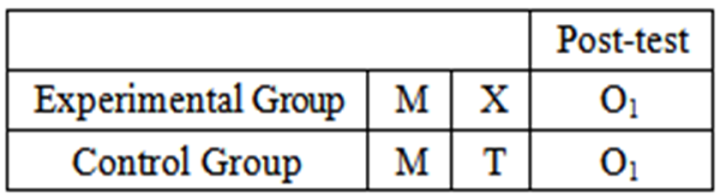
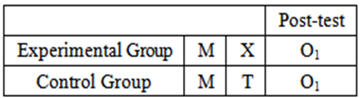
The study used a quasi-experimental research approach utilizing a post-test control group design. The study divided the participants into two groups: the experimental group and the control group. Students with a reliable internet connection were assigned to the experimental group, while those who did not were assigned to the control group.
This study's independent variables included learning through a mobile educational application (X) and usual teaching-learning (T), while the dependent variable was students’ academic achievement (O1).
The study was conducted in the Municipality of Villaverde located in the Province of Nueva Vizcaya. The Municipality of Villaverde is the home of Bintawan National High School which caters to junior and senior high school students.
Bintawan National High School is a public high school in Villaverde, Nueva Vizcaya, situated in Bintawan Sur. The class size is approximately 39 students, with 1805 students in the School Year 2020-2021. The school accommodates junior and senior high school students, with Information and Communication Technology subjects given in each grade level and as one of the senior high school strands. The school transitioned from face-to-face to modular or online education throughout the academic year because of the COVID-19 pandemic. Students were urged to use their accessible devices to engage in online classes. For this reason, Bintawan National High School was chosen as the research locale of the study conducted during the second quarter of the School Year 2020-2021.
2.3. Research SubjectsThe main subjects of the study were junior high school students, specifically Grade 9 students, who were enrolled during the School Year 2020-2021. This was to acquire the needed data to have a general picture of the influence of mobile educational applications on the students’ achievement in mathematics.
For the proper selection of subjects and group categorization, a list of students with or without access to mobile phones and a stable internet connection was obtained from the Grade 9 advisors. Following that, consent forms were distributed to the students on the list. Two groups were created based on their agreement to participate in the study, and then groups were made based on their access to mobile phones and reliable internet connections.
Before the research, the grades of the students in mathematics for the first quarter were used to ensure that the two groups were comparable. Table 1 shows the results of the independent samples t-test, which demonstrates that there was no significant difference in the students' grades before the intervention. As a result, the two groups were similar.
The post-test in Mathematics 9 was used to determine the students’ achievement in mathematics after the use of the mobile educational application. The post-test was based on the most essential learning competencies from the K to 12 Curriculum Guide for Mathematics.
A standardized post-test was used for this study and adapted from the 2014 Mathematics Grade 9 Learner's Material. The test consisted of 36 items about concepts and one item solving problems on variations and radicals with a total of 40 points. The test also covered the topics already discussed with the subjects. It was administered after integrating the mobile educational application to assess students' mathematics achievement. Along with the test were its assessment matrices.
The post-test was validated by three professional teachers; two of them practiced teaching mathematics for over 20 years and were employed at Bintawan National High School while the other one is a statistician working at the Municipal Office of Solano, Nueva Vizcaya. A softcopy of the post-test was given to them to be validated. According to the validators, the post-test was good enough to be used for the research and the researcher was only advised to comprehensively discuss the part of the problem-solving with the subjects during the conduct of the post-test.
An inter-rater correlation was also sought. The post-test was rated by a licensed professional teacher majoring in mathematics, a statistician, and the researcher. Results showed a 99.59% agreement in ratings.
2.5. Data TreatmentDescriptive statistics such as frequencies, percents, means, and standard deviations were used to treat the gathered data.
In evaluating the items correctly answered by the students, Table 2 was used as a guide in checking their responses.
Table 2 shows the scoring rubric to observe objectivity in checking. For the problem-solving part, the score ranges from 0 to 2 based on the descriptions presented. The multiple-choice part is either 0 or 1 with a total of 40 points for the post-test.
Table 3 displays the description of the qualitative scales for the scores of the students on their post-test adapted from Etcuban and Pantinople 23. The post-test consists of 34 items on multiple-choice and one problem-solving item equivalent to six points which gives a total of 40 points.
T-test for independent samples was used to analyze the significant difference between the students’ achievements of students from both the experimental and control group.
2.6. Ethical ConsiderationsUpon the approval of this study, the post-test was validated by three external evaluators, who are experts in mathematics. Inter-rater correlation for the scoring of the post-test using the given rubrics was also pursued. Approval from the Department of Education Schools Division of Nueva Vizcaya, the school division superintendent, and the school principal of Bintawan National High School were sought before the conduct of the study. Consent from both the parents and students was also sought before the students were considered subjects of the study.
The researcher conducted this study purely out of a personal interest in improving the teaching and learning of mathematics. There were no conflicts of interest present throughout the study.
Confidentiality was treated as a top priority throughout the study. The researcher ensured that no one apart from themselves had access to the data collected, and the students' identities were kept anonymous in any publications related to the research. In addition, the data collected were kept confidential during the analysis and interpretation of the survey results. After the study, all the collected data were securely deleted once the results were compiled in a book.
Before administering the study, the subjects were well-informed of its purpose, how the survey results would be used, and the protocols to ensure their anonymity was protected. As the study included minors, parents and students were required to sign a consent form, and students who wished to participate were asked to complete the questionnaires.
There was no known risk in students' participation in the study. Subjects helped in creating new knowledge on the effect of interventions using the mobile educational application on the students.
Section 1. The Students’ Achievement in Mathematics after the use of the Mobile Educational Application
Table 4 shows the frequency and percent of the scores for post-test of both the control and experimental groups. The scores are divided into five intervals, 0 – 7 (Poor), 8 – 15 (Less Proficient), 16 – 23 (Proficient), 24 – 31 (Very Proficient), and 32 – 40 (Excellent). The mean and standard deviation for the post-test of both groups are also presented in the table.
Table 4 shows the post-test score distribution in the control and experimental group. Accordingly, most of the students or 43.48% (10 out of 23) under the control group have post-test scores that range from 8 to 15 (Less Proficient) while 39.13% (9 out of 23) of them have post-test scores that range from 16 to 23 (Proficient). Also, 13.04% (3 out of 23) of the students have post-test scores that range from 24 to 31 (Very Proficient), and only 4.35% (1 out of 23) student scored from 32 to 40 (Excellent). Moreover, the control group obtained a post-test mean score of 17.73 and a standard deviation of 5.94 with a qualitative description of “proficient”.
Comparatively, after using the mobile educational application, majority, or 60% (21 out 35) of the students in the experimental group obtained post-test scores that range from 24 to 31 (Very Proficient). Meanwhile, 25.71% (9 out of 35) of them got scores that range from 32 to 40 (Excellent). Only 5.71% (2 out of 35) of them got scores on those scales from 32 to 40 (excellent) while 8.57% (3 out of 35) of them are less proficient after obtaining scores that range from 8 to 15. Furthermore, the experimental group obtained a post-test mean score of 24.83 and a standard deviation of 5.50 with a qualitative description of “very proficient”. The result implies that there is a practical difference in the achievement of the students in the control and experimental group as depicted by the post-test mean scores of 17.73 and 24.83, respectively. The result suggests the effectiveness of using mobile educational application as indicated by a higher level of proficiency of “very proficient” over the traditional teaching strategy (proficient).
Results of the study by Serin and Oz 24 indicated that integrating technology into the teachers' way of teaching students increases mathematics learning. The use of technology increases the engagement and participation of students in the learning process and creates discussions that increase students' interactivity.
A survey by Crompton et al. 25 also agrees with the result of the study. Their survey revealed that out of 48 students, 75 percent indicated positive outcomes in learning mathematics with mobile technology. Likewise, 24 out of 31 students in Fabian et al.’s 26 review on mobile learning in mathematics showed a boost in students' achievement in mathematics.
However, a trial of mobile game-based learning conducted by Miller and Robertson 27 reported no significant difference between the achievement of students who played mobile games and those who did not participate. In another study where Roberts and Vänskä 28 administered a 24-week mobile tutorial service reported that the scores of students on a test were lower throughout the study. Furthermore, students who used iPads in the study of Perry and Steck 29 as an intervention had twice a decrease in their scores. Overall, mobile learning studies in mathematics have shown a positive effect on the intervention, and the study design's nature affects the success or failure of mobile learning interventions.
Table 5 presents the mean and standard deviation for the assessment matrix of the post-test for each level of assessment (Knowledge, Process/Skills, Understanding, Product/Performance) of the topics included, namely variations and zero, negative, rational exponents, and radicals.
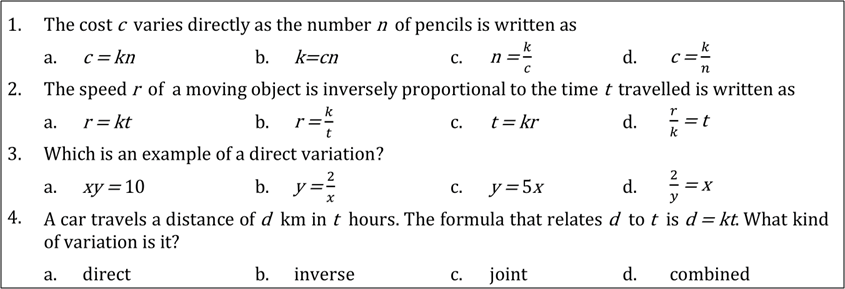
Under the topic variations, the knowledge level which consists of items 1 to 4 has a mean of 37.50 and a standard deviation of 5 for the post-test. This shows that the Grade 9 students were excellent in demonstrating their understanding of key concepts of variation after the conduct of the intervention.
Figure 2 shows the questions of the post-test for items 1 to 4 regarding the topic of variations under the “knowledge” level of assessment. For item number one, a total of 43 (74.14%) subjects got the correct answer for the post-test. Thirty-seven (63.79%) subjects answered correctly for item number two. Moreover, 39 (67.24%) students correctly answered item number 3. For item number 4, 31 (53.45%) subjects answered correctly.
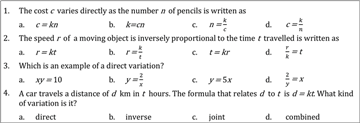

As shown in Figure 2, the students were asked about writing given statements in equation form. It also shows that the topic was about the familiarity of students with a direct and inverse variation.
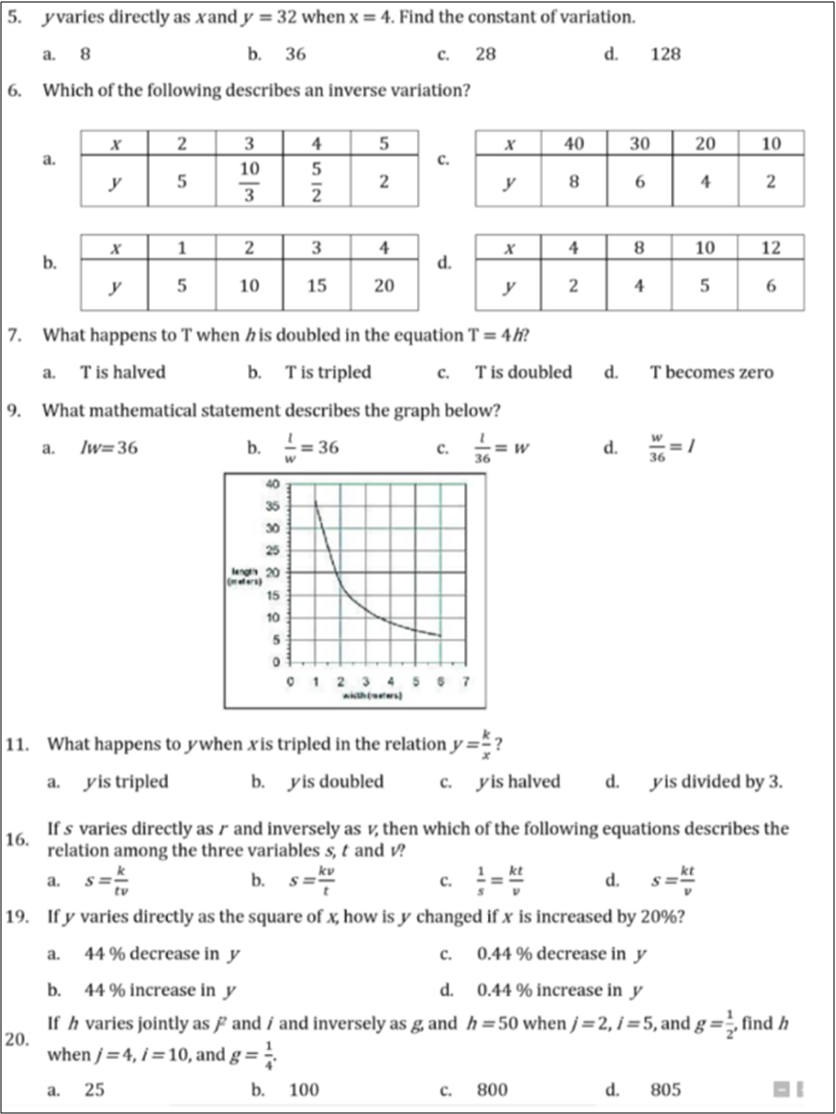
For items 5, 6, 7, 9, 11, 16, 19, and 20 under the process/skills level of assessment, the mean and standard deviation for the post-test are 23.75 and 9.82, respectively. This shows that the Grade 9 students were proficient in identifying situations that illustrate direct, inverse, joint, and combined variations, describing the relationship between quantities, and illustrating situations that are direct, inverse, joint, and combined variations.
Figure 3 presents questions of the post-test of items 5, 6, 7, 9, 11, 16, 19, and 20 regarding the topic of variations under the “process/skills” level of assessment which aimed to measure the following: “Identifying situations that illustrate direct, inverse, joint, and combined variations.” “Describing the relationship between quantities.” and “Illustrating situations that are direct, inverse, joint and combined variations.” 37 (63.79%) subjects answered item number five correctly. For item number six, 16 (27.59%) subjects correctly answered the post-test. Also, 31 (58.62%) subjects correctly answered item number seven. 33 (56.90%) students got item number nine correctly. Moreover, 25 (43.10%) subjects correctly answered item number 11. For item number 16, 18 (31.03%) subjects got the correct answer. 15 (25.86%) students correctly answered item number 19. Furthermore, for item number 20, 12 (20.69%) subjects answered correctly in the post-test.
As shown in Figure 3, the students were questioned about their skill to differentiate different variations according to given situations. Additionally, the questions involved solving problems that use their skill to process what they have learned on variations.
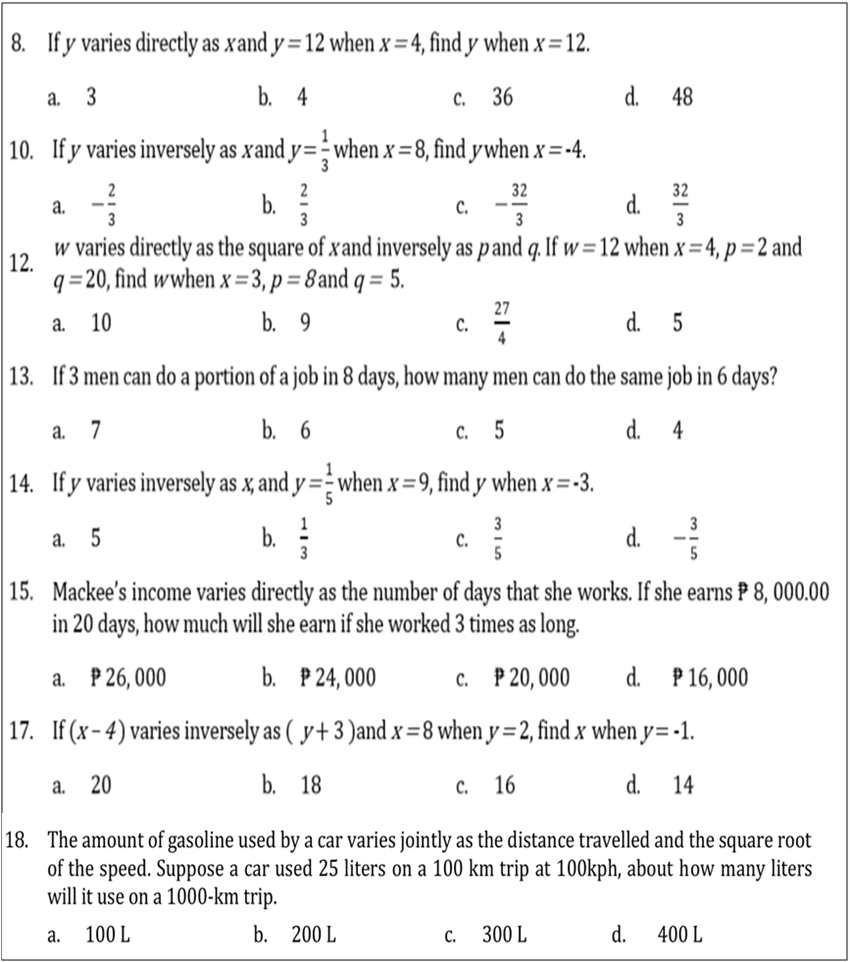
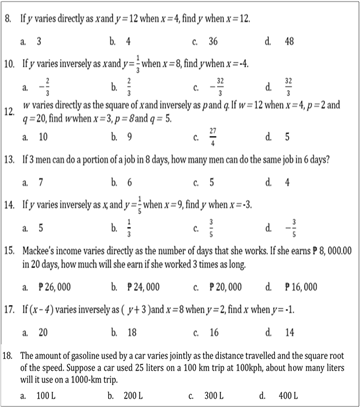
For items 8, 10, 12, 13, 14, 15, 17, and 18 under the understanding level of assessment for the topic variation, the mean and standard deviation for the post-test are 26.38 and 8.55, respectively. This indicates that the Grade 9 students are proficient in solving problems by applying the concept of variations and real-life problems involving variations.
Figure 4 displays questions of the post-test for items 8, 10, 12, 13, 14, 15, 17, and 18 regarding the topic of variations under the “understanding” level of assessment. The items aimed to measure if the learner is “Solving problems applying the concept of variations” and is “Solving real-life problems involving variations.” For item number 8, 21 (36.21%) subjects got the correct answer in the post-test. 25 (43.10%) subjects correctly answered item number 10. Additionally, 21 (36.21%) subjects got the correct answer for item number 12. For item number 13, 34 (58.62%) subjects answered correctly in the post-test. Moreover, 31 (53.45%) subjects got the answers correct for item number 14. 41 (70.69%) students answered item number 15 correctly. For item number 17, 14 (24.14%) students answered correctly. Furthermore, 24 subjects correctly answered item number 18.
As shown in Figure 4, the students were asked to solve word problems that include concepts on variations. Also, the questions involved solving problems in real-world situations that involve variation.
For items 21 to 23, under the knowledge level the topic zero, negative, rational exponents and radicals has a mean of 22 and a standard deviation of 7.94. This illustrates that students were proficient in identifying radical equations, illustrating expressions with rational exponents, and simplifying radical expressions.

Figure 5 shows item number 21 on the topic zero, negative, rational exponents, and radicals under the “knowledge” level of assessment which aimed to measure if the learner can “Identify radical equations.” 25 (43.10%) subjects correctly answered the item. As presented in Figure 6, the question infers the student can pinpoint equations in radical form.

Figure 6 shows item number 22 on the topic zero, negative, rational exponents, and radicals under the “knowledge” level of assessment which aimed to measure if the learners can “Illustrate expressions with rational exponents.” 13 (22.41%) subjects got the answer correct. The question in Figure 7 displays the question which elucidates to the student the rational exponents included in every mathematical expression.

Figure 7 shows item number 23 on the topic Zero, Negative, Rational Exponents, and Radicals under the “knowledge” level of assessment which aimed to measure if the learner can “Simplify radical expressions.” For the post-test, 28 (48.28%) subjects answered correctly. The question involved the addition of radical expressions using exponential notation.
As displayed in Figure 5, Figure 6, and Figure 7, the students answered questions on radical equations. It also shows that the topic aims to acquaint students with the different radical expressions and how the expressions are presented.
For items 24 to 28, under the Process/Skills level of Zero, Negative, Rational Exponents, and Radicals, the mean is 30.4 and a standard deviation of 4.24. This expresses that students were very proficient in simplifying radical expressions using the laws of radicals, performing operations, and simplifying radical expressions.

Figure 8 displays the question for item number 24 on the topic zero, negative, rational exponents, and radicals under the “process/skills” level of assessment which aimed to measure if the learner “Simplifies radical expressions using the laws of radicals.” 35 (60.34%) subjects correctly answered item number 24. As shown in Figure 9, the question finds a radical equation that is equal when substituted by a number.

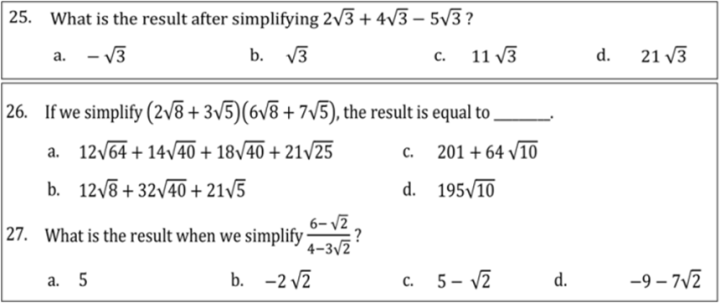
Figure 9 shows the questions for items number 25-27 on the topic zero, negative, rational exponents, and radicals under the “process/skills” level of assessment which aimed to measure if the learner “Performs operations on radical expressions.” For item number 25, 35 (60.34%) subjects correctly answered in the post-test. 27 (46.55%) subjects answered correctly in the post-test. Additionally, 20 (34.48%) students got the correct answer for item number 27.

Figure 10 exhibits the question for item number 28 on the topic zero, negative, rational exponents, and radicals under the “process/skills” level of assessment which aimed to measure if the learner “Simplifies radical expressions.” Thirty-five subjects (60.34%) got the answer correctly for the item.
As presented in Figures 8, 9, and 10, the items demonstrate how to solve and simplify radical expressions. The questions also emphasize that students be comprehensive in performing different operations.
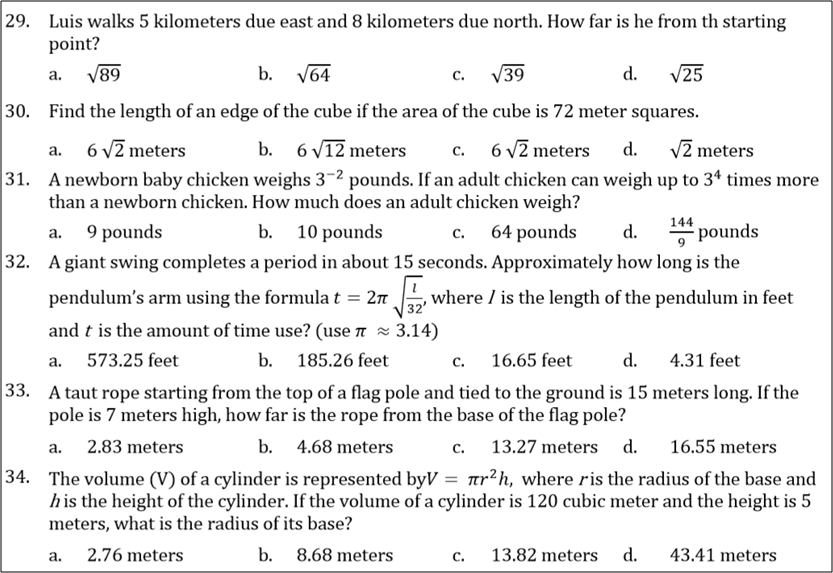
Under the level of understanding for the topic zero, negative, rational exponents, and radicals which consists of items 29 to 34, the mean is 19.33 with a standard deviation of 9.09. This indicates that students were proficient in solving problems that involve radicals.
Figure 11 illustrates the questions for numbers 29-34 on the topic zero, negative, rational exponents, and radicals under the “process/skills” level of assessment which aimed to measure if the learner “Solves problems involving radicals.” Sixteen (27.59%) subjects answered item number 29 correctly. For item number 30, seven (12.07%) subjects answered the exam correctly. Also, twenty-one (36.21%) subjects got item number 31 correctly. Thirteen (22.41%) students got the correct answer for item number 32. Moreover, thirty (51.72%) subjects correctly answered item number 33. For item number 34, twenty-nine (50.00%) subjects got the correct answer.
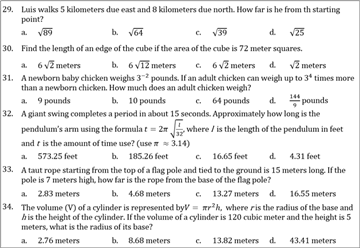
As shown in Figure 12, the questions revolve around problems that include radical expressions. Students are tasked to analyze and work on the problem to arrive at the best possible answer.
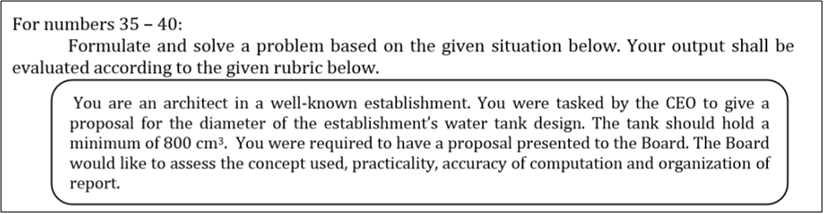
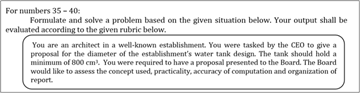
For items 35 to 40 which are under the level of product/performance, the items have a mean of 16 indicating that students were proficient in formulating and accurately solving problems involving radicals.
Figure 12 exhibits the questions for numbers 35-40 on the topic zero, negative, rational exponents, and radicals under the “product/ performance” level of assessment which aimed to measure if the learner “Formulates and accurately solves problems involving radicals.” Sixteen (27.59%) students got full marks on the item for correctly and completely answering the problem.
Overall, the students performed excellently in demonstrating their understanding of the key concepts of variation which were items one to four under the topic variation. However, students had the least performance on formulating and accurately solving problems that involved` radicals which are items 35-40 under the topic zero, negative, rational exponents, and radicals.
To be successful in mathematics, all students are expected to engage in problem-solving, acquire abstract and analytic thinking abilities, learn to deal efficiently and comfortably with variables and equations and utilize mathematical notation effectively to represent events. It can be concluded that the results of the exam show students’ difficulty in solving problems involving variations and radicals. With the help of an intervention like using the educational mobile application, knowledge increases. The findings of a prior investigation indicate that the challenges students face are linked to understanding concepts and principles. The research discovered that students face a broad range of difficulties when dealing with algebraic problems. Specifically, some challenges are related to comprehending the concepts, while others are associated with applying the principles 30.
Section 2. Significant Difference between Achievement of Students in Control and Experimental Groups
Table 7 shows the significant difference between the post-test scores for students’ achievement in mathematics for the experimental and control groups.
An independent sample t-test was run to determine if significant difference exists between the mean scores of the experimental and control groups. Based on the results, students from the experimental groups show a higher mean score of 24.83 (SD=5.501) than the students from the control group with a mean score of 17.13 (SD=5.941). When treated statistically, the t-calculated value of 5.051 is high. The result suggests the rejection of the null hypothesis in favor of the research hypothesis. This means that there is a significant difference between the mean scores of the experimental and control groups. The result is further supported by the p-value of .000 which is less than 0.01 level of significance. This indicates that the use of the educational mobile application has a better outcome in the students’ achievement in mathematics than the traditional way of teaching the competencies.
Proserpio and Gioia 31 conducted a similar study on Grade 8 students which revealed that the experimental group’s score is greater than the control group. It was concluded that the use of the mobile application in teaching mathematics helped enhance students’ achievement and learning. A study by Etcuban and Pantinople 23 also concluded that using the mobile application to teach mathematics in a public national high school somehow helped enhance students' learning achievement.
The result of the study is also supported by the study of Vogel et al. 32. The study explored the learning performance of students when using mobile learning technology. Results showed that learners' performance was enhanced and showed positive support for constructive alignment in mobile learning technology.
The students' achievement in mathematics ranged from less proficient to excellent after using the mobile educational application. It is concluded that using a mobile educational application in the class to teach mathematics to students has aided in the favorable rating of students' performance and learning. The students were excellent in the knowledge level of assessment under the topic variation and performed least on the product/performance level of assessment under the topic zero, negative, rational exponents, and radicals. This shows that students can demonstrate their understanding better than formulating or solving problems.
The experimental group outperformed the control group in the Mathematics Achievement Test. This suggests that the usage of educational mobile applications has a better impact in terms of students' achievement in mathematics than the traditional approach to teaching.
The favorable rating of students’ mathematics achievement when exposed to mobile educational applications can be used as a basis to promote the use of various mobile educational applications. Moreover, it is important to guide students in assessing and examining different methods of solving problems. Teachers can take the initiative to increase the use of mobile educational applications during group projects or collaborative activities to provide students with more exposure to such technology. Finally, teachers should sustain the use of mobile educational application in the classroom because the students have positive experiences in the use of such applications.
We are grateful for the financial support from the Department of Science and Technology's Science Education Institution provides under the CBPSME (Capacity Building Program in Science and Mathematics Education).
| [1] | Puentadura, R. (2006). Transformation, technology, and education. http://hippasus.com/resources/tte/. | ||
| In article | |||
| [2] | Cochrane, T. D. (2010). Exploring mobile learning success factors. Research in Learning Technology, 18(2). | ||
| In article | View Article | ||
| [3] | Quinn, C. (2001, July 20). mLearning: Mobile, wireless, in-your- pocket learning. ResearchGate. https://www.researchgate.net/publication/343083598_mLearning_Mobile_Wireless_In-Your-_Pocket_Learning. | ||
| In article | |||
| [4] | Farrah, A. professor Dr. M., & Abu-Dawood, A. K. (2018). Using mobile phone applications in teaching and learning process. International Journal of Research in English Education, 3(2), 48-68. | ||
| In article | View Article | ||
| [5] | Alqahtani, M., & Mohammad, H. (2015). Mobile applications' impact on student performance and satisfaction. Turkish Online Journal of Educational Technology-TOJET, 14(4), 102-112. | ||
| In article | |||
| [6] | Krouska, A., Troussas, C., & Virvou, M. (2019). SN-Learning: An exploratory study beyond e-learning and evaluation of its applications using EV-SNL framework. Journal of Computer Assisted Learning, 35(2), 168-177. | ||
| In article | View Article | ||
| [7] | Krouska, A., Troussas, C., & Virvou, M. (2017). Comparing LMS and CMS platforms supporting social e-learning in higher education. International Conference on Information, Intelligence, Systems and Applications. | ||
| In article | View Article | ||
| [8] | Hirsh-Pasek, K., Zosh, J. M., Golinkoff, R. M., Gray, J., Robb, M. A., & Kaufman, J. (2015). Putting education in “educational” apps. Psychological Science in the Public Interest, 16 (1), 3-34. | ||
| In article | View Article PubMed | ||
| [9] | Project Tomorrow. (2010). Students leverage the power of mobile devices through the Project K-Nect Mobile Learning Initiative in Onslow County. http://www.tomorrow.org/docs/Project_k-Nect_Evaluationreport_Final_Jul7.pdf. | ||
| In article | |||
| [10] | Tangney, B. (2016, January 22). MobiMaths: an approach to utilising smartphones in teaching mathematics. https://www.academia.edu/20508798/MobiMaths_an_approach_to_utilising_smartphones_in_teaching_mathematics. | ||
| In article | |||
| [11] | Zurita, G., & Nussbaum, M. (2004). Computer supported collaborative learning using wirelessly interconnected handheld computers. Computers & Education, 42 (3), 289-314. | ||
| In article | View Article | ||
| [12] | Spikol, D., & Eliasson, J. (2010). Lessons from designing geometry learning activities that combine mobile and 3d tools. Wireless, Mobile and Ubiquitous Technologies in Education. | ||
| In article | View Article | ||
| [13] | Kalloo, V., & Mohan, P. (2012). Correlating questionnaire data with actual usage data in a mobile learning study for high school mathematics. Electronic Journal of e-Learning, 10(1), 76-89. | ||
| In article | |||
| [14] | Drigas, A., & Pappas, M. A. (2015). A review of mobile learning applications for mathematics, International Journal of Interactive Mobile Technologies, 9(3), 18. | ||
| In article | View Article | ||
| [15] | Walker, R. (2013). ‘“I don’t think I would be where I am right now”’. Pupil perspectives on using mobile devices for learning. Research in Learning Technology, 21. | ||
| In article | View Article | ||
| [16] | Zaranis, N., Kalogiannakis, M., & Papadakis, S. (2013). Using mobile devices for teaching. | ||
| In article | |||
| [17] | Bitter, G. G., & Meylani, R. (2013, April 4). Creating Higher-Achieving Math Students in the App Generation. | ||
| In article | |||
| [18] | Gurat, M.G.(2017). Test Development for Cellular Phone Addiction among College Students. International Journal of BioSciences, Psychiatry and Technology, 4(3), 27-36. | ||
| In article | |||
| [19] | Malipot, M. (2019, December 28). Year-end report: DepEd in 2019: The quest for quality education continues. Manila Bulletin. https://mb.com.ph/2019/12/29/year-end-report-deped-in-2019-the-quest-for-quality-education-continues/. | ||
| In article | |||
| [20] | Giangan Jr., B. & Gurat, M. (2022). Perception and Academic Performance of STEM Students in Learning Calculus. Psychology and Education: A Multidisciplinary Journal, 4(1). | ||
| In article | |||
| [21] | Ng, S. F., & Lee, K. (2009). The Model Method: Singapore Children’s Tool for Representing and Solving Algebraic Word Problems. Journal for Research in Mathematics Education, 40(3), 282-313. | ||
| In article | View Article | ||
| [22] | Gurat, M. G., del Rosario, F. Y. G., Dizon, P. K. L., & Saludarez, M. U. (2018). Assessment of research faculty development program efficacy in writing research proposals. International Research Journal of Management, IT and Social Sciences, 5(4), 1-17. | ||
| In article | View Article | ||
| [23] | Etcuban, J. O., & Pantinople, L. D. (2018). The effects of mobile application in teaching high school mathematics, International Electronic Journal of Mathematics Education, 13(3). | ||
| In article | View Article | ||
| [24] | Serin, H., & Oz, Y. (2017). Technology-integrated mathematics education at the secondary school level. International Journal of Social Sciences & Educational Studies, 3(4), 148. | ||
| In article | View Article | ||
| [25] | Crompton, H., Burke, D. & Gregory, K.(2017). The use of mobile learning in PK-12 education: A systematic review, Computers & Education, 110, 51-63. | ||
| In article | View Article | ||
| [26] | Fabian, K., Topping, K.J. & Barron, I.G. Using mobile technologies for mathematics: effects on student attitudes and achievement. Education Tech Research Dev. 66, 1119-1139 (2018). | ||
| In article | View Article | ||
| [27] | Miller, D.J. and Robertson, D.P. (2011). ‘Educational benefits of using game consoles in a primary classroom: a randomised controlled trial’, British Journal of Educational Technology, 42, 5, 850-864. | ||
| In article | View Article | ||
| [28] | Roberts, N., & Vanska, R. (2011). Challenging assumptions: Mobile Learning for Mathematics project in South Africa. Distance Education, 32(2), 243-259. | ||
| In article | View Article | ||
| [29] | Perry, D. S., & Steck, A. K. (2015). Increasing student engagement, self-efficacy, and meta-cognitive self-regulation in the high school geometry classroom: Do ipads help? Computers in the Schools, 32(2), 122-143. | ||
| In article | View Article | ||
| [30] | Sugiarti, L. & Retnawati, H. (2019). Analysis of student difficulties on algebra problem solving in junior high school. Journal of Physics: Conference Series, 1320. | ||
| In article | View Article | ||
| [31] | Proserpio, L. & Gioia, D. (2017). Teaching the virtual generation. Academy Management Learning & Education, 6(1). | ||
| In article | View Article | ||
| [32] | Vogel, D. L., Wade, N. G., & Hackler, A. H. (2007). Perceived public stigma and the willingness to seek counseling: The mediating roles of self-stigma and attitudes toward counseling. Journal of Counseling Psychology, 54(1), 40-50. | ||
| In article | View Article | ||
Published with license by Science and Education Publishing, Copyright © 2023 Charlotte M. Canilao and Melanie G. Gurat
 This work is licensed under a Creative Commons Attribution 4.0 International License. To view a copy of this license, visit
http://creativecommons.org/licenses/by/4.0/
This work is licensed under a Creative Commons Attribution 4.0 International License. To view a copy of this license, visit
http://creativecommons.org/licenses/by/4.0/
| [1] | Puentadura, R. (2006). Transformation, technology, and education. http://hippasus.com/resources/tte/. | ||
| In article | |||
| [2] | Cochrane, T. D. (2010). Exploring mobile learning success factors. Research in Learning Technology, 18(2). | ||
| In article | View Article | ||
| [3] | Quinn, C. (2001, July 20). mLearning: Mobile, wireless, in-your- pocket learning. ResearchGate. https://www.researchgate.net/publication/343083598_mLearning_Mobile_Wireless_In-Your-_Pocket_Learning. | ||
| In article | |||
| [4] | Farrah, A. professor Dr. M., & Abu-Dawood, A. K. (2018). Using mobile phone applications in teaching and learning process. International Journal of Research in English Education, 3(2), 48-68. | ||
| In article | View Article | ||
| [5] | Alqahtani, M., & Mohammad, H. (2015). Mobile applications' impact on student performance and satisfaction. Turkish Online Journal of Educational Technology-TOJET, 14(4), 102-112. | ||
| In article | |||
| [6] | Krouska, A., Troussas, C., & Virvou, M. (2019). SN-Learning: An exploratory study beyond e-learning and evaluation of its applications using EV-SNL framework. Journal of Computer Assisted Learning, 35(2), 168-177. | ||
| In article | View Article | ||
| [7] | Krouska, A., Troussas, C., & Virvou, M. (2017). Comparing LMS and CMS platforms supporting social e-learning in higher education. International Conference on Information, Intelligence, Systems and Applications. | ||
| In article | View Article | ||
| [8] | Hirsh-Pasek, K., Zosh, J. M., Golinkoff, R. M., Gray, J., Robb, M. A., & Kaufman, J. (2015). Putting education in “educational” apps. Psychological Science in the Public Interest, 16 (1), 3-34. | ||
| In article | View Article PubMed | ||
| [9] | Project Tomorrow. (2010). Students leverage the power of mobile devices through the Project K-Nect Mobile Learning Initiative in Onslow County. http://www.tomorrow.org/docs/Project_k-Nect_Evaluationreport_Final_Jul7.pdf. | ||
| In article | |||
| [10] | Tangney, B. (2016, January 22). MobiMaths: an approach to utilising smartphones in teaching mathematics. https://www.academia.edu/20508798/MobiMaths_an_approach_to_utilising_smartphones_in_teaching_mathematics. | ||
| In article | |||
| [11] | Zurita, G., & Nussbaum, M. (2004). Computer supported collaborative learning using wirelessly interconnected handheld computers. Computers & Education, 42 (3), 289-314. | ||
| In article | View Article | ||
| [12] | Spikol, D., & Eliasson, J. (2010). Lessons from designing geometry learning activities that combine mobile and 3d tools. Wireless, Mobile and Ubiquitous Technologies in Education. | ||
| In article | View Article | ||
| [13] | Kalloo, V., & Mohan, P. (2012). Correlating questionnaire data with actual usage data in a mobile learning study for high school mathematics. Electronic Journal of e-Learning, 10(1), 76-89. | ||
| In article | |||
| [14] | Drigas, A., & Pappas, M. A. (2015). A review of mobile learning applications for mathematics, International Journal of Interactive Mobile Technologies, 9(3), 18. | ||
| In article | View Article | ||
| [15] | Walker, R. (2013). ‘“I don’t think I would be where I am right now”’. Pupil perspectives on using mobile devices for learning. Research in Learning Technology, 21. | ||
| In article | View Article | ||
| [16] | Zaranis, N., Kalogiannakis, M., & Papadakis, S. (2013). Using mobile devices for teaching. | ||
| In article | |||
| [17] | Bitter, G. G., & Meylani, R. (2013, April 4). Creating Higher-Achieving Math Students in the App Generation. | ||
| In article | |||
| [18] | Gurat, M.G.(2017). Test Development for Cellular Phone Addiction among College Students. International Journal of BioSciences, Psychiatry and Technology, 4(3), 27-36. | ||
| In article | |||
| [19] | Malipot, M. (2019, December 28). Year-end report: DepEd in 2019: The quest for quality education continues. Manila Bulletin. https://mb.com.ph/2019/12/29/year-end-report-deped-in-2019-the-quest-for-quality-education-continues/. | ||
| In article | |||
| [20] | Giangan Jr., B. & Gurat, M. (2022). Perception and Academic Performance of STEM Students in Learning Calculus. Psychology and Education: A Multidisciplinary Journal, 4(1). | ||
| In article | |||
| [21] | Ng, S. F., & Lee, K. (2009). The Model Method: Singapore Children’s Tool for Representing and Solving Algebraic Word Problems. Journal for Research in Mathematics Education, 40(3), 282-313. | ||
| In article | View Article | ||
| [22] | Gurat, M. G., del Rosario, F. Y. G., Dizon, P. K. L., & Saludarez, M. U. (2018). Assessment of research faculty development program efficacy in writing research proposals. International Research Journal of Management, IT and Social Sciences, 5(4), 1-17. | ||
| In article | View Article | ||
| [23] | Etcuban, J. O., & Pantinople, L. D. (2018). The effects of mobile application in teaching high school mathematics, International Electronic Journal of Mathematics Education, 13(3). | ||
| In article | View Article | ||
| [24] | Serin, H., & Oz, Y. (2017). Technology-integrated mathematics education at the secondary school level. International Journal of Social Sciences & Educational Studies, 3(4), 148. | ||
| In article | View Article | ||
| [25] | Crompton, H., Burke, D. & Gregory, K.(2017). The use of mobile learning in PK-12 education: A systematic review, Computers & Education, 110, 51-63. | ||
| In article | View Article | ||
| [26] | Fabian, K., Topping, K.J. & Barron, I.G. Using mobile technologies for mathematics: effects on student attitudes and achievement. Education Tech Research Dev. 66, 1119-1139 (2018). | ||
| In article | View Article | ||
| [27] | Miller, D.J. and Robertson, D.P. (2011). ‘Educational benefits of using game consoles in a primary classroom: a randomised controlled trial’, British Journal of Educational Technology, 42, 5, 850-864. | ||
| In article | View Article | ||
| [28] | Roberts, N., & Vanska, R. (2011). Challenging assumptions: Mobile Learning for Mathematics project in South Africa. Distance Education, 32(2), 243-259. | ||
| In article | View Article | ||
| [29] | Perry, D. S., & Steck, A. K. (2015). Increasing student engagement, self-efficacy, and meta-cognitive self-regulation in the high school geometry classroom: Do ipads help? Computers in the Schools, 32(2), 122-143. | ||
| In article | View Article | ||
| [30] | Sugiarti, L. & Retnawati, H. (2019). Analysis of student difficulties on algebra problem solving in junior high school. Journal of Physics: Conference Series, 1320. | ||
| In article | View Article | ||
| [31] | Proserpio, L. & Gioia, D. (2017). Teaching the virtual generation. Academy Management Learning & Education, 6(1). | ||
| In article | View Article | ||
| [32] | Vogel, D. L., Wade, N. G., & Hackler, A. H. (2007). Perceived public stigma and the willingness to seek counseling: The mediating roles of self-stigma and attitudes toward counseling. Journal of Counseling Psychology, 54(1), 40-50. | ||
| In article | View Article | ||