The COVID 19 pandemic brought drastic changes on the teaching and learning process not just on the Department of Education but other private and public institutions as well. Growth mindset drives the attributes and attitudes of teachers toward development and flexibility as well as influencing their level of work engagement. The purpose of the study was to identify the level of teachers’ growth mindset and work engagement among six selected schools and its significant relationship. The study employed a quantitative design and data are gathered via printed survey questionnaire. With the use of mean, One and Two Way ANOVA and Pearson’s R Correlation, the information gathered were processed and interpreted. The result shows that teachers have growth mindset despite the struggles caused by the pandemic. With regards to the work engagement they have a Very High level of dedication and High level of vigor and absorption. Statistics show that there is a significant relationship between growth mindset and vigor and dedication but no significant relationship on absorption. The study suggests that there be an online website for teachers’ wellbeing where topics like mental health, wellbeing assessment tool and financial literacy lectures are available because these aspects are the most common sources of burnout and stress of teachers. By being aware of it, teachers are more likely to adopt growth mindset not just on their professional but also to their personal life.
COVID 19 pandemic caused lots of changes in our daily lives. Schools and universities are forced to change the modality of learning from face-to-face to modular distance learning. Due to the urgency of need to continue and push through the process of education, the Department of Education resulted into implementing modular distance learning whether printed or digital. With unprepared teachers and personnel, schools find it difficult to cope up with the new learning modalities, thereby causing stress to them. Side by side responsibilities plus difficulties in movement due to strict health protocols makes it hard for some teachers to carry out with their task and maintain a healthy well-being.
The struggles and difficulties faced in the new normal could potentially affect the engagement and mindset of teachers towards their institution. Kahn’s theory 1 on employee engagement and Herzberg’s Motivation theory 2 also serves as a basis for this research. Carol Dweck’s Growth Mindset 3 theory can be attributed to in the context of teachers. Maslow’s 4 hierarchy of needs both taps the two variables of the study, for either of the two belongs to one or two levels on the hierarchy model.
The Department of Education in response to the needs of educators and personnels for programs and interventions that will focus on their mental health and wellbeing, launched the “DepEd TAYO Naman: Tulong, Alaga, Yakap at Oras”; 5 a virtual series.
Websites have been used in other countries to provide tips and platforms for positive coping mechanism in response to stresses and difficulties that they (teachers/ educators) are facing due to the pandemic. Such websites and online platforms are ReachOut Australia2021 6 and online platforms for teachers’ sharing of experiences and solutions (David and King 2020) 7.
Previous studies showed that there is a significant relationship between work engagement and growth mindset (Zeng at.al 2019) 8, and work engagement and other factors such as job performance, quality of school work life, leadership and etc. The significance and importance of the present study is that it focuses on the relationship between the variables growth mindset (on teachers) which is rarely given emphasis because majority of growth mindset studies are on students, and work engagement along vigor, dedication and absorption during the COVID-19 crisis.
This research study aims to find the relationship between the teachers’ growth mind-set and work engagement as it is affected by the COVID 19 pandemic. Specifically it aims to answer the following queries:
1. What is the level of teachers' growth mindset and work engagement?
2. Is there a significant difference among groups and aspects?
3. Is there a significant relationship between a growth mindset and the work engagement of teachers?
This quantitative research made use of printed survey questionnaire to gather the necessary data. The purposively selected 165 teachers participated in the data gathering process. Permission from the current Schools Division Superintendent was sought before the conduct of the study. Personal information and responses of teachers were treated with utmost confidentiality as the researcher adheres to the Data Privacy Act of 2012 or RA 10173.
The modified research survey questionnaire was based on the downloaded work engagement questionnaire from UTRECHT and the growth mindset questionnaire from sadlierschool.com. The tool was divided into three parts. Part I is for personal information, part 2 is for the growth mindset and part 3 is for the work engagement along vigor, dedication and absorption. Parts 2 and 3 made use of the Likert type scale on the degree of agreeableness for easier collection and processing of information.
The researcher distributed the printed survey questionnaires to the three selected primary and secondary schools. Results of the survey were treated using one and two way ANOVA and Pearson’s R Correlation.
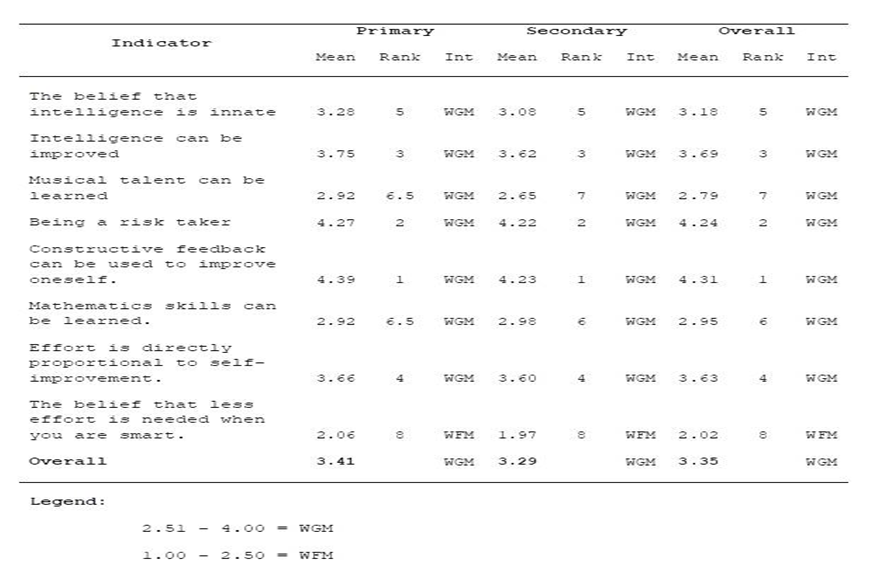
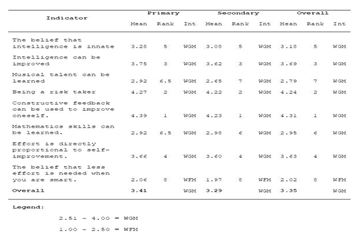
The primary school teachers and the secondary school teachers with a mean of 3.41 and 3.29 both exhibit growth mindset. Overall, the teacher responses show that they have growth mindset with a mean of 3.35. It is found out that the all teachers likes to receive constructive feedbacks especially on things they understand well with a mean of 4.31 and interpreted as having growth mindset. On the other hand, the indicator stating that there is no need to put effort to continue to do well with a mean of 2.02 is interpreted to be a fixed mindset. Figure 1 presents the data on the level of growth mindset of teachers.
Growth mindset affects how the teachers perform in their work place and in their wellbeing. It as well has an impact on the learning development of students. According to Zeng et.al (2019) 8, there is a positive relationship among growth mindset, wellbeing and perseverance. Bicaj and Treska (2014) 9, Kusmaryani (2016) 10, Abaro (2018) 11 and Rabacal (2020) 12 puts emphasis on the impact of professional development to the growth mindset of teachers.
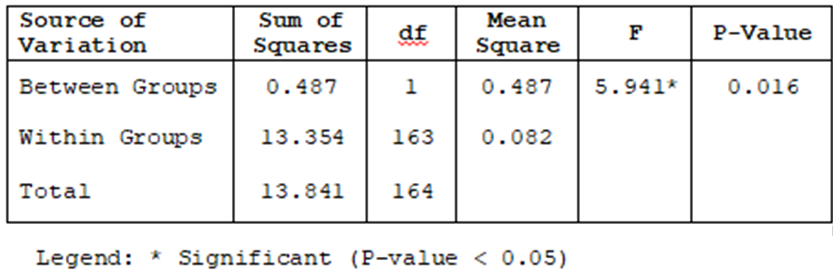
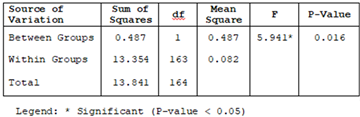
4.2. Significant Difference on the Perceived Level of Growth Mindset among GroupsData reveals the computed F-value of 5.941 is greater than the computed P-value of 0.016. This means that there is a significant difference on the level of teachers’ growth mindset among groups. Primary schools have higher level of growth mind-set with a mean of 3.41 while secondary schools have a mean of 3.29 though both interpreted as having growth mindset. This suggests that even though teachers share the same profession, each individual have different level of growth mindset which is further affected by several internal and external factors. Figure 2 shows the One Way Anova for the significant difference on the level of growth mindset among groups.
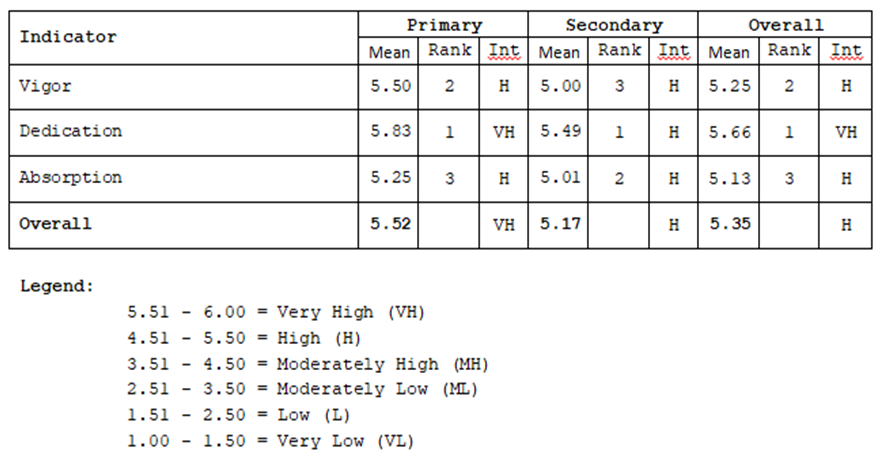
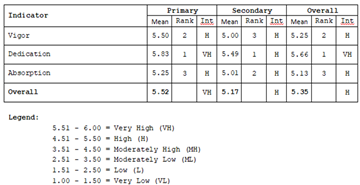
Primary schools has a high level of work engagement along Vigor and absorption with a mean of 5.25 and 5.50. They have a Very High level of work engagement along dedication with a mean of 5.83. Overall, the primary schools have a Very High level of work engagement with a mean of 5.52. With a mean of 5.00, 5.49, and 5.01 secondary schools have High level of work engagement along vigor, dedication and absorption. Overall, the primary and secondary schools have High level of work engagement along vigor and absorption with a mean of 5.25 and 5.13 and has a Very High level along dedication with a mean of 5.66. Figure 3 presents the summary of the perceived level of work engagement of teachers among vigor, dedication and absorption.
One of the possible factors while although they have a very high level of dedication towards work but is only high on the level of work engagement along vigor and absorption is that they may be avoiding burnout at work. Though they are well motivated towards their profession, they might be trying to avoid stress in their workplace.
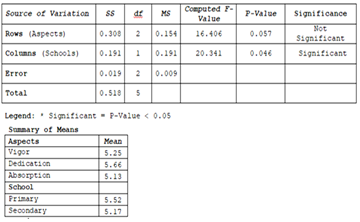
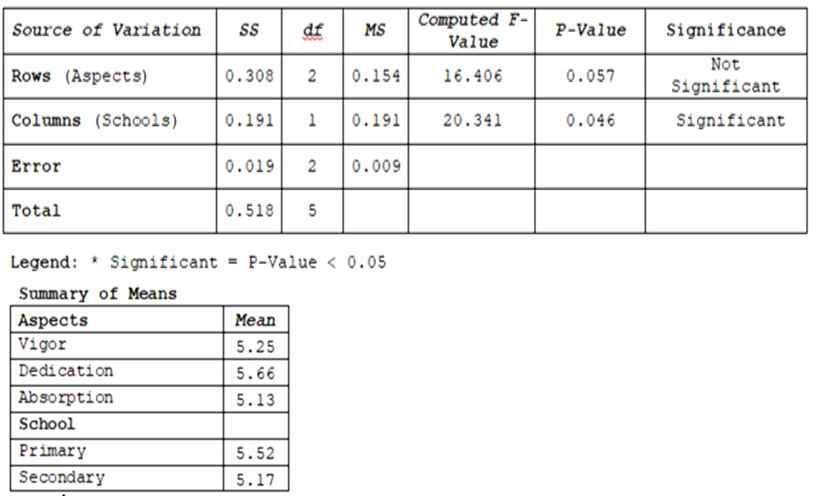
The computed F-value of 16.406 and 20.341 is greater than the computed P-value of 0.057 and 0.046 which means that there is no significant difference on the level of work engagement along vigor, dedication and absorption among schools and aspects. Figure 4 shows the significant difference among groups and aspects on the perceived level of teachers’ work engagement along vigor, dedication and absorption.
4.5. Significant Relationship between the perceived Level of Teachers’ Growth Mindset and Work Engagement along Vigor, Dedication and AbsorptionThe research study results show that there is a significant relationship between the level of growth mindset and work engagement of teachers.
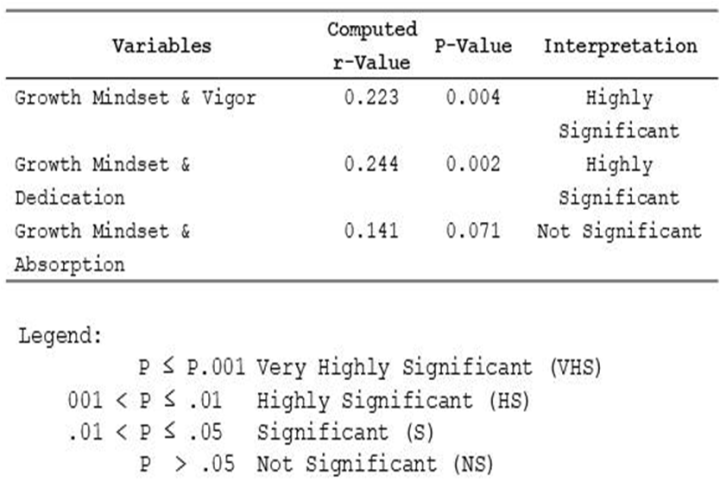
Between growth mindset and vigor the computed R-value of 0.223 shows a highly significant result (P<0.01). So the test is highly significant. Between growth mindset and dedication, the R-value of 0.244 also shows a highly significance rest result (p<0.01), a significant relationship between the variables are also observed. Lastly, between growth mindset and absorption, the computed R-value of 0.141 shows a non-significant statistical test result (P>0.05); this implies a non-significant relationship between growth mindset and the work engagement of teachers along absorption.
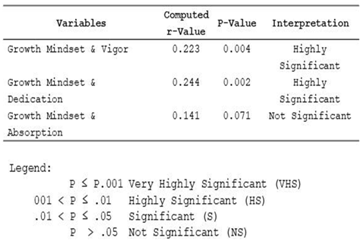
The result reveals that there is a significant relationship between growth mindset and work engagement along dedication and vigor but no significant relationship between growth mindset and absorption. This could be due to the reason that teachers have the passion for teaching and are well motivated both to provide their services to schools and motivated to enhance themselves in their profession. One factor that may be considered why absorption and growth mind-set is not significantly related to one another is that, teachers could be well motivated and dedicated towards their work but are trying not to be too submerged on their job so as to avoid stress and further burnouts. Figure 5 presents the significant relationship between the perceived level of Teachers’ Growth Mindset and Work Engagement along Vigor, Dedication and Absorption.
Zeng et.al (2019) 8 said that growth mindset has a positive relationship with work engagement and perseverance but it revealed that there are factors causing teachers to have low work engagement like heavy workload and such. Also, Altunova and Kalman (2020) 13 mentioned that there are personal and professional factors that affect the work engagement of teachers such as administrative factors, systematic factors personal characteristics and salary and personal rights.
4.6. Use of an Online Platform to Cater to Teachers’ WellbeingAccording to the findings of the present study, there is a significant relationship between teachers’ growth mindset and work engagement along vigor and dedication but not with absorption. This indicates that teachers are capable of separating themselves from work and are preventing themselves from having burnouts and being stress. Despite teachers having emotional quotient, still in small numbers, there are cases where teachers result into suicides and other related cases like depressions and other mental illnesses. These selective cases can be traced back to having low or fixed mindset and low vigor on work engagement for both shows lack of mental resilience and adaptability towards struggles and problems.
4.7. AMIGA: An Online Platform for Teachers’ Well-beingOn this online platform, teachers will have access to an online wellbeing survey with an automatic result generator, YouTube and other videos that shows the importance of having awareness on mental health and lectures/seminars/blogs that focuses on the financial literacy.
This website serves as a hub and spoke of different websites that will be useful for teachers.
The reason why it is made online is because by such way, it could reach even teachers that are assigned on remote areas. Furthermore, it provides confidentiality to teachers who would like to be informed, who would like to assess their mental health and wellbeing and those who would like to be educated on financial literacy.
This online platform is composed of three main sections: financial literacy, mental health and wellbeing. The Financial literacy button redirects the server to a website that provides lectures and reading materials focusing on the need to be financial literate and the benefits of being such. Figure 6 shows the proposed online website for Teachers’ Wellbeing.
One of the importance of having such online platform is that it can be accessed by teachers anytime and on their convenient time without payment.
The overall result showed that teachers have a growth mindset and high level of work engagement. This study revealed that the level of growth mindset of teachers have a positive relationship with the work engagement along vigor and dedication but has no significant relationship to absorption. This result indicates that teachers exhibits passion, perseverance and effort towards their work but are low in absorption or the state of being carried away with the task that the employee fails to track time. A possible reason could be, teachers may be preventing stress and burnout. The recommended output which is the online platform about teachers’ wellbeing provides support to the programs implemented by the DOH, DepEd and DRRM concerning the mental health and wellbeing of teachers.
| [1] | William Kahn’s Theory on Employee Engagement (1990). Robinson, A. (2022, September 27). Employee Engagement Theory: Definition & Examples. teambuilding.com. https://teambuilding.com/blog/employee-engagement-theory. | ||
| In article | |||
| [2] | Frederick Herzberg’s Two Factor Theory (1959). Nickerson, C. (2021, November 16). Herzberg’s Motivation Two-Factor Theory. https://www.simplypsychology.org/herzbergs-two-factor-theory.html. | ||
| In article | |||
| [3] | “Carol Dweck’s Growth Mindset Theory.” Street, F. (2021, February 5). Carol Dweck: A Summary of Growth and Fixed Mindsets. Farnam Street. https://fs.blog/carol-dweck-mindset/. | ||
| In article | |||
| [4] | Abraham Maslow’s Theory of Motivation/ Hierarchy of Needs (1943). Mcleod, S. (2022, April 4). Maslow’s Hierarchy of Needs. https://www.simplypsychology.org/maslow.html. | ||
| In article | |||
| [5] | Department of Education, (2021, May 21). Deped launches new virtual series-to-support-personnels-mental-health. https://www.deped.gov.ph/2021/05/21/deped-launches-new-virtual-series-to-support-personnels-mental-health/. | ||
| In article | |||
| [6] | ReachOut Australia.Teacher Wellbeing in a Changing Environment. https://schools.au.reachout.com/articles/teacher-wellbeing-in-a-changing-environment. | ||
| In article | |||
| [7] | ReachOut Australia. Tips for Teacher Wellbeing . https://schools.au.reachout.com/articles/tips-for-teacher-wellbeing. | ||
| In article | |||
| [8] | Zeng,Guang et.al. April 18, 2019.Teacher’s Growth Mindset and Work Engagement in the Chinese Educational Context: Wellbeing and perseverance of Effort as Mediator. https://www.frontiersin.org/articles/10.3389/fpsyg.2019.00839/full. | ||
| In article | View Article PubMed | ||
| [9] | Bicaj, Arberore. November 2014. The Effect of Teacher Professional Development in Raising the Quality of Teaching (Pilot Research). https://www.researchgate.net/publication/280339618_The_Effect_of_Teacher_Professional_Development_in _Raising_the_Quality_of_Teaching_Pilot_Research. | ||
| In article | View Article | ||
| [10] | Kushmaryani, Rosita Endang et.al. February 20, 2016. Key Factors in Teacher Professional Development. https://mpsi.umm.ac.id/files/file/704%20-%20708%20Rosita%20Endang%20Kusmaryani, %20Juke%20R_Siregar, %20Hanna%20Widjaja,%20Ratna%20Jatnika.pdf. | ||
| In article | |||
| [11] | Abaro, J. 2018. Factors Affecting the Performance of Public School Teachers in the Division of Antipolo City, Philippines. https://www.semanticscholar.org/paper/Factors-Affecting-the-Performance-of-Public-School-Abarro/ d46d4aab0c970f9a9409abbce0f5f04b6a96421e. | ||
| In article | |||
| [12] | Rabacal, Judith S. et.al. November 30, 2020. Research Note Volume 8 Issue 4, 2020. COVID 19, Impact on the Quality of Life of Teachers:A Cross Sectional Study. https://www.ajpor.org/article/17801-covid-19-impact-on-the-quality-of-life-of-teachers-a-cross-sectional-study. | ||
| In article | |||
| [13] | Altunova, Nebi and Kalman, Dr. Mamhut. 2020. Research in Pedagogy, Volume 10, No. 2 Year 2020, pp. 285-312. | ||
| In article | View Article | ||
Published with license by Science and Education Publishing, Copyright © 2023 Bernadette Q. Samson
 This work is licensed under a Creative Commons Attribution 4.0 International License. To view a copy of this license, visit
http://creativecommons.org/licenses/by/4.0/
This work is licensed under a Creative Commons Attribution 4.0 International License. To view a copy of this license, visit
http://creativecommons.org/licenses/by/4.0/
| [1] | William Kahn’s Theory on Employee Engagement (1990). Robinson, A. (2022, September 27). Employee Engagement Theory: Definition & Examples. teambuilding.com. https://teambuilding.com/blog/employee-engagement-theory. | ||
| In article | |||
| [2] | Frederick Herzberg’s Two Factor Theory (1959). Nickerson, C. (2021, November 16). Herzberg’s Motivation Two-Factor Theory. https://www.simplypsychology.org/herzbergs-two-factor-theory.html. | ||
| In article | |||
| [3] | “Carol Dweck’s Growth Mindset Theory.” Street, F. (2021, February 5). Carol Dweck: A Summary of Growth and Fixed Mindsets. Farnam Street. https://fs.blog/carol-dweck-mindset/. | ||
| In article | |||
| [4] | Abraham Maslow’s Theory of Motivation/ Hierarchy of Needs (1943). Mcleod, S. (2022, April 4). Maslow’s Hierarchy of Needs. https://www.simplypsychology.org/maslow.html. | ||
| In article | |||
| [5] | Department of Education, (2021, May 21). Deped launches new virtual series-to-support-personnels-mental-health. https://www.deped.gov.ph/2021/05/21/deped-launches-new-virtual-series-to-support-personnels-mental-health/. | ||
| In article | |||
| [6] | ReachOut Australia.Teacher Wellbeing in a Changing Environment. https://schools.au.reachout.com/articles/teacher-wellbeing-in-a-changing-environment. | ||
| In article | |||
| [7] | ReachOut Australia. Tips for Teacher Wellbeing . https://schools.au.reachout.com/articles/tips-for-teacher-wellbeing. | ||
| In article | |||
| [8] | Zeng,Guang et.al. April 18, 2019.Teacher’s Growth Mindset and Work Engagement in the Chinese Educational Context: Wellbeing and perseverance of Effort as Mediator. https://www.frontiersin.org/articles/10.3389/fpsyg.2019.00839/full. | ||
| In article | View Article PubMed | ||
| [9] | Bicaj, Arberore. November 2014. The Effect of Teacher Professional Development in Raising the Quality of Teaching (Pilot Research). https://www.researchgate.net/publication/280339618_The_Effect_of_Teacher_Professional_Development_in _Raising_the_Quality_of_Teaching_Pilot_Research. | ||
| In article | View Article | ||
| [10] | Kushmaryani, Rosita Endang et.al. February 20, 2016. Key Factors in Teacher Professional Development. https://mpsi.umm.ac.id/files/file/704%20-%20708%20Rosita%20Endang%20Kusmaryani, %20Juke%20R_Siregar, %20Hanna%20Widjaja,%20Ratna%20Jatnika.pdf. | ||
| In article | |||
| [11] | Abaro, J. 2018. Factors Affecting the Performance of Public School Teachers in the Division of Antipolo City, Philippines. https://www.semanticscholar.org/paper/Factors-Affecting-the-Performance-of-Public-School-Abarro/ d46d4aab0c970f9a9409abbce0f5f04b6a96421e. | ||
| In article | |||
| [12] | Rabacal, Judith S. et.al. November 30, 2020. Research Note Volume 8 Issue 4, 2020. COVID 19, Impact on the Quality of Life of Teachers:A Cross Sectional Study. https://www.ajpor.org/article/17801-covid-19-impact-on-the-quality-of-life-of-teachers-a-cross-sectional-study. | ||
| In article | |||
| [13] | Altunova, Nebi and Kalman, Dr. Mamhut. 2020. Research in Pedagogy, Volume 10, No. 2 Year 2020, pp. 285-312. | ||
| In article | View Article | ||