The COVID-19 pandemic has disrupted the traditional operations of academic libraries worldwide. In response to the shift towards remote learning and working, this study was conducted to develop and implement a Contextualized Pandemic-Proof Library Program for the Central Bicol State University of Agriculture Calabanga Campus Library. The study aimed to describe the level of access to library services for students through document analysis, develop a contextualized pandemic-proof library program, and determine the program's effect on student access to library services. Findings reveal that the COVID-19 pandemic significantly decreased the total number of accesses to library services, resulting in a low level of access for students. However, the implementation of Project LIBRO, the developed contextualized pandemic-proof library program, resulted in a dramatic increase in access to library services. The average access per month increased by 235.97% in 2022 compared to 2021, with offline access increasing by 597.33% and online access by 102.00%. Based on these significant findings the study suggests continuing to implement and promote Project LIBRO, gathering feedback from students, conducting further research, and exploring how the program can be adapted to continue providing valuable services in a post-pandemic context.
The library is the heart of any school and should be accessible to all students. Its collections inspire readers of all ages and are essential to the academic community. Cautious storage is unnecessary; hence, expansion is necessary within the company. The library significantly contributes to the educational system’s success in achieving its goals. Both students and instructors require access to library resources to make learning exciting, stimulating, and ultimately satisfying.
In today's world, libraries are compelled to go digital. A library without an online presence is considered outdated. Digital services are essential in any library, even more so in this age of rapid information access. The internet delivery of goods, services, and data is becoming increasingly common. Digital technology has enabled libraries to communicate more effectively with their users and make their holdings accessible online through various channels such as repositories, digital libraries, and online public access catalogs 1. Libraries have used internet platforms such as Facebook, Twitter, Instagram, and YouTube, among others, to promote their services and cultivate ties with the local community.
The library system of the Philippines has been at the forefront of using digital materials for a long time. Academic library communities often serve as incubators for new concepts. In the early 2000s, many top institutions in the Metro Manila region utilized online reference services 2. Popular digital services include public online catalogs, bibliographies, digital resources, digital catalogs, and indexes. Libraries frequently use Facebook and other forms of text messaging, email, online applications, and "Ask a Librarian" features to aid clients needing reference materials 3.
At many libraries, clients still receive assistance, primarily through in-person sessions. Unfortunately, the COVID-19 outbreak has affected libraries, and their service in 2020 has been challenging for everyone on the planet, and its repercussions can be seen in every aspect of human life. The proliferation of Covid-19 caused a paradigm shift in teaching practices, which altered the purpose of academic libraries 4. To preserve public health, the government-imposed sterilization operations and other forms of quarantine. Due to lockdowns and community quarantines, libraries in the Philippines have been temporarily closed since March 2020. Rules have been set for preventing the spread of the virus, and libraries that have reopened must adhere to them 5.
In the Philippines, the Commission on Higher Education (CHED) released Memorandum No. 4 on Flexible Learning Implementation Guidelines on September 2, 2020. Each university or college may decide on its institution's most effective learning tactics. While some students have used both o and modular modes, others have utilized only one. Still, some have combined the two approaches based on their needs and available resources. 6 believes that intelligent pedagogical practices can encourage flexibility, centered on giving students more outstanding excellence in their educational environment, such as the mode of delivery, location, and scheduling.
The trend toward online education has presented libraries and librarians with a new set of challenges. Although many libraries have incorporated digital services, others may need to catch up or expand their collection. By providing links to and curating open-access content, libraries have allowed remote access to their holdings. While a wealth of information is available online, it can be overwhelming for the casual user. Libraries had traditionally struggled to remain relevant during crises like the pandemic due to their inability to assist patrons when their services were not emphasized.
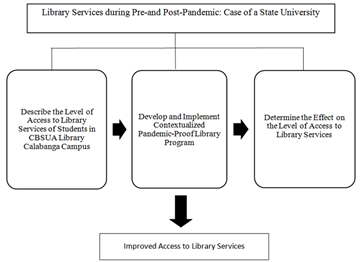
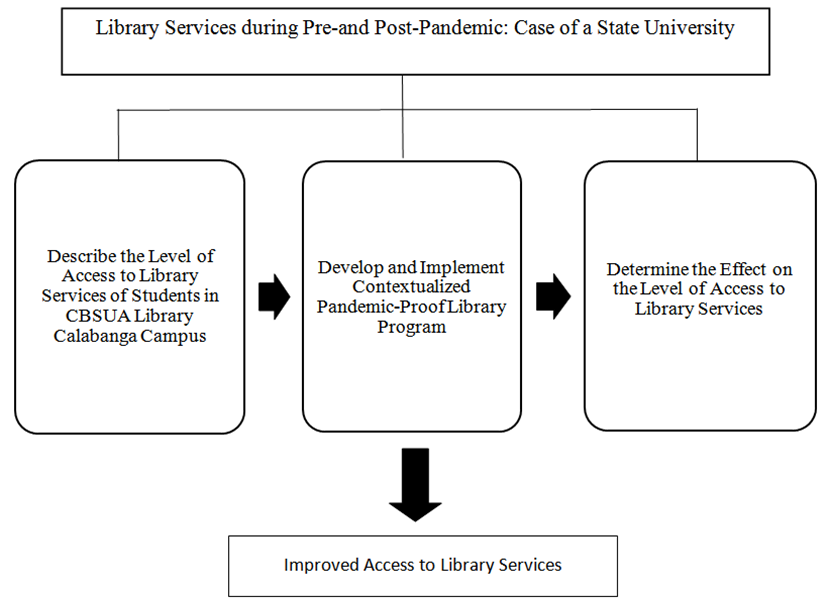
The ongoing coronavirus (COVID-19) pandemic highlights the need for access to information and the critical role of libraries as providers of accurate information and access to e-books and other digital content. Libraries are often on the front lines of public health crises, providing access to information, offering space for public meetings, and serving as trusted community resources 7. See Figure 1 of conceptual framework.
The Design Thinking Approach, Contingency Approach of Management Theory, Practice theory, and Theory of Change were utilized in the development of a pandemic-proof library program. The Design Thinking Approach, which focuses on empathy and experimentation, was instrumental in creating a library program that takes into consideration the needs and wants of its users, especially during a pandemic where remote access is crucial. The rapid prototyping process of design thinking was particularly effective in solving complex library problems that arise in a pandemic context. empathy is a key component of the Design Thinking Approach and involves "listening to users, observing their behavior, and building deep connections to understand their needs and desires" 8. By using empathy to understand how the pandemic has impacted library users and what they need from library services during this time, library professionals can design programs that are truly responsive to their users' needs.
The Contingency Approach of Management Theory was also taken into account, emphasizing the importance of considering situational factors in developing the library program. Every situation is different, and the best practices for libraries may vary depending on the clients and the environment they operate in. The Contingency Approach of Management suggests that there is no one-size-fits-all approach to management and that the most effective management practices depend on the specific circumstances of a given situation 9. This approach can be applied to the development of a pandemic-proof library program by recognizing that different libraries may have different needs and challenges during the pandemic, depending on factors such as their size, location, and the demographics of their user base. By taking these factors into account, library professionals can develop programs that are tailored to the unique needs of their library and its users. The Practice theory, on the other hand, emphasizes the relationship between established cultural structures and how people act within those structures. This theory helped in the development of a program that considers the community's needs and values, as well as the competencies and skills of library professionals needed to support them. Finally, the Theory of Change was utilized to guide library professionals in charting their own path toward becoming data-driven leaders, community advocates, stewards of the public library, and networked innovators. Practice Theory can be useful in the development of a pandemic-proof library program by helping library professionals understand the role that social structures and cultural norms play in shaping user behavior 10. For example, during the pandemic, many library users may be hesitant to visit the library in person due to concerns about the spread of the virus. By understanding the social and cultural factors that are influencing this behavior, library professionals can design programs that address these concerns and make it easier for users to access library resources and services in a safe and convenient way.
To ensure that the program development followed a systematic process, the researchers employed the Process concept, which shows the procedures for systematic data analysis, interpretation, and validation. This helped in developing a pandemic-proof library program that was based on current levels of access to library services, taking into account the need for remote access and the potential impact of a pandemic on library services. The Theory of Change can be a useful tool for library professionals to chart their own professional development paths and identify opportunities to improve library services during the pandemic 11 by using the Theory of Change to identify areas where they can improve their skills and knowledge related to pandemic-proof library services, library professionals can better serve their users and make a greater impact in their communities.
The implementation of the pandemic-proof library program was aimed at improving the level of access to library services for students, despite the ongoing pandemic. The program was contextualized, taking into consideration the specific needs of the Central Bicol State University of Agriculture Calabanga Campus in Camarines Sur, Philippines. The program was designed to provide remote access to library resources and services, which is crucial during a pandemic when physical access is limited. Through the program, students were able to access library materials and services online, including e-books, e-journals, and online databases.
The Covid-19 pandemic has created unprecedented challenges for educational institutions worldwide, including access to library resources and services. In response, libraries have had to adopt innovative strategies to ensure continued access to information for their patrons. 12, 13, 14 offer insights into these strategies and underscore the importance of libraries in supporting students' academic success during times of crisis. Building on these insights, the current study aimed to develop and implement a Contextualized Pandemic Proof Library Program at the Central Bicol State University of Agriculture Calabanga Campus. The program's objectives were to (1) describe the level of access to library services of students in CBSUA Calabanga Campus, (2) develop and implement contextualized pandemic-proof library program, and (3) determine the effect of the program on the level of access to library services. The study's findings were validated through qualitative analyses.
This study adopted a qualitative research design 15. Document Analysis, Comparative Analysis, and developmental methods of research were employed specifically in describing the level of access to library services of students and determining the effect of the program on the level of access to library services. Moreover, the developmental aspect of this study created and developed contextualized/pandemic-proof library programs for the selected institutions. Data were collected from both primary and secondary sources. The secondary sources include textbooks, journals, magazines, and the Internet. The primary source includes the library statistics for clients served and utilization of library materials for the year 2019 to 2022 and an in-depth interview with the respondents. 15 undergraduate students participated in the interview conducted.
4.1. Interview Guide QuestionsThis is constructed by the researcher and consisted of nine question statements. Before this was implemented, the questionnaire was validated by the experts in their area of specialization.
4.2. Document Analysis MethodThis study used document analysis to describe the level of access to library services of students using the library statistics collected from the year 2020 to 2021 which includes the library statistics for the utilized library materials and the library statistics for library clients served during the Pre-Pandemic. Document analysis is particularly useful when direct observation or interviewing is not possible or practical, and when existing documents provide rich data on the topic of interest. Based on 16.
4.3. Comparative Analysis MethodA comparative analysis of the access to library services was conducted which includes the offline and online library services. The data was collected for the year 2021 to 2022, with the year 2021 considered as the period before the program and the year 2022 as the period after the implementation of the program. Based on 17 Comparative analysis is a method of studying two or more items, phenomena, or groups in order to identify similarities and differences and understand how they relate to one another. The goal of comparative analysis is to understand how different elements compare and contrast with each other and how they affect one another.
The study describes the level of access to library services of students during the Pre-Pandemic period. The library statistics for the Central Bicol State University of Agriculture Calabanga Campus from 2019 to 2021 demonstrate the effect of the Covid-19 pandemic on library usage.
In 2019, the highest number of library clients served was in June and July, with counts of 7692 and 6699, respectively, while the lowest number of clients was in January and February, with counts of 7690 and 7401, respectively. In 2020, before the pandemic, February registered the highest number of clients served in 2068, followed by January with 1532 and March with 1478. However, after the pandemic, the number of in-person visits decreased by about 99%, with the months of April and May 2020 recording zero clients served since the library had to close temporarily due to lockdowns and community quarantines. Following two months of strict quarantine, the library reopened with restrictions to prevent the virus from spreading. After the quarantine level was dropped from Extended Community Quarantine (ECQ) to General Community Quarantine (GCQ), the month with the lowest number of in-person visits was June 2020, with only six trips recorded.
Similar trends were observed in the utilization of library materials. Before the pandemic in 2019, library materials were relatively stable, with monthly utilization ranging between 3119 and 6487 materials. The utilization rate for printed library resources could have been higher, while none for online help. However, the arrival of the pandemic in 2020 brought about significant changes to utilizing library materials. The utilization of library materials dropped significantly, likely due to the restrictions and closures imposed during the pandemic. The utilization rate was lowest in April 2020, with no materials being utilized, reflecting the challenges and disruptions caused by the pandemic.
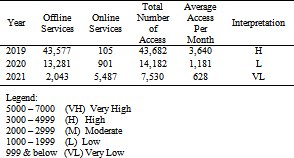
Presented in Table 1 is the access to library services by students at Central Bicol State University of Agriculture (CBSUA) Calabanga Campus from 2019 to 2021.
The data is classified as offline and online access, which includes various library services such as book loans, access to e-books, e-journals, e-magazines, and others. The table shows that in 2019, before the pandemic, there were a total of 43,682 accesses, with an average of 3,640 per month, and the high level of access was considered "High" (H). However, due to the COVID-19 pandemic, the total number of accesses to library services decreased significantly in 2020 to 14,182, with an average of 1,181 per month, and the low level of access was considered "Low" (L). The numbers remained low in 2021, with a total of 7,530 accesses for the year and an average of 628 per month, and the low level of access was considered "Very Low" (VL). In 2021, online access increased significantly, with five times more online accesses than offline accesses, reflecting the shift towards remote learning as a result of the pandemic.
The findings indicate that the COVID-19 pandemic had a significant impact on students access to library services at CBSUA Calabanga Campus. The total number of accesses to library services decreased by over 65% in 2020 compared to 2019, with a total of 14,182 accesses and an average of 1,181 per month. However, online access increased significantly in 2021, with five times more online accesses than offline accesses, reflecting the shift towards remote learning due to the pandemic. This suggests that students may have adapted to the new remote learning environment and are utilizing online library resources more frequently. The shift towards online access during the pandemic has several implications. It may have advantages for students who have reliable internet access and prefer digital resources, but it may also have disadvantages for students who do not have reliable internet access or prefer physical materials. The decrease in offline library service utilization may also suggest a need for the library to adapt to the changing needs of students and provide more online resources and services.
The findings of this study are consistent with those of 18, which reported that the COVID-19 pandemic has had a significant impact on library services, resulting in many libraries transitioning to virtual or remote services. Students have faced various challenges in accessing library services during the pandemic, such as difficulties with technology, including lack of access to reliable internet or sufficient computer hardware, as well as challenges related to the shift to online learning, such as time management and self-motivation. These challenges were also observed in the study conducted by 19, which found that the transition to virtual services has presented several challenges for libraries, including the need to rapidly adapt to new technologies, provide training and support for staff and users, and ensure that virtual services are accessible to all users. The findings of this study align with 20 survey, which investigated the usage of library resources during the COVID-19 pandemic. These findings are further supported by 21 study, which found that the usage of some library online services, such as "Email a librarian" and "Chat with a librarian," doubled during remote learning compared to the previous year. An increase in the usage of online resources, such as e-books and e-journals, was noted, while a significant decrease in the usage of printed materials in the library was observed during the COVID-19 pandemic.
5.2. LIBRO PROGRAM: A Contextualized Pandemic-Proof Library ProgramThis study utilized the IPO model to develop and evaluate a contextualized pandemic-proof library program called "Project LIBRO: A Contextualized Pandemic-Proof Library Program." The program aimed to enhance students' access to online library services and resources at the Central Bicol State University of Agriculture Calabanga Campus.
Input: The input for this study was a combination of primary and secondary data sources, including library statistics, a survey questionnaire, and in-depth interviews with undergraduate students at the Central Bicol State University of Agriculture Calabanga Campus. The primary data sources used in this study were library statistics for clients served and utilization of library materials from 2019 to 2022, as well as an in-depth interview with 15 respondents. The study used guide questions for the critical discussion to describe students' access level to library services during the COVID-19 pandemic. The study also utilized secondary data sources, including textbooks, journals, magazines, and the internet. These sources were used in document analysis to extract information and gain insights that take time to be evident from reading the documents.
Ethical considerations were considered, and informed consent was obtained from all participants before participating. Participants had the right to withdraw from the study without any negative consequences. The confidentiality and anonymity of participants were strictly protected throughout the study.
Process: The process involved the following steps:
Step 1. A thorough analysis of library data, such as statistics for library clients served and the utilization of library materials from 2019 to 2021, and feedback was gathered through in-depth interviews with identified respondents.
Step 2. Based on the analysis findings and feedback from respondents, a contextualized pandemic-proof library program was developed and implemented from January 2022 to December 2022.
Step 3. The program's effect on access to library services was evaluated after 12 months of implementation through a comparative analysis of library data, including access to offline and online library services from 2021 to 2022.
Output: The output of the study is entitled “Project LIBRO: A Contextualized Pandemic-Proof Library Program.”
LIBRO is a program designed to improve the access of students, faculty, and staff to online library services and resources during the ongoing pandemic. The program is contextualized, meaning it is designed to address the specific challenges posed by the pandemic at the Central Bicol State University of Agriculture Calabanga Campus in Camarines Sur. The acronym "LIBRO" stands for Literacy Information, Booking, and Reservations Online, which is the project’s main focus. The program includes two main components: the Online Information Literacy Program and the Online Library Booking System. The Online Information Literacy Program aims to improve students’ information literacy skills by providing them with the knowledge and skills needed to access, evaluate, and use online library resources effectively. The Online Library Booking System, on the other hand, aims to provide a more efficient and convenient way for users to access library materials and resources by allowing them to reserve materials and resources online. The project is pandemic-proof which means that it is designed to adapt to the current circumstances of the pandemic, ensuring that students have access to the resources they need while keeping them safe.
Access to library services through LIBRO Program. Table 2 presents the access to library services provided by Project LIBRO at CBSUA Calabanga Campus during the second semesters of the school years 2021-2022 and 2022-2023, along with the corresponding percentages of each type of access.
The data reveals that online library resources were the most accessed service, accounting for 45.98% of all library access in 2021-2022 and 45.94% in 2022-2023, indicating the increasing importance of digital resources for students. In terms of physical resources, the number of book loans increased from 756 (14.55%) in 2021-2022 to 1,402 (19.92%) in 2022-2023, suggesting that physical books remain important for some students despite the growth of digital resources. This increase could be due to key texts being available only in print format or a preference for physical books. The second most accessed service in 2021-2022 was reader's services, which accounted for 19.50% of all library access. This service includes assistance from librarians and other staff members, as well as access to reference materials and other resources. In 2022-2023, book loan was the second most accessed service, accounting for 19.92% of all library access, indicating that students may be increasingly using the library's physical resources in addition to digital resources. Other library services accessed include reservation of books, reservation of learning rooms, and signing of clearance. The data shows that the number of accesses for these services varied between the two semesters. For example, the number of accesses for signing of clearance decreased from 501 (9.64%) in 2021-2022 to 200 (2.84%) in 2022-2023, possibly indicating that students are becoming more aware of the need to return borrowed materials on time or that library staff is becoming more efficient at managing overdue items.
The result of this study was supported by the study conducted by 22 which evaluates the impact of pandemic-proof library programs on student access to library services at a large university in the United States. The authors found that the programs successfully improved access for students, particularly those who faced challenges with accessing digital resources due to limited internet access or technology.
5.3. Effect of the LIBRO Program on Access to Library ServicesThe study determined the effect of the LIBRO Program on the level of access to library services of students. To determine the program's effect, the level of access to library services was evaluated after 12 months of its implementation, covering the months from January to December 2022. A comparative analysis of the key to library services was conducted, including the offline and online library services. The data was collected for the year 2021 to 2022, with the year 2021 considered as the period before the program and the year 2022 as the period after the implementation of the program.
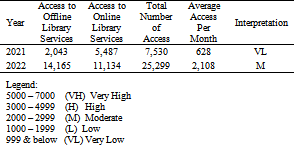
Table 3 presents access to offline library services before and after the implementation of Project LIBRO. This data provides information about the number of book loans and other offline library services provided by the Central Bicol State University of Agriculture Calabanga Campus before and after the implementation of Project LIBRO, a contextualized pandemic-proof library program. The data provided shows the level of access to library services for students during and before the implementation of Project LIBRO. In 2021, there were 2,043 offline accesses and 5,487 online accesses, resulting in a total of 7,530 accesses. On average, there were 628 accesses per month. This is considered to be in the "Very Low" range of access based on the provided interpretation. In contrast, in 2022, there were 14,165 offline accesses and 11,134 online accesses, resulting in a total of 25,299 accesses. On average, there were 2,108 accesses per month. This is considered to be in the "Moderate" range of access based on the provided interpretation.
Comparing the two years, there was a significant increase in access to library services after the implementation of Project LIBRO. There was a 597.33% increase in offline accesses, a 102.00% increase in online accesses, and a 235.10% increase in total accesses. The average access per month increased by 235.97% from 2021 to 2022. The increase in access to offline library services is particularly noteworthy.
Based on the findings, it can be inferred that the implementation of Project LIBRO has had a positive impact on the level of access to library services for students. The significant increase in access in 2022, particularly in offline access, indicates that the program has been effective in improving students' ability to access library resources. However, there may still be room for further improvement, as the level of access in 2022 is only considered to be in the "Moderate" range.
The result of this study is consistent with the findings of the study by 23, as it highlights the positive impact of implementing programs like Project LIBRO on increasing access to library services, especially during the pandemic. By investing in digital and virtual offerings, libraries can reach a wider audience, including vulnerable communities, and provide greater access to services.
Despite the significant negative impact of the COVID-19 pandemic on physical library resources, the shift towards online electronic resources has accelerated, with students increasingly relying on these resources to access information and complete their academic work. Students' reduced library usage during the pandemic was due to concerns about the pandemic, library safety measures, and the inconvenience of accessing materials or finding time to visit the library.
However, the implementation of Project LIBRO at the Central Bicol State University of Agriculture Calabanga Campus was successful in addressing these challenges, positively impacting the number of clients served and the utilization of library materials. The project provided a range of library services, including access to both digital and physical resources, with online library resources being the most accessed service, and physical books continuing to be an important resource for students. Additionally, the project offered other services, such as reader's services, reservation of books and learning rooms, and signing of clearance, catering to the different needs and preferences of students.
As a result, the significant increase in the number of book loans and other offline library services suggests that Project LIBRO effectively achieved its goals. Despite the pandemic, the project successfully increased access to library resources for the students and faculty of the Central Bicol State University of Agriculture Calabanga Campus.
The findings of this study can be used to implement a strategy aimed at transforming the library with an innovative version of information services, including increasing the availability and promoting the use of online resources and providing training and support for users to access and use these resources. Furthermore, the library should continue to implement and promote Project LIBRO, gather feedback from students, conduct further research, and explore how Project LIBRO can be adapted to continue to provide valuable services in a post-pandemic context.
The study was limited to the library services provided by the Central Bicol State University of Agriculture Calabanga Campus and did not include other institutional services offered by the university.
| [1] | Kumar, R. (2020). Digital Libraries in India: A Study of Major Digital Library Initiatives. DESIDOC Journal of Library & Information Technology, 40(3), 121-127. | ||
| In article | |||
| [2] | Ramos, J. M. C., & Abrigo, E. P. (2011). Online Reference Services in the Philippines. Journal of Library Administration, 51(6), 559-572. | ||
| In article | |||
| [3] | Laquihon, J. R. (2017). Digital Library Services and Applications in Academic Libraries in the Philippines. Journal of Librarianship and Information Science, 49(4), 417-429. | ||
| In article | |||
| [4] | Ahn, S., & Heo, Y. (2021). Academic Libraries and the COVID-19 Pandemic: Challenges and Opportunities. College & Research Libraries, 82(1), 1-12. | ||
| In article | |||
| [5] | Salazar, A. (2020). Changes in Academic Library Services During the COVID-19 Pandemic in the Philippines. Journal of Academic Librarianship, 46(6), 102225. | ||
| In article | |||
| [6] | Gordon, A. (2014). Flexibility in Learning and Teaching: Encouraging Better Educational Outcomes Through Pedagogical Practice. Higher Education Research & Development, 33(3), 529-542. | ||
| In article | |||
| [7] | ALA. (2020). Libraries and pandemics. American Library Association. https://www.ala.org/tools/libraries-pandemic. | ||
| In article | |||
| [8] | Brown, T. (2008). Design thinking. Harvard Business Review, 86(6), 84-92. | ||
| In article | |||
| [9] | Claravall, G. T. (2005). Management theories in the 21st century. Rex Bookstore, Inc. | ||
| In article | |||
| [10] | Reckwitz, A. (2002). Toward a theory of social practices: A development in culturalist theorizing. European Journal of Social Theory, 5(2), 243-263. | ||
| In article | View Article | ||
| [11] | Public Library Association. (n.d.). Professional development theory of change. Retrieved September 1, 2021, from https://www.ala.org/pla/resources/tools/theoryofchange. | ||
| In article | |||
| [12] | Bawden, D., & Robinson, L. (2020). Libraries and the COVID-19 pandemic: Staying engaged through innovation and creativity. Journal of Business Research, 116, 252-259. | ||
| In article | |||
| [13] | Owusu-Ansah, E. K., & Dawson, P. (2021). The impact of COVID-19 on academic libraries and librarians in Ghana. Library Management, 42(3/4), 151-164. | ||
| In article | |||
| [14] | Rowley, J., & Johnson, F. (2021). Information literacy: The impact of COVID-19 on teaching and learning. Journal of Librarianship and Information Science, 53(1), 74-82. | ||
| In article | |||
| [15] | George, A. L. (2022). Qualitative research design. In The SAGE Handbook of Social Science Methodology (pp. 131-146). Sage Publications. | ||
| In article | |||
| [16] | Bowen, G. A. (2009). Document analysis as a qualitative research method. Qualitative research journal, 9(2), 27-40. | ||
| In article | View Article | ||
| [17] | Baptist, C and Befani, B (2015). ‘Qualitative Comparative Analysis - A rigorous qualitative method for assessing impact.’ Coffey ‘How To’ Note. Available at: http://www.coffey.com/assets/Ingenuity/Qualitative-Comparative-Analysis-June2015.pdf. | ||
| In article | |||
| [18] | Zhang, Y., Yang, H., Shi, Y., & Liu, X. (2020). Reflections on the challenges and opportunities for academic libraries during the COVID-19 pandemic. The Journal of Academic Librarianship, 46(5), 102194. | ||
| In article | |||
| [19] | Taştekin, Ö. Ş., Özel, M. B., & Yıldız, M. (2020). Impact of COVID-19 on academic libraries: A review of the literature. The Journal of Academic Librarianship, 46(5), 102202. | ||
| In article | |||
| [20] | Gonzales, J. (2020). Library Use During the COVID-19 Pandemic: A Survey of Users of the University of North Carolina at Chapel Hill Libraries. Journal of Library Administration, 60(7), 775-791. | ||
| In article | |||
| [21] | Kailani, A. S. (2020). A cross-sectional study of the effect of the COVID-19 pandemic on usage pattern of library resources in university libraries in India. DESIDOC Journal of Library & Information Technology, 40(5), 308-314. | ||
| In article | |||
| [22] | Wichert, R. A. (2021). The impact of pandemic-proof library programs on student access to library services. Journal of Academic Librarianship, 47(2), 102304. | ||
| In article | |||
| [23] | Tabachnick, R. G., & Rathemacher, A. (2021). Pandemic-proofing library services: A study of the impact of COVID-19 on public libraries in New York City. Journal of Library Administration, 61(1), 54-71. | ||
| In article | |||
Published with license by Science and Education Publishing, Copyright © 2023 Lowell P. Francisco
 This work is licensed under a Creative Commons Attribution 4.0 International License. To view a copy of this license, visit
http://creativecommons.org/licenses/by/4.0/
This work is licensed under a Creative Commons Attribution 4.0 International License. To view a copy of this license, visit
http://creativecommons.org/licenses/by/4.0/
| [1] | Kumar, R. (2020). Digital Libraries in India: A Study of Major Digital Library Initiatives. DESIDOC Journal of Library & Information Technology, 40(3), 121-127. | ||
| In article | |||
| [2] | Ramos, J. M. C., & Abrigo, E. P. (2011). Online Reference Services in the Philippines. Journal of Library Administration, 51(6), 559-572. | ||
| In article | |||
| [3] | Laquihon, J. R. (2017). Digital Library Services and Applications in Academic Libraries in the Philippines. Journal of Librarianship and Information Science, 49(4), 417-429. | ||
| In article | |||
| [4] | Ahn, S., & Heo, Y. (2021). Academic Libraries and the COVID-19 Pandemic: Challenges and Opportunities. College & Research Libraries, 82(1), 1-12. | ||
| In article | |||
| [5] | Salazar, A. (2020). Changes in Academic Library Services During the COVID-19 Pandemic in the Philippines. Journal of Academic Librarianship, 46(6), 102225. | ||
| In article | |||
| [6] | Gordon, A. (2014). Flexibility in Learning and Teaching: Encouraging Better Educational Outcomes Through Pedagogical Practice. Higher Education Research & Development, 33(3), 529-542. | ||
| In article | |||
| [7] | ALA. (2020). Libraries and pandemics. American Library Association. https://www.ala.org/tools/libraries-pandemic. | ||
| In article | |||
| [8] | Brown, T. (2008). Design thinking. Harvard Business Review, 86(6), 84-92. | ||
| In article | |||
| [9] | Claravall, G. T. (2005). Management theories in the 21st century. Rex Bookstore, Inc. | ||
| In article | |||
| [10] | Reckwitz, A. (2002). Toward a theory of social practices: A development in culturalist theorizing. European Journal of Social Theory, 5(2), 243-263. | ||
| In article | View Article | ||
| [11] | Public Library Association. (n.d.). Professional development theory of change. Retrieved September 1, 2021, from https://www.ala.org/pla/resources/tools/theoryofchange. | ||
| In article | |||
| [12] | Bawden, D., & Robinson, L. (2020). Libraries and the COVID-19 pandemic: Staying engaged through innovation and creativity. Journal of Business Research, 116, 252-259. | ||
| In article | |||
| [13] | Owusu-Ansah, E. K., & Dawson, P. (2021). The impact of COVID-19 on academic libraries and librarians in Ghana. Library Management, 42(3/4), 151-164. | ||
| In article | |||
| [14] | Rowley, J., & Johnson, F. (2021). Information literacy: The impact of COVID-19 on teaching and learning. Journal of Librarianship and Information Science, 53(1), 74-82. | ||
| In article | |||
| [15] | George, A. L. (2022). Qualitative research design. In The SAGE Handbook of Social Science Methodology (pp. 131-146). Sage Publications. | ||
| In article | |||
| [16] | Bowen, G. A. (2009). Document analysis as a qualitative research method. Qualitative research journal, 9(2), 27-40. | ||
| In article | View Article | ||
| [17] | Baptist, C and Befani, B (2015). ‘Qualitative Comparative Analysis - A rigorous qualitative method for assessing impact.’ Coffey ‘How To’ Note. Available at: http://www.coffey.com/assets/Ingenuity/Qualitative-Comparative-Analysis-June2015.pdf. | ||
| In article | |||
| [18] | Zhang, Y., Yang, H., Shi, Y., & Liu, X. (2020). Reflections on the challenges and opportunities for academic libraries during the COVID-19 pandemic. The Journal of Academic Librarianship, 46(5), 102194. | ||
| In article | |||
| [19] | Taştekin, Ö. Ş., Özel, M. B., & Yıldız, M. (2020). Impact of COVID-19 on academic libraries: A review of the literature. The Journal of Academic Librarianship, 46(5), 102202. | ||
| In article | |||
| [20] | Gonzales, J. (2020). Library Use During the COVID-19 Pandemic: A Survey of Users of the University of North Carolina at Chapel Hill Libraries. Journal of Library Administration, 60(7), 775-791. | ||
| In article | |||
| [21] | Kailani, A. S. (2020). A cross-sectional study of the effect of the COVID-19 pandemic on usage pattern of library resources in university libraries in India. DESIDOC Journal of Library & Information Technology, 40(5), 308-314. | ||
| In article | |||
| [22] | Wichert, R. A. (2021). The impact of pandemic-proof library programs on student access to library services. Journal of Academic Librarianship, 47(2), 102304. | ||
| In article | |||
| [23] | Tabachnick, R. G., & Rathemacher, A. (2021). Pandemic-proofing library services: A study of the impact of COVID-19 on public libraries in New York City. Journal of Library Administration, 61(1), 54-71. | ||
| In article | |||