This study investigated the contextual scenarios of teachers at Bicol Regional High School in Ligao, Albay. This study investigated the contextual scenarios of teachers during the pandemic by looking into the varied problems and issues encountered, then designed and developed a prototype of an intervention. The study employed mixed methods, which employed qualitative and quantitative research approaches. Thematic analysis was used to examine qualitative data, while frequency and percentage were used to analyze quantitative data. Data were gathered from 21 respondents using a survey of the issues and problems encountered by the teachers, Depression, Anxiety, and Stress Scale-21 (DASS-21), and the Self-Care Analysis. The collected data was analyzed using Statistical Package for Social Sciences (SPSS) and thematic analysis. The finding reveals that six themes emerged: 1.) limited mobility, 2.) anxiety, 3.) avoidance, 4.) financial difficulties, 5.) homeschool dissatisfaction, and 6.) challenges of children with distance learning. Data also indicated that teachers were experiencing different levels of stress, anxiety, and depression. Teachers agreed that self-care is needed to improve mental health to ensure students’ academic achievement. Based on these findings, an intervention was recommended. – A Self-Care Module. A modified version of the ADDIE Model for module development. During the design phase, the blueprint was created. It included an overarching goal, objectives, activities, resources, and assessments in the physical, emotional, psychological, professional, and personal self-care plan. After validation with three experts, the Self-Care Module 2.0 was developed, which is the output of the study. This output is highly recommended for teachers to develop and sustain positive mental health. The online module can be accessed via shorturl.at/bgJP1.
Teaching is considered one of the most stressful jobs before Covid-19. Ramaiah and Ramchandram 1 and Hojo 2 stated that everyday stressors that beset the teaching profession include, but are not limited to, longer work hours, work demands, big classroom sizes, planning, behavior management, and insurmountable paperwork. In the Philippines, personal, work-related, and economic factors contribute to the teachers' stress levels. Individual factors affecting stress are relationships, age-related issues, and death. Also added to the stressors of teachers are the demands from paperwork, too many students, particularly in public schools and state universities, non-teaching duties, incompetent supervisors, and enrollment in graduate studies. Mingoa 3 also pointed out that meager salaries and a high cost of living contributed to teachers' stress.
One cannot just imagine how the pandemic made the life of the people in the academy more challenging and exhausting. On the contrary, COVID-19 created a "new normal" scenario that changed people's daily routines and ways of life that some individuals prefer.
When COVID-19 hit the globe, learning ceased for a while. When classes needed to resume, many adjustments challenged all stakeholders in the academy. Carreon 4 stated that it is well-documented from studies that teachers experienced stress, anxiety, and depression due to insurmountable stressors such as technological challenges, printing modules, parent communication, ongoing professional developments, documentation/reports, and lack of boundaries between work and personal life. Leite, Hodgkinson, & Gruber 5 stated that due to Covid-19, health problems also created public health emergencies. Filipinos are also affected nationwide due to prolonged social isolation. The isolation and confinement created alienation, loneliness, anxiety, depression, and even led to post-traumatic stress disorder.
An increased workload had burdened the teachers in the new learning remote set-up as they needed to learn and determine the use of technology and preparation of modules for transcription and production. Given this workload, teaching tasks are being sidelined by teachers' many other responsibilities and roles 6.
In Turkey, teachers experience issues while teaching during the pandemic. Teachers indicated they had problems with technology use, internet connectivity, lack of student engagement, and students were not motivated to learn. Furthermore, parents cannot create a learning environment conducive to learning, and teachers reported that they could not support their children at home. In addition, the importance of face-to-face education and social interactions was not evident during online learning, negatively impacting students' learning, engagement, and achievement 7.
Kraft, Simon, & Lyon 8 also stated that schools and teachers must pivot to fully remote or virtual instruction with no warning or less preparation time. This sudden and total change in how teachers delivered instruction, combined with the pandemic's health threats and economic consequences, created a uniquely stressful and demanding context for teachers' work, significantly impacting their mental health.
Mental health and well-being at work are influenced by the relationship among workers, their environment, and their workload 9. Thus, a teacher's mental health and well-being may be impacted if their workload exceeds the necessary units and there are insufficient resources to meet those requirements.
Ferguson and Hall 10 cited that this increased workload and managing students' behavior and employment conditions were also predictors of anxiety. In addition, Yasar and Demir 11 acknowledged that teachers are more prone to experience depression and burnout as teaching requires a lot of emotional labor work. This situation, thus, truly affected the delivery of learning among teachers as teachers also experienced burnout.
According to Shen, Mc Caughtry, Martin, Kulik & Fahlman 12, teachers' burnout negatively affects students' motivation. Teachers influence students' motivation not only through proven based- instructional styles but also through their outward emotions and motivations toward students. Inevitably though, teachers had been plagued with stress, and some even had symptoms of depression.
The works of Greenberg, Brown, & Abenavoli 13 and Ventayen and Ventayen 14 underscored that teachers' unmanaged stress and depression lead to health issues and poor performance, which affect the happy environment in the classroom. Moreover, they added that this scenario, in effect, also leads to poor students' academic achievement.
Backing the citation above is Jimenez's 15 argument that "a teacher that is stressed simply can't bring innovations to the classroom." Teachers cannot bring innovative ideas or try some strategies, as they are already exhausted to begin with. However, as teachers are stressed, they must still fulfill their obligations as second parents to their students. Smith and Lim 16 stated that teachers were called upon to guide, assist, and support their students' academic development and well-being throughout the shift to remote learning during the pandemic. Teachers must fulfill this obligation as they are accountable for students' achievement while navigating adversity and stress in their own lives.
In many countries, students have returned to classrooms, and teachers have been called upon to make this return as smooth as possible 16. As of 2022, the Philippines have not returned to in-person instruction. Teachers find it frustrating that some parents answer the modules or some students turn in an unanswered worksheet. However, in March of 2021, 99% of the students in the public school received a passing grade despite students' lack of motivation to complete their packets or their inability to complete the modules. Due to socio-economic disparity, some students cannot access online platforms due to weak internet connectivity. Some do not even have the gadget to access instructions via Facebook or video conferencing. The digital divide becomes evident, and these circumstances stress teachers. Knowing that students cannot access instruction to a lack of resources 17.
There is a great urgency for teachers to provide social-emotional learning support as teaching is one of the caring professions. Teachers are expected to provide socio-emotional support to the students to address their needs holistically- physical, emotional, social, moral, and psychological. However, it would be challenging for the teachers to support students' well-being if they are stressed or burned out. Recognizing these needs and acknowledging that teachers' and students' well-being are at risk, the Department of Education (DepEd) launched a helpline system to respond to this crisis 18. This initiative acknowledges that teachers and students are experiencing psychological distress during the shutdown. DepEd responded by providing support such as a Helpline system and a program called "Gabay Bahay".
From this perspective, the researcher decided to conduct this study to analyze the contextual scenarios of teachers during the pandemic and to design and develop a prototype for an intervention program. This intervention program will help teachers to take care of themselves and to enable them to be well enough to provide social-emotional learning to their students, create a learning environment, improve student interaction/relationships, and improve students' academic achievement. This necessitates the identification of the prevalence of depression, anxiety, and stress among teachers during the Covid-19 pandemic, where school administrators can support the teachers in prioritizing wellness. The study also sought to determine teachers' perceptions of self-care and the identification of the self-care practices that they employ.
The reviewed literature evoked an understanding of the significant variables of the study. There was a straightforward elucidation of stress, anxiety, and depression, integrating how these became prevalent among teachers even before the pandemic outbreak. The idea of self-care was discussed, but no interventions on its usage were revealed in the reviewed literature and studies. On the other hand, this study captured a specific set of respondents who unraveled their experiences that made them succumb to stress and anxiety. The researcher also aimed to reveal if there are respondents whose stress and anxiety led to depression. Their levels of such conditions were highlighted. From the findings, this study proposes an intervention, the Self-Care Module. Based on the results of the study, the researcher developed the module for teachers' utilization.
This study investigated the contextual scenarios of teachers in a selected public secondary school. Specifically, it analyzed the varied problems and issues encountered; designed and developed a prototype of an intervention program.
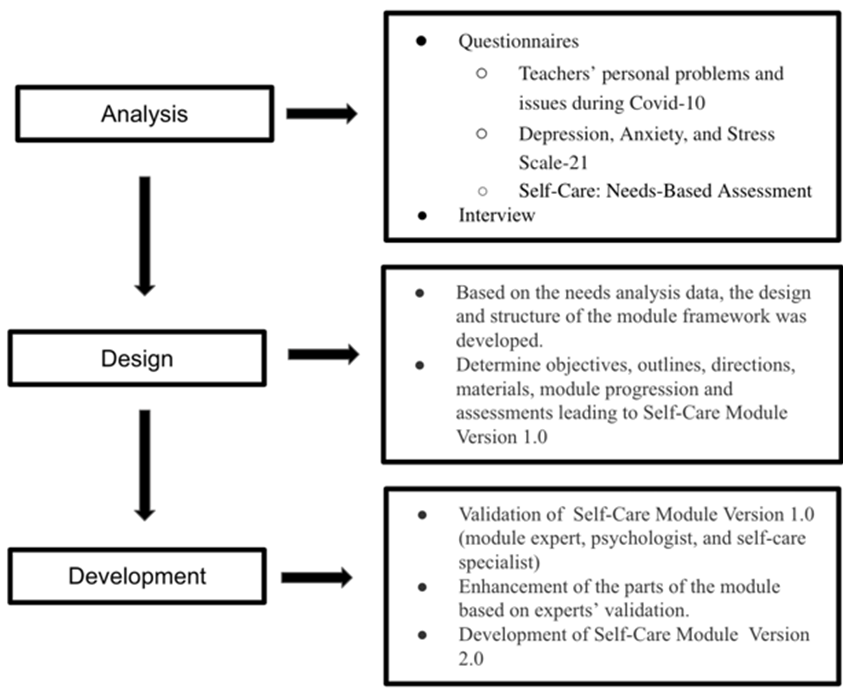
This research used a modified ADDIE model in developing the proposed intervention – The Self-Care Module as shown in Figure 1.
Analysis: In this initial phase, needs analysis was conducted. An online Google Form was developed to include the following: a survey of the issues and problems encountered by the teachers, Depression, Anxiety, and Stress Scale - 21 Items 19, and the Self-Care Need Analysis 20. In addition, follow-up interviews were conducted to dig deeper into the respondents’ issues and problems encountered during Covid-19. The questionnaire and interview created the teachers’ contextual scenario during the pandemic and assisted the researcher in determining the need, content, and resources needed to design and develop a module.
Design: According to Kurt 21, the design phase should be implemented systematically, following a detailed set of rules. In this phase, data collected during the needs analysis phase serves as the basis for the design phase helping instructional designers select instructional approaches and materials to attain the goal of the course and materials that will be most effective for the learners involved 22. The timeline for the activities and mechanisms is also determined at this stage. In this study, based on the data, the learning module was developed in the following areas: physical, psychological, emotional, professional, and personal. It was also in this stage that the objectives, outlines, directions, materials, progression of the module, and assessments were determined. Self-Care Module 1.0 was designed at this stage. No timeline was established for each area as this module is intended to be asynchronous and allows teachers to choose which self-care activities they want to study and explore.
Development: According to Mayfield 23, instructional designers get to develop materials described in the previous design phase. The content includes the learning framework, objectives, exercises, lectures, simulations, and other training materials. Experts in the field reviewed and validated the Self-Care Module Version 1.0 using different procedures to identify the planned instructional strategies and materials errors and improve the process as needed. This study developed the framework with learning goals, activities, materials, and assessments. After reviewing the experts' validations and suggestions, the module was revised based on the recommendations. Thus, the Self-Care Module Version 2.0 was developed.
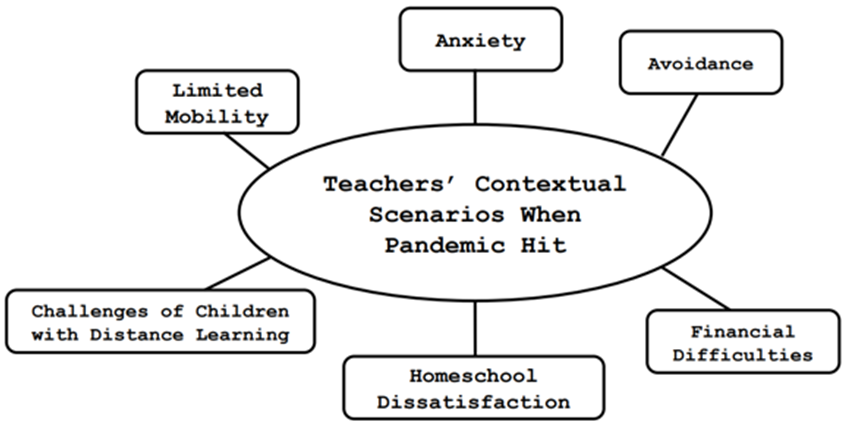
There are six teachers’ contextual scenarios, as shown in Figure 2. These are 1.) limited mobility, 2.) anxiety, 3.) avoidance, 4.) financial difficulties, 5.) homeschool dissatisfaction, and 6.) challenges of children with distance learning.
Limited Mobility. Most countries restricted mobility to limit the spread of COVID-19, as reflected in community quarantine. The apparent reason was to contain the virus and slow its spread.
The limited mobility added to the stress and anxiety teachers encountered, disrupting the respondents' daily activities, making things more challenging, and impacting their well-being and quality of life, affecting students’ performance.
Though Filipinos are known for their close family ties, visiting family and friends was not considered essential during community quarantine. Therefore, it can be interpreted that social support and connections were cut-off. One of the respondents stated, “Difficulty in mobility led to my inability to visit loved ones living in other provinces”. The limited mobility due to travel restrictions heightened the guilt of being unable to be with and care for their loved ones. At the same time, social connection is hampered, leading to feelings of disconnection and loneliness.
Another effect of travel restrictions is the feeling of isolation due to a lack of interaction with others. For example, one of the respondents stated, “Limited mobility made me stay home and made me a sense of isolation from the rest of the world”.
It is second nature for teachers to interact with others professionally. The restrictions changed the way teachers collaborated with others and interacted with parents, peers, and students in person. Teachers are not used to being confined to one area. Teachers can use technology like Facebook Messenger and phones to connect with others. The sudden shift due to travel restrictions prevented teachers from adjusting to the new normal. Poston 24 stated that it is human nature for individuals to interact with others. Love and belongingness are on the third level of the hierarchy, indicating that an individual requires social connection, which is crucial to one’s psychological well-being. This is supported by Smith and Lim 16 and Jakubowski and Sitko-Dominick 25, stating that prolonged quarantine led to social isolation and loneliness that negatively affected one’s psychological well-being. On the other hand, Pietrabissa and Simpson 26 also indicated that loneliness increases depressive symptomatology in individuals, which could dramatically affect one’s quality of life.
Limited mobility also leads to unprecedented and abrupt disruption of regular routines and work of the respondents while supporting recommendations for quarantining and social distancing. These are some responses of the respondents: “Limited freedom in my daily undertakings is frustrating”, “Travel restrictions made me bored at home,”; and “I wasn’t able to tutor”. Based on these statements, teachers were frustrated as they tended to hope that their pre-Covid lifestyle and routines would go back. Teachers were also angry and frustrated about losing income due to limited mobility. Arnaldo 27 stated that one of the teachers' sources of stress is having meager salaries; therefore, having a tutorial job would solve that financial aspect of their lives. Jakubowski and Sitko-Dominick 25 added that the restrictions led to financial problems that made teachers more prone to symptoms of anxiety and depression. Because of the new normal, teachers' unable to cope and accept the new normalcy led to anger, frustration, stress, anxiety, and depression.
Another statement was, “I cannot keep up with my exercise regime - biking”. Outdoor physical activities and exercises are good coping strategies for teachers to destress, prevent chronic diseases, and help teachers with chronic conditions improve their physical and mental health. However, most preferred outdoor physical activities were restricted due to limited mobility. Teachers were confined in their houses, either sitting down to watch TV or walking from one place of their home to another, limiting their physical activities. Wright 28, Puccinelli 30 and Giuntella, Hyde, & Sadoff) stated limited physical activities lead to fatigue, mood disorders, anxiety, and depressive symptoms. Therefore, teachers must engage in physical activities to maintain healthy mental health.
The researcher concludes that teachers are predisposed to mental health issues due to limited mobility that affects traditional social interactions. The above findings also get validation from Philippine Educators Explore Mental Health Concerns in UNODC Webinar Series 31 Will 32 and 33 and Smith and Lim 16, who indicated that isolation, loneliness, lack of social support and interaction due to health protocols negatively impacted teachers’ ability to cope with stress and created emotional distress that further exacerbates the situation. In addition, the loneliness brought about by social isolation led to surges in mental health issues that negatively affect one’s health, which is not helpful for teachers. That being the case, the community quarantine and lockdown, which was to keep the respondents safe, affected the respondents' physical and mental health negatively.
With these results, the following are recommended. First, there is a need for teachers to spend time with their families in one household. Second, teachers need to maintain social connectedness through technology such as Facebook Messenger, Zoom, Google Meet, and the use of phones. Third, due to the nature of the stress, anxiety, and depression stemming from the uncertainties brought about by the pandemic, teachers need to engage in relaxing exercises such as yoga and mindfulness. Finally, teachers are encouraged to engage in physical activities individually at home or pursue outdoor activities in areas where social distancing can be maintained while engaging in physical exercises.
Anxiety. As the world deals with the novel virus and the exacerbated fear of the unknown, most respondents reported experiencing anxiety.
This theme reveals that government restrictions that aim to slow the spread of the virus led to disruption of everyday routines, safety concerns, people being overwhelmed with duties at home and work, and lastly, the uncertainly of the future, which led to financial problems, lost work, and isolation, making teachers more prone to symptoms of anxiety and depression 25.
A high level of anxiety stems from the fear of the known. For example, safety is uncertain. Even if respondents practiced safety protocols, they were still very anxious about getting infected with the virus. As the infection rate increased, so was the mortality rate, mainly for those with comorbidities. Worst, one might get infected and could transmit the virus even without knowing it, as many asymptomatic cases were found to be prevalent during the pandemic. One respondent stated, “My family and I can’t go out due to the fear of getting COVID-19”. Respondents feared contracting Covid-19 as getting Covid-19 treatment and hospitalization was not cheap in the Philippines. Therefore, to avoid the extravagant cost of contracting Covid-19, teachers would prefer to quarantine and follow the government protocols to prevent contracting the virus, which could lead to sickness or even death. Poston 24 stated that safety is the second in Abraham Maslow’s Hierarchy of Needs. When the safety needs of an individual are not met, it often leads to anxiety. Anxiety also arises due to uncertainties and one’s ability to predict the future. Teachers were unsure when things would return to normal, like going back to traditional class, when the pandemic would be over, helplessness, loss of control, and inability to tolerate uncertainties. All these uncertainties and fears created anxiety on the part of the respondents. The responses result from the imminent threat of being infected with COVID-19, especially when there was still no vaccine; hence, the rising number of infections. Like most people, the respondents felt anxious thinking about their safety and that of their family, which is a normal reaction. This feeling has become constant in the respondents’ daily struggles with the new normal.
Worrying and fear are normal reactions to the unknown, although heightened levels lead to anxiety. Respondents reported being overwhelmed and worried during the pandemic. Some of the concerns expressed were experiencing anxiety due to the unknown - future, work, and safety”, “The unknown made me worried and fearful as I struggled with the new normal.”, and “It is overwhelming”. Because no one had experienced a pandemic before, it is a normal reaction for teachers to overthink the situation, considering little is known about the novel virus. The future is uncertain as experts navigate and rush through the development of the vaccine while everyone waits for what will happen next-teaching career.
Anxiety is highlighted due to the uncertainties brought about by the pandemic were added to the respondents' worries about the unknown as they navigated uncharted territory. This supports the findings of Brackett and Cipriano 34 that anxiety is the top reported emotion reported by teachers during the pandemic due to severe worrying about the future and struggles in navigating the new normal. Talindog and Toquero 35 and Kim and Ashbury 36 also stated that anxiety stems from the fear of having themselves and loved ones getting infected, more so, losing a loved one due to the virus. On the other hand, Lalu 38 stated that the uncertainty of the pandemic created more stress among Filipino respondents, leading to a feeling of helplessness and frustration for failing to do things they usually do.
One respondent stated,”Pinapa-Diyos ko na lamang and lahat” (I just let go and put everything in God’s hands), a coping style wherein comfort, protection, and guidance are sought by praying during the crisis. The pandemic helped teachers realize that they have no control over many things. But they have a superior being they can rely on to help with their fear. Bentzen 38 stated, “People pray to cope with adversity”. It was reported that more than half of the population relied on prayers, and there were increased Google searches on different kinds of prayers.
The researcher concluded that anxiety impacts teachers' ability to handle personal and professional roles. Likewise, if fear and chronic worrying are not addressed, it will affect teachers’ personal and professional roles, impacting students learning.
With these results, the following are recommended: First, teachers must care for themselves by eating nutritious food, exercising, getting enough rest, and sleeping. Second, teachers need to interrupt and break the “worry cycle” through self-management techniques to manage anxious thoughts, such as meditation, yoga, breathing techniques, realization techniques, and journaling. Third, they should seek support and assistance if needed.
Avoidance. The avoidance strategy is a theme that emerged to cope with stress and anxiety brought about by the pandemic. However, an avoidance strategy can be effective in managing and can also lead to detrimental effects.
Analysis of this theme reveals that avoidance is a strategy that teachers employ to dismiss uncomfortable thoughts or situations by avoiding them.
The teachers would avoid going out in public to lessen the probability of contracting the virus due to apprehension. Respondents shared, “I limit the times I go out as I fear getting infected with COVID-19”, “I avoid going to public places”, “I do not visit my parents as I might bring COVID-19 to them, but I worry for them”. Therefore, teachers supported and complied with the CDC and government mandate of staying at home to reduce the transmission of the virus and to avoid contracting the virus. Furthermore, the health care system of the Philippines is weak due to a lack of resources. Therefore, teachers knew that they or their loved ones should not contract the virus as they could not afford hospital treatment.
Some teachers also avoided watching the news as it led to information overload, inability to trust the media, sensationalized information, and invocating anxiety. “I stopped watching the news as it affects my mental health”. However, due to the quarantine, teachers' usage of social media and TV increased dramatically and brought some comfort at some point. In addition, news provided information about the novel virus. Thus, watching the news was emotionally draining, resulting in a high incidence of teachers experiencing stress, anxiety, and depression 40.
Some overwhelmed teachers try to use avoidance behavior by getting away from work to attend to important things that matter to them. For example, “I stopped working at 5 PM to give time to my family”. Because teachers were working from home, the homework boundary ceased to exist, which led to exhaustion, resentment, and overwhelm 41 and 15. Therefore, avoiding work at some time to attend to one’s family would mean living a balanced life and prioritizing what matters most.
Others used avoidant behavior by engaging in negative coping skills such as drinking alcohol or drugs to forget the situation momentarily. One respondent said, “I drink alcohol to forget the stress brought about by the pandemic''. Teachers may employ a negative strategy of coping by ignoring the problem, thinking it will go away. Avoidance does not solve the problem, making it worse when problem issues are not dealt with. This aligns with the result of Stapleton, Garby, & Sabot 41, stating that when individuals do not employ positive coping skills, they tend to use unhealthy coping skills such as avoidance behavior. Aydin 42 also noted that a teacher experiencing mental health issues negatively impacts the effectiveness and quality of instruction as it leads to work avoidance that affects planning, managing time, and classroom organization. Therefore, it is essential to address this problem.
The researcher concludes that avoidance can be a coping strategy that helps teachers avoid discomfort to maintain their mental health. But on the other hand, avoidance could employ negative maladaptive behavior in preventing an issue that must be tackled and addressed, affecting mental health and wellness.
With these results, the following are recommended: using mindfulness as an effective stress management technique; pursuing professional development on coping skills; stress relief techniques; journaling; and . These are highly effective for managing emotional stress,
Financial Difficulties and Struggles. The pandemic highlighted that teachers are financially struggling as they were exposed to the economic consequences of the pandemic.
Analysis of this theme indicates that financial struggle is crucial to mental health. Teachers are more prone to psychological distress from the inability to pay debts, lack of additional income, and the guilt of being unable to provide.
Financial struggle can be interpreted as a lack of additional income and meager salary. During Covid-19, due to government restrictions, the teachers and other members of the family were impacted economically due to loss of supplemental income, as supported by the respondents' statements, “I am unable to tutor, so my income is limited'' and “My husband was an OFW before, but because of the pandemic, he wasn't able to go back to KSA”. In addition, due to travel restrictions imposed by the government, there was limited mobility impacting the teachers and loved ones to additional earnings as teachers are reportedly underpaid in the Philippines. Even before the pandemic, meager salaries and the high cost of living contributed to teachers’ stress. Financial problems are one of the triggers of negative emotions that could lead to poor teaching performance 44. Therefore, this can add to the teachers' stress and anxiety or lead to depression as teachers cannot earn and struggle to meet their basic needs.
Some respondents stated that there is an increase in their spending, as evidenced by the following statements: “Children mostly stay at home and eat a lot”, “Electricity and water bill is high”, “I have to pay my loans still”, and “Expenditures went up due to additional expenses like vitamins and eating nutritious and healthy food”. Due to the lockdown, family members of teachers had to stay at home increasing bills, food expenses, Covid related expenses such as vitamins and masks. Casingal and Ancho 44 stated that food, bills, and loan payment are the top expenses reported by teachers during the pandemic. To begin with, teachers' salary is insufficient, so most teachers would opt to work after school by rendering tutorials or borrowing money from family or friends. Given that supplemental income was gone due to restrictions and financial responsibilities, teachers now have to worry about making ends meet, affecting their mental health. While at home, spending among households increased; even if they did not go to business establishments, families had ample time to browse online and access products and services they wanted to purchase and avail.
Hence, according to Stapleton, Garby, & Sabot 41, Mesquita, Boiger, & Leersynder 43, and Nagoski and Nagoski 45, finances have been a source of stress. Teachers' expenses increase as they stay and work at home, particularly their utilities, vitamins, and food. Financial struggle is equated with teachers’ high absenteeism and low job satisfaction, negatively impacting students’ achievement. In addition, the overall mental health of the teachers is negatively affected by financial distress.
The researcher concludes that financial strain is one of the common stressors of teachers due to meager salaries and the inflation brought about by the pandemic.
With these results, the following are the recommendations. First, school administrators should include Financial Literacy during in-service training of the teachers to reduce financial strain and economic stress, resources, and tools to help manage finances and reduce financial strain, improving teachers' overall well-being.
Homeschool Dissatisfaction. Dissatisfaction with homeschooling is another theme that emerged. The respondents, who were teachers, also played the role of being a parent while delivering alternative instruction.
Analysis of this theme indicated that due to school closure and abrupt change to modular/online learning, teachers, who were also parents, were not satisfied with how instruction was delivered virtually due to deficiency in the alternative learning modality due to lack of support, technological challenges, and lack of students’ social interaction. Indeed, the new learning modality increased the stress of the respondents.
Interpretation of homeschooling dissatisfaction indicates that parents question the effectiveness of this alternative learning mode when providing the quality education that face-to-face instruction offers.
The respondents are very concerned about the minimal or lack of progress of their children due to modular/online learning. “Home studying isn't enough for their education,” and, “It seems like he is not learning enough, especially since he was just in Grade 2 back then”. Their teachers, who are also parents, find dissatisfaction with alternative learning. Due to abrupt changes from traditional face-to-face learning to alternative education, stakeholders and teachers had to plan and use available resources to make it happen. Due to a lack of planning and resources, learning contents were vague and insufficient resources to carry out online or through modular learning. On the part of the students, the house may produce a poor learning environment and cannot mimic the traditional classroom. Therefore, these factors impeded teaching and learning.
Teachers also stated that since students are struggling with learning, support was provided, like, tutorials after school. However, as stated by the respondent, “No tutorial is provided”. As teachers grasp alternative learning and due to lack of homework boundaries, teachers would struggle to provide support to struggling students, therefore, widening the achievement gap. Pew Research Center 46 said that students were falling behind during online learning, and parents were very concerned. So, parents supported or supplemented their children’s education by providing resources if they could. On the other hand, another concern of the parents due to online learning, their children spend a lot of screen time, which hindered their social skills development, and caused a lack of access to extracurricular activities.
Technological challenges were also reported as a source of dissatisfaction and frustration for the teachers impacting their children's learning. Due to poor internet connection, the teachers’ children had difficulty grasping the content being delivered by the teacher and vice-versa. A respondent stated, “My child barely understands what the teacher is saying due to weak Wi-Fi signal”. Therefore, weak internet connection caused students to be left behind academically. Knowing that the respondents had already reported financial struggles, subscribing to an internet provider with a fast connection was costly. Therefore, most respondents would avail of the affordable plan but might not provide an immediate connection. Thus, poor connections impacted students' academic progress and added up to the stress of the respondents seeing their children not being able to access instruction to the limitation imposed by the unstable internet connection. Jain, Lall, & Singh 47 and Trust and Whalen 48 supported this claim, stating that Wi-Fi connection plays a vital role in online learning delivery.
And lastly, alternative learning does not allow students social interaction. “My child needs social interactions with classmates”. Respondents stated a considerable concern about students being unable to interact as teachers use Zoom or Messenger to teach the children. One of the limitations of alternative learning is that students could not get opportunities to converse with students. Eventually, a lack of social interaction harms the quality of the learning experience.
It can be concluded that the alternative mode of learning virtually mimics traditional face-to-face instruction. However, virtual learning and modular learning have limitations that affect the quality of education as they lack the teachers' ability to provide support in a timely manner, and students are allowed to interact with other students.
With these results, conclusions that followed were formed. First, there is a need for the respondents to collaborate with their children's teachers as issues arise so a possible solution can be employed. As dissatisfaction with children’s alternative modality is frustrating, there is a need for the respondents to destress by engaging in a hobby and keeping in touch with family and friends.
Challenges with Children’s Distance Learning. One of the emerging themes is the challenges with their children with distance learning. Due to school closure, teachers were obliged to provide distance learning. Work-home boundaries cease to exist during this time. When delivering online learning, the teachers’ children are in online learning too.
Analysis of this theme indicated that distance learning introduced new educational challenges to the respondent, wearing two hats at home and personal life. Although this meant that the respondents would deliver instruction from home as a teacher, they indicated this yearning to provide support and monitor their children’s learning. Still, they were unable to perform both duties at the same time.
This can be interpreted as the respondents could not balance personal life and work, impacting their ability to be involved and monitor their children’s learning. This leads to guilt. One respondent stated, “Feeling guilty for not assisting my children with online learning as I struggle to figure out how to juggle work”. The guilt feeling stemmed from the inability of the respondents to be parents and teachers at the same time. It seems that parents were experiencing an identity crisis as it is a struggle to balance work and personal life demands, especially if both happen in the same place-home. Leonhardt 49 supported this claim stating that more than half of the respondents in her study indicated that working parents feel guilty for being unable to fully take care of their children considering demands from work while doing house chores and taking care of the children while maintaining mental health.
Additional statements supporting the guilt stemming from one’s inability to do all things simultaneously are “I can’t monitor my own children’s learning,” as the respondents cannot wear two hats simultaneously. With the abrupt transition to alternative learning, the respondents somehow are overworked as they navigate how to fulfill their teaching duties and cannot assist their children. One respondent stated, “Lack of time in assisting my two kids in their distance learning” and “Coping with the children's distance learning modality”. These statements indicate that the respondents were acknowledging that time is not enough to assist, and because of that, they cannot cope with the demands that can be stressful and frustrating at the same time.
The respondents' struggles to assist their children are supported by Jakubowski & Sitko-Dominik 25, Nikmah, Indrianti, & Pribadi 40, and Jimenez 15. According to them, teachers struggle to distinguish the thin boundary line between home and work. With this, they cannot balance time for family and work. Furthermore, since teachers teach when their children are in their online classes, they cannot monitor them. Therefore, they cannot provide the support they need to make their children successful with online learning.
The research concludes that there is a struggle for the respondents to wear two hats while at home – teacher and parent. As their children navigate the alternative mode of instruction, the teachers are not there to provide support and monitor their students, which adds up to the guilt feelings and adds up to their psychological distress.
With these results, conclusions that followed were formed. First, because of guilt stemming from one’s inability to balance work and personal life, the respondents need to reframe their thoughts by replacing negative thoughts and feelings with positive reviews. Teachers need to practice being kind to themselves and others by being grateful for what they have. Journaling will also help the respondents create awareness and distress at the same time. Finally, respondents need to engage in self-care to take care of others well.
4.2. Prevalence of Depression, Anxiety, and Depression, and Stress among Teachers During Covid-19 Pandemic Based on DASS-21Table 1 summarizes the prevalence of stress, anxiety, and depression among respondents.
Regarding stress, 81% of respondents reported that their stress level falls below average, while 19% reported mild stress.
Based on these findings, most teachers could handle daily life stressors, while almost 19% were showing symptomology of mild stress indicating that they are experiencing low-stress levels. This can be interpreted as teachers being exposed to many stressors as part of being a teacher. Teaching is one of the stressful occupations, and teachers deal with common stressors daily by employing different coping strategies. In the process, teachers developed resiliency in dealing with common stressors or issues. Nagoski & Nagoski 45 stated that stress is a normal reaction when an individual is confronted with stress that disrupts the person’s equilibrium. They also highlighted how individuals handle stress-flight, fight, and freeze. The person can confront the stress or run away from it. The person can also freeze by not doing anything with the threat. In this case, the respondents were able to confront the threat as resilient teachers are experts in dealing with everyday stressors.
It can be concluded that the respondents were not experiencing burnout as they were resilient enough to bounce back. This is supported by Flunger, Pretsch, Schmitt, & Ludwig 50 stated teachers who are resilient when encountering stress at work tend to report high quality of life.
Furthermore, about 20% were experiencing mild stress that the themes in this study could bring about: limited mobility, anxiety, avoidance, financial difficulties, homeschool dissatisfaction, and challenges of children with distance learning. These themes are in addition to unprecedented work-stress-related problems such as challenges with technology, increased workload, lack of work-home boundaries, and health mandates such as wearing masks, and social distancing, to name a few 51. This is supported by Rubilar and Oros 53, that teachers are affected by work-related stress, which negatively affects students’ achievement. In addition, Sims 33 teachers working from home as a response to the lockdown tend to feel isolated and forced by the daunting tasks and demands of online teaching. Lack of social support negatively affects their ability to cope with stress.
It can be concluded that some teachers are experiencing mild stress, which needed support as it affects students’ achievement. Stapleton, Garby, & Sabot 41 acknowledge that teachers need help to lessen their psychological distress, as it directly impacts students.
From these findings, the researcher recommends a healthy lifestyle, professional development on building coping strategies, stress management, focus groups to reduce teachers’ discomfort, reframing thinking, breathing exercises, physical exercises, yoga, and meditation.
Regarding the prevalence of anxiety severity, 48% fall on the average level. However, 52% were not under the normal level as they were scattered under moderate (33.3%), mild, and severe (both at 9.5%).
It can be analyzed from these results that almost half of the teachers can cope with the demand of home and work brought about by the pandemic preventing the respondents from manifesting symptomology of anxiety.
This can be interenterprise as much as the teachers have worries and fear of the unknown brought by the pandemic. They can deal with it using appropriate coping skills. Smith and Osborn 52 and Houston Behavioral Healthcare Hospital 54 cited that anxiety is a normal and healthy response in anticipation of a future threat. Anxiety alerts the body and allows it to prepare to get out of a dangerous situation. Similar to stress, anxiety can trigger the need for fight and flight. Therefore, anxiety is necessary when experienced in response to a threat. That being said, teachers can handle their worries and fear of the unknown using coping strategies. Smith and Lim 16 stated that the uncertainties of the current situation contributed to short-term anxiety, a normal response to a series of stressors. Experiencing short-term anxiety may include physical and emotional symptoms such as nervousness, hyperventilation, tiredness, difficulty sleeping, increased heart rate, and chest pains.
It can be concluded from this data that half of the teachers could employ coping strategies and manage, and therefore, they could not experience anxiety.
On the other hand, 52% of the respondents reported mild anxiety (9.5%), moderate anxiety (33.3%), and severe anxiety (9.5%)
Based on these results, it is evident that more than half of the respondents are showing symptomology of anxiety. Brackett and Cipriano 34 stated that anxiety is one of the reported emotions being experienced by teachers during the pandemic. This indicates that more than half of the respondents were exposed to consistent and intense worrying and fear to the point that it can be overwhelming, affect the respondents' teaching, and negatively impact students’ academic performance. Stapleton, Garby, & Sabot 41 supported this, stating that anxiety negatively affects the quality of instructions provided to the students as teachers use maladaptive coping skills such as avoidance, alcohol, and drugs. In addition, Aydin 42 stated that teaching anxiety negatively affects instruction effectiveness and quality as it leads to work avoidance that affects planning, managing time, and classroom organization. It is also said that teaching anxiety leads to a decline in students’ academic achievement, and teaching anxiety can be passed on to the students. Lastly, the Anxiety and Depression Association of America 55 excessively worries about fears that interfere with personal, relationships, or professional work, which can lead to anxiety disorder.
It can be concluded that there is a need to armed teachers with tools and resources to ensure that they preserve their mental health and psychological well-being.
From these findings, the researcher recommends a healthy lifestyle, mindfulness programs, wellness programs, positive coping skills, focus groups, professional development on time management, and mental health support.
Regarding the prevalence of depression severity, 76.2% fall on the normal level. Further, 4.8% reported mild depression, and 19% reported moderate depression. It was notable that none of the respondents had a severe level of depression severity.
It can be analyzed from this data that a quarter of the respondents did not manifest symptomatology of depression despite teachers being exposed to stressors. As a result, they can function and preserve their mental health.
This can be interpreted that as teachers experienced the themes that emerged in the contextual scenarios of teachers, they were able to use positing coping mechanisms.
It can be concluded that much as teachers were affected by the effects of Covid-19, there were able to cope. From this perspective, much as the news and impact of Covid-19 affected teachers negatively, they can deal with it, which jeopardized their psychological well-being. Talidong and Toquero 35 indicated that Covid-19 altered the lifestyle of Filipinos. But much as it was depressing at some point, teachers could deal with the issues and preserve their mental health. In support, Van Droogenbroeck and Spruyt 56 stated that much of the teaching profession causes mental fatigue, and no studies have been conducted that teachers are more prone to psychiatric disorders.
On the other hand, almost a quarter of the respondents reported mild to moderate depression. Mild depression indicates that the respondent experiences a prolonged sadness that interferes with normal activities but is easier to treat. While Moderate depression interferes with work at home, affects social skills, and may require medication.
This can be analyzed that some respondents are experiencing depression as they were not able to persevere in their mental health by utilizing positive coping skills. Stapleton, Garby, & Sabot 41 supported that depressed teachers use maladaptive coping strategies such as alcoholism, which leads to psychological distress and decreased life satisfaction. In addition, Klapproth, Federkeil, Heinschke, & Jungmann 57 and Stapleton, Garby, & Sabot 41 also stated that if dysfunctional strategies such as alcoholism, gambling, drugs, or avoidance of work when employed, it is less likely that teachers will preserve their mental health. It has been said that teachers’ depression can be transferred to the students and impact their academic achievement. However, Wu and Lu 58 research stated that there is a negative correlation between teachers’ depressive symptoms and students’ depressive symptoms. Therefore, teachers with depressive symptoms do not pass them on to their students.
It can be concluded from this study that teachers who employ positive coping mechanisms are more likely to have good mental health. On the other hand, teachers who use harmful coping mechanisms are likely to be depressed.
From these findings, interventions for teachers with mild and moderate depression are different. For mild depression, the following are recommended: a healthy lifestyle, mindfulness programs, wellness programs, positive coping skills training, focus groups, a self-care support system, and mental health support. For teachers who are experiencing moderate symptoms: medical help is needed.
With the overall results in the symptomology of stress, anxiety, and depression, the following recommendations were formed. First, it is recommended to develop a self-care module for teachers. The essence of the module is seen not just in the revealed existence of anxiety, depression, and stress but in consideration of the teachers' shared experiences, which identified the issues and problems they encountered during the COVID-19 pandemic and as they journey to the new normal.
4.3. Perceived Self-Care Needs of Teachers Based on the Self-Care Need Assessment ToolTable 2 shows the self-care needs of the teachers broken into five categories: self-care awareness and practices; physical self-care; emotional self-care; psychological self-care, and professional self-care.
The table shows that Self-Care Awareness and Practices generated a mean of 4.12, meaning teachers agreed that self-care is essential and needs to integrate and practice self-care. Based on the survey results, teachers know what self-care is, see the relevance of incorporating it into their daily life to improve mental health and find it necessary to become successful. However, much as the teachers agree that they know the definition of self-care, there are a lot of misconceptions about its definition. At times, self-care has been defined and presented as synonymous with being extravagant and pampering oneself with expensive vacations.
On the other hand, self-care would mean integrating self-care in a trial and error during the pandemic, practicing self-awareness by engaging in mindfulness, and being optimistic and solution focused as issues and problems arise 59. The respondents also agreed that a self-care plan is needed to achieve self-care goals. Teachers know that having a self-care plan assists them in establishing a routine to make sure that the self-care activities written on the self-care plan are carried out. By having a self-care plan, teachers can take charge and take proactive steps to minimize stress and anxiety. From this perspective, self-care is perceived as a preventive intervention. Leahy and Wolfe 20 stated that self-care is subjective and there is no one-size fits all approach to self-care. It must be individualized, and those activities should be incorporated into daily life. A goal must be established, and those activities should be evaluated weekly - is it working or not. The self-care is modified based on the dynamic and situation of a person. It is about creating a purposeful lifestyle and personalizing activities to care for oneself.
For physical self-care, the mean generated is 3.5, meaning the teachers agreed that physical self-care is relevant. In addition, the teachers agreed they could drink at least six glasses of water and consume an assortment of fruits and veggies to promote physical wellness. Indeed, teachers need to eat and drink to get the energy required to get ready for the insurmountable workload that comes with their profession as teachers. Isaac 60 indicated that eating and drinking are physiological needs to be met to stay healthy. Unable to do so will lead to illness or death.
On the other hand, teachers responded neutral when it comes to sleeping at least 7 hours per day and exercising at least 20 minutes a day. With the pandemic, the work that teachers needed to do quadrupled. Without the life-work boundary, teachers would spend more time working to meet the job's demands. Because of this, teachers may struggle to find the time to sleep and exercise. However, if teachers are not rested, they tend to feel sluggish and unable to focus on things that must be done. Poon, Hui, Yuen, Kwong, & Chan 61 study shows that teachers' lack of sleep leads to stress. Teachers who lack sleep tend to be irritable, negatively affecting students’ motivation and in-class participation. As regards exercise, however, Stults-Kolehmainen and Sinha 62stated that it is possible that exercising can lead to additional stress if it is inconvenient for the individual as one struggles with demands from work or demands from the family. This is not true, as most experts' findings support the benefits of exercise. For instance, Edenfield and Blumenthal 63 cited that the physical benefits of exercise are widely recognized. An abundance of epidemiological evidence supports an association linking exercise to physical health and overall quality of life.
On the other hand, emotional self-care shows that the mean is 4.24, meaning teachers agreed that emotional health is tied to physical health. This indicates that teachers know that good emotional health can improve the body’s immune system. Moreso, poor emotional health can likely weaken the immune system, leading to illnesses. This is supported by Rooney 64, stating that a person unable to regulate emotions is more likely to experience stress, anxiety, and depression.
The findings above also revealed psychological self-care. The mean for this category is 4.12, meaning the teachers agreed that psychological self-care is relevant. In this category, the teachers indicated that practicing self-care is beneficial to overall mindfulness practices, and implementing attainable daily goals assists in practicing self-care. Teachers are very aware of writing SMART goals. Having specific, achievable, and measurable daily goals create accountability for the teachers. It allows them to stay committed to their goals and check their progress or lack thereof to modify them. On the other hand, mindfulness is a tool known to manage stress as it increases awareness. According to Shen, Mc Caughtry, Martin, Kulik & Fahlman 12, mindfulness is important to developing resiliency as it incorporates mindful presence, openness to experience, and non-judgment acceptance.
The last category is professional self-care which shows a mean of 3.62, meaning the teachers’ response to this category is neutral. The teachers acknowledge that self-care is necessary to succeed in professional commitments. Furthermore, they are aware that it is relevant to engage in activities that are related to the teaching profession. The teachers agreed that work-related stress inhibits them from practicing self-care. On the other hand, they rated the field of education as so demanding that it limits self-care as neutral. With an insurmountable workload and endless things a teacher needs to do daily, they may not have the time or energy to engage in self-care activities. Since work quadrupled during the pandemic, teachers are overworked and tend to navigate unchartered territory. Wolgast and Fischer 65 indicate that time constraints are one of the stressors of teachers as they cannot fit in all the things they have to do during the day. Therefore, they must utilize their personal/family time in completing paperwork. In this case, teachers cannot do their preferred activities to de-stress as they never had the time to do so.
The teachers responded neutral by putting students first in front of the teachers’ self-care. At the same time, school and administration support the practice of self-care, indicating that the teachers surveyed were undecided on those areas. Teachers are in the caring profession, and there is a tendency to put others first instead of oneself. As the cliche goes, “Put your oxygen first before assisting others”. It seems it is in teachers' nature to put others before themselves. However, practicing self-care means “I matter too!”. To support the caring nature of the teachers, the study by Kim and Ashbury 36 indicated that teachers tend to worry about their vulnerable students who are starving and lack the resources to carry on online learning. School and administration support for the practice of self-care was rated neutral. It seems that the teachers are unsure whether administrators support teachers’ self-care. Often, the school administrations receive orders from the higher authorities and impose those orders to get done on the teachers’ level, increasing the teacher workloads and their stress levels. Shen, Mc Caughtry, Martin, Kulik & Fahlman 12 and Gewertz 66 indicated that administrators need to address the stress being experienced by teachers by providing workshops to manage stress, time management, and coping of teachers. In addition, Jennings, Brown, Frank. Doyle, Oh, Davis, Rasheed, DeWeese, DeMauro, Cham & Greenberg 67 indicated that teachers must be taught social and emotional competence to regulate emotions, lessen psychological distress, and allow teachers to rekindle their passion for learning and teaching. The grand mean is 3.93, meaning that the teachers agree that self-care activity (physical, emotional, psychological, and professional makes one healthy and improves wellness.
Oducado, Rabacal, Moralista, & Tamdang 68 indicated that teachers need to improve their well-being and alleviate the effect of stress on their bodies. Mingoa 3 also stated that if teachers can take care of themselves and their well-being, students would benefit from it. It is evident that with a positive teacher-student relationship, there is also increased motivation and students’ achievement.
It can be concluded that to address the stress, anxiety, and depression of teachers, they should integrate proactive self-care to protect and improve their mental health.
With these results, the following were recommended. First, most respondents agreed to the benefits they would get by understanding and practicing self-care for their personal and professional journeys. Therefore, the researcher strengthened her position to develop a Self-Care module for them. The importance of this proposed module is supported by Glowiak 69, who stated that people who engage in a self-care routine have been shown in studies to lessen or eliminate anxiety and depression; it also reduces experiencing stress. In addition, self-care can also improve concentration as well as minimize frustration and anger.
Further, self-care can also increase happiness and enhance energy. In their article, ‘Self-Care Tips for Teachers During COVID-19,’ UNICEF reiterates that prioritizing self-care is necessary, not a luxury. Therefore, making time for self-care among teachers is essential for maintaining well-being, as the pandemic significantly affects teachers' mental health 70.
4.3. Design of Prototype of an Intervention for the TeachersThis part discusses the rationale and the design of the Online Self-Care Module Version 1.0 as an intervention so that teachers can enhance their well-being. As stated in the analysis part of this study, the following themes emerged: limited mobility, anxiety, avoidance, financial difficulties, homeschool dissatisfaction, and challenges of children with distance learning. Teachers experiencing different symptomology of stress, anxiety, and depression and teachers agree that self-care is relevant and crucial to one’s psychological well-being. The themes, when analyzed, affect the mental health and psychological well-being of the respondents negatively. Ample of literature states that teachers’ well-being affects students’ achievement. Therefore, there is a need to design an intervention that aims to protect and maintain the well-being of the teachers, a prototype of a Self-Care Module.
The design phase serves as the blueprint of the learning module, where learning objectives, materials, activities, resources, and assessments are organized and sequenced to provide an authentic learning experience for the teachers so they can attain the overall goal of the module - to create their self-care plan 71.
Activities for each of the self-care areas follow these patterns: (1) objectives; (2) specific self-care pretest survey; (3) activities - articles, videos, trackers, and podcasts; and (4) Self-Reflection The objectives of the module provide a brief description of what they should be able to know and do after completing each part of the module as this is a learning resource. In addition, since this module is asynchronous, it is relevant for teachers to know the outcomes of their independent study that will contribute to the ultimate goal of this learning tool, which is to develop a self-care plan.
Writing Module-Based Learning Objectives 72 stated that writing objectives should be concise and specific using action verbs. In this study, Bloom’s Taxonomy was utilized in writing the goals. According to Shabatura 73, Bloom’s Taxonomy is hierarchical and thoroughly explains the learning process based on the users' ability to remember, understand, apply, analyze, evaluate, and create. Therefore, Bloom’s taxonomy was utilized in this module to ensure that teachers primarily use, analyze, synthesize, and evaluate. The ultimate goal is for teachers to know and integrate the different self-care strategies.
The objectives for physical self-care are: 1) I will assess my own physical self-care 2) I will review and examine the importance of eating healthy food, staying hydrated, getting sleep, and exercising 3) I will identify activities and strategies that will support my physical self-care 4) I will incorporate the use of trackers and journal to monitor my progress, and 5) I will reflect on physical self-care using my journal.
For emotional self-care, the objectives are: 1) I will assess my emotional self-care, 2) I will identify the importance of taking care of myself emotionally, 3) I will formulate ways to change, transform, or shift negative emotions using positive self-talk and write self-affirmations, 4) I will monitor my own emotions using the mood meter, 5) I will compile a list of positive affirmations about myself, and 6) I will reflect on my emotional self-care using my journal.
The objectives for psychological self-care are the following: 1) I will assess my psychological self-care, 2) I will explore Palouse Mindfulness, 3) I will establish clear boundaries between personal and professional life, 4) I will monitor where the teacher’s time goes and prioritize what matters 5) I will determine if there is a need for a digital detox; 6) I use the power of music to calm the mind, and 7) I will reflect on my own psychological self-care using my journal.
Moreso, the objectives for professional self-care include: 1) I will assess my own professional self-care, 2) I will determine which things are essential and which can be dropped, 3) I will utilize brain breaks, 4) I will explore websites that provide free online professional development, and 5) I will reflect on my professional self-care using my journal.
Since this module is asynchronous and reflective, each starts with a survey of the teachers’ physical, emotional, psychological, and professional self-care. A survey is a tool for the teachers to assess what self-care strategies they employ and what strategies they can use to promote wellness. This survey result will create self-awareness about how they are doing in self-care. It also allows the respondents to identify strategies they can employ for their self-care journey. The survey automatically provides the teachers with a result as to what level (low, medium, or high) utilizing the particular self-care activities. In addition, it includes a list of strategies that the teachers can employ immediately. This process helps with creating self-awareness regarding the self-care module. Eurich 74 stated that the person becomes mindful of their own self-care by being self-aware. It also allows them to transcend knowledge when applying self-care strategies.
Since teachers are considered students in this online module, the materials used address their multimodal learning. Litonjua 75 indicated that there are four learning modalities. These are speech, audio, written, and illustrations. Therefore, videos, podcasts, articles, trackers, and songs were utilized as activities. Acuram 76 indicated that a learning module must provide activities that will increase learners’ motivation to engage in the module. For instance, videos are a great educational tool for teaching self-care concepts. Brame 77 states that selecting videos requires promoting independent, active learning and maximizing engagement. Since this module is asynchronous, the videos are an excellent resource for explaining and teaching self-care strategies. Podcasts are audio recordings, and they were utilized in this module to stimulate mental images while listening to the topic.
Jalali, Leddy, Gauthier Sun, Hincke. & Carnegie 78 stated that podcasts and audiobooks are great tools for learning by listening to lectures, interviews, and demonstrations. Articles are also utilized in this module. They are practical tools for teaching self-care content to teachers and promoting active learning. Kumari 79 stated that articles are an excellent tool for exploring and learning concepts. Since this module utilizes a Self-Care Journal, trackers were used. Trackers, as the name implies, assist teachers in tracking activities that are vital in their self-care journal. As they practiced the self-care activity, they were tasked to track them until they became habits and part of their daily lives. Moison 80 stated that trackers are visuals for the learner to monitor their progress or lack of. The trackers guide teachers to learn about themselves and help them achieve their goals faster in learning a particular self-care activity.
The last part of the module is self-reflection. This allows the teachers to stop and reflect on their learning process. Shifting Schools 81 indicated that self-reflections are self-directed opportunities to integrate the learnings and how they will be utilized to transcend from knowing to applying it in their daily lives, which is the ultimate goal of the Self-Care Module - create a self-care plan by integrating preferred self-care activities into their daily lives.
4.4. Development of the Designed PrototypeThis part discusses the results of the expert validation and how the Self-Care Module 1.0 was enhanced, leading to the development of the Online Self-Care Module Version 2.0.
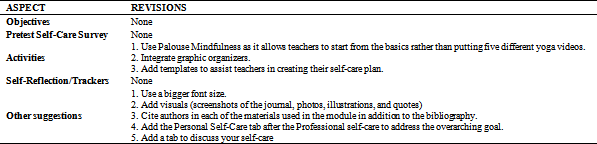
Upon completing the Self-Care Online Module version 1.0, three experts validated the module: an academician (module expert), a psychologist, and a Self-care specialist. In addition, a validation tool and a short discussion were utilized to get specific expert feedback, as shown in Table 3.
Regarding activities, the experts suggested replacing yoga videos with Palouse Mindfulness. Porter, D. 82 stated that yoga poses range from beginner to advanced. In addition, since this module involves independent learning, graphic organizers should be added to assist teachers in organizing information. It was also suggested that different kinds of self-care plan templates be added to allow teachers to choose the plan they want to utilize.
A bigger font for readability was recommended to catch the readers' attention. The expert also stated that the Online Self-Care Module is overloaded with many words. Therefore, it was recommended to add screenshots of the journal, photos, illustrations, and quotes.
It was also recommended to cite the materials' authors and the bibliography for academic integrity.
Lastly, it was recommended to add tabs for personal self-care and compile a list of self-care plans to achieve the overall rating goal of the module. Adding a tab where the researchers can discuss her self-care journey was also suggested.
Since the module is a learning tool, graphic organizers were recommended to assist in clarifying and organizing complex information about the topic provided. Therefore, the use of graphic organizers will facilitate learning.
Self-care plan templates were suggested. After all the self-care strategies are provided, the template will assist the teachers in developing detailed steps to promote wellness. Since this is independent learning, having a couple of examples will assist teachers in choosing the template that works best for them. Phoenix 83 stated that the self-care plan would allow teachers to create a purposeful lifestyle by personalizing activities to take care of themselves.
In the self-care module, citations were provided as materials were presented in addition to the bibliography.
The original font of the Online Self-Care Module and Journal is size 12. Su, Li, Zheng, Hu, Fan, & Luo 84 stated that people believe that information presented in a larger font is easier to understand. This belief also makes people think that it is easier to remember because it is easier to remember. This equates to a bigger font with better comprehension and better recall. Therefore, the font size will be increased to 18.
Because the Online Self-Care module is asynchronous, the experts recommended adding visuals. Visuals include screenshots of the Self-Care Journal, photographs, illustrations, and quotes. According to West 85, visuals in an online module assist learners in comprehending the information quickly, increasing the motivation to stay engaged in the learning process.
The materials utilized in the Self-Care Online Module were given credits on the bibliography page of the module. However, one of the experts recommended that they be acknowledged, and their materials are shown in the module. In addition, Bell, Bradley, Lindsay, Mahoney, Paylina, Rasmussen, Szpunar, Trinoskey & Bash 86 stated that researchers and authors should be acknowledged and cited for academic integrity for the work they have done.
A module titled “Personal Self-Care” should be added where templates of the Self-Care Plan will be housed. In this way, teachers consolidate all their preferred self-care strategies in a plan to guide them as they start their self-care journey. Webber, Guo, & Mann 87 indicated that self-care refers to selected activities that promote wellness and prevent illness.
Lastly, a tab should be added on the Online Self-Care Journey for the researcher to add her self-care journey. As an advocate for teachers to make time to take care of themselves, having this tab in the module will explain the WHY the author as to why this study was conducted.
So based on the experts' recommendations, Online Self-Care Version 1.0 was updated. As a result, the updated version is called Online Self-Care Version 2.0. According to Mintz 88, the updated version of online learning provides a rich and better learning experience for learners.
The Online Self-Care Module has a font size of 54 for titles and a font size of 18 for the rest of the module. Su, Li, Zheng, Hu, Fan, & Luo 84 stated that bigger fonts could be catchy, creating an illusion that it is easier to read and, therefore, easier to understand.
Clip art, illustrations, pictures, and quotes were added. Jandhyala 89 stated that visual information assists in learning materials quickly. Visual increases motivation and engagement. It also simplifies complicated concepts and tasks. Citations were also added to every learning material and cited in the bibliography to demonstrate academic integrity.
There are a total of five modules, namely physical self-care, emotional self-care, psychological self-care, professional self-care, and personal self-care. In addition, personal care has been added so teachers can now consolidate and plan the preferred activities they want to engage in as they start their self-care journey.
Different activities were added and updated. In the yoga session, the Palouse Mindfulness was added with eight weeks of training modules, allowing teacher respondents to start at a comfortable level. The graphic organizer “Rose, Thorn, and Bud” was utilized in this section to highlight success, identify challenges, and new ideas gained while doing Palouse Mindfulness. Different self-care templates were added to allow learners to choose the templates that work for them as they navigate their self-care plan.
In addition, a tab titled “My Self-Care Journey” has been added so the researcher could share how she struggles with work demands and how it negatively impacted her health until she decided to break the cycle of stress by engaging in different self-care activities.
Online Self-Care Module Version 2.0 can be accessed at shorturl.at/bgJP1 while the Self-Care Journal can be accessed at:shorturl.at/bBFP.
This chapter presents the study's findings, conclusions, and recommendations on the Design of a Self-care Module for Teachers: Its Basis and Enhancements. This study specifically analyzed the teachers’ contextual scenarios by examining the teachers’ context and self-care perceptions of teachers. A prototype of an intervention program was designed and developed based on the analysis of teachers' contextual scenarios.
Objective 1: Analyze teachers’ contextual scenarios.
5.1. Findings:1. The six themes emerged regarding the issues and Problems teachers encountered during the pandemic: limited mobility, anxiety, avoidance, financial difficulties, homeschool dissatisfaction, and challenges of children with distance learning modality.
2. Teachers were experiencing different levels of stress, anxiety, and depression.
3. Teachers agree that physical, emotional, psychological, and professional self-care is crucial in improving mental health and wellness.
5.2. Conclusions1. The emerging themes highlight personal issues and problems teachers encounter professionally and personally. Moreover, these stressors add to the challenges encountered prior to the pandemic.
2. Teachers are experiencing varied levels of stress, anxiety, and depression as they experience more stressors related to personal and professional roles. In addition, the uncertainty and lack of control over events also contributed to this dynamic.
3. Self-care is an investment that each teacher needs to engage in to maintain and protect their well-being.
5.3. Recommendations1. Teachers must be armed with tools and resources to address emerging themes. School administrators must also provide training professional development on self-care and allow teachers the space and time to do it.
2. Teachers need to prioritize mental health as teaching is an intensive job. Therefore, teachers must invest in self-care activities to help or decrease symptomatology of stress, anxiety, and stress. Prioritizing oneself isn’t self-fish but rather an investment where teachers better serve their students by creating an environment conducive to learning. Teachers should also seek medical help when experiencing stress, anxiety, and depression to provide resources and activities tempower themselves and seek treatment as needed.
3. Teachers must find time to engage in self-care activities to maintain and protect their mental health. Teachers can significantly benefit from learning about and practicing self-care. For school administrators, self-care would be an excellent in-service training to support and teach teachers about self-care.
Objective 2: Design of an Intervention Program
The designed program is named Self-Care. Initially, Self-Care 1.0 provided a sequence or blueprint of the module. The identified parts of the module allow identification of the flow of the module and areas of self-care that can improve the health and well-being of the teachers. The outline of the Self-Care module included the objectives, materials, activities, resources, and assessments in the physical, emotional, psychological, professional, and personal self-care plan. The overall goal is for teachers to be able to create their self-care plans.
Since Self-Care version 1.0 is raw at this stage, there is a need to review the parts and activities to get feedback to identify weaknesses to get the opportunity to enhance those. In this way, improvements could be made so the module can create a rich and interactive learning experience so teachers will engage in the different activities that are being said to reduce stress, anxiety, and depression.
Objective 3: Develop the Self-Care Module
Inputs to the Development of the Self-Care Module
Self-Care version 1.0 was validated by three experts and after the validation, the three experts suggested the: Under activities: Use Palouse Mindfulness, graphic organizer, different self-care templates. Other suggestions: use bigger font, add visuals, cite authors in each material used, and add the Personal Self-Care tab.
Process in the Development of the Self-Care Module
Based on the recommendations, the website was updated. The entire program for Palouse Mindfulness was included in the website that allowed teachers identify their levels when it comes to yoga. Visuals, graphic organizers, and self-care templates were added to the website. Font size was made bigger for readability and authors were cited as the materials are being presented. The final output is Self-Care Module Version 2.0.
Output
Utilizing the Self-Care Module Version 2.0 developed by the researcher as the output of this study is highly recommended for teachers to develop and sustain positive mental health. Teachers are in the caring profession and are used to caring for others. Through this learning module, teachers will be able to take care of themselves first so that they can take care of others too. The Self-Care Module Version 2.0 can be accessed at shorturl.at/bgJP1. The Self-Care Journal can be accessed at shorturl.at/bBFP9. In addition, the module has an evaluation that the researcher will utilize in upgrading the module.
| [1] | Ramaiah, K., & Ramchandram, V. (2021). Occupational Stress Among High School Teachers. Global Journal For Research Analysis, 41-43. | ||
| In article | View Article | ||
| [2] | Hojo, M. (2021). Association between student-teacher ratio and teachers' working hours and workload stress: Evidence from a nationwide survey in Japan. BMC Public Health, 21(1). | ||
| In article | View Article PubMed | ||
| [3] | Mingoa, T. (2017, June 20). Filipino teachers' stress levels and coping strategies. Https://Www.Dlsu.Edu.Ph/. Retrieved January 28, 2022, from https://www.dlsu.edu.ph/wp-content/uploads/pdf/conferences/research-congress-proceedings/2017/LLI/LLI-I-020.pdf. | ||
| In article | |||
| [4] | Carreon, T. (2021b, May 4). Fear of COVID-19 and Remote Teaching Burnout of Filipino K to 12 Teachers | IJERI: International Journal of Educational Research and Innovation. Www.Upo.Es. Retrieved November 7, 2021, from https://www.upo.es/revistas/index.php/IJERI/article/view/5853. | ||
| In article | View Article | ||
| [5] | Leite, H., Hodgkinson, I. R., & Gruber, T. (2020). New development: 'Healing at a distance'—telemedicine and COVID-19. Public Money & Management, 40(6), 483-485. | ||
| In article | View Article | ||
| [6] | David, C. C., Albert, JR. G., Vizmanos, J.F.V. (2019). “Pressures on Public School Teachers and Implications on Quality.” Philippine Institute for Development Studies Policy Notes, No.2019-1, 2020. | ||
| In article | |||
| [7] | Aytaç, T. (2022, January). The Problems Faced by Teachers in Turkey during the COVID-19 Pandemic and Their Opinions. International Journal of Progressive Education, 17(N.1), 404-420. | ||
| In article | View Article | ||
| [8] | Kraft, M. A., Simon, N. S., Lyon, MA. (2020). Sustaining a Sense of Success: The Importance of Teacher Working Conditions During the COVID-19 Pandemic.Annenberg Brown University. EdWorkingPaper No. 20-279. | ||
| In article | View Article | ||
| [9] | White, J. (2020). Supporting teachers' mental health and well-being: Evidence Review. Edinburgh: NHS Health Scotland. | ||
| In article | |||
| [10] | Ferguson, Kristen & Hall, David. (2011). Predicting Teacher Anxiety, Depression, and Job Satisfaction. J Teach Learn. 8. | ||
| In article | View Article | ||
| [11] | Yasar, H. and Demir, S. (2015). The Mediating Role of Teachers' Depression Levels on The Relationship Between Emotional Labor and Burnout. International Journal of Educational Methodology Volume 1, Issue 1, 1-8. | ||
| In article | View Article | ||
| [12] | Shen, B., Mc Caughtry, N., Martin, J., Gam, A. Kulik, N. and Fahlman, M. (2015). The relationship between teacher burnout and student motivation. Educational Psychology. Vol. 85, Issue 4: December 2015. (Pages 519-532). https://bpspsychub.onlinelibrary. | ||
| In article | View Article PubMed | ||
| [13] | Greenberg, M. T., Brown J. L., J. L., & Abenavoli, R. M. (2016, September). Teacher stress and health effects on teachers, students, and schools. Edna Bennett Pierce Prevention Research Center: Pennsylvania State University. https://www.prevention.psu.edu/uploads/files/rwjf430428-TeacherStress.pdf. | ||
| In article | |||
| [14] | Ventayen, C. C., & Ventayen, R. J. M. (2021). Stress and Depression in the Workplace of Educators in the Philippines. Stress and Depression in the Workplace of Educators in the Philippines. Published. | ||
| In article | |||
| [15] | Jimenez, E. C. (2021). Impact of mental health and stress level of teachers to learning resource development. Shanlax International Journal of Education, 9(2), 1-11. | ||
| In article | View Article | ||
| [16] | Smith, B. J., and Lim, M. H. (2020). How the COVID-19 pandemic is focusing attention on loneliness and social isolation. Public Health Res. Pract. 30:3022008. | ||
| In article | View Article PubMed | ||
| [17] | Guzman, C. de. (2021, December 2). The Philippines Still Hasn't Fully Reopened Its Schools Because of COVID-19. What Is This Doing to Children? Time. Retrieved October 2, 2022, from https://time.com/6124045/school-closures-covid-education-philippines/. | ||
| In article | |||
| [18] | Bautista, J. (2021). DepEd launches a mental health helpline for students, teachers. Inquirer.net. https://newsinfo.inquirer.net/1521089/deped-launches-mental-health-helpline-for-students-teachers#ixzz7YE91EmI9. | ||
| In article | |||
| [19] | Lovibond, S. H., & Lovibond, P. F.(1995). Depression Anxiety Stress Scales (DASS--21, DASS--42) [Database record]. APA PsycTests. | ||
| In article | View Article | ||
| [20] | Leahy, J., & Wolfe, J. (2021). Teacher Self-Care: A Guide for Educators [Doctoral dissertation, Lynn University]. SPIRAL. https://spiral.lynn.edu/etds/365. | ||
| In article | |||
| [21] | Kurt, S. (2017, October 6). Definitions of the Addie model. Educational Technology. Retrieved from https://educationaltechnology.net/definitions-addie-model/. | ||
| In article | |||
| [22] | Arkün, S., & Akkoyunlu, B. (2008). A Study on the development process of a multimedia learning environment according to the ADDIE model and students’ opinions of the multimedia learning environment. Interactive Educational Multimedia, (17); 1-19. | ||
| In article | |||
| [23] | Mayfield, M. (2011). Creating training and development programs: using the ADDIE method. Development and Learning in Organizations: An International Journal. | ||
| In article | View Article | ||
| [24] | Poston, B. (2009). Maslow's hierarchy of needs, Surgical technologist, 41 (8), 374-353. | ||
| In article | |||
| [25] | Jakubowski, T. D., & Sitko-Dominik, M. M. (2021). Teachers' mental health during the first two waves of the COVID-19 pandemic in Poland. PLOS ONE, 16(9), e0257252. | ||
| In article | View Article PubMed | ||
| [26] | Pietrabissa, G., & Simpson, S. (2020). Psychological Consequences of Social Isolation During COVID-19 Outbreak. Frontiers in Psychology, 11. | ||
| In article | View Article PubMed | ||
| [27] | Arnaldo, S. (2022, August 28). For tired teachers: Self-care tips to survive school stress. RAPPLER. Retrieved November 25, 2022, from https://www.rappler.com/life-and-style/health-and-wellness/self-care-tips-teachers/. | ||
| In article | |||
| [28] | Wright, L. J. (2021, March 11). Physical Activity Protects Against the Negative Impact of Coronavirus Fear on Adolescent Mental Health and Well-Being During the COVID-19 Pandemic. Frontiers. | ||
| In article | View Article PubMed | ||
| [29] | Puccinelli, P. J. (2021, March 29). Reduced level of physical activity during COVID-19 pandemic is associated with depression and anxiety levels: an internet-based survey - BMC Public Health. BioMed Central. https://bmcpublichealth.biomedcentral.com/articles/10.1186/s12889-021-10470-z. | ||
| In article | View Article PubMed | ||
| [30] | Giuntella, O., Hyde, K., Saccardo, S., & Sadoff, S. (2021).Lifestyle and mental health disruptions during COVID-19. Proceedings of the National Academy of Sciences, 118(9). | ||
| In article | View Article PubMed | ||
| [31] | UNODC Regional Office for Southeast Asia and the Pacific. (2022, January 25). Philippine educators explore mental health concerns in UNODC Webinar series. United Nations: UNODC Regional Office for Southeast Asia and the Pacific. Retrieved January 31, 2031, from https://www.unodc.org/roseap/en/philippines/2022/01/mental-healthconcerns/story.html. | ||
| In article | |||
| [32] | Will, M. (2021, January 15). The Success of Social-Emotional Learning Hinges on Teachers. Education Week. Retrieved November 7, 2021, from https://www.edweek.org/leadership/the-success-of-social-emotional-learning-hinges-on-teachers/2020/04. | ||
| In article | |||
| [33] | Sims, S. J. J. A. R. (2020, February 2). How did the early stages of the COVID-19 pandemic affect teacher wellbeing? Https://Repec-Cepeo.Ucl.Ac.Uk/. Retrieved November 7, 2021, from https://ideas.repec.org/p/ucl/cepeow/20-15.html. | ||
| In article | |||
| [34] | Brackett, M. and Cipriano, C. (2020). Teachers Are Anxious and Overwhelmed. They Need SEL Now More Than Ever. Social Emotional Learning. EdSugre. https://www.edsurge.com/news/2020-04-07-teachers-are-anxious-and overwhelmed-they-need-sel-now-more-than-ever. | ||
| In article | |||
| [35] | Talidong, K.J. B. & Toquero, C.M. D. (2021). Facing COVID-19 through Emergency Online Education Anchored in Khan’s Framework: Case of Philippine Teachers in Xi’an, China. European Journal of Interactive Multimedia and Education. https://www.ejimed.com/download/facing-COVID-19-through-emergency-online-education-anchored-in-khans-framework-case-of-philippine-9683.pdf. | ||
| In article | |||
| [36] | Kim, L. E., & Ashbury, K. (2020). “Like a rug had been pulled from under you”: The impact of COVID-19 on teachers in England during the first six weeks of the UK lockdown. British Journal of Educational Psychology, 90(4), 1062-1083. | ||
| In article | View Article PubMed | ||
| [37] | Lalu, G. P. (2020). 86% of adult Filipinos stressed over COVID 10-SWS. Inquirer.net. https://newsinfo.inquirer.net/1345408/86-of-adult-filipinos-stressed-over-COVID-19-sws#ixzz7YEffSetP. | ||
| In article | |||
| [38] | Bentzen, J. S. (2021). In crisis, we pray: Religiosity and the COVID-19 pandemic. Journal of Economic Behavior & Organization, 192, 541-583. | ||
| In article | View Article PubMed | ||
| [39] | Drillinger, M. (2022, May 3). How to Balance Staying Informed and Not Being Overwhelmed By Stressful News. Healthline. https://www.healthline.com/health-news/how-to-balance-staying-informed-and-not-being-overwhelmed-by-stressful-news. | ||
| In article | |||
| [40] | Nikmah, F., Indrianti, T. & Pribadi, J. (2021). The Effect of Work Demand, Role Conflict, and Role Ambiguity on Work-Family Conflict (Impact of Work From Home due to The Covid-19 Pandemic). Journal of Family Sciences. 5. 92-102. | ||
| In article | View Article | ||
| [41] | Stapleton, P., Garby, S. and Sabot, D. (2020). Psychological distress and coping styles in teachers: A Preliminary Study. Australian Journal of Education. | ||
| In article | View Article | ||
| [42] | Aydın, S. (2021). A systematic review of research on teaching anxiety. International Online Journal of Education and Teaching (IOJET), 8(2). 730-761. | ||
| In article | |||
| [43] | Mesquita, B., Boiger, M., & De Leersnyder, J. (2015, September 25). The cultural construction of emotions. Current opinion in psychology. Retrieved March 13, 2022, from https://pubmed.ncbi.nlm.nih.gov/29506799/. | ||
| In article | |||
| [44] | Casingal, C., & Ancho, I. (2022). Financial Literacy Status of Public-School Teachers: The Case of the Philippines. Journal of Management, Economics, and Industrial Organization, 63-80. | ||
| In article | View Article | ||
| [45] | Nagoski, A. & Nagoski, E. (2020). Burnout: Solve Your Stress Cycle. Ebury Publishing: UK. | ||
| In article | |||
| [46] | Pew Research Center. (2020, October 28). Lower-income parents of K-12 students are the most concerned about their children falling behind in school | Pew Research Center. Pew Research Center’s Social & Demographic Trends Project. https://www.pewresearch.org/socialtrends/2020/10/29/most-parents-of-k-12-students-learning-online-worry-about-them-falling-behind/psdt_10-29-20_kids-edu-00-4/. | ||
| In article | |||
| [47] | Jain, S., Lall, M., & Singh, A. (2020). Teachers’ Voices on the Impact of COVID-19 on School Education: Are Ed-Tech Companies Really the Panacea? Contemporary Education Dialogue, 18(1), 58-89. | ||
| In article | View Article | ||
| [48] | Trust, T.; Whalen, J. (2021). Should Teachers be Trained in Emergency Remote Teaching? Lessons Learned from the COVID-19 Pandemic. J. Technol. Teach. Educ. 2020, 28, 189-199. | ||
| In article | |||
| [49] | Leonhardt, M. (2020, September 17). Parents struggle with remote learning while working from home: “I’m constantly failing.” CNBC. https://www.cnbc.com/2020/09/17/remote-learning-why-parents-feel-theyre-failing-with-back-to-school-from-home.html. | ||
| In article | |||
| [50] | Flunger, B., Pretsch, J., Schmitt, M., & Ludwig, P. (2013). The role of explicit need strength for emotions during learning. Learning and Individual Differences, 23, 241-248. | ||
| In article | View Article | ||
| [51] | Holt, S. G. A. S., & Gershenson, S. (2022, March 9). How much do teachers struggle with stress and burnout? Brookings. Edu. Retrieved November 25, 2022, from https://www.brookings.edu/blog/brown-center-chalkboard/2022/02/08/how-much-do-teachers-struggle-with-stress-and-burnout/. | ||
| In article | |||
| [52] | Rubilar, N. & Oros, L. (2021). Stress and Burnout in Teachers During Times of Pandemic. Frontiers in Psychology. 12; 756007. | ||
| In article | View Article PubMed | ||
| [53] | Smith J.A. & Osborn, M. (2015). Interpretative phenomenological analysis as a useful methodology for research on the lived experience of pain. Br J Pain. 2015 Feb; 9(1): 41-2. | ||
| In article | View Article PubMed | ||
| [54] | What is Normal Anxiety and What is an Anxiety Disorder? (2018, January 9). Houston Behavioral Healthcare Hospital. https://www.houstonbehavioralhealth.com/blog/understanding-anxiety-whats-normal-whats-not | ||
| In article | |||
| [55] | Tips and Strategies to Manage Anxiety and Stress | Anxiety and Depression Association of America, ADAA. (2022, July 28). Anxiety & Depression Association of America. Retrieved July 29, 2022, from https://adaa.org/tips. | ||
| In article | |||
| [56] | Van Droogenbroeck, F. & Spruyt, B. (2015). Do teachers have worse mental health? Review of the existing comparative research and results from the Belgian Health Interview Survey. Teaching and Teacher Education: An International Journal of Research and Studies, 51(1), 88-100. Elsevier Ltd. Retrieved October 24, 2022. | ||
| In article | View Article | ||
| [57] | Klapproth, F., Federkeil, L., Heinschke, F., & Jungmann, T. (2020). Teachers’ experiences of stress and their coping strategies during COVID-19 induced distance teaching. Journal of Pedagogical Research, 4(4), 444 452.. | ||
| In article | View Article | ||
| [58] | Wu, W. & Lu, Y. (2022). Is Teachers' Depression Contagious to Students? A Study Based on Classes' Hierarchical Models. Front Public Health. 2022 Mar 21; 10: 804546. | ||
| In article | View Article PubMed | ||
| [59] | Pate, C. (2020). Self-care strategies for educators during the coronavirus crisis: Supporting personal social and emotional well-being. WestEd. https://www.wested.org/resources/self-care-strategies-for-educators-covid-19. | ||
| In article | |||
| [60] | Isaac, A. M. (2013). Objective similarity and mental representation. Australasian Journal of Philosophy, 91(4), 683-704. | ||
| In article | View Article | ||
| [61] | Poon, C. Y. S., Hui, V. K., Yuen, G. W., Kwong, V. W. Y., & Chan, C. S. (2019). A well‐slept teacher is a better teacher: A multi‐respondent experience‐sampling study on sleep, stress, and emotional transmission in the classroom. PsyCh Journal, 8(3), 280-292. https://doi.org/10.1002/pchj.282 | ||
| In article | |||
| [62] | Stults-Kolehmainen MA, Sinha R. (2014). The effects of stress on physical activity and exercise. Sports Med. 2014 Jan; 44(1): 81-121. | ||
| In article | View Article PubMed | ||
| [63] | Edenfield, T. M., & Blumenthal, J. A. (2011). Exercise and stress reduction. In R. J. Contrada & A. Baum (Eds.), The handbook of stress science: Biology, psychology, and health (pp. 301-319). Springer Publishing Company. | ||
| In article | |||
| [64] | Rooney, L., & McNicholas, F. (2020). ‘Policing’a pandemic: Garda wellbeing and COVID-19. Irish Journal of psychological medicine, 37(3), 192-197. | ||
| In article | View Article PubMed | ||
| [65] | Wolgast, A. & Fischer, N. (2017). You are not alone: colleague support and goal-oriented cooperation as resources to reduce teachers’ stress. Social Psychology of Education. 20. | ||
| In article | View Article | ||
| [66] | Gewertz, C. (2021). Teachers’ Mental Health Has Suffered in the Pandemic. Education Week. https://www.edweek.org/leadership/teachers-mental-health-has-suffered-in-the-pandemic-heres-how-districts-can-help/2021/05. | ||
| In article | |||
| [67] | Jennings, P. A., Brown, J. L., Frank, J. L., Doyle, S., Oh, Y., Davis, R., Rasheed, D., DeWeese, A., DeMauro, A. A., Cham, H., & Greenberg, M. T. (2017). Impacts of the CARE for Teachers program on teachers’ social and emotional competence and classroom interactions. Journal of Educational Psychology, 109(7), 1010-1028. | ||
| In article | View Article | ||
| [68] | Oducado, R. M., Rabacal, J., Moralista, R., & Tamdang, K. (2021). Perceived Stress Due to COVID-19 Pandemic among Employed Professional Teachers. International Journal of Educational Research and Innovation, 15, 305-316. | ||
| In article | View Article | ||
| [69] | Glowiak, M. (2022). What is Self-Care and Why is it Important for You? Southern New Hampshire University 2500 North River Road Manchester, NH 03106. Retrieved from https://www.snhu.edu/about-us/newsroom/health/what-is-self-care. | ||
| In article | |||
| [70] | Self-care tips for teachers during COVID19. (n.d.).UNICEF. https://www.unicef.org/coronavirus/self-care-tips-for-teachers | ||
| In article | |||
| [71] | Tuama Jebur, M., Mohammed’amin Albayati, H., & Radhi, M. (2021). The Effect of an Educational Curriculum According to ADDIE Model in Developing the Accuracy of Spiking Skill in Volleyball for Students. Special Education Special Education, Vol. 1(Issue 43), p2938-2946. | ||
| In article | |||
| [72] | Writing Module-Based Learning Objectives. (2020, August 10). Faculty Center for Professional Excellence. https://www.adelphi.edu/fcpe/programs/online-and-blended-course-development/resources-for-planning-and-development/course-mapping-and-learning-objectives/writing-module-based-learning-objectives/. | ||
| In article | |||
| [73] | Shabatura, J. (2002, July 26). Using Bloom’s Taxonomy Write Effective Learning Outcomes | Teaching Innovation and Pedagogical Support. University of Arkansas. https://tips.uark.edu/using-blooms-taxonomy/. | ||
| In article | |||
| [74] | Eurich, T. (2018, January 4). What Self-Awareness Really Is (and How to Cultivate It). Harvard Business Review. https://hbr.org/2018/01/what-self-awareness-really-is-and-how-to-cultivate-it. | ||
| In article | |||
| [75] | Litonjua, E. (2020, December 16). What Is Multimodal Learning? eLearning Industry. https://elearningindustry.com/what-is-multimodal-learning. | ||
| In article | |||
| [76] | Acuram, J. (2015, August 12). INSTRUCTIONAL MODULE AND ITS COMPONENTS. Creativeandhumble. https://creativeandhumble.wordpress.com/2015/08/12/instructional-module-and-its-components/. | ||
| In article | |||
| [77] | Brame, C. (2016). Effective Educational Videos: Principles and Guidelines for Maximizing Student Learning from Video Content. CBE—Life Sciences Education, 15(4), es6. | ||
| In article | View Article PubMed | ||
| [78] | Jalali, A., Leddy, J. J., Gauthier, M., Sun, R., Hincke, M. T., & Carnegie, J. A. (2010). Use of Podcasting as an Innovative Asynchronous E-Learning Tool for Students *. US-China Education Review. https://files.eric.ed.gov/fulltext/ED529387.pdf. | ||
| In article | |||
| [79] | Kumari, S. (1996). Teaching with the Internet. www.uvm.edu. https://www.uvm.edu/%7Ehag/naweb96/zkumari.html. | ||
| In article | |||
| [80] | Moison, L. (2023, January 29). Stay motivated with reviewers' favorite habit tracking journals. Elite Daily. Retrieved January 31, 2023, from https://www.elitedaily.com/lifestyle/best-habit-tracker-journals | ||
| In article | |||
| [81] | Shifting Schools. (2020). Module 8 Reflection. https://www.shiftingschools.com/module8-2. | ||
| In article | |||
| [82] | Porter, D. (n.d.). MBSR - Getting Started. https://palousemindfulness.com/.MBSR/gettingstarted.Html. | ||
| In article | |||
| [83] | Phoenix, O. (2021). The Ultimate 7 Step Guide to the Self-Care Wheel: How to Create the Life You Love with the #1 Rated Self-Care Tool in the World. Retrieved from https://www.centerffs.org/sites/default/files/Self%20Care%20Guide%20Toolkit_0.pdf. | ||
| In article | |||
| [84] | Su, N., Li, T., Zheng, J., Hu, X., Fan, T., & Luo, L.(2018). How font size affects judgments of learning: Simultaneous mediating effect of item-specific beliefs about fluency and moderating effect of beliefs about font size and memory. PLOS ONE, 13(7), e0200888. | ||
| In article | View Article PubMed | ||
| [85] | West, C. (2019, April 29). 12 Must-Have Visuals in an Online Course | Learn Worlds Blog. Learn Worlds. https://www.learnworlds.com/12-visuals-online-course/ | ||
| In article | |||
| [86] | Bell, J., Bradley, E., Lindsay, B., Mahoney, J., Pavlina,A., Rasmussen, M., Szpunar, R., Trinoskey, J., & Bash, C. (2022, December 8). LibGuides: PALNI Information Literacy Modules: Module 11: Understanding Plagiarism & Citing Sources. PALNI Information Literacy Modules. https://libguides.palni.edu/instruction_resources/ILModule11. | ||
| In article | |||
| [87] | Webber, D.E., Guo, Z, and Mann, S. (2015). Self-Care in Health: We can define it, but should we also measure it? Self-Care Journal. https://selfcarejournal.com/. | ||
| In article | |||
| [88] | Mintz, S. (2020, August 11). 8 Ways to Improve Your Online Course. Inside Higher Ed. https://www.insidehighered.com/blogs/higher-ed-gamma/8-ways-improve-your-online-course. | ||
| In article | |||
| [89] | Jandhyala, D. (2019, December 8). Visual Learning: 6 Reasons Why Visuals Are The Most Powerful Aspect Of eLearning. eLearning Industry. https://elearningindustry.com/visual-learning-6-reasons-visuals-powerful-aspect-elearning. | ||
| In article | |||
Published with license by Science and Education Publishing, Copyright © 2023 Maricel T. Bustos
 This work is licensed under a Creative Commons Attribution 4.0 International License. To view a copy of this license, visit
http://creativecommons.org/licenses/by/4.0/
This work is licensed under a Creative Commons Attribution 4.0 International License. To view a copy of this license, visit
http://creativecommons.org/licenses/by/4.0/
| [1] | Ramaiah, K., & Ramchandram, V. (2021). Occupational Stress Among High School Teachers. Global Journal For Research Analysis, 41-43. | ||
| In article | View Article | ||
| [2] | Hojo, M. (2021). Association between student-teacher ratio and teachers' working hours and workload stress: Evidence from a nationwide survey in Japan. BMC Public Health, 21(1). | ||
| In article | View Article PubMed | ||
| [3] | Mingoa, T. (2017, June 20). Filipino teachers' stress levels and coping strategies. Https://Www.Dlsu.Edu.Ph/. Retrieved January 28, 2022, from https://www.dlsu.edu.ph/wp-content/uploads/pdf/conferences/research-congress-proceedings/2017/LLI/LLI-I-020.pdf. | ||
| In article | |||
| [4] | Carreon, T. (2021b, May 4). Fear of COVID-19 and Remote Teaching Burnout of Filipino K to 12 Teachers | IJERI: International Journal of Educational Research and Innovation. Www.Upo.Es. Retrieved November 7, 2021, from https://www.upo.es/revistas/index.php/IJERI/article/view/5853. | ||
| In article | View Article | ||
| [5] | Leite, H., Hodgkinson, I. R., & Gruber, T. (2020). New development: 'Healing at a distance'—telemedicine and COVID-19. Public Money & Management, 40(6), 483-485. | ||
| In article | View Article | ||
| [6] | David, C. C., Albert, JR. G., Vizmanos, J.F.V. (2019). “Pressures on Public School Teachers and Implications on Quality.” Philippine Institute for Development Studies Policy Notes, No.2019-1, 2020. | ||
| In article | |||
| [7] | Aytaç, T. (2022, January). The Problems Faced by Teachers in Turkey during the COVID-19 Pandemic and Their Opinions. International Journal of Progressive Education, 17(N.1), 404-420. | ||
| In article | View Article | ||
| [8] | Kraft, M. A., Simon, N. S., Lyon, MA. (2020). Sustaining a Sense of Success: The Importance of Teacher Working Conditions During the COVID-19 Pandemic.Annenberg Brown University. EdWorkingPaper No. 20-279. | ||
| In article | View Article | ||
| [9] | White, J. (2020). Supporting teachers' mental health and well-being: Evidence Review. Edinburgh: NHS Health Scotland. | ||
| In article | |||
| [10] | Ferguson, Kristen & Hall, David. (2011). Predicting Teacher Anxiety, Depression, and Job Satisfaction. J Teach Learn. 8. | ||
| In article | View Article | ||
| [11] | Yasar, H. and Demir, S. (2015). The Mediating Role of Teachers' Depression Levels on The Relationship Between Emotional Labor and Burnout. International Journal of Educational Methodology Volume 1, Issue 1, 1-8. | ||
| In article | View Article | ||
| [12] | Shen, B., Mc Caughtry, N., Martin, J., Gam, A. Kulik, N. and Fahlman, M. (2015). The relationship between teacher burnout and student motivation. Educational Psychology. Vol. 85, Issue 4: December 2015. (Pages 519-532). https://bpspsychub.onlinelibrary. | ||
| In article | View Article PubMed | ||
| [13] | Greenberg, M. T., Brown J. L., J. L., & Abenavoli, R. M. (2016, September). Teacher stress and health effects on teachers, students, and schools. Edna Bennett Pierce Prevention Research Center: Pennsylvania State University. https://www.prevention.psu.edu/uploads/files/rwjf430428-TeacherStress.pdf. | ||
| In article | |||
| [14] | Ventayen, C. C., & Ventayen, R. J. M. (2021). Stress and Depression in the Workplace of Educators in the Philippines. Stress and Depression in the Workplace of Educators in the Philippines. Published. | ||
| In article | |||
| [15] | Jimenez, E. C. (2021). Impact of mental health and stress level of teachers to learning resource development. Shanlax International Journal of Education, 9(2), 1-11. | ||
| In article | View Article | ||
| [16] | Smith, B. J., and Lim, M. H. (2020). How the COVID-19 pandemic is focusing attention on loneliness and social isolation. Public Health Res. Pract. 30:3022008. | ||
| In article | View Article PubMed | ||
| [17] | Guzman, C. de. (2021, December 2). The Philippines Still Hasn't Fully Reopened Its Schools Because of COVID-19. What Is This Doing to Children? Time. Retrieved October 2, 2022, from https://time.com/6124045/school-closures-covid-education-philippines/. | ||
| In article | |||
| [18] | Bautista, J. (2021). DepEd launches a mental health helpline for students, teachers. Inquirer.net. https://newsinfo.inquirer.net/1521089/deped-launches-mental-health-helpline-for-students-teachers#ixzz7YE91EmI9. | ||
| In article | |||
| [19] | Lovibond, S. H., & Lovibond, P. F.(1995). Depression Anxiety Stress Scales (DASS--21, DASS--42) [Database record]. APA PsycTests. | ||
| In article | View Article | ||
| [20] | Leahy, J., & Wolfe, J. (2021). Teacher Self-Care: A Guide for Educators [Doctoral dissertation, Lynn University]. SPIRAL. https://spiral.lynn.edu/etds/365. | ||
| In article | |||
| [21] | Kurt, S. (2017, October 6). Definitions of the Addie model. Educational Technology. Retrieved from https://educationaltechnology.net/definitions-addie-model/. | ||
| In article | |||
| [22] | Arkün, S., & Akkoyunlu, B. (2008). A Study on the development process of a multimedia learning environment according to the ADDIE model and students’ opinions of the multimedia learning environment. Interactive Educational Multimedia, (17); 1-19. | ||
| In article | |||
| [23] | Mayfield, M. (2011). Creating training and development programs: using the ADDIE method. Development and Learning in Organizations: An International Journal. | ||
| In article | View Article | ||
| [24] | Poston, B. (2009). Maslow's hierarchy of needs, Surgical technologist, 41 (8), 374-353. | ||
| In article | |||
| [25] | Jakubowski, T. D., & Sitko-Dominik, M. M. (2021). Teachers' mental health during the first two waves of the COVID-19 pandemic in Poland. PLOS ONE, 16(9), e0257252. | ||
| In article | View Article PubMed | ||
| [26] | Pietrabissa, G., & Simpson, S. (2020). Psychological Consequences of Social Isolation During COVID-19 Outbreak. Frontiers in Psychology, 11. | ||
| In article | View Article PubMed | ||
| [27] | Arnaldo, S. (2022, August 28). For tired teachers: Self-care tips to survive school stress. RAPPLER. Retrieved November 25, 2022, from https://www.rappler.com/life-and-style/health-and-wellness/self-care-tips-teachers/. | ||
| In article | |||
| [28] | Wright, L. J. (2021, March 11). Physical Activity Protects Against the Negative Impact of Coronavirus Fear on Adolescent Mental Health and Well-Being During the COVID-19 Pandemic. Frontiers. | ||
| In article | View Article PubMed | ||
| [29] | Puccinelli, P. J. (2021, March 29). Reduced level of physical activity during COVID-19 pandemic is associated with depression and anxiety levels: an internet-based survey - BMC Public Health. BioMed Central. https://bmcpublichealth.biomedcentral.com/articles/10.1186/s12889-021-10470-z. | ||
| In article | View Article PubMed | ||
| [30] | Giuntella, O., Hyde, K., Saccardo, S., & Sadoff, S. (2021).Lifestyle and mental health disruptions during COVID-19. Proceedings of the National Academy of Sciences, 118(9). | ||
| In article | View Article PubMed | ||
| [31] | UNODC Regional Office for Southeast Asia and the Pacific. (2022, January 25). Philippine educators explore mental health concerns in UNODC Webinar series. United Nations: UNODC Regional Office for Southeast Asia and the Pacific. Retrieved January 31, 2031, from https://www.unodc.org/roseap/en/philippines/2022/01/mental-healthconcerns/story.html. | ||
| In article | |||
| [32] | Will, M. (2021, January 15). The Success of Social-Emotional Learning Hinges on Teachers. Education Week. Retrieved November 7, 2021, from https://www.edweek.org/leadership/the-success-of-social-emotional-learning-hinges-on-teachers/2020/04. | ||
| In article | |||
| [33] | Sims, S. J. J. A. R. (2020, February 2). How did the early stages of the COVID-19 pandemic affect teacher wellbeing? Https://Repec-Cepeo.Ucl.Ac.Uk/. Retrieved November 7, 2021, from https://ideas.repec.org/p/ucl/cepeow/20-15.html. | ||
| In article | |||
| [34] | Brackett, M. and Cipriano, C. (2020). Teachers Are Anxious and Overwhelmed. They Need SEL Now More Than Ever. Social Emotional Learning. EdSugre. https://www.edsurge.com/news/2020-04-07-teachers-are-anxious-and overwhelmed-they-need-sel-now-more-than-ever. | ||
| In article | |||
| [35] | Talidong, K.J. B. & Toquero, C.M. D. (2021). Facing COVID-19 through Emergency Online Education Anchored in Khan’s Framework: Case of Philippine Teachers in Xi’an, China. European Journal of Interactive Multimedia and Education. https://www.ejimed.com/download/facing-COVID-19-through-emergency-online-education-anchored-in-khans-framework-case-of-philippine-9683.pdf. | ||
| In article | |||
| [36] | Kim, L. E., & Ashbury, K. (2020). “Like a rug had been pulled from under you”: The impact of COVID-19 on teachers in England during the first six weeks of the UK lockdown. British Journal of Educational Psychology, 90(4), 1062-1083. | ||
| In article | View Article PubMed | ||
| [37] | Lalu, G. P. (2020). 86% of adult Filipinos stressed over COVID 10-SWS. Inquirer.net. https://newsinfo.inquirer.net/1345408/86-of-adult-filipinos-stressed-over-COVID-19-sws#ixzz7YEffSetP. | ||
| In article | |||
| [38] | Bentzen, J. S. (2021). In crisis, we pray: Religiosity and the COVID-19 pandemic. Journal of Economic Behavior & Organization, 192, 541-583. | ||
| In article | View Article PubMed | ||
| [39] | Drillinger, M. (2022, May 3). How to Balance Staying Informed and Not Being Overwhelmed By Stressful News. Healthline. https://www.healthline.com/health-news/how-to-balance-staying-informed-and-not-being-overwhelmed-by-stressful-news. | ||
| In article | |||
| [40] | Nikmah, F., Indrianti, T. & Pribadi, J. (2021). The Effect of Work Demand, Role Conflict, and Role Ambiguity on Work-Family Conflict (Impact of Work From Home due to The Covid-19 Pandemic). Journal of Family Sciences. 5. 92-102. | ||
| In article | View Article | ||
| [41] | Stapleton, P., Garby, S. and Sabot, D. (2020). Psychological distress and coping styles in teachers: A Preliminary Study. Australian Journal of Education. | ||
| In article | View Article | ||
| [42] | Aydın, S. (2021). A systematic review of research on teaching anxiety. International Online Journal of Education and Teaching (IOJET), 8(2). 730-761. | ||
| In article | |||
| [43] | Mesquita, B., Boiger, M., & De Leersnyder, J. (2015, September 25). The cultural construction of emotions. Current opinion in psychology. Retrieved March 13, 2022, from https://pubmed.ncbi.nlm.nih.gov/29506799/. | ||
| In article | |||
| [44] | Casingal, C., & Ancho, I. (2022). Financial Literacy Status of Public-School Teachers: The Case of the Philippines. Journal of Management, Economics, and Industrial Organization, 63-80. | ||
| In article | View Article | ||
| [45] | Nagoski, A. & Nagoski, E. (2020). Burnout: Solve Your Stress Cycle. Ebury Publishing: UK. | ||
| In article | |||
| [46] | Pew Research Center. (2020, October 28). Lower-income parents of K-12 students are the most concerned about their children falling behind in school | Pew Research Center. Pew Research Center’s Social & Demographic Trends Project. https://www.pewresearch.org/socialtrends/2020/10/29/most-parents-of-k-12-students-learning-online-worry-about-them-falling-behind/psdt_10-29-20_kids-edu-00-4/. | ||
| In article | |||
| [47] | Jain, S., Lall, M., & Singh, A. (2020). Teachers’ Voices on the Impact of COVID-19 on School Education: Are Ed-Tech Companies Really the Panacea? Contemporary Education Dialogue, 18(1), 58-89. | ||
| In article | View Article | ||
| [48] | Trust, T.; Whalen, J. (2021). Should Teachers be Trained in Emergency Remote Teaching? Lessons Learned from the COVID-19 Pandemic. J. Technol. Teach. Educ. 2020, 28, 189-199. | ||
| In article | |||
| [49] | Leonhardt, M. (2020, September 17). Parents struggle with remote learning while working from home: “I’m constantly failing.” CNBC. https://www.cnbc.com/2020/09/17/remote-learning-why-parents-feel-theyre-failing-with-back-to-school-from-home.html. | ||
| In article | |||
| [50] | Flunger, B., Pretsch, J., Schmitt, M., & Ludwig, P. (2013). The role of explicit need strength for emotions during learning. Learning and Individual Differences, 23, 241-248. | ||
| In article | View Article | ||
| [51] | Holt, S. G. A. S., & Gershenson, S. (2022, March 9). How much do teachers struggle with stress and burnout? Brookings. Edu. Retrieved November 25, 2022, from https://www.brookings.edu/blog/brown-center-chalkboard/2022/02/08/how-much-do-teachers-struggle-with-stress-and-burnout/. | ||
| In article | |||
| [52] | Rubilar, N. & Oros, L. (2021). Stress and Burnout in Teachers During Times of Pandemic. Frontiers in Psychology. 12; 756007. | ||
| In article | View Article PubMed | ||
| [53] | Smith J.A. & Osborn, M. (2015). Interpretative phenomenological analysis as a useful methodology for research on the lived experience of pain. Br J Pain. 2015 Feb; 9(1): 41-2. | ||
| In article | View Article PubMed | ||
| [54] | What is Normal Anxiety and What is an Anxiety Disorder? (2018, January 9). Houston Behavioral Healthcare Hospital. https://www.houstonbehavioralhealth.com/blog/understanding-anxiety-whats-normal-whats-not | ||
| In article | |||
| [55] | Tips and Strategies to Manage Anxiety and Stress | Anxiety and Depression Association of America, ADAA. (2022, July 28). Anxiety & Depression Association of America. Retrieved July 29, 2022, from https://adaa.org/tips. | ||
| In article | |||
| [56] | Van Droogenbroeck, F. & Spruyt, B. (2015). Do teachers have worse mental health? Review of the existing comparative research and results from the Belgian Health Interview Survey. Teaching and Teacher Education: An International Journal of Research and Studies, 51(1), 88-100. Elsevier Ltd. Retrieved October 24, 2022. | ||
| In article | View Article | ||
| [57] | Klapproth, F., Federkeil, L., Heinschke, F., & Jungmann, T. (2020). Teachers’ experiences of stress and their coping strategies during COVID-19 induced distance teaching. Journal of Pedagogical Research, 4(4), 444 452.. | ||
| In article | View Article | ||
| [58] | Wu, W. & Lu, Y. (2022). Is Teachers' Depression Contagious to Students? A Study Based on Classes' Hierarchical Models. Front Public Health. 2022 Mar 21; 10: 804546. | ||
| In article | View Article PubMed | ||
| [59] | Pate, C. (2020). Self-care strategies for educators during the coronavirus crisis: Supporting personal social and emotional well-being. WestEd. https://www.wested.org/resources/self-care-strategies-for-educators-covid-19. | ||
| In article | |||
| [60] | Isaac, A. M. (2013). Objective similarity and mental representation. Australasian Journal of Philosophy, 91(4), 683-704. | ||
| In article | View Article | ||
| [61] | Poon, C. Y. S., Hui, V. K., Yuen, G. W., Kwong, V. W. Y., & Chan, C. S. (2019). A well‐slept teacher is a better teacher: A multi‐respondent experience‐sampling study on sleep, stress, and emotional transmission in the classroom. PsyCh Journal, 8(3), 280-292. https://doi.org/10.1002/pchj.282 | ||
| In article | |||
| [62] | Stults-Kolehmainen MA, Sinha R. (2014). The effects of stress on physical activity and exercise. Sports Med. 2014 Jan; 44(1): 81-121. | ||
| In article | View Article PubMed | ||
| [63] | Edenfield, T. M., & Blumenthal, J. A. (2011). Exercise and stress reduction. In R. J. Contrada & A. Baum (Eds.), The handbook of stress science: Biology, psychology, and health (pp. 301-319). Springer Publishing Company. | ||
| In article | |||
| [64] | Rooney, L., & McNicholas, F. (2020). ‘Policing’a pandemic: Garda wellbeing and COVID-19. Irish Journal of psychological medicine, 37(3), 192-197. | ||
| In article | View Article PubMed | ||
| [65] | Wolgast, A. & Fischer, N. (2017). You are not alone: colleague support and goal-oriented cooperation as resources to reduce teachers’ stress. Social Psychology of Education. 20. | ||
| In article | View Article | ||
| [66] | Gewertz, C. (2021). Teachers’ Mental Health Has Suffered in the Pandemic. Education Week. https://www.edweek.org/leadership/teachers-mental-health-has-suffered-in-the-pandemic-heres-how-districts-can-help/2021/05. | ||
| In article | |||
| [67] | Jennings, P. A., Brown, J. L., Frank, J. L., Doyle, S., Oh, Y., Davis, R., Rasheed, D., DeWeese, A., DeMauro, A. A., Cham, H., & Greenberg, M. T. (2017). Impacts of the CARE for Teachers program on teachers’ social and emotional competence and classroom interactions. Journal of Educational Psychology, 109(7), 1010-1028. | ||
| In article | View Article | ||
| [68] | Oducado, R. M., Rabacal, J., Moralista, R., & Tamdang, K. (2021). Perceived Stress Due to COVID-19 Pandemic among Employed Professional Teachers. International Journal of Educational Research and Innovation, 15, 305-316. | ||
| In article | View Article | ||
| [69] | Glowiak, M. (2022). What is Self-Care and Why is it Important for You? Southern New Hampshire University 2500 North River Road Manchester, NH 03106. Retrieved from https://www.snhu.edu/about-us/newsroom/health/what-is-self-care. | ||
| In article | |||
| [70] | Self-care tips for teachers during COVID19. (n.d.).UNICEF. https://www.unicef.org/coronavirus/self-care-tips-for-teachers | ||
| In article | |||
| [71] | Tuama Jebur, M., Mohammed’amin Albayati, H., & Radhi, M. (2021). The Effect of an Educational Curriculum According to ADDIE Model in Developing the Accuracy of Spiking Skill in Volleyball for Students. Special Education Special Education, Vol. 1(Issue 43), p2938-2946. | ||
| In article | |||
| [72] | Writing Module-Based Learning Objectives. (2020, August 10). Faculty Center for Professional Excellence. https://www.adelphi.edu/fcpe/programs/online-and-blended-course-development/resources-for-planning-and-development/course-mapping-and-learning-objectives/writing-module-based-learning-objectives/. | ||
| In article | |||
| [73] | Shabatura, J. (2002, July 26). Using Bloom’s Taxonomy Write Effective Learning Outcomes | Teaching Innovation and Pedagogical Support. University of Arkansas. https://tips.uark.edu/using-blooms-taxonomy/. | ||
| In article | |||
| [74] | Eurich, T. (2018, January 4). What Self-Awareness Really Is (and How to Cultivate It). Harvard Business Review. https://hbr.org/2018/01/what-self-awareness-really-is-and-how-to-cultivate-it. | ||
| In article | |||
| [75] | Litonjua, E. (2020, December 16). What Is Multimodal Learning? eLearning Industry. https://elearningindustry.com/what-is-multimodal-learning. | ||
| In article | |||
| [76] | Acuram, J. (2015, August 12). INSTRUCTIONAL MODULE AND ITS COMPONENTS. Creativeandhumble. https://creativeandhumble.wordpress.com/2015/08/12/instructional-module-and-its-components/. | ||
| In article | |||
| [77] | Brame, C. (2016). Effective Educational Videos: Principles and Guidelines for Maximizing Student Learning from Video Content. CBE—Life Sciences Education, 15(4), es6. | ||
| In article | View Article PubMed | ||
| [78] | Jalali, A., Leddy, J. J., Gauthier, M., Sun, R., Hincke, M. T., & Carnegie, J. A. (2010). Use of Podcasting as an Innovative Asynchronous E-Learning Tool for Students *. US-China Education Review. https://files.eric.ed.gov/fulltext/ED529387.pdf. | ||
| In article | |||
| [79] | Kumari, S. (1996). Teaching with the Internet. www.uvm.edu. https://www.uvm.edu/%7Ehag/naweb96/zkumari.html. | ||
| In article | |||
| [80] | Moison, L. (2023, January 29). Stay motivated with reviewers' favorite habit tracking journals. Elite Daily. Retrieved January 31, 2023, from https://www.elitedaily.com/lifestyle/best-habit-tracker-journals | ||
| In article | |||
| [81] | Shifting Schools. (2020). Module 8 Reflection. https://www.shiftingschools.com/module8-2. | ||
| In article | |||
| [82] | Porter, D. (n.d.). MBSR - Getting Started. https://palousemindfulness.com/.MBSR/gettingstarted.Html. | ||
| In article | |||
| [83] | Phoenix, O. (2021). The Ultimate 7 Step Guide to the Self-Care Wheel: How to Create the Life You Love with the #1 Rated Self-Care Tool in the World. Retrieved from https://www.centerffs.org/sites/default/files/Self%20Care%20Guide%20Toolkit_0.pdf. | ||
| In article | |||
| [84] | Su, N., Li, T., Zheng, J., Hu, X., Fan, T., & Luo, L.(2018). How font size affects judgments of learning: Simultaneous mediating effect of item-specific beliefs about fluency and moderating effect of beliefs about font size and memory. PLOS ONE, 13(7), e0200888. | ||
| In article | View Article PubMed | ||
| [85] | West, C. (2019, April 29). 12 Must-Have Visuals in an Online Course | Learn Worlds Blog. Learn Worlds. https://www.learnworlds.com/12-visuals-online-course/ | ||
| In article | |||
| [86] | Bell, J., Bradley, E., Lindsay, B., Mahoney, J., Pavlina,A., Rasmussen, M., Szpunar, R., Trinoskey, J., & Bash, C. (2022, December 8). LibGuides: PALNI Information Literacy Modules: Module 11: Understanding Plagiarism & Citing Sources. PALNI Information Literacy Modules. https://libguides.palni.edu/instruction_resources/ILModule11. | ||
| In article | |||
| [87] | Webber, D.E., Guo, Z, and Mann, S. (2015). Self-Care in Health: We can define it, but should we also measure it? Self-Care Journal. https://selfcarejournal.com/. | ||
| In article | |||
| [88] | Mintz, S. (2020, August 11). 8 Ways to Improve Your Online Course. Inside Higher Ed. https://www.insidehighered.com/blogs/higher-ed-gamma/8-ways-improve-your-online-course. | ||
| In article | |||
| [89] | Jandhyala, D. (2019, December 8). Visual Learning: 6 Reasons Why Visuals Are The Most Powerful Aspect Of eLearning. eLearning Industry. https://elearningindustry.com/visual-learning-6-reasons-visuals-powerful-aspect-elearning. | ||
| In article | |||