Gradual increase of the higher education role and influence on society, together with its' convergence with the market, forces governments to find different tools for regulating the autonomy of universities and academic freedom. To display the current state of scientific literature on this topic and formulate future trends, a bibliometric analysis of metadata from Web of Science and Scopus was conducted. Using the Citespace software and quantitative tools of scientometric analysis, all relevant articles published from 1992 to 2021 were subjected to statistical analysis and visualization. The co-author analysis highlighted 2004-2007 and 2017-2021 as the most active and growing research periods, the University of California as the most active institution, and Alberto Amaral as the most active author. Through co-citation analysis, it appeared that publications mainly analyze higher education systems, innovative policies, the impact of autonomy, and economic factors of autonomy. The current article is one of the few that draws the scientific literature network of academic freedom and university autonomy regulations research field. The results of this study make an important contribution to the field of knowledge, helping scholars to become more familiar with research topics, thereby contributing to the quantity and quality of future publications.
After the post-industrial era, higher education became the progressive society foundation by stimulating economic, scientific, and technological development, together with a transition to a "knowledge society." The knowledge society has accelerated the evolution and complication of higher education systems and stimulated the emergence of complex management methods improving the efficiency and quality of higher education 1. Nowadays, because of multiple global problems, governments need to preserve the manageability of educational systems, which resulted in an increased focus on issues of higher education governance (HEG). The most used formulation by Rowlands 2 describes the mission of HEG as creating tools to regulate internal and external relationships, university-market connections and facilitate decision-making processes.
An overall analysis of the HEG research field was conducted a few times before, like publications of Pillai et al. 3 and Huang et al. 4. Both researchers outlined numerous main directions and made simple classifications, but inside of their classifications, topics of academic freedom and university autonomy regulations are absent despite on critical importance of these themes. Autonomy and freedom are considered as fundamental values of universities since the whole system of higher education was built on the principle of relative independence from the state.
Nowadays, the most popular publication on this topic is University Autonomy in Europe by Estermann and Nokkala 5 - a detailed analysis of the real autonomy in European universities. According to them, university autonomy has four main components: organizational autonomy (covering academic and administrative structures, leadership, and governance), financial autonomy (covering the ability to raise funds, own buildings, borrow money, and set tuition fees), staffing autonomy (including the ability to recruit independently, promote and develop academic and non-academic staff), and academic autonomy (including study fields, student numbers, student selection as well as the structure and content of degrees).
Among other highly cited papers, the main research topics are country-specific case studies, policymaking issues, new organizational autonomy, and autonomy control. Most of the studies were conducted before 2010, which makes the relevance of these studies relative. Also, the author could not find a comprehensive scientific review of the academic freedom and university autonomy research field, so it was decided to fill this gap and conduct an analysis of the research area for the past 30 years. As a result, this study can be considered as a complex all-in-one bibliometric analysis for other researchers doing practical analysis of the autonomy of higher education institutions. Working on this study, the researchers set the following objectives:
• Identify the overall structure of the research field;
• Identify the most active elements of the research system by conducting a co-authorship analysis.
• Identify the core agents of the research field by conducting a co-citation analysis.
• Analyze key research areas through clustering (the process of organizing objects into groups whose members are similar in some way 6.
• Identify the trends in the research field by formulating future research directions.
This study is organized as follows: in the first part we present the research background, make a brief analysis of other publications, and formulate the objectives. In the second part, we present the research methodology. The third part presents the results formulated in accordance with the objectives of the study. Future research topics and trends are presented in the fourth part. The last section includes the conclusions of the study.
After analyzing other studies on processing large data sets, it was decided to use a bibliometric method to inspect the literature. Bibliometric toolkit suitable for quantitative audit of scientific literature structure with results visualization 7, 8.
2.1. Data Collection, Merging and DeduplicationFirst, the researcher prepared a dataset - an organized digital collection of bibliographic references of published literature. As a source of scientific papers Web of Science Core Collection and Scopus default database were used, as they have a large number of publications and store all citation information. The results of two databases were combined into one data file manually.
Before conducting the search procedure, three original search phrases: "academic freedom", "university autonomy" and "regulation" got some editing, and the addition of alternative keywords to exclude irrelevant results: "academics" as an alternative to "academic"; "self-governance" as an alternative to "freedom"; "higher education institution" as an alternative to "university"; "freedom", "independence" as an alternative to "autonomy"; "reform", "policy", "management", "administration", "governance" as an addition to "regulation".
The final version of search queries:
Scopus: TITLE-ABS-KEY ((“academics” OR “academic”) AND (“freedom” OR “self-governance”)) AND TITLE-ABS-KEY ((“higher education institution” OR “university”) AND (“autonomy” OR “freedom” OR “independence”)) AND TITLE-ABS-KEY ((“regulation” OR “reform” OR “policy” OR “governance” OR “management” OR “administration”)) AND PUBYEAR > 1991 AND (LIMIT-TO (DOCTYPE, “ar”)) AND (LIMIT-TO (LANGUAGE, “English”)) AND (LIMIT-TO (SRCTYPE, “j”))
Web of Science: TS=((“academics” OR “academic”) AND (“freedom” OR “self-governance”)) AND TS=((“higher education institution” OR “university”) AND (“autonomy” OR “freedom” OR “independence”)) AND TS=((“regulation” OR “reform” OR “policy” OR “governance” OR “management” OR “administration”)) AND PY=(1992-2022) AND LA=English AND DT=Article
After removing inappropriate options, 2,913 results were obtained from Scopus and 1,857 from Web of Science. When merging the lists of Scopus and Web of Science into one, records with incomplete citation information were removed, leaving the appropriate 4677 records. The following manual removal of duplicates by comparing the unique DOI number, article title, list of authors, and article abstract provided the researcher with a final data file of 4125 unique values.
2.2. Data Analysis Tool and Parameter SettingThere are many tools for bibliographic analysis: Citespace, SciMat, sci2 tool, VOSviewer, and others. Based on other scholars' research on the advantages of each tool 9 and after personal testing, a comparison based on six scores was made, giving points from 1 to 3, where 1 is weak, 2 is medium, and 3 is strong.
Based on the average score, researchers decided to use CiteSpace, details of which can be found in the developer publication 10. The following parameters were modified: Link Retaining Factor "-1"; Look back years "-1"; Maximum Links Per Node "-1"; Filters Refs by Instinct Citations "on"; Percentage of nodes to label "1%"; Time Slicing "1992 Jan to 2021 Dec"; Years per slice "1"; Selection Criteria "g-index"; Scale Factor "35".
A standard strategy in bibliographic analysis is to conduct co-author and co-citation analysis 11:
• Co-authorship analysis investigates connections between researchers, showing networking and its effectiveness within the field. Types of co-authoring analysis: between countries, institutions, and authors 12.
• Co-citation analysis inspects groups of most cited connected publications inside the dataset. Types of citation analysis: among journals, authors, and references, which is divided into node analysis and clustering 13.
For the readers' comfort, in the next chapters, the "Academic Freedom and University Autonomy Regulation" will be shortened to AFUAR.
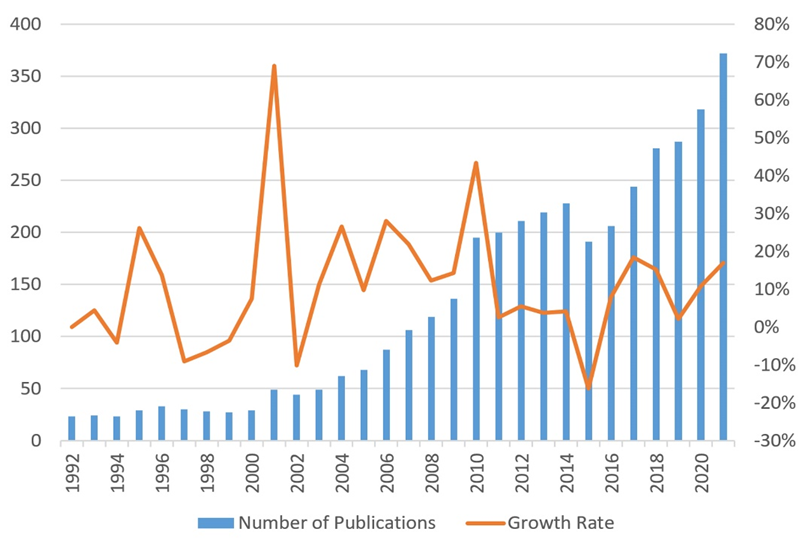
The first stage of analysis identifies time intervals with a sharp increase or decrease in publication numbers. The first period in Figure 1 - 1992 to 2000, with a range of 23-33 publications per year and 26.4 average articles per year; the largest growth of 26% during 1994-1995, and the largest decline of 9% during 1996-1997.
During 2001-2014 a stable period of growth can be seen with the highest growth segments of 69% in 2001, 43% in 2010, and 28% in 2006. The only period of decline is 2002 with a 10% decrease. The 2007-2009 period showed 120 publications per year on average, followed by 2010-2014 with 210 papers on average. The median annual growth rate from 2001 to 2014 was 17%. The 2015-2021 period started with a single 16% drop in 2015, but from 2016 to 2021, the number of articles annually grew by an average of 8%. Special attention can be given to the 2019-2021 COVID-19 period with progressive growth of 2%, 11%, and 17%, respectively.

Countries' co-authorship analysis shows that the most productive country in the field is the United States, with 878 articles, or 21.3% of all publications, followed by Great Britain, with 593 published articles, or 14.4% of all. Next stands China with 305 articles or 7.4%, and Australia with 220 articles and 5.3% of all publications. Also, in case of adding up the quantities of these four countries, we get 48.4% or half of the whole dataset publications. Among others: Canada – 187 publications (4.5%), Spain – 160 publications (3.9%), Germany – 139 publications (3.4%), Russian Federation – 114 publications (2.8%), Netherlands – 99 (2.4%) and Italy – 93 publications (2.3%).
The affiliations' co-authorship analysis shows the leadership of the University of California, with 51 papers published since 1993, followed by the University of London, publishing 41 papers since 1998. The next are: the University of Hong Kong with 34 articles since 1996; the University College London with 33 articles since 1999 and the University of Toronto with 30 articles since 1998. Analysis showed that universities from Great Britain more often cooperated with other countries' universities and became a link hub of the AFUAR field of research. The majority of universities started between 1996 and 1999, averaging 1996 as the time of first publications in the field.
The result of the researchers' co-authorship analysis showed effective chains of collaboration between authors. The most productive publication chains are built by Amaral A., Magalhaes A., Veiga A.: three papers were co-authored by Amaral A., Magalhaes A., Veiga A.; one by Amaral A., Magalhaes A.; one by Veiga A., Amaral A.; two by Magalhaes A., Veiga A., Videira P. Most of the researchers are from the University of Porto with the research direction "Governance in Portuguese higher education". The same problems are investigated by Horta H., who published 7 articles representing the University of Lisbon. Another highly productive author - Karran T. has published 8 papers focusing on autonomy in European and British universities. Among other active researchers: Liu X. and Zhang Y. - explored university autonomy governance of China; Hou A.Y.C. - researched higher education narrowly in Taiwan; Jones G.A. - explored the problems of higher education in Canada, and Kohtamaki V. - discovered the AFUAR problems in Finland.
3.2. Co-citation AnalysisCo-citation analysis is revealed in two aspects based on reference citation quantity: visualization maps and explanatory tables. The most important element of visualization is the node - an indicator on the visualization map whose size demonstrates the number of citations 14. Commonly, the largest nodes indicate the most cited objects and the proximity between them demonstrates the link quantity. Also, different colors on the visualization map show different research brunches.
According to the visualization map (Figure 2), the AFUAR literature field is homogeneous, and most journals are working on the same category of questions.
The most cited journal of AFUAR literature is Higher Education, with 264 articles and a centrality of 0.12 (centrality defines the middle position of the node within the network making connections with other papers 15), demonstrating the core position in the research area. Higher Education Policy and Studies in Higher Education published 133 and 130 cited articles, respectively, having a centrality of 0.06. The visualization map shows the opposite positions of the journals but identical centrality, demonstrating the same role but different topic directions of the journals:
• Higher Education - Studies in Higher Education - Administrating Science Quarterly. This brunch of journals emphasizes the general study of higher education administration.
• Higher Education - Higher Education Policy - Journal of Education Policy. This branch goes deeper into the problems of practical implementation of managerial decisions.

Co-citation analysis of references displays the structure and main directions of research, using clustering method to group nodes 16.

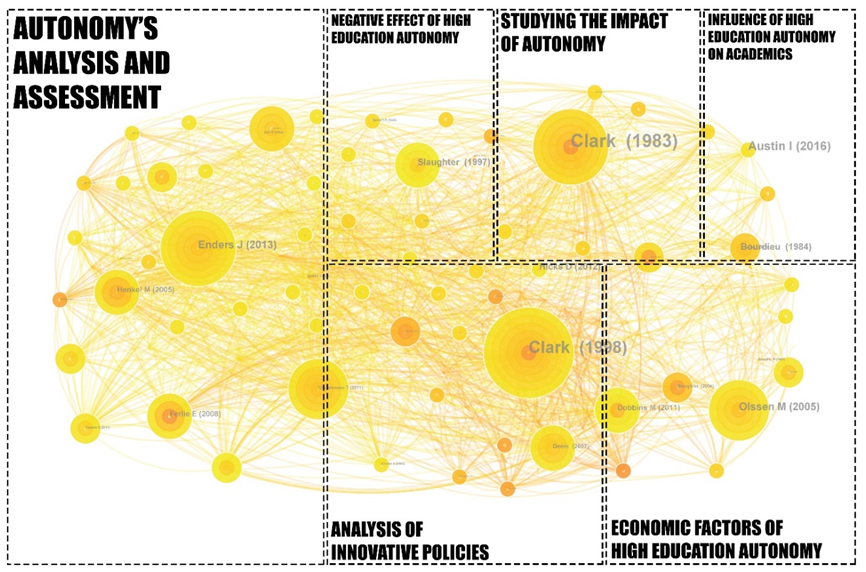
The visualization map (Figure 3) identifies the most cited works as Clark B.R. 1983 and 1998 - large guidebooks of the AFUAR area. But book analysis is beyond the time frame of this study, so for node analysis, only articles were considered. The most cited articles of AFUAR literature are presented in Table 2.
Among the most-cited articles, the lowest citation number is 25, and the majority of articles belong to Cluster 1. By citation burst parameter (significant fluctuations during a short time interval within the overall time period 17), all articles have scored more than 5, proving core status. In addition, all articles were published between 2005 and 2012.
Clustering of AFUAR literature identified 4 main and 3 smaller clusters (Table 3). All main clusters have a silhouette parameter higher than 0.8 (uncertainty estimation involved in identifying the nature of a cluster, ranging from -1 as uncertain to 1 as certain), which makes them representable.
Cluster 1. Autonomy Analysis and Assessment
First cluster publications analyze and evaluate AFUAR systems mainly from European countries. The most fundamental works of Cluster 1 are research methodologies such as Karran 18, who in 2007 made the first own methodology for the evaluation of European education systems, comparing the level of academic freedom protection in 23 European Union countries. Later Estermann and Nokkala 5 published the "EUA University Autonomy in Europe I". The proposed system of evaluation covered financial, organizational, institutional, and personal aspects of autonomy and became an exemplary model for other researchers. Further, Dobbins et al. 1 published a universal method for systematic change tracking in higher education focusing on academic self-governance, connection to the state, and market connections. In 2017, Karran et al. 19 proposed a comprehensive assessment tool for higher education reforms consisting of 37 specific questions and repeated every 5 years.
The oldest representative publication of Cluster 1 is Gornitzka 20, presenting a theoretical framework for implementing higher education reforms and expanding autonomy based on global trends. Bleiklie and Kogan 21 continued by looking for differences between global and local trends in the AFUAR field.
Later, Ferlie et al. 22 investigated three main methods of reform implementation: new public management (NPM), network management, and the neo-weberian narrative concluding that reformation methods of higher education and other public services in Europe are the same.
One of the most active researchers in the field - Capano, in 2011 23 made an analysis of the higher education systems of England, Germany, Italy, and the Netherlands, and concluded an absence of university autonomization since 1990, and proved that government control has remained unchanged. In 2018, Capano and Pritoni 24 described a thirty-year process of reform in European higher education, highlighting three approaches of administration: global results-oriented, small goals oriented, and an adaptive approach.
The biggest amount of publications of Cluster 1 is occupied by local studies, like the British higher education system analysis made by Deem 25, who made a chronological analysis of AFUAR during the 1960s, 1970s, 1980s, and 1990s and found the absence of transformations till 1990s. In addition, Henkel 26 investigated the reformed approach to interpersonal relations between the different actors of education in Britain, calling for changes in the AFUAR system of Britain.
Dutch higher education system is also analyzed by many researchers like De Boer et al. 27, who evaluated the structures of identity construction, hierarchy, and rationality in the Netherlands over the last 20 years, proving the ineffectiveness of traditional autonomy control methods and the effectiveness of extended autonomy approach. In contrast, Enders et al. 28 could not find the benefits of extended autonomy.
Also, some part of Cluster 1 studies is devoted to the analysis of the Australian higher education system as Christensen 29 examined the higher education reforms of Australia and New Zealand and found a paradox when reforms aimed at university autonomy increase the lead to real autonomy decrease. Later, Martin-Sardesai et al. 30 analyzed differences in the Australian government's AFUAR approach between 1980 and 2015.
Cluster 2. Analysis of Innovative Policies
Cluster 2 publications focus on specific tools and methodologies for HEAR. The first representative publication by Hood 31 examines the idea of a "new state governance" having advantages like universality, adaptability, and "infinite re-programmability". Further, the "Evaluative State" system of governance was described by Neave 32 and described as even more adaptive because of remote control, self-regulation, and a high degree of posterior control. Later, Etzkowitz and Leydesdorff 33 described an interaction system between the university, industry, and government called the "Triple Helix of relationships," which transforms the university into an independent social organization.
Continuing the ideas of Hood, Neave, and Etzkowitz, Sporn 34 creates a hybrid adaptive "partnership triangle" system combining shared leadership, professional management, and cooperation between administrators and faculty to maintain functional autonomy in an unstable environment.
The next widely studied system was the university performativity method, which regulated the university autonomy level according to the fulfillment of their goals. Ball 35 was one of the first to articulate the advantages and disadvantages of this system, simulating many possible implementation scenarios.
In 2008, Jongbloed et al. 36 published their vision of adaptive tripartite cooperation, proposing to classify and define the importance of stakeholders, giving universities the opportunity to choose the best development vector. At the same time, Deem et al. 37 analyzed the system of "world university", showing the practical failure of this approach, and Enders et al. 38 revealed the advantages of the "university organization" system with increased university autonomy.
Later, Smith et al. 39 started a new vector of performance-based systems analysis with an exploration of the Research Excellence Framework aimed at changing the education funding system. Then Hicks 40 explained the impact of prestige on education investment. Following by Agyemang and Broadbent 41, who proved the negative impact of internal university processes on AFUAR reform's effectiveness.
Finally, one of the most recent representative studies of Cluster 2 by Kleemann 42 demonstrated a "multiple hybrid organization" university system with the goal of balancing autonomy and task fulfillment.
Cluster 3. Research on Autonomy Impact
Publications of Cluster 3 focus on the increased autonomy impact on education. The first representative paper by Krucken and Meier 43 describes how enhanced financial autonomy transforms universities into full-fledged organizations. Henkel 44 continues by suggesting that extended autonomy allows universities to have more state and market power within the educational system.
Simultaneously, Anderson 45 explored the interaction problems between higher education administration and staff, demonstrating the negative impact on university corporate culture. In addition, Aghion et al. 46 demonstrated the positive influence of increased financial autonomy and competition in U.S. universities on a number of publications and patents.
Later, Ylijoki and Ursin 47 re-examined the university corporate culture topic on Finland's example to conclude that higher education structural changes diversify and polarize academic society. Lynch and Ivancheva 48 reiterate the importance of the distinction between the institutional autonomy of the university and the professional freedom of individual scholars. In the same year, Cannizzo 49 introduces a new concept of "administration mentality" by analyzing state subjectivism of the Australian education system. Reasserting universities' subjectivism Maassen 50 found the paradox of falling university efficiency in cases where university administration has an autonomy of reforms' implementation.
Cluster 4. Economic Factors of High Education Autonomy
Publications of Cluster 4 focus specifically on the macroeconomic side of university autonomy, beginning with Partha and David 51, who analyzed the questionable efficiency of resource allocation in the "new economics of science" financing scheme. Gumport 52 formulated the real economic reasons for academic management transformation, academic consumerism, and academic stratification, confirmed by Slaughter and Leslie 53, who proved the deterioration of academics' effectiveness with increasing economic pressure.
Later, Etzkowitz 54 represented the "entrepreneurial university" by describing the process of academic entrepreneurship activities in terms of endogeneity and exogeneity and linked these processes to the increasing university influence on society together with internal university development and market powers.
Increasing the scope of the study, Olssen and Peters 55 described the increased political influence of universities through links with industry and business in globalization time. Altbach and Knight 56 continued by describing the international global market influence on the internationalization of curricula, cross-border movement of students, and academic stuff internationalization.

The most cited author in the field is Clark, with main works "The higher education system. Academic organization in cross-national perspective" (1983) and "Creating Entrepreneurial Universities: Organizational Pathways of Transformation. Issues in Higher Education" (1998).
Because of the rapid higher education evolving, researchers can observe numerous transformations in education governance, academic freedom, and university autonomy control 4. Dozens of variables have led to the diversification of this field of research, causing many uncertainties for policymakers and young researchers who explore the topic. Obviously, specifying and systematizing the field of research will help to identify the most and least researched topics and hopefully will clarify the structure of the AFUAR area.
To fulfill the objectives of the study, a bibliometric analysis of 4000 articles about academic freedom regulation and university autonomy published from 1992-2021 in Web of Science and Scopus databases was carried out. It was found that the field of AFUAR research is expanding every year, with the most active period from 2017 to 2021, with a steady increase of 12.7% annually. Geographically, United States, United Kingdom, Peoples Republic of China, and institutionally, University of California, University of London, University of Hong Kong represent the most researchers. These results may explain the popularity or avoidance of some research topics. For example, because more researchers represent the US and UK, the negative impact of wide academic freedom and university autonomy is less explored, as these countries ideologically support freedom in all its aspects, and verse versa.
Among the most active authors in the analyzed dataset, Amaral Alberto and Karran Terence published 8 articles each; Horta Hugo, Veiga Amelia, and Magalhaes Antonio published 7 papers each. Analysis showed that among the five most productive researchers, four are from Portugal, and three of them represent University of Porto. These results may explain the increased attention to Portuguese higher education, demonstrating how the relatively small number but the high quality of research papers positively draws attention to the education system of the whole country.
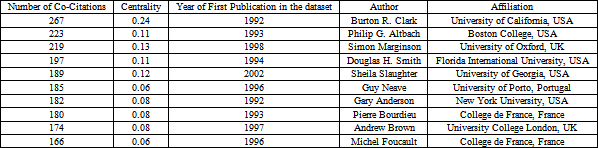
Followed co-citation analysis showed the most cited journals of the AFUAR field: Higher Education, with 264 cited articles; Higher Education Policy and Studies in Higher Education, with 130 cited articles each, and all indexed as SSCI. The most cited authors in the field were Robert Burton Clark, Philip Altbach, and Simon Marginson, with over 200 citations within the collected dataset. According to the centrality index of the analyzed dataset, the work of Robert Burton Clark has a centrality index of 0.24, showing the foundational nature of this publication in the research area. Also, burst index analysis showed the works of Olssen and Peters 55 and Enders, De Boer, and Weyer 28 to have a score above seven, which displays the great influence on the entire field of research. Referring to the basic index of citation count, publications of Olssen and Peters 55, Enders, De Boer and Weyer 28, and Christensen 29 were the most cited inside of the analyzed dataset. Finally, the following knowledge clusters were founded: Autonomy Analysis and Assessment, Analysis of Innovative Policies, Studying the Impact of Autonomy, and Economic Factors of Higher Education Autonomy.
After conducting a detailed analysis of the literature, numerous low-researched topics of the AFUAR field were found. The first visible under-researched topic is the analysis of relationships between different elements of autonomy - how the increase of some aspects affects the autonomy of others. Continuing, the differences in the management of public and private universities from the perspective of understanding the borders of autonomy for each of them and how the state should act within these boundaries also need to be researched more. In addition, research on the differences between documented and real autonomy would be useful, but this is a difficult topic to research due to the subjectivity of the information sources.
Continuing with under-researched areas, it should be noted that the topic of the negative impact of autonomy is presented with a comparatively low number of articles, which creates an imbalance in opinions assuming that wide autonomy is always the best option. Thus, researchers should pay more attention to the disadvantages of broad autonomy and freedom. Along with studies of the negative factors of autonomy, the factors of reforms' ineffective implementation are also under-researched. Problems with the implementation of reforms can be both human-centered, at different levels of governance, and culturally or historically centered, when specific autonomy management methods may not be culturally appropriate. A logical extension of this research branch could be the development of new objective methods for evaluating the effectiveness of autonomy or other related factors. The majority of studies of higher education evaluation use subjective survey methods, and a small part uses statistical data. A possible new direction of such research could be the use of big data to quickly and objectively assess the effectiveness, which in the long run would help to predict future results.
Another under-research direction is the topic of international university governance. More research is needed on the implementation of university autonomy and academic freedom in an internationalized education since many universities have branches in other cities or other countries, and it is necessary to understand how to regulate autonomy within a single structure with a broad geography. Also, the impact of international processes, such as transnational politics and international labor market trends, on the autonomy of the world's universities needs to be researched more. A final addition future articles should pay attention to less researched countries, or those in the "developing" category, like South Asia, the Middle East, and Eastern Europe, which would potentially help find new solutions to old problems.
When checking the results of this study, it should be understood that this article is not intended to address a specific topic in the field of higher education governance but is an attempt to structure publications and create a research map. Together with other articles on this topic by Pillai et al. 3 and Huang et al. 4, this paper demonstrates the structure of the higher education research area. Compared to Pillai et al., which mainly focuses on quantitative data, the current study uses quantitative and qualitative approaches, conducting a detailed qualitative analysis of the quantitative results. Another similar work by Huang et al. looks at the intersections between other research areas and higher education. His work has more general nature, attempting to formulate which other disciplines are most likely to investigate educational issues. In contrast to these two papers, the current study focuses on the regulation of academic freedom and university autonomy rather than on educational governance in general. Likewise, the authors find the methodology of this study to be more thoughtful, yielding clearer results.
Despite the detailed planning, it cannot be denied that this study has some limitations. The first limitation is the subjectivity of search query design. Authors believe that the keywords "higher education", "autonomy", "freedom," and "regulation", together with alternative words, are appropriate for the purpose of study, but it is possible that they do not reflect the full picture. Another limitation could be the method of selecting metadata for the dataset since this study mainly used peer-reviewed articles, not including books, book chapters, conference papers, etc., and studies in other languages, which cannot exclude the distortion of analysis results. A final limitation may be the software choice because sometimes the software encountered errors that were solved manually, but possibly such processes could distort the final results of the study.
By summarizing, by showing the structure of research in the field of academic freedom and university autonomy governance, this study demonstrates the main research directions, shows the main topics and problems on which scholars are working, and also exposes the under-researched areas. These findings will help young scholars and policymakers of all levels to better understand the topic. It is hoped that an expanded understanding of the research will positively influence the direction of other research and increase the adaptability and effectiveness of higher education administrations.
No potential conflict of interest was reported by the author(s).
This work was supported by the Ministry of Education of China, Science and Technology Policy Research Project under the Grant No. JKJ2020111, “Research on the Construction of High-level Science and Technology Talents in Universities”.
| [1] | Dobbins, M., Knill, C., & Vogtle, E. M. (2011). An analytical framework for the cross-country comparison of higher education governance. Higher Education, 62(5), 665-683. | ||
| In article | View Article | ||
| [2] | Rowlands, J. (2017). Academic governance in the contemporary university. 1st edition. Springer. ISBN: 978-981-10-2688-1. | ||
| In article | View Article | ||
| [3] | Pillai, R. K., Sankaran, K., Ramnarayan, K. and Prabhu, N. K. P. (2021). Research in higher education governance: past performance and an agenda for the future. Educational Review. | ||
| In article | View Article | ||
| [4] | Huang, C., Yang, C., Wang, S., Wu, W., Su, J., & Liang, C. (2020). Evolution of topics in education research: a systematic review using bibliometric analysis. Educational Review, 72:3, 281-297. | ||
| In article | View Article | ||
| [5] | Estermann, T., Nokkala, T. (2009). University autonomy in Europe I: exploratory study. Brussels: European University Association (EUA) https://eua.eu/resources/publications/350:university-autonomy%C2%A0in-europe-iii-%C2%A0the-scorecard-2017.html. | ||
| In article | |||
| [6] | Jain, A. K., Dubes, R. C. (1988). Algorithms for clustering data. Upper Saddle River, NJ: Prentice-Hall, Inc. http://dl.acm.org/citation.cfm?id=SERIES10022.42779. | ||
| In article | |||
| [7] | Ferrara, A., Salini, S. (2012). Ten challenges in modeling bibliographic data for bibliometric analysis. Scientometrics, 93(3), 765-785. | ||
| In article | View Article | ||
| [8] | Zupic, I., Cater, T. (2014). Bibliometric methods in management and organization. Organizational Research Methods, 18(3), 429-472. | ||
| In article | View Article | ||
| [9] | Moral-Munoz, J.A., Herrera-Viedma, E.E., Santisteban-Espejo, A., & Cobo, M.J. (2020). Software tools for conducting bibliometric analysis in science: An up-to-date review. Profesional De La Informacion, 29, 4. | ||
| In article | View Article | ||
| [10] | Chen, C. (2017). Science mapping: a systematic review of the literature. Journal of data and information science. 2. 1-40. | ||
| In article | View Article | ||
| [11] | Liben-Nowell, D., Kleinberg, J. (2007). The link-prediction problem for social networks. Journal of the American Society for Information Science and Technology, 58(7), 1019-1031. | ||
| In article | View Article | ||
| [12] | Ankrah, S., AL-Tabbaa, O. (2015). Universities–industry collaboration: A systematic review. Scandinavian Journal of Management, 31(3), 387-408. | ||
| In article | View Article | ||
| [13] | Surwase, G., Sagar, A., Kademani, B., & Bhanumurthy, K. (2011). Co-citation analysis: an overview. BOSLA National Conference Proceedings. https://www.researchgate.net/publication/277119876_Co-citation_Analysis_An_Overview. | ||
| In article | |||
| [14] | Duhe, S. (2015). An overview of new media research in public relations journals from 1981 to 2014. Public Relations Review, 41(2), 153-169. | ||
| In article | View Article | ||
| [15] | Brandes, U. (2001). A faster algorithm for betweenness centrality. The Journal of Mathematical Sociology, 25(2), 163-177. | ||
| In article | View Article | ||
| [16] | Quezado, T.C.C., Cavalcante, W.Q.F., Fortes, N., & Ramos, R.F. (2022). Corporate social responsibility and marketing: a bibliometric and visualization analysis of the literature between the years 1994 and 2020. Sustainability, 14, 1694. | ||
| In article | View Article | ||
| [17] | Kleinberg, J. (2002). Bursty and Hierarchical Structure in Streams. Proceedings of the 8th ACM SIGKDD International Conference on Knowledge Discovery and Data Mining, Edmonton, 23-26 July 2002, 91-101. | ||
| In article | View Article | ||
| [18] | Karran, T. (2007). Academic freedom in Europe: a preliminary comparative analysis. Higher Education Policy, 20(3), 289-313. | ||
| In article | View Article | ||
| [19] | Karran, T., Beiter, K., & Appiagyei-Atua, K. (2017). Measuring academic freedom in Europe: a criterion referenced approach. Policy Reviews in Higher Education, 1:2, 209-239. | ||
| In article | View Article | ||
| [20] | Gornitzka, A. (1999). Governmental policies and organisational change in higher education. Higher Education 38, 5-31. | ||
| In article | View Article | ||
| [21] | Bleiklie, I., Kogan, M. (2007). Organization and governance of universities. Higher Education Policy, 20(4), 477-493. | ||
| In article | View Article | ||
| [22] | Ferlie, E., Musselin, C., & Andresani, G. (2008). The steering of higher education systems: a public management perspective. Higher Education, 56(3), 325-348. | ||
| In article | View Article | ||
| [23] | Capano, G. (2011). Government continues to do its job. A comparative study of governance shifts in the higher education sector. Public Administration, 89(4), 1622-1642. | ||
| In article | View Article | ||
| [24] | Capano, G., Pritoni, A. (2018). Varieties of hybrid systemic governance in European Higher Education. Higher Education Quarterly. | ||
| In article | View Article | ||
| [25] | Deem, R. (2004). The knowledge worker, the manager-academic and the contemporary UK university: new and old forms of public management? Financial Accountability and Management, 20(2), 107-128. | ||
| In article | View Article | ||
| [26] | Henkel, M. (2005). Academic identity and autonomy in a changing policy environment. Higher Education, 49, 155-176. | ||
| In article | View Article | ||
| [27] | De Boer, H. F., Enders J., & Leisyte, L. (2007). Public sector reform in Dutch higher education: the organizational transformation of the university. Public Administration, 85(1), 27-46. | ||
| In article | View Article | ||
| [28] | Enders, J., De Boer, H., & Weyer, E. (2012). Regulatory autonomy and performance: the reform of higher education re-visited. Higher Education, 65(1), 5-23. | ||
| In article | View Article | ||
| [29] | Christensen, T. (2010). University governance reforms: potential problems of more autonomy? Higher Education, 62(4), 503-517. | ||
| In article | View Article | ||
| [30] | Martin-Sardesai, A., Guthrie, J., Tooley, S., & Chaplin, S. (2018). History of research performance measurement systems in the Australian higher education sector. Accounting History, 103237321876855. | ||
| In article | View Article | ||
| [31] | Hood, C. (1991). A public management for all seasons? Public Administration, 69(1), 3-19. | ||
| In article | View Article | ||
| [32] | Neave, G. (1998). The evaluative state reconsidered. European Journal of Education, 33(3), 265-284. | ||
| In article | |||
| [33] | Etzkowitz, H., Leydesdorff, L. (2000). The dynamics of innovation: from National Systems and Mode 2 to a Triple Helix of university–industry–government relations. Research Policy, 29(2), 109-123. | ||
| In article | View Article | ||
| [34] | Sporn, B. (2001). Building adaptive universities: emerging organisational forms based on experiences of European and US universities. Tertiary Education and Management, 7(2), 121-134. | ||
| In article | View Article | ||
| [35] | Ball, S. J. (2003). The teacher’s soul and the terrors of performativity. Journal of Education Policy, 18(2), 215-228. | ||
| In article | View Article | ||
| [36] | Jongbloed, B., Enders, J., & Salerno, C. (2008). Higher education and its communities: Interconnections, interdependencies and a research agenda. Higher Education, 56(3), 303-324. | ||
| In article | View Article | ||
| [37] | Deem, R., Mok, K. H., & Lucas, L. (2008). Transforming higher education in whose image? Exploring the concept of the world-class university in Europe and Asia. Higher Education Policy, 21(1), 83-97. | ||
| In article | View Article | ||
| [38] | Enders, J., De Boer, H., & Leisyte, L. (2008). On striking the right notes: shifts in governance and the organisational transformation of universities. In: Amaral, A., Bleiklie, I., Musselin, C. (eds) From governance to identity. Higher Education Dynamics, vol 24. Springer, Dordrecht. | ||
| In article | View Article | ||
| [39] | Smith, S., Ward, V., & House, A. (2011). Impact in the proposals for the UK’s Research Excellence Framework: Shifting the boundaries of academic autonomy. Research Policy, 40(10), 1369-1379. | ||
| In article | View Article | ||
| [40] | Hicks, D. (2012). Performance-based university research funding systems. Research Policy, 41(2), 251-261. | ||
| In article | View Article | ||
| [41] | Agyemang, G., Broadbent, J. (2015). Management control systems and research management in universities: An empirical and conceptual exploration. Accounting, Auditing & Accountability Journal, Vol. 28 No. 7, pp. 1018-1046. | ||
| In article | View Article | ||
| [42] | Kleimann, B. (2018). Universities as multiple hybrid organizations. Higher Education, 77(6), 1085-1102. | ||
| In article | View Article | ||
| [43] | Krucken, G., Meier, F. (2006). Turning the university into an organizational actor. In: Drori, G., Hwang, H., Meyer, J. (eds.), Globalization and organization. World society and organizational change. Oxford, Oxford University Press, 2006: 241-257. | ||
| In article | |||
| [44] | Henkel, M. (2007). Can academic autonomy survive in the knowledge society? A perspective from Britain. Higher Education Research & Development, 26(1), 87-99. | ||
| In article | View Article | ||
| [45] | Anderson, G. (2008). Mapping academic resistance in the managerial university. Organization, 15(2), 251-270. | ||
| In article | View Article | ||
| [46] | Aghion, P., Dewatripont, M., Hoxby, C., Mas-Colell, A., & Sapir, A. (2010). The governance and performance of universities: evidence from Europe and the US. Economic Policy, 25(61), 7-59. | ||
| In article | View Article | ||
| [47] | Ylijoki, O.-H., Ursin, J. (2013). The construction of academic identity in the changes of Finnish higher education. Studies in Higher Education, 38(8), 1135-1149. | ||
| In article | View Article | ||
| [48] | Lynch, K., Ivancheva, M. (2015). Academic freedom and the commercialisation of universities: a critical ethical analysis. Ethics in Science and Environmental Politics, 15: 71-85. | ||
| In article | View Article | ||
| [49] | Cannizzo, F. (2015). Academic subjectivities: governmentality and self-development in higher education. Foucault Studies, 20), 199-217. | ||
| In article | View Article | ||
| [50] | Maassen, P. (2017). The university’s governance paradox. Higher Education Quarterly, 71(3), 290-298. | ||
| In article | View Article | ||
| [51] | Partha, D., David, P. A. (1994). Toward a new economics of science. Research Policy, 23(5), 487-521. | ||
| In article | View Article | ||
| [52] | Gumport, P.J. (2000). Academic restructuring: Organizational change and institutional imperatives. Higher Education 39, 67-91. | ||
| In article | View Article | ||
| [53] | Slaughter, S., Leslie, L. L. (2001). Expanding and elaborating the concept of academic capitalism. Organization, 8(2), 154-161. | ||
| In article | View Article | ||
| [54] | Etzkowitz, H. (2003). Research groups as quasi-firms: the invention of the entrepreneurial university. Research Policy, 32(1), 109-121. | ||
| In article | View Article | ||
| [55] | Olssen, M., Peters, M. A. (2005). Neoliberalism, higher education and the knowledge economy: from the free market to knowledge capitalism. Journal of Education Policy, 20(3), 313-345. | ||
| In article | View Article | ||
| [56] | Altbach, P. G., Knight, J. (2007). The internationalization of higher education: motivations and realities. Journal of Studies in International Education, 11(3-4), 290-305. | ||
| In article | View Article | ||
Published with license by Science and Education Publishing, Copyright © 2023 Oleksandr Shevchuk, Xiaodong Xu and Chunxia Sun
 This work is licensed under a Creative Commons Attribution 4.0 International License. To view a copy of this license, visit
http://creativecommons.org/licenses/by/4.0/
This work is licensed under a Creative Commons Attribution 4.0 International License. To view a copy of this license, visit
http://creativecommons.org/licenses/by/4.0/
| [1] | Dobbins, M., Knill, C., & Vogtle, E. M. (2011). An analytical framework for the cross-country comparison of higher education governance. Higher Education, 62(5), 665-683. | ||
| In article | View Article | ||
| [2] | Rowlands, J. (2017). Academic governance in the contemporary university. 1st edition. Springer. ISBN: 978-981-10-2688-1. | ||
| In article | View Article | ||
| [3] | Pillai, R. K., Sankaran, K., Ramnarayan, K. and Prabhu, N. K. P. (2021). Research in higher education governance: past performance and an agenda for the future. Educational Review. | ||
| In article | View Article | ||
| [4] | Huang, C., Yang, C., Wang, S., Wu, W., Su, J., & Liang, C. (2020). Evolution of topics in education research: a systematic review using bibliometric analysis. Educational Review, 72:3, 281-297. | ||
| In article | View Article | ||
| [5] | Estermann, T., Nokkala, T. (2009). University autonomy in Europe I: exploratory study. Brussels: European University Association (EUA) https://eua.eu/resources/publications/350:university-autonomy%C2%A0in-europe-iii-%C2%A0the-scorecard-2017.html. | ||
| In article | |||
| [6] | Jain, A. K., Dubes, R. C. (1988). Algorithms for clustering data. Upper Saddle River, NJ: Prentice-Hall, Inc. http://dl.acm.org/citation.cfm?id=SERIES10022.42779. | ||
| In article | |||
| [7] | Ferrara, A., Salini, S. (2012). Ten challenges in modeling bibliographic data for bibliometric analysis. Scientometrics, 93(3), 765-785. | ||
| In article | View Article | ||
| [8] | Zupic, I., Cater, T. (2014). Bibliometric methods in management and organization. Organizational Research Methods, 18(3), 429-472. | ||
| In article | View Article | ||
| [9] | Moral-Munoz, J.A., Herrera-Viedma, E.E., Santisteban-Espejo, A., & Cobo, M.J. (2020). Software tools for conducting bibliometric analysis in science: An up-to-date review. Profesional De La Informacion, 29, 4. | ||
| In article | View Article | ||
| [10] | Chen, C. (2017). Science mapping: a systematic review of the literature. Journal of data and information science. 2. 1-40. | ||
| In article | View Article | ||
| [11] | Liben-Nowell, D., Kleinberg, J. (2007). The link-prediction problem for social networks. Journal of the American Society for Information Science and Technology, 58(7), 1019-1031. | ||
| In article | View Article | ||
| [12] | Ankrah, S., AL-Tabbaa, O. (2015). Universities–industry collaboration: A systematic review. Scandinavian Journal of Management, 31(3), 387-408. | ||
| In article | View Article | ||
| [13] | Surwase, G., Sagar, A., Kademani, B., & Bhanumurthy, K. (2011). Co-citation analysis: an overview. BOSLA National Conference Proceedings. https://www.researchgate.net/publication/277119876_Co-citation_Analysis_An_Overview. | ||
| In article | |||
| [14] | Duhe, S. (2015). An overview of new media research in public relations journals from 1981 to 2014. Public Relations Review, 41(2), 153-169. | ||
| In article | View Article | ||
| [15] | Brandes, U. (2001). A faster algorithm for betweenness centrality. The Journal of Mathematical Sociology, 25(2), 163-177. | ||
| In article | View Article | ||
| [16] | Quezado, T.C.C., Cavalcante, W.Q.F., Fortes, N., & Ramos, R.F. (2022). Corporate social responsibility and marketing: a bibliometric and visualization analysis of the literature between the years 1994 and 2020. Sustainability, 14, 1694. | ||
| In article | View Article | ||
| [17] | Kleinberg, J. (2002). Bursty and Hierarchical Structure in Streams. Proceedings of the 8th ACM SIGKDD International Conference on Knowledge Discovery and Data Mining, Edmonton, 23-26 July 2002, 91-101. | ||
| In article | View Article | ||
| [18] | Karran, T. (2007). Academic freedom in Europe: a preliminary comparative analysis. Higher Education Policy, 20(3), 289-313. | ||
| In article | View Article | ||
| [19] | Karran, T., Beiter, K., & Appiagyei-Atua, K. (2017). Measuring academic freedom in Europe: a criterion referenced approach. Policy Reviews in Higher Education, 1:2, 209-239. | ||
| In article | View Article | ||
| [20] | Gornitzka, A. (1999). Governmental policies and organisational change in higher education. Higher Education 38, 5-31. | ||
| In article | View Article | ||
| [21] | Bleiklie, I., Kogan, M. (2007). Organization and governance of universities. Higher Education Policy, 20(4), 477-493. | ||
| In article | View Article | ||
| [22] | Ferlie, E., Musselin, C., & Andresani, G. (2008). The steering of higher education systems: a public management perspective. Higher Education, 56(3), 325-348. | ||
| In article | View Article | ||
| [23] | Capano, G. (2011). Government continues to do its job. A comparative study of governance shifts in the higher education sector. Public Administration, 89(4), 1622-1642. | ||
| In article | View Article | ||
| [24] | Capano, G., Pritoni, A. (2018). Varieties of hybrid systemic governance in European Higher Education. Higher Education Quarterly. | ||
| In article | View Article | ||
| [25] | Deem, R. (2004). The knowledge worker, the manager-academic and the contemporary UK university: new and old forms of public management? Financial Accountability and Management, 20(2), 107-128. | ||
| In article | View Article | ||
| [26] | Henkel, M. (2005). Academic identity and autonomy in a changing policy environment. Higher Education, 49, 155-176. | ||
| In article | View Article | ||
| [27] | De Boer, H. F., Enders J., & Leisyte, L. (2007). Public sector reform in Dutch higher education: the organizational transformation of the university. Public Administration, 85(1), 27-46. | ||
| In article | View Article | ||
| [28] | Enders, J., De Boer, H., & Weyer, E. (2012). Regulatory autonomy and performance: the reform of higher education re-visited. Higher Education, 65(1), 5-23. | ||
| In article | View Article | ||
| [29] | Christensen, T. (2010). University governance reforms: potential problems of more autonomy? Higher Education, 62(4), 503-517. | ||
| In article | View Article | ||
| [30] | Martin-Sardesai, A., Guthrie, J., Tooley, S., & Chaplin, S. (2018). History of research performance measurement systems in the Australian higher education sector. Accounting History, 103237321876855. | ||
| In article | View Article | ||
| [31] | Hood, C. (1991). A public management for all seasons? Public Administration, 69(1), 3-19. | ||
| In article | View Article | ||
| [32] | Neave, G. (1998). The evaluative state reconsidered. European Journal of Education, 33(3), 265-284. | ||
| In article | |||
| [33] | Etzkowitz, H., Leydesdorff, L. (2000). The dynamics of innovation: from National Systems and Mode 2 to a Triple Helix of university–industry–government relations. Research Policy, 29(2), 109-123. | ||
| In article | View Article | ||
| [34] | Sporn, B. (2001). Building adaptive universities: emerging organisational forms based on experiences of European and US universities. Tertiary Education and Management, 7(2), 121-134. | ||
| In article | View Article | ||
| [35] | Ball, S. J. (2003). The teacher’s soul and the terrors of performativity. Journal of Education Policy, 18(2), 215-228. | ||
| In article | View Article | ||
| [36] | Jongbloed, B., Enders, J., & Salerno, C. (2008). Higher education and its communities: Interconnections, interdependencies and a research agenda. Higher Education, 56(3), 303-324. | ||
| In article | View Article | ||
| [37] | Deem, R., Mok, K. H., & Lucas, L. (2008). Transforming higher education in whose image? Exploring the concept of the world-class university in Europe and Asia. Higher Education Policy, 21(1), 83-97. | ||
| In article | View Article | ||
| [38] | Enders, J., De Boer, H., & Leisyte, L. (2008). On striking the right notes: shifts in governance and the organisational transformation of universities. In: Amaral, A., Bleiklie, I., Musselin, C. (eds) From governance to identity. Higher Education Dynamics, vol 24. Springer, Dordrecht. | ||
| In article | View Article | ||
| [39] | Smith, S., Ward, V., & House, A. (2011). Impact in the proposals for the UK’s Research Excellence Framework: Shifting the boundaries of academic autonomy. Research Policy, 40(10), 1369-1379. | ||
| In article | View Article | ||
| [40] | Hicks, D. (2012). Performance-based university research funding systems. Research Policy, 41(2), 251-261. | ||
| In article | View Article | ||
| [41] | Agyemang, G., Broadbent, J. (2015). Management control systems and research management in universities: An empirical and conceptual exploration. Accounting, Auditing & Accountability Journal, Vol. 28 No. 7, pp. 1018-1046. | ||
| In article | View Article | ||
| [42] | Kleimann, B. (2018). Universities as multiple hybrid organizations. Higher Education, 77(6), 1085-1102. | ||
| In article | View Article | ||
| [43] | Krucken, G., Meier, F. (2006). Turning the university into an organizational actor. In: Drori, G., Hwang, H., Meyer, J. (eds.), Globalization and organization. World society and organizational change. Oxford, Oxford University Press, 2006: 241-257. | ||
| In article | |||
| [44] | Henkel, M. (2007). Can academic autonomy survive in the knowledge society? A perspective from Britain. Higher Education Research & Development, 26(1), 87-99. | ||
| In article | View Article | ||
| [45] | Anderson, G. (2008). Mapping academic resistance in the managerial university. Organization, 15(2), 251-270. | ||
| In article | View Article | ||
| [46] | Aghion, P., Dewatripont, M., Hoxby, C., Mas-Colell, A., & Sapir, A. (2010). The governance and performance of universities: evidence from Europe and the US. Economic Policy, 25(61), 7-59. | ||
| In article | View Article | ||
| [47] | Ylijoki, O.-H., Ursin, J. (2013). The construction of academic identity in the changes of Finnish higher education. Studies in Higher Education, 38(8), 1135-1149. | ||
| In article | View Article | ||
| [48] | Lynch, K., Ivancheva, M. (2015). Academic freedom and the commercialisation of universities: a critical ethical analysis. Ethics in Science and Environmental Politics, 15: 71-85. | ||
| In article | View Article | ||
| [49] | Cannizzo, F. (2015). Academic subjectivities: governmentality and self-development in higher education. Foucault Studies, 20), 199-217. | ||
| In article | View Article | ||
| [50] | Maassen, P. (2017). The university’s governance paradox. Higher Education Quarterly, 71(3), 290-298. | ||
| In article | View Article | ||
| [51] | Partha, D., David, P. A. (1994). Toward a new economics of science. Research Policy, 23(5), 487-521. | ||
| In article | View Article | ||
| [52] | Gumport, P.J. (2000). Academic restructuring: Organizational change and institutional imperatives. Higher Education 39, 67-91. | ||
| In article | View Article | ||
| [53] | Slaughter, S., Leslie, L. L. (2001). Expanding and elaborating the concept of academic capitalism. Organization, 8(2), 154-161. | ||
| In article | View Article | ||
| [54] | Etzkowitz, H. (2003). Research groups as quasi-firms: the invention of the entrepreneurial university. Research Policy, 32(1), 109-121. | ||
| In article | View Article | ||
| [55] | Olssen, M., Peters, M. A. (2005). Neoliberalism, higher education and the knowledge economy: from the free market to knowledge capitalism. Journal of Education Policy, 20(3), 313-345. | ||
| In article | View Article | ||
| [56] | Altbach, P. G., Knight, J. (2007). The internationalization of higher education: motivations and realities. Journal of Studies in International Education, 11(3-4), 290-305. | ||
| In article | View Article | ||