All teachers and other stakeholders must be committed to evaluating students' learning in a genuine and honest manner. This study aimed to explore the teachers', students', parents', and school administrators’ perspectives on the integrity of mathematics classroom assessment in the new normal, as well as their experienced challenges and difficulties on the assessment of learning practices. A quantitative descriptive research design was undertaken in the study utilizing validated survey questionnaires. This was conducted to fourteen (14) Junior High Schools in the division of Misamis Oriental comprising large, medium, and small-sized secondary schools. Actual respondents of the study were 67 mathematics teachers; 1,481 G10 students; 1,037 G10 parents; and 24 school administrators. Descriptive statistics was used for the data processing. Analysis of the data revealed that under the new normal, teachers and parents’ perception on mathematics classroom assessment had a low level of integrity, whereas students and school administrators thought it had a high level of integrity. Parents believed that the majority of high school students do cheat. The findings suggested that the teachers' observations of low integrity were backed up by the parents' observations, as they are now the facilitators of learning at home. With regard to the experienced challenges and difficulties, the integrity of mathematics classroom assessment is a critical concern and a challenge for teachers, parents, and students. More research is needed to develop effective preventive measures to mitigate assessment dishonesty and to give a long-term alternative way to provide high-quality education especially during an emergency circumstance.
The new normal paradigm shift in education had posed a challenge to the learning delivery modality not only within the country but worldwide. Along with this shift, was the challenge on how to genuinely assess the students’ learning in mathematics through the blended distance learning modality. Transitioning from established face-to-face courses, like mathematics and statistics, to online can be difficult, and their quality is at risk 1. Lopez, et al. 1 underscored that in this sudden shift, according to their research, two-thirds of the instructors found evaluating students in relation to honor code violations and motivating students to engage with one another to be extremely difficult. Gao 2 also claimed that there is still a long way to go for distance learning modality with regard to the areas such as accommodating students' special needs, involving students in the assessment decision process, and increasing the authenticity of assessment tasks, since mathematics assessments demonstrate congruence with planned learning and transparency.
Promoting authenticity and academic integrity in assessment continues to present a priority for educational institutions 3. Sotiriadou, et al. 3 stated that besides providing the foundation for high academic standards and best practice, assessments’ authenticity and integrity enrich students with skills that advance their employability. Assessment integrity is critical for supporting teaching and learning, evaluating programs, determining how well a system is running, and improving educational outcomes 4. These, however, will not be achieved if the authenticity and integrity of the product are questionable.
In April 2021, the Council of Deans for Teacher Education (CODTE Region 10) conducted an initial survey on Assessment in the New Normal among the 140 professors and instructors from 42 different Teacher Training Institutions in the region. Accordingly, issues on the assessment authenticity and integrity were the top two challenges faced by the respondents. Moreover, it was reported that Philippines senators during the senate hearing early this year, voiced concerns about cheating in distance learning. They had urged DepEd to step up their efforts to combat cheating in distance learning 5. Recently, after learning about the Online Kopyahan on Facebook groups, the Department of Education published an official statement against any type of academic dishonesty. “The Department does not tolerate the perpetuation of cheating regardless of the learning delivery modality. We are now exhausting all possible means to put a stop to these activities; and prevent similar attempts of academic dishonesty that promote laziness, irresponsibility, and instant gratification. We appeal to parents, teachers, and learners to help us eradicate online cheating, which undermines the development of values and morality among the youth. It demeans the quality of education that the Department is committed to improve” 6.
Undeniably, there is a pressing need for study in this field because we can no longer prevent remote learning and returning to conventional modality is still difficult to predict. If the challenges of assessment integrity are not addressed, our educational system is unlikely to produce a long-term alternative strategy of offering high-quality education in times of crisis. Thus, meetings, conferences, and seminars are held to research on this topic and find solutions to the problem, particularly after most educational institutions throughout the world adapted distance learning during and after the COVID-19 epidemic spread 7. Some higher education institutions utilize a variety of online anti-cheating applications. To name one, Mellar et al. 8 investigated student authentication and authorship checking systems to assist teachers in addressing cheating and plagiarism. Another is the Proctortrack software, which is designed to prevent students from inventing new ways to cheat on an online exam 9. These apps aid in the integrity of assessments, but they are not applicable in our circumstance because DepEd does not have such resources. Many studies on assessment concerns had been undertaken, but the majority of them had focused on traditional face-to-face settings and on higher education institutions. Moreover, there were few studies that examine the perspectives of school administrators and parents, in addition to teachers and students, on this topic, particularly on the new adapted learning landscape.
Hence, to fill in the gaps in the variety of areas of the literature on classroom assessment's integrity, this study aimed to investigate and understand more about the teachers', students', parents', and school administrators' perspectives on the integrity of mathematics classroom assessment in the new normal, as well as their experienced challenges and difficulties in assessing the students’ true learnings, so that appropriate and meaningful countermeasures could be implemented next. Specifically, it sought to answer the following questions:
1. What are the levels of perception about the integrity of mathematics classroom assessment in this new normal in terms of the student’s attitude towards academic dishonesty as perceived by the (a) teachers, (b) students, (c) parents, and (d) school administrators?
2. What are the levels of challenges and difficulties experienced by the teachers, students, parents, and school administrators on the assessment of learning practices in this new normal?
The Planned Behavior Theory is one perspective outlining this study. This is in relation to the issues on assessment integrity. Academic dishonesty is prevalent especially in the new normal. The theory posits that cheating occurs as a result of both the opportunity and the intention to cheat 10. This is true in modular distance learning in mathematics since the opportunity to do such behavior is high. Resources in different forms are very much readily available. Rowland 11 and Peled, et al. 12 cited many studies showing that distance learning has created a lot of opportunities for academic dishonesty than in traditional forms. Teachers had no face-to-face contact with the students; hence they did not have actual control over what the students really were doing or what had really transpired in their respective homes as they answered the tasks in the self-learning modules given to them. In the study of Abante 13, some teachers in DepEd shared that they experience difficulties in giving grades to their students because they are not sure if the students are really the ones doing the learning tasks. The validation of students’ learning is a challenge on the part of the teachers since there are modules being answered by parents and tutors, not the learners 14. Indeed, these empirical implications are consistent with the Planned Behavior Theory. Stone, et al. 15 also said, the theory stipulates that the following three components predict intention to engage in a specific behavior and intention predicts subsequent engagement in that behavior. According to the authors, intention to engage in a behavior is affected by (a) attitudes toward the behavior, that is, beliefs about a specific behavior and its consequences; (b) subjective norms, that is, normative expectations of other people who are important to the actor regarding the behavior, and (c) perceived behavioral control, that is, the perceived difficulty or ease of performing the behavior.
This study is also grounded on Gardner & Melvin’s 16 study on attitude towards academic dishonesty. They highlighted that academic ability and academic honesty are two of the most important and desirable characteristics of the students. They added that there exist reams of research on ability but there is a dearth of research on academic honesty. Furthermore, it was found that attitude towards academic dishonesty mediated the association between self-control and academic dishonesty, as well as the relationship between perceived opportunity and academic dishonesty 17. Bolin 17 cited some authors who claimed that students' attitudes could be changed through interventions such as education, and that students who had negative attitudes towards academic dishonesty were less likely to take advantage of opportunities to cheat.
The researcher used the quantitative descriptive research design. Validated survey questionnaires were used in the collection of quantitative data. After the data collection, data analysis followed using descriptive statistics.
3.2. The RespondentsThis study was administered to fourteen (14) Junior High Schools in the division of Misamis Oriental comprising large, medium, and small-sized secondary schools. The researcher employed disproportionate stratified random sampling for the school-respondents. Stratified random sampling ensures that each subgroup of a given population is adequately represented within the whole sample population of a research study. In a disproportional stratified sample, the size of each stratum is not proportional to its size in the population 18. Actual respondents of the study were 67 mathematics teachers; 1,481 G10 students; 1,037 G10 parents; and 24 school administrators.
3.3. The InstrumentsFour instruments were used in this study, one for each of the four groups of respondents. The instruments used had the indicators for Assessment Integrity, and Experienced Challenges/Difficulties on the Assessment of Learning Practices in this New Normal. The content of the instruments intended for the four groups of the respondents were the same but phrased slightly different to suit to the level of each group. The study adapted The Attitude Towards Cheating Scale 16 with modifications in a 4-point Likert-type Scale for the Assessment Integrity. For the Experienced Challenges, the researcher-made questionnaire in a 4-point Likert-type Scale was used. This adapted instrument with modifications, and the researcher-made questionnaire were subjected to face and content validity by the 6 chosen experts of the topic under investigation with the following S-CVI/Ave.: 0.968 for teachers and school administrators, 0.947 for students, and 0.950 for parents. It has the following reliability (Cronbach’s alpha): 0.815, 0.834, and 0.736 for teachers and school administrators, students, and parents respectively.
3.4. Data Gathering ProcedureTo conduct the study, the researcher asked permission from the Schools Division Superintendent of the division of Misamis Oriental and from the principals or school heads of the fourteen (14) schools in the Division. The researcher adhered to ethical standards and the restrictions of the Data Privacy Act when acquiring pertinent data for the study. The necessary consent from the respondents were sought during the conduct of the study. Because the study was exclusively for academic purposes, the respondents were oriented on the research and were promised that their answers would be kept anonymous.
The following were the quantitative phases undertaken to ensure success in the implementation and conduct of the study: First is the Development of the Research Instruments. This phase is the development of the scales or survey questionnaires. The study used the adapted-modified instrument and the researcher-made questionnaire with the acceptable CVI and reliability specified in the preceding section. Second is the Quantitative Data Collection. In this phase, the validated instruments were given to the four groups of respondents (mathematics teachers, G10 students, G10 parents, and school administrators) from the fourteen randomly selected junior high schools in the division of Misamis Oriental. Google Forms were used to perform these survey questionnaires to those who have internet access, and printed/hard copies were given to those who do not have. During the data collection phase, the researcher personally visited the 14 different schools. Then the third is the Quantitative Data Analysis. The characteristics of the data set were summarized and analyzed using descriptive statistics.
The levels of perception about the integrity of mathematics assessment in this new normal in terms of the student’s attitude towards academic dishonesty as perceived by the (a) teachers, (b) students, (c) parents, and (d) school administrators, is presented in Table 1 below.
As shown in Table 1, the overall mean as perceived by the teachers is 2.478, followed by 2.491, 2.530, and 2.668 as perceived by the parents, students, and school administrators, respectively. Teachers and parents have perceived low integrity on mathematics classroom assessment, while students and school administrators perceived it with high integrity, based on the interpretation scheme in the study of Pornel, et al. 19. As to the variability of the perceptions of the four groups of respondents, the teachers, students, parents, and school administrators (SD= 0.244, SD= 0.235, SD= 0.212, and SD= 0.246, respectively) have closely similar spread.
Furthermore, it can be seen in Table 1 that the indicator “If I perceive a student cheating, it is just my word against the student’s, unless the student admits he or she was cheating” was perceived with the lowest mean implying lowest integrity by three groups of respondents, the teachers, students, and administrators (M=1.836, SD=0.709; M=2.010, SD=0.751; M=1.542, SD=0.721, respectively); while parents perceived the indicator “most high school students never cheat” with the lowest integrity. “Cheating on tests in any way is morally wrong” was perceived by the teachers, parents and school administrators with the highest integrity (M=3.090, SD=0.452; M=3.180, SD=0.781; and M=3.792, SD=0.588 respectively). Students perceived “it is lying when a student who cheated denies it” as the indicator with the highest integrity level.

It can be gleaned from the results that the observation of the teachers, that is low integrity, was supported by that of the parents. They perceived that most high school students do cheat. It’s because in this new normal the parents were the ones with direct interaction and supervision with the students. Somehow, they are now playing the role of the teacher because they are the facilitators of learning at home. Teachers, students, and school administrators are more tolerant about student cheating unless students themselves admitted the act. This result corroborated the study of Rowland 11 who cited some authors affirming that (1) the pressure placed on administrators to keep their "customers" satisfied is related to academic dishonesty, and that principals frequently approach educational issues in a businesslike manner, making judgments based on survival rather than morals and ethics; (2) teachers are under pressure from both administration and parents; thus, they are necessarily under pressure from many sources; (3) as a result of this fact, students frequently believe that faculty members do not punish academic integrity violations harshly since many teachers prefer to avoid confrontations by looking the other way.
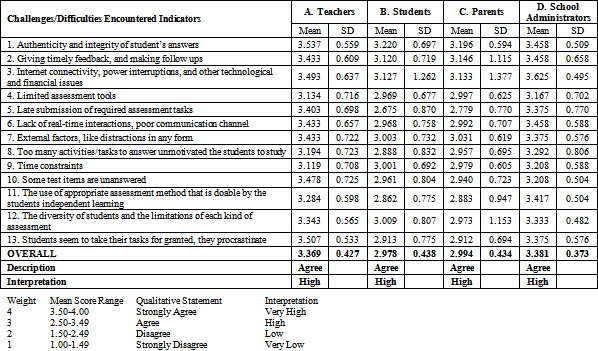
To explore about the teachers’, students’, parents’, and school administrators’ experienced challenges and difficulties on the assessment of learning practices in this new normal, Table 2 is presented next.
Table 2 showed the result of the challenges and difficulties experienced by the teachers, students, parents, and school administrators on the assessment of learning practices in this new normal. As reflected, all indicators were high based on the interpretation scheme in the study of Pornel, et al. 19. The variability of the teachers’, students’, parents’, and school administrators’ responses have almost the same spread (M=3.369, SD=0.427; M=2.978, SD=0.438; M=2.994, SD=0.434; M=3.381, SD=0.373 respectively). Additionally, teachers, students and parents agreed that “authenticity and integrity of student’s answers” is a challenge, hence, this is the indicator perceived with the highest mean (M=3.537, SD=0.559; M=3.220, SD=0.697; M=3.196, SD=0.594 respectively), while the school administrators perceived “internet connectivity, power interruptions, and other technological and financial issues” as the top difficulty (M=3.625, SD=0.495).
These findings substantiated the research of Castroverde, et al. 14, which found that a common problem for teachers in monitoring students' performance is a lack of effective communication due to students' lack of gadgets, as well as unstable internet connectivity, because most monitoring is done via messenger and other social media platforms. Teachers utilize text messages as well, however there are some parents whose phone numbers are no longer current and cannot be reached. Also, validating students' learning is difficult for teachers because some modules are addressed by parents and tutors rather than the students. This is also consistent with Meccawy's 20 study, which indicated that many teachers were concerned about assessment integrity in this new normal because they find it difficult to detect who is genuinely taking the tests, and cheating will affect the meaning and general validity of the student's obtained scores.
Based on the study's findings, the integrity of mathematics classroom assessment in the new normal is a serious concern and a challenge for teachers, parents, and students alike. Assessment integrity has entered new area in light of the abrupt educational transition. It is being questioned due to the widespread availability of cheating techniques and the growing pressure on students to perform even during this trying times. More research may be performed in order to develop effective countermeasures to mitigate assessment dishonesty and to provide a long-term alternative approach for providing high-quality education especially in times of an emergency situation.
The researchers would like to extend their heartfelt gratitude to the Department of Science and Technology-Science Education Institute (DOST-SEI) for the scholarship grant.
| [1] | Lopez, S. R., Bruun, G. R., Mader, M. J., & Reardon, R. F. (2021). The Pandemic Pivot: The Impact of COVID-19 on Mathematics and Statistics Post-Secondary Educators. International Journal for Cross-Disciplinary Subjects in Education. | ||
| In article | View Article | ||
| [2] | Gao, M. (2012). Classroom Assessments in Mathematics: High School Students’ Perceptions. International Journal of Business and Social Science. | ||
| In article | |||
| [3] | Sotiriadou, P., Logan, D., Daly, A., & Guest, R. (2019). The role of authentic assessment to preserve academic integrity and promote skill development and employability. Studies in Higher Education. | ||
| In article | View Article | ||
| [4] | Clarke, M., & Luna-Bazaldua, D. (2021). Primer on Large-Scale Assessments of Educational Achievement. In Primer on Large-Scale Assessments of Educational Achievement. | ||
| In article | View Article | ||
| [5] | ABS-CBN News, April 4, 2021. Gov’t urged to step up efforts vs ‘distance cheating’. https://news.abs-cbn.com/news/04/04/21/govt-urged-to-step-up-efforts-vs-distance-cheating | ||
| In article | |||
| [6] | DepEd's Official Statement, September 22, 2021. On “Online Kopyahan”. https://www.deped.gov.ph/2021/09/22/on-online-kopyahan/ | ||
| In article | |||
| [7] | Mokdad, M., & Aljunaidi, S. (2020). Whither plagiarism in distance learning academic assessment during COVID-19? Proceedings of the International Conference on E-Learning, ICEL. | ||
| In article | View Article PubMed | ||
| [8] | Mellar, H., Peytcheva-Forsyth, R., et al. (2018). Addressing cheating in e-assessment using student authentication and authorship checking systems: teachers’ perspectives. https://link.springer.com/content/pdf/10.1007/s40979-018-0025-x.pdf. | ||
| In article | View Article | ||
| [9] | Proctortrack (article posted December 17, 2020). Preventing creative ways students cheat in an online exam. https://www.proctortrack.com/blog/article/preventing-creative-ways-students-cheat-in-an-online-exam/. | ||
| In article | |||
| [10] | DiPietro, M. (2010). 14: Theoretical Frameworks for Academic Dishonesty. To Improve the Academy. | ||
| In article | View Article | ||
| [11] | Rowland, A. (2007). “Descriptive Analysis of Georgia High School Teachers' Perceptions of Academic Dishonesty”. Electronic Theses and Dissertations. 215. https://digitalcommons.georgiasouthern.edu/etd/215. | ||
| In article | |||
| [12] | Peled Y., Eshet Y., Barczyk C. & Grinautski K., (2018). Predictors of Academic Dishonesty among undergraduate students in online and face-to-face courses, Computers & Education. | ||
| In article | View Article | ||
| [13] | Abante, A. S. (2021). A Comparative Analysis on the Challenges of Online Learning Modality and Modular Learning Modality: A Basis for Training Program. International Journal of Multidisciplinary Research and Analysis. | ||
| In article | View Article | ||
| [14] | Castroverde, F., & Acala, M. (2021). Modular distance learning modality: Challenges of teachers in teaching amid the Covid-19 pandemic. International Journal of Research Studies in Education. | ||
| In article | View Article | ||
| [15] | Stone, T., Jawahar, I. M. & Kisamore, J. (2010): Predicting Academic Misconduct Intentions and Behavior Using the Theory of Planned Behavior and Personality, Basic and Applied Social Psychology, 32: 1, 35-45. | ||
| In article | View Article | ||
| [16] | Gardner, W. M., & Melvin, K. B. (1988). A scale for measuring attitude toward cheating. Bulletin of the Psychonomic Society. | ||
| In article | View Article | ||
| [17] | Bolin, A. U. (2004). Self-control, perceived opportunity, and attitudes as predictors of academic dishonesty. Journal of Psychology: Interdisciplinary and Applied. | ||
| In article | View Article PubMed | ||
| [18] | Hayes, A. (2021). Stratified Random Sampling. https://www.investopedia.com/terms/stratified_random_sampling.asp. | ||
| In article | |||
| [19] | Pornel, J. B., & Saldaña, G. A. (2013). Four Common Misuses of the Likert Scale. Philippine Journal of Social Sciences and Humanities University of the Philippines Visayas. | ||
| In article | |||
| [20] | Meccawy, Z., Meccawy, M., and Alsobhi, A. (2021). Assessment in ‘survival mode’: student and faculty perceptions of online assessment practices in HE during Covid-19 pandemic. International Journal for Educational Integrity. | ||
| In article | View Article PubMed | ||
Published with license by Science and Education Publishing, Copyright © 2022 Merly V. Pandan and Laila S. Lomibao
 This work is licensed under a Creative Commons Attribution 4.0 International License. To view a copy of this license, visit
http://creativecommons.org/licenses/by/4.0/
This work is licensed under a Creative Commons Attribution 4.0 International License. To view a copy of this license, visit
http://creativecommons.org/licenses/by/4.0/
| [1] | Lopez, S. R., Bruun, G. R., Mader, M. J., & Reardon, R. F. (2021). The Pandemic Pivot: The Impact of COVID-19 on Mathematics and Statistics Post-Secondary Educators. International Journal for Cross-Disciplinary Subjects in Education. | ||
| In article | View Article | ||
| [2] | Gao, M. (2012). Classroom Assessments in Mathematics: High School Students’ Perceptions. International Journal of Business and Social Science. | ||
| In article | |||
| [3] | Sotiriadou, P., Logan, D., Daly, A., & Guest, R. (2019). The role of authentic assessment to preserve academic integrity and promote skill development and employability. Studies in Higher Education. | ||
| In article | View Article | ||
| [4] | Clarke, M., & Luna-Bazaldua, D. (2021). Primer on Large-Scale Assessments of Educational Achievement. In Primer on Large-Scale Assessments of Educational Achievement. | ||
| In article | View Article | ||
| [5] | ABS-CBN News, April 4, 2021. Gov’t urged to step up efforts vs ‘distance cheating’. https://news.abs-cbn.com/news/04/04/21/govt-urged-to-step-up-efforts-vs-distance-cheating | ||
| In article | |||
| [6] | DepEd's Official Statement, September 22, 2021. On “Online Kopyahan”. https://www.deped.gov.ph/2021/09/22/on-online-kopyahan/ | ||
| In article | |||
| [7] | Mokdad, M., & Aljunaidi, S. (2020). Whither plagiarism in distance learning academic assessment during COVID-19? Proceedings of the International Conference on E-Learning, ICEL. | ||
| In article | View Article PubMed | ||
| [8] | Mellar, H., Peytcheva-Forsyth, R., et al. (2018). Addressing cheating in e-assessment using student authentication and authorship checking systems: teachers’ perspectives. https://link.springer.com/content/pdf/10.1007/s40979-018-0025-x.pdf. | ||
| In article | View Article | ||
| [9] | Proctortrack (article posted December 17, 2020). Preventing creative ways students cheat in an online exam. https://www.proctortrack.com/blog/article/preventing-creative-ways-students-cheat-in-an-online-exam/. | ||
| In article | |||
| [10] | DiPietro, M. (2010). 14: Theoretical Frameworks for Academic Dishonesty. To Improve the Academy. | ||
| In article | View Article | ||
| [11] | Rowland, A. (2007). “Descriptive Analysis of Georgia High School Teachers' Perceptions of Academic Dishonesty”. Electronic Theses and Dissertations. 215. https://digitalcommons.georgiasouthern.edu/etd/215. | ||
| In article | |||
| [12] | Peled Y., Eshet Y., Barczyk C. & Grinautski K., (2018). Predictors of Academic Dishonesty among undergraduate students in online and face-to-face courses, Computers & Education. | ||
| In article | View Article | ||
| [13] | Abante, A. S. (2021). A Comparative Analysis on the Challenges of Online Learning Modality and Modular Learning Modality: A Basis for Training Program. International Journal of Multidisciplinary Research and Analysis. | ||
| In article | View Article | ||
| [14] | Castroverde, F., & Acala, M. (2021). Modular distance learning modality: Challenges of teachers in teaching amid the Covid-19 pandemic. International Journal of Research Studies in Education. | ||
| In article | View Article | ||
| [15] | Stone, T., Jawahar, I. M. & Kisamore, J. (2010): Predicting Academic Misconduct Intentions and Behavior Using the Theory of Planned Behavior and Personality, Basic and Applied Social Psychology, 32: 1, 35-45. | ||
| In article | View Article | ||
| [16] | Gardner, W. M., & Melvin, K. B. (1988). A scale for measuring attitude toward cheating. Bulletin of the Psychonomic Society. | ||
| In article | View Article | ||
| [17] | Bolin, A. U. (2004). Self-control, perceived opportunity, and attitudes as predictors of academic dishonesty. Journal of Psychology: Interdisciplinary and Applied. | ||
| In article | View Article PubMed | ||
| [18] | Hayes, A. (2021). Stratified Random Sampling. https://www.investopedia.com/terms/stratified_random_sampling.asp. | ||
| In article | |||
| [19] | Pornel, J. B., & Saldaña, G. A. (2013). Four Common Misuses of the Likert Scale. Philippine Journal of Social Sciences and Humanities University of the Philippines Visayas. | ||
| In article | |||
| [20] | Meccawy, Z., Meccawy, M., and Alsobhi, A. (2021). Assessment in ‘survival mode’: student and faculty perceptions of online assessment practices in HE during Covid-19 pandemic. International Journal for Educational Integrity. | ||
| In article | View Article PubMed | ||