The advances in technology have paved the way for student-centered learning environment which is expected to allow higher students’ engagement, active participation, deep meaningful learning, and critical thinking. One of the technology applications which have gained popularity at the beginning of the 1990s is the use of e-portfolio. The development of e-portfolio affordances over a period of time has yet to be explored to ascertain its usefulness particularly in the area of teacher education. This research was conducted to determine the teacher’s affordances in using academic e-portfolio among the teachers in a schools division in the Philippines. Using the descriptive inferential research design, 120 teachers were identified through stratified random sampling design. Data revealed that (1) the respondents have high affordances in terms of basic technical skills; (2) age group affects the basic technical skills of the respondents, teachers who have less than three years in service had higher basic technical skills compared to teachers who are more than four years in service; (3) the respondents practice e-portfolio in their respective fields most of the times; and (4) the respondents who have less than three years in service had higher affordance in academic e-portfolio practices compared to other counterparts. On the other hand, they have comparable results when grouped by school affiliation and grade level taught.
Teaching portfolios have been typically used in teacher education since 1980s’. The portfolio allows teachers to do more self-directed learning and self-correction, and provide more opportunities and time frames. However, the use of conventional teaching portfolios has several limitations, for instance, selecting and choosing data and work samples can be time consuming to teachers. With the advancement of technology and Web 2.0, the conventional teaching portfolios have shifted to the use of digital technology or known as e-portfolio. The e-portfolio provides a wide range of opportunities for teachers and teacher-educators to embark on the 21st-century learning taking into consideration the connectedness among individuals, community, and society, at large 1, 2.
Modern teachers are invited to go ahead of their time. The education of the future should have an open structure and practice–oriented content. The trend of modern education is e-learning and networking of educational institutions 3, 4. An e-portfolio is a demonstration of a teacher’s capabilities through state-of-the-art IT tools that provide instant expertise and collaboration with colleagues on the global web. The e-portfolio can help satisfy both the need to evaluate the performance of teachers who are already working and students who are in a stride of mastering their crafts towards efficacious learning. The e-portfolio allows students and teachers to collect and organize portfolios artefacts in various media types such as audio, video, graphics, and texts 5, 6. The research experience of teachers and students at the University of Saudi Arabia has found that an e-portfolio is very useful and indispensable in the field of education, and its content is necessary for the development of professional standards 7, 8, 9. In addition, research findings showed that the use of an e-portfolio enhances the capabilities, skills, and knowledge of both learners and teachers 10, 11. The learners developed self-study habits at their own pace of intelligence which motivate students to learn more. On the other hand, the teacher’s e-portfolio is a personal digital document demonstrating professional competencies and learning style.
The development of e-learning facilitates the educational services market and requires teachers to continue learning in a competitive environment. Creating the necessary ICT-enabled educational environment will allow teachers to be competitive in the market and ensure their continuous professional development. Digitalization in education is a prerequisite for creating e-resources among teachers and requires teachers' readiness to use ICT and to initiate new knowledge in digital form. Thus, it is empirical that this paper evaluates the basic technical skills of the respondents and determine their academic e-portfolio practices.
1.1. Theoretical Framework of the StudySocial constructivist theory of learning stipulates that content-meaning is constructed by the learner, working with others in systematically and progressively developed learning experiences. As such, we must create an effective means to document and analyze students’ legitimate engagement in the complex interplay of persons, activity, and ideas as they study and grow. The principles of constructivism on knowledge building, active and self-directed learning, collaborative learning and practice can all be applied to support e-portfolio based learning. The e-portfolio encourages students to capture learning in multi-media ways including image, video, audio and text, and to connect learning experiences 12.
This study employed the Quantitative Research Design. The proponents used G*power to determine the desired number of respondents and employed stratified random sampling method to determine the distribution of respondents. Results were analyzed through descriptive inferential method.
The respondents of this study were teachers from a schools division in the Philippines. The proponents seek permission from the teacher-respondents to conduct an online survey using google docs. The survey questionnaire was sent to the known teacher-respondents who at the time of the study, could be reached online. A total of 120 teachers voluntarily participated in the online survey. The online survey questionnaire was sent to the respondents with the privacy consent and given liberty to deny the survey if it causes them discomfort.
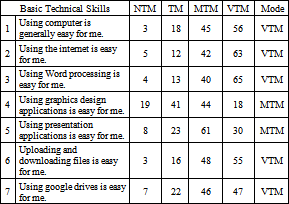
The table presents the basic technical Skills of the respondents. It is notable that most of our respondents are equipped with basic technical skills with their level of truancy as “most true of me” and “very true of me”. This implies that our teachers can work independently in their laptop, e.g., browsing, downloading and uploading, making presentations, and saving files online. Moreover, the table presents a unimodal result indicating that most of our respondents are at the same level of ability in terms of basic skills.
This result was complemented by the studies of references 6, 13, 14 when they underscored that the affordances of teachers on e-portfolio can also be discerned in the form of improving teachers’ technological skills through the assimilation process of ICT application.
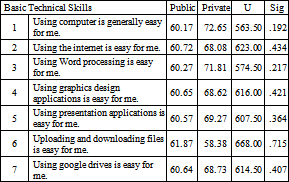
Table 3 presents the technical skills of the respondents when grouped by grade level taught. The test revealed that there is no significant difference on the respondents’ basic technical skills when grouped by grade level taught. Therefore, grade level taught has nothing to do with the respondents’ basic technical skills. This implies that elementary and secondary teachers’ affordances are comparable in terms of their basic technical skills in e-portfolio.
The foregoing results are similar to the findings of reference 16. Study results revealed that there was no significant difference on the perceived ICT competency among pre-service teachers according to gender and academic year or level. On the other hand, reference 15 concluded that the teachers from various bodies are of similar states in terms of ICTs usage skills.
Furthermore, studies also revealed that elementary school teachers have knowledge on the use of appropriate office and teaching productivity while secondary school teachers used computer to research, teach, plan and keep records 15, 16. On the other hand, the foregoing result contradicts the findings of reference 17 stating that the visual arts teacher-candidates' perceptions of innovation skills and their attitudes towards computer aided teaching are high. In addition, significant differences were found in computer aided teaching attitudes and innovation skills according to faculty type, grade level and gender.
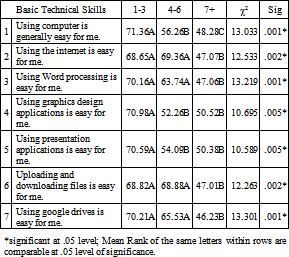
Table 4 presents the basic technical skills of the respondents when grouped by number of years in teaching. The test revealed significant difference. Therefore, number of years in teaching has something to do with the basic technical skills of the respondents. The results show that respondents who have less than four years in service have the highest affordance in basic technical skills when compared to other counterparts. In addition, teachers who have less than seven years in service are comparable and had better affordance in terms of browsing the internet, using Microsoft word, uploading and downloading files, and google drive when compared to respondents with more than seven years in service. Furthermore, teachers who spent more than three years in service are comparable and had lower affordances when compared to teachers who have less than three years in service in terms of using graphic designs and using presentation when compared to teachers who have less than four years in service. Therefore, number of years in teaching greatly affects the teachers’ basic technical skills while the younger teachers perform better with such skills.
The foregoing results were supported by reference 14, 15 when they concluded that respondents from the most recent academic year reported more experience with word processing than respondents from previous years in terms of word processing, database, and spreadsheet software. On the other hand, the foregoing result contradicts the findings of reference 18 who stated that there is growing concern over graduating trainee teachers’ insufficient level of Information and Communication Technology (ICT) literacy.
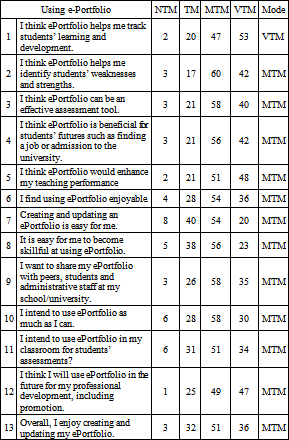
Table 5 presents the academic portfolio practices of the respondents. It can be inferred that the respondents practice the use of e-portfolio with their response, “Most True of Me”. This implies that the teacher-respondents are practicing e-portfolio in their respective fields. It can also inferred further that teachers enjoy creating and uploading their e-portfolios. The foregoing result was supported by the findings of reference 19 which stated that e-portfolio is the primary use of teachers and practitioners to develop their individual teaching skills and the learning of the students. The acceptance of these e-portfolio practices is directly and significantly affects their efficacy at work and professional development. This was also supported by references 20, 21 who stated that the use of e-portfolio benefited quite significantly the pre-service teachers in terms of their development as future teachers through five facets: (i) community of practice; (ii) professional learning and identity; (iii) relevant skills; (iv) resources; and (v) confidence. Graduates are better equipped for a lifetime of self-directed learning if taught to regulate their learning behaviors; to document, critically reflect on, and integrate their learning. Furthermore, given student mobility and the new culture of learning generated by webs information, e-portfolio is an avenue to foster collaborative, deep, and continuous learning.
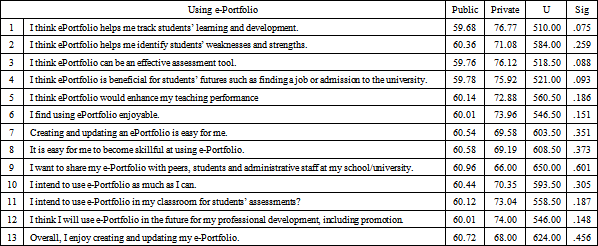
Table 6 presents the academic e-portfolio practices of the respondents when grouped by school affiliation. The result show that the practices of teachers in private and public-school regarding e-portfolio are comparable. This implies that both public and private schools practice e-portfolio in a comparable manner. The foregoing result is corroborated by the results of reference 22 stating that e-portfolio were practiced among k-12 teachers to enhance the required 21st century competencies. The seven private and public schools in UAE were supporting the hypothetical change in the practice of documentation by using e-portfolios. The results revealed that a substantial proportion of participants felt positively towards the possibility of using e-portfolios. However, the survey also revealed that the majority of teachers in the field need to acquire knowledge, associated skills, and competencies, through professional developmental training programs to cultivate and improve reflective, selective, organizational, constructive feedback skills, along with familiarity and proficiency in using online collaborative and professional networking tools.
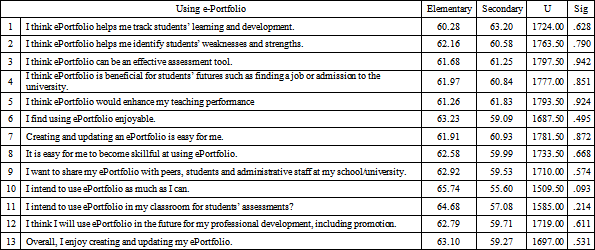
Table 7 presents the academic e-Portfolio practices of the respondents when grouped by grade level taught. The result posts no significant difference. Therefore, grade level taught has nothing to do with the e-portfolio practices of the teachers. This implies that teachers of different grade levels have the same e-portfolio practices. Hence, the respondents’ practices in e-portfolio are comparable. The foregoing result was supported by references 23, 24, 25 when they found that e-portfolio were practiced among k-12 teachers to enhance the required 21st century competencies and e-portfolio practices in high school influence goal setting and learning and a learning tool supporting reflection and individual progress assessment to develop pedagogical competencies within the framework of professional training of elementary school teachers for work in the constructive learning model. In addition, reference 25 stated that e-portfolio is for large groups as a tool for teaching, learning, assessment and self-assessment of student learning.
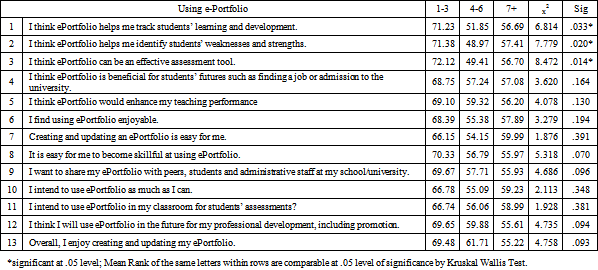
Table 8 presents the academic e-portfolio practices of the respondents when grouped by number of years in teaching. It is notable that there is a significant difference in the respondents e-portfolio practices. Teachers with less than four years in service had higher appreciation on e-portfolio in terms of tracking learners’ development, identifying weakness and strengths and effective assessment tool when compared to other counterparts. This implies that number of years in teaching has something to do with teachers academic e-portfolio practices. This is corroborated by the earlier findings of this paper which indicates that younger teachers had higher basic technical skills that is necessary in the creation and use of academic e-portfolio. Hence, the technical skills of the respondents affect their academic e-portfolio practices. The foregoing result contradicts the findings of references 18, 21, 25 who stated that there is a growing concern over graduating trainee teachers’ insufficient level of Information and Communication Technology (ICT) literacy and teaching experience is of utmost importance in the context of technology use in education.
Based on the foregoing results, the following are concluded: (1) the respondents have high affordances in terms of basic technical skills; (2) age group affects the basic technical skills of the respondents, teachers who have less than three years in service had higher basic technical skills compared to teachers who are more than four years in service; (3) the respondents practice e-portfolio in their respective fields most of the times; and (4) the respondents who have less than three years in service had higher affordance in academic e-portfolio practices compared to other counterparts. On the other hand, they have comparable results when grouped by school affiliation and grade level taught.
| [1] | Lim, J., Newby, T.J. (2020). Preservice teachers’ Web 2.0 experiences and perceptions on. Web 2.0 as a personal learning environment. Journal Computing in Higher Education, 32 (2) 234-260. | ||
| In article | View Article | ||
| [2] | Darling-Hammond, L. (2012). Evaluating teacher evaluation. Phi Delta Kappan, 93(6). | ||
| In article | View Article | ||
| [3] | Galimullina, E.Z., Ljubimova, E.M., Sharafeeva, L.R., & Ibatullin, R.R. (2017). Foresight requirements to the teacher on the verge of cognitive revolution. Man in India, 97, (22). 157-166. (in English). | ||
| In article | |||
| [4] | Aydin, C., Woge, M.G., & Verbeek, P.P. (2019). Technological Environmentality: Conceptualizing technology as a mediating milieu. Philosophy & Technology, 32, 321-338. | ||
| In article | View Article | ||
| [5] | Barrett, H.C. (2007). Researching electronic portfolios and learner engagement: The REFLECT initiative. Journal of Adolescent & Adult Literacy, 50(6), 436-449. | ||
| In article | View Article | ||
| [6] | De Jager, T. (2019). The impact of e-portfolios on science student teachers’ reflective metacognitive learning and the development of higher order thinking skills. Journal of University Teaching and Learning Practice, 16(3). | ||
| In article | View Article | ||
| [7] | Gugino, J. (2018). Using google docs to enhance the teacher work sample: Building e-portfolios for learning and practice. Journal of Special Education Technology, 33, (1), 54-65. | ||
| In article | View Article | ||
| [8] | Barbera, E. (2009). Mutual feedback in e-portfolio assessment: an approach to the netfolio system. British journal of educational technology, 40 (2), 342-357. | ||
| In article | View Article | ||
| [9] | Rico Martín, A. M. (2010). The portfolio in the teaching practices of the degree in teacher in primary education. Interuniversity electronic journal on the training of revista, 13 (3), 37-45. | ||
| In article | |||
| [10] | Alajm, M. M. (2019). The impact of e-portfolio use on the development of professional standards and life skills of students: A case study. Curriculum & Instruction Department, College of Education, Princess NourahBint Abdulrahman University, Riyadh, Saudi Arabia Entrepreneurship and Sustainability Issues 6 (4) 1714-1735. | ||
| In article | View Article | ||
| [11] | Parker, R. D. (2012). Critical theory: A reader for literary and cultural studies. Oxford University Press. 896. | ||
| In article | |||
| [12] | Babaee, M., Swabey, KJ., & Prosser, M (2014). A theoretical framework for use of e-portfolios: A combination of constructivism, SAL and the 3P model, Proceedings of IAC-ETeL 2014, 28 February - 1 March 2014, Prague, Czech Republic, pp. 1-8. | ||
| In article | |||
| [13] | Chuang, H.H. (2008). Perspectives and issues of the creation of weblog-based electronic portfolios in teacher education. British Journal of Educational Technology. 39(1), 170-174. | ||
| In article | |||
| [14] | Sardegna, V.G., & Dugartsyrenova, V.A. (2014). Pre-service foreign language teachers’ perspectives on learning with technology. Foreign Language Annals 47 (1), 147-167. | ||
| In article | View Article | ||
| [15] | Caluz et. Al. (2017). An Assessment of ICT Competencies of Public School Teachers: Basis for Community Extension Program. IOSR Journal Of Humanities And Social Science (IOSR-JHSS) 22(3), 01-13. | ||
| In article | View Article | ||
| [16] | Kisirkoi FK (2015). Integration of ICT in Education in a Secondary School in Kenya: A Case Study. Literacy Information and Computer Education Journal (LICEJ). 6(2). | ||
| In article | View Article | ||
| [17] | Kara. S. (2020). Prospective visual arts teachers’ innovation skills and attitudes towards computer assisted instruction. International Journal of Technology in Education and Science (IJTES), 4(2), 98-107. | ||
| In article | View Article | ||
| [18] | Markauskaite, L. (2017). Exploring the structure of trainee teachers’ ICT literacy: the main components of, and relationships between, general cognitive and technical capabilities. Education Tech Research Dev 55, 547-572 (2007). | ||
| In article | View Article | ||
| [19] | Kajder, S., & Parkes, K., (2012). Examining preservice teachers’ reflective practice within and across multimodal writing environments. Journal of Technology and Teacher Education. 20(3), 229-249. | ||
| In article | |||
| [20] | Kabilan, M. K. (2016). Using Facebook as an e-portfolio in enhancing pre-service teachers’ professional development. Australasian Journal of Educational Technology, 32(1). | ||
| In article | View Article | ||
| [21] | Tondeur, J., Valcke, M., & van Braak, J. (2008). A multidimensional approach to determinants of computer use in primary education: Teacher and school characteristics. Journal of Computer Assisted Learning, 24(6), 494-506. | ||
| In article | View Article | ||
| [22] | Pols, A.J. (2012). Characterizing affordances: The description-of-affordances-model. Design Studies 33 (2), 113-125. | ||
| In article | View Article | ||
| [23] | Tang, E. (2013). The reflective journey of pre-service ESL teachers: An analysis of interactive blog entries. Asia Pacific Education Researcher, 22(4), 449-457. | ||
| In article | View Article | ||
| [24] | Tondeur, J. (2008). The impact of primary school teachers’ educational beliefs on the classroom use of computers. Computers & education 51 (4), 1499-1509. | ||
| In article | View Article | ||
| [25] | Planas, G., Torres T., Garcia D., & Ramon, P., (2015). Using the e-portfolio for large groups of students. A: International Technology Education and Development Conference. “INTED2015 Proceedings”. Madrid: International Association of Technology, Education and Development (IATED), 2015, p. 1352-1360. | ||
| In article | |||
Published with license by Science and Education Publishing, Copyright © 2022 Fluther NG Ligado, Janice T. Palattao, Joan L. Gamis, Chairmaine C. Felix and Romiro G. Bautista
 This work is licensed under a Creative Commons Attribution 4.0 International License. To view a copy of this license, visit
http://creativecommons.org/licenses/by/4.0/
This work is licensed under a Creative Commons Attribution 4.0 International License. To view a copy of this license, visit
http://creativecommons.org/licenses/by/4.0/
| [1] | Lim, J., Newby, T.J. (2020). Preservice teachers’ Web 2.0 experiences and perceptions on. Web 2.0 as a personal learning environment. Journal Computing in Higher Education, 32 (2) 234-260. | ||
| In article | View Article | ||
| [2] | Darling-Hammond, L. (2012). Evaluating teacher evaluation. Phi Delta Kappan, 93(6). | ||
| In article | View Article | ||
| [3] | Galimullina, E.Z., Ljubimova, E.M., Sharafeeva, L.R., & Ibatullin, R.R. (2017). Foresight requirements to the teacher on the verge of cognitive revolution. Man in India, 97, (22). 157-166. (in English). | ||
| In article | |||
| [4] | Aydin, C., Woge, M.G., & Verbeek, P.P. (2019). Technological Environmentality: Conceptualizing technology as a mediating milieu. Philosophy & Technology, 32, 321-338. | ||
| In article | View Article | ||
| [5] | Barrett, H.C. (2007). Researching electronic portfolios and learner engagement: The REFLECT initiative. Journal of Adolescent & Adult Literacy, 50(6), 436-449. | ||
| In article | View Article | ||
| [6] | De Jager, T. (2019). The impact of e-portfolios on science student teachers’ reflective metacognitive learning and the development of higher order thinking skills. Journal of University Teaching and Learning Practice, 16(3). | ||
| In article | View Article | ||
| [7] | Gugino, J. (2018). Using google docs to enhance the teacher work sample: Building e-portfolios for learning and practice. Journal of Special Education Technology, 33, (1), 54-65. | ||
| In article | View Article | ||
| [8] | Barbera, E. (2009). Mutual feedback in e-portfolio assessment: an approach to the netfolio system. British journal of educational technology, 40 (2), 342-357. | ||
| In article | View Article | ||
| [9] | Rico Martín, A. M. (2010). The portfolio in the teaching practices of the degree in teacher in primary education. Interuniversity electronic journal on the training of revista, 13 (3), 37-45. | ||
| In article | |||
| [10] | Alajm, M. M. (2019). The impact of e-portfolio use on the development of professional standards and life skills of students: A case study. Curriculum & Instruction Department, College of Education, Princess NourahBint Abdulrahman University, Riyadh, Saudi Arabia Entrepreneurship and Sustainability Issues 6 (4) 1714-1735. | ||
| In article | View Article | ||
| [11] | Parker, R. D. (2012). Critical theory: A reader for literary and cultural studies. Oxford University Press. 896. | ||
| In article | |||
| [12] | Babaee, M., Swabey, KJ., & Prosser, M (2014). A theoretical framework for use of e-portfolios: A combination of constructivism, SAL and the 3P model, Proceedings of IAC-ETeL 2014, 28 February - 1 March 2014, Prague, Czech Republic, pp. 1-8. | ||
| In article | |||
| [13] | Chuang, H.H. (2008). Perspectives and issues of the creation of weblog-based electronic portfolios in teacher education. British Journal of Educational Technology. 39(1), 170-174. | ||
| In article | |||
| [14] | Sardegna, V.G., & Dugartsyrenova, V.A. (2014). Pre-service foreign language teachers’ perspectives on learning with technology. Foreign Language Annals 47 (1), 147-167. | ||
| In article | View Article | ||
| [15] | Caluz et. Al. (2017). An Assessment of ICT Competencies of Public School Teachers: Basis for Community Extension Program. IOSR Journal Of Humanities And Social Science (IOSR-JHSS) 22(3), 01-13. | ||
| In article | View Article | ||
| [16] | Kisirkoi FK (2015). Integration of ICT in Education in a Secondary School in Kenya: A Case Study. Literacy Information and Computer Education Journal (LICEJ). 6(2). | ||
| In article | View Article | ||
| [17] | Kara. S. (2020). Prospective visual arts teachers’ innovation skills and attitudes towards computer assisted instruction. International Journal of Technology in Education and Science (IJTES), 4(2), 98-107. | ||
| In article | View Article | ||
| [18] | Markauskaite, L. (2017). Exploring the structure of trainee teachers’ ICT literacy: the main components of, and relationships between, general cognitive and technical capabilities. Education Tech Research Dev 55, 547-572 (2007). | ||
| In article | View Article | ||
| [19] | Kajder, S., & Parkes, K., (2012). Examining preservice teachers’ reflective practice within and across multimodal writing environments. Journal of Technology and Teacher Education. 20(3), 229-249. | ||
| In article | |||
| [20] | Kabilan, M. K. (2016). Using Facebook as an e-portfolio in enhancing pre-service teachers’ professional development. Australasian Journal of Educational Technology, 32(1). | ||
| In article | View Article | ||
| [21] | Tondeur, J., Valcke, M., & van Braak, J. (2008). A multidimensional approach to determinants of computer use in primary education: Teacher and school characteristics. Journal of Computer Assisted Learning, 24(6), 494-506. | ||
| In article | View Article | ||
| [22] | Pols, A.J. (2012). Characterizing affordances: The description-of-affordances-model. Design Studies 33 (2), 113-125. | ||
| In article | View Article | ||
| [23] | Tang, E. (2013). The reflective journey of pre-service ESL teachers: An analysis of interactive blog entries. Asia Pacific Education Researcher, 22(4), 449-457. | ||
| In article | View Article | ||
| [24] | Tondeur, J. (2008). The impact of primary school teachers’ educational beliefs on the classroom use of computers. Computers & education 51 (4), 1499-1509. | ||
| In article | View Article | ||
| [25] | Planas, G., Torres T., Garcia D., & Ramon, P., (2015). Using the e-portfolio for large groups of students. A: International Technology Education and Development Conference. “INTED2015 Proceedings”. Madrid: International Association of Technology, Education and Development (IATED), 2015, p. 1352-1360. | ||
| In article | |||