Problem: Today, the official instructions signed by the authorities of the Congolese Ministry of Education introducing the Competency-based-Education (CbE) in the Congolese education system have remained a dead letter. All the more so as they give rise to various interpretations on the part of educational actors. Goals: (i) analyze the application of the CbE in the electricity option by teachers of optional courses (ii) Identify the logic that governs the design, construction and evaluation of the knowledge transmitted by teachers in the classes of electricity from the Salama Technical Institute through the skills-based approach. Methods and techniques: The survey method and direct observation technique were the tools for data collection, and content analysis was used for data processing. Participants: We had followed eight electricity teachers in their different lessons, and then there was sharing through the meetings of the teaching unit. Results: About the CbE design, the communication of learning sequence objectives to learners and the use of integration situations were not respected in the majority of lessons. For the transmission of knowledge in electricity to the Salama technical institute, the most used method is expo-interrogative and the work submitted to learners at the end of the learning sequences generally refers to the elements of the objective approach that those of the Competency-based-Education. The evaluation system applied in the electricity classes by the observed teachers does not use differentiated evaluation or integration situation, and even less remedial activities. Conclusion: Managers and supervisors of the Congolese education system must ensure the proper implementation of the CbE, which in view of the results struggles to apply especially in the electricity classes at the Salama Technical Institute. They must find ways and means to get teachers to change their forbidding attitude towards pedagogical innovations and to improve the organizational and pedagogical conditions of schools, necessary for the application of the CbE.
Nowadays, knowing no longer simply meant mastering observable and evaluable knowledge and know-how; to know is to be competent, which supposes being able to mobilize them in a relevant way in families of problem situations or families of complex tasks 1.
Knowing becomes showing proof of one's mastery of knowledge, skills and know-how expressed in observable, evaluable and measurable terms. Teaching therefore consists in applying the principles of mastery pedagogy. This states that anyone can learn whatever they want as long as you take the necessary time, take the learner into account and do it properly; By this expression, Bloom means that there is a logical sequence in the learning and that one should never move on to a new sequence if the learner does not master the objective of the previous sequence 2.
Teaching no longer simply means teaching basic knowledge and skills ("resources", to use a concept associated with the definition of competence), but creating situations conducive to learning how to mobilize resources 2.
The determination of a competency framework for a teaching unit or a course involves the analysis of the trades, the development of the objectives and the training content as well as the choice of instruments and conditions for the execution of the curriculum learning.
Electrical engineering education has been benefited by including experiential methodologies and competency-based learning at different levels 3.
According to the model known as the “competency-based-education” in the specific case of technical education, government objectives mainly aim to set up programs that are more flexible and adapted to the needs of the labor market. also to increase school attendance and success 4.
The CbE is part of the legal prescription that drives educational reforms and the teaching profession of today, ... and must enable them to gradually face the complexity of the world around them by wisely mobilizing knowledge and procedural skills to learn throughout their life, to lead a professional life and, ultimately, to exercise civic and social responsibilities 5.
CbE thus finds its applications in different components: curricula, textbooks, evaluation systems and teacher training. In this sense, does this methodological, pedagogical and didactic current represent a break in the paradigm compared to the so-called Objective-based-Learning (ObL) implemented in the 1960s in order to respond to the need to introduce more rigorous in training systems 5.
If the CbE has never overlooked knowledge, it has given rise to various interpretations, both among teachers and researchers, more particularly on the relative place it reserves for them 6.
It is a pedagogy based on the learner, his learning and the interdisciplinarity between general training associated with knowledge (mother tongue, mathematics, humanities and sciences) and professional training 4.
The historical evolution of the CbE is part of a context of social and economic changes characterized by restructuring of production sectors, by frequent renewal of professions and by changes in the forms and organization of work including the requirements go beyond the fragmentation of learning practiced in the OPP 5.
The CbE represents the new methodological and didactic current which opposes the pedagogy by objectives, also called the traditional teaching / learning approach which emerged in the 1960s following the translation of the works of Benjamin Bloom.
This is how the emergence of the CbE will be recognized as the response to these different requirements, because it takes advantage of the overstepping of the limits of the Objective-based-Learning by paying more attention to the realities and needs of learners and of the world 5.
In the 1980s, the reference to skills: [. ..] refers to a certain ability or potential to act effectively in a specific context. It is no longer the knowledge itself that matters, but the use that is made of it. The construction of competences allows individuals to mobilize, apply and integrate the knowledge acquired in diverse, complex and unpredictable situations 4.
According to De Ketele 1, to successfully implement CbE in the field, it is necessary to:
- validation of the tools (in particular the methodological guide, bank of integration and evaluation situations for terminal skills;
- effective training and support for the main players (trainers, inspectors and teachers);
- boosting the actions to be carried out (awareness raising, class visits, and follow-up).
Our goals can be summarized as:
1. Analyze the application of the CbE in the electricity option by teachers of optional courses;
2. Identify the logic that governs the design, construction and evaluation of the knowledge transmitted by teachers in the classes of electricity from the Salama Technical Institute through the skills-based approach.
1.2. Review of the Literature on the skills-Based Approach1. Obstacles that hinder the application of the competency-based approach by qualifying secondary school teachers, by Abdelali Arbia, et al. 7: wonders about the representations that teachers have of CbE and the impact of these on learning. One wonders, among other things, whether teachers are actually adopting this approach and whether they are actually applying it in their classroom practices. 300 Qualifying Secondary cycle teachers from several establishments of the Regional Academy of Education and Training of Fès-Boulemane in Morocco were questioned, and the results show that the main obstacles to the application of the CbE are four: (i) the low level of pupils; (ii) overloading of programs; (iii) the high number of pupils in the classes; (iv) the lack of teacher training in CbE. Almost half of teachers say that the objectives of applying the competency-based approach are not being met. Hence the need, in order to operationalize this approach, to act at all levels, namely learners, teachers and curricula.
2. Development Of Learning Competency Based Electricity in the Vocational High School, by Riana T. Mangesa 8 was based on producing a competency-based learning software engineering of electrical power installations that meet the category used in a valid and effective learning in the Vocational School. And results were: (i) the electrical field of competency-based learning is embodied in the implementation manual pembelaran and learning modules, (ii) devices that meet the criteria for effective learning and practical competency-based learning is used in the electrical field in the CMS, because the process active learning, learning objectives achieved so that individual students get an average value exceeds the value of working capital.
3. Skills and knowledge in science, by Denise Orange Ravachol and Christian Orange 6 presents a critical analysis of French legal prescriptions in the field of life and earth sciences. For the past ten years or so, France has also opted for CbE, skills being defined as "a set of values, knowledge, languages and practices". A priori, these changes appear to be in line with the socioconstructivist conceptions of learning advocated by didactic research: study of complex tasks, consideration of students 'strategies for solving these tasks, active mobilization of students' conceptions. The results highlight that CbE carries the risk of not clearly distinguishing "functional activities" and "work from problems scientists”. Finally, they indicate the confusion that exists between assessment and learning situations.
4. Competency Based Education: Best Practices and Implementation Strategies for Institutions of Higher Education 9: The purpose of his qualitative study was to explore the landscape of Competency-based-Education in institutions of higher education, and how these institutions have successfully implemented a new model into their existing structures. Interviews were conducted to explore the rationale, implementation strategies, and challenges at institutions involved in CbE. Interviews were conducted with ten professionals who held positions in administrative roles, faculty roles, and sometimes both roles simultaneously. The strategies in place for the implementation of this change at the institutions was analyzed through the lens of John Kotter’s (1985) 8-steps model for change implementation.
1.3. Theoretical Views on the Competency-based ApproachThe term competency is used in several contexts and has a range of meanings ascribed to it. As well, the literature reflects a debate about the nature of the concept of competency. In order to clarify and understand the origins of this controversy, it is first necessary to encapsulate relevant information related to the concept of “competency” and the “competency-based education” model 10.
The demonstrated ability to apply knowledge, skills and attitudes in order to successfully complete work activities to a defined standard of performance, as expected in a real-life workplace environment 11.
The notion of competence does not primarily belong to the world of school, but to the world of organizations, work and social interactions. It only becomes a pedagogical notion when we want to construct it deliberately, in didactic-type situations 4.
Conferring to Beckers 12, the term “competence” is defined as the ability of a subject to mobilize, in an integrated manner, quality internal resources (knowledge, know-how and attitudes), but also resources which are external to him, to face open situations, susceptible of different approaches, of plural solutions of which the degree of adequacy calls for a critical judgment.
For the authors, the establishment of standards demonstrates a strengthening of the link between economic imperatives and education. The skills are there to adapt to the labor market and to qualify the workforce. The use of the concept of competence is generalized in general education and "if the term competence today replaces that of knowledge, it is in particular to underline the inseparability of knowledge and its cognitive processing" 4.
The frequently used expression “Competency-based-Education” is ambiguous because it seems above all to evoke a methodology. It is to be used as a shortcut to characterize a change in aims, teaching objects, didactic approaches and evaluation practices, in short, a change in curriculum supposed to serve the equality of acquired knowledge deemed essential to development of everyone in their living environment 12.
Although much discussion has taken place on the topic of competency in workforce development and education, the concept of competency at university has centered on what is expected of a professional in the workplace rather than on the learning process. As such, one area of concern that provides scope for additional investigation is how to systematically link competencies to student learning outcomes or assessment of student learning 13. That is not our mater in this paper which concerns secondary school, but not university.
The definition of the words "skills-based approach" has several meanings, depending on the authors or research teams. Nevertheless, all are unanimous on the fact that it is about the mobilization of the knowledge of the learner to solve a complex situation.
In many ways, CbE may appear as a new wave of so-called "new" pedagogies. These began to emerge around the 1960s in North America, before spreading to a large number of European countries, first at preschool level and gradually spreading to primary and secondary schools 12.
Vincent Carette 14 defends the idea of CbE as learning to mobilize knowledge, a project he considers beneficial to educational work.
Although the concept and boundaries of CbE are frequently blurred, there is a general agreement that CbE is characterized by the development of clearly defined competencies, a mapping of the curriculum to achieve those competencies, and an assessment process matched to the competencies 15.
Educational delivery model that organizes content according to what a student knows and can do, often referred to as a “competency.” There is a focus on learning outcomes, rather than time spent in the classroom 9.
Jeonghyun Kim 13 clarified that such competencies are often linked to workforce needs, as defined by employers and the profession: i.e., specific knowledge, skills, and abilities (KSAs) valued by working practitioners in the field.
According to Marcel Crahay 16, “the CbE tackles a real problem - that of mobilizing knowledge in problem situations - but [it] offers a flawed solution”, and suggests returning to the notion of 'learning. He defends the idea that the vocabulary of skills comes from the business world and that it fits into a utilitarian perspective: "cognition is linked to action, itself finalized by a problem to be solved", knowledge being useful only in action.
Indeed, the approach first emanates from the theoretical work of Anglo-Saxon researchers in whom the theme of competency based education has emerged. This research, which was devoted to vocational training and served to establish the link between the achievements of adult training and work situations, will be gradually taken up in the school field 5.
According to De Ketele 2, three situation-based approaches (didactics, problems, projects) fall under the skills-based approach in the full sense of the term.
Another consideration looks at position that CbE is incompatible with an objective-based approach. If by this we mean that the CbE was born in reaction to the Objective-based-Learning and is incompatible with the behaviorist and technicist conception of the division into operational micro-objectives, we can only agree; our reasoning has clearly shown it. But to say that the CbE is incompatible with the concept of objective and therefore with an approach by objectives, that amounts to abusive generalization 2.
Levine, E. & Patrick, S. 17 described Revised Definition of CbE in 2019 like this:
Students are empowered daily to make important decisions about their learning experiences, how they will create and apply knowledge, and how they will demonstrate their learning.
Assessment is a meaningful, positive, and empowering learning experience for students that yields timely, relevant, and actionable evidence.
Students receive timely, differentiated support based on their individual learning needs.
Students progress based on evidence of mastery, not seat time.
Students learn actively using different pathways and varied pacing.
Strategies to ensure equity for all students are embedded in the culture, structure, and pedagogy of schools and education systems.
Rigorous, common expectations for learning (knowledge, skills, and dispositions) are explicit, transparent, measurable, and transferable.
Competency-based education, as an approach, is an intentionally designed program through which students acquire knowledge, build skills and demonstrate mastery of competencies. Scholar learning is at the core of this approach. CbE programs are designed in all kinds of ways. On the whole, CbE might be agnostic to the details of how knowledge is acquired (for example, CbE programs could be course-based or project-based, they could rely heavily on open educational resources, or they could encourage independent learning through experiences), but a specific CbE program is designed a certain way for a reason. CbE programs might employ PLA (Prior learning assessment) to determine the knowledge, skills and abilities with which students enter a program—in similar fashion to a traditional educational approach 18.
Sara Elizabeth Kellogg 9 described that CbE differs from traditional education in several ways. The table below shows a comparison between traditional education that many have experienced in the U.S. education system and CbE.
In the same line, Strategy-labs 18 matched Competency-based-Education and Traditional Education and considered basics elements of comparison, as is shows in the followed table
In 2011, Sturgis and Casey 19 described that 100 innovators in competency education came together for the first time. At that meeting, participants finetuned a working definition of high-quality competency education:
1) Students advance upon demonstrated mastery. By advancing upon demonstrated mastery rather than on seat time, students are more engaged and motivated, and educators can direct their efforts to where students need the most help.
2) Competencies include explicit, measurable, transferable learning objectives that empower students. With clear, transparent learning objectives, students have greater ownership over their education.
3) Assessment is meaningful and a positive learning experience for students. New systems of assessments give students real-time information on their progress and provide the opportunity to show evidence of higher order skills, whenever they are ready, rather than at set points in time during the school year.
4) Students receive timely, differentiated support based on their individual learning needs. Students receive the supports and flexibility they need, when they need them, to learn, thrive and master the competencies they will need to succeed.
5) Learning outcomes emphasize competencies that include application and creation of knowledge, along with the development of important skills and dispositions. Personalized, competency-based learning models meet each student where they are to build the knowledge, skills and abilities they will need to succeed in postsecondary education, in an ever-changing workplace and in civic life.
De Villers and Desagher 14 list some utilitarian concepts in the use of the skills-based approach. These include:
1° competence: ability to apply an organized set of knowledge, skills and attitudes to accomplish a certain number of tasks;
2° bases of skills: reference system presenting in a structured manner the basic skills to be exercised until the end of the first eight years of compulsory education and those which must be mastered at the end of each of these stages because they are considered necessary for social integration and the pursuit of studies; (…)
3° terminal skills: framework presenting in a structured manner the skills whose mastery at a given level is expected at the end of secondary education;
4° disciplinary skills: reference system presenting in a structured manner the skills to be acquired in a school subject;
5° transversal skills: attitudes, mental approaches and methodological approaches common to the various disciplines to be acquired and implemented during the development of the various knowledge and skills; their mastery aims at increasing student autonomy in learning;
6° formative evaluation: evaluation carried out during the activity and aimed at assessing the progress made by the pupil and understanding the nature of the difficulties he encounters during learning; its goal is to improve, correct or readjust the student's progress; it is based in part on self-assessment;
7° summative tests: tests located at the end of a learning sequence and aimed at establishing the assessment of student achievement;
8° differentiated pedagogy: teaching approach which consists in varying the methods to take into account the heterogeneity of the classes as well as the diversity of the methods and the learning needs of the students; (…)”.
This list should be completed with the following expressions to clarify the understanding of the competency-based approach 2:
a) The situational approach (Sa) is centered on scenarios. These have different foundations and can take different forms. We think we can identify three categories: approaches by didactic situations (DS); problem-based-leaning (Pbl) and project-based-leaning (Pbl).
b) the training-based-leaning (Tbl): Popularized by some university training, the problem-based approach offers not simple applications (see definition above) but real problems, that is to say (1) contextualized situations (case, natural or simulated situation, etc.), (2) asking a question to be solved or an obstacle to be overcome or a gap to be filled between an expected situation and a real situation, (3) for which the student or the student does not yet have everything necessary to resolve the question or overcome the obstacle or reduce the gap.
c) the project-based-leaning (Pbl): Popularized by active pedagogy movements (Dewey, Freinet, Decroly, etc.) and currently by certain university courses, the approach by projects is based on problems of greater magnitude and which involves the following characteristics: (1) the design, the realization of a product, the management of long-term activities, the demonstration and the understanding of the (good) functioning of the "product"; (2) necessarily interdisciplinary work; (3) an "unprecedented possible" approach (an unprecedented achievement and approach, initially perceived as difficult, but nevertheless possible and gradually perceived as such).
d) The application-based-leaning (AbL) leaves much more room for the activity of the student or trainee. It is focused on the application (not to be confused with the problem): it submits to the learner statements that require the putting into practice of a principle or a rule or an algorithm or an approach (solve a quadratic equation; respect the rules of the past participle chord…). Teaching practices take the form of exercise sequences. This is an educational paradigm that could best be described as "pedocentric". Observation shows that application-based-leaning is often associated sequentially.
Strategy-labs 18 indicated that as states and institutions communicate about competency-based education, they should:
• Use multiple pathways and messages;
• Know the audience and meet them where they are;
• Anticipate questions and prepare responses ahead of time;
• Rely on lessons learned and publicly available sources to help craft messages;
• Provide specific examples;
• Keep communication simple and avoid jargon, but look for ways to make it fun;
• Repeat, repeat, repeat; and
• Practice.
Indeed, the basic thought about CbE comes from socioconstructivism, which originates from the ideas of the cognitive social approach defended by Rotter J. (1916-1914) and Bandura (1986). Socio-constructivism fills the shortcomings attributed to behaviorist and constructivist theories by favoring the consideration of interactions, exchanges and co-development in learning activities.
It therefore seems that the CbE is linked to a pedagogy centered on the student and his learning. Constructivism is then presented as the only educational environment, even if the NCTM does not explicitly adhere to it, it uses a language and advocates a learning model which is claimed by constructivism, which it supports 4.
This vision integrates the aspect of the thought of the learner, his classmates, the social environment and even his cultural realities. This paradigm takes into account the following three elements:
• The constructivist dimension referring to the learning subject;
• The social dimension which refers to the partners present who are the teachers and the other classmates;
• The interactive dimension which refers to the environment.
In addition, he introduced the notion of the proximal development zone, which he sees as the gap between what the individual is able to achieve intellectually on his own at a point in his career and what he would be able to achieve mediation of others.
For him, interactions have a structuring effect by causing the learner to reorganize his previous knowledge in order to integrate the new elements brought by the situation.
According to Schuman 10, constructivism is based on the idea that individuals construct their own perceptions and perspectives of the world from both previous and ongoing individual experiences and circumstances. This adaptability and flexibility prepares the learner to solve problems in new and unpredictable situations.
Socio-constructivism is a paradigm that emphasizes the relational dimension of learning. Partly from constructivism, socioconstructivism adds the dimension of contact with others in order to build knowledge. Socioconstructivism also calls into question certain principles of cognitivism, centered on individual mechanisms, and updates theoretical approaches that place more emphasis on the social dimensions in the formation of skills. The building of knowledge, although personal, takes place in a social framework. The information is related to the social environment, the cultural context and comes both from what one thinks and from what others bring as interactions.
For Boissonnade 20, the socio-constructivist framework, largely inspired by Vygotskian thought, but also in part from the Piagetian approach, assumes that interactions, supervisory or collaborative, as well as the material and instrumental environment, are levers for change the child's thinking.
In didactics, we will say that the learner develops his understanding of reality by comparing his perceptions with those of his peers and the teacher. Socio-constructivism is a model of teaching and learning for which three didactic elements are inseparable to allow progress:
1. The constructivist dimension which refers to the subject who is learning: the student;
2. The social dimension which refers to the partners present: the other students and the teaching team;
3. The interactive dimension which refers to the environment: the situations and the learning object organized within these situations. The object of the proposed learning is the teaching content.
Socioconstructivism introduced the dimension of the influence of the outside world on the development of skills. Beyond the relationship to knowledge, the integration of the environmental and social dimension is the basis of our interest in this paradigm, because the version of the skills-based approach adopted by our system gives pride of place to the learner's environmental data that influence learning.
a) Lesson design
The design of the lesson in CbE should be based on three appropriate teaching tools, without which the CbE cannot be applied in the classroom. It is:
- The skills framework
- The program
- Student books
- Educational guides
Depending on the version of the CbE adopted by a system, the lesson design has nuances, nevertheless in the version of the CbE, the teacher is called upon to design or choose the problem situations to be submitted to the pupils, to be foreseen; the learning tasks and the most appropriate modalities for carrying out the assessment of prior learning.
b) Knowledge transfer
However, we must recognize that a theory of complex learning is still lacking, while classical approaches (APT and APA) can be based on learning theories such as associationist theories and theories of memory 2.
c) Assessment of acquired knowledge
The evaluation of learning focuses on two dimensions: the verification of mastery of essential knowledge and the verification of the student's competence 2
Kim 13 testified that The University of North Texas Department of Library and Information Sciences recently developed and implemented a digital curation curriculum based on a competency-based approach according to the following three phases:
1. Identifying competencies;
2. Linking competencies to courses; and
3. Assessing competencies in curriculum.
The Assessment and Certification Council of Kenya Republic 21 recommended the followed Delivery and Assessment Methods of CbE in for electrical installation.
Competencies are classified into: (a) technical/professional competencies; and (b) transversal/general competencies (skills and attitudes the individual is expected to display while performing tasks), which are also coined as life skills/ core work skills/soft skills/employability skills, etc. They are important for specific occupations, but also for strengthening labour mobility 11.
The electricity training repository in the Congolese education system can be summarized in the table below.
The Assessment and Certification Council of Kenya Republic 21 instructed this main units of learning for electrical installation.
Council for Technical Education and Vocational Training 22 noted that after completion of training the trainees in electricity will be able to:
1. State the concept of electricity;
2. Perform basic calculation;
3. Apply electrical instruments for measuring resistance, voltage, current and power;
4. Identify and interpret electrical symbols and codes;
5. Install and connect accessories, fittings, protective devices and distribution board;
6. Install and control various pattern of wiring system;
7. Install and connect earthing electrode;
8. Repair and replace components of damaged wiring system;
9. Control/install electricity generation in three phase;
10. Carryout a complete wiring system;
11. Apply simple mathematical technique related occupation;
12. Be familiar with First Aid and HIV/AIDS;
13. Be familiar with occupational health and apply safe working technique;
14. Apply Communication and Small Enterprise Development skills.
We carried out our investigations at the Salama Technical Institute which is located at Lubumbashi tow in Democratic Republic of the Congo. Currently, it organizes 6 sections: electricity, electronics, printing, general mechanics, machine-tool mechanics, long cycle and professional automobile mechanics; and produces 300 technicians with a baccalaureate on average each year. In order to complete the vocational training given to students, the school has initiated since 2012 the 7th year of professionalization in all sections.
From a historical point of view, the Salama Don Bosco Technical Institute opened its doors on October 11, 1955 under the name of the Official Vocational School of profession Don Bosco. 92 young people were accommodated in the three sections of the school, namely car mechanics, carpentry and masonry.
During the Zairianization, the school took the name of "Salama Professional Technical Institute", in the idea of the managers at the time; the school should remain a place of peace, a school where one feels at home.
To date, the school is engaged in the construction of the boarding school, the acquisition of new school buses for the transport of its students in addition to the only one it has, the modernization of the workshops and the maintenance of the infrastructure. She appeals to all those who have gone through this school, to all those who love and believe in the training that this school gives, which in reality has few competitors on the national level to support the realization of these projects.
Being in the field in the electricity classes at the Salama Technical Institute, we found that the lessons were given as usual. That is to say on a logic of the Objective-based-Learning notwithstanding the instructions instructing to integrate the CbE in the lessons and the multiple training sessions to which the teachers have been subjected, they have remained in their old practices with regard to the knowledge transfer to their students. All educational innovation and reform are designed to boost the quality of teaching by pushing teachers to improve their performance. This attitude seems paradoxical, hence the interest of this study.
Scientific instruments helped us to collect data, analyse it and find interpretations in the light of proven theories. The survey method and direct observation technique were the tools for data collection, and content analysis was used for data processing.
We had followed eight teachers of electricity in their various teachings and then there was sharing through the meetings of the teaching unit. Two months was the maximum time to which we had devoted this work. Either from October to December 2019 for two sessions per week.
Three followed thematics were observed on eight electricity teachers’ at Salama Technical Institute: a) lesson designs’ indicators; b) Indicators of knowledge transmissions' and; c) Indicators of acquired knowledge Assessment.
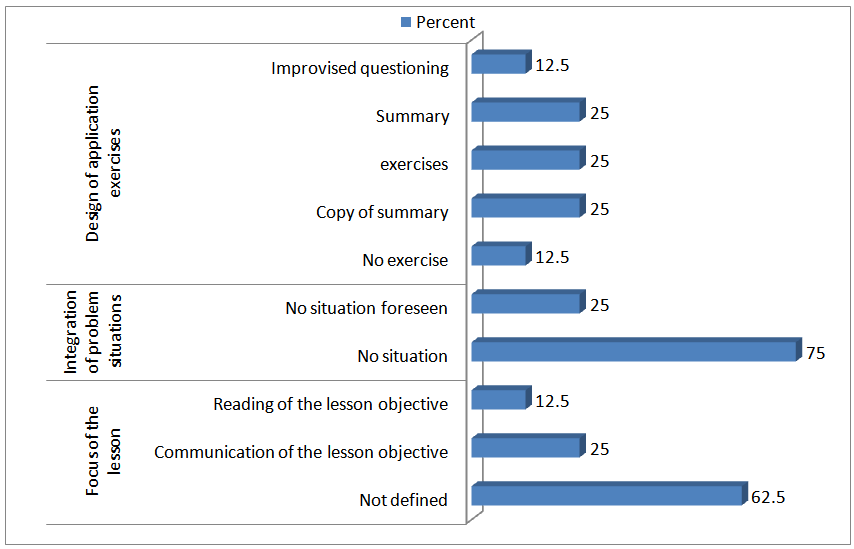
3.1. Lesson DesignThree indicators were analysed: (i) Focus of the lesson, (ii) Integration of problem situations and (iii) Design of application exercises (Summary or not, Exercises or not, and questioning) which are report in the tracked graphic.
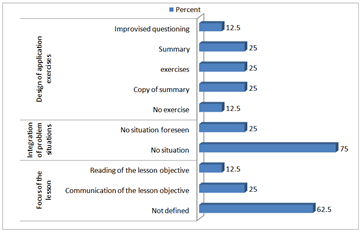
In electricity optional courses at Salama Technical Institute, results showed that the first indicator concerning the focus of the lesson was not defined (62,5%) for many teachers, and focus of the lesson was the communication of the lesson objective for 25%, but only for 12,5%, focus of the lesson was the reading of the lesson objective.
About the second indicator, items demonstrated that, in electricity optional courses at Salama Technical Institute, all teachers were no integrated situations problem (75% of no situation and 25% of No situation foreseen).
And the last indicator showed that, in electricity optional courses at Salama Technical Institute, teachers’ exercises Design application were 25% based on Summary, Copy of summary, or doing exercises, 12,5% based on Improvised questioning or No exercise.
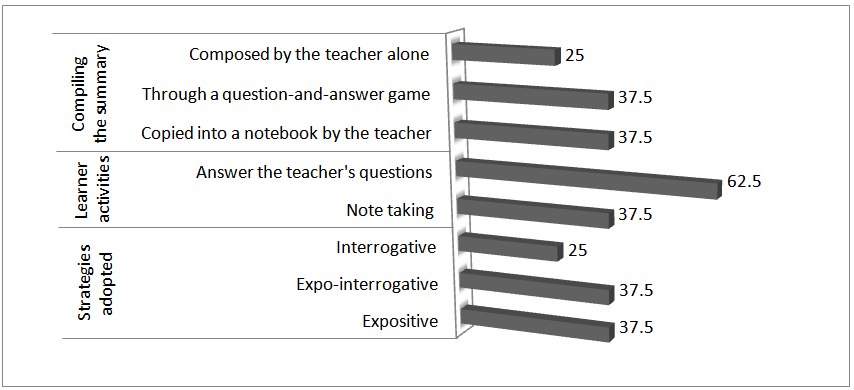
3.2. Transmission of KnowledgeThree indicators were analysed: (i) Strategies adopted (Expositive, Interrogative and Expo-interrogative), (ii) learner activities (note taking and answer the teacher's questions) as well as (iii) compiling the summary (copied into a notebook by the teacher, through a question-and-answer game, and composed by the teacher alone) which are report in the followed graphic.
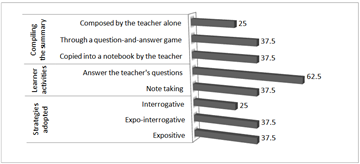
The knowledge transmission’s in electricity optional courses at Salama Technical Institute, the strategies used by teachers vary between expositive (37,5%), expo-interrogative (37,5%), interrogative (25,0%) methods; about learner activities indicator, we discovery 62,5% of Answer the teacher's questions and 37,5% of Note taking.
At last, the compiling the summary indicator, showed that students, in electricity optional courses at Salama Technical Institute, copied into a notebook by the teacher (37,5%), through a question-and-answer game (37,5%) or composed by the teacher alone (25,0%).
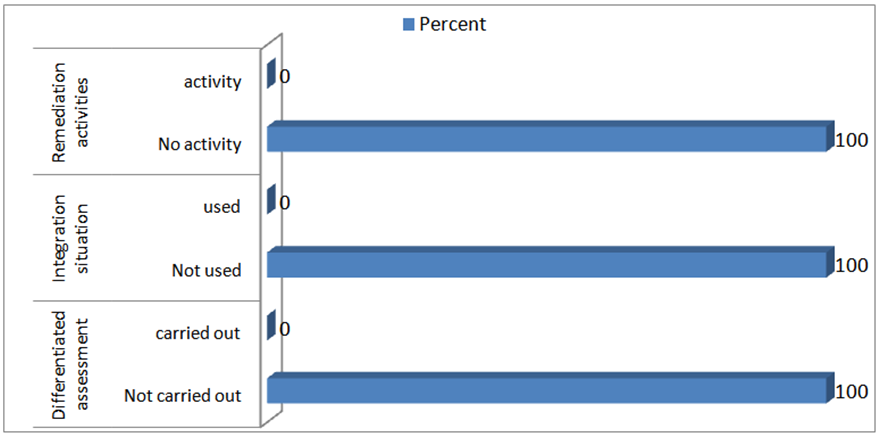
3.3. Assessment of Acquired KnowledgeThree indicators were analysed: (i) Differentiated assessment (carried out or not), (ii) Integration situation (used or not) as well as (iii) Remediation activities (activity or not) which are report in the followed graphic.
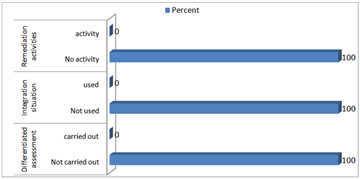
The result on acquired knowledge assessment, in electricity optional courses at Salama Technical Institute, detailed not carried out about differentiated assessment, not used of integration situation and no remediation activities used.
Concerning the results about lesson designs’ indicators, let remembered that the focus of the lesson was not defined for 62,5% of eight electricity teachers’ at Salama Technical Institute, all teachers were no integrated situations problem and teachers’ exercises Design application were 25% based on Summary.
The teacher, by introducing the session, makes sure that the instructions are understood, he begins with a few questions oriented towards the subsequent lesson. He begins to solve the activity, referring to the necessary help tools suggested by the situations to be exploited.
Yet, the CbE requires the following steps:
The teacher introduces the activity by
1) Provide learners with a series of questions that prompt them to think about how to participate in the lesson and how to communicate;
2) The learners suggest activities to be carried out;
3) Constructive discussions on the various proposals regarding their originality, their feasibility, the possible difficulties and the resources necessary to mobilize and justify their different choices;
4) They specify the knowledge to be mobilized;
5) They break up into working groups to carry out the activities selected.
All of its activities are carried out under the supervision and collaboration of the teacher.
The results are not corroborated by Levine, E. & Patrick, S. 17 for who with CbE, Students progress based on evidence of mastery, not seat time and Strategies to ensure equity for all students are embedded in the culture, structure, and pedagogy of schools and education systems.
4.2. Indicators of Knowledge Transmissions'Regarding the results about indicators of knowledge transmissions', let call to mind that the knowledge transmission’s in electricity optional courses at Salama Technical Institute were mostly expo-interrogative methods (37,5%), 62,5% of Answer the teacher's questions, and students, the summary indicator is copied into a notebook by the teacher (37,5%).
Even if the Assessment and Certification Council of Kenya Republic 21 suggested Delivery Methods, we find that during the lesson activity, the teacher draws the learners' attention to the mistakes made, corrects a few statements, and responds to requests. When the time comes, he ends the activity. We read the statements obtained, we comment on them and correct them, and then we put the work away.
All students do the same thing under the same conditions according to a single instruction decided by the teacher. The situation is exclusively academic, that is to say, targeting only a very sharp disciplinary micro-competence.
However, the CbE requires the following steps:
1) He coordinates the smooth running and progress of the work.
2) He manages time, reminds him often.
3) It helps, guides, provides help tools,
4) He may intervene in the event of a conflict and proceed to immediate and ad hoc regulations.
5) It records the shortcomings which require a subsequent more substantial remediation.
Concerning the work completed:
1) They are presented by their authors, commented on and corrected by the other groups.
2) The clean-up, which is a very important step, is taken care of by each group which can carry out this work either at school during a subsequent session or outside the school: the pupils organize freely but are subject to a contract fixing the date of delivery of the work and the methods of presentation.
3) The finalization of the work results in their posting in class, in the courtyard, their publication in the school newspaper and other ...
The results are not corroborated by Levine, E. & Patrick, S. 17 for who with CbE, Students are empowered daily to make important decisions about their learning experiences, how they will create and apply knowledge, and how they will demonstrate their learning, Students receive timely, differentiated support based on their individual learning needs, Students learn actively using different pathways and varied pacing.
4.3. Indicators of Acquired Knowledge AssessmentRegarding the results about indicators of acquired knowledge Assessment, let evoked that in electricity optional courses at Salama Technical Institute, detailed not carried out about differentiated assessment, not used of integration situation and no remediation activities used.
Although the Assessment and Certification Council of Kenya Republic 21 suggested Assessment Methods that must follow, we discovery at Salama Technical Institute that the exercises are kept in the students' notebooks; and if the whole class has passed the suggested exercise, the teacher writes an assessment on the notebook or assigns a mark and programs another objective for the next day. If a large number of students do not pass the exercise, the teacher schedules a review and continues to achieve the goals already planned for the following day.
However, the CbE requires the following steps:
i. Initiation of remedial activities in the event of identification of gaps related to the lack of mastery of learning, Thus, the skill and its abilities become tools for appropriating the disciplinary content in order to carry out tasks. It is therefore not only a matter of teaching disciplinary content, but also the skills to effectively use this declarative knowledge related to the content. In addition, these skills will not be learned in a piecemeal fashion, but integrated into a skill. The idea of competence denotes the desire to initiate from school the development of complex skills that will be essential to the individual's subsequent adaptation to a changing environment.
ii. The skills-based approach must aim to fight against the fragmentation of learning as it is implemented in the strategies of pedagogy by objectives by giving them a visible purpose, while maintaining the objectives of mastering fundamental knowledge.
iii. This learning approach makes it possible to develop oral and written disciplinary skills to the extent that knowledge and skills are mobilized and integrated to resolve a significant problem situation. This learning strategy also contributes to the development of transversal skills such as working in cooperation (with peers); implement a working method (search for an appropriate approach to carrying out the requested task) and exercise critical thinking (during the debate around the first proposals). The productions are varied; the pupils are totally involved in the work.
The results are not corroborated by Levine, E. & Patrick, S. 17 for who with CbE, Assessment is a meaningful, positive, and empowering learning experience for students that yields timely, relevant, and actionable evidence and Rigorous, common expectations for learning (knowledge, skills, and dispositions) are explicit, transparent, measurable, and transferable.
In view of the results found, there is reason to wonder about the difficulties of implementing the CbE in the Congolese education system. This leads us to formulate several questions which may constitute subjects for much more in-depth reflection in future studies.
Does the educational organization of the Congolese education system allow the CbE to be able to establish itself in the long term? Because it requires that each learner has their own workstation, flexible hours, company visits, work placements and modular apprenticeships? Also, it is necessary to know if the teachers are not in a forbidding attitude towards the novelty?
Moreover, are the managers and supervisors of the Congolese education system sufficiently equipped to support teachers in the application of this innovation that is the CbE? Recall that our sample was 8 teachers, so this requires much more in-depth and generalized studies to answer the above questions.
In view of the results obtained, it is clear that the competency-based approach is an approach that has remained in the official instructions signed by the authorities of the Ministry of Education. Another reality is recorded in the classrooms where the lessons take place without taking into account the data of the new reform.
It is still the objective or rather content approach that continues to apply in the electricity classes at the Salama Technical Institute.
In his pedagogical approaches, the teacher's leitmotif remains the desire to complete the program without being unduly concerned with the mastery of the concepts learned in terms of knowledge, know-how, and attitudes and even less the reinvestment of concepts learned.
This state of affairs is the result of the junction of the organizational problems of the system and the training of the pedagogical actors concerned.
Indeed, the electricity classes in this school are overcrowded (over 80 students), the organization of learning time does not relate to the new approach, (the learning sequences are partitioned into a period 50 '); competency frameworks and textbooks are not always available at school.
Regarding the training of actors, neither school heads nor teachers received capacity building sessions to understand and subsequently put into practice this approach.
Let us recall here that the CbE is not a panacea, capable of reaching the end, on its own, of all the difficulties that plague our classes in particular and our system in general, but its intelligent application alongside other approaches could solve the problem of employability of the output of the system.
Despite the government decisions which impose its establishment in the classes, especially those of technical option, the capacity building training in this area, the monitoring of the public authority and the support of the technical and financial partners of the education system, the results found sufficiently demonstrate that the CbE is neither mastered nor applied in the classes.
So Managers and supervisors of the Congolese education system must ensure the proper implementation of the CbE, which in view of the results struggles to apply especially in the electricity classes at the Salama Technical Institute. They must find ways and means to get teachers to change their forbidding attitude towards pedagogical innovations and to improve the organizational and pedagogical conditions of schools, necessary for the application of the CbE.
| [1] | De Ketele, J.-M. Mise en œuvre de l’APC dans l’élaboration des curricula. Paris: Conférences données à Fès (9-2-05) & Rabat (11-02-05)., 2005. | ||
| In article | |||
| [2] | L’approche par compétences : au-delà du débat d’idées, un besoin et une nécessité d’agir. De Ketele, Jean-Marie. Paris: L’harmattan, 2009, In M. Ettayebi, P. Jonnaert et R. Opertti. Logique de comprendre et développement curriculaire débats perspectives et alternatives pour les systèmes éducatifs, pp. pp.61-78. | ||
| In article | |||
| [3] | “Comparing Competency Assessment in Electronics Engineering Education with and without Industry Training Partner by Challenge-Based Learning Oriented to Sustainable Development Goals”. In. Dieck-Assad, G., Ávila-Ortega, A. and González Peña, O.I. [ed.] Sustainability. 13, 2021, Electronics Engineering Education with and without Industry Training Partner by Challenge-Based Learning Oriented to Sustainable Development Goals”. In . ,. 10721. | ||
| In article | View Article | ||
| [4] | Arpin, Rober. “Approche par compétences: l'enseignement des mathématiques a-t-il un avenir dans les programmes d'études techniques au collégial?”. Montréal: Mémoire de maîtrise en mathématiques. Université du Québec à Montréal, 2007. | ||
| In article | |||
| [5] | Iramène, Destin. “L’approche par compétences en contextes scolaires francophones : quels enjeux contextuels dans le cas d’Haïti et du Burkina Faso?”. Thèse en Sciences de l’Education. Paris: Université Sorbonne, 2017. | ||
| In article | |||
| [6] | “La place des savoirs dans l’approche par compétences”. Simons, Germain. 2014, Education & Formation, pp. e-302. | ||
| In article | |||
| [7] | “Les obstacles qui entravent l’application de l’approche par compétences par les enseignants du secondaire qualifiant”. Abdelali Arbia, Fatiha Kaddari, Rida Hajji Hour et Abdelrhani Elachqar. 4, 2018, European Scientific Journal, Vol. 14. | ||
| In article | View Article | ||
| [8] | “Development Of Learning Competency Based Electricity in the Vocational High School”. Mangesa, Riana Tangkin. 2015, www.uny.ac.id. | ||
| In article | |||
| [9] | “Competency Based Education: Best Practices and Implementation Strategies for Institutions of Higher Education”. Doctorate in Education. Kellogg, Sara Elizabeth. 2018, Concordia University St. Paul. 3. https://digitalcommons.csp.edu/edd/3. | ||
| In article | |||
| [10] | Ramirez, Nelida. “The challenges and opportunities of using a competency based education model in social work education”. Doctor in Social Work. Saskatchewan: University of Regina, 2012. | ||
| In article | |||
| [11] | ILO. “Competency-Based Training (CBT): An Introductory Manual for Practitioners”. Geneva: The International Labour Office, 2020. | ||
| In article | |||
| [12] | “Contribuer en communauté française de Belgique à une approche par compétences qui réduirait les inégalités d’apprentissage”. Beckers, Jacqueline. 30, 2011, Bulletin du Centre interfacultaire de formation des enseignants. | ||
| In article | |||
| [13] | Competency-based Curriculum: An Effective Approach to Digital Curation Education. Kim, Jeonghyun. 4, 2015, Journal Of Education For Library And Information Science, Vol. 56. | ||
| In article | View Article | ||
| [14] | “Les dédales de l’approche par compétence (APC). Premier volet: clé de lecture”. De Villers, Johanna et Desagher, Christophe. Bruxelles: s.n., 2015, Fédération des Associations de Parents de l’Enseignement Officiel. | ||
| In article | |||
| [15] | Defining and assessing learning: Exploring competency-based initiatives. Jones, E., Voorhees, R., & Paulson, K. Washington, DC: s.n., 2002, Council of the National Postsecondary Education Cooperative. | ||
| In article | |||
| [16] | “Dangers, incertitudes et incomplétude de la logique de la compétence en éducation”. Crahay, M. 154, 2006, Revue française de pédagogie, pp. 97-110. | ||
| In article | View Article | ||
| [17] | Levine, E. and Patrick, S. What is competency-based education? An updated definition. Vienna: Aurora Institute, 2019. | ||
| In article | |||
| [18] | Understanding Competency-based education. State Policy to Increase Higher Education Attainment. Strategy-labs. 2021, StrategyLabs.LuminaFoundation.org. | ||
| In article | |||
| [19] | Sturgis, C. and Casey, K. Quality Principles for Competency-Based Education. Vienna: INACOL, 2018. | ||
| In article | |||
| [20] | “Apprendre et raisonner: approche développementale et socio-cognitive du rôle des situations collectives et individuelles d’apprentissage”. Boissonnade, R. [ed.] Université de Neuchâtel et Université Toulouse 2-Le Mirail. Neuchâtel et Toulouse. 2011, Thèse en co-tutelle en Sciences humaines et en Psychologie. | ||
| In article | |||
| [21] | TVET-CDACC. “Competency-based curriculum for electrical installation. Level 3”. Nairobi: TVET Curriculum Development, Assessment and Certification Council. Republic of Kenya, 2018. | ||
| In article | |||
| [22] | CTEVT. Curriculum for Building Electrician (A Competency Based, Short-term Curriculum). Curriculum development division. Sanothimi, Bhaktapur: Council for Technical Education and Vocational Training., 2008. | ||
| In article | |||
| [23] | “L’accès aux compétences est-il plus (ini) équitable que l’accès aux savoirs traditionnels?”. Letor, C. & Vandenberghe, V. 25, 2003, Cahier de recherche du GIRSEF. | ||
| In article | |||
Published with license by Science and Education Publishing, Copyright © 2022 Christian Kabongo Malonda
 This work is licensed under a Creative Commons Attribution 4.0 International License. To view a copy of this license, visit
http://creativecommons.org/licenses/by/4.0/
This work is licensed under a Creative Commons Attribution 4.0 International License. To view a copy of this license, visit
http://creativecommons.org/licenses/by/4.0/
| [1] | De Ketele, J.-M. Mise en œuvre de l’APC dans l’élaboration des curricula. Paris: Conférences données à Fès (9-2-05) & Rabat (11-02-05)., 2005. | ||
| In article | |||
| [2] | L’approche par compétences : au-delà du débat d’idées, un besoin et une nécessité d’agir. De Ketele, Jean-Marie. Paris: L’harmattan, 2009, In M. Ettayebi, P. Jonnaert et R. Opertti. Logique de comprendre et développement curriculaire débats perspectives et alternatives pour les systèmes éducatifs, pp. pp.61-78. | ||
| In article | |||
| [3] | “Comparing Competency Assessment in Electronics Engineering Education with and without Industry Training Partner by Challenge-Based Learning Oriented to Sustainable Development Goals”. In. Dieck-Assad, G., Ávila-Ortega, A. and González Peña, O.I. [ed.] Sustainability. 13, 2021, Electronics Engineering Education with and without Industry Training Partner by Challenge-Based Learning Oriented to Sustainable Development Goals”. In . ,. 10721. | ||
| In article | View Article | ||
| [4] | Arpin, Rober. “Approche par compétences: l'enseignement des mathématiques a-t-il un avenir dans les programmes d'études techniques au collégial?”. Montréal: Mémoire de maîtrise en mathématiques. Université du Québec à Montréal, 2007. | ||
| In article | |||
| [5] | Iramène, Destin. “L’approche par compétences en contextes scolaires francophones : quels enjeux contextuels dans le cas d’Haïti et du Burkina Faso?”. Thèse en Sciences de l’Education. Paris: Université Sorbonne, 2017. | ||
| In article | |||
| [6] | “La place des savoirs dans l’approche par compétences”. Simons, Germain. 2014, Education & Formation, pp. e-302. | ||
| In article | |||
| [7] | “Les obstacles qui entravent l’application de l’approche par compétences par les enseignants du secondaire qualifiant”. Abdelali Arbia, Fatiha Kaddari, Rida Hajji Hour et Abdelrhani Elachqar. 4, 2018, European Scientific Journal, Vol. 14. | ||
| In article | View Article | ||
| [8] | “Development Of Learning Competency Based Electricity in the Vocational High School”. Mangesa, Riana Tangkin. 2015, www.uny.ac.id. | ||
| In article | |||
| [9] | “Competency Based Education: Best Practices and Implementation Strategies for Institutions of Higher Education”. Doctorate in Education. Kellogg, Sara Elizabeth. 2018, Concordia University St. Paul. 3. https://digitalcommons.csp.edu/edd/3. | ||
| In article | |||
| [10] | Ramirez, Nelida. “The challenges and opportunities of using a competency based education model in social work education”. Doctor in Social Work. Saskatchewan: University of Regina, 2012. | ||
| In article | |||
| [11] | ILO. “Competency-Based Training (CBT): An Introductory Manual for Practitioners”. Geneva: The International Labour Office, 2020. | ||
| In article | |||
| [12] | “Contribuer en communauté française de Belgique à une approche par compétences qui réduirait les inégalités d’apprentissage”. Beckers, Jacqueline. 30, 2011, Bulletin du Centre interfacultaire de formation des enseignants. | ||
| In article | |||
| [13] | Competency-based Curriculum: An Effective Approach to Digital Curation Education. Kim, Jeonghyun. 4, 2015, Journal Of Education For Library And Information Science, Vol. 56. | ||
| In article | View Article | ||
| [14] | “Les dédales de l’approche par compétence (APC). Premier volet: clé de lecture”. De Villers, Johanna et Desagher, Christophe. Bruxelles: s.n., 2015, Fédération des Associations de Parents de l’Enseignement Officiel. | ||
| In article | |||
| [15] | Defining and assessing learning: Exploring competency-based initiatives. Jones, E., Voorhees, R., & Paulson, K. Washington, DC: s.n., 2002, Council of the National Postsecondary Education Cooperative. | ||
| In article | |||
| [16] | “Dangers, incertitudes et incomplétude de la logique de la compétence en éducation”. Crahay, M. 154, 2006, Revue française de pédagogie, pp. 97-110. | ||
| In article | View Article | ||
| [17] | Levine, E. and Patrick, S. What is competency-based education? An updated definition. Vienna: Aurora Institute, 2019. | ||
| In article | |||
| [18] | Understanding Competency-based education. State Policy to Increase Higher Education Attainment. Strategy-labs. 2021, StrategyLabs.LuminaFoundation.org. | ||
| In article | |||
| [19] | Sturgis, C. and Casey, K. Quality Principles for Competency-Based Education. Vienna: INACOL, 2018. | ||
| In article | |||
| [20] | “Apprendre et raisonner: approche développementale et socio-cognitive du rôle des situations collectives et individuelles d’apprentissage”. Boissonnade, R. [ed.] Université de Neuchâtel et Université Toulouse 2-Le Mirail. Neuchâtel et Toulouse. 2011, Thèse en co-tutelle en Sciences humaines et en Psychologie. | ||
| In article | |||
| [21] | TVET-CDACC. “Competency-based curriculum for electrical installation. Level 3”. Nairobi: TVET Curriculum Development, Assessment and Certification Council. Republic of Kenya, 2018. | ||
| In article | |||
| [22] | CTEVT. Curriculum for Building Electrician (A Competency Based, Short-term Curriculum). Curriculum development division. Sanothimi, Bhaktapur: Council for Technical Education and Vocational Training., 2008. | ||
| In article | |||
| [23] | “L’accès aux compétences est-il plus (ini) équitable que l’accès aux savoirs traditionnels?”. Letor, C. & Vandenberghe, V. 25, 2003, Cahier de recherche du GIRSEF. | ||
| In article | |||