 sciepub.com
 Quick Submission

Proca-Maxwell Equations for Dyons with Quaternion
B. C. Chanyal1, , S. K. Chanyal2, Virendra Singh1, A. S. Rawat3
1Department of Physics, G.B. Pant University of Agriculture & Technology, Pantnagar-263145 (U.K.) India
2Department of Mathematics, Kumaun University, D.S.B. Campus Nainital-263001 (U.K.) India
3Department of Physics, H.N.B. Garhwal University, Pauri Campus Pauri-246001 (U.K.) India
Abstract
The quaternions are first hyper-complex numbers, having four-dimensional structure, which may be useful to express the 4-dimensional theory of dyons carrying both electric and magnetic charges. Keeping in mind t’Hooft’s monopole solutions and the fact that despite the potential importance of massive monopole, we discuss a connection between quaternionic complex field, to the generalized electromagnetic field equations of massive dyons. Starting with the Euclidean space-time structure and two four-components theory of dyons, we represent the generalized charge, potential, field and current source in quaternion form with real and imaginary part of electric and magnetic constituents of dyons. We have established the quaternionic formulation of generalized complex-electromagnetic fields equations, generalized Proca-Maxwell’s (GPM) equations and potential wave equations for massive dyons. Thus, the quaternion formulation be adopted in a better way to understand the explanation of complex-field equations as the candidate for the existence of massive monopoles and dyons where the complex parameters be described as the constituents of quaternion.
Keywords: quaternion, dyons, electrodynamics, complex-field equations, Proca-Maxwell’s equations
Copyright © 2016 Science and Education Publishing. All Rights Reserved.Cite this article:
- B. C. Chanyal, S. K. Chanyal, Virendra Singh, A. S. Rawat. Proca-Maxwell Equations for Dyons with Quaternion. Applied Mathematics and Physics. Vol. 4, No. 1, 2016, pp 9-15. http://pubs.sciepub.com/amp/4/1/2
- Chanyal, B. C., et al. "Proca-Maxwell Equations for Dyons with Quaternion." Applied Mathematics and Physics 4.1 (2016): 9-15.
- Chanyal, B. C. , Chanyal, S. K. , Singh, V. , & Rawat, A. S. (2016). Proca-Maxwell Equations for Dyons with Quaternion. Applied Mathematics and Physics, 4(1), 9-15.
- Chanyal, B. C., S. K. Chanyal, Virendra Singh, and A. S. Rawat. "Proca-Maxwell Equations for Dyons with Quaternion." Applied Mathematics and Physics 4, no. 1 (2016): 9-15.
| Import into BibTeX | Import into EndNote | Import into RefMan | Import into RefWorks |
1. Introduction
In particle physics, the magnetic monopole is a hypothetical elementary particle that is an isolated magnet with only one magnetic pole. Furthermore, a magnetic monopole would have a net magnetic charge. Many particle theories, the grand unified and superstring theories predict the existence of magnetic monopole. The quantum theory of magnetic charge started with the physicist Paul A. M. Dirac in 1931 [1]. Dirac showed that if any magnetic monopoles exist in the universe, then all electric charge in the universe must be quantized (called Dirac quantization condition). The electric charge is, quantized, which is consistent with the existence of monopoles. The subject of magnetic monopoles [1, 2] has intrigued and fascinated the physics community dating back to the early twentieth century. Recently, the question of existence of monopole has become a challenging new frontier and the object of more interest in connection with quark confinement problem of quantum chromo dynamics. The eight decades of this century witnessed a rapid development of the group theory and gauge field theory to establish the theoretical existence of monopoles and to explain their group properties and symmetries. Keeping in mind t’Hooft’s solutions [3] and the fact that despite the potential importance of monopoles, the formalism necessary to describe them has been clumsy and not manifestly covariant, Rajput et.al. [4, 5] developed the self-consistent quantum field theory of generalized electromagnetic fields associated with dyons (particles carrying electric and magnetic charges). The analogy between linear gravitational and electromagnetic fields leads the asymmetry in Einstein’s linear equation of gravity and suggests the existence of gravitational analogue of magnetic monopole [6]. On the other hand, there has been a revival in the formulation of natural laws so that there exists [7] fourdivision algebras consisting the algebra of real numbers, complex numbers, quaternions and octonions. All four algebra’s are alternative with totally anti symmetric associators. Quaternions [8, 9] were very first example of hyper complex numbers have been widely used [10, 11, 12] to the various applications of mathematics and physics. Recently, Chanyal et al [13, 14, 15] studied the role of highest norm division algebra (i.e. octonions  ) in higher dimensional theories of physics.
Since quaternion is non commutative norm division algebra, it has four dimensional structure which may be useful to express the 4-dimensional theory of dyons. In order to understand the theoretical existence of monopoles as well as dyons in grand unified theories (GUTs) and keeping in view their recent potential importance, the fact that the formalism necessary to describe them has been clumsy, in the present paper we discuss the generalized electromagnetic EM-field equations of massive dyons along with the quaternion formulation in consistent manner. The quaternionic algebra shows the four dimensional representation of space-time in Euclidean space. We describe the generalized charge, potential, field, current source of dyons in quaternionic form along with real and imaginary parts of electric and magnetic constituents. After that we formulate the quaternionic representation of generalized complex-electromagnetic (C-EM) field equations and generalized Proca-Maxwell’s (GPM) equations for massive dyons. Finally, it has been concluded that the quaternion formulation be adopted in a better way to understand the explanation of the field equations, generalized Proca-Maxwell’s (GPM) equations as the candidate for the existence of massive monopoles and dyons where the complex parameters be described as the constituents of quaternion. As such the unified theory of electromagnetism in presence of massive magnetic monopole are discussed in terms of quaternion algebra.
2. 4-dimensional Theory of Dyons
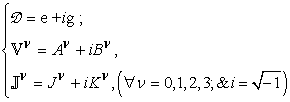
A dyon is defined as a particle which simultaneously carries electric and magnetic charge in 4-dimensional theory. The grand unified theories predicted the existence of both magnetic monopoles and dyons. Starting with the idea of Cabbing and Ferrari [16], the generalized charge, generalized four-potential, and generalized current of dyons can be written in terms of complex quantity with their real and imaginary parts of electric and magnetic constituents
 | (2.1) |
where (e, g; 

 and
and  ) are respectively the electric charge, magnetic charge, electric four-potential, magnetic four-potential, electric four-current and magnetic four-current. We may write the symmetric Maxwell’s equations known as Generalized Dirac Maxwell’s (GDM) equations for dyons given by
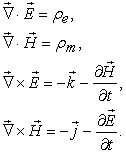 | (2.2) |
Here  is the electric field,
  is the magnetic field,
  is the charge source density due to electric charge,
  is the charge source density due to magnetic charge (monopole),
  is the current source density due to electric charge and
  is the current source density due to magnetic charge. We have used the following notations:
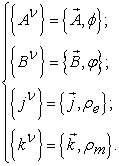 | (2.3) |
We have also used the unit value of coefficients along with natural units  through out the text. The electric and magnetic fields of dyons satisfying the GDM equations (2.2) are now expressed in terms of components of two four potentials in a symmetrical manner i.e.
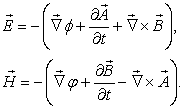 | (2.4) |
The complex vector field  associated with generalized electromagnetic fields of dyons is defined as
 | (2.5) |
which reduces the four GDM equations (2.2) to following two differential equations as
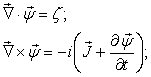 | (2.6) |
where 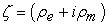 is the generalized charge density and
  is the generalized current source density of dyons. These are regarded as the temporal and spatial components of generalized four current
  of dyons. As such, we may write the generalized electromagnetic field vector
  in the following manner in terms of components of generalized four potential
  with
with  and
and  as
as
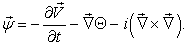 | (2.7) |
Thus, we can express the GDM equations (2.2) of dyons in the following covariant notation [17],
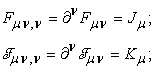 | (2.8) |
where 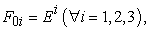

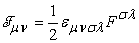 while
while  is completely antisymmetric Ricci tensor of rank four. Therefore, we may write the Lagrangian which follows the minimum action principle for generalized electromagnetic fields of massive dyons as
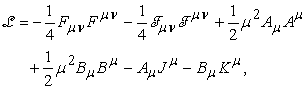 | (2.9) |
where  is the mass term of dyons. The Euler-Lagrange equations can be expressed as
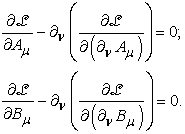 | (2.10) |
Then, the generalized Proca equations are defined:
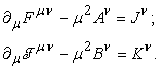 | (2.11) |
The Proca equation [18] describing electrodynamics with finite range (or equivalently with a non-zero mass). In the case of massive dyons, the generalized fields equation may be written as [19],
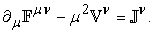 | (2.12) |
On the other hand, the ’t Hooft-Polyakov monopole solutions [3, 20, 21] describe an object of finite size which from far away can not be distinguished from a Dirac monopole of charge  In view of the energy density of generalized electromagnetic-vector field, we may write the mass formula for dyon as
 | (2.13) |
which plays an important role in supersymmetric gauge theories. Furthermore, according to Bogomolny bound [22], the mass of a dyons (or massive dyon) is expressed as
 |
which is known as BPS [22, 23] mass formula where v specifies the magnitude of the vacuum expectation value of scalar Higgs field. Moreover, in Higgs mechanism, the Higgs-field providing the mechanism whereby the vacuum spontaneously breaks the SU(2) gauge symmetry down to the U(1) group. The above mass formula does not distinguish between the fundamental quantum particles and the magnetic monopoles, being applicable to all of them, like meson-Solitons democracy in Sine Gorden Model. The BPS mass formula is universal and is also invariant under electromagnetic duality transformations. Thus, for massive magnetic monopole (e→0) or ’t Hooft-Polyakov monopole, the Bogomolny bound [22] is given by
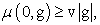 | (2.14) |
which is possible in Prasad-Sommerfield limit [23].
3. The Quaternion
The algebra  of quaternion [8, 9] is a four-dimensional algebra over the field of real numbers
  . The quaternion is very suitable to express the typical four-qualities in physics, such as four-position, four-momentum, four-force, four-potential and four-current etc. Similar to a complex number
  where
where  a real quaternion
  which is a four component number can be defined as
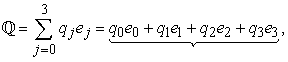 | (3.1) |
where the scalar part of the quaternion is represented by  the vector part is represented by
  and
and  while
while 
 are quaternion units. The quaternion units
  is known as the quaternion basis and its elements satisfy the following conditions,
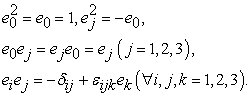 | (3.2) |
Here  is the delta symbol and
  is the Levi Civita three index symbol having value
  for cyclic permutation,
  for anti cyclic permutation and
  for any two repeated indices. Addition and multiplication are defined by the usual distribution law
 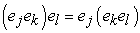 along with the multiplication rules given by equation (3.2).
  is an associative but non commutative algebra. If
  are taken as complex quantities, the quaternion is said to be a bi-quaternion or complex quaternion. The quaternion conjugate
  is defined as
Here  is the delta symbol and
  is the Levi Civita three index symbol having value
  for cyclic permutation,
  for anti cyclic permutation and
  for any two repeated indices. Addition and multiplication are defined by the usual distribution law
 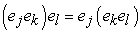 along with the multiplication rules given by equation (3.2).
  is an associative but non commutative algebra. If
  are taken as complex quantities, the quaternion is said to be a bi-quaternion or complex quaternion. The quaternion conjugate
  is defined as
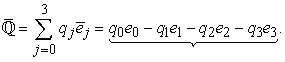 | (3.3) |
In practice  is often represented as a
  matrix
  where
where 
 and
and  are the usual Pauli spin matrices. The quaternion
  and quaternion conjugate
  may be written as a linear combination of scalar
  and spatial vector
  i.e.
i.e.
 | (3.4) |
The real part of the quaternion  is defined as
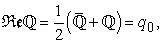 | (3.5) |
where  denotes the real part and if
  then we have
  and imaginary
  is known as pure quaternion written as
 | (3.6) |
Now the internal and external vector products and the vector itself can be used in quaternion equations. The quaternion sum and product are as follows:
 | (3.7) |
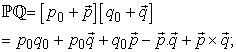 | (3.8) |
where the dot and cross, respectively indicate the usual three-dimensional scalar and vector products. It should be noted that  because
 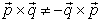 . The quaternion product is associative and distributive:
 | (3.9) |
The norm  of a quaternion
  may be expressed as
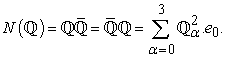 | (3.10) |
Accordingly, the inverse of a quaternion  (non-zero norm) is defined as
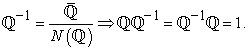 | (3.11) |
The norm  of a quaternion
  is zero if
  and is always positive otherwise. It also satisfies the following property of normed algebra
 | (3.12) |
4. Quaternion Formulation of massive Complex Fields of Dyons
Keeping in mind the quaternionic formulation which shows a formulation of Euclidean four-dimensional spacetime in the universe, we discuss the generalized Dirac-Maxwell’s equations and also generalized Proca-Maxwell’s equations for massive dyons in the case of quaternion algebra. In this section we study the various classical field equations for massive magnetic monopole, e.g. the equations of complex-potential, complex-field and complexcurrent and then relate these equations in terms of quaternionic basis for massive dyons. To do this let us define the space time four differential operator as
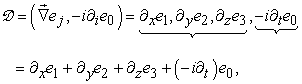 | (4.1) |
which shows the quaternionic form of four differential operator
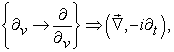 |
and  The quaternionic conjugate differential operator (i.e.
  ) of equation (4.1) can be written as:
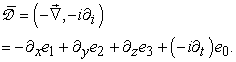 | (4.2) |
Then, the product of  will be
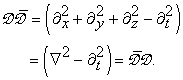 | (4.3) |
Here  is defined the D’ Alembert operator. In order to consider the generalized electromagnetic fields of massive dyons, we can define quaternionic form of generalized four potential of dyons as
 | (4.4) |
where  are described as the components of generalized four potential associated with generalized charge
  of dyons. We have assumed the generalized dyonic charge
  which is complex in nature [5], as the same way we can take the quaternionic generalized potential
  of dyons in complex nature. Thus, we may now identify the components of generalized complex-potential
 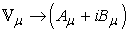 of massive dyons as
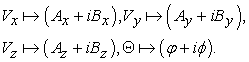 | (4.5) |
Therefore, the generalized complex-potential  of massive dyons can be expressed in terms of quaternionic elements,
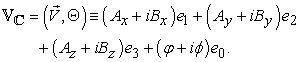 | (4.6) |
As such, we can write the generalized quaternionic electromagnetic fields  of massive dyons as
 | (4.7) |
where  is defined by
 | (4.8) |
In quaternionic representation of Y, we have used the EM-field components  and
and 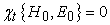 because of Lorenz gauge conditions applied separately on electric and magnetic four potential. Using (4.7), the generalized quaternionic complex-electromagnetic fields
  of dyons can be written as
 | (4.9) |
where  are respectively the components of complex-electromagnetic field for massive dyons. Thus the generalized vector field can be expressed in terms of following quaternionic form,
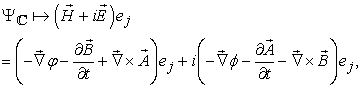 |
where the electric and magnetic field vectors for dyons are already defined in equation (2.4).
4.1. Generalized Proca-Maxwell’s (GPM) Equations for Massive DyonsIn order to obtain the generalized massive field equations of dyons in four-dimensional space-time, we may now applying differential operator  to the generalized quaternion complex EM-fields
  given by the following way
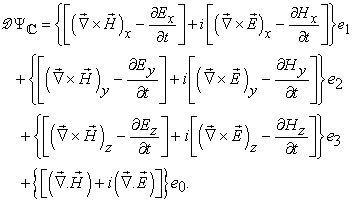 | (4.10) |
The definition for the general quaternionic field of massive dyons will be,
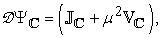 | (4.11) |
where  is the mass term for dyons given by (2.13) and
  is the quaternionic form of generalized complex-current source of dyons. Thus using generalized complex potential of dyons, we can write
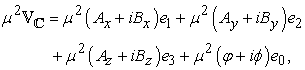 | (4.12) |
and the quaternionic form of generalized complex-current
 | (4.13) |
which may be reduced in term of dyonic form, i.e.,
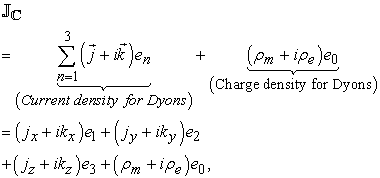 | (4.14) |
here  and
and  are respectively the four currents associated with electric charge, magnetic monopole and generalized fields of massive dyons. Thus the right hand part of the equation (4.11) can be expressed as
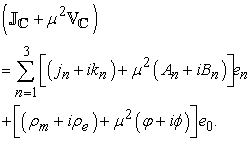 | (4.15) |
From equation (4.11), we get the following differential equations
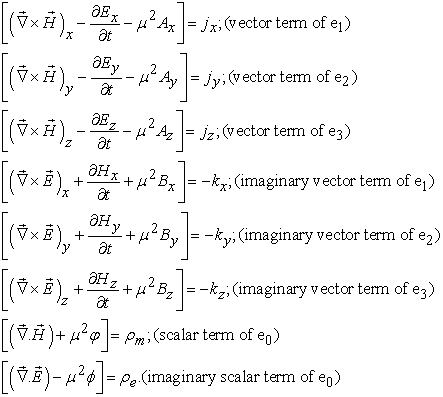 | (4.16) |
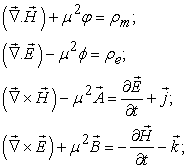
In equation (4.16), we have obtained eight components of generalized EM-field of dyons in terms of quaternionic vector and scalar parts. First three sub-equations are vector field equations, next three sub-equations are the imaginary parts of vector field equations, and last two sub-equations are scalar field equations. Thus the quaternionic formulation can be used to study each components of generalized EM-field of massive dyons. As such, equation (4.16) leads to following compact form:
 | (4.17) |
which are the generalized Proca-Maxwell’s (GPM) equations of generalized fields of massive dyons. If we put  i.e. massless particles, then (4.17) exhibits the simplest generalized Dirac-Maxwell’s equation for dyons. The present quaternion reformulation of generalized fields of massive dyons represents well the invariance of field equations under Lorentz and duality transformations. It also reproduces the dynamics of electric (magnetic) charge yielding to the usual form of Maxwell’s equations in the absence of magnetic (electric charge) in compact, simpler and consistent way.
In the case of quaternionic wave equations for massive dyons, let us start with the following equation
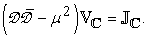 | (4.18) |
Equation (4.18) can be expressed in terms of following real and imaginary parts of quaternionic potentials and currents, i.e.
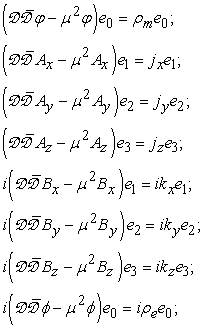 | (4.19) |
which can be reduced as
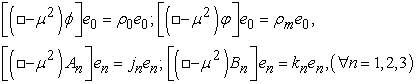 | (4.20) |
with the Lorenz gauge condition for electric and magnetic charges:
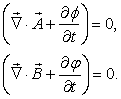 | (4.21) |
Accordingly, we get the following eight differential equations called quaternionic potential wave equations in presence of massive magnetic monopole,
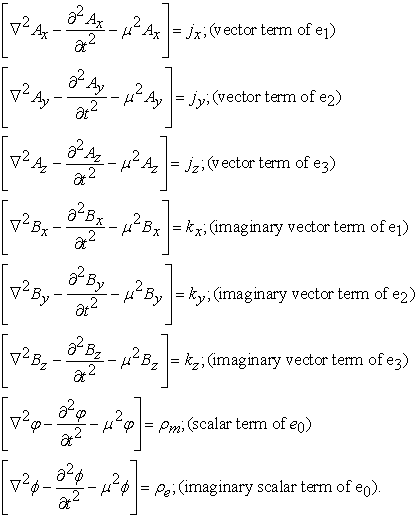 | (4.22) |
The beauty of quaternionic formulation is that, each quaternionic basis element has its own complex fields, e.g. in potential wave equations,  basis has one vector and one imaginary vector fields. However, if
  then (4.22) exhibits the simplest n quaternionic potential wave equation for massless dyons. Moreover, in case of free space
  there is a pleasing symmetry in Maxwell’s wave equations for massive dyons, i.e.
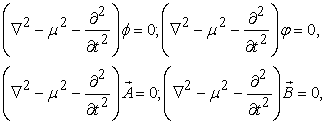 | (4.23) |
which yield,
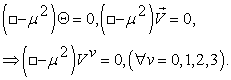 | (4.24) |
Therefore, the generalized electromagnetic potential wave equation for massive dyons is a second-order partial differential equation that describes the propagation of electromagnetic waves through a medium or in a vacuum if to put  and
and  Furthermore, equation (4.24) shows the well known Klein-Gordon equation for four potentials of dyons in terms of quaternionic formulation. Similarly we also can obtain the Klein-Gordon field equations for dyons (i.e.
  ) if we operate quaternionic differential operator D to the equation (4.18). Therefore, we concluded that the four dimensional quaternion algebra is very simple and consistent to represent the electromagnetic theory of massive dyons.
5. Conclusion
In this paper, we have considered the electric and magnetic four complex-potentials of dyons in usual fourdimensional quaternionic space. In four-dimensional quaternionic theory, a massive dyon is a hypothetical particle with both electric and magnetic charges. A massive dyon with a zero electric charge is usually referred to as a massive magnetic monopole. In Table 1, we summarized the dyonic components corresponding to its complex structure of the quaternion unit elements.





Thus, we have described the quaternionic formulation of generalized complex-electromagnetic fields equations and generalized Proca-Maxwell’s (GPM) equations of massive dyons. Equation (4.17) is the compact form of GPM equations of massive dyons. After that, we have obtained the wave equations for massive dyons (4.20) in usual four-dimensional quaternionic space. The quaternionic EM-wave equations in free space has been discussed by equation (4.23). The advantage of presents formalism are discussed in terms of compact and simpler notations of quaternion valued complex-potentials, complex-fields and complex-currents of massive dyons despite of non commutative of quaternion. Finally, it has been concluded that the quaternion formulation be adopted in a better way to understand the explanation of the field equations, GPM equations as the candidate for the existence of massive monopoles and dyons where the complex parameters be described as the constituents of quaternion.
References
| [1] | P. A. M. Dirac, “Quantized singularities in the electromagnetic field”, Proc. Roy. Soc. London, A133 (1931), 60. | ||
 In article In article | View Article | ||
| [2] | J. Schwinger, “Dyons Versus Quarks”, Science, 166 (1969), 690. | ||
| In article | View Article PubMed | ||
| [3] | G. pt Hooft, “Magnetic monopoles in unified gauge theories”, Nucl. Phys., B79 (1974), 276. | ||
| In article | View Article | ||
| [4] | P. S. Bisht, O. P. S. Negi and B. S. Rajput, “Null-tetrad formulation of dyons”, IL Nuovo Cimento 104A (1991), 337. | ||
| In article | View Article | ||
| [5] | B. S. Rajput, S. R. Kumar and O. P. S. Negi, “Quaternionic formulation for dyons”, Lett. Nuovo Cimento, 34 (1982), 180. | ||
| In article | View Article | ||
| [6] | J. S. Dowker and J. A. Roche, “The Gravitational Analogues of Magnetic Monopoles”, Proc. R. Soc., 92 (1967), 1. | ||
| In article | View Article | ||
| [7] | L. E. Dickson, “On Quaternions and Their Generalization and the History of the Eight Square Theorem”, Ann. Math., 20 (1919), 155. | ||
| In article | View Article | ||
| [8] | W. R. Hamilton, “Elements of quaternions”, Chelsea Publications Co., NY, (1969). | ||
| In article | |||
| [9] | P. G. Tait, “An elementary Treatise on Quaternions”, Oxford Univ. Press, NY, (1875). | ||
| In article | PubMed | ||
| [10] | D. Finklestein, J. M. Jauch, S. Schiminovich and D. Speiser, “Principle of general quaternion covariance”, J. Math. Phys., 4 (1963), 788. | ||
| In article | View Article | ||
| [11] | S. L. Adler, "Quaternion Quantum Mechanics and Quantum Fields", Oxford Univ. Press, NY, (1995). | ||
| In article | |||
| [12] | P. S. Bisht, O. P. S. Negi and B. S. Rajput, “Quaternion Gauge Theory of Dyonic Fields” Prog. Theor. Phys., 85 (1991), 157. | ||
| In article | View Article | ||
| [13] | B. C. Chanyal, P. S. Bisht and O. P. S. Negi , “Generalized Octonion Electrodynamics”, Int. J. Theor. Phys., 49 (2010), 1333. | ||
| In article | View Article | ||
| [14] | B. C. Chanyal, P. S. Bisht and O. P. S. Negi, “Octonion electrodynamics in isotropic and chiral medium”, Int. J. Mod. Phys. A 29 (2014), 1450008. | ||
| In article | View Article | ||
| [15] | B. C. Chanyal, S. K. Chanyal, ö. Bektas, S. Yüce, “A new approach on electromagnetism with dual number coefficient octonion algebra”, Int. J. Geom. Meth. Mod. Phys. 13 (2016), 1630013. | ||
| In article | View Article | ||
| [16] | N. Cabibbo and E. Ferrari, “Quantum electrodynamics with Dirac monopoles”, Nuovo Cim., 23 (1962), 1147. | ||
| In article | View Article | ||
| [17] | B. S. Rajput, S. Kumar and O. P. S. Negi, “Quaternionic formulation for generalized field equations in the presence of dyons”, Lett. Nuovo Cimento, 34 (1982), 180. | ||
| In article | View Article | ||
| [18] | A. Proca, “Sur 1’equation de Dirac” Compt. Rend. 190 (1930), 1377. | ||
| In article | |||
| [19] | A.Yu. Ignatiev and G. C. Joshi, “Massive electrodynamics and the magnetic monopoles”, Phys. Rev., D 53 (1996), 984. | ||
| In article | View Article PubMed | ||
| [20] | G. pt Hooft, “A property of electric and magnetic flux in non-Abelian gauge theories”, Nucl. Phys., B153 (1979), 141. | ||
| In article | View Article | ||
| [21] | A. M. Polyakov, “Particle spectrum in the quantum field theory”, JETP. Lett., 20 (1974), 194. | ||
| In article | |||
| [22] | E. B. Bogomolny, “Stability of Classical Solutions”, Sov. J. Nucl. Phys., 24 (1976), 449. | ||
| In article | |||
| [23] | M. K. Prasad and C. M. Sommerfield, “Exact Classical Solution for the ’t Hooft Monopole and the Julia-Zee Dyon”, Phys. Rev. Lett., 35 (1975), 760. | ||
| In article | View Article | ||
 CiteULike
 Mendeley
 StumbleUpon
 Delicious
 Facebook
 Twitter
 LinkedIn