This study engages with the prime objective: to examine to what extent the existing agricultural delivery practices of local government has affected the livelihood of farmers and their capacity development. Methodologically, the three Rural Municipalities were selected in terms of past performance representing each ecological belt of Province Number 1. The study applied quantitative approach as well as exit-poll and institutional survey research strategies. The 504 respondents; local elected representatives, administrative staffs, and service receivers were selected using standard sampling techniques to the structured interview. The research issues have been further interpreted through theoretical insights i.e. decentralization, new public management, and multi-level governance perspectives. The study has identified that people are expecting some larger expectations of improved service delivery in the changed perspectives of governance. After local elections, the local government units are working effectively and efficiently through the reformative administrative functions for offering good networking of agriculture service delivery practices. As a result, the integration of this sector along with other commercial activities is helpful to boost the rural economy and encourage more people including educated/skilled youths in the agriculture farming. Finally, knowledge generated from this study has greater implication on knowledge level (theoretical, methodological and constitutional), practical level (to the duty bearers and service receivers) and policy level (to the policy makers and planners working in central to local levels).
Governance is about the performance of agents in carrying out the wishes of principals, and not about the goals that principals set 1. Thereby, local government bodies are independently elected by the local citizens. Politically, they look like autonomous and independent. But there is lack of fiscal decentralization, no role of beaurocrats in political decision and contradictory acts with central government while carrying out the wishes of principals. Local government often experiences lack of human, financial, and technical resources, which prevents the government to provide appropriate public services under decentralization and thus power remains in the hands of central government 2.
Another difficulty with local governance is the least role of civil society and pressure groups in local levels. In the context of Nepal, civil society has been urban centric. Though the responsibility of the civil society is to create pressure for effective government, it has come to play a role of shareholder of local governance itself. It is also believed that responsible civil society can protect civic rights and articulate interests and demands of local people. It is catalyst for creating proper environment for citizen's participation in local development activities. Development of social capital is, in the end, a responsibility and function of civil society 3. In decentralization theory, governance is characterized by incorporation of non-governmental actors into processes that, in the past, were considered exclusive of governments 4. But in the context of Nepal, because of conflict between and among political parties and frequently changing government mechanism, the role of civil society and effective service delivery have been a mess.
Public service delivery is as a set of institutional arrangements adopted by the government to provide public goods and services to its citizens. A public service is a service benefiting the public and it is provided by the government. The public benefits from outcomes of service delivery rather from its inputs 5. More precisely; buildings, textbooks, teachers, assurance of pedagogical training and quality instruction, are inputs for delivery of education service, but the public service is to yield an output of students with skills. Public service delivery has been one of the key functions of the public sector which uses civil service as the instrument for the delivery of services 5. The given scenario portrays that service delivery is an essential function of the government bodies and it is through such services government-citizens relation is established. It is not an isolated thing, but is a part of a complex relation between government, society and citizens. The government must guarantee service delivery in equal access to all, irrespective of social and cultural background, and in affordable prices. Citizen's satisfaction, trust, reliability and legitimacy are key elements of public service delivery or public administrative functions 6. Citizen's satisfaction is achieved by providing effective and efficient public service delivery in local level. Similarly, trust can be maintained through transparent decision making, through effective and efficient action of the government and clearly defined role of the elected representatives. So, building trust is the first responsibility of the political administration.
In the context of Nepal, the Local Self Governance Act (LSGA) (1999) focused on participatory planning and budgeting for local development 7. Its purpose was to maintain social justice to deprived and marginalized people. LSGA 1999 also has emphasized on inclusive development through accessible and equitable public service delivery especially to the local people from centralized system 7. Some significant results of it over the two decades were: provision of information cell in district development committee and municipality, practices of right to information (RTI) by various non-government organizations (NGOs), local bodies' formation of citizen awareness center, ward citizen forum, public hearings, public and social audits, public finance management system for making local governance effective and result oriented 8. Local governance system also provisioned transparency, public accountability, increased local leadership and participation of private sectors in local governance for providing basic services to the people 9.
With the promulgation of the new constitution of Nepal (2015), a three-tier governance system (i.e. federal, provincial and local level) has been introduced 10. The elected bodies have been exercising their power and jurisdiction since the local election held in 2017 AD. And they have started working together with local stakeholders in order to provide effective/efficient service delivery to the citizens. In this federal context, there is urgent need to explore and analyze accessibility and accountability of public administration functions and service delivery mechanism of local governments. It is also reasonable to observe whether there are changing perceptions of the service receivers on local governments before and after local election of 2017 AD.
Agriculture is one of the most promising instruments for reducing poverty and securing local livelihoods in the context of Nepal. One of the critical conditions required to the agricultural sector is to ensure good governance structures and the operation of related policies of it. Studies have shown that agriculture-based economies around the world are to be found mostly in developing countries and countries with economy in transition. It is in these countries, however, that scores for governance are at their lowest and often negative position 11. The study explores the implications of Nepal’s new federal Constitution which was promulgated in September 2015 for governance of the agricultural sector 12, 13. In transitioning from a unitary to a federal republic with greater authority and autonomy granted to sub national units of government it is of paramount importance to ensure that the agricultural sector is guided by coordinated planning, retains sufficient human capacity, and receives adequate fiscal resources. These considerations are particularly important given that the governance of Nepal’s agricultural sector already suffers from poor coordination, low human resources capacity, and inadequate financial resources 14. They argue that addressing these issues may become more difficult under a federal structure.
In this context, this study is to describe how the agriculture service delivery practices are taking place in the local government of Mechi Zone in Province Number 1 of Nepal. Operational definition of the local government, in this study, refers to specific entities created by national constitutions to deliver a range of specified services to geo-graphically delineated area 10. This study is so important to carry out by analyzing perceptions and understanding of service providers and service receivers focusing on agriculture service delivery practices before (2002-2016{1}) and after local level election of Nepal held in 2017. Agriculture is highly prioritized realm in Nepal for several reasons. The dominant source of employment in Nepal, for instance, is agriculture. Its growth has been instrumental for reducing poverty. But in reality, it has been insufficient even to ameliorate people’s nutritional status for the last two decades. Still, a poverty rate in Nepal has started to decline from 42 percent in 1994/95 to 18.7 percent in 2020 15. The major research issue of this study is on agriculture service delivery practices of local government in federal context.
I: To examine to what extent the existing agricultural service delivery and commercial farming practices have affected the livelihood of the local farmers and their capacity development.
II: To look at on some challenges ahead for effective agriculture service delivery practices in Nepal.
Nepal is a least developed country in the world with per capita of US$ 998 in 2017 15. Sixty-one percent of Nepal’s population resides in rural areas (MoFAGA, 2019) and 66 percent are engaged in agriculture 16. Nepal ranks 197th in terms of Gross Domestic Product (GDP) per capita and 145th out of 186 countries in terms of Human Development Index 17. The country’s agro- ecological zones are very distinct. They span the low lands of Tarai to the high mountains of the Himalaya across the mid-level hilly area; these areas have specific potential for agro- economic development, and are populated by diverse ethnic groups with varied social norms. The nutritional status of Nepal’s population is poor; it ranks 118 out of 162 in the world with an average daily dietary energy consumption of 2340 kilocalories per day and 2.3 million people (8.1 percent) undernourished 16.
As mentioned above, Nepal has predominantly an agrarian economy which is the main source of livelihood of the Nepalese people. Still 60.4 percent people are dependent on agriculture and that contributes for about 27 percent of the GDP. Nepalese economy has undergone a gradual structural shift in the recent years. Against poor economic indicators of the country, current 15th Plan aimed to increase economic growth rate 10.5 percent through agriculture sectorial development policies. The GDP contribution of agriculture sector will be reduced from 27 percent into 9 percent from 18.
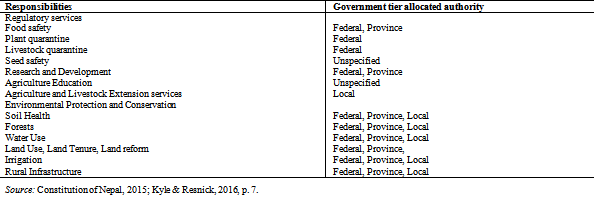
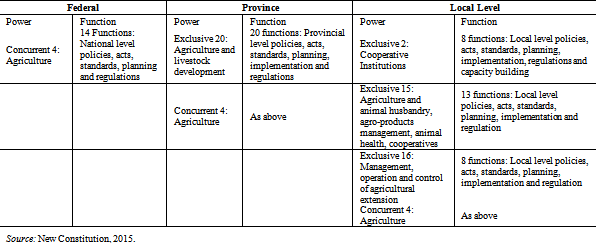
3.2. Unbundling of Powers with Reference to Agriculture Sector, 2015Table 1 and Table 2 portray the unbundling of responsibilities in governing the agricultural sector and the government tiers given primary authority for a particular responsibility. Many of the unbundling functions are officially allocated across multiple tiers of government, leaving it unclear where certain powers should lie, as per the Constitution. In particular, there is ambiguity over concurrent functions over agricultural research, food safety, environmental protection and conservation, and agricultural education. Typically, when there are concurrent functions, the rule of subsidiary prevails, which means that the lowest government tier which is capable of performing the function should be given the mandate to do so.
Lai and Cistulli (2005) argue the relationships between decentralization and agriculture development 19. Even in Nepal decentralized agriculture service delivery has improving the livelihoods of the farmers residing in rural areas. Some of the prioritized national goals of the Government of Nepal (GoN) include: achieving food and nutrition security, reducing poverty, realizing the Sustainable Development Goals (SDGs), and others. The country’s agricultural development priorities are aligned with these goals and with the Sustainable Development Agenda-particularly SDG-1 and SDG-2 - focusing on access to increased employment opportunities, sustainable management of natural resources, supportive infrastructures development, creating new avenues for economic growth, coping with emerging effects of climate change, social inclusion, and the development of farmer- responsive governance 20.
In the reference of SDGs-1 and 2, agriculture service delivery practices of federal government becoming major concern in Rural Development process of Nepal. Even in the study areas local people are seeking agriculture marketing opportunities outside home. Thus, there is another reason to explain agriculture development process in the study area by focusing on agriculture service delivery practices in general and decentralized agriculture development practices in particular 20.
The Constitution of Nepal (2015) and Local Government Operation Act (LGOA) 21 ensures accountability and autonomy by stipulating that local governments be elected rather than appointed and by delineating responsibilities at all levels of government (that is, federal, provincial and local). Authority may, however, be constrained by overlapping mandates across levels of government, requiring attention to both horizontal and vertical coordination mechanisms. In the sectors that have already been deconcentrated, attention should be directed at incentive structures to ensure adequate capacity at the local level, where staff will now be hired and fired.
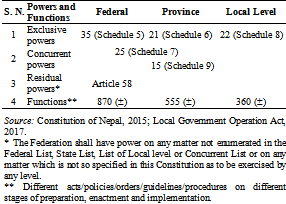
At present, Constitution of Nepal, 2015 defines Nepal as a federal democratic republic and provisions three tiers of government: local, provincial, and federal. Constitutionally Nepal comprises 753 local governments, 7 provincial governments, and one federal/central government 10. Local and provincial governments hold a variety of political, fiscal, as well as administrative powers in addition to concurrent powers with the federal government. There are 35 political, fiscal, as well as administrative powers given to the federal government, 21 to the provincial governments, and 22 to the local governments. Simultaneously, there are 25 concurrent powers between federal and provincial governments, whereas 15 are shared between federal, provincial, and local governments (see Table 3).
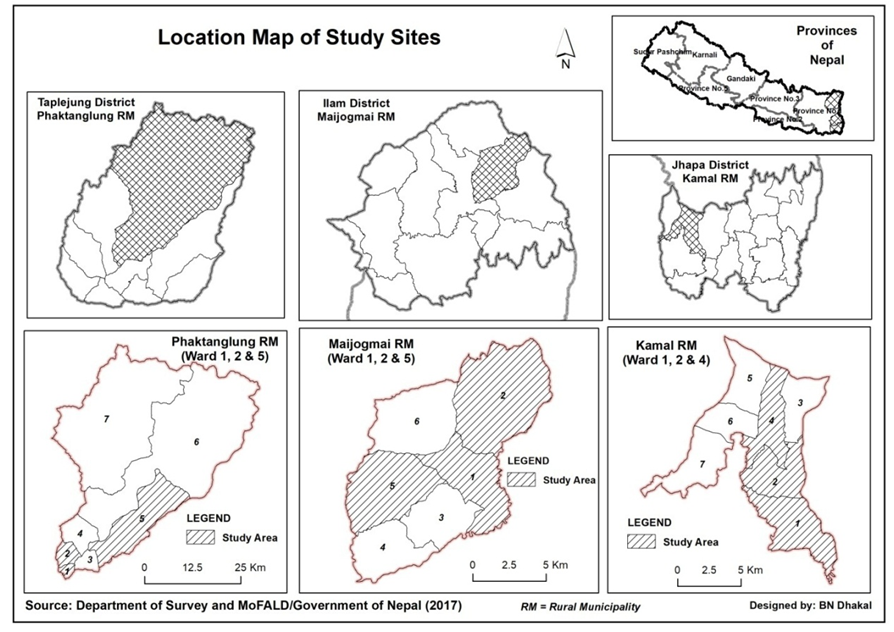
Nepal possesses a wide range of terrain, which consists of mountains, hills, elevated plains (locally called tars), river valleys and flat plains. The topography varies greatly from the low Tarai plain in the south, which has an average height of 300 meters above sea level, to the Himalayas in the north, which peak at more than 8,000 meters above sea level. The topography of Nepal can be divided conveniently into three main ecological regions: Mountain, Hill, and Tarai. The socio-economic and cultural contexts of the people inhabiting these regions vary immensely. In this background, in first stage, purposively, Mechi Zone{2} within Province No. 1{3} is selected for the study. Vertically there are three Ecological regions (i.e. Mountain, Hill and Tarai) in this zone. In second stage, purposively one district representing each Ecological region has been selected. Taplejung is selected from Mountain region, Ilam from Hill region and Jhapa from Tarai region (see Figure 1).
Taplejung is the mountainous district of Province Number 1 and covers 3646 sq. km. with 127, 461 populations 22. There are nine local units (one Municipality and eight Rural Municipalities) in Taplejung District. Faktanglung is one of Rural Municipalities of Taplejung and is also the third largest Rural Municipality in Nepal with an area of 1858.51 sq. km. It has a total population of 12017 with 7 persons per square kilometer. This Rural Municipality is divided into total 7 wards. Phaktalung Rural Municipality borders with the Tibet of China in the north, Phugling Municipality in the south, Sirjungha in the east and Mikwakhola Rural Municipalityto the west 23.
Ilam is one of the hilly districts of Province Number 1 and covers 1,703 sq. km. with 290,294 populations 22. There are 10 municipalities in Ilam in which four are urban and six are rural. Maijogmai is one of the Rural Municipalitiesof Ilam. Maijogmai has an area of 172.41 sq.km and the total population of the Municipality is 21,044. This Rural Municipality is divided into total 6 wards. Maijogmai Rural Municipality borders with Ilam and Deumai Municipality in the north, Jhapa District in the south, Rong Rural Municipality in the east, Mangsebung and Chulachuli Rural Municipalites in the west 23.
Jhapa is one of the Tarai districts of Province Number 1 and covers 1606 sq. km. with 812,650 populations 22. There are 15 local units (eight Municipalities and seven Rural Municipalities) in Jhapa District. Kamal Rural Municipality is one of the Rural Municipalities of Jhapa and has an area of 104.57 sq. km. With its total population of 44,365 24. This Rural Municipality is divided into total 7 wards. The Kamal Rural Municipality borders with Ilam to the north, Gauradhah Municipality to the south, Shivastakshi Municipality to the east and Damak Municipality to the west 23.
Philosophically, based on positivist (objectivity) assumption{4} 25, 26, this study has applied post-positivism pragmatism to describe research issues. Post-positivism helps to explain objective reality of knowledge 27. Methodologically, this study was designed under quantitative approach as well as exit poll and institutional survey strategies. Survey research design describes the nature and features of existing conditions, identifies standards against which existing conditions can be compared and determines the relationships that exist between specific events 28, 29, 30. Thus, the survey was used to understand the existing status of institutional environment from where they offer agriculture service delivery functions to the right holders. The required numerical data were collected from 504 sample respondents belonging to three ecological region of the country through self administered questionnaires. For the reliability of tools Cronbach alpha value of tool for pilot test is found to be 0.871 that was calculated through the 52 (larger than 10 percent) samples, out of total 504 respondents{5}. Similarly, Cronbach's Alpha's value of entire tools also found 0.802>0.78 which is reliable in terms of internal consistency 30.
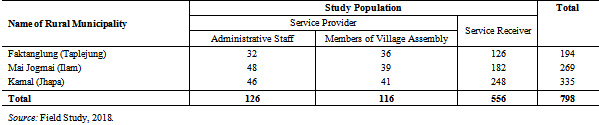
5.2. Introduction to Study Population and Sampling DesignThe 504 study populations both service providers (administrative staff and members of village assembly) and service receivers are selected randomly/purposively by using sampling determination formula 31 who visited service providing institutions from August 11, 2018 to September 11, 2018. The names of service receivers were taken from respective Rural Municipality’s monthly official records. There were 126 service receivers in Faktanglung Rural Municipality, 182 in Mai Jogmai Rural Municipality and 248 in Kamal Rural Municipality (see Table 4 and Table 5).
Table 5 shows the sample allocation over study Rural Municipalities. Based on sample population, sample numbers are calculated according to sample determination formula. For both administrative staff and service receivers, the response rate was more than 95 percent whereas the response rate of village assembly members was only about 86 percent. In Faktanglung and Mai Jogmai, there were equal number of administrative staffs who were interviewed i.e., 28, however, 44 administrative staffs were interviewed from Kamal Rural Municipality. An equal number of village assembly members were interviewed from each Rural Municipality. There were 80 service receivers in Faktanglung Rural Municipality of Taplejung District, 108 in Mai Jogmai Rural Municipality of Ilam District and 132 in Kamal Rural Municipality of Jhapa District.
Social and demographic characteristics of the respondents are classified according to sex, age group, caste/ethnic group, education. In this study, most (320/504=63.5 percent) of them are service receivers, followed by administrative staff (100/504=19.8 percent) and member of village assembly (84/504=16.7 percent). The Local Government Operation Act 2017 (Government of Nepal, 2017) has even envisaged the bureaucracy as the integral part of local governance along with the elected representatives. The service receivers have the regular attachment with the local leaders as well as the government staffs to receive the effective service delivery at local level.
Age is very crucial factor for determining the physical and mental soundness of an individual. There were two broad age groups: Younger (upto 30 years old) and matured (more than 30 years old). Among these, about 39 percent (154 out of 504) are younger respondents. The majority of the elected representatives (69.4 percent) are quite matured people. Matured age followed by the other different factors is one of the significant factors for the local representatives, due to which people trust and vote them easily. Despite this, Boerrigter (2015) claims that there is no significant linkage between the age and leadership outcomes, the scenario is different in the case of Nepal. Likewise, the figure has highlighted one bright aspect in administrative functioning that a majority of the government staffs are young and energetic.
The proportion of male respondents (63.5 percent) is higher than that of counterpart female (36.5 percent). In Taplejung, out of 28 interviewed administrative staffs, only 14 percent are female. Likewise, the percentages of female local representatives in the district are 40 percent. In Jhapa, out of 44 bureaucrats, 36 percent are female. In Illam, out of 28 government staffs, about 56 percent are female. Similarly, their presence in the local bureaucracy is in the range of 14 percent to 55 percent. In bureaucratic inclusion of females, Taplejung district seems to have been the lowest in number.
Nepal displays a vertical zonation of ethnic (janajatis)/caste (jat) settlements. High mountain areas throughout the northern part of the country are inhabited by the mountain ethnic groups{6} early as well as recent migrants from Tibet. In the hills, ethnic groups{7} generally occupy the temperate zone and sub-tropical zone by castes{8} including Hill untouchable caste (locally called Dalit).{9} The forested foothills and inner Tarai (plain) valleys are the home of small groups of autochthonous people who engage in hunting, gathering, and fishing{10}, but they have been overwhelmed by Madhesis castes{11} spilling over from the Gangetic plain. In this study all respondents are classified into three broad caste/ethnic groups: Brahman/Chhetri, Janjati and Dalit including others.
The majority respondents are Brahman/Chhetri (50.4 percent), followed by Janajati (37.5 percent) and Dalits and others (12.1 percent). Out of total 100 administrative staffs, the majority of respondents (69 percent) belong to Brahmin/Chhetri community and the lowest percent of respondents belongs to Dalit and other communities (1.2 percent). More specifically, three in every four (75 percent) government officials are from Janajati group in Taplejung District.
Out of total 320 service receivers, nearly majority (47.2 percent) belong to Brahman/Chhetri and second highest of interviewees are from Janajatis (40.3 percent). Out of total 84, both Brahman/Chhetri and Janajati communities have more or less same number of village assembly/elected representatives across the study areas. In Jhapa, all administrative staffs are from Brhaman/Chhetri communities where as around 75 percent belongs to Janjati community in Taplejung district.
In the case of elected representatives, the composition of Janajati and Dalit including others comprises nearly 60 percent. The credit for this representation goes to the devolution of political authority to the local level by the Constitution of Nepal (2015), due to which the people can choose their local representative themselves. However, the privileged caste groups dominate the current bureaucracy. A report of Asian Development Bank mentions that the dominant group continued their grasp in the Nepalese bureaucracy, "because of their proficiency in Nepali, and their ease of access to and influence upon those who dominate governance structures, continue to enjoy greater access to civil service employment and the benefits thereof 32.
The education status is one of the important dimensions related with the performance, service delivery and critical awareness of the stakeholders of the local governments. The definition of literacy has been drawn from CBS which refers to the ability to read and write with understanding and to perform simple arithmetic calculations (CBS, 2011) in this study. The survey uses the following definitions of the level of education: The literacy rate is defined as the ratio of the literate population aged 5 years and above to the literate population of the same age group and is expressed as a percentage. In this study, about 88 percentages of the total respondents is literate. All administrative staff and elected representatives are educated. Literacy of the elected leaders may be helpful in the effective service delivery mechanism and decision making at local levels. Out of 443 literate respondents, about 35 percent have completed secondary level education.
6.2. Agriculture Service Delivery PracticesFrom the examination of survey data, about 96 percent of total respondents reported that they had agriculture land telling that agriculture was the major subsistence of livelihood in the study areas. By occupation, about 72 percent of total research participants were found engaged in agriculture during the survey. Among them, one-third of total interviewees (33.6 percent) hold more than 1.75 hectors (25 ropanis) land. By ecological belt, about 50 percent of total respondents living in Hill (Jogmai Rural Municipality) have more than 1.75 hectors (25 ropanis) landholdings, and followed by Mountain (Faktanglung Rural Municipality) 31.1 percent. One in every four respondents (25 percent) is living in Tarai (Kamal Rural Municipality) and has less than 0.25 hectors (5 ropanis) land. To understand the food sufficiency status, the following question was asked to eligible respondents:
How many months does your family have food sufficiency in a year?
IFAD (2015) envisioned poverty reduction in rural Nepal through agriculture development in general and increasing family food sufficiency in particular. In this respect, responding to this question, less than 50 percent (47.7 percent) of total respondents stated that their land is the main source of food subsistancy. In other words, across the study areas the majority of respondents (52.3 percent) are dependent in other source of income to maintain their livelihood. Approximately 28 percent of total interviewees had involvement in non-agriculture sectors (employment, business and wage labour) which is an alternative source of income for them. By municipal, nearly two-third majority of research participants (65.2 percent) living in Kamal Rural Municipality (Tarai) informed that they are supported by their livelihood from the landholdings, followed by Hill (Jogmai Rural Municipality) 39.3 percent and Mountain (Faktanglung Rural Municipality) 34.1 percent. To modernize the existing agriculture landholdings, hence, is the best way to commercialize it. In this context, necessary information was collected by asking the following question to the respondents:
Have you practiced commercial farming?
Responding to this question, simple majority of respondents (50.4 percent) reported that they do not have any commercial farming practice whereas about 34 percent of respondents have already commercialized farming. The remaining 16 percent of respondents informed that they are willing to commercialize their agriculture landholdings. The percentage of undecided on commercializing farming is found the highest (58.3 percent) among the respondents living in Kamal Rural Municipality (Tarai). To modernize the farming system, people belonging to mountainous region (65.4 percent) have more systematic plans compared to other regions (Hill: 20.7 percent and Tarai: 2.1 percent). The findings indicate that commercial farming practices becoming priority sector of the farmers who are residing in rural areas. Pasa and Bishwokarma (2020) and Pasa (2018a) also argue that large portion of family earning has been investing in commercial vegetable farming equally in urban and rural areas of Nepal.
6.3. Commercial Farming PracticesThe agricultural farming system in Nepal is intertwined among the multiplicity of enterprises of crops, livestock, poultry, vegetables, fruits, spices, fisheries, agro-forestry and non-timber forest products. Until quite recently, majority of the farmers produce what they consume and consume what they produce. According to the 2011 Nepal Agriculture Census, the average farm size is 0.68 hectors 22. Rice, maize, wheat, finger millet and barley are the major cereals grown. Maize and millet are mostly grown in the non-irrigated uplands and rice-based cropping pattern is popular in the irrigated areas. Oil seeds, pulses, sugarcane and potato are the other important crops. Different fruits and vegetables are cultivated in summer and winter seasons in different ecological regions.
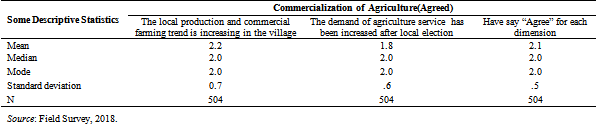
In Nepal, agriculture contributes to a third of Gross Domestic Product. The rural population is comprised mostly of smallholder farmers whose level of income from agricultural production is low by international standards 33. The 15th Development Plan of Government of Nepal (GoN) aims to make the agricultural sector competitive and move towards self-reliance through sustainable and commercial agriculture development 18. In this context, the commercialization of the agricultural practices has been assessed by the changing trend in saleable farm products and the growth in the demand of the service seekers about the improved agriculture service delivery at local level. To understand the current status of commercial farming practices, two statements as shown in Table 6 are evaluated from the point of view of study population (administrative staff, village assembly members and service receivers) and see whether they agree or disagree.
The values of some descriptive statistics (mean, median and mode) range from 1.85 to 2.02 which shows the majority of interviewees agree with the two statements. Seven in every ten respondents (70.0 percent) reported that both commercial farming and agriculture service delivery have been increasing in the village since the local election of 2015. Out of total respondents, the highest proportion observed among Village Assembly Members (73.8 percent) agreed with the fact that the trend of commercial farming and demand of agricultural service delivery has been increasing during the same period across the regions, followed by service receivers (70.0 percent) and administrative staffs (63.0 percent). Overall, Jhapa (Tarai) is found to have good commercial farming and agriculture delivery system (77.9 percent) compared to Taplejung (66.2 percent) and Ilam (63.4 percent). Some empirical studies 34, 35) also reveal that demand of modern agricultural tool and technological have increased even in rural areas of Nepal that has been promoting commercial farming practices.
6.4. Some Challenges Ahead for Agriculture Service Delivery PracticesThe commercialization of the agriculture practices in terms of changing trend in saleable farm products and the growth in the demand of the service seekers about the improved agriculture service delivery at local level shows that commercial farming is gradually increasing in the villages. Schoengold & Zilberman (2004) has mentioned that enhanced commercialization of farming practices all over the globe has become helpful in improving the "standard of living of the people" (p. 4) 36. Majority of the population is getting aware of growing local agricultural products and selling it for changing their family economic livelihood. Similarly, the demand of the agricultural service delivery has been grown after the people got their elected local governments in 2017. However, the study has enlisted following challenges ahead for agriculture service delivery practices:
1. The road networking is foundation of economic development but it has seasonable only in Nepalese context. Tarai has a huge potentiality of producing paddy, wheat, potato, fish and dairy products and has easy connection with the national highways the Mountain is still struggling with road construction projects for easy access to the market and enhancement of the local economy through agricultural transformation.
2. The agriculture service delivery and livelihood improvement is one of the top priorities of local government. The different interventions like providing capacity and skill focused trainings to the farmers are in operation to assist them in different farm related activities. Dhital (2017) has stressed that skill development training is an important intervention in the agricultural transformation through the improvement of farm management practices and enhancement of "production, yield and income" (p. 1072) 37.
3. Local government has been offering sufficient skill development training to the farmers through which the farmers have achieved a lot as well. Likewise, agricultural service center and local government have been offering effective services to the farmers. However, a lot of reform is necessary to enhance the capacity of farmers and offer them effective services.
4. The administrative staffs have to operate all the administrative functions for planning the capacity enhancement and skill development trainings to the farmers in addition to implement decentralization practices. As a result, agricultural service delivery has not been satisfactory. Instead, the administrative mechanism has to offer capacity development trainings to the staff by coordinating with different government and non-government agencies. As a result, their services would be more efficient. Local government has to build a strong institutional mechanism to strengthen the capacity of the farmers by following the principles of new public management 38.
5. Likewise, the satisfaction level of service receivers in agricultural service delivery mechanism is average. The aspirations of the local people have really elevated after they have got their representatives. It is only through professionalism in farming that can directly contribute to the transformation in agriculture. The incentives and farm related subsidies of the local government have been really motivating the farmers. The soft loan, provisions of food processing training, management of local market, agricultural infrastructures, long term planning for agro-based development and increasement of fund for marketing of local agro-products are the major issues to be addressed in this sector. The local governments are planning to identify the role model farmers and provide them incentives. The he farmers have been are getting organized in Tarai and have formed committees to receive fertilizers, seeds and agricultural tools from the local government. In the mountainous districts, the local governments have been distributing modern hybrid seeds and vitamins to the farmers annually. The farmers have also been receiving agricultural loans from Agriculture Development Bank and Cooperatives for commercial farming.
6. The local government has been offering different agricultural commercialization related skill trainings and exposure visits to the farmers. The intervention will somehow replace the traditional practices of agriculture farming in the local area. The farmers have been applying modern seeds and technologies in farming activities. Collaborative working model of the government has also been changing farmers' lives. Twenty-two devolved powers to the local governments mostly coincide with the agricultural transformation. But it is also apparent that the authority of the governments is helpless without sufficient agro-technicians. Still, their subsidies, grants and modern inputs to the selected farmers have contributed to promote agro-based entrepreneurship. Thus government of Nepal needs to offer effective and efficient agriculture service delivery by applying principles of multi-level governance multi-level governance 39. Besides policy for agricultural development, the major hindrances in the Hilly region are all-weather road connections and marketing of the farm products and dominance of mediators (who take more profits that the real farmers).
7. Agreeing with Dasgupta and Roy (2011) 40 and Fan et al., (2013) 41, establishing agriculture cooperatives is essential in changing the livelihood of the farmers at local levels. Those whose major profession is agriculture and have access to better service delivery through cooperative and local governmental efforts, their farming as well as their livelihood have been really transformed.
8. The farmers from Hill region are also planning to establish direct link between farmers’ cooperative and wholesalers so that they can be released from the deception of the mediators. They are also planning to operate Orange Processing Centers for producing wine and juice. In Tarai, the cooperatives have been the means of marketing the farm products. Of course, social structure is the reflection of the social, economic, cultural and political contexts. Theoretical perspective of structure and agency sees both individual and society as major concern of the study. Obviously, there are specific structures and conditions that produce human action, behavior and agency relationships through the constraints and structures where they exist. An agency relationship is one in which “one or more persons engage with another person (the agent) to perform some service on their behalf which involves delegating some decision-making authority to the agent 42. The need of reformed structure and its actors (duty bearers) with the changed mindset can bring a substantive change in agriculture transformation at the local level.
9. Availability of farmland really matters for commercialization of agricultural practices. Similarly, researches have shown that the irrigation services do not have significant contribution in commercialization of agricultural practices. Also, it could be claimed that the ecological diversity is also a necessary factor for the commercialization of agricultural practices.
10. The major problems in the mountains are barren land and weak marketing channels. The natural herbs grow abundantly there but local farmers do not have the access and know-how to sell them in national and international markets. The priorities of the local governments in the Hill are also in constructing micro to mega irrigation projects. They have been investing huge amount of money on them. Hilly region survives with traditional system of water supply which needs urgent improvement at present. Respondents feel that irrigation sector is the least prioritized in the region and their problem of drinking water is severe. In agriculture, they have other concerns like seeds, fertilizers, pesticides, trainings and technical schools. In Tarai region, the flood hazard creates most difficult trouble to the lives and agricultural items every year. Whatever the condition, all regions seem dependent on subsistence-based farming which needs massive transformation for agricultural growth in the country 43.
11. Of course, abundant farmland in Nepal has high potentiality of commercialization. However, in the Hill, production of cardamom and organic tea is gradually decreasing due to diseases. The priority of the local government does not appear in controlling such diseases and initiate the crop-insurance policies. In additions, here the farmers are compelled to sell raw large cardamom in cheap prices because of lack of scientific method of cardamom collection and processing center. Besides this, the common problem of agricultural development in all three ecological regions is the availability of less number of agricultural technicians deployed in the villages. The problem is more severe in Mountainous region. Another challenge traced in Tarai is the lack of annual plan for agricultural development at local level. Due to this, many agriculture related projects have been conducted haphazardly.
12. A large section of the annual budget in the Hill is allocated for agricultural road and small irrigation projects. However, the elected leaders’ do not prioritize to develop a concrete plan and program for marketing channels. In contrast, formation of farmers group, identifying the farm pocket areas, promoting commercial farming and developing the local market infrastructures are rapidly undertaken by the local governments in Tarai region. The lack of rapid transformation of agriculture in the Mountainous region is the result of youths' attraction in foreign employment. In the Hill, as the milk collection centers are scattered, the locals have to rely on mules and horses for selling milk in the market. Similarly, the establishment of food collection and distribution centers as well as food processing centers is necessary in major hinterlands. This could directly benefit to the local farmers and the buyers. In this scenario, Gauchan and Shrestha (2017) 44 has mentioned that,
A high geo-ecological diversity exists in Nepal ranging from flat lowlands and rivers basin to rugged mid hills and Steep Mountain slopes with subtropical to warm temperate, cool temperate, and alpine to arctic type climates. As a result, there is a diversity and complexity of farming systems with adaptation to specific crops and commodities in specific altitudinal zones." (p. 97-98)
13. With the delegated power, the local governments should not waste their time in table works like registrations and paper works. They must shift their focus to agricultural development, entrepreneurship development and local market expansions which are the provisions mentioned in decentralized power and jurisdiction of the local government. The constructions of agriculture roads need to be in priority. Local governments should also be involved in providing agricultural educations and skills to the youths through different academic programs.
14. The federal government is deploying less numbers of staffs with technical expertise and they are poor in institutional set ups. Similarly, the concurrent powers among three tiers of government in managing forest, land and water-resource management process has been creating confusions among people. Utilization of natural resource related powers have not been provided to the local levels. The better functioning of the local administrations and coping up with the challenges in agricultural development will energize the people to be involved in agricultural sectors. Such good initiation will also help them to have positive impression and goodwill among the people and increase possibility to be re-elected in the next election
15. System of check and balance measure in the government structures form the core of good governance and help empower the citizens. The incentives that motivate public servants and policy makers the rewards and sanctions linked to results that help shape public sector performance are rooted in a country’s accountability frameworks. Sound management of the public sector integrity, efficiency and providence are the ways of economic and agricultural development of the country.
According to Shah and Shah (2006) 45, many developing countries, however, continue to suffer from unsatisfactory and often dysfunctional governance systems that include rent-seeking and malfeasance, inappropriate allocation of resources, inefficient revenue systems, and weak delivery of vital public services. Such poor governance leads to unwelcome outcomes for access to public services by the poor and other disadvantaged members of the society. In dealing with these concerns, the development assistance community in general and the World Bank in particular are continuously striving to learn lessons from practices around the world and achieve a better understanding of what works and what does not work in improving public sector governance, especially with respect to combating corruption and making services work for poor people.
Ivanyna and Shah (2018) 46 further point out that the public-sector governance and accountability advances our knowledge by providing methods of evaluating public sector programs; frameworks for responsive, fair, responsible and accountable governance and local governance by providing tools and lessons from practices in improving efficiency and equity of public services provision and strengthening institutions of accountability in governance.
The first 2018 Nepal National Governance Survey (NNGC) 47 adopted a similar framework on governance which is defined “as a system or process for the exercise of authority by state authorities and other entities, in reference to broadly shared values (foundations of governance) and through democratically-established institutional mechanisms (infrastructure of governance), that deliver on the state’s commitments for public goods and services (service delivery) that together define and consolidate the relationship between the state and citizens “(NASC, 2018, p. 2).
Finally, reflecting upon the literature on governance and agriculture development 36, 37, 43, 44, 45, 46, 47, 48, 49 and increasing trend of public expenditure in agriculture sector 50 federal government also has identified agriculture as lead sector of economy. The agriculture service delivery and livelihood improvement is becoming one of the top priorities of local government. Besides, literature on farm based livelihood 51, 52, 53 some skillful youth are also investing in commercial farming and improving their family economy. Thus it has devolved power/jurisdictions to the local government for transforming agriculture system. Owing to that demand of the agricultural service delivery has been growing dramatically and farmers are also becoming skillful due to agricultural commercialization related trainings and exposure visits. However, shortage of agriculture technician, poor incentives support to the farmers, inconsistent price policy and weak marketing channels are identified as major challenges facing by the farmers.
This study comes to the conclusion that agriculture service delivery of local government of Nepal has been improving gradually after the local election. For this progress local elected representatives and administrative staffs have played vital role in making local government as accountable, responsive, responsible and accessible according to the spirit of the expectation of the people and larger developmental aspirations of the federal governance. The management of information flow and creation of capacities to produce goods and services to people are crucial to the success of decentralization and local self-government system. There are some positive signposting, as the devolution of authority to the federal and local levels in brining substantive changes in the lives of the people will positively intervene various sectors such as effective agricultural service deliveries. However it needs the involvement of every stakes of local governments: elected representatives, administrative staffs and common people work together to make the result-oriented progress at local units. Although the local government units are working effectively to positively shape the lives of people in reforming the agricultural deliveries locally, it needs to encompass all sections of the community by addressing all their concerns. The concept of multiple levels of governance can be applied in reducing the challenges of the agriculture sector. This component is the most versatile to promote the local economy. As this sector has been facing multiple adversities, single intervention through government line agency alone is not sufficient to promote it. Thus, the integration of agriculture sector along with other commercial activities is helpful to revitalize the rural economy and encourage more people in the farming profession.
7.2. Policy ImplicationsFor that purpose, this study has following seven themes for the possible policy implications:
• Local government must develop by laws before implementing devolved power and jurisdictions related to agricultural service delivery functions.
• Of course central government policy has favored local government mechanism but still fiscal policy must be revised for allocating sufficient technical financial supports to the local government from provinces and federation.
• Strict policies have to be developed and implemented against derelict elected representatives and administrative staffs.
• Fiscal budget of local level must be determined based on geography and ecology of the local government.
• Federal government must develop and implement land use plan for promoting agriculture development practices throughout the country.
• Local government mechanism must develop and implement affirmative policy related commercial farming and marketing.
• There must be supportive and cooperative policies for the youths who are involved in micro entrepreneurship development for migrant returnees.
We would like to acknowledge Professor Pushpa Kamal Subedi for providing constructive feedback on this manuscript. We would also like to acknowledge our respondents; local elected representatives, administrative staffs and service receivers (right holders) of the respected field for their moral and constructive support during the study.
The authors have declared that no competing interests exist.
The first author got research fund from University Grant Commission of Nepal to initiate this study.
1). In this period there were no elected representatives in local government. The VDC secretary got to act the role of VDC Chairman during this period.
2). Mechi Zone is located in the eastern part of the country. There are four districts; Jhapa, Ilam, Pachthar and Taplejung, ecologically situated in Mountain, Hill and Tarai regions.
3). Province No. 1 includes 14 districts (Taplejung, Panchthar, Ilam, Jhapa, Morang, Sunsari, Dhanakuta, Terhathum, Sankhuwashabha, Bhojpur, Solukhmbhu, Okhuldhunga, Khotang and Udayapur). There are 137 local units including one Metropolitan Municipality, two Sub-metropolitan Municipalites, 46 Munnicipalities and 88 Rural Municipalities.
4). Explain and explore objective nature of realities (ontology) with deductive logic generations process (epistemology)
5). Valid Item=52 (100%), Case excluded a. Listwise deletion based on all variables in the procedure=0 90.0%) and total item (100.0%).
6). Sherpa, Bhotia, Walung, Byasi, Hyolomu, Baramu, Pahari, Yakkah, Lepcha and Hayu
7). Magar, Tamang, Newar, Gurung, Thakali, Rai, Limbu, Gharti/Bhujel, Kumal, Sunwar, Chhantel, Jirel, Darai, Dura, Majhi, Danuwar, Thami, Chepang, Bote, Raji, Raute and Kusunda
8). Brahman, Kshhetri, Thakuri and Sanyasi, Churaute (religious minority living in the hill
9). Kami, Damai Sarki, Ganie and Badi
10). Tharu, Dhanukh, Dhimal, Rajbansi, Tajpuriya, Meche, Kisan, Gangai, Rajbansi, Munda, Satar, Koche, Patharkatta/Kushbadiya and Jhanger
11). Tarai Brahman, Rajour, Kayastha, Baniya, Marwadi, Jain, Nurang, Bangali, Yadav, Teli, Kalwar, Sudhi, Sonar, Lohar, Koiri, Kurmi, Kanu, Haluwai, Hajam,Thakur, Badhe, Bahee, Rajbar, Kewat, Mallah, Nuniya, Kumhar, Kahar, Lodhar, Bing, Banda, Bhediya, Mali, Kamarm,Dhunia, religious minority (Musalman living in Tarai) including Tarai Dalit: Chamar, Musahar, Dhusdah/Paswan, Tatma, Khatway, Bantar, Dom, Chidimar, Dhobi, Halkhor.
| [1] | Fukuyama, F. (2013). What is governance? Governance, 26(3), 347-368. | ||
| In article | View Article | ||
| [2] | Faguet, J. P. (2002). Does decentralization increase government responsiveness and to local bodies? Evidence from Bolivia. Centre for Economic Performance and Development Studies Institute, London School of Economics. | ||
| In article | View Article | ||
| [3] | Wilson, R. H. (2000).Understanding local governance: An international perspective. Sao Paulo, 40(2), 51-63. University of Texas at Austin. E-mail: rwilson@mail.utx.edu | ||
| In article | View Article | ||
| [4] | Jordan, A., Wurzel, R. & Zito, A. (2005). Environmental governance or government? The international politics of the environmental instruments. In P. Dauvergne (Ed.), handbook of global environmental politics (pp. 202-217). Edward Elgar. | ||
| In article | View Article | ||
| [5] | World Bank [WB]. (2004). World Bank development report: Making services work for poor people. http://www.imf.org/external/pubs/ft/fandd/2003/09/pdf/devaraja.pdf. | ||
| In article | |||
| [6] | Eigeman, J. (2007). Service delivery, a challenge for local governments. VNG International (Association of Dutch Municipalities). | ||
| In article | |||
| [7] | Local Self-Governance Act [LSGA]. (1999). Ministry of Federal Affairs and Local Development (2013). Local body resource mobilization and management procedure 2012. Government of Nepal. | ||
| In article | |||
| [8] | Sharma, B. (2017). Rich man’s election. My republica. https://myrepublica.nagariknetwork.com/news/30300/. | ||
| In article | |||
| [9] | Ministry of Federal Affair and Local Development [MOFALD]. (2016). Local government and governance. Government of Nepal. | ||
| In article | |||
| [10] | Constitution Assembly Secretrait [CAS]. (2015). New constitution of Nepal 2072 BS. Lumbini Pustak Pasal. | ||
| In article | |||
| [11] | Kaufmann, D., Kraay, A., & Zoito-Lobaton, P. (2008). Governance matters. World Bank PRD Working Paper, No. 2196). World Bank. | ||
| In article | |||
| [12] | Kyle, J. & Resnick, D. (2016). Nepal’s 2072 federal constitution: Implications for the governance of the agriculture sector. IFPRI discussion paper 01589. | ||
| In article | |||
| [13] | Kyle, J. & Resnick, D. (2018). Nepal’s 2072 federal constitution: What are the implications for governance of the agricultural sector? ReSAKSS Asia Policy Note 18. International Food Policy Research Institute (IFPRI). http://ebrary.ifpri.org/cdm/ref/collection/p15738coll2/id/132723. | ||
| In article | |||
| [14] | International Food Policy Research Institute [IFPRI]. (2016). Global food policy report. | ||
| In article | View Article PubMed | ||
| [15] | Ministry of Finance [MoF]. (2020). Economic survey 2019/20. Government of Nepal. | ||
| In article | |||
| [16] | Ministry of Agriculture, Land Management and Cooperatives [MoALMC]. (2018). Food and nutrition security enhancement project report. Government of Nepal. | ||
| In article | |||
| [17] | National Planning Commission [NPC]. (2014). Nepal human development report 2014. Government of Nepal. | ||
| In article | |||
| [18] | National Planning Commission [NPC]. (2019). Unofficial translation an approach paper to the fifteenth plan (2019 – 2021). Government of Nepal. | ||
| In article | |||
| [19] | Lai, K. C., & Cistulli, V. (2005). Decentralized development in agriculture: An overview. Module 12. Food and Agriculture Organization. https://bit.ly/3oa5sBp. | ||
| In article | |||
| [20] | Provincial and Local Government Support Program [PLGSP]. (2021). SDG localization in Nepal. Unpublished report submitted to PLGSP Office. Prepared by Central Department of Rrual Development. | ||
| In article | |||
| [21] | Local Government Operation Act [LGOA]. (2017). Local government operation act 2074. Government of Nepal. | ||
| In article | |||
| [22] | Central Bureau of Statistics [CBS]. (2012). Population census report, 2011. Government of Nepal. | ||
| In article | |||
| [23] | National Association of Village Development Committee in Nepal [NAVIN]. (2016). Voice of village. A Journal of Local Democracy, 13(18), 20-22. | ||
| In article | |||
| [24] | Central Bureau of Statistics [CBS]. (2018). National agriculture household survey. Government of Nepal. | ||
| In article | |||
| [25] | Creswell, J. W. (2009). Research design: Qualitative, quantitative and mix methods approaches (3rd ed.). University of Nebraska-Lincoln: Sage Publication. | ||
| In article | |||
| [26] | Creswell, J. W. (2012). Educational research: Planning, conducting, and evaluating quantitative and qualitative research (4th ed.). Pearson Education Inc. | ||
| In article | |||
| [27] | Phillips, D. C., & Barbules, N. C. (2000). Post positivism and educational research. Lanham, MD: Rowman & Littlefield. | ||
| In article | |||
| [28] | Baker, T. L. (1994). Doing social research. McGraw-Hill, Inc. | ||
| In article | |||
| [29] | Sharma, P. (2007). A handbook of social science research methodology (3rd ed.). Kriti Prakashan. | ||
| In article | |||
| [30] | Cohen, L., Manion, L., & Morrison, K. (2007). Research method in education (6th ed.). Taylor & Francis Group. | ||
| In article | View Article | ||
| [31] | Krejcie, R. V., & Morgan, D. W. (1970). Determining sample size for research activities. Educational and Psychological Measurement, 30, 607-610. | ||
| In article | View Article | ||
| [32] | Pradhan, R., & Shrestha, A. (2005). Ethnic and caste diversity: Implications for development. Nepal: Asian Development Bank. https://www.adb.org/sites/default/files/publication/28686/wp4.pdf. | ||
| In article | |||
| [33] | World Bank (2019). Local service delivery in Nepal. World Bank South Asia Governance and Public Sector (SASGP) South Asia Region. | ||
| In article | |||
| [34] | Pasa, R. B. (2018a). Social capital and local development activities: A rural development perspective. Research Nepal Journal of Development Studies, 1(2), 96-115. | ||
| In article | View Article | ||
| [35] | Pasa, R. B. (2018b). Technological interventions in agriculture development: A case from Lele village of Godavari Municipality, Lalitpur. Nepalese Journal of Development and Rural Studies, 14(1&2), 86-97. | ||
| In article | View Article | ||
| [36] | Schoengold, K., & Zilberman, D. (2004). Water and development: The importance of irrigation in developing countries. https://bit.ly/3BYvtbN | ||
| In article | |||
| [37] | Dhital, P. R. (2017). Agricultural extension in Nepal: Experiences and issues. Journal of Advances in Agriculture, 7(3), 1071-1082. | ||
| In article | View Article | ||
| [38] | Islam, F. (2015). New public management [NPM]: A dominating paradigms in public sectors. African Journal on Political Science and International Relations, 9(4), 141-151. | ||
| In article | View Article | ||
| [39] | Ivan, A., & Cuglesan, N. (2009). Multi-level governance and decentralization in the Unitary States of the European Union. NEJ, 14(1), 47-59. | ||
| In article | |||
| [40] | Dasgupta, S., & Roy, I. (2011). Good agricultural governance: A resource guide focused on small holder crop production. Food and Agriculture Organization of the United Nations. | ||
| In article | |||
| [41] | Fan, S., Brzeska, J. Keyzer, M., & Halsema, A. (2013). Transforming smallholder farms: From subsistence to profit. International Food Policy and Research Institute (IFPRI). | ||
| In article | View Article | ||
| [42] | Jensen, M. C., & Meckling, W. H. (1976). Theory of the firm: Managerial behavior, agency costs, and ownership structure. Journal of Financial Economics, (3), 305-360. | ||
| In article | View Article | ||
| [43] | Khatioda, S. P., Deng, W., Paudel, B., Khatiwada, J. R., Zhang, J.,& Su, Y. (2017). Household livelihood strategies and implication for poverty reduction in rural areas of central Nepal. Sustainability, 9, 1-20. | ||
| In article | View Article | ||
| [44] | Gauchan, D., & Shrestha, M. (2017). Agricultural and rural mechanisation in Nepal: Status, issues and options for future. https://www.researchgate.net/publication/318055923. | ||
| In article | |||
| [45] | Shah, A., & Shah, S. (2006). The new vision of local governance and the evolving roles of local governments. In A. Shah (Ed.), Local governance in developing countries (1-46). World Bank. | ||
| In article | View Article | ||
| [46] | Ivanyna, M & Shah, A. (2018). Ranking countries for good governance using public opinion surveys. The Palgrave Handbook of Indicators in Global Governance (pp.407-429). | ||
| In article | View Article | ||
| [47] | Nepal Administrative Staff College [NASC]. (2018). Nepal national governance survey 2017/18. Nepal Administrative Staff College, Nepal. | ||
| In article | |||
| [48] | Shah, A. (2006). Corruption and decentralization public governance: World Bank policy research working paper 3824. https://bit.ly/3mUzPfV. | ||
| In article | View Article | ||
| [49] | Garbuja, B. P. & Pasa, R. B (2016). Role of technical and vocational education and training in women empowerment: A case from Bima VDC of Myagdi District, Nepal. Journal of Training and Development, 2, 33-41. | ||
| In article | View Article | ||
| [50] | Ministry of Finance [MoF]. (2021). Budget speech of fiscal year 2020/21. Government of Nepal. | ||
| In article | |||
| [51] | Pasa, R. B. & Bishwokarma, J. B. (2020). Microeconomic analysis of remittance in Mulabari village of Galchhi, Nepal. IOSR Journal of Humanities and Social Science (IOSR-JHSS), 25(3), 20-26. | ||
| In article | |||
| [52] | Central Bureau of Statistics [CBS]. (2014). Population monograph, 2014. Government of Nepal. | ||
| In article | |||
| [53] | International Fund for Agricultural Development [IFAD]. (2015). Building a poverty- free world; enabling poor rural people to overcome poverty in Nepal. | ||
| In article | |||
Published with license by Science and Education Publishing, Copyright © 2021 Dr. Suman Kharel and Dr. Rajan Binayek Pasa
 This work is licensed under a Creative Commons Attribution 4.0 International License. To view a copy of this license, visit
http://creativecommons.org/licenses/by/4.0/
This work is licensed under a Creative Commons Attribution 4.0 International License. To view a copy of this license, visit
http://creativecommons.org/licenses/by/4.0/
| [1] | Fukuyama, F. (2013). What is governance? Governance, 26(3), 347-368. | ||
| In article | View Article | ||
| [2] | Faguet, J. P. (2002). Does decentralization increase government responsiveness and to local bodies? Evidence from Bolivia. Centre for Economic Performance and Development Studies Institute, London School of Economics. | ||
| In article | View Article | ||
| [3] | Wilson, R. H. (2000).Understanding local governance: An international perspective. Sao Paulo, 40(2), 51-63. University of Texas at Austin. E-mail: rwilson@mail.utx.edu | ||
| In article | View Article | ||
| [4] | Jordan, A., Wurzel, R. & Zito, A. (2005). Environmental governance or government? The international politics of the environmental instruments. In P. Dauvergne (Ed.), handbook of global environmental politics (pp. 202-217). Edward Elgar. | ||
| In article | View Article | ||
| [5] | World Bank [WB]. (2004). World Bank development report: Making services work for poor people. http://www.imf.org/external/pubs/ft/fandd/2003/09/pdf/devaraja.pdf. | ||
| In article | |||
| [6] | Eigeman, J. (2007). Service delivery, a challenge for local governments. VNG International (Association of Dutch Municipalities). | ||
| In article | |||
| [7] | Local Self-Governance Act [LSGA]. (1999). Ministry of Federal Affairs and Local Development (2013). Local body resource mobilization and management procedure 2012. Government of Nepal. | ||
| In article | |||
| [8] | Sharma, B. (2017). Rich man’s election. My republica. https://myrepublica.nagariknetwork.com/news/30300/. | ||
| In article | |||
| [9] | Ministry of Federal Affair and Local Development [MOFALD]. (2016). Local government and governance. Government of Nepal. | ||
| In article | |||
| [10] | Constitution Assembly Secretrait [CAS]. (2015). New constitution of Nepal 2072 BS. Lumbini Pustak Pasal. | ||
| In article | |||
| [11] | Kaufmann, D., Kraay, A., & Zoito-Lobaton, P. (2008). Governance matters. World Bank PRD Working Paper, No. 2196). World Bank. | ||
| In article | |||
| [12] | Kyle, J. & Resnick, D. (2016). Nepal’s 2072 federal constitution: Implications for the governance of the agriculture sector. IFPRI discussion paper 01589. | ||
| In article | |||
| [13] | Kyle, J. & Resnick, D. (2018). Nepal’s 2072 federal constitution: What are the implications for governance of the agricultural sector? ReSAKSS Asia Policy Note 18. International Food Policy Research Institute (IFPRI). http://ebrary.ifpri.org/cdm/ref/collection/p15738coll2/id/132723. | ||
| In article | |||
| [14] | International Food Policy Research Institute [IFPRI]. (2016). Global food policy report. | ||
| In article | View Article PubMed | ||
| [15] | Ministry of Finance [MoF]. (2020). Economic survey 2019/20. Government of Nepal. | ||
| In article | |||
| [16] | Ministry of Agriculture, Land Management and Cooperatives [MoALMC]. (2018). Food and nutrition security enhancement project report. Government of Nepal. | ||
| In article | |||
| [17] | National Planning Commission [NPC]. (2014). Nepal human development report 2014. Government of Nepal. | ||
| In article | |||
| [18] | National Planning Commission [NPC]. (2019). Unofficial translation an approach paper to the fifteenth plan (2019 – 2021). Government of Nepal. | ||
| In article | |||
| [19] | Lai, K. C., & Cistulli, V. (2005). Decentralized development in agriculture: An overview. Module 12. Food and Agriculture Organization. https://bit.ly/3oa5sBp. | ||
| In article | |||
| [20] | Provincial and Local Government Support Program [PLGSP]. (2021). SDG localization in Nepal. Unpublished report submitted to PLGSP Office. Prepared by Central Department of Rrual Development. | ||
| In article | |||
| [21] | Local Government Operation Act [LGOA]. (2017). Local government operation act 2074. Government of Nepal. | ||
| In article | |||
| [22] | Central Bureau of Statistics [CBS]. (2012). Population census report, 2011. Government of Nepal. | ||
| In article | |||
| [23] | National Association of Village Development Committee in Nepal [NAVIN]. (2016). Voice of village. A Journal of Local Democracy, 13(18), 20-22. | ||
| In article | |||
| [24] | Central Bureau of Statistics [CBS]. (2018). National agriculture household survey. Government of Nepal. | ||
| In article | |||
| [25] | Creswell, J. W. (2009). Research design: Qualitative, quantitative and mix methods approaches (3rd ed.). University of Nebraska-Lincoln: Sage Publication. | ||
| In article | |||
| [26] | Creswell, J. W. (2012). Educational research: Planning, conducting, and evaluating quantitative and qualitative research (4th ed.). Pearson Education Inc. | ||
| In article | |||
| [27] | Phillips, D. C., & Barbules, N. C. (2000). Post positivism and educational research. Lanham, MD: Rowman & Littlefield. | ||
| In article | |||
| [28] | Baker, T. L. (1994). Doing social research. McGraw-Hill, Inc. | ||
| In article | |||
| [29] | Sharma, P. (2007). A handbook of social science research methodology (3rd ed.). Kriti Prakashan. | ||
| In article | |||
| [30] | Cohen, L., Manion, L., & Morrison, K. (2007). Research method in education (6th ed.). Taylor & Francis Group. | ||
| In article | View Article | ||
| [31] | Krejcie, R. V., & Morgan, D. W. (1970). Determining sample size for research activities. Educational and Psychological Measurement, 30, 607-610. | ||
| In article | View Article | ||
| [32] | Pradhan, R., & Shrestha, A. (2005). Ethnic and caste diversity: Implications for development. Nepal: Asian Development Bank. https://www.adb.org/sites/default/files/publication/28686/wp4.pdf. | ||
| In article | |||
| [33] | World Bank (2019). Local service delivery in Nepal. World Bank South Asia Governance and Public Sector (SASGP) South Asia Region. | ||
| In article | |||
| [34] | Pasa, R. B. (2018a). Social capital and local development activities: A rural development perspective. Research Nepal Journal of Development Studies, 1(2), 96-115. | ||
| In article | View Article | ||
| [35] | Pasa, R. B. (2018b). Technological interventions in agriculture development: A case from Lele village of Godavari Municipality, Lalitpur. Nepalese Journal of Development and Rural Studies, 14(1&2), 86-97. | ||
| In article | View Article | ||
| [36] | Schoengold, K., & Zilberman, D. (2004). Water and development: The importance of irrigation in developing countries. https://bit.ly/3BYvtbN | ||
| In article | |||
| [37] | Dhital, P. R. (2017). Agricultural extension in Nepal: Experiences and issues. Journal of Advances in Agriculture, 7(3), 1071-1082. | ||
| In article | View Article | ||
| [38] | Islam, F. (2015). New public management [NPM]: A dominating paradigms in public sectors. African Journal on Political Science and International Relations, 9(4), 141-151. | ||
| In article | View Article | ||
| [39] | Ivan, A., & Cuglesan, N. (2009). Multi-level governance and decentralization in the Unitary States of the European Union. NEJ, 14(1), 47-59. | ||
| In article | |||
| [40] | Dasgupta, S., & Roy, I. (2011). Good agricultural governance: A resource guide focused on small holder crop production. Food and Agriculture Organization of the United Nations. | ||
| In article | |||
| [41] | Fan, S., Brzeska, J. Keyzer, M., & Halsema, A. (2013). Transforming smallholder farms: From subsistence to profit. International Food Policy and Research Institute (IFPRI). | ||
| In article | View Article | ||
| [42] | Jensen, M. C., & Meckling, W. H. (1976). Theory of the firm: Managerial behavior, agency costs, and ownership structure. Journal of Financial Economics, (3), 305-360. | ||
| In article | View Article | ||
| [43] | Khatioda, S. P., Deng, W., Paudel, B., Khatiwada, J. R., Zhang, J.,& Su, Y. (2017). Household livelihood strategies and implication for poverty reduction in rural areas of central Nepal. Sustainability, 9, 1-20. | ||
| In article | View Article | ||
| [44] | Gauchan, D., & Shrestha, M. (2017). Agricultural and rural mechanisation in Nepal: Status, issues and options for future. https://www.researchgate.net/publication/318055923. | ||
| In article | |||
| [45] | Shah, A., & Shah, S. (2006). The new vision of local governance and the evolving roles of local governments. In A. Shah (Ed.), Local governance in developing countries (1-46). World Bank. | ||
| In article | View Article | ||
| [46] | Ivanyna, M & Shah, A. (2018). Ranking countries for good governance using public opinion surveys. The Palgrave Handbook of Indicators in Global Governance (pp.407-429). | ||
| In article | View Article | ||
| [47] | Nepal Administrative Staff College [NASC]. (2018). Nepal national governance survey 2017/18. Nepal Administrative Staff College, Nepal. | ||
| In article | |||
| [48] | Shah, A. (2006). Corruption and decentralization public governance: World Bank policy research working paper 3824. https://bit.ly/3mUzPfV. | ||
| In article | View Article | ||
| [49] | Garbuja, B. P. & Pasa, R. B (2016). Role of technical and vocational education and training in women empowerment: A case from Bima VDC of Myagdi District, Nepal. Journal of Training and Development, 2, 33-41. | ||
| In article | View Article | ||
| [50] | Ministry of Finance [MoF]. (2021). Budget speech of fiscal year 2020/21. Government of Nepal. | ||
| In article | |||
| [51] | Pasa, R. B. & Bishwokarma, J. B. (2020). Microeconomic analysis of remittance in Mulabari village of Galchhi, Nepal. IOSR Journal of Humanities and Social Science (IOSR-JHSS), 25(3), 20-26. | ||
| In article | |||
| [52] | Central Bureau of Statistics [CBS]. (2014). Population monograph, 2014. Government of Nepal. | ||
| In article | |||
| [53] | International Fund for Agricultural Development [IFAD]. (2015). Building a poverty- free world; enabling poor rural people to overcome poverty in Nepal. | ||
| In article | |||