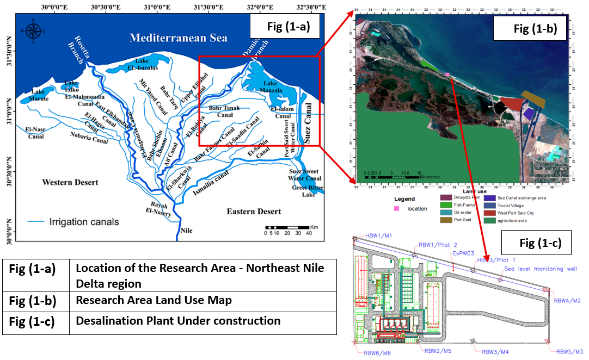
The study area lies in the northeast Nile Delta along the Mediterranean coast, where growing industrial, tourism, and energy projects have sharply increased the demand for potable water. With Nile water resources limited and seawater desalination increasingly challenged by petroleum contamination, reliance on the coastal multi-layered aquifer system has become essential. This research evaluates the quantitative and qualitative impacts of groundwater extraction to ensure a sustainable supply for a planned desalination plant requiring 50,000 ± 5% m³/day of raw water over a 50-year operational life. Time series analysis, supported by analytical modelling, was applied to short- and long-term pumping data from five exploration wells and two pilot production wells. Step drawdown tests determined efficiency, specific drawdown, specific capacity, and safe yield. Constant-rate pumping tests established aquifer transmissivity (T), hydraulic conductivity (K), and storativity (S). A continuous three-month pumping test assessed long-term operational performance. These field results were used to calibrate a mathematical model simulating drawdown within both wells and the aquifer, predicting interference between overlapping cones of depression. Simulation results suggest an optimal well field configuration of ten stations, each comprising two alternating production wells (A & B) pumping 220–260 m³/hr, yielding ~5,280 m³/day per station. Station spacing of 30–55 m is recommended to evenly distribute the drawdown and minimize interference. Analytical modelling confirmed that this layout would sustainably meet project demands while maintaining aquifer drawdown below ~29 m after 50 years of operation at 52,800 m³/day. Based on salinity predictions, extracted groundwater is expected to remain between the aquifer baseline (~25,000 mg/L) and Mediterranean seawater salinity, with no significant increase observed during the pilot pumping phase.
Egypt’s increasing need for fresh water has made alternative conventional water sources increasingly critical. 1, especially as pollution from oil and other contaminants degrades the quality of seawater used for desalination 2. In this context, groundwater has become a more attractive option due to its relatively better quality. 3. However, the growing reliance on groundwater necessitates a clear understanding of how pumping influences groundwater levels over time. 4.
In this study, time series analysis techniques were applied to quantify the effects of various stresses, particularly pumping, on groundwater levels within a complex coastal aquifer system. The approach involves modelling the aquifer’s head response to individual stressors, enabling the isolation of their respective impacts and providing better management and predictive capabilities for groundwater resources. The analysis draws on data collected during both short- and long-duration pumping tests.
The research focuses on an under-construction desalination plant in the northeast Nile Delta, illustrating how time series analysis can reveal temporal trends and assess the impacts of pumping on aquifer behaviour. This work supports the design of a production well field intended to supply the plant (Figure 1-c), with a required yield of 50,000 ± 5% m³/day over a projected 50-year operational life. 5. The study estimates interference between drawdown cones caused by neighbouring production wells, forecasts groundwater level variations over time, and proposes an optimal well field layout to ensure sustainable and continuous groundwater extraction over the plant’s operational lifespan.
Baseline information and data for the study area were collected, reviewed, and analyzed. This included published literature. 6, general and specific hydrogeological maps 7, and well inventory reports 8, 9, 10, 11, 12, 13, 14. The dataset also included groundwater level measurements from long-term continuous pumping tests, short-step drawdown tests, and extended pilot production well operation. These inputs supported the hydrogeological characterization of the study area and the application of time series analysis to reevaluate pumping data, determine aquifer hydraulic parameters, calibrate an analytical model to simulate aquifer conditions, and predict groundwater level declines and interference zones between production wells.
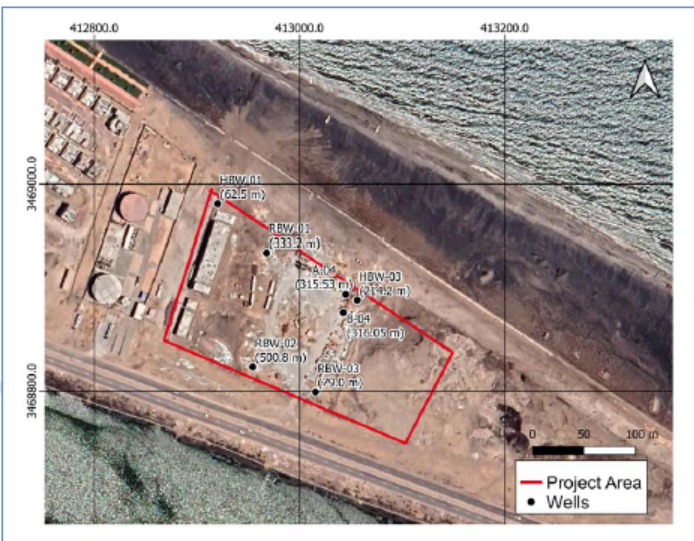
2.2. Analysis of Pumping Data for Seven Exploration/Production WellsThe study area contains five exploration wells and two pilot production wells (Table 1, Figure 3), constructed to evaluate well efficiency and assess the sustainability of proposed production well field operations. Eight autonomous CTD Diver sensors were installed to monitor groundwater level fluctuations, temperature, and electrical conductivity at high frequency, providing detailed records of short-term and long-term variations during pumping tests. These data were critical for assessing aquifer response and well performance over various pumping scenarios.


In the phase of well inventory the authors registered the basic data of (73) wells in the research area, depth from 60 to 780 meters, distributed in (8) development areas extracting groundwater, among them (25) observation wells, (47) production wells feeding the desalination plants and one deep injection well drains brine water.
2.4. Analysis of Pumping Test DataStep drawdown pumping test, Constant rate pumping test, and Recovery pumping test were conducted for the test production wells, PPW04A & PPW04B tapping the middle aquifer (B), and the observation was in the surrounding five exploration wells:
Pump test analysis has been carried out in this paper for all available pumping test data using several methods of analysis: Jacob 1 method (S-t analysis) (Jacob, 1947)Andthe Jacob 2 method (S-r analysis).Section2.5.2 presents analysis results for constant rate and recovery pumping tests and estimation of aquifer parameters from these tests. Section 3.2.2presents the results of the step drawdown pumping test analysis and estimation of general well equations and well efficiency for the different test wells. It shows details of the analysis and provides a summary ofthe obtained results at the end of each section.
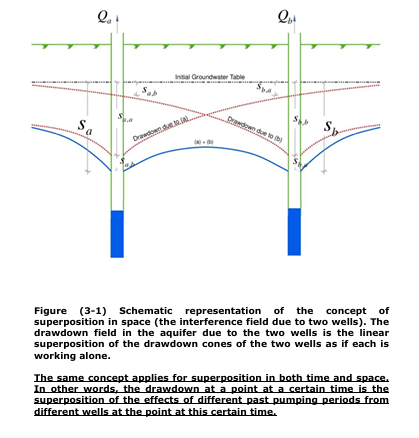
2.5. Analytical Model Development and CalibrationThe authors applied this model to ensure a good operation of the production well field and to avoid any negative impacts on the Aquifer (A) along the project lifetime. The model is based on the principle of linear superposition of well effects in space and time (Figure 4 shows a schematic representation of the superposition principle). This principle has been employed in the past in many studies and has proved successful in simulating the interference of well fields. This is because in all drawdown models, the drawdown value at a certain location in the aquifer is always linearly related to the discharge. Theis model has been and still is considered the widely accepted model to fit drawdown observations due to a well that fully penetrates a confined aquifer.

Modifications are made to allow for partial penetration, such as Hantush and Jacob (1955) (Kruseman and Ridder, 2000).The interference field due to two wells and the drawdown field in the aquifer due to the two wells' operation is the linear superposition of the drawdown cones of the two wells, as if each is working alone; the same concept applies for superposition in both time and space. In other words, the drawdown at a point at a certain time is the superposition of the effects of different past pumping periods from different wells at the point at this certain time.
To illustrate the general equation used in the model, consider a point in aquifer space at a distance ri from several n operating wells (where i = 1, 2, 3…, n). Consider also that the wells undergo periods of operations and stops (i.e., recovery) or periods of variable discharge pumping where j denotes a period of pumping (j = 1, 2, 3…..., np). Let t denote the elapsed time since pumping initially started in the aquifer. The drawdown S (t, z) at the point under consideration at height z from Aquifer Bottom and at time t is calculated from the following general equation:
 | (1) |
Where:
 Discharge from well i due to pumping period j (started at time
  and stopped at the time
 ).
).
 At which pumping period j started in well i.
 At which pumping period j started in well i.
 Partial penetration additional drawdown due to pumping period j at height z from bottom (calculated using iterative solutions of Bessel functions). See Kruseman and De Ridder (1994).
 = Partial penetration extra recovery due to the recovery period j at height z from the bottom. See Kruseman and De Ridder (1994).
T = Transmissivity
Sp = Pumping storativity
Sr = Recovery storativity (i.e., inverse due to recharge)
A spatiotemporal Python model was written in this study to implement the above general equation (equation 1), with libraries for both Theis, 1935 and Hantush and Jacob, 1955 formulations. Given that aquifer (B) contains multiple clay lenses with very low vertical permeability, the flow regime is dominated by horizontal movement. A sensitivity test was performed by running the model with partial penetration included (Hantush–Jacob) and comparing results to the Theis-only solution. The difference in predicted drawdown at observation well RBW01 was less than 5%, confirming that partial penetration effects are negligible in this system. This is consistent with Kruseman and De Ridder (1994), who noted that partial penetration has limited influence in confined multilayer aquifers with low vertical conductivity. Therefore, the Theis formulation was adopted for subsequent analysis, providing both a simpler form and an excellent fit to observed pumping test data. Accordingly, equation (1) reduces to:
 | (2) |
Although the study area aquifer is multilayered with clay interbeds, the effect of partial penetration was explicitly tested by comparing Theis (1935) and Hantush–Jacob (1955) formulations. The difference in predicted drawdown at the nearest observation well (RBW01) was less than 5%. This finding is consistent with Kruseman and De Ridder (1994), who noted that partial penetration has limited influence in confined multilayer aquifers with low vertical conductivity. Therefore, neglecting partial penetration in the final model is justified, as its influence on predicted drawdown and well interference is negligible in this system. The estimated aquifer parameters are Transmissivity (T), Storativity in pumping (Sp) and Storativity in recovery (Sr). These indicate how groundwater is released from the storage, and the ratio (Sr/Sp) should be close to unity. The value of (Sr/Sp< 1) suggests fast recharge during pumping tests, indicating a close recharge boundary, whereas (Sr/Sp> 1) indicates a no-flow boundary (less recharge).
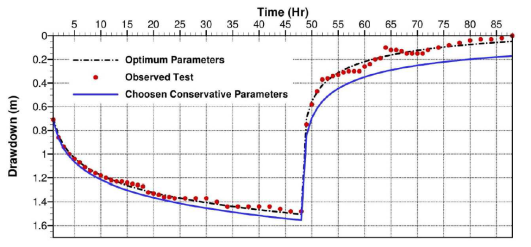
The model is applied to simulate the drawdown due to the short-term continuous pumping test with recovery, 48 hours of pumping followed by 40 hours of recovery, pilot production well PW04_B. The test was conducted by pumping a discharge of 295 m³/h. from well PW04_B and measuring the drawdown in observation well RBW1, which is at a distance of 78.38 m from the pumped well PW04_B. The calibration optimises the aquifer parameters (T, Sp, and Sr) that minimize the sum of squares of errors (SSE) between the observed drawdown and the calculated drawdown during the whole test (pumping and recovery) as follows:
Where: nt= total hours of test = 48 pumping+40 recovery = 88 hours
SSE = sum of squares of errors (note that the root mean square error can be calculated from 
st, obs = observed drawdown at hour t during the test
st, calc = calculated drawdown at hour t during the test
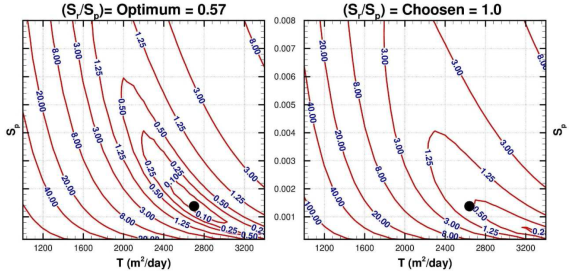
The optimum aquifer parameters are those that minimize SSE with the real observed drawdown. However, to account for the effect of any activities on the aquifer in the neighbourhood and any tidal effect, a background recovery trend was added to the observed values, and different aquifer parameters were selected accordingly. For the optimum case, the transmissivity (T) was estimated at 3,100 m²/day, the specific yield (Sy) at 0.0087, and the storage ratio (Sr/Sp) at 0.57. The chosen parameters, adjusted to reflect potential neighbourhood activities, were a transmissivity of 3,000 m²/day, the same specific yield of 0.0087, and a storage ratio of 1.0.
To provide an analysis of error, the SSE is evaluated at different levels of the aquifer parameters (T, Sp, and Sr/Sp). The SSE response surface is plotted versus possible combinations of model parameters in Figure 5, where the left panel is for Sr/Sp = 0.57 and the right panel is for Sr/Sp = 1. The optimum and chosen solutions fall into a distinguished global optimum (i.e., minimum) on the SSE surface. This indicates that there are no other solutions to the problem. In addition, the SSE value at both solutions is significantly lower than its values at the other possible combinations of the aquifer parameters, which reinforces the certainty of the solutions. (Figure 6) presents a comparison between the observed drawdown and the calculated drawdown for the short-term test using the optimum and the chosen parameters.


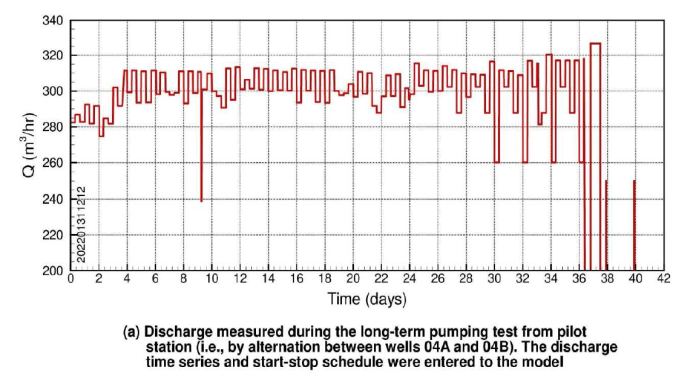
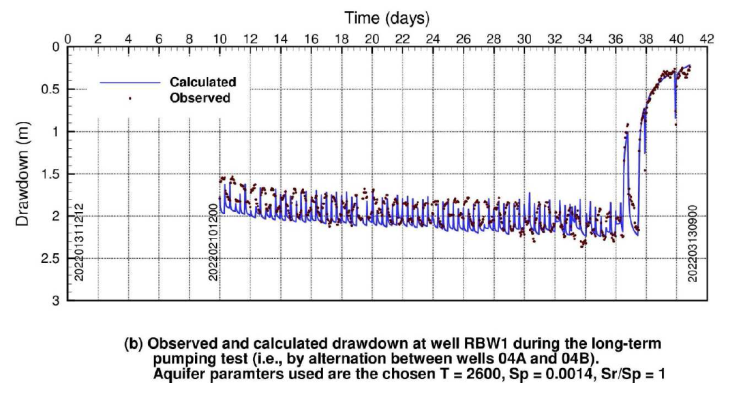
To test Aquifer Behaviour under long-term pumping, a long-termexperimental pumping for the pilot station 04 has been conducted from 24/1/2022 to 09/03/2022 by the owner by alternating pumping from the pilot station(wells 04A & 04B). The pumping during this period was kept continuous by alternatingthe pumping between wells 04B and 04A. Pumping discharges weremeasured, and the drawdown at observation well RBW1 was recordedcontinuously during this period. RBW1 is at 78.38 m and 68.37 m from 04B and 04A, respectively. Note thatobservation RBW01 is of the same depth configuration as thepumping wells 04A and 04B. The model has been fed with thedischarges exactly as measured (variable discharges – averaged foreach pumping period), and the start-stop schedule for alternatingbetween the two wells has also been entered into the model. Aquiferparameters are taken as the chosen parameters (i.e., T = 2600 m2/d, Sp = 0.0014, and Sr/Sp= 1). The time series of the discharge used in the model is given in Figure 7, whilemodel model-calculated drawdown and the observed drawdown along thevalidation period are presented in Figure 8. The model with thechosen parameters could successfully simulate the drawdownobserved during this long-term validation. It should be noted herethat long-term drawdown observations used in the validation alreadycapture any activities on the aquifer in the neighbourhood, and noadjustment was required.


For clarity, a comparison between the optimum and chosen aquifer parameters used in the calibration is summarized in Table 2, along with the rationale for each adjustment.
To account for possible uncertainties in aquifer properties, a sensitivity analysis was conducted by varying the calibrated parameters within a ±20% range around their chosen values. Transmissivity (T) was tested from 2,400 to 3,600 m²/day, and storativity (Sp) from 0.0011 to 0.0017. The storage ratio (Sr/Sp) was also varied between 0.8 and 1.2. Simulations showed that such parameter variations caused less than ±8% deviation in predicted drawdown at key observation points during the 50-year operational period. These results indicate that the model’s predictions are robust within reasonable parameter uncertainty bounds. Furthermore, the sum of squared errors (SSE) surface (Figure 5) confirms that the chosen parameters lie within a well-defined global minimum, reinforcing their reliability.
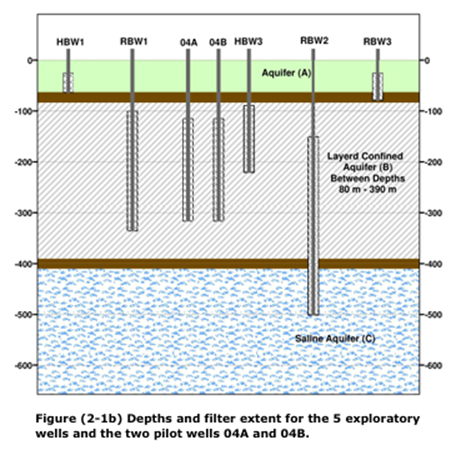
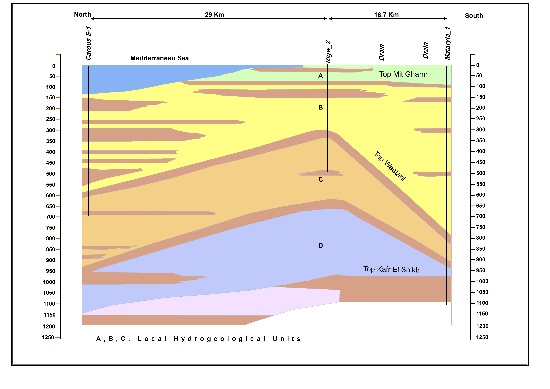
The research area consists of three aquifers separated by clay layers. The upper aquifer (A) extends from the surface to a depth of 50-75m, the middle Aquifer (B) extends from 80-390m, and the lower Aquifer (C) extends from 410-800m. Aquifer (B), which is isolated from the top and bottom by clay layers. This conceptualization was confirmed using the lithology data of the dug wells in the project area, and as illustrated in the conceptual hydrogeologic sketch of the aquifer system in the research area (Figure 9), where Aquifer (B) has a good potential for supplying raw water to the desalination project. Because it is naturally protected it connects to the sea some 10 to 20 km offshore, of course, there is some uncertainty regarding the extent of the aquifer into the sea due to limited offshore data, but there is evidence of hydraulic connection through some oil well logs (RIGW and PETROBEL, 2005), and through continuous monitoring of water level fluctuations in the observation wells tapping this layer and sealed off from other aquifers therefore, we avoided the groundwater extraction from the upper unconfined aquifer which is highly vulnerable to pollution from the sea to feed the desalination plant project.

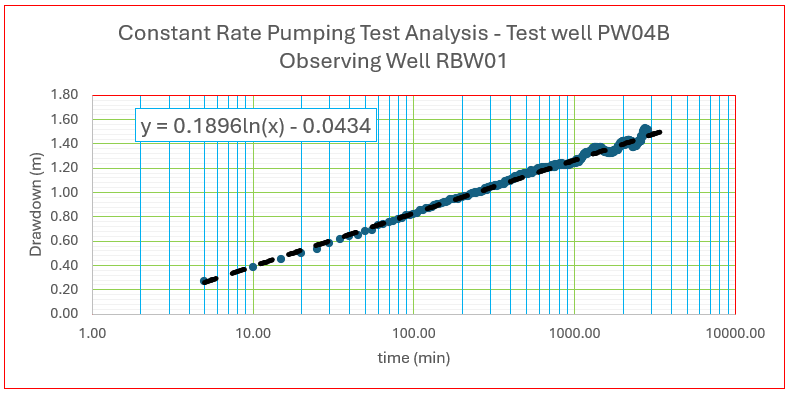
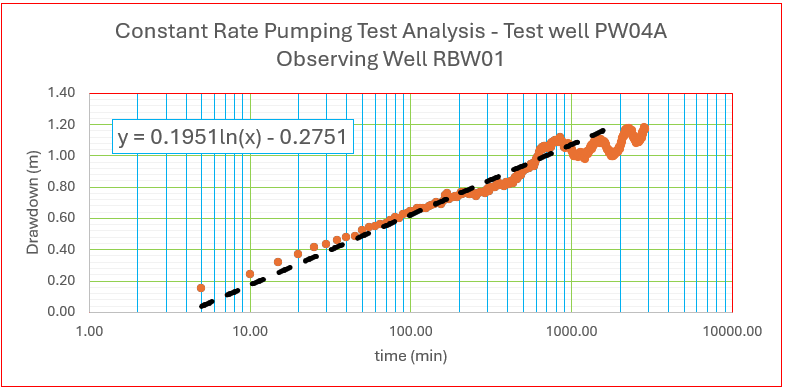
A long-duration constant-rate pumping test was carried out on the confined aquifer using pilot production wells PW04A and PW04B. Groundwater levels were monitored in the observation well RBW01, located near the pumping wells, to minimize the effects of well losses and capture the aquifer-scale response.
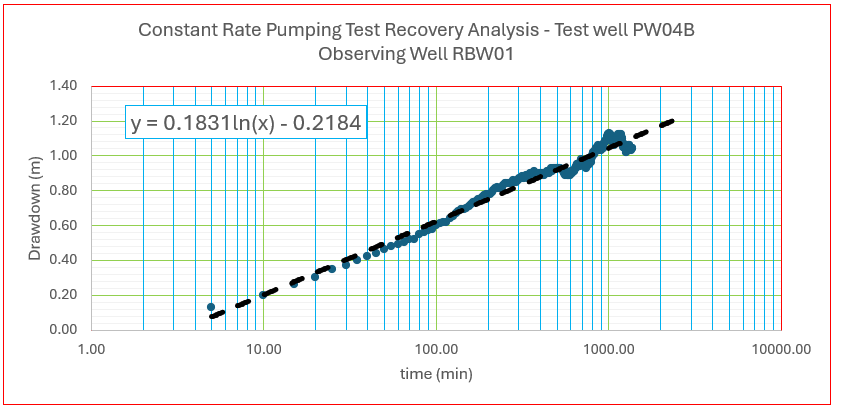
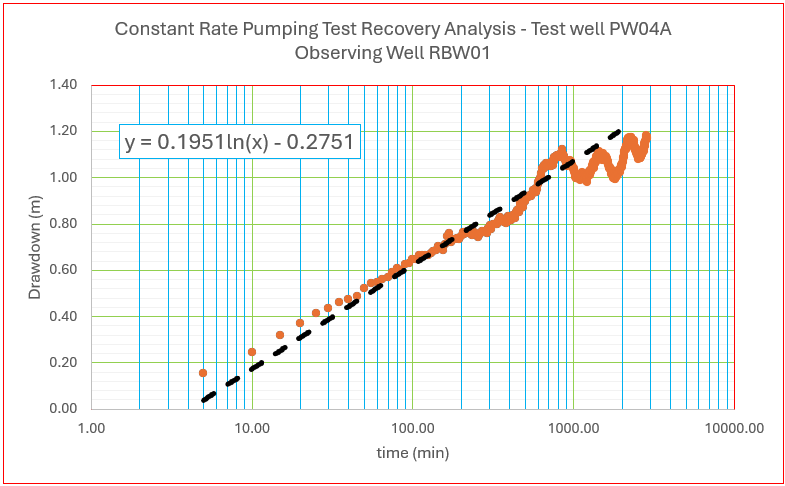
The pumping and recovery data were analyzed using the Cooper–Jacob time-drawdown method. (Jacob, 1947), which is a late-time simplification of the Theis solution. Transmissivity T and storativity S were estimated using the following equations:
Where:
T = transmissivity (m²/day)
Q = The pumping rate (m³/day)
Δs = is the slope of the line per one log cycle (m)
Storativity was calculated from the zero-drawdown time intercept (to) on the semi-log plot using:
 | (5) |
Where:
• S = storativity (dimensionless)
• T = transmissivity (m²/day)
• To= time at zero drawdown intercept (days)
• r = distance between pumping and observation wells (m)
The estimated transmissivity ranged between 2,851 and 3,283 m²/day, with an average of 3,025 m²/day, while the storativity ranged from 1.0×10⁻³ to1.2×10−3, indicating moderate to high permeability confined aquifers.


The pumping test results for well PW04A indicate that the transmissivity values obtained from the step drawdown test and recovery test analyses are 3001 m²/day and 3398 m²/day, respectively. Constant-rate pumping test analysis using the Jacob time-drawdown (S-t) method yielded a transmissivity of 3044 m²/day with a storativity of 1.1×10⁻³, while the Jacob recovery (S-r) method provided a transmissivity of 3283 m²/day and a storativity of 1.2×10⁻³. The average transmissivity across all methods is approximately 3182 m²/day, with an average storativity of about 1.1×10⁻³.
For well PW04B, the step drawdown test and recovery test analyses yielded transmissivity values of 3130 m²/day and 3851 m²/day, respectively. Constant-rate pumping test analysis using the Jacob time-drawdown (S-t) method resulted in a transmissivity of 2851 m²/day with a storativity of 1.0×10⁻³, while the Jacob recovery (S-r) method gave a transmissivity of 2919 m²/day and a storativity of 1.1×10⁻³. The average transmissivity from all methods is approximately 3188 m²/day, with an average storativity of about 1.1×10⁻³.
Step-drawdown pumping tests were performed to assess the efficiency and head losses in the two production wells, where the values are shown in Table 4 Specific drawdown (s/Q), specific capacity (Q/s), and well efficiency were calculated using the Jacob, 1947Method, separating total drawdown into formation losses (BQ) and well losses (CQ²).
 | (6) |
Where:
• E = well efficiency (%),
• B = aquifer loss coefficient (linear head loss, m),
• C = well loss coefficient (nonlinear head loss, s²/m⁵),
• Q = discharge rate (m³/s).
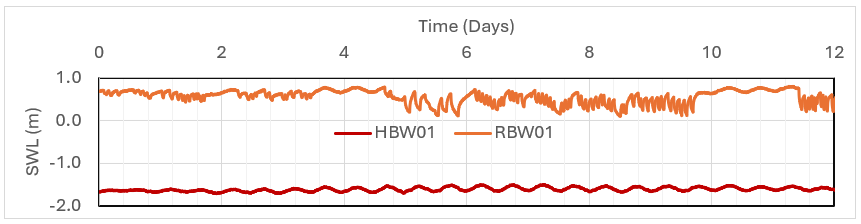
Static water level (SWL) measurements were conducted over a continuous 12-day period to evaluate groundwater flow directions and velocities in the aquifer system Figure 14. Monitoring focused on two key observation wells: HBW01, screened in Aquifer (A), and RBW01, screened in Aquifer (B). The recorded water levels demonstrated a clear distinction between the two aquifers. In Aquifer (B), SWL ranged from 0.6 m to 0.8 m above mean sea level, whereas in Aquifer (A), levels were consistently lower, ranging from –1.6 m to –1.4 m. This vertical head difference of over 2 m strongly indicates the presence of a low-permeability aquitard separating the two units. The stability of these readings throughout the monitoring period, and the absence of any influence from pumping in Aquifer (B) on water levels in Aquifer (A), further confirms the lack of vertical connectivity.

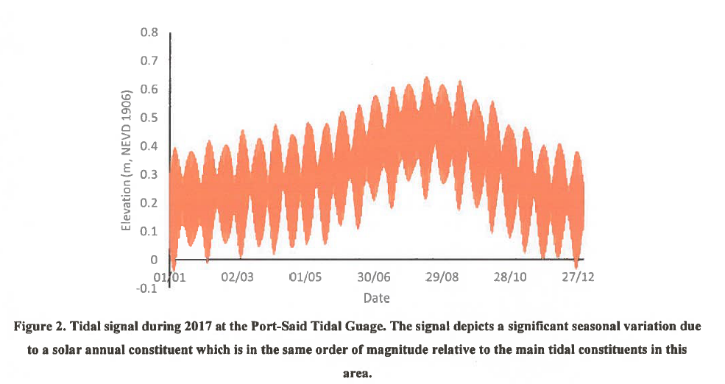
The nearest sea-tide gauge with available hourly sea level data is in Port Said, approximately 50 km northeast of the study area, and is maintained by the Coastal Research Institute (NWRC). Tidal records from this station (Figure 15) show that tides cause water level fluctuations of about ±0.30 m, driven by both the main tidal constituents and a seasonal (annual) component. This tidal influence is also visible in the SWL monitoring results of the observation wells and must be considered when interpreting groundwater level data in coastal aquifers connected to the sea.
Tidal influence was quantified using hourly sea-level records from the Port Said gauge, which indicated fluctuations of approximately ±0.30 m. Similar oscillations were detected in static water level monitoring at wells RBW01 and HBW01. During model calibration, this periodic component was incorporated as a background recovery trend to avoid bias in the parameter estimation. The magnitude of the tidal signal is minor compared to the predicted dynamic drawdowns of 20–30 m over the project’s 50-year horizon. Therefore, while tidal forcing is detectable in short-term water level records, its effect on long-term aquifer drawdown predictions is negligible.

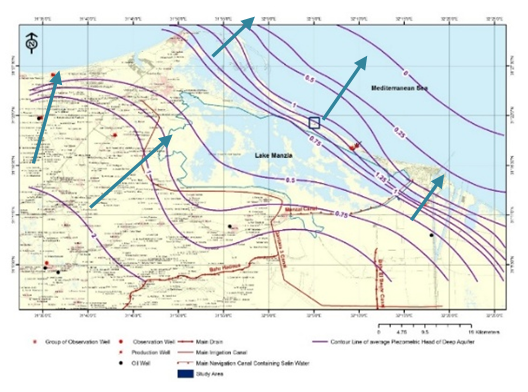
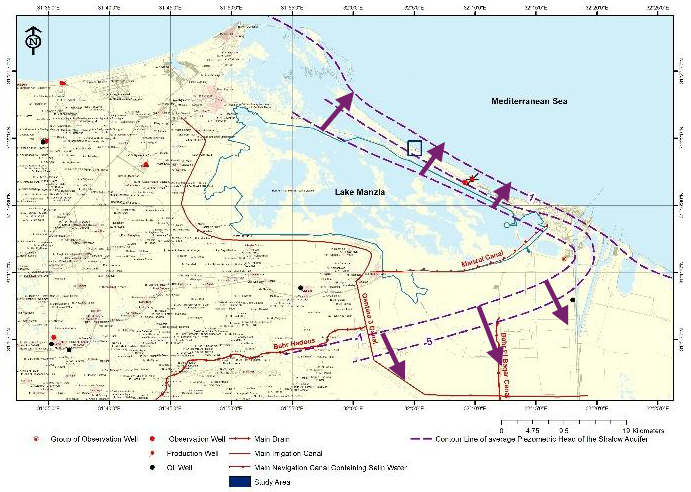
Updated groundwater level data from 17 wells in the RIGW National Monitoring Network were used to produce regional groundwater flow maps. In Aquifer (B), groundwater flows from the southeast (+2 m) toward the northeast (+1 m) and the Mediterranean Sea, largely independent of surface water influences.Figure 16. In Aquifer (A), groundwater flows from the northwest (0 m) to the southeast (–5 m), before turning east toward the Suez Canal, where heads reach approximately –24.7 m, a pattern strongly influenced by surface water bodies (Figure 16).

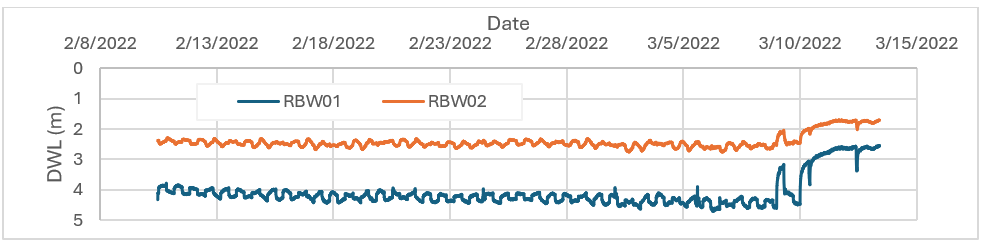
Dynamic water level monitoring during alternate pumping from production wells PW04A and PW04B showed distinct drawdown and recovery responses in observation wells RBW01 and RBW02 (Figure 18). The sharper and more pronounced response in RBW01 reflects stronger hydraulic connectivity to the pumped middle aquifer, while the more moderated change in RBW02 is consistent with its dual connection to both the pumped middle Aquifer and the deeper, unpumped bottom aquifer.

The authors applied the model to simulate the anticipated effects of the proposed extraction wells field on groundwater levels and salinity and focused on determining the anticipated drawdown in both the static and dynamic groundwater levels as well as salinity changes over the lifetime of the project and. proposes useful recommendations for wells field layout,operation pattern and the production well design in the light of the modeling and tests results.
4.1. Discharge of Single Well and Operation ShiftsTo ensure that wells operation falls in the optimum rangewith the least possible well head losses inside wells, and to cope with thelong lifetime of the project, it is advised at this stage of the project toconsider a wells field composed of 10 stations each station composed of two alternating production wells A&B to provide project with 50,000+5% /day,each station produce 5200 : 5500 m3/day and each well produce from 220 to 250 m3/hr.However, after testing the first stage of well construction, the numberof stations and the recommended operation pattern willbe adjusted depending on the testingresults.
During the simulations,the authors consider that the system iscomposed of 10 stations. Where each station consists of two alternating wells (A and B).Group (A) wells alternate with group (B) wells, where each group worksfor 24 hours continuously,and the other group recovers at the same time. Accordingly, the designdischarge of a single well that will be used in the wells field simulationsis 220 m3/hr.to keep the least linear(Formation losses) and nonlinear (Well Losses) lossessea Table 5.
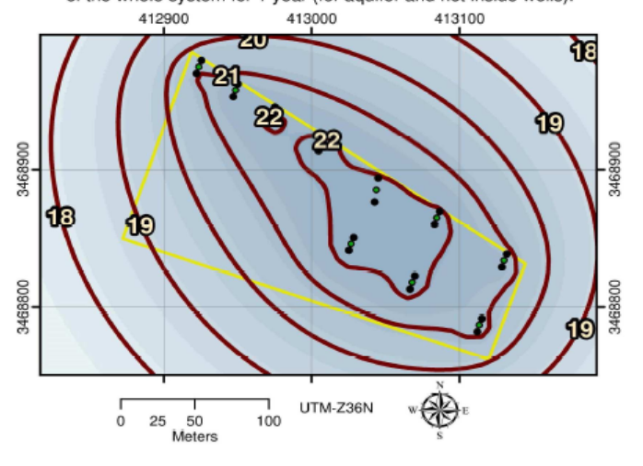
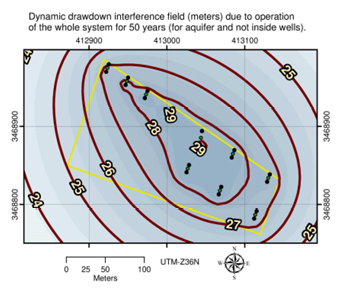
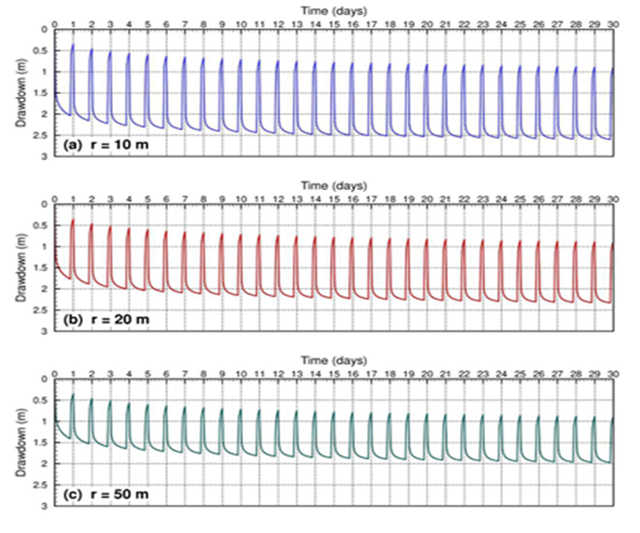
The estimated dynamic drawdown, as shown in the figures below, is attributed to the interference within the aquifer resulting from the well operation pattern. The desalination plant operates on a rotating system in which either Group A or Group B of wells are active at a time. Each group operates for 24 hours before switching to the other group. The discharge of each well is approximately 5,280 m³/day, resulting in a total daily production of around 52,800 m³/day from the 10 paired wells (A&B).


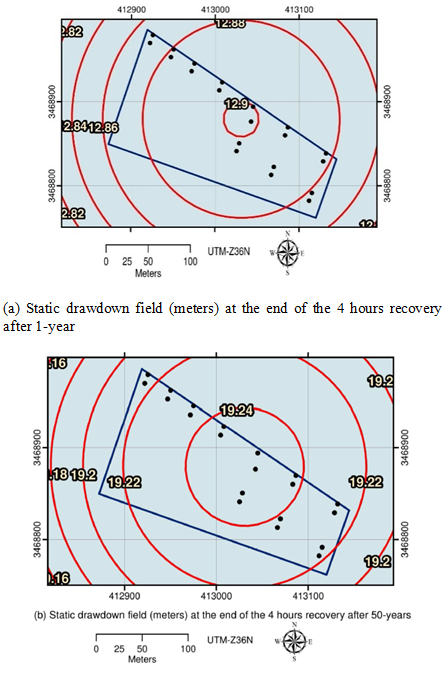
The well stations are arranged at variable horizontal distances; the minimum distance is 30 m, while the maximum distance is 55 m.This section provides a detailed simulation of the wells interference zones and presents their drawdown contours. The cone of interference, even with conservative parameters, is accepted.
4.3. Estimated Salinity ChangesBased on the estimated salinity changes, the raw groundwater quality is expected to meet the required standards for desalination. Throughout the project’s lifetime, salinity is projected to remain between the current aquifer salinity of about 25,000 mg/L (lower limit) and the Mediterranean Sea salinity (upper limit). In the early months of operation, salinity will be closer to the aquifer’s current level, gradually increasing toward sea salinity within the first year, after which it will rise very slowly, remaining bound by the maximum seawater.
Static water level analysis (Figure 14) indicates that the aquifer is hydraulically connected to the sea offshore at an estimated distance of 10–20 km, where bathymetric levels match the aquifer thickness. This explains the rapid recovery observed in nearby observation wells after pumping and sets an upper salinity limit equal to that of the sea. Groundwater mixing from the Nile Delta is expected to reduce salinity, particularly during the early operational phase. Mixing with the lower-salinity Aquifer C is unlikely, as all aquifers have very low vertical permeability, and Aquifers B and C are separated by an impermeable black clay layer at depths of 390–410 m, as confirmed in lithological profiles from wells RBW2 and RBW1, and supported by previous studies.
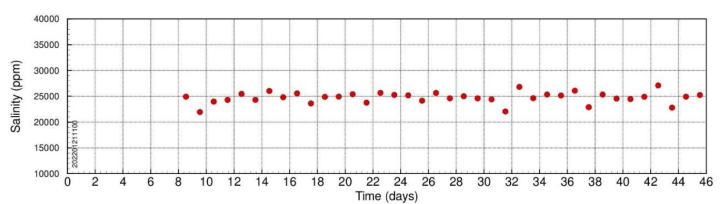
To assess potential salinity trends due to pumping, continuous salinity monitoring was carried out during the long-term pumping test (January–March 2022) at Pilot Station No. 4. Results (Figure 21) show no significant statistical increase in salinity during the test. However, this finding is not conclusive because the average pumping rate of 300 m³/hr produced only a small drawdown of approximately 2 m over the two-month test period.

Hence, the range of the salinity to expect is certainly between a minimum limit of 25,000 mg/L and a maximum limit of sea salinity. However, and since the sea constitutes a very close constant-head boundary condition, Drawdown-driven inflow from the sea is expected to dominate recharge at the project site the contribution of water from the Nile Delta Aquifer and accordingly the expected steady state salinity will be close to sea salinity which will be reached quickly before the end of first year of operation.
4.4. Estimated Salinity ChangesThe Dynamic drawdown inside the wells (sw, i) inside well idue to the operation of the 10-station system at any time is calculated from:
Where:
•  = Well drawdown at well i at time t.
•  = Aquifer dynamic drawdown at the well location at time t due to the past operation of the whole system.
•  = Aquifer dynamic drawdown just outside the well i due to itself alone working for a period (
 Wheret’ is the last time pumping started from well i. This component is subtracted because it is already accounted for in the value of BiQ.
• Bi, Ci = Well i head loss coefficients.
• Q = Discharge of the well = 265 m3/hr
Figure 22 Shows time series of the same month at different times along the project lifetime (at time zero, 1 year, 10 years and 50 years) at the location of maximum drawdown in the aquifer. The figures give the drawdown at the critical point in the aquifer. Table 7 summarizes the results.

The calibrated analytical model tested the production Wells field Horizontal Arrangement, effects of the proposed extraction on the groundwater levels and suggested an optimum wells field layout.Generally, increasing the wells' separation and orienting the wells as much as possible on one line parallel to the shoreline is the ideal arrangement and since the project area is very limited and wells must be installed inside the area, which constitutes a constraint on setting well arrangements, but since the aquifer is characterized by good transmissivity. The drawdown due to a pumping well in the Aquifer at a distance of 20 m is not significantly higher than the drawdown at a distance of 50 m (Figure 19)

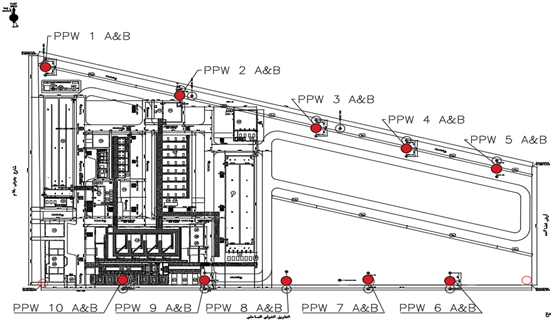
Figure 24 Illustrates that the two alternating wells operate with discharge rates of about 220 m³/hr. Given that the spacing between wells varies from 30 to 55 meters, this configuration is technically acceptable, and this operation schedule can be summarized in the following daily discharge equation:
 |
Figure 24 The proposed well field layout contains 10 Stations, each consisting of two wells, A & B, based on the model simulation results. Table 8 shows the proposed well locations.

Optimizing the design of production wells in this field is an iterative process, as the operating conditions will vary slightly among the 20 planned wells. Observations from Pilot 4A well indicate that the high drawdown is primarily due to low well efficiency, underscoring the importance of careful design and construction to maximize performance.
To ensure proper gravel pack placement and adequate well development, it is recommended to construct production wells to a depth of 330 m ± 5%, using 400 mm diameter PVC casing and 300 mm diameter screens with 12–15% open area, fitted with a reducer. For safe pump operation, a minimum water cover of 30 m above the pump intake should be maintained. Based on predicted drawdown conditions, submersible pumps should be installed at a depth of approximately 90 m, with a recommended installation depth of 100 m to provide additional operational safety and flexibility.
Based on the measured dynamic drawdown in well PW04B (29.00 m, Section 3.2.1.1) and the predicted aquifer drawdown at the well location after 50 years of operation (28.78 m, Section 4.2.2), along with the estimated head losses in the well, the pump setting depth can be determined. At the design pumping rate of 260 m³/hr, the combined total dynamic drawdown is 57.78 m. For operational safety, the pump should be positioned at least 30 m below the water level, with an additional 3 m to account for the pump length. This results in a required pump setting depth of approximately 90 ± 5 m, with a recommended installation depth of 100 m.
The groundwater level and pumping test datasets supporting this study are available from the corresponding author upon reasonable request. The Python scripts used to implement the analytical superposition model (Theis and Hantush–Jacob formulations) can also be shared for academic and research purposes.
• Hydrogeological conceptual model shows that the research area is underbed by three aquifers separated by clay layers units upper unconfined aquifer extends from the surface to a depth of 50-75m, middle confined aquifer extends from 80-390m, and lower confined aquifer extends from 410-800m the middle aquifer was bounded from top and bottom by aquitard layer. This conceptualization was confirmed using the lithology data of the dug exploration wells in the research area.
• The constant-rate pumping tests confirmed that the middle-confined aquifer possesses moderate to high permeability, with transmissivity values averaging around 3,025 m²/day and storativity about 1.1×10⁻³. These results indicate that the aquifer’s capacity will support sustainable groundwater extraction, and the analysis of recovery data reinforces the reliability of the estimated hydraulic parameters from the constant pumping test.
• The step drawdown test results for the pilot production wells, PW04A and PW04B, revealed a consistent decline in well efficiency as discharge rates increased. For PW04A, efficiency decreased from 76.4% at a discharge of 147 m³/hr. To 60.5% at 311 m³/hr., with drawdown increased from 17.6 m to 46.4 m and specific capacity dropping from 8.4 to 6.7 m³/hr./m. Similarly, PW04B showed a reduction in efficiency from 76.0% at 150 m³/hr. To 59.3% at 327 m³/hr., as drawdown increased from 14.9 m to 40.2 m and specific capacity declined from 10.1 to 8.1 m³/hr./m. These trends indicate increased head losses and reduced well performance under higher pumping rates. However, both exhibited improved efficiency and more stable behaviour during long-term constant rate pumping between 220 :260 m3/h, suggesting that the aquifer system responds better under steady-state continuous long pumping conditions compared to short-term stepped increases in stress.
• Findings arising from this paper offer valuable input for further analysis of expected groundwater changes due to short- and long-term pumping within the complex Northeast Nile Delta aquifer system and suggest the optimum well field layout, which will produce. 50,000 + 5% m3/dayraw groundwater to feed sustainably a desalination plant under construction in the research area, along its lifetime (50 years)
• Based on estimated salinity changes, expected that the raw groundwater quality meets the requested standards for desalination, where the salinity during thelife time of the project shall fall within the current aquifer salinity25,000 mg/L as a lower limit and the Mediterranean Sea salinityas an upper limit especially in the first months of operation and itwill reach close to sea salinity during the first year of operationand very slowly increases, but it will be bound by sea salinity as a maximum limit.
• Based on the Analytical Model simulation of the drawdown interference due to multiple neighboring production wells operation, the extraction well fields should be composed of ten stations, each composed of two alternating production wells, A & B, each well producing 220 to 260 m3/hr. And each station produces about 5280 m3/day to feed the project with the required raw water. In the condition that the horizontal distance between the neighbouring stations ranges from 30 to 55 meters,to distribute the drawdown in the aquifer due to the neighbouringwells interference equally in the project area.
• The dynamic drawdown inside a well depends on both the dynamic drawdown in the Aquifer at the well location and the head losses of the well, and tocalculate the pump setting inside the well, you will sum the total dynamic drawdown in the wells corresponding pumping ratesof 220 to 260 m3/hr.Which is about 56.8 m. and taking an additional 30 m. of water cover above the submersible pump, in addition to 3 meters of the pump length. Therefore,the pump depth should be installed at 90+ 5 m. meters depth.
• Time series analysis is a powerful tool for understanding the complex dynamics of multi-layered coastal aquifers used to evaluate the effectiveness of different mitigation strategies, such as reducing pumping rates, improving the groundwater quality, increasing the production efficiency and evaluating the impacts of pumping on groundwater resources. This study highlights the importance of time-series analysis for sustainable groundwater management in vulnerable coastal regions, demonstrated here for the northeast Nile Delta.
6.2. Recommendations• The recommendations provided for well design can be useful and should be considered carefully. In addition, lessons learnt during the construction and testing of the test wells on the site should also be considered.
• The high drawdown observed inside the pumping wellsconstructed so far, exceeding 40 m during pumping from the well, is mainly attributed to the low well efficiency. Care needs to be taken during the final design and construction of the project wells in the future, to increase efficiency as far as possible
• Future production wells should be constructed to ~330 m depth (±5%) using 400 mm PVC casing and 300 mm screens with reducers. Proper gravel packing and well development are essential to maximize efficiency, especially given the large well depth.
The author gratefully acknowledges the Regional Institute for Groundwater (RIGW) and Veolia for their valuable assistance in data collection and for providing useful information that greatly supported this study. Sincere thanks are also extended to Prof. Hoda Sousa for her insightful discussions and constructive guidance, which enriched the quality of this research.
| [1] | Abdelfattah, M., A. Gaber, M.H. Geriesh, and T.M. Hassan, 2021. Investigating the Less Ambiguous Hydrogeophysical Method in Exploring the Shallow Coastal Stratified-Saline Aquifer: A Case Study at West Port Said Coast, Egypt. Environmental Earth Sciences 80: 159. | ||
| In article | View Article | ||
| [2] | Elsaie, Y., S. Ismail, H. Soussa, M. Gado, and A. Balah, 2023. Water Desalination in Egypt: Literature Review and Assessment. Ain Shams Engineering Journal 14: 101998. | ||
| In article | View Article | ||
| [3] | Ogunbiyi, O., R. Al-Rewaily, J. Saththasivam, J. Lawler, and Z. Liu, 2023. Oil Spill Management to Prevent Desalination Plant Shutdown from the Perspectives of Offshore Cleanup, Seawater Intake and Onshore Pretreatment. Desalination 564: 116780. | ||
| In article | View Article | ||
| [4] | Stein, S., A. Russak, O. Sivan, Y. Yechieli, E. Rahav, Y. Oren, and R. Kasher, 2016. Saline Groundwater from Coastal Aquifers As a Source for Desalination. Environmental Science & Technology 50: 1955–1963. | ||
| In article | View Article PubMed | ||
| [5] | Lapworth, D.J., T.B. Boving, D.K. Kreamer, S. Kebede, and P.L. Smedley, 2022. Groundwater Quality: Global Threats, Opportunities and Realising the Potential of Groundwater. Science of the Total Environment 811: 152471. | ||
| In article | View Article PubMed | ||
| [6] | IGWEC, 2018. Results of the Additional Groundwater Field Investigations to Reassure the Technical Feasibility of West Port Said Project Phase One; Extraction of 50,000 M3/Day, based on the Analytical Model Method. Technical Report, Port Said, Egypt. Unpublished Report. | ||
| In article | |||
| [7] | Hydrogeological Map of Nile Delta, 1992. | ||
| In article | |||
| [8] | DASCO, 2018a. Final Technical Report of Well HBW 01. National Egyptian Drilling & Petroleum Services Co. (DASCO), Cairo, Egypt. | ||
| In article | |||
| [9] | DASCO, 2018b. Final Technical Report of Well RBW 01. National Egyptian Drilling & Petroleum Services Co. (DASCO), Cairo, Egypt. | ||
| In article | |||
| [10] | DASCO, 2018c. Final Technical Report of Well RBW 02. National Egyptian Drilling & Petroleum Services Co. (DASCO), Cairo, Egypt. | ||
| In article | |||
| [11] | DASCO, 2018d. Final Technical Report of Well HBW 03. National Egyptian Drilling & Petroleum Services Co. (DASCO), Cairo, Egypt. | ||
| In article | |||
| [12] | DASCO, 2018e. Final Technical Report of Well RBW 03. National Egyptian Drilling & Petroleum Services Co. (DASCO), Cairo, Egypt. | ||
| In article | |||
| [13] | DASCO, 2021a. Final Technical Report of Well PW04A. National Egyptian Drilling & Petroleum Services Co. (DASCO), Cairo, Egypt. | ||
| In article | |||
| [14] | DASCO, 2021b. Final Technical Report of Well PW04B. National Egyptian Drilling & Petroleum Services Co. (DASCO), Cairo, Egypt. | ||
| In article | |||
Published with license by Science and Education Publishing, Copyright © 2025 Momen Taher, Mohamed Eizeldin, Samia A. Saad, Mostafa Soliman and Mohamed Gad
 This work is licensed under a Creative Commons Attribution 4.0 International License. To view a copy of this license, visit
http://creativecommons.org/licenses/by/4.0/
This work is licensed under a Creative Commons Attribution 4.0 International License. To view a copy of this license, visit
http://creativecommons.org/licenses/by/4.0/
| [1] | Abdelfattah, M., A. Gaber, M.H. Geriesh, and T.M. Hassan, 2021. Investigating the Less Ambiguous Hydrogeophysical Method in Exploring the Shallow Coastal Stratified-Saline Aquifer: A Case Study at West Port Said Coast, Egypt. Environmental Earth Sciences 80: 159. | ||
| In article | View Article | ||
| [2] | Elsaie, Y., S. Ismail, H. Soussa, M. Gado, and A. Balah, 2023. Water Desalination in Egypt: Literature Review and Assessment. Ain Shams Engineering Journal 14: 101998. | ||
| In article | View Article | ||
| [3] | Ogunbiyi, O., R. Al-Rewaily, J. Saththasivam, J. Lawler, and Z. Liu, 2023. Oil Spill Management to Prevent Desalination Plant Shutdown from the Perspectives of Offshore Cleanup, Seawater Intake and Onshore Pretreatment. Desalination 564: 116780. | ||
| In article | View Article | ||
| [4] | Stein, S., A. Russak, O. Sivan, Y. Yechieli, E. Rahav, Y. Oren, and R. Kasher, 2016. Saline Groundwater from Coastal Aquifers As a Source for Desalination. Environmental Science & Technology 50: 1955–1963. | ||
| In article | View Article PubMed | ||
| [5] | Lapworth, D.J., T.B. Boving, D.K. Kreamer, S. Kebede, and P.L. Smedley, 2022. Groundwater Quality: Global Threats, Opportunities and Realising the Potential of Groundwater. Science of the Total Environment 811: 152471. | ||
| In article | View Article PubMed | ||
| [6] | IGWEC, 2018. Results of the Additional Groundwater Field Investigations to Reassure the Technical Feasibility of West Port Said Project Phase One; Extraction of 50,000 M3/Day, based on the Analytical Model Method. Technical Report, Port Said, Egypt. Unpublished Report. | ||
| In article | |||
| [7] | Hydrogeological Map of Nile Delta, 1992. | ||
| In article | |||
| [8] | DASCO, 2018a. Final Technical Report of Well HBW 01. National Egyptian Drilling & Petroleum Services Co. (DASCO), Cairo, Egypt. | ||
| In article | |||
| [9] | DASCO, 2018b. Final Technical Report of Well RBW 01. National Egyptian Drilling & Petroleum Services Co. (DASCO), Cairo, Egypt. | ||
| In article | |||
| [10] | DASCO, 2018c. Final Technical Report of Well RBW 02. National Egyptian Drilling & Petroleum Services Co. (DASCO), Cairo, Egypt. | ||
| In article | |||
| [11] | DASCO, 2018d. Final Technical Report of Well HBW 03. National Egyptian Drilling & Petroleum Services Co. (DASCO), Cairo, Egypt. | ||
| In article | |||
| [12] | DASCO, 2018e. Final Technical Report of Well RBW 03. National Egyptian Drilling & Petroleum Services Co. (DASCO), Cairo, Egypt. | ||
| In article | |||
| [13] | DASCO, 2021a. Final Technical Report of Well PW04A. National Egyptian Drilling & Petroleum Services Co. (DASCO), Cairo, Egypt. | ||
| In article | |||
| [14] | DASCO, 2021b. Final Technical Report of Well PW04B. National Egyptian Drilling & Petroleum Services Co. (DASCO), Cairo, Egypt. | ||
| In article | |||