The study revealed high concentrations of cadmium (Cd), mercury (Hg) and uranium (U) in the tributary streams of the Lobaye river in the Moboma region. The results of mathematical models of sediment contamination suggest that anthropogenic activities may be the main sources of heavy metal pollution, which may come from gold mining activities. All the watercourses present a considerable ecological risk index. The effects of this pollution are devastating. Heavy metals, such as mercury, accumulate in sediments and bioaccumulate in the food chain, affecting not only aquatic fauna, but also the human communities that depend on these resources for their livelihood. The contamination of water resources by gold mining calls for effective decontamination solutions. Among the techniques available, media filtration, in particular the use of zeolite bricks, stands out as an inexpensive option that can be easily adapted to the CAR. Thanks to their porous structure and ion exchange properties, these local materials effectively trap heavy metals such as mercury, lead and others. This simple, cost-effective filtration system offers a sustainable alternative to costly chemical methods. By incorporating this technology, local communities can reduce the toxicity of their water resources while minimising environmental impacts.
Considered to be the backbone of the economy in developing countries, artisanal gold mining makes a significant contribution to GDP on the African continent 1, 2. Artisanal gold mining, commonly known as orpaillage, consists of searching for and mining gold contained in alluvial, eluvial or vein deposits 3. This activity can be carried out using rudimentary means (peels, pans, tubs, packhorses, etc.) or mechanised means. Since the 2000s, the African continent has seen a boom in artisanal gold mining due to its attractiveness on the world market. This has contributed to the destruction of plant cover and the contamination of water by man-made chemicals such as mercury, cyanide, acids used in the gold extraction process to improve yield 4 and geochemical substances. Several authors have shown that gold mining has a considerable impact on the environment. In Côte d'Ivoire, L.M.Koudio et al (2023) have shown that the health risks associated with drinking contaminated water are very high in the gold mining area 4. In addition, studies carried out in gold-mining areas in Ghana, Egypt, the Republic of Congo, Sierra Leone, Burkina Faso and Mali have confirmed the physical and chemical alteration of rivers and sediments and the extinction of aquatic species as a result of poor gold-mining practices 5, 6, 7, 8. The Central African Republic is not immune to the effects of gold mining. In 2019, an interministerial report showed that the Ouham River at Bozoum is heavily contaminated with heavy metals, particularly mercury 9. These metal contaminants are known to affect the function of vital organs, delay neurological development in children, and many are linked to increased risks of cancer 10.
The Lobaye River and its tributaries in the Moboma region of southwest Central Africa are currently under the influence of gold panning since the 2013 gold rush marked by the discovery of the Ndolobo deposit. In this region. gold mines use artisanal and semi-mechanized methods to extract gold. depending on the type of gold deposit exploited. To date. very few studies have been carried out on the possible impact of gold panning activities in Moboma. The main objectives of this study were to determine the distribution of heavy metals and the degree of pollution in sediments from Moboma gold panning sites.
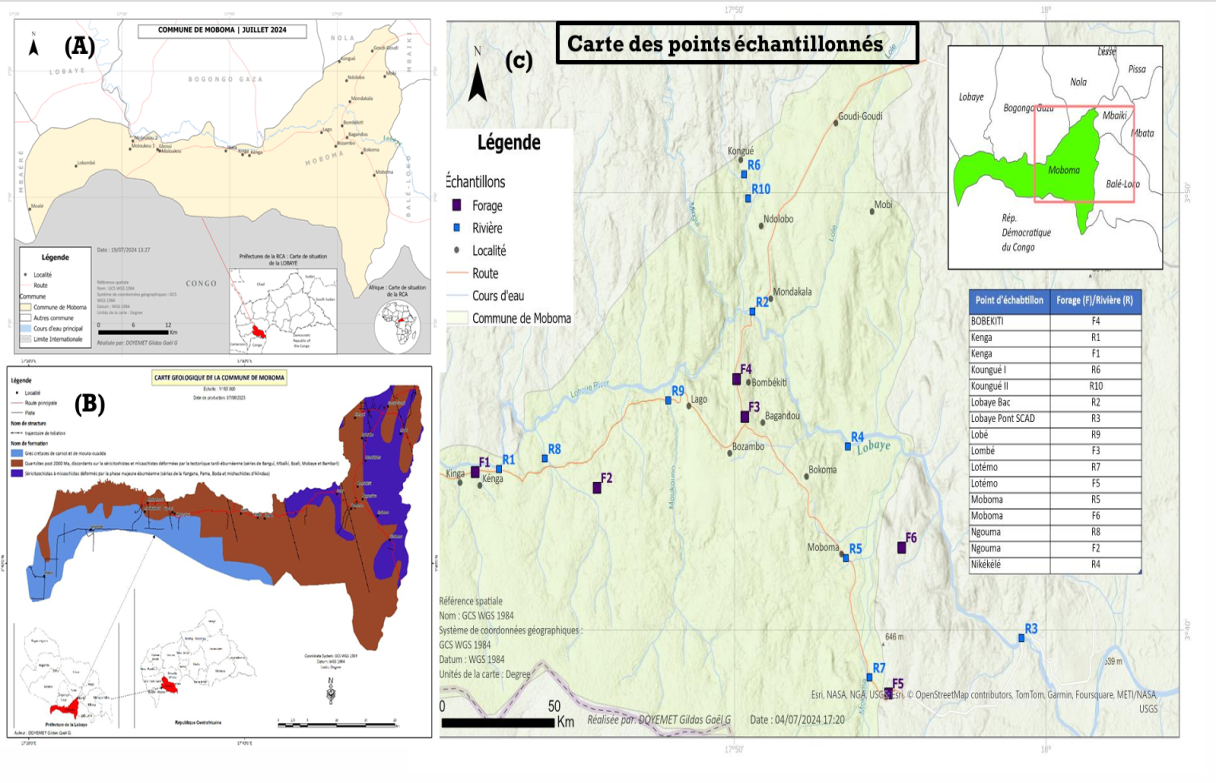
The Moboma gold zone is located in the M'baïki sub-prefecture in the south-west of the Central African Republic (CAR) between latitudes 3°66‘ and 3°85’ north and longitudes 17°65‘ and 18°98’ east (figure 1.A). The commune of Moboma is influenced by the humid tropical climate of the Central African Republic, with two seasons. The dry season is limited to the months of December, January and February, while the rainy season lasts longer. The region has numerous streams and temporary marigots alongside perennial watercourses. Moboma's watercourses have regimes that are closely linked to rainfall. Average annual rainfall varies between 1300 mm and 1600 mm. Average annual temperatures range from 21.5°C to 32.7°C. The watercourses in the commune of Moboma flow into the Lobaye river, which in turn feeds the Congo river. The Lobaye river, a right-hand tributary of the Oubangui, rises in the Yadé massif near Bouar, and is a favourite fishing ground for the local population, as it is rich in fish. The physiography of Moboma shows that the commune is formed by sandstone plateaux at altitudes ranging from 330 m to 650 m and ancient peneplains. Many international researchers have taken an interest in the geology of the Central African Republic, particularly the LOBAYE prefecture. They have shown that the schisto-quartzite formations are at the origin of Moboma's gently undulating landscape, and the cover formations observed are mostly quartzites resting on lower formations dominated by schists (figure 1. B).There are different types of soil in Moboma, depending on colour, texture, humus content and laterite evolution. Generally, the soils are impoverished lateritic with intrusions of hydromorphic soils. Their sandy texture on the surface and clay at depth allows good root penetration. The forest covers a large part of the commune, enabling the local people to grow coffee, oil palm, cassava, groundnuts and maize.
2.2. SamplingThe various sampling points (figure 1.C) were selected on the basis of site accessibility and the nature of the gold mining techniques used. We therefore targeted the semi-mechanised extraction site at Nikékélé, where alluvial mining is carried out using dredges. To assess the impact of this activity, we took samples of water and sediment (0-20 cm) deep at. manual coring) upstream (R2, Lobaye bac), at the site bank (R4, Nikékélé) and downstream (R3, Lobaye pont scad). Extraction activities were not taking place during the sampling period. Samples were also taken at seven other sites where gold miners were using the sluice and panning technique. These were points R1, R5, R6, R7, R8, R9 and R10. It should be noted that points R6 and R10 are tributaries of the Lobaye river and flow upstream from R2, about 2 kilometres away. In addition to these sampling points, we took groundwater samples (six in total) from boreholes in the surrounding villages. During the sampling campaign, physical field measurements (pH and turbidity) were taken. Water samples for heavy metal analysis were taken in acidified scintillation vials (50µl, HNO3 37%). The samples (sediment and water) were kept in a cooler and then sent to LASIRE (advanced spectroscopy laboratory for interactions, reactivity and the environment) at the University of Lille for analysis.

In order to determine the concentrations of major and minor elements present in the sediments of the 10 sites, we carried out total attacks (total mineralisation) on the fine fraction of the sediment, which is generally considered to be the fraction in which metals are mainly associated. Chemical analysis of TMEs in sediments was carried out on the fine fraction (<63µm) of sediments to which trace metals preferentially associate (Bouih. 2005). Sediments were digested by total decomposition following the methods used by Lesven (2008) in his doctoral thesis. In a Teflon etching tube. approximately 0.2 g of fine. dry sediment was mixed with 10 ml of 50% concentrated hydrofluoric acid (Prolab) and 5 ml of supra-pure nitric acid (HNO3) (Merck. 65%). The tube is heated at 140°C for approximately 48 hours. This first step solubilizes the majority of carbonates. aluminosilicates. sulfides. certain oxides and organic compounds. Following evaporation of the solution. the residue is mineralized with a mixture of 6 ml hydrochloric acid (HCl) (Merck. supra pure. 37%) and 2 ml nitric acid (Merck supra pure. 65%). This mixture is heated to 120°C until the solid residue is completely dissolved. The latter solution is then almost completely evaporated (0.5ml); then 20ml milli-Q water is added to rinse the tube walls and solubilize the metals adsorbed to them. The solution is then filtered over a cellulose acetate membrane (Swinnex. Millipore) with a porosity of 0.45 µm to remove any remaining carbon particles. Trace metal analysis was carried out by ICP-AES at the Laboratoire Avancé de Spectroscopie pour les Interactions. la Réactivité et l'Environnement (LASIRE) at the University of Lille. To validate our results. certified sediments (HISS-1; MESS-3 and PACS-3) were analyzed using the same mineralization protocol.
Analysis of total mercury in sediments was carried out by AMA 254. The sample (50mg) was placed in a nickel scoop. The assembly is then introduced into the decomposition/calcination furnace. First. a temperature rise to 750°C. under a stream of oxygen. dries the matrix. decomposes it and then calcines it. The decomposition products and mercury are carried by the stream of oxygen through the catalytic furnace. heated continuously to 550°C. At the outlet of this second furnace. the mercury vapor is trapped on a quartz tube filled with gold-coated sand (Timmerman trap). The entire system is purged for 45 seconds. then the Timmerman trap is heated to release the mercury. Measurement takes place in a double absorption cell. and the signal given by the detector is processed by the software. The AMA 254 mercury analyzer is controlled by a PC running under Windows. The user-friendly software controls and diagnoses the instrument. and processes the results statistically.
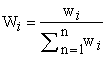
2.4. Assessment of Water and Sediment QualityTo assess overall water quality. The Water Quality Index (WQI) was used. This is a mathematical method for reducing an enormous amount of measurable information about water into a single piece of information in an intelligible format 11. First we calculated the relative weight ( ) of each parameter using equation.
 | (1) |
We assigned weights ( ) to each parameter according to its importance for water quality. The weights range from 1 to 5 12, 13.
Then we assessed the quality ( ) of each parameter using the following equation:
 | (2) |
Where  is the quality index.
  is the drinking water standard (mg/l) according to international guidelines (WHO. 2017) and Ci is the average concentration (mg/l) of the parameter.
Then the parameter sub-index ( ) was calculated for each parameter using the following equation:
 | (3) |
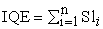
Finally. the sum of the sub-indices for all parameters was estimated using the equation:
 | (4) |
The water quality index (WQI) is classified into five categories 14, 15: excellent (<50); good (50 -100); poor (100-200); very poor (200-300) and unfit for consumption (>300).
There are several tools for diagnosing sediment contamination 16, 17, 18, 19 in the literature. For the study of our sites, we focused on the geoaccumulation index (Igeo), the enrichment factor, the sediment pollution index and the ecological risk potential index.
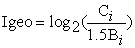
It was developed by Müller 16 and is widely used to determine the level of metal contamination in sediment. The principle is based on comparing the concentration of a metal in the sediment studied with that in the regional geological background. Due to insufficient data from the geological background of the Lobaye River, we worked with data from the upper continental crust presented by Taylor and McLennan (1985). The geoaccumulation index (Igeo) is determined according to the following formula 20, 21.
 | (5) |
Where Cn represents the concentration of the metal in the sediment (mg/kg) and Bn represents the geological background concentration of the same metal (mg/kg). The constant 1.5 takes into account natural and anthropogenic fluctuations in the content of a given substance in sediments. Based on the Igeo values, RUIZ (2001) 22 established a contamination intensity ranging from class 0 (non-contaminated) to class 6 (extremely contaminated sediment), see Table 1.
After determining the level of contamination of each sediment with respect to trace metals using the Igeo index, we proposed to determine the level of metallic contamination as a function of a parameter linked to the granulometry of the sediment, although the coefficient 1.5 in the Igeo calculation takes into account the heterogeneity of the sediment, but remains debatable as it does not necessarily represent reality. It has been shown that heavy metals are mainly associated with fine particles (clays, iron oxides and hydroxides, organic matter, sulphides, etc.), so for our study we chose to normalise the concentrations of metals measured in relation to aluminium, a major constituent of clay minerals 23, 24, 25. The enrichment factor noted FE has been widely used and is expressed by the following formula:
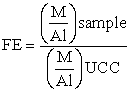 | (6) |
Where ‘’M‘’ and ‘’Al‘’ in the numerator indicate respectively the concentrations of ETM and aluminium in the sediment studied. And the ratio in the denominator represents the concentrations of the same metal and aluminium from the upper continental crust.. According to the Tomlinson (1980) grid, for values of FE<2, there is minimal enrichment (white), 2<FE<5, moderate enrichment (green); 5<FE<20 significant enrichment (yellow), 20<FE<40 very high enrichment (orange) and FE>40 very high enrichment (red). The different classes of contamination factor are listed in Table 2.
Because of the very high enrichment observed, we proposed to study the ecological risk in the watercourses in the Moboma region that are tributaries of the Lobaye River, which feeds the Congo River. To this end, we applied the mathematical model developed by the Swede Hakanson (1980) and widely used to assess the ecological risk associated with Moboma sediments. The formula for calculating the potential ecological risk index (IR) is as follows:
 |
Where  is the toxicity response factor. The toxicity response factors for the elements Cd, Pb, Cr, Hg and Cu are 30, 5, 2, 40 and 5 respectively 26, 27, 28. The ratio
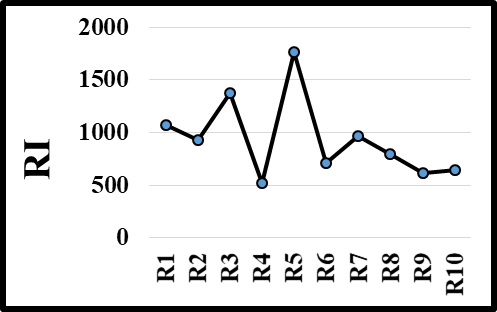
  represents the concentration of the metal detected in the sediment compared with the concentration of the same metal in the continental crust. When RI <150, it was classified as a low risk level; 150≤RI <300 as a moderate risk level; 300≤RI <600 as a high risk level; 600≤RI <800 as a very high risk level and RI ≥800 as an extremely high ecological risk level.
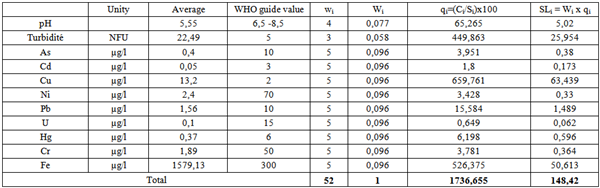
The average values for each parameter and the water quality index (WQI) are shown in the table below.
Physicochemical analysis of Moboma's water (Table 5) shows that it has freshwater characteristics, with a pH of between 4.01 and 6.65. The pH values are outside the guide value recommended by the WHO in 2017. The acidity of these waters could increase the risk of metals being present in more toxic ionic form. This acidity could be explained, on the one hand, by the tropical forest ecosystem and, on the other, by the geological nature of the soils in which the watercourses in the Moboma region originate. The turbidity of the waters studied ranged from 0.42 to 129 NFU, with high values recorded in surface waters. This indicates strong pressure from gold-panning activity on streams and rivers. It should also be noted that all the metal ions do not exceed the WHO guide values, except for iron (Fe), copper (Cu) and lead (close to limit value). The high iron content found in surface water can be explained by the mineralisation or oxidation of laterite from land excavated on mine sites. Heavy metals such as Cu and Pb most often come from used batteries, used oil and other solid waste. Finally, the water quality index calculated confirms that the water in the Moboma gold mining region is of poor quality ((100<WQI<200).
Minor elements are naturally present in small quantities in sediments. However, levels can vary considerably as a result of different types of natural or anthropogenic pollution, whether from watercourses, the atmosphere or run-off.
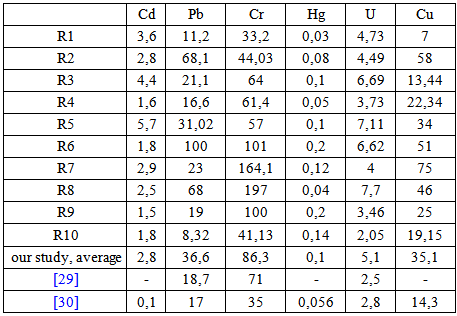
The levels of trace metals in each sediment from the Moboma gold panning sites in the Lobaye are shown in the table below.
Trace metal levels in Moboma sediments are higher than those found in uncontaminated geological beds. Comparison of our values with those of references and those derived from the work of J. Gaillardet 29, 30 on a global geological mass balance applied to the rivers of the Congo basin, taking into account the Oubangui, Lobaye, Zaire, Sangha, Kassaï and Congo rivers, indicates significant contamination of the sediments with uranium, mercury, lead, copper and cadmium, and moderate contamination with chromium. The contamination of each sediment will be assessed on the basis of the trace elements showing significant contamination.
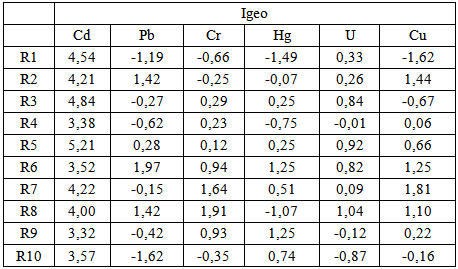
The Igeo indices calculated are shown in the table below:
Using Ruiz's (20001) contamination intensity grid, the geoaccumulation indices for sediments in the Moboma gold panning area show significant cadmium contamination at the 10 sites. Lead, chromium and copper contamination remains moderate at some sites. Similarly, there was moderate mercury contamination at Koungué I, which confirms the use of mercury in the gold extraction process at certain artisanal sites in Moboma, although contamination remains low at some sites (Lotémo and Moboma). We also observed moderate uranium contamination in the sediments of Ngouma, Koungué I and Moboma. Finally, Table 5 shows that, in addition to heavy cadmium contamination, the Lobaye River is contaminated downstream by uranium, mercury and chromium. This shows that the semi-mechanised artisanal gold mining site at Nikékélé is exerting pressure on the Lobaye River in the Moboma region.
The enrichment factors calculated (Table 6) indicate very high copper contamination in all the sediments analysed. High Cd contamination was also observed in 50% of the sediments and in the other sediments, the contamination was of the significant to very high type. In addition, the enrichment factors show contamination ranging from moderate to significant for U, Hg, Cr and Pb.
The results show that gold mining activities at Koungué I and Koungué II contaminate the river Lobaye (Lobaye bac) with mercury. This substance is undoubtedly trapped in part on plant debris, which is then consumed by certain aquatic species such as fish. This could explain the reduction in mercury levels at Nikékélé. However, semi-mechanised gold panning at this site, which probably involves the use of mercury, has released this substance into the Lobaye river, which would confirm the presence of mercury at Lobaye pont scad.
Finally, the enrichment factors, normalised to aluminium and calculated for our ten sites, confirm the conclusions drawn from the Igeo geoaccumulation index. All the sites therefore show major enrichment in copper and cadmium (some sites) in their sediments. In addition, the artisanal sites at Koungué II, Lobé and Moboma show significant mercury enrichment. This enrichment reflects a high level of contamination, both long-standing, since the Moboma gold mines have been exploited since 1956 by the Société Minière de Moboma (SMM), and more recent, following the gold rush that hit the region in early 2013, with the arrival of artisanal miners from other countries in the sub-region importing mining techniques. such as amalgamation to optimise the yield of extracted gold. This constant is observed at the semi-mechanised Nikékélé site, which shows significant mercury enrichment downstream (Lobaye pont bac).
The results of the ecological risk index calculations, presented in the histogram below, show that the Kenga, Lobaye bac, Nikékélé, Moboma and Lotémo sites present an extremely high level of risk (RI ≥ 800), while the Koungué I, Koungué II, Ngouma and Lobé sites present a very high risk (600 ≤ RI <800). Finally, the Nikékélé site presents a high ecological risk.
The study carried out on the state of water and sediment contamination around the Moboma gold-panning sites enabled the level of contamination to be determined by calculating contamination indices. The results showed that, overall, the water is of mediocre quality, and some sites are enriched in trace metallic elements, mainly cadmium, uranium and mercury. This is due partly to the lack of legislation governing gold panning activities and partly to the lack of training and awareness-raising among artisanal miners.
The contamination of water resources by gold mining calls for effective decontamination solutions. Among the techniques available, media filtration, in particular the use of zeolite bricks, stands out as an inexpensive option that is easily adaptable to the CAR. Thanks to their porous structure and ion exchange properties, these local materials effectively trap heavy metals such as mercury and lead. This simple, cost-effective filtration system offers a sustainable alternative to costly chemical methods. By incorporating this technology, local communities can reduce the toxicity of their water resources while minimising environmental impacts.
Conceptualization: Gildas DOYEMET, Michel WARTEL, Oscar ALLAHDIN and Baghdad OUDDANE
Méthodology: Gildas DOYEMET, Barthel Primael KOGUENGBA KOGBO
formal analysis: Gildas DOYEMET, Barthel Primael KOGUENGBA KOGBO
investigation: Gildas DOYEMET, Barthel Primael KOGUENGBA KOGBO, Oscar ALLAHDIN, Eric FOTO,
resources: Gildas DOYEMET, Barthel Primael KOGUENGBA KOGBO, Oscar ALLAHDIN, Eric FOTO and Baghdad OUDDANE.
Data curation: Gildas DOYEMET and Barthel Primael KOGUENGBA KOGBO
writing—original draft preparation: Gildas DOYEMET
writing—review and editing: Gildas DOYEMET supervision: Oscar ALLAHDIN, Eric FOTO and Baghdad OUDDANE and Michel WARTEL
project administration: Gildas DOYEMET, Oscar ALLAHDIN and Baghdad OUDDANE
funding acquisition: Michel WARTEL. All authors have read and agreed to the published version of the manuscript
Scientific works were undertaken successfully owing to the cooperation between the University of Lille (France) and the University of Bangui (Central African Republic). This collaboration (being still underway) and the Grant-in-Aid to Gildas Doyemet for his Doctoral-Thesis preparation is financially supported by the Embassy of France to Bangui. Financial support from the IR INFRANALYTICSFR2054 for conducting the research is gratefully acknowledged. The Region “Hauts de France” and the French government are warmly acknowledged for the co-funding of these apparatus.
| [1] | APP. (2013). Equité et Industries Extractives en Afrique Pour une gestion au service de tous [Rapport sur les progrès en Afrique], 120p. | ||
| In article | |||
| [2] | Ouedraogo, L. (2019). Orpaillage artisanal et développement rural [Thèse]. Université de Laval, Canada, 152p. | ||
| In article | |||
| [3] | C.M. Dipakama, N. Watha-Ndoudy, J. Nzila, I. Nguelet, V. Kimpouni .Impact de l’exploitation artisanale de l’or sur l’environnement dans le secteur de Dimonika (Massif forestier du Mayombe, Congo). | ||
| In article | |||
| [4] | O. BAMBA, S. PELEDE, A. SAKO, N. KAGAMBEGA, M. Y. W. MININGOU .impact de l’artisanat minier sur les sols d’un environnement agricole aménage au Burkina Faso. Journal des Sciences. /J. Sci. Vol. 13, N° 1 (Octobre 2013) 1-11. | ||
| In article | |||
| [5] | Lucas Moses Kouadio, 2023. Contribution à l’évaluation des niveaux de contamination des eaux et des sols des sites d’orpaillage clandestin et élimination des métaux (Hg, Pb, Cd) et de l’arsenic des eaux polluées, à l’aide des argiles de Côte d’Ivoire - Archive ouverte HAL. | ||
| In article | |||
| [6] | G. Y. Hadzi, D. K. Essumang, G. A. Ayoko. Assessment of contamination and potential ecological risks of heavy metals in riverine sediments from gold mining and pristine areas in Ghana. Journal of Trace Elements and Minerals 7 (2024) 100109. | ||
| In article | View Article | ||
| [7] | H.A. Kyowe, O.O. Awotoye, J.A.O. Oyekunle, J.A. Olusola. Index of heavy metal pollution and health risk assessment with respect to artisanal gold mining operations in Ibodi-Ijesa, Southwest Nigeria. Journal of Trace Elements and Minerals 9 (2024) 100160. | ||
| In article | View Article | ||
| [8] | A. A. Surour, M. M. El Desouky, M. M. Ismail, R. A. Aissa H. Zaghloul a Gold mineralization and environmental impacts of artisanal mining in the Um Araka area, Egypt: Microanalyses and heavy metals assessment. Journal of African Earth Sciences 223 (2025) 105519. | ||
| In article | View Article | ||
| [9] | A. Jaillon, G. de Brier, Cartographie des sites miniers artisanaux dans l’ouest de la Centrafrique, IPIS, novembre 2019. | ||
| In article | |||
| [10] | K. McCourt, G. Sautter, S.L. Estes, C. McMahan, C. Lee, E.R. Carraway, I. Vélez-Torres, D. Vanegas. Participatory assessment of pollution and health risk in artisanal and small-scale gold mining communities in Colombia. GroundwaterforSustainableDevelopment25(2024)101158. | ||
| In article | View Article | ||
| [11] | Stambuk-Giljanovic. N.. 1999. Water quality evaluation by index in Dalmatia. Water Resour. 33. 3423–3440. | ||
| In article | View Article | ||
| [12] | Yidana. S.M.. Yidana. A.. 2010. Assessing water quality using water quality index and multivariate analysis. Environ. Earth Sci. 59 (7). 1461–1473. | ||
| In article | View Article | ||
| [13] | Varol. S.. Davraz. A.. 2015. Evaluation of the groundwater quality with WQI (Water Quality Index) and multivariate analysis: a case study of the Tefenni plain (Burdur/ Turkey). Environ. Earth Sci. 73. 1725–1744. | ||
| In article | View Article | ||
| [14] | Sener. S.. Sener. E.. Davraz. A.. 2017. Evaluation of water quality using water quality index (WQI) method and GIS in Aksu River (SW-Turkey). Sci. Total Environ. 584–585. 131–144. | ||
| In article | View Article PubMed | ||
| [15] | M. N. Ayiwouo . F. N. Yamgouot. L. L. N. Mambou. S. T. Kingni. I. Ngounouno. Impact of gold mining on the water quality of the lom river. Gankombol. Cameroon. Heliyon 8 (2022) e12452 | ||
| In article | View Article PubMed | ||
| [16] | Müller G. Die Schwermetallbelastung der Sedimente des Neckars und seiner Nebenflusse: eine Bestandsaufnahme. Chemiker Zeitung 1981; 105: 157164. | ||
| In article | |||
| [17] | Ruiz F. Trace Metals in Estuarine Sediments from the Southwestern Spanish Coast. Marine Pollution Bulletin 2001; 42: 481489. | ||
| In article | View Article PubMed | ||
| [18] | Sainz A, Ruiz F. Influence of the very polluted inputs of the TintoOdiel system on the adjacent littoral sediments of southwestern spain: A statistical approach. Chemosphere 2006; 62: 16121622. | ||
| In article | View Article PubMed | ||
| [19] | Turner A, Millward GE. Suspended particles: their role in estuarine biogeochemical cycles. Estuarine, Coastal and Shelf Science 2002; 55: 857883. | ||
| In article | View Article | ||
| [20] | Williams J.A., Antoine J. Evaluation of the elemental pollution status of Jamaican surface sediments using enrichment factor, geoaccumulation index, ecological risk and potential ecological risk index. | ||
| In article | |||
| [21] | Kim B. S. M, Angeli J. L. F., Ferreira P. A. L., Michaelovich de Mahiques M., Figueira R C. L. Critical evaluation of different methods to calculate the Geoaccumulation Index for environmental studies: A new approach for Baixada Santista Southeastern Brazil. | ||
| In article | |||
| [22] | Ruiz F. Trace Metals in Estuarine Sediments from the Southwestern Spanish Coast. Marine Pollution Bulletin 2001; 42: 481489. | ||
| In article | View Article PubMed | ||
| [23] | Ryan J.D., Windom H.L. A geochemical and statistical approach for assessing metal pollution in coastal sediments. Metals in Coastal Environments of Latin America. Springer, Berlin Heidelberg, 1988; 47–58. | ||
| In article | View Article | ||
| [24] | Sinex S.A., Wright D.A. Distribution of trace metals in the sediments and biota of Chesapake Bay. Marine Pollution Bulletin, 1988; 19: 425–431. | ||
| In article | View Article | ||
| [25] | Emmerson R.H.C., O'Reilly-Wiese S.B., Macleod C.L., Lester J.N. A multivariate assessment of metal distribution in intertidal sediments of the Blackwater Estuary, UK. Marine Pollution Bulletin, 1997; 34: 960– 968. | ||
| In article | View Article | ||
| [26] | Emmerson R.H.C., O'Reilly-Wiese S.B., Macleod C.L., Lester J.N. A multivariate assessment of metal distribution in intertidal sediments of the Blackwater Estuary, UK. Marine Pollution Bulletin, 1997; 34: 960– 968. | ||
| In article | View Article | ||
| [27] | Hakanson. L. An ecological risk index for aquatic pollution control.a sedimentological approach. Water Reseach. Volume 14, Issue 8, 1980, Pages 975-1001. | ||
| In article | View Article | ||
| [28] | Ma, J., Han, C., Jiang, Y., 2020. Some problems in the application of potential ecological risk index. Geogr. Res. 39 (6), 1233–1241. | ||
| In article | |||
| [29] | J. GAILLARDET, B. DUPRE, and C. J. ALLEGRE. A global geochemical mass budget applied to the Congo Basin rivers: Erosion rates and continental crust composition. 0016-7037(95)00230-8. Geochimica et Cosmochimica Acta, Vol. 59, No. 17, pp. 3469-3485, 1995. | ||
| In article | View Article | ||
| [30] | Taylor, S.R., 1964. Abundance of chemical elements in the continental crust: a new table. Geochim. Cosmochim. Acta 28 (8), 1273–1285. | ||
| In article | View Article | ||
Published with license by Science and Education Publishing, Copyright © 2025 Gildas DOYEMET, Barthel Primael KOGUENGBA KOGBO, Oscar ALLAHDIN, Baghdad OUDDANE, Eric FOTO and Michel WARTEL
 This work is licensed under a Creative Commons Attribution 4.0 International License. To view a copy of this license, visit
http://creativecommons.org/licenses/by/4.0/
This work is licensed under a Creative Commons Attribution 4.0 International License. To view a copy of this license, visit
http://creativecommons.org/licenses/by/4.0/
| [1] | APP. (2013). Equité et Industries Extractives en Afrique Pour une gestion au service de tous [Rapport sur les progrès en Afrique], 120p. | ||
| In article | |||
| [2] | Ouedraogo, L. (2019). Orpaillage artisanal et développement rural [Thèse]. Université de Laval, Canada, 152p. | ||
| In article | |||
| [3] | C.M. Dipakama, N. Watha-Ndoudy, J. Nzila, I. Nguelet, V. Kimpouni .Impact de l’exploitation artisanale de l’or sur l’environnement dans le secteur de Dimonika (Massif forestier du Mayombe, Congo). | ||
| In article | |||
| [4] | O. BAMBA, S. PELEDE, A. SAKO, N. KAGAMBEGA, M. Y. W. MININGOU .impact de l’artisanat minier sur les sols d’un environnement agricole aménage au Burkina Faso. Journal des Sciences. /J. Sci. Vol. 13, N° 1 (Octobre 2013) 1-11. | ||
| In article | |||
| [5] | Lucas Moses Kouadio, 2023. Contribution à l’évaluation des niveaux de contamination des eaux et des sols des sites d’orpaillage clandestin et élimination des métaux (Hg, Pb, Cd) et de l’arsenic des eaux polluées, à l’aide des argiles de Côte d’Ivoire - Archive ouverte HAL. | ||
| In article | |||
| [6] | G. Y. Hadzi, D. K. Essumang, G. A. Ayoko. Assessment of contamination and potential ecological risks of heavy metals in riverine sediments from gold mining and pristine areas in Ghana. Journal of Trace Elements and Minerals 7 (2024) 100109. | ||
| In article | View Article | ||
| [7] | H.A. Kyowe, O.O. Awotoye, J.A.O. Oyekunle, J.A. Olusola. Index of heavy metal pollution and health risk assessment with respect to artisanal gold mining operations in Ibodi-Ijesa, Southwest Nigeria. Journal of Trace Elements and Minerals 9 (2024) 100160. | ||
| In article | View Article | ||
| [8] | A. A. Surour, M. M. El Desouky, M. M. Ismail, R. A. Aissa H. Zaghloul a Gold mineralization and environmental impacts of artisanal mining in the Um Araka area, Egypt: Microanalyses and heavy metals assessment. Journal of African Earth Sciences 223 (2025) 105519. | ||
| In article | View Article | ||
| [9] | A. Jaillon, G. de Brier, Cartographie des sites miniers artisanaux dans l’ouest de la Centrafrique, IPIS, novembre 2019. | ||
| In article | |||
| [10] | K. McCourt, G. Sautter, S.L. Estes, C. McMahan, C. Lee, E.R. Carraway, I. Vélez-Torres, D. Vanegas. Participatory assessment of pollution and health risk in artisanal and small-scale gold mining communities in Colombia. GroundwaterforSustainableDevelopment25(2024)101158. | ||
| In article | View Article | ||
| [11] | Stambuk-Giljanovic. N.. 1999. Water quality evaluation by index in Dalmatia. Water Resour. 33. 3423–3440. | ||
| In article | View Article | ||
| [12] | Yidana. S.M.. Yidana. A.. 2010. Assessing water quality using water quality index and multivariate analysis. Environ. Earth Sci. 59 (7). 1461–1473. | ||
| In article | View Article | ||
| [13] | Varol. S.. Davraz. A.. 2015. Evaluation of the groundwater quality with WQI (Water Quality Index) and multivariate analysis: a case study of the Tefenni plain (Burdur/ Turkey). Environ. Earth Sci. 73. 1725–1744. | ||
| In article | View Article | ||
| [14] | Sener. S.. Sener. E.. Davraz. A.. 2017. Evaluation of water quality using water quality index (WQI) method and GIS in Aksu River (SW-Turkey). Sci. Total Environ. 584–585. 131–144. | ||
| In article | View Article PubMed | ||
| [15] | M. N. Ayiwouo . F. N. Yamgouot. L. L. N. Mambou. S. T. Kingni. I. Ngounouno. Impact of gold mining on the water quality of the lom river. Gankombol. Cameroon. Heliyon 8 (2022) e12452 | ||
| In article | View Article PubMed | ||
| [16] | Müller G. Die Schwermetallbelastung der Sedimente des Neckars und seiner Nebenflusse: eine Bestandsaufnahme. Chemiker Zeitung 1981; 105: 157164. | ||
| In article | |||
| [17] | Ruiz F. Trace Metals in Estuarine Sediments from the Southwestern Spanish Coast. Marine Pollution Bulletin 2001; 42: 481489. | ||
| In article | View Article PubMed | ||
| [18] | Sainz A, Ruiz F. Influence of the very polluted inputs of the TintoOdiel system on the adjacent littoral sediments of southwestern spain: A statistical approach. Chemosphere 2006; 62: 16121622. | ||
| In article | View Article PubMed | ||
| [19] | Turner A, Millward GE. Suspended particles: their role in estuarine biogeochemical cycles. Estuarine, Coastal and Shelf Science 2002; 55: 857883. | ||
| In article | View Article | ||
| [20] | Williams J.A., Antoine J. Evaluation of the elemental pollution status of Jamaican surface sediments using enrichment factor, geoaccumulation index, ecological risk and potential ecological risk index. | ||
| In article | |||
| [21] | Kim B. S. M, Angeli J. L. F., Ferreira P. A. L., Michaelovich de Mahiques M., Figueira R C. L. Critical evaluation of different methods to calculate the Geoaccumulation Index for environmental studies: A new approach for Baixada Santista Southeastern Brazil. | ||
| In article | |||
| [22] | Ruiz F. Trace Metals in Estuarine Sediments from the Southwestern Spanish Coast. Marine Pollution Bulletin 2001; 42: 481489. | ||
| In article | View Article PubMed | ||
| [23] | Ryan J.D., Windom H.L. A geochemical and statistical approach for assessing metal pollution in coastal sediments. Metals in Coastal Environments of Latin America. Springer, Berlin Heidelberg, 1988; 47–58. | ||
| In article | View Article | ||
| [24] | Sinex S.A., Wright D.A. Distribution of trace metals in the sediments and biota of Chesapake Bay. Marine Pollution Bulletin, 1988; 19: 425–431. | ||
| In article | View Article | ||
| [25] | Emmerson R.H.C., O'Reilly-Wiese S.B., Macleod C.L., Lester J.N. A multivariate assessment of metal distribution in intertidal sediments of the Blackwater Estuary, UK. Marine Pollution Bulletin, 1997; 34: 960– 968. | ||
| In article | View Article | ||
| [26] | Emmerson R.H.C., O'Reilly-Wiese S.B., Macleod C.L., Lester J.N. A multivariate assessment of metal distribution in intertidal sediments of the Blackwater Estuary, UK. Marine Pollution Bulletin, 1997; 34: 960– 968. | ||
| In article | View Article | ||
| [27] | Hakanson. L. An ecological risk index for aquatic pollution control.a sedimentological approach. Water Reseach. Volume 14, Issue 8, 1980, Pages 975-1001. | ||
| In article | View Article | ||
| [28] | Ma, J., Han, C., Jiang, Y., 2020. Some problems in the application of potential ecological risk index. Geogr. Res. 39 (6), 1233–1241. | ||
| In article | |||
| [29] | J. GAILLARDET, B. DUPRE, and C. J. ALLEGRE. A global geochemical mass budget applied to the Congo Basin rivers: Erosion rates and continental crust composition. 0016-7037(95)00230-8. Geochimica et Cosmochimica Acta, Vol. 59, No. 17, pp. 3469-3485, 1995. | ||
| In article | View Article | ||
| [30] | Taylor, S.R., 1964. Abundance of chemical elements in the continental crust: a new table. Geochim. Cosmochim. Acta 28 (8), 1273–1285. | ||
| In article | View Article | ||