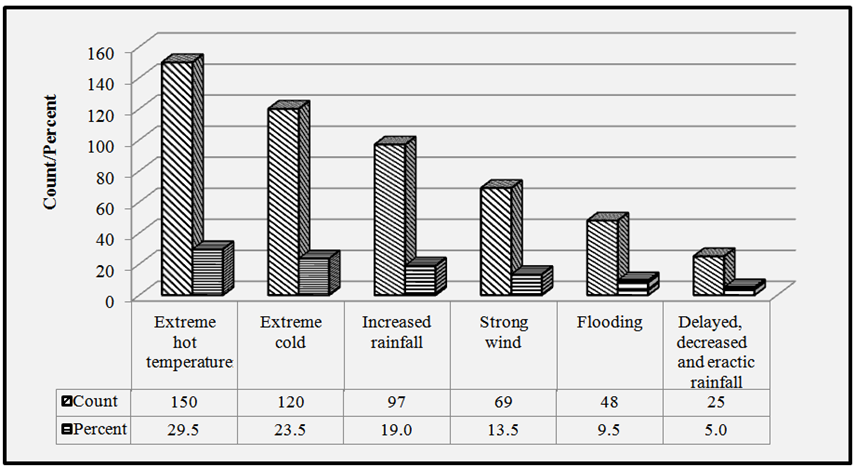
Food security and sustainable supply remain a big challenge against achieving key SDGs, and this is especially the case in most Sub-Saharan African countries where extreme poverty, social unrest, terrorism, youth unemployment and corruption remain a huge setback to economic development. Climate change is further compounding these problems, with huge implications for the agricultural sector which has over 70% of the population depending on it for livelihood. Smallholder farmers are even worst hit, owing to their limited capital, lack of modern agricultural technology, little or no government supports etc. This study is therefore aimed to investigate the dimensions of changes in the climatic pattern of communities in Edo north, and the associated effects on smallholder farming operations. Primary data were collected through questionnaires, interviews and focused group discussions with sampled crop famers (SCF). The study found that majority of SCF were migrant farmers (44.6 %), while the indigenous farmers only constituted about 33.4 %. In terms of type of crop(s) cultivated in the study area, 145 (28.4 %) of the respondents cultivated multiple crops (tuber/ plantain/ cereal/ vegetables), 26.6 % exclusively cultivated tuber crops (cassava/yam/ cocoyam/ potato), while 16.5 %) solely cultivated plantain/banana. Other farm types include cereal crop (rice/bean/maize/corn) 14.4 %, and vegetables (pumpkin/tomato/melon/okra) 9.5 %. Most notable evidence of climate change was extreme hot temperature in the day (n 29.5%, while extreme cold at night was 23.5%. Similarly, 19.0% of sampled crop farmers also viewed increased rainfall as notable evidence of climate change in the study area, while another 13.5% linked strong wind to climate change. Others notable evidences were flooding 9.5% and delayed, decreased and erratic rainfall with a total percentage of 5.0%. In terms of effects on farming operations, impact on fertilizer and manure application emerged as mostly affected with a weighted mean score (WMS) of 3.05. This was followed by effect on spraying of farm against pest and disease control with a WMS of 2.92, while weeding of farm and late planting ranked 3rd (WMS = 2.87). In terms of impact on the farming families, reduction in farm income and frequent washing away of valuable soil nutrient were mostly reported with the WMS of 3.56. This was followed by poor quality and quantity of yield/output (WMS = 3.42; rank = 2nd).
A sustainable agricultural sector is a key driver of economic development and essential towards attainment of Sustainable Development Goals. This is especially true of a country like Nigeria with abundance of natural and human resources. In Nigeria, the agricultural sector is one of the mainstay of the economy, contributing 22.35% of overall GDP in real terms in Q1 2021, 1 and employs 70 percent of the labor force in the country 2. More so, of the four activities that make up agricultural operations in Nigeria, i.e crop production, livestock, forestry and fishing, crop production remained the major driver of the sector, as it accounts for 72% of overall nominal growth in the sector during first quarter 2021. Similarly, based on Nigeria’s official definition of smallholders, about 95% of Nigerian farmers falls under this category, while the corporate and government supported large-scale farms account for only 5 percent 3. Research has further shown that smallholder farmers produces 99 percent of Nigeria’s agricultural outputs, yet their productivity and operations are hindered by several limitations 2. Studies have attributed these problems to lack and high cost of labor and agricultural inputs in rural areas; limited access to information, modern agricultural technology, inadequate financial services, land tenure system that prevents the acquisition of new land; and inconsistent support from local government councils 3, 4, 5, 6, 7, 8, 9.
To compound the challenges faced by smallholder farmers in Nigeria, is the problem of climatic change and variability. Climate change is defined as changes in climate variability and in the frequency of extreme weather events 10. Hegerl et al 11 also defined climate change as a change in the state of the climate that can be identified (e. g. using statistical tests) by changes in the mean and / or the variability of its properties that persists for an extended period, typically decades or longer. Although climatic variability may be due to natural internal processes within the climate system (internal variability) processes associated anthropogenic activities are known to be major drivers of global warming and climate change 12, 13. As a result, the global temperature has been on the rise since late 20th century and the beginning of the 21st century 14. Study has further shown that the earth’s temperature has risen by 0.14° F (0.08° C) per decade since 1880, and the rate of warming over the past 40 years is more than twice that: 0.32°F (0.18°C) per decade since 1981 15. By 2020, it was reported that averaged surface temperature across land and ocean, was 1.76° F (0.98° Celsius) warmer than the twentieth-century average of 57.0°F (13.9°C) and 2.14˚F (1.19°C) warmer than the pre-industrial period (1880-1900) 15. Currently, the six datasets used by WMO in the analysis place 2021 as the sixth or seventh warmest year on record globally 16. In Nigeria, studies have reported gradual rise in the range of 1901 and 2005 17, 18, 19, 20, 21. These studies found a mean air temperature of 26.3°C from 1901-1970 and then an increase to 27.8°C from 1971 to 2005.
Evidence of rising temperature has the tendency to trigger hydo-meteorological droughts as reported by Butu and Emeribe 22 Emeribe et al., 20, 21. This because as temperature rises, crops will loses water rapidly through transpiration thereby increasing crop water need. High potential evapotranspiration (PET) is usually observed during high temperature condition 23. Thus, higher value of PET, means increased moisture loss, leading to deficit water balance which is unfavourable to crops. Crops growing under low soil moisture, yield little and poor quality seeds. As reported by Obi 24, while increase in temperature is expected to elongate the growing season in temperate region, such an increase in the tropics will result in decimated agricultural output due to aggravating soil evaporation rate and invariably drought. Increasing temperature weakens plants and their leaves wither easily hence there is poor photosynthesis 23. Kim 25 established that rising temperature will result in reduced crop quantity and quality due to the reduced growth period following high levels of temperature rise; reduced sugar content, bad coloration, and reduced storage stability in fruits; increase of weeds, blights, and harmful insects in agricultural crops; reduced land fertility due to the accelerated decomposition of organic substances. In a similar study 26 found that increase in temperature not only affects the physiological processes that are needed for plants growth and development but also on the entire human endeavor. The development and growth of a plant depends upon the exposure of the plant to mean temperature during its growing stage, suggesting that plant growth relies on the degree of hotness or coldness to which the plant is subjected to when it is growing 27. Apart from crops, animals also die in large number during prolonged drought as a result of heat stress, dehydration and attack by drought induced diseases.
Although there are many impacts expected from global warming and climate change 28, 29, 30, 31, 32, 33, 34, 35, 36, studies have shown that one of the largest impacts is expected on the agriculture sector 12, 19, 37, 38, 39, 40, 41, 42. This especially true of communities in the developing countries where over 75% of the source of livelihood depend on agriculture, and with little or no financial interventions from the formal sector. In view of the contribution of this critical sector to development, and owing to the ongoing impact of climatic change, it thus become necessary to examine how the changing climatic conditions is affecting smallholder farming operations. Such information is germane in providing insights into farmer’s level of awareness on the impact of changing environment, their responses patterns and the effectiveness of the existing adaption approaches.
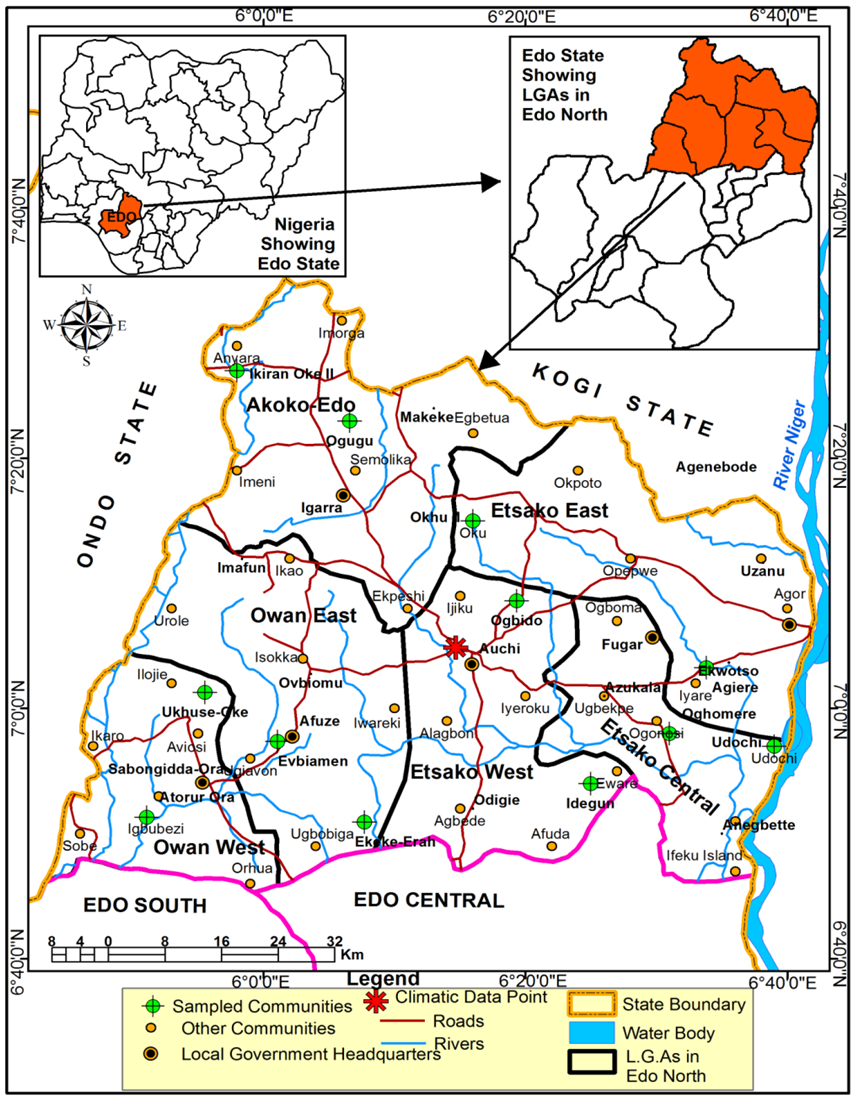
The study was carried out in communities in Edo north, Edo State. The area, lies within Latitudes 6°45' 15.04'' and 7°34' 31.31.23'' North of the Equator while the longitudinal extent expands from Longitudes 5°43' 21.347'' and 6°41' 46.579'' East of the Greenwich (Figure 1). Edo north is bounded in the north by Kogi State, in the east by River Niger, in the south by Edo Central and Edo South and in the west by Ondo State. Edo North occupies an area of approximately 6169.56km2. Over the years the population of the study area has grown. In 1991, the population of the six (6) local government areas (LGAs) namely: Akoko Edo, Etsako East, Etsako Central, Etsako West, Owan East and Owan West stood at 549,496 people. The population increased to about 955,791 in 2006 and projected to 1,494,815 in 2019 (National Population Commission, 2010). The people are presently distributed among three major sub-ethnic groups namely: Akoko Edo largely in the north, Etsako in the central and eastern parts and Owan in the western region of Edo North. Each sub-ethnic group is strongly connected by common tradition of origin, and they speak closely related dialects while at the same time exhibiting other numerous similar cultural traits. The climate of the study area fall within the warm-humid tropical climate region with marked wet and dry seasons. The rainy season last for about seven months (May to October) and the dry season last for about five months (November to April). Rainfall is moderate between the months of March and May and heaviest between June and September with average rainfall between 1000 mm and 1500 mm and temperature as high as 36.7°C especially within the hottest period of February to April 43.

The data type used in this study comprised of essentially of primary sources. These data were derived from field survey through the use of questionnaire, interviews and focused group discussion with sampled crop famers (SCF). This involved the use of structured questions for the purpose of gathering information on the variables under investigation. The questionnaires were administered to farmers in the selected sample areas. The farmers were required to give vital information on the subject under investigation. The questionnaire focused on the impacts/effects of climate change on farmers
2.2. Sample Population and Determination of Sampling SizeThe population of the study consists of farmers in the selected communities from Edo north. However, to determine the sample size, 44 asserted that, it is not always possible to determine the size of most populations or to be certain that each element in the population has an equal chance of being included in the sample. Sample size is almost invariably controlled by cost and time 45. Nevertheless, 46 provided a useful framework for determining an appropriate sample size. The required sample size is a function of population size and the desired accuracy (within 5%, 3%, or 1%) at the 95% confidence level. For instance, if a researcher is sampling from a population that consists of 10,000 respondents and wishes to be 95% confident that the outcome will be within 5% of the true percentage in the population, the researcher need to randomly sample 370 respondents” 46. However, to obtain the study population, the 1991 census figures which was released at the community level was used due to the non-availability of same data in 2006 census. Given that population of any place is not static but dynamic, 1991 population of the area was projected to 2019 using 3.2 % annual Edo State growth rate. This gave a figure of 35,510 which therefore, formed the population for the study. Thus, 46 sampling framework was adopted to obtain the sample size from the sample population of 35,510 at 95% confidence level and 3% error margin. This also equals to 533 farmers which formed the sample size which was shared proportionally according to the population in each communities as shown in Table 1.
The study area is made up of six LGAs and purposive sampling was used in selecting two (2) communities each from the six LGAs. A total of 12 communities were purposively selected for this study. The purpose of using purposive sampling is based on their level of farming activities in the communities. Systematic random sampling was adopted in picking farmers in the communities. The working of this method is that, in each street, lane or layout in the community, the first house was picked and thereafter every third residential houses selected. In a case where there is no farmer in a particular house, the next residential house was chosen.
2.4. Data AnalysisData were subjected to descriptive statistics include mean, standard deviation, range, minimum, maximum and variance. A four-point Likert’s scale was adopted to examine the extent of effects of climate change on agricultural practices and on farming households. The four-point Likert’s scale ranged from ‘high’ (weight = 4), ‘moderate’ (weight = 3), ‘low’ (weight = 2) and ‘can’t tell’ (weight = 1). Also, the five-point Likert’s scale ranged from ‘very high’ (weight = 5), ‘high’ (weight = 4), ‘moderate’ (weight = 3), ‘low’ (weight = 2) and ‘very low’ (weight = 1). This used to rate effects of climate change on farming families in Edo north.
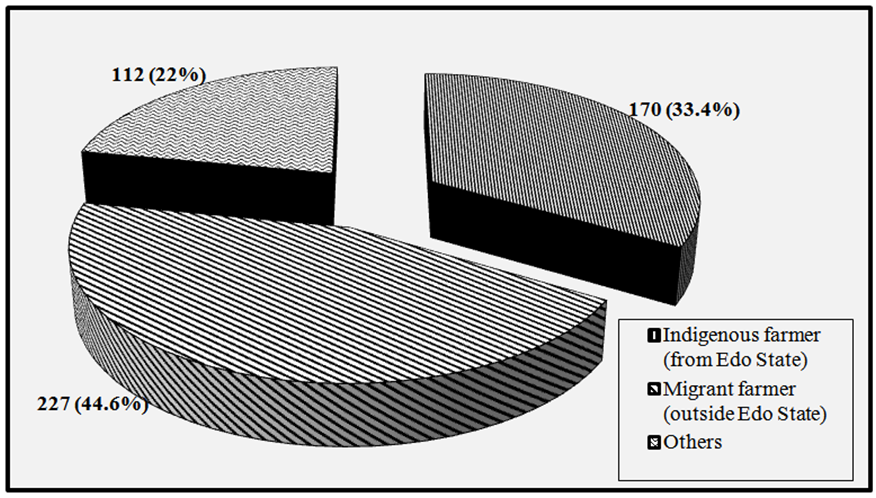
The identities of farmers in the study area is presented in Figure 2. It can be seen that majority (n = 227; 44.6 %) were migrant farmers (outside Edo State) while the indigenous farmers (from Edo State) constituted about 170 (33.4 %) of the sampled crop farmers (SCF). The fact that migrant famers dominate farming operations in the study area was attributed to the cheap cost of labour and the fact that most of the young indigenous people have left the communities to cities in search of better job opportunities. These migrant famers are mostly from neighboring state and far northern Nigeria.

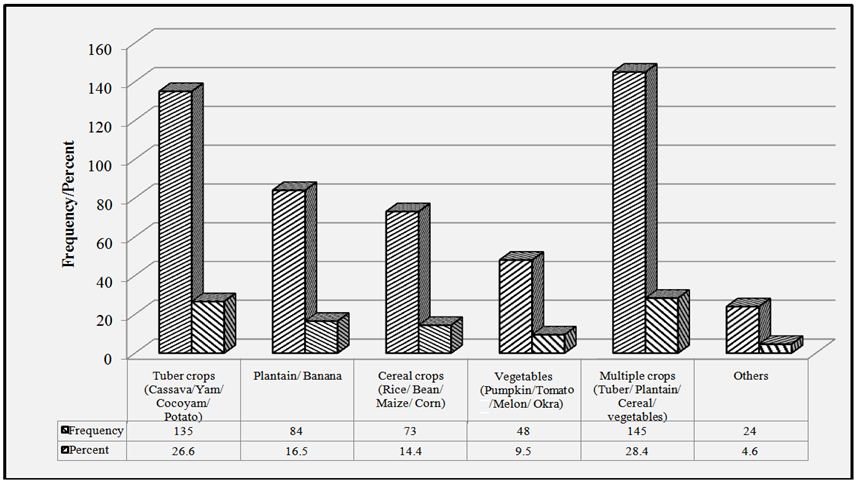
More so, the domination of migrant farmers in the study is an indication that food security in Edo North is in the hands of non-indigenes. In event of mass withdrawal of services by this group of individuals to their roots or other places could result in grave food insecurity, hunger and starvation. In terms of type of crop(s) cultivated in the study area, multiple crops production (tuber/plantain/cereal/ vegetables) was mostly practiced with percentage value of 28.4 %, while 26.6% exclusively cultivated tuber crops (cassava/yam/ cocoyam/ potato). Also, 84 (16.5 %) solely cultivated plantain/banana. Others focused on cereal crop (rice/bean/maize/corn) 73 (14.4 %), while 48 (9.5 %) of the respondents only focused on vegetables (pumpkin/tomato/melon/okra) production (Figure 3). The practice of multiple cropping as seen in this study may not be unconnected the desire of farmers to boost food production and hence increase their food security. Mixed cropping also contributes in the reduction of farmers’ vulnerability to single crop failure induced by climate change.

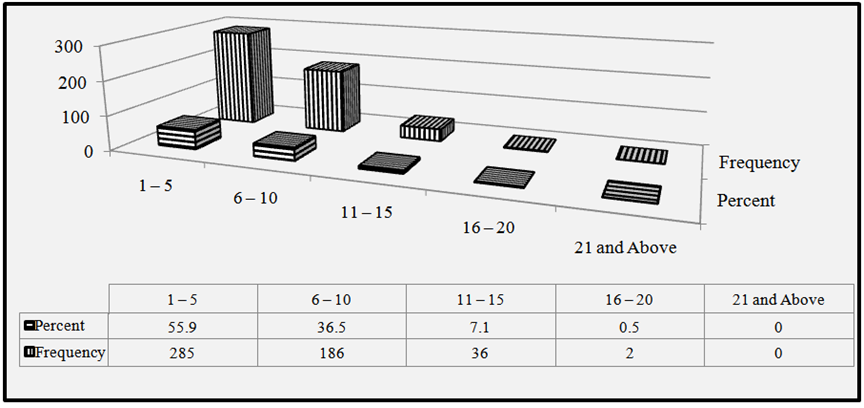
Furthermore, as seen in Figure 4, the modal class of farm size was 1 - 5 hectares with a total of 285 (55.9%) 186 (36.5 %) of the sampled crop famers owned between 6 - 10 hectares of farmland in the study area. Besides, the ownership of farmland ranging from 11 - 15 hectares centered around 36 (7.1 %) the respondents while 2(0.5 %) respondents owned between 16 - 20 hectares of farmland. The fact that more than half of the respondents owned at least 1 - 5 hectares of farmland portrays the pleasantness of crop production in southern Nigeria as reported by Oriakhi et al. 47.

Other socio-economic profile of sampled respondents in Edo North is also presented in Table 2. As it could be seen, the modal monthly income category was N 31, 000.00 - N 60, 000.00 with 25.2 (49.5 %). This was followed by income class of less than N30, 000.00 per month with 208 (40.8 %) of the sampled crop farmers (SCF). On the other hand, 44 (8.7 %) of the sampled crop farmers in the study area earned between N61,000.00 - N90,000.00 monthly. On the contrary, 3 (0.6 %) of the sampled crop farmers in Edo North earned between N91, 000.00 - N120, 000.00 while 2 (0.4 %) earned N121, 000.00 - N150, 000.00 monthly. This finding is line with earlier assertion by Okoro et al. 48 that the monthly take home pay of many farmers in localities are still less than the N30, 000.00 national minimum wage.
Additionally, the result also showed that a greater number (n = 131; 25.8 %) of the sampled crop farmers had farming experience ranging from 1 - 10 years while 114 (22.4 %) of the sampled crop farmers had farming experience varying between 11 - 20 years in Edo North. Equally, 100 (19.6 %) of the sampled crop farmers in the study area possessed farming experience varying between 21 - 30 years even as 87 (17.1 %) had farming experience varying between 31 - 40 years. In contrast, 77 (15.1 %) of the sampled crop farmers had been farming for over 40 years in Edo North. Again, the finding where majority of the sampled crop farmers having farming experience of 1 - 10 years agrees with that of 47 who argued that the more the farmers are experienced, the higher their level of resilience to climate change impacts and ability to deploy appropriate adaptation strategies.
Furthermore, the finding also indicates that 134 (26.3%) of the sampled crop farmers in the study area did none/nothing else. This means that farming was their only source of sustenance. On the other hand, 111 (21.9%) of the sampled crop farmers took part in trading (buying and selling) in addition to crop farming whereas 95 (18.6 %) respondents took to artisan/driving/cyclist as off-farm employment. Paid labour as an as off-farm source of livelihood was passively engaged by 77 (15.1 %), while 56 (11 %) of the sampled respondents depend on hunting/fishing as part-time occupation. Unstipulated (other) sources of livelihood were engaged by 36 (7.1 %) of sampled respondent farmers (SRF) in the study area. This finding corroborates that of NBS 49 who stated that agriculture supports up to 70% of rural dwellers in Nigeria. In Figure 5, the most notable evidence of climate change in Edo North was extreme hot temperature (n = 150; 29.5%) in the day, while 120 (23.5%) respondents said it was extreme cold at night. Also, 97 (19.0%) of sampled crop farmers viewed increased rainfall as the most notable evidence of climate change in the study area, while another 69 (13.5%) linked strong wind to climate change. Others notable evidences were flooding (n = 48; 9.5%) and delayed, decreased and erratic rainfall with a total percentage of 5.0%.

Similarly, the extent of effects of climate change on agricultural practices in Edo North is presented in Table 3. About 158 (31.1%) of the respondents stated that climate change exerted high effect during fertilizer and manure application, while 227 (44.6%) agreed that it was Moderate, 116 (22.7%) reported Low effect, while 8 (1.5%) said they can’t tell whether climate change has any effect. Also, 88 (17.3%) of the sampled crop famers reported high, 225 (44.1%) stated moderate, 175 (34.4%) stated low effect of climate change during spraying of the farm against pest and disease control, whereas 21 (4.1%) could not tell if climate change has any effects on pest control. On whether climate affects weeding of farm and late planting, 130 (25.5%) of the respondents reported high impact, moderate (n = 207; 40.6%), low (n = 149; 29.3%) while the remaining; 4.6% could not tell the difference. Similarly, 127 (25%) of the respondents stated that climate change exerted High effect during Seed planting and transplanting, 191 (37.5%) agreed that it was moderate, 157 (30.9%) reported low effect. In terms of effects on clearing and preparation of farmland, 106 (20.9%) of the sampled crop famers reported High, 217 (42.6%) stated Moderate, 162 (31.9%) stated Low effect of climate change during clearing and preparation of farmland whereas 24 (4.6%) sampled crop farmers could not tell the difference. The respondents also reported high effect of climate change on Harvesting time/period, 94 (18.4%), Moderate (n = 231; 45.4%), Low (n = 151; 29.6%) and Can’t Tell (n = 33; 6.6%).
Another agricultural practice that was reported to be adversely affected by climate change is ploughing/soil tillage operations. The extent of climate change effect on this practice is considered High (n = 96; 18.9%), Moderate (n = 212; 41.6%), Low (n = 178; 34.9%), while 4.6% of the respondents can tell if there is effect. On the extent of climate change effect on the frequency of farm inspection/crop pruning the respondents reported high (n = 86; 16.8%), Moderate (n = 226; 44.4%) and Low (n = 166; 32.7%). With respect to Postharvest operations, the extent of climate change effect on it were High (n = 99; 19.4%), Moderate (n = 214; 42.1%) and Low (n = 142; 27.8%) Regarding Crop storage and marketing, the extent of climate change effect on it were High (n = 100; 19.6%), Moderate (n = 198; 39%) and Low (n = 147; 28.8%).
Furthermore, fertilizer and manure application emerged as the agricultural practice that was mostly affected by climate change based on the weighted mean score (WMS) of 3.05 and ranked 1st. The 2nd most perceived agricultural practice based WMS of 2.92 was spraying of the farm against pest and disease control. Spraying of the farm for pest and disease control (WMS = 2.92) while weeding of the farm and late planting (WMS = 2.87) occupied the 3rd place in the continuum. Seed planting and transplanting ranked 4th based on the WMS of 2.81 while, clearing and preparation of farmland ranked 5th position among other agricultural practice adversely affected by climate change. These findings show that nearly all the agricultural practices are adversely affected by observed changing climatic pattern in the study area. This finding is supported by some of the respondents who reported, during oral interaction, that no matter how healthy or strong they crops are, they normally get overstressed while applying fertilizer and manure or during routine farm inspection and crop pruning and attributed this to the scorching hot sun. Others also complained that it was always painful to see the fertilizer, manure, herbicides and pesticides in the farm watched away by heavy rainfall, erosion and flooding. This will eventually lead to reduced yield, discouragement of the individuals whose source of sustenance have been destroyed and subsequent urge to seek for other means of survival as reported by 50.
The extent of effects on their household is presented in Table 4. Reduction in farm income, was considered very high effect was experienced by 105 (20.7%), high effects was 183 (35.9%), moderate effect was experienced by 121 (23.7%) S, while low effects was reported by 93 (18.2%) of the studied participants. On whether climate change is responsible for increased disease outbreak/frequent pest attack, very high and high effects were perceived at 98 (19.2%) and 223 (43.9%) by respondents respectively, moderate effect was perceived by 69 (13.6%) while low and very low effects were perceived by 103 (20.2%) and 16 (3%) respectively. On the effects of climate change on poor quality and quantity of yield/output, very high and high effects were observed at 62 (12.1%) and 195 (38.4%) respectively, moderate effect was observed by 154 (30.3%), while low and very low effects were observed by 91 (17.7%) and 7 (1.5%) in that order.
In terms of washing away of valuable nutrient, fertilizers and agro-chemicals, very high and high effects were observed at 81 (15.9%) and 175 (34.3%) respectively, moderate effect was observed by 135 (26.6%) while low and very low effects were observed by 92 (18.2%) and 26 (5.1%) in that order. On whether climate change causes retardation of growth rate/delayed maturity, very high and high effects were detected at 85 (16.7%) and 193 (37.9%) respectively, moderate effect was detected by 85 (16.7%) while low and very low effects were detected by 120 (23.7%) and 26 (5.1%) in that order. On whether climate change is responsible for the destruction of animal/farm buildings/houses, very high and high effects were reported at 100 (19.7%) and 154 (30.3%) of sampled famers respectively, moderate effect was noticed by 72 (14.1%) while low and very low effects were noticed by 167 (32.8%) and 16 (3%) in that order. On the effect of climate change on the loss of improved planting materials, very high and high effects were noticed at 54 (10.6%) and 183 (35.9%) of the respondents respectively, moderate effect was noticed by 108 (21.2%) while low and very low effects were noticed by 148 (29.3%) and 16 (3%) in that order. On whether climate change affect the loss of improved/high yielding species of seedling, very high and high effects were perceived at 110 (21.7%) and 110 (21.7%), moderate effect was perceived by 77 (15.2%) while low and very low effects were perceived by 188 (36.9%) and 24 (4.5%) in that order. On the effect of climate change on post-harvest losses, very high and high effects were perceived by 80 (15.7%) and 134 (26.3%) sampled crop farmers respectively, moderate effect was perceived by 103 (20.2%) while low and very low effects were perceived by 169 (33.3%) and 23 (4.5%) in that order. The Coefficient of variation-induced effects on crop damage/breaking due to windstorm were also perceived as very high, high, moderate, low and very low by approximately 74 (14.6%), 131 (25.8%), 113 (22.2%), 172 (33.8%) and 19 (3.5%) of the sampled crop famers respectively. Other effects of climate change on farming households can be seen in Table 4.
In terms of WMS and rank, reduction in farm income and Frequent Washing away of valuable nutrient were the most reported climate change effect on farming household with the WMS of 3.56 each and was ranked 1st in the continuum. This was followed by poor quality and quantity of yield/output (WMS = 3.42; rank = 2nd). This finding corroborates that of 51 who established that 21% of cassava output, 19% of pepper output and 27% of tomatoes output were influenced by ACE mostly (variability in rainfall, temperature and relative humidity). In addition, washing away of fertilizers/agro-chemicals and increased disease outbreak with WMS of 3.38 each ranked 3rd in the continuum. Similarly, slow growth rate/delayed maturity (WMS = 3.31; rank = 4th), Frequent pest attack (WMS = 3.22; rank = 5th), increased heat stress (WMS = 3.18; rank = 6th), increase in cost of production (WMS = 3.16; rank = 7th) and destruction of animal/farm buildings/houses (WMS = 3.14; rank = 8th). Other perceived climate change effects on farming household were loss of improved planting materials (WMS = 3.11; rank = 9th), post-harvest losses (WMS = 3.10; rank = 10th), Crop damage/breaking due to windstorm (WMS = 3.05; rank = 11th) as well as Increase in labour demand and cost on the farm (WMS = 2.97; rank = 12th). This above observations are in line with findings of 52. For instance, 81%, 56%, 39%, 39%, 18% and 18% of the sampled respondents in 52 study link climate change impacts on food production, reduced water supply, and rise in cost of food crops, reduced rainfall to for crop irrigation as well as prevalence of hard and infertile soil. Recent study also showed that 66% and 19% of sampled respondents strongly agreed and agreed respectively, to the fact that climate change has made animal and crop disease and pest to increase. Also, reduction in yield were strongly agreed and agreed by 56% and 32% of the rural farmers in Southern Benin Republic as climate change effect on their farming livelihood 53.
Climate is one key factor that could directly or indirectly affect food security and key SDGs, especially as ongoing global warming and changing in the climate can impact on the physiological processes of crops. More so, it is very important to understanding the different ways climate is changing and how these changes are affecting farming operations. This necessitated the need for the present study. Sampled crop farmers of smallholder scale were sampled and it was found that majority of smallholder farmers in the study area were migrant farmers (outside Edo State) and this could be attributed to the rural-urban migration of indigenous population in search of better opportunities in the cities. These migrant famers are mostly from neighboring state and far northern Nigeria. The study revealed that multiple crops (tuber/ plantain/ cereal/ vegetables) was mostly practiced by smallholder famers in the study area. This was followed tuber crops (cassava/yam/ cocoyam/ potato), while vegetables (pumpkin/tomato/melon/okra) production was the least practiced in the study area. The most notable evidence of climate change in the study area was extreme hot temperature in the day, extreme cold at night increased rainfall, strong wind, increased flood frequency and delayed, decreased and erratic rainfall. Furthermore, fertilizer and manure application was mostly affected by climate change based on the weighted mean score (WMS). This was followed by effect of changing climate on pesticide spay and disease control, while, clearing and preparation of farmland ranked 5th position among other agricultural practice adversely affected by climate change in the study area. These findings show that nearly all the agricultural practices are adversely affected by the changing weather and climate pattern of the study area. On the impact of climate change on the farming families in the study area, reduction in farm income and frequent washing away of valuable nutrient were the mostly reported. This was followed by poor quality and quantity of yield/output. In addition, washing away of fertilizers/agro-chemicals and increased disease outbreak ranked 3rd in the continuum. In view of these findings, it is recommended that the government should initiate plans and policies to promote investment strategies which should be geared towards supporting improved extension service, providing on-farm demonstration training and disseminating information about climate change adaptation strategies. There is also need for the government, stakeholders such as financial institutions, and donor agencies interventions to provide capacity-building innovations with focus on climate change information, communication technologies and training of smallholder farmers across the country.
| [1] | National Bureau of Statistics. (2021). Nigerian Gross Domestic Product Report (Q1 2021), Central Business District Abuja. | ||
| In article | |||
| [2] | Anderson, J., Marita, C., Musiime, D., and Thiam, M (2017). National Survey and Segmentation ofSmallholder Households in Nigeria. Understanding Their Demand for Financial, Agricultural, and Digital Solutions. CGAP Working Paper. | ||
| In article | |||
| [3] | Sabo, B.B., Isah, S.D., Chamo, A.M., and Rabiu, M.A (2017). Role of Smallholder Farmers in Nigeria’s Food Security Scholarly Journal of Agricultural Science 7(1), pp. 1-5. | ||
| In article | |||
| [4] | Saminu, U.D, (2011). An Assessment of tree density and Diversity on smallholder farm Parkland agroforestry systems in Daura. Unpublished MSc Thesis Submitted to Department of geography Bayero University Kano. | ||
| In article | |||
| [5] | Sabo, U.U, (2005). Impact of Participatory Extension Activities on Sesame production in Ringim and Taura local government areas of Jigawa state. A Thesis Submitted to the Post-graduate School, Ahmadu Bello University, Zaria. | ||
| In article | |||
| [6] | Akinnifesi, F.K., Sileshi, G., Ajayi, O.C., Chirwa, P.W., Kwesiga, F., Harawa, R. (2008). Contributions of agroforestry research and development to livelihood of smallholder farmers in Southern Africa: 1 Taking stock of the adaptation, adoption and the impact of fertilizer tree options. Agricultural Journal. 3(1) 58-75. | ||
| In article | |||
| [7] | Mgbenka, R.N., Mbah, E.N. (2016). A review of smallholder farming in Nigeria: need for transforma-tion. Int J Agric Ext Rural Dev Stud 3(2):43-54. | ||
| In article | |||
| [8] | Masebo, N., and Menamo, M. (2016). A Review Paper on: The Role of Agroforestry for Rehabilitation of Degraded Soil Journal of Biology, Agriculture and Healthcare. Vol. 6(5), ISSN 2224-3208. | ||
| In article | |||
| [9] | Daura, U.S., Badr, A.M., M. El-Tantawi, A.M. (2017): An Overview of Challenges on Smallholder Agroforestry Farms in Jigawa State, Northern Nigeria. Journal of Environment and Earth Science. 7(5), 37-44. | ||
| In article | |||
| [10] | Liu, L., and Basso B. (2020). Impacts of climate variability and adaptation strategies on crop yields and soil organic carbon in the US Midwest. PLoS One 15(1): e0225433. | ||
| In article | View Article PubMed | ||
| [11] | Hegerl, G.C., F. W. Zwiers, P. Braconnot, N.P. Gillett, Y. Luo, J.A. Marengo Orsini, N. Nicholls, J.E. Penner and P.A. Stott. (2007). Understanding and Attributing Climate Change. In: Climate Change 2007: The Physical Science Basis. Contribution of Working Group I to the Fourth Assessment Report of the Intergovernmental Panel on Climate Change [Solomon, et al. (eds.)] Cambridge University Press, Cambridge, United Kingdom and New York, NY, USA 690pp. | ||
| In article | |||
| [12] | IPCC. (2007). Annex B. Glossary of terms. Intergovernmental Panel on Climate Change. | ||
| In article | View Article | ||
| [13] | IPCC. (2014). Climate Change 2014: Synthesis Report. Contribution of Working Groups I, II and III to the Fifth Assessment Report of the Intergovernmental Panel on Climate Change. Geneva; 2014. | ||
| In article | |||
| [14] | NOAA (2007). Observing Climate Variability and Change, National Oceanic and Atmospheric Administration. 2007. | ||
| In article | |||
| [15] | NOAA (2022). National Centers for Environmental Information, State of the Climate: Global Climate Report for March 2022, published online April 2022, retrieved on April 25, 2022 from https://www.ncdc.noaa.gov/sotc/global/202203. | ||
| In article | |||
| [16] | WMO, (2021). State of Climate in 2021: Extreme events and major impacts. World Meteorological Oragnization Press Release Number: 31102021. | ||
| In article | |||
| [17] | Nwafor, J.C. (2006). Environmental Impact Assessment for sustainable Development. Enugu. EDPCA Publishers. | ||
| In article | |||
| [18] | Tercula, I. (2015). Desertification: Water Scarcity hits Sokoto Farmers. Sunday, 09 February. Retrieved from www.sundaytrust. | ||
| In article | |||
| [19] | Onyia, C. (2015). Climate Change and Conflict in Nigeria: The Boko Haram Challenge. American International Journal of Social Science, 4(2): 181-190. | ||
| In article | |||
| [20] | Emeribe, C.N., Ezeh, C.U. and Butu, A.W (2020). Modelling climatic water balance for water stress-detection for select crops under climate variability in the Sudano-Guinean Savanna, Nigeria. Model. Earth Syst. Environ. (Springer Nature). | ||
| In article | View Article | ||
| [21] | Emeribe, C.N., Ezeh, C.U. and Butu, A.W (2020a). Climatic Water Balance Over Two Climatic Periods and Effect on Consumptive Water Need of Selected Crops in the Chad Basin, Nigeria. Agric. Res. (Springer nature). | ||
| In article | View Article | ||
| [22] | Butu, A.W and Emeribe C.N (2019): Spatial patterns of climatic variability and water budget over Sudan Savannah Region of Nigeria. African Journal of Environmental Science and Technology. 13(12), pp. 464-480. | ||
| In article | View Article | ||
| [23] | Audu, E.B., Audu, H.O., Binbol, N.L, Gana, J.N (2013). Climate Change and Its Implication on Agriculture in Nigeria. Abuja Journal of Geography and Development 3(2): 8-19. | ||
| In article | |||
| [24] | Obi, C.O., (2010). Climate Change and Management of Degraded Soils for Sustainable Crop of Production. Tropical Built Environment Journal Vol, 1. | ||
| In article | |||
| [25] | Kim, C (2009). Strategies for Implementing Green Growth in Agricultural Sector." in Proceedings in Green Korea 2009 - Green Growth and Cooperation. National Research Council for Economics, Humanities and Social Science. | ||
| In article | |||
| [26] | Rasul, G., Chaudhry, Q.Z., Mahmood, A., Hyder, K.W (2014). Effect of Temperature Rise on Crop Growth and Productivity, Pakistan Journal of Meteorology. 8(15):53- 62. | ||
| In article | |||
| [27] | Ramirez, D., Ordaz, J.L., Mora, J., Acosta, A., Serna, B.. Belize. (2003). Effect of Climate Change on Agriculture, Department for International Development, United Nations. 2003 | ||
| In article | |||
| [28] | Shongwe, M. E., G. J. van Oldenborgh, B. van den Hurk, and M. van Aalst (2011). Projected changes in mean and extreme precipitation in Africa under global warming. Part II: East Africa, J. Clim., 24(14), 3718-3733. | ||
| In article | View Article | ||
| [29] | Cook, K. H., and E. K. Vizy (2013). Projected changes in East African rainy seasons, J. Clim., 26(16), 5931-5948. | ||
| In article | View Article | ||
| [30] | Otieno, V. O., and R. O. Anyah (2013). CMIP5 simulated climate conditions of the Greater Horn of Africa (GHA). Part II: Projected climate, Clim. Dyn., 41(7-8), 2099-2113. | ||
| In article | View Article | ||
| [31] | Kent, C., R. Chadwick, and D. P. Rowell (2015). Understanding uncertainties in future projections of seasonal tropical precipitation, J. Clim., 28(11), 4390-4413. | ||
| In article | View Article | ||
| [32] | Rosell, S., and B. Holmer (2015). Erratic rainfall and its consequences for the cultivation of teff in two adjacent areas in south Wollo, Ethiopia, Nor. Geogr. Tidsskr. Nor. J. Geogr., 69(1), 38-46. | ||
| In article | View Article | ||
| [33] | Tierney, J. E., and C. C. Ummenhofer (2015). Past and future rainfall in the horn of Africa, Sci. Adv., 1, e1500682. | ||
| In article | View Article PubMed | ||
| [34] | Eghonghon, U.K (2017). Temperature variability study for Auchi, Edo State, Nigeria. International Journal of Advanced Engineering and Technology .1(4); 34-43. | ||
| In article | |||
| [35] | Nicholson, S. E. (2017), Climate and climatic variability of rainfall over eastern Africa, Rev. Geophys., 55, 590-635. | ||
| In article | View Article | ||
| [36] | Olagunju, T.E., Adewoye, S.O., Adewoye, A.O., Opasola, O.A (2021). Climate Change Impacts on Environment: Human Displacement and Social Conflicts in Nigeria IOP Conf. Ser.: Earth Environ. Sci. 655 012072. | ||
| In article | View Article | ||
| [37] | Nordhaus, William D. (1991): To slow or not to slow: The economics of the greenhouse effect, The Economic Journal, 101, pp. 920-937. | ||
| In article | View Article | ||
| [38] | Pearce, D., Cline, W., Achanta, A., Fankhauser, S., Pachauri, R., Tol, R. and Vellinga, P. (1996). The social costs of climate change: Greenhouse damage and benefits of control, in: J. Bruce, H. Lee and E. Haites (Eds) Climate Change 1995: Economic and Social Dimensions of Climate Change, pp.179-224 (Cambridge: Cambridge University Press. | ||
| In article | |||
| [39] | Cline, W. (2007). Global Warming and Agriculture (Washington, DC: Peterson Institute for International Economics). | ||
| In article | |||
| [40] | Mendelsohn, R., Dinar, A. and Sanghi, A. (2001). The effect of development on the climate sensitivity of agriculture, Environment and Development Economics, 6, pp. 85-101. | ||
| In article | View Article | ||
| [41] | Mendelsohn, R., Nordhaus., W. and Shaw, D. (1994). Measuring the impact of global warming on agriculture, American Economic Review, 84, pp. 753-771. | ||
| In article | |||
| [42] | Mortimore, M.J., and Adams, W.A. (2001). Farmer adaptation, change and crisis in the Sahel. Global Environmental Change, 11: 49-57. | ||
| In article | View Article | ||
| [43] | Banmeke, T. O.A., Fakoya, E.O. and Ayanda, I. F. (2012). Agricultural Researchers’ Awareness of the Causes and Effects of Climate Change in Edo State, Nigeria Journal of Agricultural Science Vol. 4(1) 233-238. | ||
| In article | View Article | ||
| [44] | Emaikwu, S.O. (2008). Fundamentals of educational research methods and statistics Kadunna: Deray Punts Ltd. | ||
| In article | |||
| [45] | Ogundele, O.J.K. (2004). Wealth Creation through the Development of indigenous Technology, 12 national Conference Environments and Behavior of Association of Nigeria, University of Agriculture, Abeokuta, 24-26 November. | ||
| In article | |||
| [46] | Mitchell, M. L., and Jolley, J. M. (2012). Research design explained (8th ed.). Belmon: Wadsworth Cengage Learning. | ||
| In article | |||
| [47] | Oriakhi, L. O., Ekunwe, P. A., Erie, G. O and Ososogie, D. I. (2017). Socio-economic Determinants of Farmers’ Adoption of Climate Change Adaptation Strategies in Edo State, Nigeria. Nigerian Journal of Agriculture, Food and Environment, Vol. 13(3): 115-121. | ||
| In article | |||
| [48] | Okoro, U. K., Chen, W., Chineke, T. C and Nwafor, O. K. (2014). Recent Monsoon Rainfall Characteristics over the Niger Delta Region of Nigeria: A Causal Link. International Journal of Science, Environment and Technology, Vol. 3(2): 634-651. | ||
| In article | |||
| [49] | National Population Commission (2010). National Population Commission. Report on the 2006 Census Result. Federal Republic of Nigeria Official Gazette, Abuja, B24. | ||
| In article | |||
| [50] | Agbola P and Fayiga A.O. (2016). Effects of Climate change on Agricultural Production and Rural Livelihood in Nigeria. Journal of Agricultural Research and Development. 15(1). | ||
| In article | |||
| [51] | Olubanjo, O. O., and Alade, A. E. (2018). Effect of Climate Variability on the Yield of Crops in Ondo State, Nigeria. International Journal of Water Resources and Environmental Engineering, Vol. 10(5): 54-63. | ||
| In article | View Article | ||
| [52] | Asekun-Olarinmoye, E.O., Bamidele, J.O., Odu, O.O., Olugbenga-Bello, A.I., Abodurin, O., Adebimpe, W.O., Oladele, E.A., Adeomi, A.A., Adeoye, O.A., and Ojofeitimi, E.O. (2014). Public perception of climate change and its impact on health and environment in rural southwestern Nigeria. Research and Reports in Tropical Medicine. 2014: 5. | ||
| In article | View Article PubMed | ||
| [53] | Fadina, A.M.R., and Barjolle, D. (2018). “Farmers’ adaptation strategies to climate change and their implications in the Zou department of South Benin”, Environments, 5(1). | ||
| In article | View Article | ||
Published with license by Science and Education Publishing, Copyright © 2022 O.O. Akingba, O.O. Olubanjo, C.N. Emeribe, O.A. Ibanga and A.E. Alade
 This work is licensed under a Creative Commons Attribution 4.0 International License. To view a copy of this license, visit
http://creativecommons.org/licenses/by/4.0/
This work is licensed under a Creative Commons Attribution 4.0 International License. To view a copy of this license, visit
http://creativecommons.org/licenses/by/4.0/
| [1] | National Bureau of Statistics. (2021). Nigerian Gross Domestic Product Report (Q1 2021), Central Business District Abuja. | ||
| In article | |||
| [2] | Anderson, J., Marita, C., Musiime, D., and Thiam, M (2017). National Survey and Segmentation ofSmallholder Households in Nigeria. Understanding Their Demand for Financial, Agricultural, and Digital Solutions. CGAP Working Paper. | ||
| In article | |||
| [3] | Sabo, B.B., Isah, S.D., Chamo, A.M., and Rabiu, M.A (2017). Role of Smallholder Farmers in Nigeria’s Food Security Scholarly Journal of Agricultural Science 7(1), pp. 1-5. | ||
| In article | |||
| [4] | Saminu, U.D, (2011). An Assessment of tree density and Diversity on smallholder farm Parkland agroforestry systems in Daura. Unpublished MSc Thesis Submitted to Department of geography Bayero University Kano. | ||
| In article | |||
| [5] | Sabo, U.U, (2005). Impact of Participatory Extension Activities on Sesame production in Ringim and Taura local government areas of Jigawa state. A Thesis Submitted to the Post-graduate School, Ahmadu Bello University, Zaria. | ||
| In article | |||
| [6] | Akinnifesi, F.K., Sileshi, G., Ajayi, O.C., Chirwa, P.W., Kwesiga, F., Harawa, R. (2008). Contributions of agroforestry research and development to livelihood of smallholder farmers in Southern Africa: 1 Taking stock of the adaptation, adoption and the impact of fertilizer tree options. Agricultural Journal. 3(1) 58-75. | ||
| In article | |||
| [7] | Mgbenka, R.N., Mbah, E.N. (2016). A review of smallholder farming in Nigeria: need for transforma-tion. Int J Agric Ext Rural Dev Stud 3(2):43-54. | ||
| In article | |||
| [8] | Masebo, N., and Menamo, M. (2016). A Review Paper on: The Role of Agroforestry for Rehabilitation of Degraded Soil Journal of Biology, Agriculture and Healthcare. Vol. 6(5), ISSN 2224-3208. | ||
| In article | |||
| [9] | Daura, U.S., Badr, A.M., M. El-Tantawi, A.M. (2017): An Overview of Challenges on Smallholder Agroforestry Farms in Jigawa State, Northern Nigeria. Journal of Environment and Earth Science. 7(5), 37-44. | ||
| In article | |||
| [10] | Liu, L., and Basso B. (2020). Impacts of climate variability and adaptation strategies on crop yields and soil organic carbon in the US Midwest. PLoS One 15(1): e0225433. | ||
| In article | View Article PubMed | ||
| [11] | Hegerl, G.C., F. W. Zwiers, P. Braconnot, N.P. Gillett, Y. Luo, J.A. Marengo Orsini, N. Nicholls, J.E. Penner and P.A. Stott. (2007). Understanding and Attributing Climate Change. In: Climate Change 2007: The Physical Science Basis. Contribution of Working Group I to the Fourth Assessment Report of the Intergovernmental Panel on Climate Change [Solomon, et al. (eds.)] Cambridge University Press, Cambridge, United Kingdom and New York, NY, USA 690pp. | ||
| In article | |||
| [12] | IPCC. (2007). Annex B. Glossary of terms. Intergovernmental Panel on Climate Change. | ||
| In article | View Article | ||
| [13] | IPCC. (2014). Climate Change 2014: Synthesis Report. Contribution of Working Groups I, II and III to the Fifth Assessment Report of the Intergovernmental Panel on Climate Change. Geneva; 2014. | ||
| In article | |||
| [14] | NOAA (2007). Observing Climate Variability and Change, National Oceanic and Atmospheric Administration. 2007. | ||
| In article | |||
| [15] | NOAA (2022). National Centers for Environmental Information, State of the Climate: Global Climate Report for March 2022, published online April 2022, retrieved on April 25, 2022 from https://www.ncdc.noaa.gov/sotc/global/202203. | ||
| In article | |||
| [16] | WMO, (2021). State of Climate in 2021: Extreme events and major impacts. World Meteorological Oragnization Press Release Number: 31102021. | ||
| In article | |||
| [17] | Nwafor, J.C. (2006). Environmental Impact Assessment for sustainable Development. Enugu. EDPCA Publishers. | ||
| In article | |||
| [18] | Tercula, I. (2015). Desertification: Water Scarcity hits Sokoto Farmers. Sunday, 09 February. Retrieved from www.sundaytrust. | ||
| In article | |||
| [19] | Onyia, C. (2015). Climate Change and Conflict in Nigeria: The Boko Haram Challenge. American International Journal of Social Science, 4(2): 181-190. | ||
| In article | |||
| [20] | Emeribe, C.N., Ezeh, C.U. and Butu, A.W (2020). Modelling climatic water balance for water stress-detection for select crops under climate variability in the Sudano-Guinean Savanna, Nigeria. Model. Earth Syst. Environ. (Springer Nature). | ||
| In article | View Article | ||
| [21] | Emeribe, C.N., Ezeh, C.U. and Butu, A.W (2020a). Climatic Water Balance Over Two Climatic Periods and Effect on Consumptive Water Need of Selected Crops in the Chad Basin, Nigeria. Agric. Res. (Springer nature). | ||
| In article | View Article | ||
| [22] | Butu, A.W and Emeribe C.N (2019): Spatial patterns of climatic variability and water budget over Sudan Savannah Region of Nigeria. African Journal of Environmental Science and Technology. 13(12), pp. 464-480. | ||
| In article | View Article | ||
| [23] | Audu, E.B., Audu, H.O., Binbol, N.L, Gana, J.N (2013). Climate Change and Its Implication on Agriculture in Nigeria. Abuja Journal of Geography and Development 3(2): 8-19. | ||
| In article | |||
| [24] | Obi, C.O., (2010). Climate Change and Management of Degraded Soils for Sustainable Crop of Production. Tropical Built Environment Journal Vol, 1. | ||
| In article | |||
| [25] | Kim, C (2009). Strategies for Implementing Green Growth in Agricultural Sector." in Proceedings in Green Korea 2009 - Green Growth and Cooperation. National Research Council for Economics, Humanities and Social Science. | ||
| In article | |||
| [26] | Rasul, G., Chaudhry, Q.Z., Mahmood, A., Hyder, K.W (2014). Effect of Temperature Rise on Crop Growth and Productivity, Pakistan Journal of Meteorology. 8(15):53- 62. | ||
| In article | |||
| [27] | Ramirez, D., Ordaz, J.L., Mora, J., Acosta, A., Serna, B.. Belize. (2003). Effect of Climate Change on Agriculture, Department for International Development, United Nations. 2003 | ||
| In article | |||
| [28] | Shongwe, M. E., G. J. van Oldenborgh, B. van den Hurk, and M. van Aalst (2011). Projected changes in mean and extreme precipitation in Africa under global warming. Part II: East Africa, J. Clim., 24(14), 3718-3733. | ||
| In article | View Article | ||
| [29] | Cook, K. H., and E. K. Vizy (2013). Projected changes in East African rainy seasons, J. Clim., 26(16), 5931-5948. | ||
| In article | View Article | ||
| [30] | Otieno, V. O., and R. O. Anyah (2013). CMIP5 simulated climate conditions of the Greater Horn of Africa (GHA). Part II: Projected climate, Clim. Dyn., 41(7-8), 2099-2113. | ||
| In article | View Article | ||
| [31] | Kent, C., R. Chadwick, and D. P. Rowell (2015). Understanding uncertainties in future projections of seasonal tropical precipitation, J. Clim., 28(11), 4390-4413. | ||
| In article | View Article | ||
| [32] | Rosell, S., and B. Holmer (2015). Erratic rainfall and its consequences for the cultivation of teff in two adjacent areas in south Wollo, Ethiopia, Nor. Geogr. Tidsskr. Nor. J. Geogr., 69(1), 38-46. | ||
| In article | View Article | ||
| [33] | Tierney, J. E., and C. C. Ummenhofer (2015). Past and future rainfall in the horn of Africa, Sci. Adv., 1, e1500682. | ||
| In article | View Article PubMed | ||
| [34] | Eghonghon, U.K (2017). Temperature variability study for Auchi, Edo State, Nigeria. International Journal of Advanced Engineering and Technology .1(4); 34-43. | ||
| In article | |||
| [35] | Nicholson, S. E. (2017), Climate and climatic variability of rainfall over eastern Africa, Rev. Geophys., 55, 590-635. | ||
| In article | View Article | ||
| [36] | Olagunju, T.E., Adewoye, S.O., Adewoye, A.O., Opasola, O.A (2021). Climate Change Impacts on Environment: Human Displacement and Social Conflicts in Nigeria IOP Conf. Ser.: Earth Environ. Sci. 655 012072. | ||
| In article | View Article | ||
| [37] | Nordhaus, William D. (1991): To slow or not to slow: The economics of the greenhouse effect, The Economic Journal, 101, pp. 920-937. | ||
| In article | View Article | ||
| [38] | Pearce, D., Cline, W., Achanta, A., Fankhauser, S., Pachauri, R., Tol, R. and Vellinga, P. (1996). The social costs of climate change: Greenhouse damage and benefits of control, in: J. Bruce, H. Lee and E. Haites (Eds) Climate Change 1995: Economic and Social Dimensions of Climate Change, pp.179-224 (Cambridge: Cambridge University Press. | ||
| In article | |||
| [39] | Cline, W. (2007). Global Warming and Agriculture (Washington, DC: Peterson Institute for International Economics). | ||
| In article | |||
| [40] | Mendelsohn, R., Dinar, A. and Sanghi, A. (2001). The effect of development on the climate sensitivity of agriculture, Environment and Development Economics, 6, pp. 85-101. | ||
| In article | View Article | ||
| [41] | Mendelsohn, R., Nordhaus., W. and Shaw, D. (1994). Measuring the impact of global warming on agriculture, American Economic Review, 84, pp. 753-771. | ||
| In article | |||
| [42] | Mortimore, M.J., and Adams, W.A. (2001). Farmer adaptation, change and crisis in the Sahel. Global Environmental Change, 11: 49-57. | ||
| In article | View Article | ||
| [43] | Banmeke, T. O.A., Fakoya, E.O. and Ayanda, I. F. (2012). Agricultural Researchers’ Awareness of the Causes and Effects of Climate Change in Edo State, Nigeria Journal of Agricultural Science Vol. 4(1) 233-238. | ||
| In article | View Article | ||
| [44] | Emaikwu, S.O. (2008). Fundamentals of educational research methods and statistics Kadunna: Deray Punts Ltd. | ||
| In article | |||
| [45] | Ogundele, O.J.K. (2004). Wealth Creation through the Development of indigenous Technology, 12 national Conference Environments and Behavior of Association of Nigeria, University of Agriculture, Abeokuta, 24-26 November. | ||
| In article | |||
| [46] | Mitchell, M. L., and Jolley, J. M. (2012). Research design explained (8th ed.). Belmon: Wadsworth Cengage Learning. | ||
| In article | |||
| [47] | Oriakhi, L. O., Ekunwe, P. A., Erie, G. O and Ososogie, D. I. (2017). Socio-economic Determinants of Farmers’ Adoption of Climate Change Adaptation Strategies in Edo State, Nigeria. Nigerian Journal of Agriculture, Food and Environment, Vol. 13(3): 115-121. | ||
| In article | |||
| [48] | Okoro, U. K., Chen, W., Chineke, T. C and Nwafor, O. K. (2014). Recent Monsoon Rainfall Characteristics over the Niger Delta Region of Nigeria: A Causal Link. International Journal of Science, Environment and Technology, Vol. 3(2): 634-651. | ||
| In article | |||
| [49] | National Population Commission (2010). National Population Commission. Report on the 2006 Census Result. Federal Republic of Nigeria Official Gazette, Abuja, B24. | ||
| In article | |||
| [50] | Agbola P and Fayiga A.O. (2016). Effects of Climate change on Agricultural Production and Rural Livelihood in Nigeria. Journal of Agricultural Research and Development. 15(1). | ||
| In article | |||
| [51] | Olubanjo, O. O., and Alade, A. E. (2018). Effect of Climate Variability on the Yield of Crops in Ondo State, Nigeria. International Journal of Water Resources and Environmental Engineering, Vol. 10(5): 54-63. | ||
| In article | View Article | ||
| [52] | Asekun-Olarinmoye, E.O., Bamidele, J.O., Odu, O.O., Olugbenga-Bello, A.I., Abodurin, O., Adebimpe, W.O., Oladele, E.A., Adeomi, A.A., Adeoye, O.A., and Ojofeitimi, E.O. (2014). Public perception of climate change and its impact on health and environment in rural southwestern Nigeria. Research and Reports in Tropical Medicine. 2014: 5. | ||
| In article | View Article PubMed | ||
| [53] | Fadina, A.M.R., and Barjolle, D. (2018). “Farmers’ adaptation strategies to climate change and their implications in the Zou department of South Benin”, Environments, 5(1). | ||
| In article | View Article | ||