 sciepub.com
 Quick Submission

Reliability and Sex Differences in a Balance Board Test on an Unstable Stool in the Elderly
Hiroki Sugiura1, , Shuhei Takeda2, Fumiyo Araki3, Sou Nobukawa4
1Faculty of Sports and Health Sciences, Fukui University of Technology, Fukui, Japan
2Faculty of Engineering, Fukui University of Technology, Fukui, Japan
3Organization for Fundamental Education, Fukui University of Technology, Fukui, Japan
4Faculty of Environmental and Information Sciences, Fukui University of Technology, Fukui, Japan
Abstract
This study aimed to examine the reliability and sex differences in elderly subjects for maintaining a stable posture on an unstable stool that leaned sharply in the backward and forward directions. Subjects consisted of 20 elderly males [mean age, 67.8 years; standard deviation (SD), 6.4 years] and 35 elderly females (mean age, 66.3 years; SD, 5.6 years). The ability to stand with both legs on the balance board for 20 sec was measured five times with a 1-min resting period between each trial. The stability index, displacement, angle change area, fluctuation index, and mean fluctuation index were selected as the measurement parameters. The female group was found to be superior in the angle change area, fluctuation index, and mean fluctuation index than the male group. However, no significant differences were found in both genders for all parameters. The intraclass correlation coefficient of two consecutive trials among the five trials was more than 0.67 in the third and fourth trials in both genders and the second and third trials in the female subjects for all parameters. In conclusion, a difference in results based on sex was found in the balance board test. These results suggest that when using the unstable stool balance board test in the elderly, the representative measurement values should be taken as the mean value of the third and fourth trials in males and the mean value of the second and third trials in females.
Keywords: reliability, sex difference, unstable stool, dynamic balance
Copyright © 2017 Science and Education Publishing. All Rights Reserved.Cite this article:
- Hiroki Sugiura, Shuhei Takeda, Fumiyo Araki, Sou Nobukawa. Reliability and Sex Differences in a Balance Board Test on an Unstable Stool in the Elderly. American Journal of Sports Science and Medicine. Vol. 5, No. 1, 2017, pp 11-14. http://pubs.sciepub.com/ajssm/5/1/3
- Sugiura, Hiroki, et al. "Reliability and Sex Differences in a Balance Board Test on an Unstable Stool in the Elderly." American Journal of Sports Science and Medicine 5.1 (2017): 11-14.
- Sugiura, H. , Takeda, S. , Araki, F. , & Nobukawa, S. (2017). Reliability and Sex Differences in a Balance Board Test on an Unstable Stool in the Elderly. American Journal of Sports Science and Medicine, 5(1), 11-14.
- Sugiura, Hiroki, Shuhei Takeda, Fumiyo Araki, and Sou Nobukawa. "Reliability and Sex Differences in a Balance Board Test on an Unstable Stool in the Elderly." American Journal of Sports Science and Medicine 5, no. 1 (2017): 11-14.
| Import into BibTeX | Import into EndNote | Import into RefMan | Import into RefWorks |
1. Introduction
Balance is defined as “the ability to maintain the center of gravity during disturbance [1].” Balance plays a very important role in maintaining a stable standing posture and is divided into static balance and dynamic balance. Static balance is the ability to stabilize the center of gravity on a supporting base during static standing [2], while dynamic balance is the ability to move the center of gravity to a new supporting base while stability is being interfered with, or to maintain a stable posture on a supporting base by movement of the body [3]. There are various types of dynamic balance ability, including measures of voluntary body movements, voluntary body movements with stimuli that are designed to make the body unstable, and involuntary body movements with continuous stimulation.
In an old age, balance ability decreases markedly and risk of falling is higher [4, 5]. A fall is defined as when “the stability of posture cannot be maintained during movement [1].” Hence, “dynamic balance ability in order to maintain physical stability when the body receives continuous involuntary stimulation” is considered to be very important in the elderly because it is similar to falling.
Recently, a balance board test has been developed to assess dynamic balance ability. This test involves maintaining a stable posture on an unstable board [6, 7, 8]. Because the supporting base always fluctuates due to an unstable board, the subjects need to be able to maintain a stable posture under unstable conditions. However, there are not many studies that have been designed to assess the ability to maintain a stable posture on an unstable moving stool in the elderly. When a new test is developed, it is necessary to examine the reliability and sex differences of the test [9].
Sex differences have been previously reported in balance tests, including differences in the center of foot pressure [10], one-leg standing [11], functional reach [12], and timed up and go [12]. Because sex differences have been found in the balance board test, it is necessary to set the assessment standards according to gender. In addition, Noguchi et al. [13] reported that a practice effect is often found in coordination tests, and, therefore, performance improves with every trial. Therefore, the representative values of the balance board test must have high intraclass correlation coefficients (ICC).
The aim of this study was to examine the reliability and sex differences of the balance board test in the elderly.
2. Methods
2.1. SubjectsThe subjects consisted of 20 elderly males (mean age, 67.8 years; SD, 6.4 years) and 35 elderly females (mean age, 66.3 years; SD, 5.6 years). All the subjects attended health classes or social educational activities hosted by municipal governments and engaged in social activities at least once per week or every alternate week. Therefore, they could perform activities of daily living (ADL) independently. After detailed explanations of the purpose and procedures of this study were provided to all subjects, informed consent was obtained. The experimental protocol was approved by the Ethics Committee on Human Experimentation of Fukui University of Technology (Ref. No. 2015–1).
2.2. ADLAn ADL survey was used in this study. This survey was developed by the Japanese Ministry of Education, Culture, Sports, Science and Technology in order to confirm whether elderly subjects could safely participate in physical fitness tests. This survey consists of the following four domains: locomotion (walking, running, jumping across a ditch, ascending and descending stairs, and conveyor belt), postural change (sitting up and standing up from the floor), stability (one-leg standing with eyes open, standing in a bus or a train, and dressing while standing), and manipulation (buttoning a shirt and placing a Japanese mattress into and removing it out of a closet). The degree of achievement in the ADLs that are required for independent life was evaluated using 12 items [14, 15]. Each item consisted of three different difficulty levels, with subjects selecting the appropriate level for each ADL item. In this present study, the total score of the 12 items was used as an index of ADL ability. Elderly subjects with higher ADL scores were judged as being superior in ADL ability.
2.3. Balance Board TestThe DYJOC Board plus (SAKAI med, Japan) was used to evaluate postural stability while standing on an unstable stool. This device, which consists of two dome-shaped structures attached to the lower surface of a flat board, can slant up to 12° in the backward and forward directions. A built-in sensor on the board detects anteroposterior movement from which measurement data are calculated. In this study, standing with both legs on the device for 20 s was measured in five trials, with a 1-min resting period between each trial. The stability index, displacement, angle change area, fluctuation index, and mean fluctuation index were used as the evaluation parameters. A trial was judged to be a failure when the edge of the stool contacted the floor or when either leg contacted the floor during measurement.
2.4. Statistical AnalysisThe mean differences of age, height, body weight, and ADL were examined using the unpaired t-test. A two-way analysis of variance (ANOVA) was used to analyze mean differences of trial and sex factors. Mean differences among the trials were analyzed using one-way ANOVA. ICC was calculated to investigate the reliability of the test. The level of significance was set at a p-value of 0.05.
3. Results
Table 1 shows the basic statistics and test results for age, height, body weight, and ADL in the elderly male and female subjects. Significant differences were found in height and body weight. The values for height and body weight were significantly higher in the male subjects compared with the female subjects.
Table 1. Basic statistics and test results of age, height, body weight, and ADL in elderly male and female





Table 2 shows the means and standard deviations of the five trials, ICCs, and test results for each parameter according to gender. A significant difference was not found for interaction. Angle change area, fluctuation index, and mean fluctuation index showed a significant difference in the sex factor, in which female subjects were found to be superior compared with the male subjects. ICC of the five trials was over 0.68 (0.60–0.70) in the male subjects and over 0.33 (0.33–0.76) in the female subjects.
Table 2. Means and standard deviations of five trials, ICC and test results in each parameter according to gender


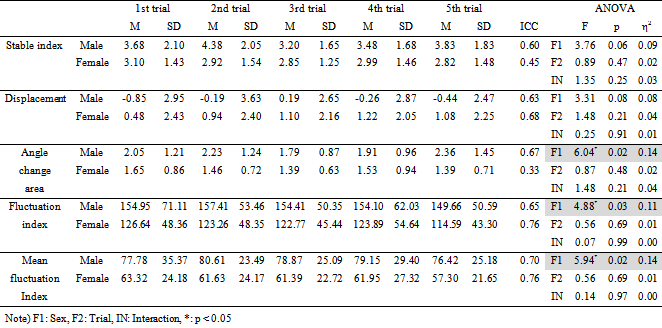


Table 3 shows ICCs of two consecutive trials of the five trials for each parameter according to gender. ICCs of the third and fourth trials in both genders and the second and third trials in the female subjects were >0.67 (0.67–0.83) for each parameter.


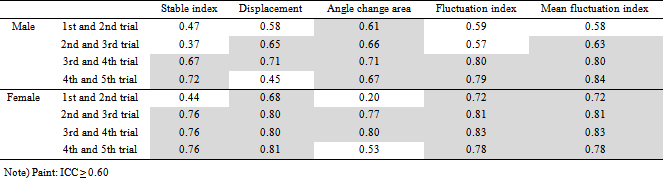

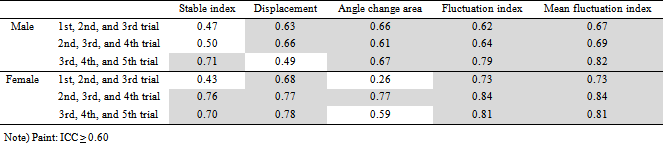
Table 4 shows ICCs of three consecutive trials of the five trials for each parameter according to gender. In the male subjects, there was no combination that had ICCs >0.60 for each parameter. In the female subjects, ICC of the second, third, and fourth trials was >0.76 (0.76–0.84) for each parameter.



4. Discussion
The balance board test is considered to be affected by ADL. Therefore, it is necessary to consider ADL of the subjects when examining sex differences. However, sex differences in ADL have not been found. Demura et al. [14] defined the ADL survey that was used in this study as follows: >24 points denotes a high physical fitness level, 12-24 points denotes a physical fitness level below average, with some difficulty in achieving activities of daily living, and <12 points denotes difficulty in achieving many ADL. In our study, all the subjects had relatively high levels of physical fitness (male, 26.3; female, 26.5).
We investigated the sex differences of the balance board test. It was found that the elderly female subjects were superior in angle change area, fluctuation index, and mean fluctuation index compared with the elderly male subjects. Sex differences in stability index and displacement were not found. However, their effect sizes were moderate (η2 = 0.09, 0.08). These results suggest that the balance board test tended to be superior in the elderly male subjects compared with the elderly female subjects. In general, elderly males have superior leg strength and performance fitness compared with elderly females. In addition, elderly males are superior in functional reach and timed up and go test assessments of dynamic balance ability compared with elderly females [11, 12, 16]. Therefore, it was hypothesized that the balance board test would be superior in elderly males compared with elderly females. However, this hypothesis was rejected. Duncan et al. [17] found a relationship between the functional reach test assessment of dynamic balance ability and height. In addition, Fujiwara et al. [18] reported that the influence of height should be considered when using center of foot pressure (COP) to assess static balance ability. Elderly males may have a larger body sway on an unstable stool because they are taller and have a higher center of gravity compared with elderly females. In any case, from the results of this study, the elderly female subjects had superior angle change area, fluctuation index, and mean fluctuation index compared to the elderly male subjects.
Because a sex difference in the results was noted, reliability was examined using male and female subjects in this study. As a result, insignificant differences were found among the means of the five trials in each gender. Because an unstable stool leans sharply in the backward and forward directions, the body receives continuous involuntary stimulation. Therefore, the influence of the practice effect is considered to be low. For a standard of reliability, ICC > 0.60, as reported by Landis and Koch [19], is widely accepted. In the elderly male subjects, ICCs between the five trials were >0.6 in all parameters; however, in the elderly female subjects, ICCs between the five trials were not >0.6 in all parameters. This test requires considerable strain and concentration. Hence, even if subjects have adequate rest between trials, the stability of the measurements in the latter trials may decrease due to loss of concentration and fatigue. From the present results, when considering the practical application of this test, it may be more appropriate to perform only two or three trials and use that mean as the representative value.
In the case of two consecutive trials, ICCs of all parameters that were >0.6 were the third and fourth trials in both genders and the second and third trials in the female subjects. On the other hand, in the case of three consecutive trials, ICC of all parameters that was >0.6 was the second, third, and fourth trials in the elderly female subjects only. Maintaining a stable posture on an unstable stool might be difficult because elderly males are taller, with a higher center of gravity compared with elderly females.
5. Conclusion
A sex difference was found in the balance board test. These results suggest that when using the unstable stool balance board test in the elderly, the representative measurement values should be taken as the mean value of the third and fourth trials in males and the mean value of the second and third trials in females.
Acknowledgements
This study was supported by special Grant-in-Aid for collaborative research projects from the Fukui University of Technology.
Conflict of Interest Statement
None.
References
| [1] | Demura, S., Fall prevention for the elderly, Kyorin shoin, Tokyo, 2012, 44-81. | ||
 In article In article | |||
| [2] | Urushihata, T., Kinugasa, T., Soma, Y., and Miyoshi, H., “Aging effects on the structure underlying balance abilities tests,” Journal of Japanese Physical Therapy Association, 13(1). 1-8. 2010. | ||
| In article | View Article PubMed | ||
| [3] | Takeshima, N., and Rogers, M.E., Theory and practice of the balance exercise for the fall prevention, Nap, Tokyo, 2010, 11-18. | ||
| In article | |||
| [4] | Sugiura, H., and Demura, S., “Effects of mild and severe knee joint pain on various activities of daily living in the female elderly. Pain Research and Treatment, 2013, Article ID 989508. 2013. | ||
| In article | View Article PubMed | ||
| [5] | American Geriatrics Society, British Geriatrics Society, and American Academy of Orthopaedic Surgeons Panel on Falls Prevention., “Guideline for the prevention of falls in older persons,” Journal of the American Geriatrics Society, 49(5). 664-672. 2001. | ||
| In article | View Article PubMed | ||
| [6] | Ogaya, S., Ikezoe, T., Tsuboyama, T., and Ichihashi, N., “Postural control on a wobble board and stable surface of young and elderly people,” Physical Therapy science, 24(1). 81-85. 2009. | ||
| In article | |||
| [7] | Ogaya, S., Ikezoe, T., Soda, N., and Ichihashi, N., “Effects of balance training using wobble boards in the elderly,” The Journal of Strength and Conditioning Research, 25(9). 2616-2622. 2011. | ||
| In article | View Article PubMed | ||
| [8] | Noguchi, T., Demura, S., and Nakagawa, T., “Posture stability during a one-leg stance on an unstable moving platform and its relationship with each leg,” Perceptual and Motor Skills, 116(2). 555-563. 2013. | ||
| In article | View Article PubMed | ||
| [9] | Kawabata, H., Demura, S., and Uchiyama, M., “Reliability and sex differences in a coordination test of a tracking moving target with the center of foot pressure,” Advances in Physical Education, 2(3). 77-81. 2012. | ||
| In article | View Article | ||
| [10] | Overstall, W.P., Exton-smith, N.A., and Imms, J.F., “Falls in the elderly related to postural imbalance”, British Medical Journal, 1(6056), 261-264. 1977. | ||
| In article | View Article | ||
| [11] | Fujisawa, H., Takeda, R., Ueki, S., Kasai, T., Takato, J., Shimanuki, H., Honda, H., and Haga, H., “Relationship between maximum side-step length and motor ability or falls among community-dwelling older adults,” Physical Therapy Japan. 32(7). 391-399. 2005. | ||
| In article | |||
| [12] | Aslan, B.U., Cavlak U., Yagci, N., and Akdag, B., “Balance performance, aging and falling. A comparative study based on a turkish sample,” Archives of Gerontology and Geriatrics, 46(3). 283-292. 2008. | ||
| In article | View Article PubMed | ||
| [13] | Noguchi, T., Demura, S., Nagasawa, Y., and Uchiyama, M., “Influence of measurement order by dominant and nondominant hands on performance of a pursuit-rotor task,” Perceptual and Motor Skills. 108(3). 905-914. 2009. | ||
| In article | View Article PubMed | ||
| [14] | Demura, S., Sato S., Minami, M., Kobayashi, H., Noda, Y., Matsuzawa, J., Kobayashi, K., and Aoki, J., “Development of ADL index for older community people,” Japanese journal of physical fitness and sports medicine, 49(3). 375-384. 2000. | ||
| In article | |||
| [15] | Sato, S., Demura, S., Matsuzawa, J., Noda, Y., Miyaguchi, H., Tada, N., Kobayashi, H., Goshi, F., Minami, M., and Sugano, N., “Development of ADL index for healthy older persons: proposal of useful ADL items and their scales,” Journal of Physical Education Health and Sport Sciences, 45(4). 472-488, 2000. | ||
| In article | |||
| [16] | Shimada, H., Furuna, T., Obuchi, S., Sugiura, M., Yoshida, H., Kim, H., Yoshida, Y., Nishizawa, S., and Suzuki, T., “Timed up & go test is a useful assessment tool for community health in elderly people,” Physical Therapy Japan. 33(3). 105-111. 2006. | ||
| In article | |||
| [17] | Duncan, P.W., Weiner, D.K., Chandler, J., and Studenski, S., “Functional reach: a new clinical measure of balance,” Journal of Gerontology. 45(6). M192-M197. 1990. | ||
| In article | View Article PubMed | ||
| [18] | Fujiwara, K., Ikegami, H., Okada, M., and Koyama Y., “Contribution of age and muscle strength of lower limbs to steadiness and stability in standing posture,” Journal of the Anthropological Society. 90(4). 385-399. 1982. | ||
| In article | View Article | ||
| [19] | Landis, J.R., and Koch, G.G., “The measurement of observer agreement for categorical data,” Biometrics. 33(1). 159-174. 1977. | ||
| In article | View Article PubMed | ||
 CiteULike
 Mendeley
 StumbleUpon
 Delicious
 Facebook
 Twitter
 LinkedIn