sciepub.com
 Quick Submission

A Talent Development Perspective on the Olympic Athlete
Rita R. Culross
Abstract
Using an integrated biopsychosocial approach, this paper examines the influences of physical ability, mental and emotional aspects, and the influences of home, school, and culture on the talent development of the elite athlete. The paper will also go beyond characteristics of individual Olympians to discuss how athletic performance can be enhanced through executive coaching, cognitive behavioral therapy, attention to aspects of health psychology, instruction, and neuropsychological interventions. A final section will address issues association with underperformance. The primary focus of the paper will be on Summer Olympians from the U.S., although similar examples could be provided from throughout the full range of countries competing in the Games.
Keywords: Olympic athletes, talent development, talent enhancement
Copyright © 2015 Science and Education Publishing. All Rights Reserved.Cite this article:
- Rita R. Culross. A Talent Development Perspective on the Olympic Athlete. American Journal of Sports Science and Medicine. Vol. 3, No. 5, 2015, pp 108-111. http://pubs.sciepub.com/ajssm/3/5/4
- Culross, Rita R.. "A Talent Development Perspective on the Olympic Athlete." American Journal of Sports Science and Medicine 3.5 (2015): 108-111.
- Culross, R. R. (2015). A Talent Development Perspective on the Olympic Athlete. American Journal of Sports Science and Medicine, 3(5), 108-111.
- Culross, Rita R.. "A Talent Development Perspective on the Olympic Athlete." American Journal of Sports Science and Medicine 3, no. 5 (2015): 108-111.
| Import into BibTeX | Import into EndNote | Import into RefMan | Import into RefWorks |
At a glance: Figures
1. Introduction
From the very beginning of the Olympic movement in ancient Greece, development of the athlete in both body and mind was seen as the route to achievement at the Games [19] The development of powers and talents through training were important responsibilities of participants in the Games that were expected by the gods and the aim of Greek educational system.
Today’s modern Olympic athletes embody this same tradition through their pursuits of their sports. While many spectators view the Olympian as an individual of exceptional physical talent, the reality of the road to the Games is quite different. Innate talent may be a factor in involvement in sport, but the trajectory from God-given talent to Olympic medal winner is filled with deliberate practice and powerful external influences.
As the world turns its attention to Rio de Janeiro and the opening of the 2016 Summer Olympics August 5, the talent development literature offers a lens through which to explain the exceptional athlete. Using an integrated biopsychosocial approach, this paper examines the influences of physical ability, mental and emotional aspects, and the influences of home, school, and culture on the talent development of the elite athlete. The paper will also go beyond characteristics of individual Olympians to discuss how athletic performance can be enhanced through executive coaching, cognitive behavioral therapy, attention to aspects of health psychology, instruction, and neuropsychological interventions. A final section will address issues association with underperformance. The primary focus of the paper will be on Summer Olympians from the U.S., although similar examples could be provided from throughout the full range of countries competing in the Games.
2. Talent Development as a Frame of Reference
Historically, American conceptions of talent originated in the attention to intelligence as measured by IQ tests (e.g. [24]). Over time the view of talent broadened both from an emphasis on mental ability to one of talent within different domains, including physical performance, artistic ability, and applied domains such as entrepreneurship; as well as from a view of talent as fixed [9] to talent as the growth of ability through the support of others and the psychosocial development of the individual [16]. Although psychomotor ability was included in the 1972 definition promulgated by the U.S. Department of Education, Piirto [23] was one of the first within the field to write at length about the development of physical performers, including athletes.
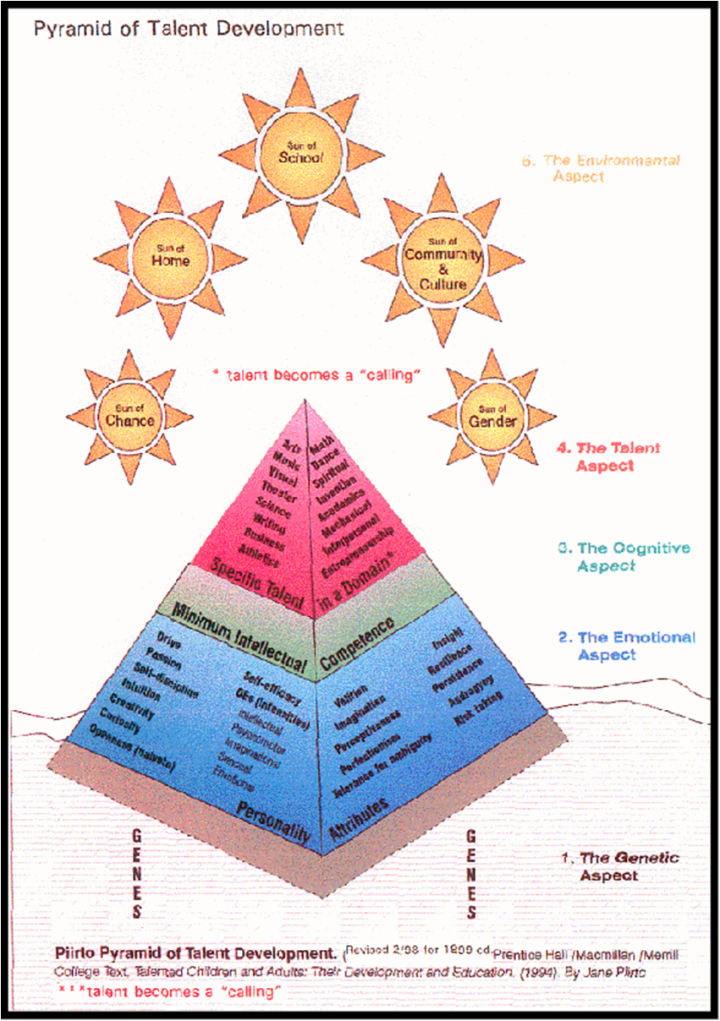
Piirto postulated a model of talent development to explain talent development in various fields from the perspective of person, process, and product, as well as environmental factors. Table 1 below shows the model.
The model postulates that talent development builds upon the individual’s genetic makeup. Contributing to the individual’s talent are the emotional and cognitive aspects of their being; that is, individuals within a certain domain share cognitive abilities and personality traits that contribute to their success within the domain. The talent itself is largely specific to a certain domain, in this case athletic performance. Finally, the individual persons (or athletes) are influenced by what she calls environmental “suns;” i.e. the influence of the home, school, community or culture, gender, and chance in the development of their talents.

 Download as
For Olympic athletes how might this look? While athletes are popularly viewed as being born with their talents, in fact, research shows that the genetic components are more likely to be quite specific traits that in and of themselves are not sufficient to lead to high-level performance. For example, female Olympic gymnasts (think Gabrielle Douglas) are usually quite short in stature with small hips and broad shoulders [1]. While there is some evidence that this is due to the increased force required to propel longer limbs through various apparatuses, the advantage also arises from the bias in the scoring system toward acrobatic talent. Similarly, swimmers can be advantaged through body type. Michael Phelps’ superior swimming ability is attributed in part to his unique body type [12]. Phelps’ wingspan stretches 80 inches, more than 10 inches greater than his total height. (A typical person’s height and length of outstretched arms are virtually the same length.) His size-14 feet bend 15 inches farther than typical swimmers, turning them into what Hadhazy calls virtual flippers. Regardless, as we shall see later in this paper, these physical attributes of athletes, while assets, are only part of what is required for Olympic success.
Cognitively, bodily-kinesthetic intelligence in combination with visual learning, provide the Olympic athlete with the ability to learn skilled movements and to adjust their performance based on feedback from visual images such as videotapes of their past performance. Former LSU athlete and Olympic hurdler Lolo Jones benefits from videotaped images of her training runs, in which more than 1500 images per second are taken of her runs [18]. Afterward she and her coach analyze the minute details of her performance and make adjustments for future training runs. Outside of the pool Olympic diver David Boudia is fluent in American Sign Language. “I’m a visual learner. Sign language is a visual foreign language. So I struck right into it, and, uh, it’s pretty easy now” [22].
Emotionally, Olympic athletes must deal with a multitude of distractions as well as regulating their emotions in competition. Naturally physically expressive, athletes must often learn to regulate their emotions through techniques to control breathing, concentrate on the task at hand, and address fears about past failures.
As Karen Cogan, U.S. Olympic Committee senior sport psychologist, has said, “For the most part, the body knows what to do. Athletes just have to turn off their minds.” ([6], p. 36) Brady Ellison, US Olympian and one of the elite archers in the world, has a tattoo of the Olympic rings on his forearm. The tattoo serves as a constant reminder of his 2008 Olympic achievement and as a motivating tool for a repeat performances in future Games. In general, Olympic athletes are highly competitive, exhibit adaptive perfectionism, and maintain mental toughness during competition [11].
Equally important to the specific abilities and aspects of the individual athlete are the environmental influences that surround the athlete’s talent development. As Bloom’s [2] studies have shown, talent development for athletes begins at home through the encouragement of parents to participate in recreational activities through their enrollment of the child in classes or teams, through their transportation of the child to sporting events, and even to the family’s relocation close to a professional coach. The current Proctor & Gamble commercial shows three (fictional) mothers waking their children for early morning training sessions, sitting in the stands as their children perform, and cheering them on to winning performances at the Olympics. Taylor Phinney, a top U.S. cyclist, is the offspring of Connie Carpenter and Davis Phinney, both former cycling champions. Parents, particularly those who were themselves competitors, may also serve as the Olympian’s coach. Valery Liukin, father and coach of 2008 U.S. Olympic gymnast, NastiaLiukin, was a famous Russian Olympian before the split up of the Soviet Union.
While schools in Piirto’s model typically refer to the formal academic training received by talented individuals, with athletes education often includes specialized camps, organized team sports, and personal coaches. Virtually every single member of the U.S. Men’s Basketball team has been involved in basketball since early in their youth. Most played high school, college and professional basketball and participated in summer leagues at all levels. The U.S. culture is also quite supportive of organized sports. High schools and colleges offer an array of sports teams, and hours upon hours of broadcast time are devoted to watching competitive sporting events.
Finally, according to Piirto’s model chance plays a role in the talent development of Olympic athletes. Boyd Martin, a member of the U.S. Olympic equestrian team and the son of an Australian father and an American mother, bought Neville Bardos, his mount in the 2012 Olympics, for $850, a pittance in a sport where horses may cost several hundred thousand dollars. Neville Bardos was on his way to the slaughterhouse. His appeal to Martin? The horse, too, was half Australian, half American. In a freak Memorial Day fire, Martin saved Neville Bardos’ life a second time when the stable in which he was housed caught on fire, killing all the other horses inside. A chance encounter and quick sale have lead to one of the most successful partnerships in U.S. Olympic history [10].
3. The Enhancement of Talent Development in the Olympic Athlete
What really separates Olympians from lesser athletes, however, is not just the physical, cognitive and emotional characteristics of the athlete. Nor is it the solely the influence of community and culture, school, parents, or other external factors. What really separates the very best from the rest is the intense preparation and careful application of techniques from the fields of nutrition, sport psychology, and sports medicine.
Consider first nutrition. Top athletes pay careful attention to their diet, working with the advice of nutritional experts. Olympians focus on maintaining proper hydration, choosing appropriate foods for training and competition, and selecting appropriate supplements to maximize performance without risking consuming banned supplements. Male cyclists appear to meet these challenges with the support of medical and nutritional support crews [3].
With respect to sport psychology, Olympians draw upon several established techniques to maximize their performance in competition. Through the application of coaching techniques, psychologists work with athletes to manage the pressure of competition, handle distractions, and deal with loss or underperformance [13]. Athletes learn to visualize successful performance, to visualize the desired performance in advance of competition, and even to visualize standing on the medal stand. Upon winning the Ladies’ Singles title at Wimbledon for the fifth timein 2012, Serena Williams said that challenging for a fourth Gold Medal at the 2012 London Olympics was a major motivator for her in overcoming her recent health problems.
More than any other single factor, however, deliberate practice is a key element in successful athletic achievement [7]. Deliberate practice is a type of practice designed to improve performance. It isn’t simply repeating a sports skill over and over; it’s repetition in the presence of feedback and mental concentration to improve performance. Olympic soccer players play in games where split-second decisions as much as physical skill can determine the outcomes of games. In such an atmosphere the ability to make wise choices is honed over thousands of hours of competition, where choices become second nature. Equally important, however, is that during those hours of practice the athlete is able to consciously make note of the results of a choice and receive feedback from an objective third party in the form of a coach.
Other techniques learned through sport psychology include goal-setting, perfectionism, and relaxation. Olympic athletes obviously have set major goals; e.g. to qualify for the team, to win a medal, etc. But many goals revolve around “besting” their prior records; in effect, they are competing against themselves. A visitor to a typical US Olympic Track and Field Trial will see personal record after personal record fall, as athletes seek to better their previous best performances. Relaxation is achieved by Olympic athletes through such techniques as deep breathing, imagery, or self-talk. Kayla Harrison, 2012 Olympic Gold Medalist in Judo, has discussed at length how she uses visualization, deep breathing, and, yes, even crying to mentally prepare for her matches [17]. One of the newer techniques being utilized by Olympic athletes to achieve these goals is neurofeedback. Beach volleyball star Kerri Walsh-Jennings has employed neurofeedback to improve her mental edge in training. Neurofeedback allows athletes to receive feedback through displays of brain wave that measure focus and concentration [21].
4. Underperformance: Talent in Trouble
In spite of tremendous talent, deliberate practice, and effective coaching, elite athletes can and do exhibit underperformance in competition and in their careers as a whole. This final section will discuss the impact of eating disorders, substance abuse, life/work balance issues, physical injury, and post-career transitions in the performance of Olympic athletes.
Eating disorders may affect any athlete but are more prevalent in female athletes. Because women are sensitized throughout life to focus on body image, sports such as gymnastics, in which the athlete’s body is on display in revealing uniforms, may provoke the athlete to reduce caloric consumption or over-exercise to avoid gaining weight. There is some evidence that eating disorders increase over the length of the season in a sport. In the case of Olympic athletes who train year-round, this can be an even greater concern. Kim Soldati, a 2004 U.S. Olympic diver has chronicled her battle with bulimia in her quest for Olympic gold [15]. While today’s Olympic organization is aware of the dangers eating disorders present, it is often difficult to identify athletes who need help because athletes hide their behavior from family and coaches.
The use of performance-enhancing drugs has cost more than one Olympian a Gold Medal. Track and field athlete Marion Jones of the U.S. lost her Olympic medals when she became tainted by a steroids scandal and eventually ended up imprisoned (Toptenz.net, n.d.). Although testing is extensive and banned substances are clearly delineated for all Olympic competitors, the pressure to excel often drives some athletes to utilize unapproved substances.
Life/work balance issues represent another area of concern for Olympians. In the U.S. sponsorships are now available to allow Olympians to dedicate large blocks of time to training without regard for financial obstacles, the pressure to balance school, family, and other aspects of life remain. U.S. Olympian Candace Parker (basketball) and Christie Rampone (soccer ) have taken leaves from their sports, only to return with children in tow to practices and games [20].
Leaves from competition may also occur due to injuries sustained in practice or competition. McKaylaMaroney, U.S. women’s gymnast, suffered a concussion just weeks before the U.S. Trials (NBC Olympics, 2012). Shawn Johnson, 2008 Olympic gymnast, withdrew from the same trials when she failed to heal in time from a knee injury sustained in a skiing accident while taking a break from competition.
Finally, athletes must cope with the end of a competitive career. While U.S. Olympic swimmer Dara Torres won twelve Olympic medals in five different Games, most Olympians have a much shorter lifespan as an elite athlete. Bruce (now Caitlyn) Jenner, U.S. Olympic decathlon champion, began competition in his sport in 1970 and finished his career a mere six years later. Although it can be argued that the competitive rules on compensation in the 1970’s precipitated the end of Jenner’s career, most Olympians compete for a relatively short period of time [4]. When their identity as an athlete wanes, they must search for a new identity through coaching, celebrity spokesperson, or an entirely new vocation. Rulon Gardner, U.S. Olympic wrestler in the Beijing Games, achieved an epic upset of a Russian champion to claim Gold in his sport. However, after returning to the U.S., his weight ballooned, and he was involved in motorcycle, snowmobiling, and archery accidents. Returning to his life as a farmer in the West, he never again regained his competitive form [5].
5. Conclusion
As we all settle in months from now to cheer our Olympic favorites on to victory, it would be wise to remember that the performances we will see represent a lifetime of work, developing talent and overcoming challenges. For the less than 10 seconds it takes to complete a 100-meter dash, it takes years of training, both mental and physical to achieve victory. The 60 seconds John Orozco competes during floor exercise represent the completion of 12 years of training, tremendous sacrifice by his family, and months of rehabilitation from a torn Achilles tendon.
Acknowledgments
The author acknowledges the support of funding from the Jo Ellen Levy Yates Professorship in the preparation of this manuscript.
Statement of Competing Interests
The author has no competing interests.
References
| [1] | Bale, P. &Goodway, J. (1990). Performance variables associated with the competitive gymnast. Sports Medicine, 10(3), 139-145. | ||
 In article In article | View Article PubMed | ||
| [2] | Bloom, B. (1985). Talent development in young people. New York, NY: Ballantine. | ||
| In article | |||
| [3] | Burke, L. (2001). Nutritional practices of male and female endurance cyclists. Sports Medicine, 31(7), 521-532. | ||
| In article | View Article PubMed | ||
| [4] | Carey, B. (2008). After glory of a lifetime, asking “What now?” New York Times. Posted on August 8, 2008 At http://www.nytimes.com/2008/08/18/sports/olympics/18psych.html. | ||
| In article | |||
| [5] | Cazeneuve, B. (2012). Despite failed comeback Rulon Gardner is not done wrestling. Sports Illustrated. Posted April 26, 2006 at http://www.si.com/more-sports/2012/04/26/rulon-gardner-olympic-bid. | ||
| In article | |||
| [6] | Clay, R. (2012). Gold-medal psychology. APA Monitor, 43(7), 34-38. | ||
| In article | |||
| [7] | Colvin, G. (2010). Talent is overrated. New York, NY: Penguin. | ||
| In article | |||
| [8] | Csikszentmihalyi, M. (1990). Flow. New York, NY: Cambridge. | ||
| In article | |||
| [9] | Dweck, C. (2006). Mindset: The new psychology of success. New York, NY: Ballantine. | ||
| In article | PubMed | ||
| [10] | Forgrave, N. (2012). Martin, saved horse have special tie. Fox Sports. Posted June 20, 2012 at http://msn.foxsports.com/olympics/equestrian/story/Boyd-Martin-and-Neville-Bardos-the-horse. | ||
| In article | |||
| [11] | Gould, D., Dieffenbach, K. & Moffatt, A. (2002). Psychological characteristics and their development in Olympic champions. Journal of Applied Sport Psychology, 14(3), 174-204. | ||
| In article | View Article | ||
| [12] | Hadhazy, A. (2008). What makes Michael Phelps so good? Scientific American, August 18, 2008. | ||
| In article | |||
| [13] | Harmon, K. (2012). Sports psychologists extend their training to athletes’ coaches and families. Scientific American. Posted August 1, 2012 at http://www.scientificamerican.com/article/olympics-sports-psychology/. | ||
| In article | |||
| [14] | Hayes, K. (2009) Performance psychology in action. Washington, DC: American Psychological Association. | ||
| In article | |||
| [15] | Helmich, N. (2006). Athletes’ hunger to win fuels eating disorders. USA Today. Posted March 5, 2006 at http://www.usatoday.com/sports/2006-02-05-women-health-cover_x.htm . | ||
| In article | |||
| [16] | Horowitz, F., Subotnik, R., and Mathews, D. (2009). The development of giftedness and talent across the lifespan. Washington, DC: American Psychological Association. | ||
| In article | View Article | ||
| [17] | Humintell. (2012). Olympians and their emotions: Kayla Harrison. Posted July 10/2012 at http://www.humintell.com/2012/07/olympians-and-their-emotions-kayla-harrison/. | ||
| In article | |||
| [18] | McCluskeyM. (2012). One one-hundredth of a second faster: Building better Olympic athletes. Wired.Posted July 25, 2012 at http://www.nytimes.com/2008/08/18/sports/olympics/18psych.html. | ||
| In article | |||
| [19] | Mechikoff, R. (2010) A history and philosophy of sport and physical education: From ancient civilizations to the modern world. New York, NY: McGraw-Hill. | ||
| In article | |||
| [20] | Moscatello, C. (2012). Hey, London, the Moms are calling! Redbook. Posted July 22, 2012 at http://www.redbookmag.com/life/mom-kids/a14072/female-olympic-athletes-who-are-moms/. | ||
| In article | |||
| [21] | Murphy, J. (2012). Mental, physical training for Olympic volleyball. Wall Street Journal, July 10, 2012. | ||
| In article | |||
| [22] | NBC Olympics (2012).Profiles of David Boudia and Kayla Maroney. Posted at http://www.nbcolympics.com/athletes/athlete-david-boudia/library and http://www.nbcolympics.com/athletes/athlete-kayla-maroney/library. | ||
| In article | |||
| [23] | Piirto, J. (2004). Understanding creativity. Scottsdale, AZ: Great Potential Press. | ||
| In article | |||
| [24] | Terman, L. & Oden,M. (1959) Genetic studies of genius. Vol. V. The gifted group at mid-life. Stanford, CA: Stanford University Press. | ||
| In article | |||
| [25] | Toptenz.net (n.d.) http://www.toptenz.net/top-10-athletes-who-lost-their-olympic-medal.php. | ||
| In article | |||
 CiteULike
 Mendeley
 StumbleUpon
 Delicious
 Facebook
 Twitter
 LinkedIn
)