Saccharum officinarum L (Poaceae) is a plant whose leaves are used as a diuretic and in the traditional treatment of high blood pressure. This study aims to evaluate the salidiuretic effect of the aqueous extract of Saccharum officinarum (Esol) leaves and detect its mechanism of action in rats. The effect of the dose of 1000 mg / kg BW is compared to those of furosemide (40 mg / kg BW), Esidrex (25 mg / kg BW) and Aldactone (50 mg / kg BW) on the concentration of Na+, K+ and Cl- ions in 24-hour urine produced by rats placed on water overload. The results show that the 24-hour urinary volume increases significantly (p < 0.001) with Esol (16.22 ± 1.89 mL) as do the diuretics used compared to the control. The determination of Na+, K+ and Cl- ions in the urine of animals treated with Esol gives respective concentrations of 2.65 ± 0.34; 0.23 ± 0.05 mEq / L and 2.67 ± 0.253 mEq / L variations significantly close to those of Aldactone. The pH of urine obtained with Esol and reference diuretics is basic. The Na+ / K+ ratio of Esol (11.27) like that of Aldactone (10.63) is greater than 10.These parameters confirm that the aqueous extract of Saccharum officinarum leaves has salidiuretic properties acting as a sparing agent potassium just like (Aldactone). These results therefore justify the use of Saccharum officinarum leaves in traditional medicine.
Diuretics are substances that inhibit renal sodium reabsorption and therefore cause urinary elimination of water and sodium chloride 1. Depending on the site of action of diuretic drugs in the nephron, four classes are distinguished: carbonic anhydrase inhibitors, loop diuretics, thiazides and potassium sparing agents 2.
However, pharmacological studies have shown that synthetic diuretics have numerous side effects (plasma acidosis, ionic imbalance, etc.) and cannot be administered in certain physiological cases such as pregnancy 3. Also, the accessibility of medicinal plants and their relatively low costs have pushed populations to use them for treatment 4.
Currently, the World Health Organization (WHO) welcomes products from the traditional pharmacopoeia, as an alternative solution to treat diseases 5. In this context, works has demonstrated the diuretic properties of Spondias mombin 6, Zizyphus mauritiana 7 and Oxystelma esculentum 8. In our case, we were interested in the leaves of Saccharum officinarum which are used in traditional medicine as a diuretic and in the treatment of high blood pressure in Ivory Coast 9, 10 and Madagascar 11. The leaf decoction of Saccharum officinarum has an effective diuretic effect and contains chemical compounds that support this 10. However, the salidiuretic effect as well as its probable mechanism of action remains to be verified.
This present study therefore aims to verify the salidiuretic effect of the aqueous extract of Saccharum officinarum leaves in rats placed on water overload and determine the parameters allowing its probable mechanism of action to be known.
The plant consists of the leaves Saccharium officinarum L. (Poaceae) which were harvested in the town of Bonoua in Kresinboville in June 2022. They were identified at the National Floristic Center (NFC) of the Felix HOUPHOUET-BOIGNY University (Abidjan, Ivory Coast) in comparison with herbarium No. UCJ007975.
Rats of the Rattus norvegecus species (Muridae), of the Wistar strain weighing between 160 grams and 190 grams, were used to carry out the tests on induced water overload. These animals are raised under standard conditions of temperature, nutrition and atmospheric pressure at the Biosciences Formation and Research Unit (FRU) of the Felix HOUPHOUET-BOIGNY University (Abidjan, Ivory Coast).
This study is conducted in accordance with the European directives of November 24, 1986 (86/609/EEC) and decree of April 19, 1988 12 on animal experiments in research.
The pharmacological substances used in this study are essentially diuretic substances, in this case Furosemide dosed at 40 mg / kg BW (Sanofi Aventis, France), Aldactone dosed at 25 mg / kg BW (Pfizer pfe, France ) and Esidrex dosed at 25 mg / kg BW (Norvartis pharma, Switzerland).
2.2. MethodsThe dry leaves of Saccharum officinarum L. (Poaceae) are crushed into small pieces at the Felix HOUPHOUET-BOIGNY University (Abidjan, Ivory Coast). The pieces obtained, 250 g, are brought to the boil in 5000 mL of distilled water for 30 minutes. The homogenate obtained is filtered through hydrophilic cotton and Whatmann No. 1 paper. The filtrate obtained is dried in oven (Venticell Med. Center type, France) at 40°C for 72 hours, in order to obtain the dry extract of the aqueous decoction of Saccharum officinarum (Esol) leaves. Then, the extract obtained is stored at 4°C.
The salidiuretic effect of the aqueous extract of Saccharum officinarum leaves is compared to that of diuretic substances. This study is based on the method for measuring urinary volume 24 hours after administration of a fluid overload and the substances tested orally 13, 3, 14. The animals were fasted 18 hours before the experiment, with free access to water. Before the experiment, 50 mL / kg BW of distilled water is given to each rat. Then, the animals in the control group each receive two (2) mL of distilled water. The animals of the 4 other batches receive respectively 2 mL: extract (1000 mg / kg BW) for batch 2, Aldactone (50 mg / kg BW) for batch 3, Esidrex (25 mg / kg BW) for the batch 4 and Furosemide (40 mg / kg BW) for batch 5. The animals are then immediately placed in individual metabolism cages. Then, the urine emitted over 24 hours was collected.
The diuretic activity of the extract was determined according to the Diuretic index values (Table 1) 15, 16.
The volume of urine emitted in 24 hours having been measured, the diuretic index is calculated according to the formula:
 |
The urinary pH is determined by measuring the pH of urine collected 24 hours after treating the rats with the substances. Thus, two (2) drops of urine are placed on a pH paper. Finally, the coloring of the paper changes and gives a coloring corresponding to the urinary pH value.
The effect of Esol on the urinary excretion of Na+, K+ and Cl- ions is studied by measuring these ions with a flame spectrophotometer. The 24-hour urine is filtered through hydrophilic cotton, then centrifuged at a speed of 3000 revolutions per minute for 10 minutes to eliminate residues. Then, the supernatant is collected and the urinary level of Na+, K+ and Cl- is directly measured with a flame spectrophotometer (Hycel PHF 104©, India). The Na+, K+ and Cl- results obtained are then multiplied by the volume of 24-hour urine to obtain the daily urinary level of these electrolytes by the animals.
The extract mechanism of action is determined with the ratios between the rate of the different ions excreted such as: Na+, Cl- and K+ as well as the pH. The sum of Na+ and Cl- makes it possible to calculate the salidiuretic activity of a product 17. The Na+/K+ ratio makes it possible to evaluate the natriuretic activity and the Cl- / (Na+ + K+) ratio makes it possible to estimate the inhibition of carbonic anhydrase 8 [16-18] 16 (Table 2)
The computer program GraphPad Prism 5.01 (San Diego CA, USA) is used for statistical analysis of the results. The results are processed by analysis of variance (ANOVA), followed by Dunnett's multiple comparison test. The difference between two values is considered significant for (p < 0.05).
GraphPad Prism software version 5.01 (San Diego CA USA) was used to plot the graphs. The diuretic activity graphs are XY and Column type curves from GraphPad Prism.
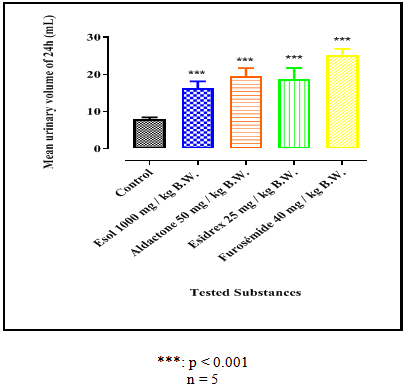
After treatment of rats placed on water overload, the 24-hour urinary volume of the group treated with Esol increased significantly (p < 0.001) compared to that of the control.
In fact, it goes from 7.8 ± 0.59 mL (for the control group) to 16.22 ± 1.89 mL (for Esol), an increase of 107.94%.
Likewise, the urinary volume of the batches treated with Aldactone, furosemide and Esidrex are respectively 19.52 ± 2.15; 25.26 ± 1.61 mL and 18.62 ± 3.09 mL Compared to the control, these urine volumes also increased significantly (p < 0.001) by 165.07%, 223.84% and 138.71% respectively for Aldactone, furosemide and Esidrex (Figure 1).

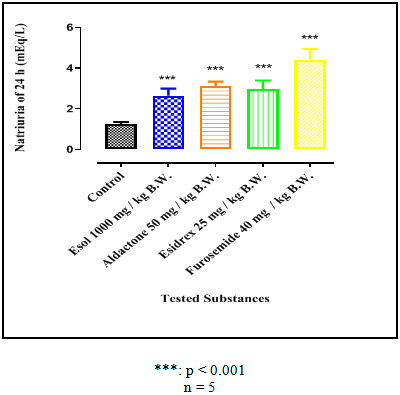
The determination of sodium in the urine of rats placed on water overload and treated with distilled water gives a concentration of 1.24 ± 0.11 mEq / L. In the rats having received Esol, Aldactone, Esidrex and Furosemide respectively, the Na+ concentration increases significantly (p < 0.001) compared to that of the control. In fact, the sodium concentration is 2.65 ± 0.34; 3.11 ± 0.22; 2.95 ± 0.11 and 4.42 ± 0.52 mEq/L for Esol, Aldactone, Esidrex and Furosemide respectively (Figure 2).

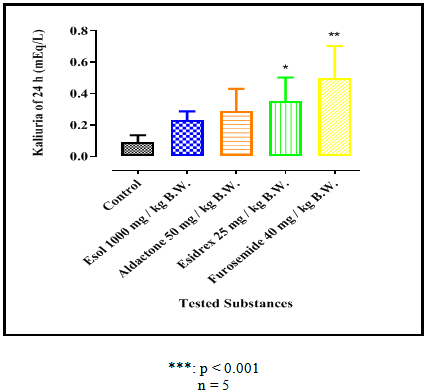
In the control, the K+ rate is 0.09 ± 0.04 mEq / L. Its concentration does not vary significantly (p > 0.05) in the rats treated with Esol and Aldactone compared to the control (Figure 3). Indeed, the potassium rate in these batches is respectively 0.23 ± 0.05 mEq / L and 0.28 ± 0.1 mEq / L for Esol and Aldactone.
On the other hand, the K+ rate increases significantly (p < 0.05 and p < 0.01) in the groups having received Esidrex and furosemide compared to the control with respective rate of 0.35 ± 0.1 mEq / L and 0.49 ± 0.2 mEq/L.

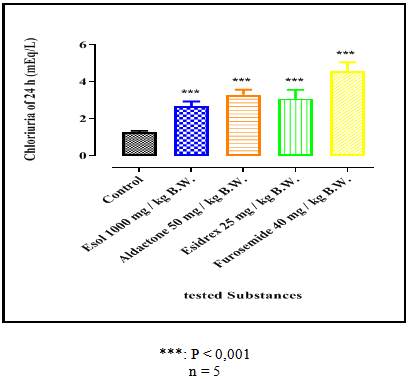
The chlorine level in the 24-hour urine of rats treated with Esol, Aldactone, Esidrex and furosemide increased significantly (p < 0.001) compared to that of the control.
Indeed, this Cl- concentration is 1.25 ± 0.09 mEq / L for the control. Rats treated with Esol, Aldactone, Esidrex and furosemide had respective rate of 2.67 ± 0.253, mEq/L; 3.29 ± 0.273; mEq/L; 3.08 ± 0.48 mEq/L and 4.56 ± 0.49 mEq/L (Figure 4).

The diuretic index of Esol is identical to that of diuretics, greater than 1.5. The pH of treated rats with Esol and diuretics is basic. The sum Na+ + Cl- of the treated batch with the aqueous extract of Saccharum officinarum like that of the diuretics and is higher than that of the control.
The Na+ / K+ ratio of Esol like that of Aldactone is greater than 10.
Also, the Cl- / (Na+ + K+) ratio is between 0.8 and 1 for all the substances (Esol, Esidrex, Furosemide and Aldactone) (Table 3).
The salidiuretic effect of the dose of 1000 mg / kg B.W. was compared to those of reference diuretics such as Aldactone, Esidrex and Furosemide. The salidiuretic study is carried out by causing a fluid overload in rats in order to promote reabsorption of electrolytes. Indeed, a water overload dilutes the concentration of electrolytes in the internal environment, thus promoting their reabsorption 3. It is also known that any salidiuretic substance increases the excretion of electrolytes despite their reabsorption 20. Our results show that the Esol extract has diuretic potential just like the reference diuretics. The extract increases natriuresis, chloriuresis and urinary pH compared to controls but not kaliuresis like Aldactone. The increase in diuresis could be explained by the retention of water in the tubular lumen, following the retention of the Na+ ion, including reabsorption 20. Esol would therefore inhibit water reabsorption. The mechanism of action of the extract of Saccharum officinarum L. (Poaceae) was determined according to the ratios between the different ions excreted. The value of the Cl- / (Na+ + K+) ratio of Esol (0.92) excludes the inhibition of carbonic anhydrase 16. Thus, these results show that Esol would not act at the level of the proximal tube. Finally, the value of the Na+ / K+ ratio shows that the elimination of the Na+ ion is significantly greater than that of K+ with Esol (11.27) and Aldactone (10.63). This indicates that Esol would spare the potassium ion just like Aldactone. In this case, the aqueous extract of Saccharum officinarum L. (Poaceae) would therefore act at the level of the distal convoluted tube 16. Indeed, Aldactone is an anti-aldosterone diuretic acting at the level of the distal convoluted tubule on the Na+ / K+ ATPase-dependent pump 21, 22. Indeed, in the final part of the distal tube and at the level of the collecting tube of the nephron, Na+ are reabsorbed in exchange with the excretion of potassium or hydrogen ions under the influence of aldosterone 23. Our results are different from those obtained with the alcoholic extracts of Oxystelma esculentum 8 and Peganum harmala 17 which promote the elimination of Na+, K+ and Cl-. However, the increase in pH by Esol indicates the presence of a high concentration of Na+ and Cl- in the urine, making it more alkaline as with the diuretics used. Esol has virtually the same effects as Aldactone (spironolactone) on diuresis and natriuria, kaliuria and pH. It is deduced that the aqueous extract of Saccharum officinarum would act as an Aldosterone antagonist or as a potassium-sparing diuretic.
In order to deepen our research initiated on the diuretic activity of the aqueous extract of Saccharum officinarum leaves, we carried out a study of the comparative effect of the extract with reference diuretics.
There are no conflicts of interest.
| [1] | Caruba T. & Jaccoulet E. Pharmacology and therapeutics, Elsevier Masson SAS, 2018, 238p. | ||
| In article | |||
| [2] | Taoufik. Pathophysiology of essential hypertension. Medicinus. Accessed June 3, 2021. 2018; https://www.medicinus.net/. | ||
| In article | |||
| [3] | Beaux D. Pharmacological study of the diuretic properties of extracts of orthosiphon, pilosella, black elderberry, sweet fennel and bearberry in rats. Human medicine and pathology. Paul Verlaine University - Metz. French. 1991; 285p. | ||
| In article | |||
| [4] | Bounihi A. Phytochemical screening, Toxicological Study and Pharmacological Valorization of Melissa officinalis and Mentha rotundifolia (Lamiaceae). Doctoral thesis, Mohamed V University, Morocco, 2016, 199p. | ||
| In article | |||
| [5] | WHO. WHO strategy for traditional medicine for 2010-2023. Ed. OMS (Geneva), 2013; 6-8. | ||
| In article | |||
| [6] | Guindo I. Study of the traditional treatment of arterial hypertension in Mali. Pharmacy thesis, Bamako, 2005; 126p. | ||
| In article | |||
| [7] | Ba, S. H. Study of the phytochemistry and biological activities of Zizyphus mauritiana Lam (Rhamnaceae) used in the traditional treatment of diabetes and high blood pressure in Mauritania. FMPOS Pharmacy Thesis, Bamako, 2006; 120p. | ||
| In article | |||
| [8] | Durairaj A. K., Mazumder U. K., Gupta M., Ray S. K. Effects of methanolic extract of Oxystelma esculentum on diuresis and urinary electrolytes excretion in rats. Iranian J. Pharmacol. Ther., 2007; 6:207-211. | ||
| In article | |||
| [9] | Tra Bi F.H., Irié M.G., N’gaman K.C.C. & Mohou C.H.B. Studies of some therapeutic plants used in the treatment of high blood pressure and diabetes: two emerging diseases in Ivory Coast. Science & Nature, 2008, 5 (1): 39 – 48. | ||
| In article | |||
| [10] | Irie B. J. S., Kouakou A. A. I., Kassi Y. Acute Toxicity and Effect of an Aqueous Extract of Saccahrum officinarum (Poaceae) on Diuresis in Rat. Sch Acad J Pharm, 2023; 12(3): 53-59. | ||
| In article | View Article | ||
| [11] | Ralahiravo D. Y. Study of the effect of RG-2 extract on diuresis in rats. Master’s thesis, University of Antananarivo, 2018; 38p. | ||
| In article | |||
| [12] | Anonymous. Council Directive of 24 November 1986 on the approximation of laws, regulations and administrative provisions of the Member States regarding the protection of animals used for experimental and other scientific purposes. Official Journal of the European Communities, 1986; 358, 1-28. | ||
| In article | |||
| [13] | Colot M. Technical notions of general pharmacology. Ed. Masson (Paris), chap. 1972; III: 137 – 138. | ||
| In article | |||
| [14] | Sanogo R., Karadji A. H., Dembele O., Diallo D. Diuretic and sadiuretic activity of a recipe used in traditional medicine for the treatment of arterial hypertension. Mali Med., 2009; 25 (4): 1-6. | ||
| In article | |||
| [15] | Kau S.T., Lokkaddie J.R., Andrews D. A method for screening diuretic agents in the rat. J. Pharmacol. Meth., 1984; 11:67-75. | ||
| In article | View Article PubMed | ||
| [16] | Welu G.G., Yimer E. M., Hailu H.G., Bhoumik D. & Lema M.M. In vivo diuretic activity of hydromethanolic extract and solvent fractions of the root bark of Clerodendrum myricoides Hochst. (Lamiaceae). Hindawi Evidence-Based Complementary and Alternative Medicine, 2020;1-8. | ||
| In article | View Article PubMed | ||
| [17] | Al-Saikhan F.I. & Ansari M.N. Evaluation of the diuretic and urinary electrolyte effects of methanolic extract of Peganum harmala L. in Wistar albino rats. Saudi Journal of Biological Science, 2016; 23:749–753. | ||
| In article | View Article PubMed | ||
| [18] | Compaore M., Lamien-Meda A., Mogosan C., Lamien C. E., Kiendrebeogo M., Vostinaru O., Vlase L., Ionescu C., Nacoulma O. G. Antioxidant, diuretic activities and polyphenol content of Stereospermum kunthianum Cham. (Bignoniaceae). Nat. Prod. Res., 2011; 25 (19): 1777-1788. | ||
| In article | View Article PubMed | ||
| [19] | Kebamo S., Makonnen E., Debella A., Geleta B. Evaluation of diuretic activity of different solvent fractions of methanol extract of Carissa edulis root bark in rats. Med. Chem., 2015; 5 (11): 472-478. | ||
| In article | View Article | ||
| [20] | Rasamindrakotroka M. T. Study of the effect of the V1-21 extract on diuresis in rats. Master of Pharmacology from the University of Antananarivo, Madagascar, 2021; 39p. | ||
| In article | |||
| [21] | Tamirisak P., Aaronsonk D. & Koelling T.M. Spironolactone-induced renal insufficiency and hyperkalemia in patients with heart failure. American Heart Journal, 2004; 148(6): 971 – 978. | ||
| In article | View Article PubMed | ||
| [22] | Rorive G. & Krzesinski J.M. Properties and indication of potassium-sparing diuretics. Revue Médicale De Liège, 1986; 9:330-335. | ||
| In article | |||
| [23] | Sherwood L., Berthet J., Amar-Costesec A., Borley N. R., Whitaker R. H., Brooker C., Derrickson B., Tortoga G. J., Faller A., Sprumont P., Schunke M., Gosling J. A., Harris P. F., Whitmore I., Willan P. L. T., Moore K. L., Dalley A. F., Schmidt R. F., Tank P., Gest T., Tortora G. J., Grabowski S. R., Weir J., Abrahams P. H. Human Physiology. Ed. Nouveaux Horizons, 2nd edition, Paris (France), 2013; Chap. XIII; XIV: 405 - 441; 443 - 463. | ||
| In article | |||
Published with license by Science and Education Publishing, Copyright © 2023 Irié bi jean séverin, Kouakou Assui Aude Ines, Kassi yomalan and Abo kouakou Jean-Claude
 This work is licensed under a Creative Commons Attribution 4.0 International License. To view a copy of this license, visit
http://creativecommons.org/licenses/by/4.0/
This work is licensed under a Creative Commons Attribution 4.0 International License. To view a copy of this license, visit
http://creativecommons.org/licenses/by/4.0/
| [1] | Caruba T. & Jaccoulet E. Pharmacology and therapeutics, Elsevier Masson SAS, 2018, 238p. | ||
| In article | |||
| [2] | Taoufik. Pathophysiology of essential hypertension. Medicinus. Accessed June 3, 2021. 2018; https://www.medicinus.net/. | ||
| In article | |||
| [3] | Beaux D. Pharmacological study of the diuretic properties of extracts of orthosiphon, pilosella, black elderberry, sweet fennel and bearberry in rats. Human medicine and pathology. Paul Verlaine University - Metz. French. 1991; 285p. | ||
| In article | |||
| [4] | Bounihi A. Phytochemical screening, Toxicological Study and Pharmacological Valorization of Melissa officinalis and Mentha rotundifolia (Lamiaceae). Doctoral thesis, Mohamed V University, Morocco, 2016, 199p. | ||
| In article | |||
| [5] | WHO. WHO strategy for traditional medicine for 2010-2023. Ed. OMS (Geneva), 2013; 6-8. | ||
| In article | |||
| [6] | Guindo I. Study of the traditional treatment of arterial hypertension in Mali. Pharmacy thesis, Bamako, 2005; 126p. | ||
| In article | |||
| [7] | Ba, S. H. Study of the phytochemistry and biological activities of Zizyphus mauritiana Lam (Rhamnaceae) used in the traditional treatment of diabetes and high blood pressure in Mauritania. FMPOS Pharmacy Thesis, Bamako, 2006; 120p. | ||
| In article | |||
| [8] | Durairaj A. K., Mazumder U. K., Gupta M., Ray S. K. Effects of methanolic extract of Oxystelma esculentum on diuresis and urinary electrolytes excretion in rats. Iranian J. Pharmacol. Ther., 2007; 6:207-211. | ||
| In article | |||
| [9] | Tra Bi F.H., Irié M.G., N’gaman K.C.C. & Mohou C.H.B. Studies of some therapeutic plants used in the treatment of high blood pressure and diabetes: two emerging diseases in Ivory Coast. Science & Nature, 2008, 5 (1): 39 – 48. | ||
| In article | |||
| [10] | Irie B. J. S., Kouakou A. A. I., Kassi Y. Acute Toxicity and Effect of an Aqueous Extract of Saccahrum officinarum (Poaceae) on Diuresis in Rat. Sch Acad J Pharm, 2023; 12(3): 53-59. | ||
| In article | View Article | ||
| [11] | Ralahiravo D. Y. Study of the effect of RG-2 extract on diuresis in rats. Master’s thesis, University of Antananarivo, 2018; 38p. | ||
| In article | |||
| [12] | Anonymous. Council Directive of 24 November 1986 on the approximation of laws, regulations and administrative provisions of the Member States regarding the protection of animals used for experimental and other scientific purposes. Official Journal of the European Communities, 1986; 358, 1-28. | ||
| In article | |||
| [13] | Colot M. Technical notions of general pharmacology. Ed. Masson (Paris), chap. 1972; III: 137 – 138. | ||
| In article | |||
| [14] | Sanogo R., Karadji A. H., Dembele O., Diallo D. Diuretic and sadiuretic activity of a recipe used in traditional medicine for the treatment of arterial hypertension. Mali Med., 2009; 25 (4): 1-6. | ||
| In article | |||
| [15] | Kau S.T., Lokkaddie J.R., Andrews D. A method for screening diuretic agents in the rat. J. Pharmacol. Meth., 1984; 11:67-75. | ||
| In article | View Article PubMed | ||
| [16] | Welu G.G., Yimer E. M., Hailu H.G., Bhoumik D. & Lema M.M. In vivo diuretic activity of hydromethanolic extract and solvent fractions of the root bark of Clerodendrum myricoides Hochst. (Lamiaceae). Hindawi Evidence-Based Complementary and Alternative Medicine, 2020;1-8. | ||
| In article | View Article PubMed | ||
| [17] | Al-Saikhan F.I. & Ansari M.N. Evaluation of the diuretic and urinary electrolyte effects of methanolic extract of Peganum harmala L. in Wistar albino rats. Saudi Journal of Biological Science, 2016; 23:749–753. | ||
| In article | View Article PubMed | ||
| [18] | Compaore M., Lamien-Meda A., Mogosan C., Lamien C. E., Kiendrebeogo M., Vostinaru O., Vlase L., Ionescu C., Nacoulma O. G. Antioxidant, diuretic activities and polyphenol content of Stereospermum kunthianum Cham. (Bignoniaceae). Nat. Prod. Res., 2011; 25 (19): 1777-1788. | ||
| In article | View Article PubMed | ||
| [19] | Kebamo S., Makonnen E., Debella A., Geleta B. Evaluation of diuretic activity of different solvent fractions of methanol extract of Carissa edulis root bark in rats. Med. Chem., 2015; 5 (11): 472-478. | ||
| In article | View Article | ||
| [20] | Rasamindrakotroka M. T. Study of the effect of the V1-21 extract on diuresis in rats. Master of Pharmacology from the University of Antananarivo, Madagascar, 2021; 39p. | ||
| In article | |||
| [21] | Tamirisak P., Aaronsonk D. & Koelling T.M. Spironolactone-induced renal insufficiency and hyperkalemia in patients with heart failure. American Heart Journal, 2004; 148(6): 971 – 978. | ||
| In article | View Article PubMed | ||
| [22] | Rorive G. & Krzesinski J.M. Properties and indication of potassium-sparing diuretics. Revue Médicale De Liège, 1986; 9:330-335. | ||
| In article | |||
| [23] | Sherwood L., Berthet J., Amar-Costesec A., Borley N. R., Whitaker R. H., Brooker C., Derrickson B., Tortoga G. J., Faller A., Sprumont P., Schunke M., Gosling J. A., Harris P. F., Whitmore I., Willan P. L. T., Moore K. L., Dalley A. F., Schmidt R. F., Tank P., Gest T., Tortora G. J., Grabowski S. R., Weir J., Abrahams P. H. Human Physiology. Ed. Nouveaux Horizons, 2nd edition, Paris (France), 2013; Chap. XIII; XIV: 405 - 441; 443 - 463. | ||
| In article | |||