In Chad, population growth is estimated at 3.5% per year; a consequence of high fertility and low use of contraceptives (3%). The objective of this study was to describe the use of contraceptives and to identify the factors associated with the use of contraceptive methods among women of childbearing age. A cross-sectional study was conducted with women and with health professionals. It took place over 3 months (December 2015 to March 2016) on the basis of a questionnaire, tested and validated, administered during face-to-face interviews. Logistic regression measured the association between contraceptive use and place of residence (urban / rural), marital status, age, education, religion and ethnicity. A total of 314 women and 17 health professionals were interviewed. 35.9% of women had no contraception. The rate of natural contraceptive methods was 28.7% and modern 25.2%. Age (≤ 19 years) (p <0.001), place of residence (p = 0.04) and Arab ethnicity (p = 0.12) were significantly associated with non-use of contraception modern by women. In Chad, particularly in the health facilities of Abéché, socio-demographic factors, information and awareness-raising on modern contraception and spousal support are indicators to be taken into account when targeting public health interventions.
The use of contraceptives increased rapidly between 1990 and 2000 in many parts of the world. Increased access to safe and effective contraception has given people more choices to make responsible reproductive health decisions 1. More than half of women aged 15 to 49 in 2013 used some form of contraception in all regions, except in sub-Saharan Africa and Oceania 2. Sub-Saharan Africa had the lowest contraceptive prevalence rate in the world with less than 25% of women having contraception in 2010 1, 2, whereas they were 62% in Asia and 65% in Latin America , with significant fluctuations from one country to another in these regions 1.
After 2000, the use of family planning (FP) services increased in parts of Africa such as Ethiopia, Mozambique, Namibia and Zambia, but declined in Kenya, Senegal and Uganda 3. Responding to FP needs is an important strategy in Africa to achieve the Millennium Development Goals (MDGs) which aim to reduce population growth and maternal and child mortality 4.
In Chad, the offer of family planning (FP) services is recent and reluctance towards FP constitutes a major obstacle to improving the health of Chadian women 5. The Chadian population is growing by 3.5% per year, a consequence of high fertility (more than 8 children per woman in the city of Abéché) and infrequent use of contraceptives (3% of women, all methods combined) 6. The percentage of contraceptive requests satisfied was only 15% in 2010 7. This high fertility is associated with one of the highest maternal and neonatal morbidity and mortality in the world 6, 8. Indeed, the maternal mortality rate, which was 827 per 100,000 live births in 1997 8, rose to 1,099 in 2004 6, and 1,084 in 2009 9. This morbidity and mortality linked to unexpected pregnancies, too early, too close together and / or too numerous, would be avoidable by the use of contraceptives 10.
The objective of this work was to describe the use of contraception among women of reproductive age (15 to 49 years old) living in the periurban area of Abéché. More specifically, our work focused on identifying the contraceptive methods used by women, describing the obstacles to contraceptive use, identifying the factors associated with the use of contraceptive methods in particular the socio-demographic characteristics and finally the attitude analysis of health professionals with regard to FP.
We carried out a cross-sectional study with women and with health professionals. It took place over the period from December 2015 to March 2016.
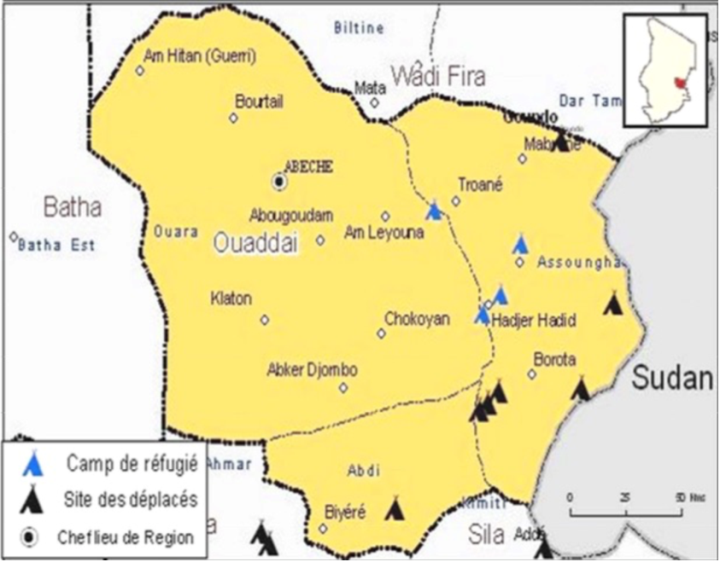
2.2. Study SettingThe city of Abéché is the capital of the Ouaddaï region. Ouaddaï is one of the 23 provinces of Chad and has historically constituted the second great kingdom of Chad. Abéché is the second largest city in Chad with a population of 138,684 inhabitants 9, located 900 km east of N’Djamena, the capital of the country (Figure 1).
The study of women took place in three urban health centers (CS) in the Abéché Health District (DSA). These were CS AHMAD EL-BADAOUI (CS-AEB), CS TAIBA and CS SALAMAT. The CS-AEB is the only maternal and child health center in the Ouaddaï region with a maternity service and care for uncomplicated deliveries. We chose these centers because they are very popular with the population and have prenatal, postnatal, family planning (FP), outpatient and care services. In Chad, health centers take care of around 90% of the health problems of the population covered 10. Care and care are provided by nurses and / or midwives 10.
2.3. Study PopulationWe selected women aged 15 to 49, who came to consult in one of the three SCs and who agreed to participate in the survey, after being selected during the sampling.
The sample size was calculated using the Schwartz formula.
 |
With p = 0.072: percentage of contraceptive use by women in Abéché 7. The expected rate of non-respondents being estimated at 10% of the sample size, we have chosen N=314.
The data were collected in a face-to-face individual interview using a questionnaire. The interviews were conducted in French and / or in the local language, which was most often necessary. They were carried out by two people previously trained. The training consisted in promoting a neutral attitude of the investigators towards contraception in order to obtain sincere responses from the women interviewed. Attention was focused on women to reassure them of their reluctance to investigate.
A first questionnaire on contraception was developed and tested on 13 women, which allowed us to correct and validate this data collection tool.
The study variables during the interview concerned socio-demographic characteristics (age, marital status, level of study, profession, religion, ethnicity and place of residence); knowledge and use of modern contraceptive methods (injectables, intrauterine device) and the reasons for reluctance to use contraceptives.
The analyzes covered all of the women interviewed. The variable of interest was the non-use of contraception as a binary variable (0/1). Women who used contraception but stopped using it were not considered to be users.
An analysis of the factors associated with the non-use of contraception was carried out by logistic regression. The univariate analysis allowed the selection of the variables to be included in the multivariate analysis: significant variables with a p less than 0.20. Certain adjustment variables could be forced for multivariate analysis according to the literature and / or the working hypotheses.
Data entry and analysis were carried out using Microsoft Excel 2007, EPI INFO 6 (2007 version) and SAS version 9.4 software.
All the professionals likely to follow women in consultation were questioned. These are professionals practicing in the various health centers (six) of the city of Abbeche and in the maternity service of the Provincial Hospital of Abéché (HPA).
Seventeen semi-structured interviews were conducted with service professionals using an interview guide with open-ended questions. The interview guide was constructed by the investigator. Several variables were retained, these are: Attitudes of professionals on contraception; Measures applied by health professionals to avoid the stock-out or supply of contraceptive products; Contraceptive methods requested and available within the health center; Types of counseling given to women in FP; Proposal of contraceptive methods for women (systematic, often, sometimes); Sources of information offered by health professionals.
The data from the survey of health professionals was processed from an Excel spreadsheet. The verbatim analysis was carried out by the principal investigator.
2.4. Ethical AspectsA research authorization has been issued by the Ministry of Public Health. A request for an investigation was also sent to the Head of Reproductive Health and the chief medical officer of the Abéché district. The oral consent of each woman and health professional included was obtained before the interview. The data was collected anonymously and treated confidentially.
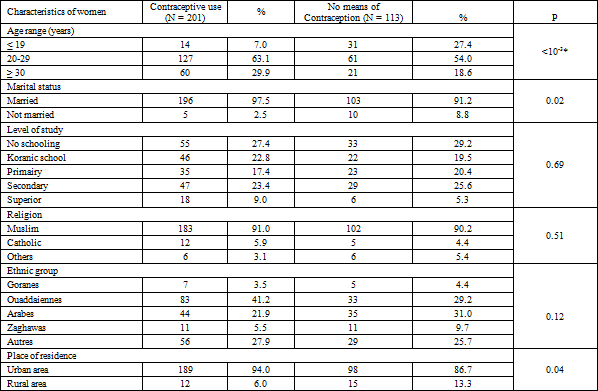
Our study population was 314 women. Among the women surveyed, 75% knew FP but 57% came for the first time to a FP service. Among the users of the service, women aged 20-29 (63.1%), married (97.5%) and living in urban areas (94%) used contraception more frequently (Table 1).
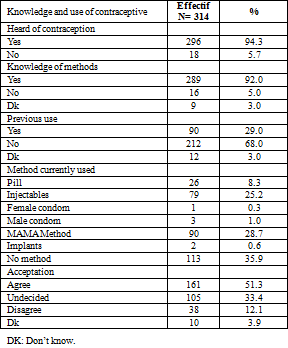
Of the women interviewed, 94.3% had heard of contraception, most of which (92%) said they were aware of contraceptive methods. Women on traditional contraception MAMA (Method of Breastfeeding and Amenorrhea) at the time of the survey represented 28.7% of the sample. Overall, 51.3% of women accepted contraception. Knowledge of contraceptive methods and methods was no different between users and non-users. Among the sample (N = 314), 64.1% of the women surveyed had used contraception in the survey (Table 2).
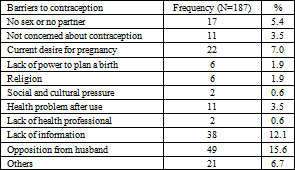
The most common barriers cited by women were opposition from the husband (15.6%) and lack of information (12.1%) (Table 3). Indeed, women could give several answers.
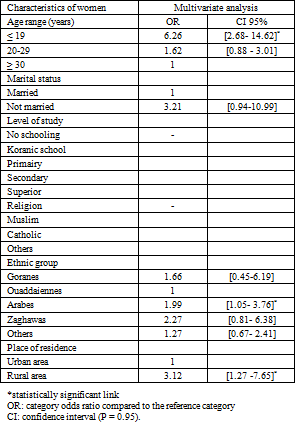
The factors significantly associated with the non-use of modern or natural contraception by Abéché women were: age (women ≤ 19 years compared to women ≥ 30 years), the place of residence (Abéché rural; OR = 3.12) and ethnicity (Arabs; OR = 1.99) in relation to the Ouaddaian ethnicity. A link between contraception, education, religion and marital status was not found (Table 4).
The health professionals of the six health centers were made up of two gynecologists, a general practitioner, a pharmacy technician, a technical health worker (nursing assistant), 8 midwives and 4 nurses. The qualitative study of the 17 health professionals interviewed made it possible to describe the opinion of professionals in the field in charge of FP in the peri-urban area of Abéché as well as their practices vis-à-vis contraceptive prescriptions for women attending health services. Professionals interviewed notably insisted that this was a way for women to space births and prevent Sexually Transmitted Infections (STIs).
The question of the type of advice to give to women was interpreted by the respondents as "to which women do you give information on contraception?". Thus, the women who were informed generally corresponded to patients at risk: carriers of chronic pathologies (hypertension, diabetes), multiparous… The information provided concerned the advantages and disadvantages of FP.
All health professionals regularly offered a contraceptive method by adapting the proposals to women consultants. According to professionals, the contraceptives most requested by women were injectables. Injectables, as well as all other methods were available in health facilities (pills, implants, intra uterine and condoms).
For better awareness and information for women on contraception, the use of radio was suggested by all of the professionals interviewed. The other means proposed were posters, town criers, involvement of leaders (religious and neighborhood leaders) and husbands or spouses.
Regarding measures to avoid stockouts in contraceptive products, all of the professionals surveyed stated that the only measure they applied was good organization, in particular the launching of orders in time to avoid the shortage of products in stock.
This mixed work was carried out by face-to-face individual interviews using a questionnaire with women and health professionals in FP.
Our study found that 92.0% of women surveyed were aware of the existence of contraceptive methods, of which 64.1% were using them at the time of the survey. This high level of knowledge had already been observed in a previous study carried out in the Mumbunda health zone in Lubumbashi, Democratic Republic of Congo in 2015: 91.1% of the women surveyed knew at least one contraceptive method in the health zone of Lubumbashi health district 11.
We found that about 28.7% of women used a traditional MAMA contraceptive method and 25.2% a modern method (injectables). This low rate of use of modern contraceptive methods among the women interviewed was shown in several African countries; 39.6% in the Central African Republic in 2000 12, 19.0% in Senegal in 2015 13 and 27.6% in the Democratic Republic of Congo in 2015 11.
Despite the availability of all contraceptive methods in health facilities, the traditional MAMA method (28.7%) was the most used, followed by injectable contraceptives (25.2%) and the pill (8.3%). This contrasts with developed countries which mainly use modern methods such as the pill (55.5%), intra uterine devices (IUDs) (26.0%) and condoms (10.3%) 14.
The women interviewed did not always have a personal choice of a contraceptive option. Due to the opposition of the husband (spouse), they most often used the more discreet injectable contraceptives. Our results are similar to the study carried out in Benin in 2015, reporting that 19% of married women users declared that their husbands were against contraception and that the decision was mainly theirs 15. This obstacle could influence women's use of FP services. In addition, not all of the women interviewed had correct and complete information about contraception. In our study, all of the women interviewed used the health service, either for prenatal or post-natal consultations or for care. However, the advice of FP professionals was not always suited to the expectations of the women interviewed. FP professionals should inform women about the full range of modern contraceptive methods that are available, as well as their benefits for maternal and child health. That said, each visit to the health service represented an opportunity for the professional to offer sexual and reproductive health services, including FP, and to sensitize women and their partner or spouse. This awareness would include not only the use of contraceptive methods but also encouragement and support for contraception by the partner.
In this study, socio-demographic factors such as age, ethnicity and place of residence had a strong influence on the use of contraceptive methods. Women over the age of 20 used a traditional (MAMA) or modern method more often than those under the age of 19. This tendency was found in other studies carried out in the Central African Republic in 2000 12 and in Ghana in 2010 16. We did not find a significant link between the use of contraception and the marital status of women. However, this link is found in the study by Hussain et al, in which women in couples used more contraceptive methods than widows or single women 17. Indeed, living in a union or being married is associated with more frequent use of contraception. The place of urban residence was more often associated with the use of a contraceptive method (66.0% compared to 44.0%). This result was found in numerous previous works, notably in India mainly at Uttar Pradeh in 2016 18 and in Mali in 2009 19.
Regarding ethnicity, Ouaddaian women used contraceptives significantly more (75.5%) than Arab women (55.6%), which could be linked to the socio-cultural differences between these two groups. Despite the availability of contraceptive products in Abéché health facilities, their use seems problematic for women of childbearing age. In order to increase contraceptive prevalence, it is therefore necessary to overcome the factors that influence the use of contraceptive methods. These factors are accessibility to health facilities in rural areas, decision-making power over the care and health of women and finally factors specific to the culture and living environment of women.
The health professionals interviewed declared that the FP offer was available in their services. They suggested sources of information on contraception, the involvement of leaders and partners enabling women to use the FP service. However, they did not have a view on the barriers to contraceptive use often cited by women. This may be explained by the fact that the health professionals interviewed may not have had sufficient knowledge of the health consequences and the potential side effects of contraception.
The limits of this work were essentially methodological, linked to the study protocol as well as to the selection of the health centers chosen for our study. Indeed, the women selected are not representative of the entire female population of Abéché. In addition, the questionnaire having been administered at the FP center, the women interviewed were already in the FP approach, therefore already sensitized or informed about contraceptive problems. In addition, the focus of the study on the three health centers does not allow the results to be generalized to the other health centers. Despite this limit, 57% of the women questioned came for the first time to the SC and to the FP service, which suggests that women who have not yet consulted have a good knowledge of the SC. This study will help to further improve the use of FP by identifying the obstacles and levers to the use of contraception in Chad. In fact, the results obtained will make it possible to develop interventions promoting the use of modern contraception.
Contraceptive prevalence was certainly overestimated in our study but remains too low in the Abéché health district. Accessibility to health centers in rural areas, information and awareness on modern contraception and spousal contraception adherence would be the main determinants for the use of FP services and the use of modern contraceptives by women, according to the health professionals interviewed.
It is therefore important to educate women and men and to make them understand the merits of this contraception on the health of mothers and children. Dialogues within the couple and the community on modern contraception should also be encouraged, and training of professionals should be strengthened so that they respond to the unmet needs of women in FP in the Abéché health district.
The authors have no competing interests.
We thank the Ministry in charge of health in Chad for allowing us to carry out our research in its various health structures.
| [1] | World Health Organization. "Planification familiale/Contraception", February 2018. [Online]. Available: https://www.who.int/fr/news-room/fact-sheets/detail/family-planning-contraception/. [Accessed Dec. 2, 2019] | ||
| In article | |||
| [2] | United Nations. "Millennium Development Goals", 2013. [Online]. Available: https://www.un.org/fr/millenniumgoals/. | ||
| In article | |||
| [3] | Andreea, A.C., Duff, G., Sabrina K. and Amy O.T. Low use of contraception among poor women in Africa: an equity issue. Bulletin of the World Health Organization, 89(4), 258-266, April 2011. | ||
| In article | View Article PubMed | ||
| [4] | Kuruvilla, S., Schweitzer, J., Bishai, D., Chowdhury, S., Caramani, D., Frost, L., ... and Cohen, R. "Success factors for reducing maternal and child mortality". Bulletin of the World Health Organization, 92(7), 533-544. July 2014. | ||
| In article | View Article PubMed | ||
| [5] | Agence Française de Développement and Assocoation Tchadienne pour le Bien-Etre Familial. "Santé des femmes au Tchad entre urgence et développement". November 2013. [Online]. Available: http://www.afd.fr/webdav/shared/PUBLICATIONS/THEMATIQUES/savoirscommuns/15-Savoirs-Communs.pdf. | ||
| In article | |||
| [6] | Inseed Tchad. "Deuxième Enquête Démographique et de Santé II", 2004. [Online]. Available: http://www.inseedtchad.com/IMG/pdf/rapport_preliminaire_edst2.pdf. | ||
| In article | |||
| [7] | Inseed Tchad. "Enquete MICS 2010", 2010. Available:https://mics-surveys-prod.s3.amazonaws.com/MICS4/West%20and%20Central%20Afr ica/Chad/2010/Final/Chad%202010%20MICS_French.pdf. | ||
| In article | |||
| [8] | Inseed Tchad. "Enquête Démographique et de Santé 1996-1997", 1991. [Online].Available:http://microdata.worldbank.org/index.php/catalog/1493/study-description. | ||
| In article | |||
| [9] | Inseed Tchad. "Deuxième Recensement général de la population et de l'habitat (RGPH2)", 2009. | ||
| In article | |||
| [10] | Ministere de la Santé Publique - Tchad. "Politique et Normes de planification familiale au Tcahd", 2014. | ||
| In article | |||
| [11] | Matungulu, C.M., Kandolo, S.I., Mukengeshayi, A.N., Nkola, A.M., Mpoyi, D.I., Mumba, S.K., ... and Kaj, F.M."Déterminants de l’utilisation des méthodes contraceptives dans la zone de santé Mumbunda à Lubumbashi, République Démocratique du Congo". Pan African Medical Journal, 22(1), December 2015. | ||
| In article | View Article PubMed | ||
| [12] | Sepou, A., Enza, J., and Nali, M.N. "Les difficultés liées à l’expansion de la contraception en zone urbaine et semi urbaine de la République Centrafricaine". Médecine d’Afrique Noire, 47(2), 73-77, 2000. | ||
| In article | |||
| [13] | Leye, M.M.M., Faye, A., Diongue, M., Wone, I., Seck, I., Ndiaye, P. and Dia, A.T. "Déterminants de l’utilisation de la contraception moderne dans le district sanitaire de Mbacké (Sénégal)". Sante Publique, 27(1), 107-116, March 2015. | ||
| In article | View Article | ||
| [14] | Inpes. "Envie de changer de contraception ? Le meilleur moyen, c’est d’en parler", 2014. [Online]. Available:http://inpes.santepubliquefrance.fr/70000/cp/14/cp140707-contraception.asp. | ||
| In article | |||
| [15] | Chae, S., Woog, V., Zinsou, C. and Wilson, M. "Obstacles à la pratique contraceptive des femmes au Bénin". Guttmacher Institute & ABMS, Cotonou, 2016. 8p. | ||
| In article | |||
| [16] | Aryeetey, R., Kotoh, A.M., and Hindin, M.J. "Knowledge, perceptions and ever use of modern contraception among women in the Ga East District, Ghana". African Journal of Reproductive Health, 14(4), 26-31, 2010. | ||
| In article | |||
| [17] | Sedgh, G. and Hussain, R. "Reasons for contraceptive nonuse among women having unmet need for contraception in developing countries", Studies in family planning, 45(2), 151-169, 2014. | ||
| In article | View Article PubMed | ||
| [18] | Singh, S., and Darroch, J.E. "Adding it up: Costs and benefits of contraceptive services". Guttmacher Institute and UNFPA, 2012. [Online]. Available: https://www.guttmacher.org/report/adding-it-need-and-cost-maternal-and-newborn-care-estimates-2012 | ||
| In article | |||
| [19] | Ayad, M., Hong, R., Kéïta, O. and Diop, M. "Pratique contraceptive et importance des besoins non satisfaits en matière de planification familiale au Mali de 1995 à 2006"; 2009. | ||
| In article | |||
Published with license by Science and Education Publishing, Copyright © 2020 Abdel-Mahamoud Adam Yaya, Giguisto Caroline, Mahamat Nadjib Abderahim, Brunet Houdard Solene, Djamalladine Mahamat Doungous, Henri Marret, Grammatico-Guillon Leslie and Emmanuel Rusch
 This work is licensed under a Creative Commons Attribution 4.0 International License. To view a copy of this license, visit
http://creativecommons.org/licenses/by/4.0/
This work is licensed under a Creative Commons Attribution 4.0 International License. To view a copy of this license, visit
http://creativecommons.org/licenses/by/4.0/
| [1] | World Health Organization. "Planification familiale/Contraception", February 2018. [Online]. Available: https://www.who.int/fr/news-room/fact-sheets/detail/family-planning-contraception/. [Accessed Dec. 2, 2019] | ||
| In article | |||
| [2] | United Nations. "Millennium Development Goals", 2013. [Online]. Available: https://www.un.org/fr/millenniumgoals/. | ||
| In article | |||
| [3] | Andreea, A.C., Duff, G., Sabrina K. and Amy O.T. Low use of contraception among poor women in Africa: an equity issue. Bulletin of the World Health Organization, 89(4), 258-266, April 2011. | ||
| In article | View Article PubMed | ||
| [4] | Kuruvilla, S., Schweitzer, J., Bishai, D., Chowdhury, S., Caramani, D., Frost, L., ... and Cohen, R. "Success factors for reducing maternal and child mortality". Bulletin of the World Health Organization, 92(7), 533-544. July 2014. | ||
| In article | View Article PubMed | ||
| [5] | Agence Française de Développement and Assocoation Tchadienne pour le Bien-Etre Familial. "Santé des femmes au Tchad entre urgence et développement". November 2013. [Online]. Available: http://www.afd.fr/webdav/shared/PUBLICATIONS/THEMATIQUES/savoirscommuns/15-Savoirs-Communs.pdf. | ||
| In article | |||
| [6] | Inseed Tchad. "Deuxième Enquête Démographique et de Santé II", 2004. [Online]. Available: http://www.inseedtchad.com/IMG/pdf/rapport_preliminaire_edst2.pdf. | ||
| In article | |||
| [7] | Inseed Tchad. "Enquete MICS 2010", 2010. Available:https://mics-surveys-prod.s3.amazonaws.com/MICS4/West%20and%20Central%20Afr ica/Chad/2010/Final/Chad%202010%20MICS_French.pdf. | ||
| In article | |||
| [8] | Inseed Tchad. "Enquête Démographique et de Santé 1996-1997", 1991. [Online].Available:http://microdata.worldbank.org/index.php/catalog/1493/study-description. | ||
| In article | |||
| [9] | Inseed Tchad. "Deuxième Recensement général de la population et de l'habitat (RGPH2)", 2009. | ||
| In article | |||
| [10] | Ministere de la Santé Publique - Tchad. "Politique et Normes de planification familiale au Tcahd", 2014. | ||
| In article | |||
| [11] | Matungulu, C.M., Kandolo, S.I., Mukengeshayi, A.N., Nkola, A.M., Mpoyi, D.I., Mumba, S.K., ... and Kaj, F.M."Déterminants de l’utilisation des méthodes contraceptives dans la zone de santé Mumbunda à Lubumbashi, République Démocratique du Congo". Pan African Medical Journal, 22(1), December 2015. | ||
| In article | View Article PubMed | ||
| [12] | Sepou, A., Enza, J., and Nali, M.N. "Les difficultés liées à l’expansion de la contraception en zone urbaine et semi urbaine de la République Centrafricaine". Médecine d’Afrique Noire, 47(2), 73-77, 2000. | ||
| In article | |||
| [13] | Leye, M.M.M., Faye, A., Diongue, M., Wone, I., Seck, I., Ndiaye, P. and Dia, A.T. "Déterminants de l’utilisation de la contraception moderne dans le district sanitaire de Mbacké (Sénégal)". Sante Publique, 27(1), 107-116, March 2015. | ||
| In article | View Article | ||
| [14] | Inpes. "Envie de changer de contraception ? Le meilleur moyen, c’est d’en parler", 2014. [Online]. Available:http://inpes.santepubliquefrance.fr/70000/cp/14/cp140707-contraception.asp. | ||
| In article | |||
| [15] | Chae, S., Woog, V., Zinsou, C. and Wilson, M. "Obstacles à la pratique contraceptive des femmes au Bénin". Guttmacher Institute & ABMS, Cotonou, 2016. 8p. | ||
| In article | |||
| [16] | Aryeetey, R., Kotoh, A.M., and Hindin, M.J. "Knowledge, perceptions and ever use of modern contraception among women in the Ga East District, Ghana". African Journal of Reproductive Health, 14(4), 26-31, 2010. | ||
| In article | |||
| [17] | Sedgh, G. and Hussain, R. "Reasons for contraceptive nonuse among women having unmet need for contraception in developing countries", Studies in family planning, 45(2), 151-169, 2014. | ||
| In article | View Article PubMed | ||
| [18] | Singh, S., and Darroch, J.E. "Adding it up: Costs and benefits of contraceptive services". Guttmacher Institute and UNFPA, 2012. [Online]. Available: https://www.guttmacher.org/report/adding-it-need-and-cost-maternal-and-newborn-care-estimates-2012 | ||
| In article | |||
| [19] | Ayad, M., Hong, R., Kéïta, O. and Diop, M. "Pratique contraceptive et importance des besoins non satisfaits en matière de planification familiale au Mali de 1995 à 2006"; 2009. | ||
| In article | |||




)