The paper aims at analyzing the impact of the nursing practice on patient experience during treatment. I identified five major themes to improve patient experience, which included nurse-patient relationship, nurse leader rounds, hourly nurse rounding, provider communications skills building, and teamwork. Much of the literature used from the United States contains information acquired through quantitative means unlike journals from other regions. The arising issues discussed in the paper is sufficient evidence serving as an indication that there is still much to do in a bid to ensure the delivery and receipt of quality services to improve patient experience during treatment. Through the research, it became evident that organizations cannot only rely on the healthcare professionals to ascertain quality healthcare. Patients also need to play their part for a successful engagement.
Nursing refers to the autonomous or joint care of people deemed as vulnerable irrespective of any associated demographic characteristic. In practice, the nurse hopes to emphasize on prevention and control of an illness, while also engaging in patient advocacy and the promotion of a healthy living environment 1. Patient experience, on the other hand, defines the nature of the interaction the patient has with the health practitioners while undergoing treatment either within a health institution or at his or her place of residence. Experience is a pivotal component of healthcare, which communicates much about the nature of the services and the professionalism of the responsible practitioners 2. Besides these, patient experience also looks into individual preferences, values, and the dire needs. When combined with other vital concepts in healthcare such as efficacy, monitoring patient experience contributes largely to the overall assessment of quality assurance in major healthcare facilities.
Many health practitioners in current practice ignore the patient experience as one of the contributing factors to better health of the patient. Given the interest taken by most researchers in the recent years, further empirical research revealed it as not only a major contributing factor to improved rates of recovery but also a necessity for stable mental health 3. According to an empirical research conducted by Ryan et.al. the four researchers put in much effort into establishing the use of economic techniques in generating quantitative estimators used to measure the height of patient experience. Like any previously performed studies, the implication from the paper was that the burden lay more on the side of the policy makers, who failed to bring on board relevant policies to guide the decision-making process 4. The written paper seeks to explore a clinical perspective of the matter by checking the impact of the nurses on improving patient experience while undertaking treatment as a major topic of study.
In writing this paper, all the sources used for reference are secondary in nature and as a result, the necessary citations are included. The included information was obtained from the NCBI and MEDLINE databases while using the following terms during the search: Nurses, literature review, patient experience, nursing leadership, communication, and leader round among others. I generated 30 relevant references of which 18 were from the United States, 7 from the UK, 1 from the Scandinavia, and 4 from Asia. Much of the information provided by the United States presents a struggling system, which is fighting other monetary-based impediments to be able to provide the patients with the quality care they deserve. Unlike the United Kingdom, researchers in the United States are more focused in performing quantitative researchers basing on specific measurable variables to quantify the experience of the patients. For this reason, there exists a slight difference in the nature of data given by the two regions as a form of improvement of the existing situation. It is notable, however, that much of the presentation involves universal issues, which if well tackled would improve the state of the patient experience.
This section constitutes the important factors considered as major contributors to better patient experience during treatment. The included factors consist of matters relating to building professionalism among the nurses while also incorporating points that will enhance meaningful interactions between the patient and the nurse in-charge. They are as below.
3.1. Improving the Patient Experience through Nurse–Patient CommunicationThe point of developing of a friendly and more trustworthy nurse-patient mode of communication is to enable the nurse to counter the patients’ psychological fears. Despite being ill, much of the pain experienced by the patient majorly originates from the mental pains, which no form of medicine can cure 5. In most cases, patients heal from physical ailments but carry psychological issues back to their residences. The quality time used in engaging in meaningful communication opens up various avenues within which the nurse can perform advocacy to ascertain that the patient receives utmost care. When examining the contemporary healthcare scene, there is no proper communication due to the increasing nature of workload in different departments and the rising patient-to-nurse ratio 6. One nurse finds it extremely overwhelming to attend effectively to the needs of all the available patients requiring their attention. Responsibilities such as monitoring the electronic health records minimize the length of stay, and the onboarding of novice nurses make it impossible to receive the required care 2. The organizations should ensure that they have sufficient staff to administer the needed attention for each patient for better experience.
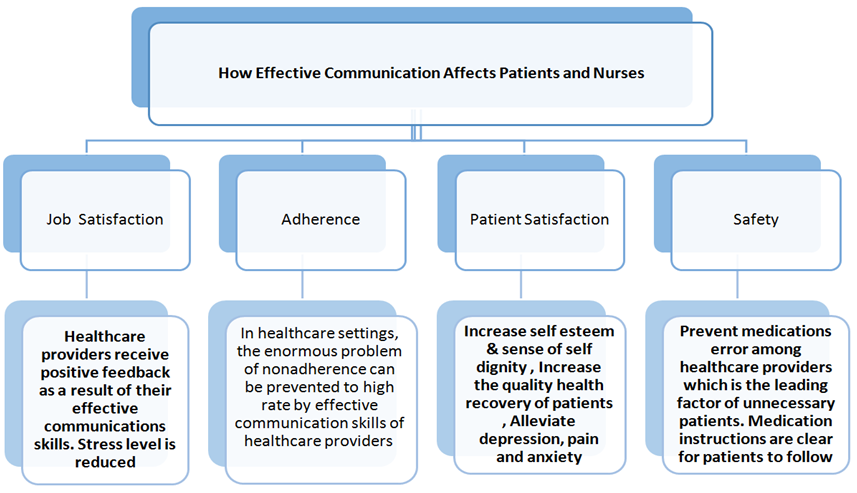
Quality relationships between the nurses and their patients creates trust, respect, and empathy. Once the nurses establish a worthwhile relationship, it simplifies the process of communication, hence, giving the patient the expected confidence in expressing the issues existing in the type of care received 2. Additionally, it increases the nurses’ interest in a patient, which in turn minimizes the number of accidental treatments administered to the patient in the absence of other family members or concerned parties. Other than the patients, the nurses should also form a relationship with the common family members in the case of extremely vulnerable patients. Figure 1. Below How effective communication affects patients and nurses.
3.2. Improving the Patient Experience through Nurse Leader RoundsThe contemporary environment expresses the use of nurse leader rounds as one of the most effective methods through which a hospital or any given health facility can improve patient experience. Nurse leader rounds involves one interacting freely with the patient or the close family members, and asking for the necessary information regarded as sufficient data to measure the level of satisfaction 7. Some of the nurse leaders with the capability to engage in the leader rounds include department managers, charge nurses, and supervisors, who choose the engagement with the aim of establishing the patients’ experience. The primary objective of the movement is to identify the existing gaps for filling and to understand patient preferences with an aim of improving the quality of the offered services.

One of the most vital capabilities of the nurse leader rounds in enhancing patient experience include its ability to strengthen the relationships between the health practitioners and the patients. Constant interaction also improves approachability, and finally, ascertains process improvement by enabling feedback from the recipients of the provided services 8. The rounding process will not only benefit the patients but also improve the effectiveness of other activities such as the hourly rounds for the benefit of both patients and nursing 9. The process introduces familiarity to the issues facing the patients, which simplifies the engagement between the nurses, the patients, and even their families.
3.3. Hourly Nurse Rounding to Proactively Address Patient’s NeedsWhen patients receive admission in order to acquire effective treatment, it often subjects them to emotional and physical dependency on the available healthcare personnel within the institution. Establishing an intentional timed pattern for checking on the patients serves as a mechanism within which the patients can communicate their needs to the approaching nurse 10. Nurses conducting the rounds should introduce themselves well and explain the purpose of the rounds so that the patient can understand its importance to enhance effective cooperation. The hourly rounds method is one way in which the hospital can decrease falls, maintain skin integrity, ensure patient safety, early detection of changes in the patient’s condition and minimize the unnecessary use of call lights, particularly because of the surety that someone will come in the next hour. From previously conducted research, the hourly rounds can improve the patient satisfaction rate by more than 12% 11. The hourly rounds portray the nurses as caring and highly committed to ascertaining the receipt of quality healthcare.
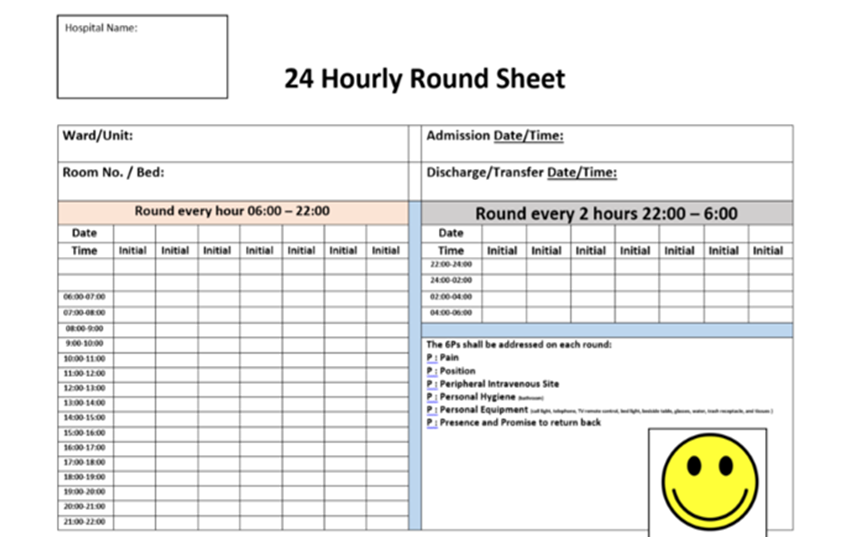
An hourly rounding program used to assess the patient’s existing state and meet any expected requirements that the patient may encounter. At present, this tool is being developed that will be placed in the patient’s room at the whiteboard. This tool resembles a watch, signifying that a nursing staff will be rounding each hour to address any patient needs. The timed hourly experience will enable those in need to express their deepest challenges with the hope that someone gets to listen and address the observable problems. Many of the admitted patients experience psychological challenges but lack someone on whom they can depend to ascertain that every of their needs are met. Besides these, there exist other patients such as the bedridden and the critically ill patients who require assistance with positioning and preventing falls. Implementing the hourly rounds intends at identifying and assisting patients in pain, need of proper positioning to minimize pressure ulcer, check signs of inflammation/infection or any discomfort in peripheral intravenous site, personal hygiene assistance, and improving patient safety by minimizing the likelihood of falls 11. These rounds reassure the patients that the facility and its staff care deeply about them; hence, enhancing their tendency to communicate the underlying challenges 12. The assigned nurses also get sufficient time to offer their services effectively to improve patient satisfaction. Figure 2. Below an example of a document tool using as an hourly rounding in a hospital.

Communication skills is an important tool in ascertaining the effective addressing of all the patient needs. Some experienced healthcare personnel are highly qualified in their line of duty but lack the ability to communicate well with their patients; thus, reducing the likelihood of success in bettering patient experience 13. Institutions across the country should consider incorporating workshops on communication as part of the routine trainings to equip personnel with the appropriate skills 14. Individuals with proper training understand issues such as patient inclusion in decision-making, making meaningful contact, and the value of empathy in strengthening the made relationships. While doing rounds enables a nurse to develop proper relationships with those in hospital, proper skills enables them to understand how to approach and assist them in situations of need without intruding in their personal space 15. Acquiring these skills places the nurse on vantage ground in terms of understanding the problems the patient is likely to undergo and identifying the relevant solutions without having to forward the issue to the administration.
3.5. Improving the Patient Experience through TeamworkTeamwork not only involves the nurses but also other members of staff within the same organization. In health practice, patient safety is one of the greatest achievements a hospital can make through enhanced collaboration between the clinical and non-clinical staff. Through the collaboration, it becomes easier to improve patient outcomes, minimize medical errors, and improve efficiency in performance to ascertain patient satisfaction 16. When nurses work as a team, they are capable of influencing other healthcare professionals into developing appropriate protocols to create a positive influence in general patient care. A united team hastens processes given that they have an objective of satisfying the needs of every patient within the facility 17. Other than with their fellow staff, nurses and the patients also need to work closely to promote quick recovery. Patients should realize their responsibility and act accordingly to ascertain that all medications are administered at the right time and every given restriction is followed accordingly 18. Some patients fail to abide by the doctor’s prescription yet are still hopeful that they will recover fast. When every party does their part effectively, it simplifies the treatment process; hence, better results.
From the reviewed information, the following are the recommendations
Ÿ Healthcare facilities should identify and promote different trainings within which the staff can acquire the appropriate communication skills to enhance communication between the nurses and patients 19
Ÿ Nurses need to interact often with the patients to build relationships that better service delivery 20. A good relationship between the service provider and the recipient creates a rapport that improves the patient experience.
Ÿ Health institutions also need to hire more nurses to reduce the patient-to-nurse ratio for higher productivity and improved patient experience 21.
The aforementioned details expound on the existing need to improve the services provided by the nurses to ascertain proper performance for the benefit of the patient. Some of the discussed means of improvement include the use of appropriate communication skills between the nurses and the patients, improvement in the hourly and lead rounds conducted by the nurses, and above all unity between both the clinical and non-clinical staff. Teamwork will enable the institution to deliver appropriately when needed.
While the nurses work to ensure their benefit, patients also need to make an effort to inform the decisions made by the health practitioners for their benefit. With these recommendations in place, it will be easier to implement the changes to ascertain an improvement in the patient experience.
I want to express our gratitude and greats thanks to the dedicated, hardworking Nurses. Your role with workplace challenges, keeping your patients as your top priority. Every day, ALL you make a big difference.
| [1] | Giddens, J. (2017). Concepts for nursing practice. Elsevier. | ||
| In article | |||
| [2] | Frank-Bader, M., Keller, R., Rumohr, G., & Sritharan, S. (2016). Strengthen nurse-patient communication with the “Social 10”. Nursing management, 47(9), 49-53. | ||
| In article | View Article PubMed | ||
| [3] | Feo, R., Rasmussen, P., Wiechula, R., Conroy, T., & Kitson, A. (2017). Developing effective and caring nurse-patient relationships. Nursing Standard, 31(28), 54. | ||
| In article | View Article PubMed | ||
| [4] | Ryan, M., Kinghorn, P., Entwistle, V. A., & Francis, J. J. (2014). Valuing patients' experiences of healthcare processes: towards broader applications of existing methods. Social Science & Medicine, 106, 194-203. | ||
| In article | View Article PubMed | ||
| [5] | Foronda, C., MacWilliams, B., & McArthur, E. (2016). Interprofessional communication in healthcare: an integrative review. Nurse education in practice, 19, 36-40. | ||
| In article | View Article PubMed | ||
| [6] | Kuwata, K. (2016). Spread Too Thin: The Case for Federally Mandated Minimum Nurse-to-Patient Rations in Hospitals. Loy. LAL Rev, 49, 635. | ||
| In article | |||
| [7] | Morton, J. C., Brekhus, J., Reynolds, M., & Dykes, A. K. (2014). Improving the patient experience through nurse leader rounds. Patient Experience Journal, 1(2), 53-61. | ||
| In article | View Article | ||
| [8] | Haugan, G., Moksnes, U. K., & Løhre, A. (2016). Intrapersonal self-transcendence, meaning-in-life and nurse–patient interaction: powerful assets for quality of life in cognitively intact nursing-home patients. Scandinavian journal of caring sciences, 30(4), 790-801. | ||
| In article | View Article PubMed | ||
| [9] | Hudson-Covolo, J. L., Rivers, R., & Irwin, B. (2018). Daily Intentional Nurse Leader Rounding on Patients. Journal of PeriAnesthesia Nursing, 33(1), 90-95. | ||
| In article | View Article PubMed | ||
| [10] | Mitchell, M. D., Lavenberg, J. G., Trotta, R., & Umscheid, C. A. (2014). Hourly rounding to improve nursing responsiveness: a systematic review. The Journal of nursing administration, 44(9), 462. | ||
| In article | View Article PubMed | ||
| [11] | Daniels, J. F. (2016). Purposeful and timely nursing rounds: a best practice implementation project. JBI database of systematic reviews and implementation reports, 248-267. | ||
| In article | View Article PubMed | ||
| [12] | Brosey, L. A., & March, K. S. (2015). Effectiveness of structured hourly nurse rounding on patient satisfaction and clinical outcomes. Journal of Nursing Care Quality, 153-159. | ||
| In article | View Article PubMed | ||
| [13] | Sprangers, S., Dijkstra, K., & Romijn-Luijten, A. (2015). Communication skills training in a nursing home: effects of a brief intervention on residents and nursing aides. Clinical interventions in aging, 10, 311. | ||
| In article | View Article PubMed | ||
| [14] | Kennedy, M. B., Denise, M., Fasolino, M. D., John, P., Gullen, M. D., & David, J. (2015). Improving the patient experience through provider communication skills building. Patient Experience Journal, 1(1), 56-60. | ||
| In article | View Article | ||
| [15] | Bramhall, E. (2014). Effective communication skills in nursing practice. Nursing Standard, 29(14), 53. | ||
| In article | View Article PubMed | ||
| [16] | Papoutsi, C., Poots, A., Clements, J., Wyrko, Z., Offord, N., & Reed, J. E. (2018). Improving patient safety for older people in acute admissions: implementation of the Frailsafe checklist in 12 hospitals across the UK. Age and ageing, 27(2), 311-317. | ||
| In article | View Article PubMed | ||
| [17] | Richter, J. P., McAlearney, A. S., & Pennell, M. L. (2016). The influence of organizational factors on patient safety: Examining successful handoffs in health care. Health care management review, 41(1), 32-41. | ||
| In article | View Article PubMed | ||
| [18] | McComb, S. A., Lemaster, M., Henneman, E. A., & Hinchey, K. T. (2017). An evaluation of shared mental models and mutual trust on general medical units: Implications for collaboration, teamwork, and patient safety. Journal of patient safety, 13(4), 237-242. | ||
| In article | View Article PubMed | ||
| [19] | Wittenberg, E., Goldsmith, J., Buller, H., Ragan, S. L., & Ferrell, B. (2019). Communication Training: Needs Among Oncology Nurses Across the Cancer Continuum. Clinical journal of oncology nursing, 23(1), 82-91. | ||
| In article | View Article PubMed | ||
| [20] | Wiechula, R., Conroy, T., Kitson, A. L., Marshall, R. J., Whitaker, N., & Rasmussen, P. (2016). Umbrella review of the evidence: what factors influence the caring relationship between a nurse and patient? Journal of Advanced Nursing, 72(4), 723-734. | ||
| In article | View Article PubMed | ||
| [21] | Cho, E., Lee, N. J., Kim, Y., E., Kim, S., Lee, K., . . . Sung, Y. H. (2015). Nurse staffing level and overtime associated with patient safety, quality of care, and care left undone in hospitals: a cross-sectional study. International journal of nursing studies, 60, 263-271. | ||
| In article | View Article PubMed | ||
Published with license by Science and Education Publishing, Copyright © 2020 Ibrahim Mubarak Al Baalharith
 This work is licensed under a Creative Commons Attribution 4.0 International License. To view a copy of this license, visit
http://creativecommons.org/licenses/by/4.0/
This work is licensed under a Creative Commons Attribution 4.0 International License. To view a copy of this license, visit
http://creativecommons.org/licenses/by/4.0/
| [1] | Giddens, J. (2017). Concepts for nursing practice. Elsevier. | ||
| In article | |||
| [2] | Frank-Bader, M., Keller, R., Rumohr, G., & Sritharan, S. (2016). Strengthen nurse-patient communication with the “Social 10”. Nursing management, 47(9), 49-53. | ||
| In article | View Article PubMed | ||
| [3] | Feo, R., Rasmussen, P., Wiechula, R., Conroy, T., & Kitson, A. (2017). Developing effective and caring nurse-patient relationships. Nursing Standard, 31(28), 54. | ||
| In article | View Article PubMed | ||
| [4] | Ryan, M., Kinghorn, P., Entwistle, V. A., & Francis, J. J. (2014). Valuing patients' experiences of healthcare processes: towards broader applications of existing methods. Social Science & Medicine, 106, 194-203. | ||
| In article | View Article PubMed | ||
| [5] | Foronda, C., MacWilliams, B., & McArthur, E. (2016). Interprofessional communication in healthcare: an integrative review. Nurse education in practice, 19, 36-40. | ||
| In article | View Article PubMed | ||
| [6] | Kuwata, K. (2016). Spread Too Thin: The Case for Federally Mandated Minimum Nurse-to-Patient Rations in Hospitals. Loy. LAL Rev, 49, 635. | ||
| In article | |||
| [7] | Morton, J. C., Brekhus, J., Reynolds, M., & Dykes, A. K. (2014). Improving the patient experience through nurse leader rounds. Patient Experience Journal, 1(2), 53-61. | ||
| In article | View Article | ||
| [8] | Haugan, G., Moksnes, U. K., & Løhre, A. (2016). Intrapersonal self-transcendence, meaning-in-life and nurse–patient interaction: powerful assets for quality of life in cognitively intact nursing-home patients. Scandinavian journal of caring sciences, 30(4), 790-801. | ||
| In article | View Article PubMed | ||
| [9] | Hudson-Covolo, J. L., Rivers, R., & Irwin, B. (2018). Daily Intentional Nurse Leader Rounding on Patients. Journal of PeriAnesthesia Nursing, 33(1), 90-95. | ||
| In article | View Article PubMed | ||
| [10] | Mitchell, M. D., Lavenberg, J. G., Trotta, R., & Umscheid, C. A. (2014). Hourly rounding to improve nursing responsiveness: a systematic review. The Journal of nursing administration, 44(9), 462. | ||
| In article | View Article PubMed | ||
| [11] | Daniels, J. F. (2016). Purposeful and timely nursing rounds: a best practice implementation project. JBI database of systematic reviews and implementation reports, 248-267. | ||
| In article | View Article PubMed | ||
| [12] | Brosey, L. A., & March, K. S. (2015). Effectiveness of structured hourly nurse rounding on patient satisfaction and clinical outcomes. Journal of Nursing Care Quality, 153-159. | ||
| In article | View Article PubMed | ||
| [13] | Sprangers, S., Dijkstra, K., & Romijn-Luijten, A. (2015). Communication skills training in a nursing home: effects of a brief intervention on residents and nursing aides. Clinical interventions in aging, 10, 311. | ||
| In article | View Article PubMed | ||
| [14] | Kennedy, M. B., Denise, M., Fasolino, M. D., John, P., Gullen, M. D., & David, J. (2015). Improving the patient experience through provider communication skills building. Patient Experience Journal, 1(1), 56-60. | ||
| In article | View Article | ||
| [15] | Bramhall, E. (2014). Effective communication skills in nursing practice. Nursing Standard, 29(14), 53. | ||
| In article | View Article PubMed | ||
| [16] | Papoutsi, C., Poots, A., Clements, J., Wyrko, Z., Offord, N., & Reed, J. E. (2018). Improving patient safety for older people in acute admissions: implementation of the Frailsafe checklist in 12 hospitals across the UK. Age and ageing, 27(2), 311-317. | ||
| In article | View Article PubMed | ||
| [17] | Richter, J. P., McAlearney, A. S., & Pennell, M. L. (2016). The influence of organizational factors on patient safety: Examining successful handoffs in health care. Health care management review, 41(1), 32-41. | ||
| In article | View Article PubMed | ||
| [18] | McComb, S. A., Lemaster, M., Henneman, E. A., & Hinchey, K. T. (2017). An evaluation of shared mental models and mutual trust on general medical units: Implications for collaboration, teamwork, and patient safety. Journal of patient safety, 13(4), 237-242. | ||
| In article | View Article PubMed | ||
| [19] | Wittenberg, E., Goldsmith, J., Buller, H., Ragan, S. L., & Ferrell, B. (2019). Communication Training: Needs Among Oncology Nurses Across the Cancer Continuum. Clinical journal of oncology nursing, 23(1), 82-91. | ||
| In article | View Article PubMed | ||
| [20] | Wiechula, R., Conroy, T., Kitson, A. L., Marshall, R. J., Whitaker, N., & Rasmussen, P. (2016). Umbrella review of the evidence: what factors influence the caring relationship between a nurse and patient? Journal of Advanced Nursing, 72(4), 723-734. | ||
| In article | View Article PubMed | ||
| [21] | Cho, E., Lee, N. J., Kim, Y., E., Kim, S., Lee, K., . . . Sung, Y. H. (2015). Nurse staffing level and overtime associated with patient safety, quality of care, and care left undone in hospitals: a cross-sectional study. International journal of nursing studies, 60, 263-271. | ||
| In article | View Article PubMed | ||