Artificial intelligence (AI) technologies are increasingly integrated into higher education and healthcare environments, raising important ethical considerations for nursing education. AI tools can enhance learning and productivity; however, their use presents concerns regarding academic integrity, critical thinking, and responsible application in professional nursing practice. Aim: This qualitative study explored Bachelor of Science in Nursing (BSN) to Doctor of Nursing Practice (DNP) students’ perceptions of artificial intelligence use and ethical considerations within nursing education. A descriptive qualitative design using focus group methodology was employed. Methods: Twenty-eight BSN to DNP students from a large metropolitan university participated in three focus groups. Data were collected using a semi-structured interview guide and analyzed using thematic analysis. Results: Four overarching themes emerged: (1) AI as a supportive learning tool, (2) ethical concerns related to academic integrity and over-reliance, (3) lack of institutional guidance regarding AI use, and (4) the need to prepare future nurses for AI-integrated healthcare environments. Participants viewed AI as a valuable academic support tool but emphasized the importance of maintaining critical thinking and professional judgment. Students also expressed uncertainty about acceptable AI use due to inconsistent faculty guidance. Conclusions: Findings suggest that nursing education programs should develop clearer policies and provide structured instruction on ethical AI use. Integrating AI literacy into nursing curricula may help prepare future nurses to engage responsibly with emerging technologies while maintaining the ethical standards central to nursing practice.
Over the past decade, artificial intelligence (AI) technology has become ubiquitous in virtually all aspects of society, and the healthcare environment is no exception. From enhancing diagnostic accuracy, to streamlining healthcare provider (HCP) and patient interactions, integrating AI technologies in the healthcare sector has proved its potential in advancing clinical practice and is only expected to grow; especially with the expansion of dynamic machine learning models 1, 2. This rapidly evolving technological shift not only brings ethical and social implications to current medical practices, but also to healthcare education and the standards of competency for future HCPs. This is especially significant in the world of nursing and nursing education, in which nurses are the largest users of the electronic health record, and are expected to be proficient in informatics and healthcare technologies as a core competency 3, 4.
As AI becomes more commonplace, nursing education institutions must recognize AI’s impact on graduate nursing education and the importance of preparing future nurses to work in technology-rich environments 5. Aside from the application of clinical simulations and interactive learning experiences, there is a growing need to address the use of AI in didactic nursing education; in which there is the most potential for misuse and misapplication 6. According to a bibliometric analysis by Shi et al. 7, AI is commonly used to enhance essential aspects of critical thinking in nursing education. These uses include applying nursing diagnoses, managing schedules, offering decision support, overseeing patient care, and predicting or preventing disease risks. However, this comes at a time in which there are significant limitations in present day publications, in which 36.6% of studies lack acceptable discussion of ethical consideration of AI in nursing and nearly 33.3% are written without the involvement of nurses 8. This raises significant critical ethical questions, especially when using large language models (LLMs) and high generative chatbots such as ChatGPT and Copilot, which has cemented themselves as one of the fastest-growing educational support tools in higher education.
Ethical use of these AI technologies has provided mixed results. On one hand, these resources can be used ethically to brainstorm ideas, as well as assist with citation formation and editing. For instance, approximately 63.9% of sampled students used generative AI to explain concepts, 51.5% used it for finding facts, and 48.7% used it for summarizing facts, demonstrating appropriate and ethical use for enhancing education. However, in the same study, the potential for misuse reveals itself, as a quarter of students reported using generative AI for paraphrasing text, writing essays or research tasks, or solving assignment problems 9. In a separate study, we found that this unethical use can further be exacerbated by external factors such the perceived pressure from time constraints, challenging coursework, as well as an instructor’s limited understanding of AI technologies 10. It is also important to note that misuse of these resources can also be in part due to the seamless integration of AI in daily life, where a lack of parameters can make it difficult to identify clear violations of ethical boundaries or academic integrity. Unfortunately, this places nursing students as a vulnerable population, especially due to the rigorous, fast-paced environment of nursing school and the hurried pace of clinical care.
Across the nation, students and educators alike have begun to acknowledge their awareness and perceptions of AI, emphasizing the need for clear policies for ethical use and the prevention of academic misconduct 11. As such, nursing educators must be encouraged to do the same to ensure the integration and continued promotion of nursing core values, including integrity, empathy, and safety 12. While AI guidelines and ethical frameworks have been emerging for clinical practice, more guidance is needed when using AI in the classroom and academic context 13. Currently, the focus in colleges and universities for developing parameters for AI in the academic setting is on generative AI (e.g. ChatGPT) and identifying its use in checking for plagiarism 14. However, this approach can be seen as punitive by students and discourage collaboration with instructors in exploring ethical and constructive uses of AI in nursing education. Utilizing a different approach and recognizing the gap in literature, this study aims to fill the void by investigating the ethical dimensions of AI utilization among graduate nursing students in non-clinical, didactic nursing education at a major university in Southern California.
Artificial intelligence is a broad term that refers to a set of computerized systems that employs digital algorithms to produce easily accessible, human-like responses to specific prompts and settings 1. Due to its many iterations and various unique applications (e.g. machine learning, distributed ledger technology, transformers, etc.), AI is rapidly transforming numerous domains of healthcare, including medical imaging and diagnostics, medical research and drug delivery, administration and data management, patient engagement and compliance, and more 1. For instance, due to its enhanced sensitivity during various screening processes across various diverse disciplines (e.g. atrial fibrillation screening, gastrointestinal endoscopy, mammograms & breast imaging, diabetic retinopathy, etc.), AI has significantly improved diagnostic accuracy and precision; thereby leading to earlier intervention, improved patient outcomes, and more cost-effective care 15.
In the world of nursing, we see a similar phenomenon take root, as the use of AI as a nursing tool is quickly becoming a growing topic of interest. In the acute care setting, predictive models and machine learning are being employed to anticipate disease progression in several critical care settings for conditions such as acute coronary syndrome, sepsis, and high-pressure injuries to advance clinical decision-making processes and prevention techniques 16. Similarly, in the primary and community care setting, AI is increasingly being utilized to coordinate care by helping nurses in this discipline identify high-risk individuals while improving consistency of care via AI-based scheduling services and enhancing personalized care plans 17. With its unlimited potential and growing presence in the field of nursing, the incorporation of AI into nursing curricula becomes essential. Not just in utilizing AI to enrich the nursing education experience, but specifically in training future nurses to be able to responsibly and ethically use AI without compromising integral nursing core values. Ultimately, some of these new users may be the designers of future AI technologies.
Acknowledging its growing role in healthcare, the American Association of Colleges of Nursing (AACN) has officially recognized the importance of integrating technology, including AI, into nursing education as outlined in Domain 8 of the essential core competencies for professional nursing education. Titled “Informatics and Healthcare Technologies,” AACN has explicitly defined the technological scope of practice for both entry-level and advanced level-nursing education 4. Specifically, AACN emphasizes the necessity of ensuring adequate digital literacy combined with sufficient moral and professional understanding to ensure appropriate application in accordance with ethical, legal, professional and regulatory standards, and workplace policies during delivery of care 4. While ethical frameworks exist for clinical practice, there is a need for more comprehensive ethical guidance for using AI in nursing education; where the lines between academic dishonesty and responsible use currently remains undefined, especially with the advent of generative high-level AI chat bots 18, 19.
2.2. Generative High-Level AI Chat BotsOne growing area of interest regarding AI in academia comes in the form of generative artificial intelligence (GAI) chatbots. This specific subset of AI describes a system of software applications that utilize natural language processing, machine learning, and knowledge base integration to produce instant conversational responses 6. With this, GAI chatbots have the unique ability to adapt and refine its answers based on previous user interactions and feedback. Due to its easy accessibility and immediate response time, GAI chatbots have quickly garnered the attention of those in the realm of higher education – including the field of nursing.
In terms of educational support, GAI has proven to have several benefits that stem from its distinctive ability to promote personalized learning experiences and enhance understanding. By analyzing user data and identifying patterns, GAI chatbots can provide customized feedback tailored to the individual needs of students that can be accessed at any time of day 19. From providing personalized learning plans, study guide and sample test creation, to assisting with research design and writing, GAI chatbots have been shown to improve student engagement by bridging knowledge gaps and facilitating more effective communication between students and faculty 19, 20. In nursing education, GAI and similar technologies (e.g., simulation-based learning) have the bonus of producing virtual clinical stimulations and patient scenarios that allow students to practice essential communication skills and strengthen psychological safety in a low-risk, judgement free environment 21.
Unfortunately, despite its many advantages, GAI still suffers from significant functional limitations with unseen implications to the overarching educational experience 22. By design, GAI chatbots are trained to utilize large unfiltered databases to generate new content, unintentionally subjecting them to innumerable biases and inaccuracies 18, 22. In nursing, evidence of this phenomenon was revealed in an exploratory study that found, when used for formulating plans of care, GAI chatbots had extremely limited ability to generate accurate nursing diagnoses in alignment with the North American Nursing Diagnosis Association (NANDA), and failed to produce detailed, case-specific nursing interventions expected of a practicing professional 23. Notably, GAI also lacks the capacity to understand its own output and simply generates text sequences based on the statistical probability of specific words appearing together 24. This is especially concerning considering that most platforms are often characterized as “black box” technology, in which the process of generating content is hidden and largely untraceable. Indirectly, this suggests GAI chatbots can generate misinformation based on superficial data, which can unwittingly subject users to misinformation and unintentional plagiarism 20. However, despite these limitations and other significant criticisms regarding the use of GAI (e.g. overreliance, privacy violations, etc.), GAI chatbots are expected to persist and even grow as an invaluable educational tool, prompting the need for further exploration, especially in nursing education.
2.3. Nursing EducationNursing as an academic pursuit is a demanding endeavor. To keep up with the fluctuating landscape of modern healthcare, nursing curricula has steadily evolved to take on a more competency-based foundation as outlined by the essential core competencies provided by the American Association of Colleges of Nursing 4, 25. Influenced by the rapid advancements of technology and the ever-changing shift of patient demographics, modern nursing curricula attempts to balance the increased quantity of theoretical and clinical content while emphasizing a strong foundation in critical thinking, leadership, and evidence-based practice 4, 26. Specifically, in terms of theoretical knowledge, students are generally expected to become proficient in a broad range of subjects, including anatomy, physiology, pharmacology, pathophysiology, and nursing theory. Concurrently, students are expected to train and complete hundreds of hours in diverse clinical settings, all ranging from hospitals to community clinics, to skilled nursing facilities, to outpatient settings, and more.
From the classroom to the clinic, each setting introduces unique technologies that students must master in addition to the various duties expected of a nurse in training. Not only does this emphasize the need for clear and concise technological guidelines, but also the need of digitally literate faculty who can facilitate students’ understanding while ensuring consistent ethical use in alignment with the virtuous nature of nursing. This remains especially true regarding the use of AI, in which the results of a national prospective study revealed that less than 28% of surveyed nursing students and faculty were educated on AI in a classroom setting, and only 30% reported knowing the actual application of AI in nursing practice 27. In the same study, it was also found that less than 10% were aware of AI’s predictive modeling applications and over 70% reported having fair or no understanding of the mechanisms used in AI and deep learning 27. Despite this significant knowledge gap, a cross-sectional study found that students generally had a favorable perception of integrating AI into nursing practice with high intentions to adopt AI into future professional practice 14. In a separate cross-sectional study, a similar sentiment was found between nursing faculty and instructors, in which faculty consistently viewed AI chatbots as valuable tools for enhancing student engagement and overall academic performance 28. Notably, this was despite the concerns regarding several glaring weakness to current AI technologies, including the potential for misinformation, misuse, plagiarism, and other similar liabilities, which still generates some resistance towards AI’s integration into nursing education 28, 29. Recognizing the need to bridge the gap between digital uncertainty and ethical accountability, this qualitative study aimed to explore the BSN-to-DNP students’ ethical considerations about using artificial intelligence in the academic setting.
This descriptive qualitative design used a focus group methodology to provide a deeper understanding of the ethical utilization of AI in nursing didactic education, considering diverse practices and perspectives. This study used focus group interviewing approach to facilitate the identification of nursing doctoral students' perspectives and opinions about AI in doctoral nursing education.
3.2. Sample and SettingThe study took place in a school of nursing in one of the metropolitan public universities in Southern California. The university’s Institutional Review Board (IRB) approved the study with exempt status. All first year Baccalaureate to Doctor in Nursing Practice (BSN-to-DNP) participants were eligible to participate in the study. An invitation email was sent to the School of Nursing (SON) director to facilitate the recruitment process through the SON Learning Management System (LMS) and student email list. Also, recruitment fliers were posted on the graduate classes’ websites inviting eligible students to participate in the study. Purposive sampling approach was used; twenty-eight first year BSN-DNP students participated in the study. The potential participants were randomly divided into three focus groups; the focus group size was 9 participants. The focus group sessions were held in person in the school of nursing after 5 pm to facilitate participation in the study while attending all scheduled classes.
3.3. Data CollectionInformed consent was used to ensure that ethical guidelines were in place to protect the rights and privacy of the participants. Informed consent was obtained before the students participated in the focus group. Participants were allowed to ask questions before signing the informed consent. Additionally, participants were given a thorough explanation about the risks and benefits of participating is the study. The researchers notified participants that their confidentiality couldn’t be guaranteed due to the other focus groups’ participants could choose to disclose information. A paper and pencil demographic survey was completed by all participants; it prompted participants to identify their sociodemographic information such as age, gender, race, marital status, parenting status as well as employment status. Information about participants primary language and their proficiency in the language of DNP classes instructions. The focus group discussions were facilitated by two of the study researchers who asked 12 questions that are included in Table 1. The researchers developed using a structured, theory-informed approach. Specifically, questions were derived from the study aim ensuring that each domain of interest such as perceptions, experiences, barriers, and facilitators was adequately explored. The number of questions was intentionally limited to balance depth and feasibility within the expected duration of the focus groups (60 minutes), which is consistent with qualitative research recommendations to avoid participant fatigue while allowing for rich discussion.
To enhance content validity, the interview guide underwent expert review by two doctoral-prepared nursing faculty with qualitative research experience and the study context. Feedback from these reviewers informed refinement of question wording, sequencing, and clarity. The guide was also pilot tested with a small group (n = 3) representative of the target population. The pilot assessed question clarity, flow, and timing. Minor revisions were made based on participant feedback, including simplifying language and adjusting prompts to improve comprehension and elicit more detailed responses. Additionally, the researchers ensured all group members had the opportunity to provide their perspectives.
Data collection and analysis from the three focus groups occurred concurrently; study researchers analyzed data using thematic analysis following Colaizzi’s method 30. Transcripts were reviewed independently and repeatedly by the two PIs to achieve familiarization with the data, which informed the development of initial codes. The researchers manually performed a statement-by-statement analysis of the transcriptions; each significant statement was evaluated for meaning and coded appropriately. Codes were then grouped into categories and organized into broader themes, which were reviewed and refined to ensure they accurately represented participants’ experiences. Direct quotations from participants were incorporated to illustrate themes and provide rich description, allowing readers to interpret findings within the context of participants’ own words.
The researchers made all efforts to implement strategies to establish rigor and trustworthiness of the study findings. A detailed description of aspects of trustworthiness of the data includes transferability, credibility, dependability, and confirmability. The credibility was established through adequate engagement with participants during focus group sessions which allowed for in-depth exploration of their perceptions. Also, member checking was conducted with two participants from each session; a copy of the transcribed verbatim shared with each session’s participants for validation and to ensure that what is included is what was meant by each participant. Analyst triangulation was employed, the three focus group discussions were audio-recorded, professionally transcribed verbatim and reviewed for accuracy by the researchers. The researchers independently coded and discussed the emerging codes.
Similar to other academic institutions, schools of nursing are challenged to regulate the AI use in nursing education. The study was conducted in one the main public universities in Southern California that has a very well-established undergraduate nursing program, however, the BSN-DNP program was new. The researchers are trying to institute the ethical and professional utilization of AI in the doctorate level education. The SON students are coming from diverse background such as Asian, Hispanic, White, and African- American. Transferability of data was established by including diverse participants mimics the SON students’ background.
The researcher documented all stages of this study, starting from deciding on the study focus, to development of the semi structured interview guide, and deciding on the coding and the emerging themes. To maintain consistency in the data collection procedures, one researcher facilitated all three focus group discussions, while the other researcher was responsible to take thorough notes. Confirmability was assured through a transparent and continuous discussions between the study researchers to identify potential biases in all phases of the study.Top of FormBottom of Form
Participants’ Sociodemographic Characteristics
Twenty-eight BSN to DNP nursing students participated in the study across three focus groups. Participants represented diverse clinical backgrounds. The mean age of participants was 31.2 years (range: 24–48). The sample consisted primarily of females (n = 21, 75%), with males comprising 25% (n = 7). Regarding marital status, 46.5% (n = 13) were married and 53.6% (n = 15) were single. Participants identified with diverse racial and ethnic backgrounds, including Asian (e.g., Singaporean Chinese, Vietnamese, Filipino), Hispanic/Latina, Black/African American, White/Caucasian, and Middle Eastern identities, reflecting a heterogeneous sample. All participants were employed as registered nurses (RNs). Most participants reported full-time employment (n = 19, 68%), while 17.8% (n = 5) worked part-time. The remaining participants (n = 4, 14.2%) reported being employed without specifying hours. Annual household income varied widely, ranging from $60,000 to $400,000. Two participants declined to report income. Nine participants (32%) reported having children, while the majority (n = 19, 68%) did not. All participants were in their first semester of graduate school and reported proficiency in English, which was also the primary language spoken at home. A small number of participants reported additional languages spoken at home, including Chinese (n = 2), Tagalog (n = 3), and Farsi (n = 1). Most participants (n = 16, 57%) reported no chronic health conditions. Reported conditions among the remaining participants included diabetes mellitus, ADHD, Hashimoto’s thyroiditis, abnormal uterine bleeding with hypertension, anxiety, anxiety/depression, and comorbid diabetes with ADHD. Two participants indicated having a condition without specifying details.
Most of the study participants shared that they had previously used AI platforms like ChatGPT, Grammarly, and AI-powered search tools to help with academic tasks such as summarizing research articles, structuring their ideas, and revising written assignments. Participants generally demonstrated familiarity with AI technologies and recognized their increasing presence in both educational and clinical settings.
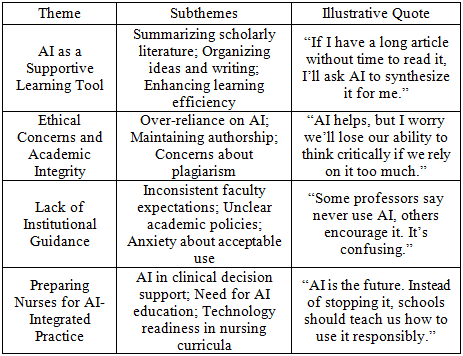
Four overarching themes emerged from the analysis of the focus group discussions: (1) AI as a supportive learning tool, (2) ethical concerns related to academic integrity and over-reliance, (3) lack of institutional guidance regarding AI use, and (4) preparing future nurses for AI-integrated practice.
Theme 1: AI as a Supportive Learning Tool
Participants described AI as a supplementary resource that enhances learning rather than replacing human judgment. Many reported using AI to synthesize large volumes of information, particularly when reviewing scholarly literature or complex documents. One participant explained: “If I have a long article without time to read it, I’ll ask AI to synthesize it for me, then I reword it in my own style.”
Theme 2: Ethical Concerns and Academic Integrity
Participants expressed concerns regarding over-reliance on AI and potential academic misconduct. Some noted that dependence on AI tools could weaken essential skills such as writing and critical thinking. “Before, I could write with no problem. Now I feel slowed down without AI.” Students also recognized that AI-generated text often has a distinct tone, leading them to revise outputs to reflect their own voice. “I would never submit it exactly how it gives it. AI has a certain way of wording things.” Participants emphasized the importance of maintaining accountability when using AI in academic work.
Theme 3: Lack of Institutional Guidance on AI Use
A recurring concern was the absence of clear institutional policies regarding AI use. Participants reported receiving inconsistent guidance from faculty, leading to confusion and uncertainty. “Some professors say AI should never be used. Others encourage it. It’s confusing.”
This lack of clarity contributed to anxiety about unintentionally violating academic integrity policies. Participants expressed a strong desire for clearer institutional guidelines.
Theme 4: Preparing Future Nurses for AI-Integrated Practice
Participants generally agreed that AI will play an increasingly important role in healthcare. Many believed nursing education should actively prepare students to use AI responsibly and effectively. Students identified potential clinical applications, including documentation support, decision-making tools, and information retrieval. “AI is the future. Instead of trying to stop it, schools should teach us how to use it responsibly.” Participants emphasized that integrating AI education into curricula would reduce uncertainty and better prepare students for everchanging healthcare environments.
This study examined BSNtoDNP students’ perceptions of artificial intelligence use in nursing education, with particular attention to ethical considerations. Findings indicate that students view AI as a useful academic support tool, especially for managing and synthesizing information, while simultaneously expressing concern about its potential impact on critical thinking, authorship, and professional accountability. These perspectives reflect an emerging tension between efficiency and skill development that is increasingly reported in the literature on AI in higher education.
Participants consistently described AI as supportive rather than substitutive, consistent with prior findings that generative AI is primarily used for summarization, organization, and clarification rather than direct submission of academic content 4, 9, 11. However, participants in this study voiced awareness of how repeated reliance on AI could affect writing confidence and independent thinking. This concern is notable in nursing education, where clinical reasoning and accountability are foundational to professional practice.
Concerns related to overreliance suggest potential risks if AI use is not intentionally structured. Participants perceived that frequent dependence on AI could reduce engagement in higherorder cognitive processes, a finding that aligns with discussions of cognitive offloading in technologysupported learning environments. These concerns are particularly relevant in the context of the AACN Essentials, which emphasize critical thinking, judgment, and ethical decisionmaking as core competencies for professional nursing practice 4.
A prominent finding in this study was the role of institutional inconsistency in shaping ethical uncertainty. Participants did not describe intentional misuse of AI; rather, they reported confusion stemming from inconsistent faculty expectations and the absence of standardized policies. This suggests that ethical challenges related to AI use may be driven less by student intent and more by unclear educational structures. These findings support calls in the literature for clearer distinctions between acceptable academic support and inappropriate substitution of student work.
Participants also emphasized the inevitability of AI integration in clinical practice and questioned the disconnect between academic restrictions and realworld healthcare environments. This viewpoint aligns with national recommendations emphasizing the integration of informatics and emerging technologies into nursing education 4, 5. Importantly, participants advocated for structured instruction focused on ethical and critical use of AI rather than exclusion or punitive enforcement.
In summary, findings highlight the need for nursing education programs to balance the instructional benefits of AI with intentional safeguards to preserve critical thinking, authorship, and professional responsibility. Clear guidance and structured integration are essential to ensuring that AI use supports, rather than undermines, professional formation in nursing education. In order to teach appropriate AI use, nursing faculty must receive training in AI technology to develop guidelines and ultimately teach nursing students about ethical use of AI.
This study has several limitations. The sample was drawn from a single institution, which limits generalizability. All participants were DNP students in their first year, potentially limiting perspectives across different levels of doctoral education. Focus group methodology may have influenced responses due to group dynamics, including conformity or reluctance to disclose controversial practices such as AI misuse. Additionally, participants may have underreported unethical AI use due to concerns about academic integrity or perceived judgment thus self-reported data may be subject to social desirability bias. Future studies should include diverse institutions and longitudinal designs to examine evolving perceptions of AI use.
Findings from this study suggest several implications for nursing education. First, nursing programs should develop clear, programlevel guidelines that define acceptable and unacceptable uses of AI in academic work. Consistent expectations across courses and faculty may reduce student confusion and support ethical engagement with AI tools. Second, AI literacy should be incorporated into existing curricular content and across the curriculum rather than addressed as a standalone topic. Integrating discussions of AI use, limitations, and ethical considerations into courses on research, informatics, evidencebased practice, and ethics may better align with competencybased curricular frameworks. Instruction should emphasize evaluation of AIgenerated content, source verification, and application of professional judgment. Third, faculty development is essential to support appropriate use and consistent implementation. Educators require preparation not only in understanding AI tools but also in designing assignments and assessments that promote ethical use while reinforcing critical thinking and original analysis. Nursing faculty must also be proficient in discriminating misuse of AI tools from appropriate use.
Finally, aligning academic preparation with AIintegrated healthcare environments may better prepare graduates for clinical practice. Exposure to AIsupported tools within an educational framework can help students develop the skills necessary to engage with emerging technologies while maintaining professional and ethical standards. Future research should examine educational strategies that support ethical AI use and assess their impact on learning outcomes, critical thinking, and professional development across diverse nursing programs.
| [1] | Al Kuwaiti A, Nazer K, Al-Reedy A, Al-Shehri S, Al-Muhanna A, Subbarayalu AV, Al Muhanna D, Al-Muhanna FA. A review of the role of artificial intelligence in healthcare. J Pers Med. 2023; 13(6): 951. | ||
| In article | View Article PubMed | ||
| [2] | Gu J, Gao C, Wang L. The evolution of artificial intelligence in biomedicine: Bibliometric analysis. JMIR AI. 2023; 2: e45770. | ||
| In article | View Article PubMed | ||
| [3] | Brunner J, Amano A, Davila J, Krein S, Sullivan SC, Church V, Sayre G, Rinne ST. Nurse experiences in an electronic health record transition. Comput Inform Nurs. 2025; 43(4): 1239. | ||
| In article | View Article PubMed | ||
| [4] | American Association of Colleges of Nursing. The essentials: Core competencies for professional nursing education. 2021. Available from: . | ||
| In article | |||
| [5] | De Gagne JC. The state of artificial intelligence in nursing education: Past, present, and future directions. Int J Environ Res Public Health. 2023; 20(6): 4884. | ||
| In article | View Article PubMed | ||
| [6] | Goktas P, Kucukkaya A, Karacay P. Leveraging the efficiency and transparency of artificial intelligence-driven visual Chatbot through smart prompt learning concept. Skin Res Technol. 2023; 29(11): 13417. | ||
| In article | View Article PubMed | ||
| [7] | Shi J, Wei S, Gao Z, Mei Y, Tian F, Zhao J, Li Z. Global output on artificial intelligence in the field of nursing: A bibliometric analysis and science mapping. J Nurs Scholarsh. 2022; 54(6): 853-863. | ||
| In article | View Article PubMed | ||
| [8] | Hobensack M, Michalowski M, Mitchell J, Nibber R, Olalia MA, Pruinelli L, Ronquillo CE, Topaz M, Peltonen LM. Artificial intelligence-based technologies in nursing: A scoping literature review of the evidence. Int J Nurs Stud. 2022; 127: 104153. | ||
| In article | View Article PubMed | ||
| [9] | Shuhaiber A, Kuhail MA, Salman S. ChatGPT in higher education: A student’s perspective. Comput Hum Behav Rep. 2025; 17: 100565. | ||
| In article | View Article | ||
| [10] | Wang Z, Yin Z, Zheng Y, Li X, Zhang L. Will graduate students engage in unethical uses of GPT? An exploratory study to understand their perceptions. Educ Technol Soc. 2025; 28(1): 286-300. | ||
| In article | |||
| [11] | Lund BD, Lee TH, Mannuru NR, Aratula N. AI and academic integrity: Exploring student perceptions and implications for higher education. J Acad Ethics. 2025; 23(3): 1554-1565. | ||
| In article | View Article | ||
| [12] | Higgins O, Chalup SK, Wilson RL. Artificial intelligence in nursing: Trustworthy or reliable? J Res Nurs. 2024; 29(2): 143-153. | ||
| In article | View Article PubMed | ||
| [13] | Kannelönning MS. Contesting futures of artificial intelligence (AI) in healthcare: Formal expectations meet informal anticipations. Technol Anal Strateg Manag. 2024; 36(11): 3845-3856. | ||
| In article | View Article | ||
| [14] | Labrague LJ, Aguilar-Rosales R, Yboa BC, Sabio JB, de los Santos JA. Student nurses’ attitudes, perceived utilization, and intention to adopt artificial intelligence (AI) technology in nursing practice: A cross-sectional study. Nurse Educ Pract. 2023; 73: 103815. | ||
| In article | View Article PubMed | ||
| [15] | El Arab RAA, Al Moosa OA. Systematic review of cost effectiveness and budget impact of artificial intelligence in healthcare. NPJ Digit Med. 2025; 8: 548. | ||
| In article | View Article PubMed | ||
| [16] | Porcellato L, Lanera E, Ocagli H, Daniels M. Exploring applications of artificial intelligence in critical care nursing: A systematic review. Nurs Rep. 2025; 15(2): 55. | ||
| In article | View Article PubMed | ||
| [17] | Palmer SJ. Artificial intelligence in primary and community care: Opportunities and challenges. Br J Community Nurs. 2025; 30(Suppl 9): 137. | ||
| In article | View Article PubMed | ||
| [18] | Montejo L, Fenton A, Davis G. Artificial intelligence (AI) applications in healthcare and considerations for nursing education. Nurse Educ Pract. 2024; 80: 104158. | ||
| In article | View Article PubMed | ||
| [19] | Srinivasan M, Venugopal A, Venkatesan L, Kumar R. Navigating the pedagogical landscape: Exploring the implications of AI and chatbots in nursing education. JMIR Nurs. 2024; 7: e52105. | ||
| In article | View Article PubMed | ||
| [20] | Abujaber A, Abd-Alrazaq A, Al-Qudimat AR, et al. A strengths, weaknesses, opportunities, and threats (SWOT) analysis of ChatGPT integration in nursing education: A narrative review. Cureus. 2023;15(1):e48643. | ||
| In article | View Article | ||
| [21] | Harder N, Ali F, Turner S, Workum K, Gillman L. Comparing artificial intelligence-enhanced virtual reality and simulated patient simulations in undergraduate nursing education. Clin Simul Nurs. 2025; 105: 1017800. | ||
| In article | View Article | ||
| [22] | Kim TW. Application of artificial intelligence chatbots, including ChatGPT, in education, scholarly work, programming, and content generation and its prospects: A narrative review. J Educ Eval Health Prof. 2023; 20: 38. | ||
| In article | View Article PubMed | ||
| [23] | Tseng LP, Huang LP, Chen WR. Exploring artificial intelligence literacy and the use of ChatGPT and copilot in instruction on nursing academic report writing. Nurse Educ Today. 2025; 147: 106570. | ||
| In article | View Article PubMed | ||
| [24] | Topaz M, Peltonen LM, Michalowski M, Stiglic G, Ronquillo C, Pruinelli L, Song J, O’Connor S, Miyagawa S, Fukahori H. The ChatGPT effect: Nursing education and generative artificial intelligence. J Nurs Educ. 2025; 64(6): 20240126-01. | ||
| In article | View Article PubMed | ||
| [25] | Matthias AD, Hundt B, Craig S, Lee JL. A blueprint for integrating nursing history: Performance indicators for competency-based education. J Prof Nurs. 2025; 56: 49-53. | ||
| In article | View Article PubMed | ||
| [26] | Mani ZA. Transitioning to competency-based education in nursing: A scoping review of curriculum review and revision strategies. BMC Nurs. 2025; 24: 111. | ||
| In article | View Article PubMed | ||
| [27] | Swan BA. Assessing the knowledge and attitudes of registered nurses about artificial intelligence in nursing and health care. Nurs Econ. 2021; 39(3): 139-143. | ||
| In article | View Article | ||
| [28] | Saleh ZT, Rababa M, Elshatarat RA, Alharbi M, Alhumaidi B, Al-Za’areer MS, Jarrad RA, Niarat TF, Almagharbeh WT, Al-Sayaghi KM, Fadila DE. Exploring faculty perceptions and concerns regarding artificial intelligence chatbots in nursing education: Potential benefits and limitations. BMC Nurs. 2025; 24(1): 3082-0. | ||
| In article | View Article PubMed | ||
| [29] | Sun G, Hoelscher S. The ChatGPT storm and what faculty can do. Nurse Educ. 2023; 48(3): 119-124. | ||
| In article | View Article PubMed | ||
| [30] | Colaizzi PF. Psychological research as the phenomenologist views it. In: Valle RS, King M, eds. Existential-phenomenological alternatives for psychology. New York: Oxford University Press; 1978: 48-71. | ||
| In article | |||
Published with license by Science and Education Publishing, Copyright © 2026 Jill Kardously, Kholoud Hardan-Khalil, Michael Williams and Samantha Wee
 This work is licensed under a Creative Commons Attribution 4.0 International License. To view a copy of this license, visit
http://creativecommons.org/licenses/by/4.0/
This work is licensed under a Creative Commons Attribution 4.0 International License. To view a copy of this license, visit
http://creativecommons.org/licenses/by/4.0/
| [1] | Al Kuwaiti A, Nazer K, Al-Reedy A, Al-Shehri S, Al-Muhanna A, Subbarayalu AV, Al Muhanna D, Al-Muhanna FA. A review of the role of artificial intelligence in healthcare. J Pers Med. 2023; 13(6): 951. | ||
| In article | View Article PubMed | ||
| [2] | Gu J, Gao C, Wang L. The evolution of artificial intelligence in biomedicine: Bibliometric analysis. JMIR AI. 2023; 2: e45770. | ||
| In article | View Article PubMed | ||
| [3] | Brunner J, Amano A, Davila J, Krein S, Sullivan SC, Church V, Sayre G, Rinne ST. Nurse experiences in an electronic health record transition. Comput Inform Nurs. 2025; 43(4): 1239. | ||
| In article | View Article PubMed | ||
| [4] | American Association of Colleges of Nursing. The essentials: Core competencies for professional nursing education. 2021. Available from: . | ||
| In article | |||
| [5] | De Gagne JC. The state of artificial intelligence in nursing education: Past, present, and future directions. Int J Environ Res Public Health. 2023; 20(6): 4884. | ||
| In article | View Article PubMed | ||
| [6] | Goktas P, Kucukkaya A, Karacay P. Leveraging the efficiency and transparency of artificial intelligence-driven visual Chatbot through smart prompt learning concept. Skin Res Technol. 2023; 29(11): 13417. | ||
| In article | View Article PubMed | ||
| [7] | Shi J, Wei S, Gao Z, Mei Y, Tian F, Zhao J, Li Z. Global output on artificial intelligence in the field of nursing: A bibliometric analysis and science mapping. J Nurs Scholarsh. 2022; 54(6): 853-863. | ||
| In article | View Article PubMed | ||
| [8] | Hobensack M, Michalowski M, Mitchell J, Nibber R, Olalia MA, Pruinelli L, Ronquillo CE, Topaz M, Peltonen LM. Artificial intelligence-based technologies in nursing: A scoping literature review of the evidence. Int J Nurs Stud. 2022; 127: 104153. | ||
| In article | View Article PubMed | ||
| [9] | Shuhaiber A, Kuhail MA, Salman S. ChatGPT in higher education: A student’s perspective. Comput Hum Behav Rep. 2025; 17: 100565. | ||
| In article | View Article | ||
| [10] | Wang Z, Yin Z, Zheng Y, Li X, Zhang L. Will graduate students engage in unethical uses of GPT? An exploratory study to understand their perceptions. Educ Technol Soc. 2025; 28(1): 286-300. | ||
| In article | |||
| [11] | Lund BD, Lee TH, Mannuru NR, Aratula N. AI and academic integrity: Exploring student perceptions and implications for higher education. J Acad Ethics. 2025; 23(3): 1554-1565. | ||
| In article | View Article | ||
| [12] | Higgins O, Chalup SK, Wilson RL. Artificial intelligence in nursing: Trustworthy or reliable? J Res Nurs. 2024; 29(2): 143-153. | ||
| In article | View Article PubMed | ||
| [13] | Kannelönning MS. Contesting futures of artificial intelligence (AI) in healthcare: Formal expectations meet informal anticipations. Technol Anal Strateg Manag. 2024; 36(11): 3845-3856. | ||
| In article | View Article | ||
| [14] | Labrague LJ, Aguilar-Rosales R, Yboa BC, Sabio JB, de los Santos JA. Student nurses’ attitudes, perceived utilization, and intention to adopt artificial intelligence (AI) technology in nursing practice: A cross-sectional study. Nurse Educ Pract. 2023; 73: 103815. | ||
| In article | View Article PubMed | ||
| [15] | El Arab RAA, Al Moosa OA. Systematic review of cost effectiveness and budget impact of artificial intelligence in healthcare. NPJ Digit Med. 2025; 8: 548. | ||
| In article | View Article PubMed | ||
| [16] | Porcellato L, Lanera E, Ocagli H, Daniels M. Exploring applications of artificial intelligence in critical care nursing: A systematic review. Nurs Rep. 2025; 15(2): 55. | ||
| In article | View Article PubMed | ||
| [17] | Palmer SJ. Artificial intelligence in primary and community care: Opportunities and challenges. Br J Community Nurs. 2025; 30(Suppl 9): 137. | ||
| In article | View Article PubMed | ||
| [18] | Montejo L, Fenton A, Davis G. Artificial intelligence (AI) applications in healthcare and considerations for nursing education. Nurse Educ Pract. 2024; 80: 104158. | ||
| In article | View Article PubMed | ||
| [19] | Srinivasan M, Venugopal A, Venkatesan L, Kumar R. Navigating the pedagogical landscape: Exploring the implications of AI and chatbots in nursing education. JMIR Nurs. 2024; 7: e52105. | ||
| In article | View Article PubMed | ||
| [20] | Abujaber A, Abd-Alrazaq A, Al-Qudimat AR, et al. A strengths, weaknesses, opportunities, and threats (SWOT) analysis of ChatGPT integration in nursing education: A narrative review. Cureus. 2023;15(1):e48643. | ||
| In article | View Article | ||
| [21] | Harder N, Ali F, Turner S, Workum K, Gillman L. Comparing artificial intelligence-enhanced virtual reality and simulated patient simulations in undergraduate nursing education. Clin Simul Nurs. 2025; 105: 1017800. | ||
| In article | View Article | ||
| [22] | Kim TW. Application of artificial intelligence chatbots, including ChatGPT, in education, scholarly work, programming, and content generation and its prospects: A narrative review. J Educ Eval Health Prof. 2023; 20: 38. | ||
| In article | View Article PubMed | ||
| [23] | Tseng LP, Huang LP, Chen WR. Exploring artificial intelligence literacy and the use of ChatGPT and copilot in instruction on nursing academic report writing. Nurse Educ Today. 2025; 147: 106570. | ||
| In article | View Article PubMed | ||
| [24] | Topaz M, Peltonen LM, Michalowski M, Stiglic G, Ronquillo C, Pruinelli L, Song J, O’Connor S, Miyagawa S, Fukahori H. The ChatGPT effect: Nursing education and generative artificial intelligence. J Nurs Educ. 2025; 64(6): 20240126-01. | ||
| In article | View Article PubMed | ||
| [25] | Matthias AD, Hundt B, Craig S, Lee JL. A blueprint for integrating nursing history: Performance indicators for competency-based education. J Prof Nurs. 2025; 56: 49-53. | ||
| In article | View Article PubMed | ||
| [26] | Mani ZA. Transitioning to competency-based education in nursing: A scoping review of curriculum review and revision strategies. BMC Nurs. 2025; 24: 111. | ||
| In article | View Article PubMed | ||
| [27] | Swan BA. Assessing the knowledge and attitudes of registered nurses about artificial intelligence in nursing and health care. Nurs Econ. 2021; 39(3): 139-143. | ||
| In article | View Article | ||
| [28] | Saleh ZT, Rababa M, Elshatarat RA, Alharbi M, Alhumaidi B, Al-Za’areer MS, Jarrad RA, Niarat TF, Almagharbeh WT, Al-Sayaghi KM, Fadila DE. Exploring faculty perceptions and concerns regarding artificial intelligence chatbots in nursing education: Potential benefits and limitations. BMC Nurs. 2025; 24(1): 3082-0. | ||
| In article | View Article PubMed | ||
| [29] | Sun G, Hoelscher S. The ChatGPT storm and what faculty can do. Nurse Educ. 2023; 48(3): 119-124. | ||
| In article | View Article PubMed | ||
| [30] | Colaizzi PF. Psychological research as the phenomenologist views it. In: Valle RS, King M, eds. Existential-phenomenological alternatives for psychology. New York: Oxford University Press; 1978: 48-71. | ||
| In article | |||