Background: Gates are points of entry or exit to areas defined by fences. These gates facilitate traffic control and flow. Gates made from various materials can be either manually-operated or power-operated. Gates can fall from their support, inflicting injuries to victims. This study aims to highlight injuries resulting from falling gates as seen in Port Harcourt, Nigeria. Methods: A descriptive observational study of injuries from falling gates as seen at the University of Port Harcourt Teaching Hospital and other private hospitals within Port Harcourt from 1st January 2006 to 31st December 2022. Their age, sex, type of gate involved, place of occurrence of the falling gate, probable cause of the falling gate, injuries sustained, definitive treatment given, duration of hospital stay, complications, follow up, and the outcome were recorded. Descriptive statistics were utilized in the data analysis. Results: During the seventeen years, 33 patients sustained injuries from falling gates. Their ages ranged from 5 to 49 years with an average of 23.24 years. The most affected age group was 10-19 years (33.33%). There was male preponderance. Majority (96.97%) were sliding metallic gates. Majority (81.82%) occurred in residential buildings. The most frequent cause of the falling gate was entrapped sand in the track (33.33%). The common injuries were tibiofibular fractures (11) and femoral fractures (11). Majority (84.62%) of the fractures were close. Various definitive treatment measures were utilized. Hospital stay was one to 70 days. Complications included superficial surgical site infection, pressure ulcer, and delayed union. Follow up duration was four to 28 months. Thirty-one patients were treated, and all recovered. Conclusion: Falling gate injuries are not common. They can affect all body regions. There is a need to consider the morbidity and mortality that can result and ensure that standards are maintained in gate design, manufacture, installation, operation and maintenance.
Gates are points of entry or exit to areas defined by fences. 1, 2, 3 Gates function to facilitate traffic control and flow to these defined areas. They thus restrict access to defined areas, thereby safeguarding these areas. However, they may be merely decorative. 1, 3 Gates can be made from metallic or wooden materials. They can be manually or power (automatic) operated. 1, 2, 3 Gates can be classified as swing, sliding, vertical lift, special gates such as turnstile (rotational) gates and collapsible gates. 1, 3, 4 Swing or hinged gates are hinged along a side and allow the gate to rotate round a fulcrum in a particular direction. Sliding gates slide along tracks. Vertical lift gates move vertically up and down. Turnstile (rotational) gates rotate only in the direction which the individual exits. Collapsible gates have panels which fold upon one another when the gate opens. Depending on the weight of gates, they can be classified as light, medium or heavy gates. Gates which are less than 200kg are light gates; medium gates are between 200kg and 400kg, while heavy gates are over 400kg. 5
Despite the usefulness of gates, their use can be associated with hazards. One of such hazards is the gate falling from its support. 1, 6 Gates falling from their support on a victim can cause bodily injury or even death. 1, 7, 8, 9 This study aims to highlight injuries resulting from falling gates as seen in Port Harcourt, Nigeria.
This was a descriptive observational study of patients managed by the authors for injuries sustained from falling gates as seen at the University of Port Harcourt Teaching Hospital, Port Harcourt and other private hospitals within Port Harcourt where the authors consult. The study spanned from 1st January 2006 to 31st December 2022. Their age, sex, type of gate involved, place of occurrence of the falling gate, probable cause of the falling gate, injuries sustained, definitive treatment given, duration of hospital stay, complications, follow up and outcome were recorded.
Descriptive statistics were utilized in the data analysis and presented in texts and tables.
Ethical clearance was obtained from the Research and Ethics Committee of the hospital.
During the seventeen years, 33 patients sustained injuries from falling gates. Two of these patients had been previously reported. 1 Thirteen (39.39%) were seen in the University of Port Harcourt Teaching Hospital while 20 (60.61%) were seen in the private clinics. Their ages ranged from 5 to 49 years with an average of 23.24 years. The average age for the males was 25.05 years while that for females was 20.78 years. The age and sex distribution of the patients is shown in Table 1. The most affected age group was the 10-19 years group which constituted 33.33%. There were 19 males and 14 females giving a male to female ratio of 1.36:1.
Thirty-two (96.97%) of the falling gates were sliding metallic gates while one (3.03%) was a hinged gate. Twenty-seven (81.82%) of the gates fell at residential buildings while six (18.18%) occurred at industrial/commercial buildings. The probable cause of the falling gate is shown in Table 2. The most frequent was entrapped sand in the track (33.33%) followed by damaged stopper (27.27%). Wind blowing down a swing gate with rusted hinges was the cause in one patient (3.03%).
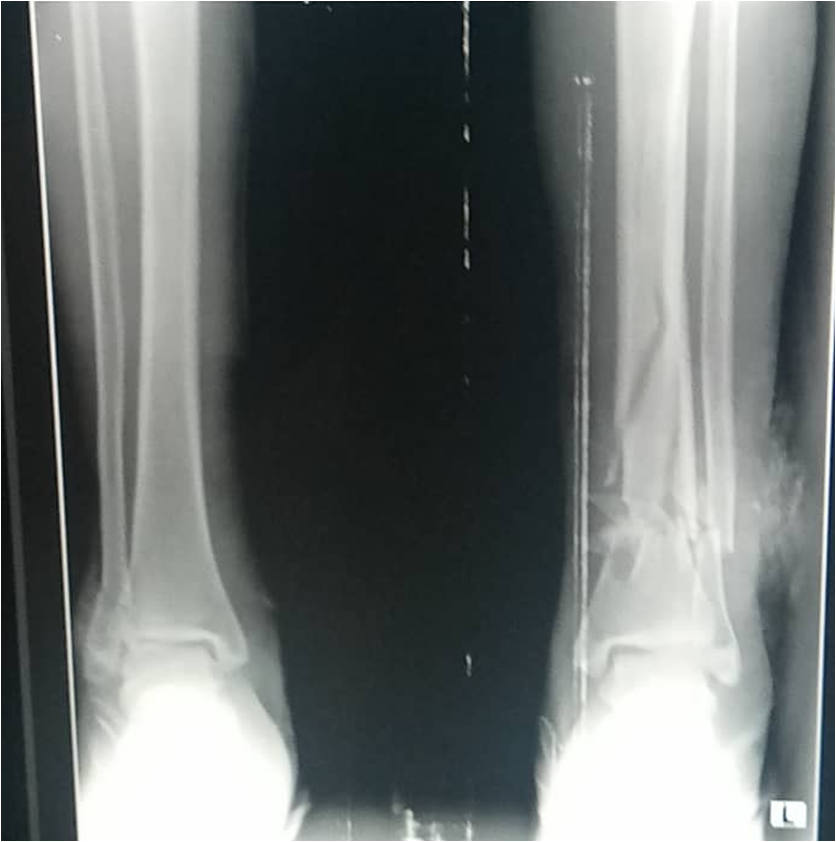
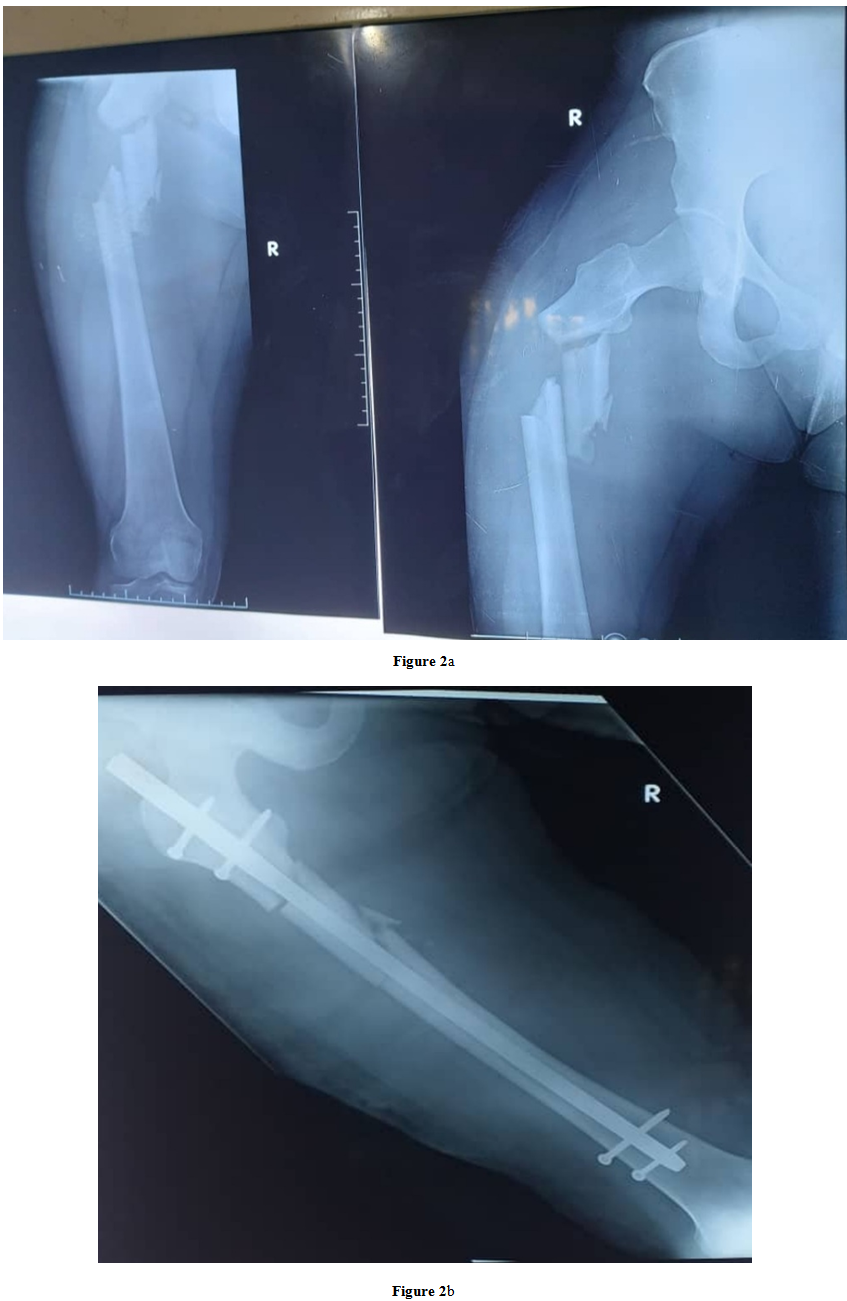
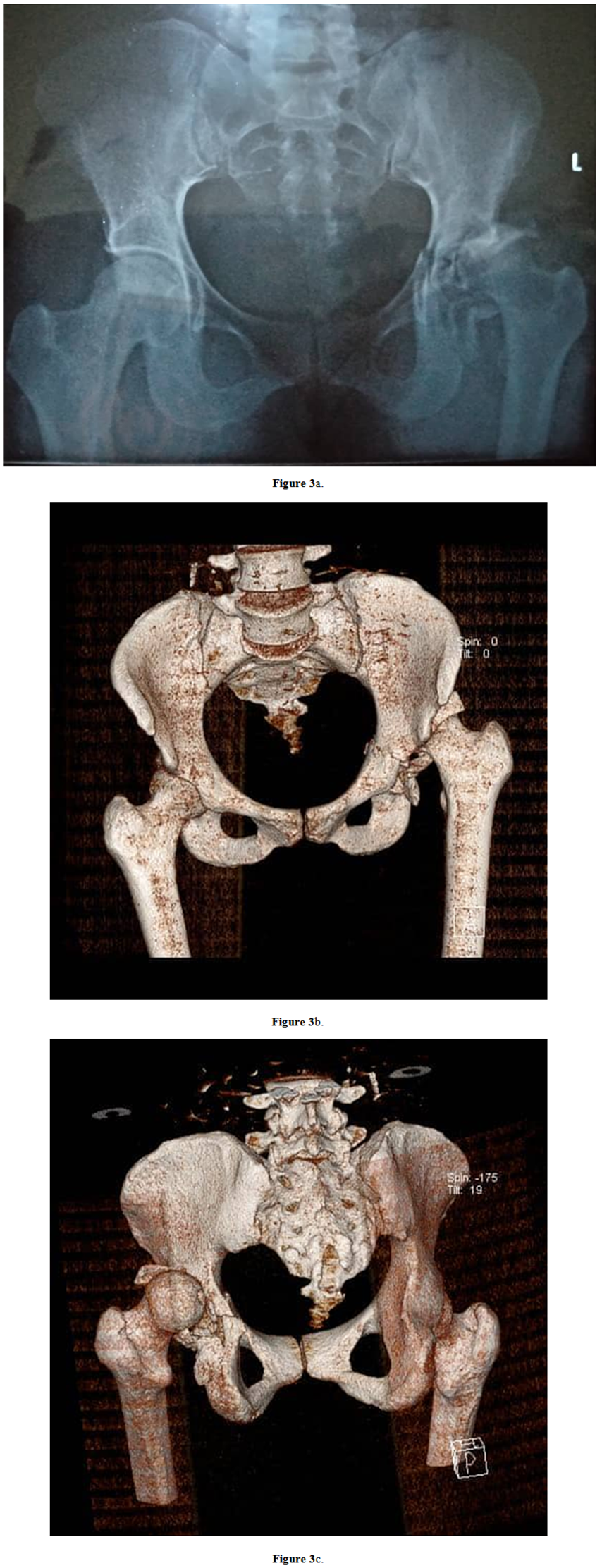
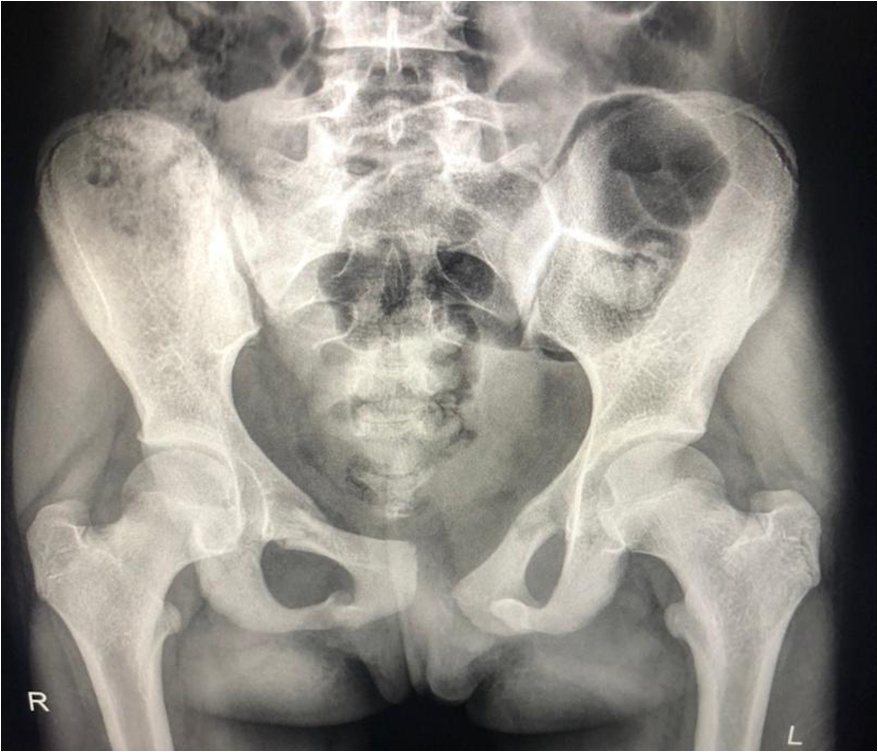
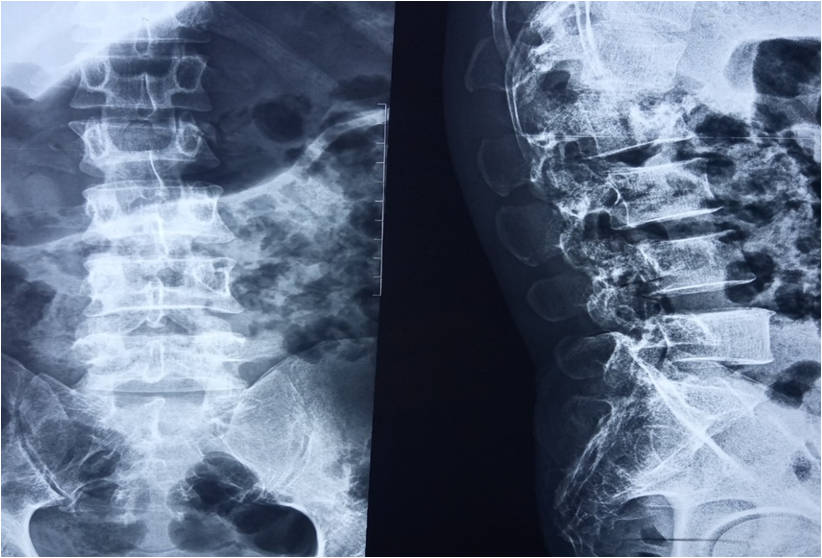
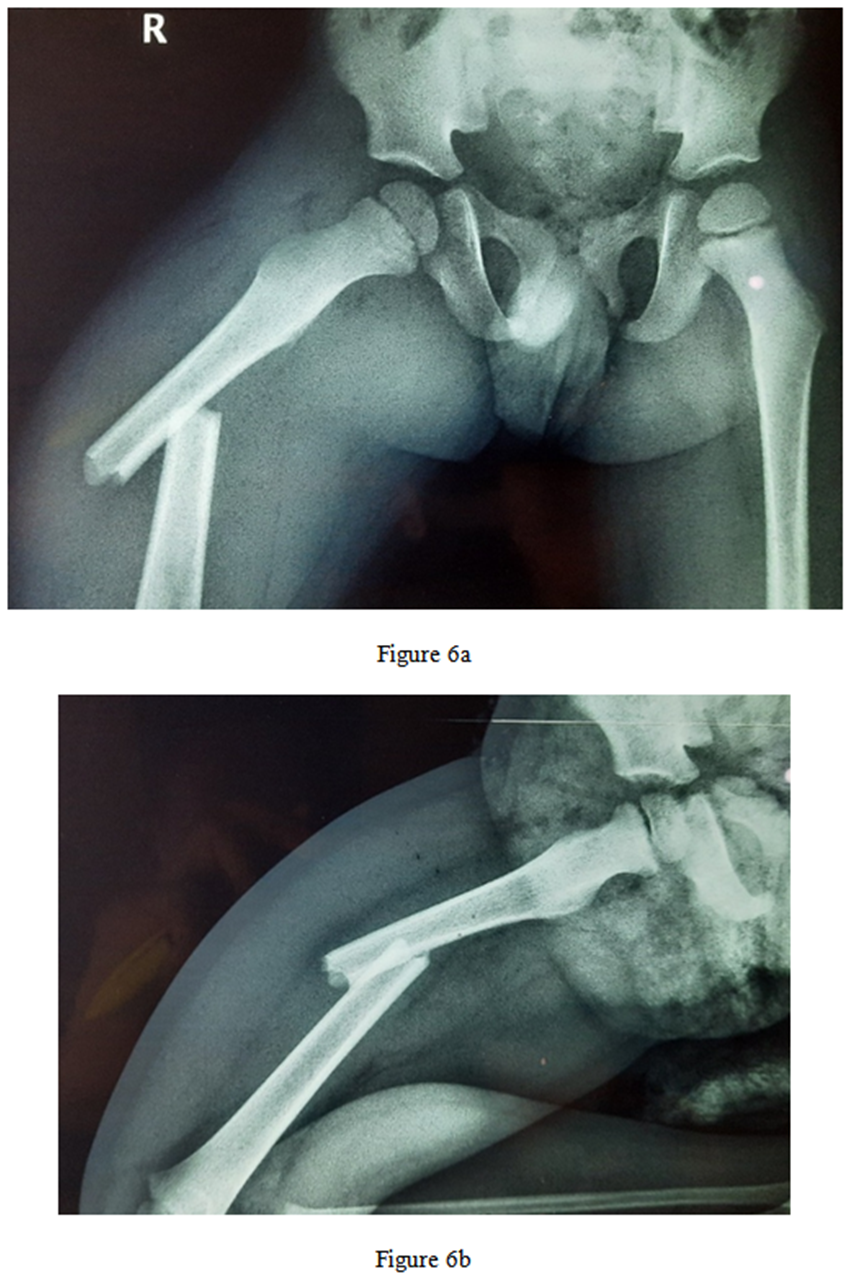
The injuries sustained are shown in Table 3. There was a total of 52 injuries in the 33 patients. Some patients had multiple injuries. The common injuries were tibiofibular fractures (11), femoral fractures (11), pelvic fractures (8) and abrasions (8). The patients with the lumbar vertebral fractures (3) had incomplete spinal cord injuries. Of the 39 fractures, 33 (84.62%) were close while six (15.38%) were open. Figures 1-6 shows radiographs/CT of some of the injuries sustained.


Definitive treatment given include wound dressing (8), skin traction (13), open reduction and internal fixation (10), extremity cast immobilization (5), hyperextension body jacket (2), open reduction (2), acetabular reconstruction (2), wound debribement and closure (3), wound debridement and external fixation (1), hammock splinting (1), and close reduction of dislocation (1).
The duration of hospital stay ranged from one to 70 days with an average of 27.61 days. Complications included superficial surgical site infection (2), sacral pressure ulcer (2) and delayed union (1). The duration of follow up ranged from four to 28 months. Two patients signed against medical advice. The 31 patients treated all recovered.
This study has shown that falling gate injuries is not common and affects both children and adults. There is a male preponderance with sliding metallic gates being the gate type involved in the majority. They occur mostly in residential buildings with entrapped sand in the rail track being the most frequent probable cause of the falling gate. All body regions can be affected. They had non-operative as well as operative treatments with good outcome.
Although it may be considered not to be common, the true incidence of these injuries may be difficult to ascertain. 1 This is due to the fact that most of the reports on these injuries have been by regulatory bodies or ministries, 7, 9, 10, 11 associations in the building industry, 12 journalists, 1, 13 as well as attorneys. 8, 14, 15, 16, 17 There is also the role of underreporting as there is the likelihood of minor cases going unreported. 1 A lot of these injuries in the medical literature are more likely to be put under objects falling on victims rather than being put as a separate entity. 1 Falling gate injuries affect both children and adults. The description by journalists depicts this as they report injuries both in children and adults. 1, 13, 18 Both males and females are affected. 1, 13, 18 In the present study, the youngest was a 5-year-old and the oldest a 49-year-old. The average age was 23.24 years and the most affected age group was the 10-19 years group (33.33%). This is an active age group. There was a male preponderance in the present study with a male to female ratio of 1.36:1. The more explorative nature of the male and their involvement in various jobs which include gate operation may have contributed to this.
Various gate types have been implicated in these injuries including sliding and swing gates. [1,6-11,13-20] Metallic as well as wooden gates which were either manually or power operated have caused these injuries or even death. This is particularly so when the gates are heavy. Swing gates falling off their hinges is considered to be very rare. 6 In the present study, majority (96.97%) of the gates involved were sliding gates with the swing (hinged) gate causing injuries in one case.
Gates falling from their supports have been reported to occur in buildings in industrial and commercial areas including business parks, residential areas as well as schools. [1,7-11,13,15-18,20] Workers, residents, passers-by and even visitors to these areas have been affected. [1,7-11,13,15-18,20] In the present study, the majority (81.82%) of the gates fell in residential buildings with 18.18% occurring in industrial/commercial buildings. In industrial buildings as compared to residential, safety is a critical issue and as a result, there will be more care for the gates in industrial buildings. Hence, the factors that predispose to falling gates will be more in residential than industrial buildings.
Various factors have been found to be responsible for falling gate accidents occurring. These include faulty methods of gate operation, safety devices, gate components and maintenance. 1, 7, 9, 10, 14, 15, 16, 18, 19 Investigations have revealed these features to include defective hinges, axles, bolts, track components, improper installation and poor maintenance and repairs of gate, vehicular impacts, sensor failure, adverse weather conditions amongst others. 1, 7, 9, 10, 13, 14, 15, 16, 18, 19, 20 As a result of prolonged operation and use in addition to lack of regular inspections, repairs and maintenance, the hinges, axles, bolts, and track components of the gate often become rusty, deformed, excessively worn, cracked and distorted 1, 7 and these contribute to the gates falling from their support. Fatigue of materials such as L-shaped stoppers with resultant cracks or fracture of the material as well as single-impact bending fracture due to repeated impacts associated with gate opening and closing operations have been implicated in failure of sliding metal gates. 20, 21 In fact, material fatigue had been reported to be responsible for at least 90% of the service failures of mechanical and structural components. 21 In the present study, the probable reasons given by the victims or their relatives for sliding gates falling included entrapped sand in the track, damaged stoppers, damaged rail track and damaged rollers. For the swing gate, the reason given for the falling gate was wind blowing down a swing gate with rusty hinges. These are indications of poor maintenance of these gates. These causes were regarded as probable causes because no investigations were carried out by the authors at the various accident scenes to confirm these. However, the reasons given are in consonance with those found by others who had previously investigated falling gate accidents. [1,7,9,10,13-20]
Serious injuries or death often occur from falling gates when the gates are heavy. 1, 6, 8, 9, 10, 16, 17, 19, 20 When a gate is noticed to fall from its support, the first reaction of the victim is to run from the scene. However, often they are not able to escape and the falling gate lands on them. Heavy gates could generate enough force to cause both soft tissue and bony injuries. 1, 16 The trauma caused by falling gates is blunt force trauma. Blunt force trauma can give rise to contusions, abrasions, lacerations and fractures if the force is significant. 21 Any of the body regions could be affected and the injuries could be either close or open. The injuries could also be multiple. Injuries that have been reported among victims of falling gates include contusions, abrasions, crush injuries, kidney failure, chest injuries, cardiac injuries, vertebral fractures, spinal cord injuries, injuries of the head, traumatic brain injuries, facial injuries and fractures, abdominal injuries, upper extremity fractures, pelvic and lower extremity fractures as well as shock and disseminated intravascular coagulation. 1, 8, 9, 11, 16, 18 Deaths have also been reported. 1, 7, 8, 9, 10, 13, 16, 18 The variable nature of the injuries underscores the need to systematically evaluate these patients and treat them appropriately. In the present study, although some patients had multiple injuries, the common injuries found were femoral fractures, tibiofibular fractures, pelvic fractures, abrasions, acetabular fractures, hip dislocations and lumbar vertebral fractures. Of the 39 fractures, the majority (84.62%) were close.
Falling gate injuries being variable will require variable treatment modalities as has been shown by the variable treatment modalities in the patients in the present study. Significant morbidity or even mortality can result from these injuries or their complications. The cost of medical treatment can be enormous going by the loss of income during the period of hospitalization/treatment, medical expenses, rehabilitation costs amongst others. Where there have been litigations, costs for compensation are also important. As have been highlighted by others, significant economic and social losses can be incurred as a result of these injuries. 1, 16, 17
The morbidity and mortality that could occur from falling gate injuries, and the fact that the lives of residents, passers-by, employees and employers alike can be endangered, is enough cause for public concern. These accidents pose risk to public safety. Hence, there is a need to ensure safety and prevent occurrence of these accidents. Safety considerations are required in gate design, installation, operation and maintenance. 1, 10, 24 All gates should be constructed with suitable materials and meet the required standards set for them. 10, 24 Although the details of the standards are beyond the scope of this work, it is essential that gates should be designed in such a way that their installation, operation and maintenance can be carried out safely. 1, 10, 24
Study Limitation: The probable causes of the falling gate were based on the account of the victims or their relatives or caregivers and no further investigation of the accident scenes was carried out by the authors to verify the acclaimed causes of the falling gates. This is a limitation.
Falling gate injuries are not common. No age group or gender is exempted. Majority of the injuries occur from sliding metallic gates and they occur both in residential as well as industrial buildings. Entrapped sand in the track and damaged stoppers were the most frequent probable causes. All body regions can be affected and can be multiple in some cases. Due to the mortality and morbidity that can result from these injuries, there is a need to ensure standards are maintained in gate design, manufacture, installation, operation and maintenance.
The authors have no competing interest.
The study was self-funded.
| [1] | Eyimina PD, Adiela VU, Echem RC. Falling gate injury. Port Harcourt Medical Journal 2013; 7(3): 243-250. | ||
| In article | |||
| [2] | Ikpeze OF, Uwazuoke EC, Samiat BM, Kareem KM. Design and construction of an automatic gate. ABUAD Journal of Engineering Research and Development (AJERD) 2019; 2(2): 123-131. | ||
| In article | |||
| [3] | Elechi P, Ahiakwo CO, Shir ST. Design and implementation of an automated security gate system using global system for mobile communication network. Journal of Network Security Computer Networks 2021; 7(1): 1-10. | ||
| In article | |||
| [4] | Department of Defense, United States of America. Gates. In: Military handbook: Design guidelines for security fencing, gates, barriers and guard facilities. MIL-HDBK-1013/10. Philadelphia, PA: Department of Defense, 1993; 23-45. | ||
| In article | |||
| [5] | EasyGate. How to install a sliding gate from EasyGate. Available from: https://www.easygate.co.nz. Accessed 2-12-2021. | ||
| In article | |||
| [6] | Ritter FD. Hazards: Falling gates. In: Ritter FD. Successful personal injury investigation: Master the technique of finding the facts that win cases for plaintiff attorneys, 1st edition. Oceanside, California: Diverse Publications, 2000; 767-770. | ||
| In article | |||
| [7] | Occupational Safety and Health Branch, Labour Department/ Occupational Safety and Health Council (Hong Kong). A safety guide on gate work. Available from: http://www.labour.gov.hk. Accessed 2-12-2021. | ||
| In article | |||
| [8] | Smith E. Gate crush accidents and injuries. Available from: https://www.autoaccident.com/gate-crush-accidents-and-injuries.html. Accessed 2-12-2021. | ||
| In article | |||
| [9] | Worksafe (Western Australia). Worker crushed by falling gate. Safety alert 08/2018. Cannington, Western Australia: Department of Mines, Industry Regulation and Safety, 2018. | ||
| In article | |||
| [10] | Ministry of Manpower/Building and Construction Authority (Singapore). Circular on safety considerations in gate design and operation. Circular No- OSHD/OSHI/MI 043. March 2012. Available from: https://www.wshc.sg. Accessed 5-12-2021. | ||
| In article | |||
| [11] | Occupational Safety and Health Administration, United States Department of Labor. Accident: 201692480 – Employee is injured when struck by falling gate. Available from: https://www.osha.gov/ords/imis/accidentsearch.accident_detail?id=201692480. Accessed 23-12-2022. | ||
| In article | |||
| [12] | Door and Hardware Foundation (DHF). Guide to gate safety legislation and standards. DHF 1053: 06/12. DHF, June 2012. Available from: www.dhfonline.org.uk. Accessed 5-12-2021. | ||
| In article | |||
| [13] | Lam N, Choi C. Sensor failure – suspected cause of collapsed gate that killed security guard in Hong Kong. South China Morning Post, 17th August 2022. Available from: https://www.scmp.com/news/hong-kong/society/article/3189179/sensor-failure-suspected-cause-collapsed-gate-killed?module=perpetual_scroll_0&pgtype=article&campaign=3189179. Accessed 23-12-2022. | ||
| In article | |||
| [14] | Panish M. Defective gate designs can cause personal injury & wrongful death. Available from: https://www.constructionwitness.com/Published-Articles/Gates-Fences/DEFECTIVE-GATE-DESIGNS-cause-Personal-Injury-Cla.aspx. Accessed 4-12-2021. | ||
| In article | |||
| [15] | Panish M. Gate & fence accidents & injuries. Available from: https://www.constructionwitness.com/documents/GATE-FENCE-Accidents-Injuries.pdf. Accessed 23-12-2022. | ||
| In article | |||
| [16] | The Dominguez Firm. Heavy gate injury lawyer. Available from: https://dominguezfirm.com/injury-lawyer/heavy-gate-injury-lawyer/. Accessed 23-12-2022. | ||
| In article | |||
| [17] | Davis JR. Falling gate case resolved. April 30th 2020. Available from: https://www.jeffdavislaw.com/falling-gate-case-resolved/. Accessed 23-12-2022. | ||
| In article | |||
| [18] | Baksh V. Falling gates: Who is responsible when they come crashing down? UWI Today (The University of West Indies, St. Augustine Campus). December 2014. Available from: https://sta.uwi.edu/uwitoday/archive/december_2014/article24.asp. Accessed 23-12-2022. | ||
| In article | |||
| [19] | Forgaty CC. Sliding gate injuries – expert article. August 2021. Available from: https://www.robsonforensic.com/articles/sliding-gate-expert-witness/. Accessed 2-12-2021. | ||
| In article | |||
| [20] | Lai JKL, Lo KH, Wong KW. Failure of a sliding metal gate due to single-impact bending fracture and poor installation practice. Journal of Failure Analysis and Prevention (J Fail Anal and Preven) 2010; 11(1): 71-76. | ||
| In article | View Article | ||
| [21] | Figueiredo AMG, de Oliveira Ribeiro G, Dias JF, Modenesi PJ, Queiroz FLP, de Oliveira Vasconcelos J, da Silveira Monteiro HA. An investigation of bending fatigue crack propagation in structural steel by the measurement of indirect parameters. Journal of the Brazilian Society of Mechanical Sciences and Engineering (J Braz Soc Mech Sci Eng). 2014; 37(1): 305-312. | ||
| In article | View Article | ||
| [22] | Kranioti EF. Forensic investigation of cranial injuries due to blunt force trauma: current best practice. Research and Reports in Forensic Medical Science 2015; 5: 25-37. | ||
| In article | View Article | ||
| [23] | Simon LV, Lopez RA, King KC. Blunt force trauma. [updated 2022 Aug 8]. In: StatPearls [Internet]. Treasure Island (FL): StatPearls Publishing; 2023. Available from: https://www.ncbi.nlm.nih.gov/books/NBK470338/. | ||
| In article | |||
| [24] | Buildings Department (Hong Kong). Large metal gates. Practice note for authorized persons, registered structural engineers and registered geotechnical engineers. APP-146. Hong Kong: Buildings Department, 2010. Available from: www.bd.gov.hk/english/documents/pnap/APP/APP146.pdf. Accessed 25th August 2022. | ||
| In article | |||
Published with license by Science and Education Publishing, Copyright © 2023 Phillip D. Eyimina, Mike T. Achor and Richard C. Echem
 This work is licensed under a Creative Commons Attribution 4.0 International License. To view a copy of this license, visit
http://creativecommons.org/licenses/by/4.0/
This work is licensed under a Creative Commons Attribution 4.0 International License. To view a copy of this license, visit
http://creativecommons.org/licenses/by/4.0/
| [1] | Eyimina PD, Adiela VU, Echem RC. Falling gate injury. Port Harcourt Medical Journal 2013; 7(3): 243-250. | ||
| In article | |||
| [2] | Ikpeze OF, Uwazuoke EC, Samiat BM, Kareem KM. Design and construction of an automatic gate. ABUAD Journal of Engineering Research and Development (AJERD) 2019; 2(2): 123-131. | ||
| In article | |||
| [3] | Elechi P, Ahiakwo CO, Shir ST. Design and implementation of an automated security gate system using global system for mobile communication network. Journal of Network Security Computer Networks 2021; 7(1): 1-10. | ||
| In article | |||
| [4] | Department of Defense, United States of America. Gates. In: Military handbook: Design guidelines for security fencing, gates, barriers and guard facilities. MIL-HDBK-1013/10. Philadelphia, PA: Department of Defense, 1993; 23-45. | ||
| In article | |||
| [5] | EasyGate. How to install a sliding gate from EasyGate. Available from: https://www.easygate.co.nz. Accessed 2-12-2021. | ||
| In article | |||
| [6] | Ritter FD. Hazards: Falling gates. In: Ritter FD. Successful personal injury investigation: Master the technique of finding the facts that win cases for plaintiff attorneys, 1st edition. Oceanside, California: Diverse Publications, 2000; 767-770. | ||
| In article | |||
| [7] | Occupational Safety and Health Branch, Labour Department/ Occupational Safety and Health Council (Hong Kong). A safety guide on gate work. Available from: http://www.labour.gov.hk. Accessed 2-12-2021. | ||
| In article | |||
| [8] | Smith E. Gate crush accidents and injuries. Available from: https://www.autoaccident.com/gate-crush-accidents-and-injuries.html. Accessed 2-12-2021. | ||
| In article | |||
| [9] | Worksafe (Western Australia). Worker crushed by falling gate. Safety alert 08/2018. Cannington, Western Australia: Department of Mines, Industry Regulation and Safety, 2018. | ||
| In article | |||
| [10] | Ministry of Manpower/Building and Construction Authority (Singapore). Circular on safety considerations in gate design and operation. Circular No- OSHD/OSHI/MI 043. March 2012. Available from: https://www.wshc.sg. Accessed 5-12-2021. | ||
| In article | |||
| [11] | Occupational Safety and Health Administration, United States Department of Labor. Accident: 201692480 – Employee is injured when struck by falling gate. Available from: https://www.osha.gov/ords/imis/accidentsearch.accident_detail?id=201692480. Accessed 23-12-2022. | ||
| In article | |||
| [12] | Door and Hardware Foundation (DHF). Guide to gate safety legislation and standards. DHF 1053: 06/12. DHF, June 2012. Available from: www.dhfonline.org.uk. Accessed 5-12-2021. | ||
| In article | |||
| [13] | Lam N, Choi C. Sensor failure – suspected cause of collapsed gate that killed security guard in Hong Kong. South China Morning Post, 17th August 2022. Available from: https://www.scmp.com/news/hong-kong/society/article/3189179/sensor-failure-suspected-cause-collapsed-gate-killed?module=perpetual_scroll_0&pgtype=article&campaign=3189179. Accessed 23-12-2022. | ||
| In article | |||
| [14] | Panish M. Defective gate designs can cause personal injury & wrongful death. Available from: https://www.constructionwitness.com/Published-Articles/Gates-Fences/DEFECTIVE-GATE-DESIGNS-cause-Personal-Injury-Cla.aspx. Accessed 4-12-2021. | ||
| In article | |||
| [15] | Panish M. Gate & fence accidents & injuries. Available from: https://www.constructionwitness.com/documents/GATE-FENCE-Accidents-Injuries.pdf. Accessed 23-12-2022. | ||
| In article | |||
| [16] | The Dominguez Firm. Heavy gate injury lawyer. Available from: https://dominguezfirm.com/injury-lawyer/heavy-gate-injury-lawyer/. Accessed 23-12-2022. | ||
| In article | |||
| [17] | Davis JR. Falling gate case resolved. April 30th 2020. Available from: https://www.jeffdavislaw.com/falling-gate-case-resolved/. Accessed 23-12-2022. | ||
| In article | |||
| [18] | Baksh V. Falling gates: Who is responsible when they come crashing down? UWI Today (The University of West Indies, St. Augustine Campus). December 2014. Available from: https://sta.uwi.edu/uwitoday/archive/december_2014/article24.asp. Accessed 23-12-2022. | ||
| In article | |||
| [19] | Forgaty CC. Sliding gate injuries – expert article. August 2021. Available from: https://www.robsonforensic.com/articles/sliding-gate-expert-witness/. Accessed 2-12-2021. | ||
| In article | |||
| [20] | Lai JKL, Lo KH, Wong KW. Failure of a sliding metal gate due to single-impact bending fracture and poor installation practice. Journal of Failure Analysis and Prevention (J Fail Anal and Preven) 2010; 11(1): 71-76. | ||
| In article | View Article | ||
| [21] | Figueiredo AMG, de Oliveira Ribeiro G, Dias JF, Modenesi PJ, Queiroz FLP, de Oliveira Vasconcelos J, da Silveira Monteiro HA. An investigation of bending fatigue crack propagation in structural steel by the measurement of indirect parameters. Journal of the Brazilian Society of Mechanical Sciences and Engineering (J Braz Soc Mech Sci Eng). 2014; 37(1): 305-312. | ||
| In article | View Article | ||
| [22] | Kranioti EF. Forensic investigation of cranial injuries due to blunt force trauma: current best practice. Research and Reports in Forensic Medical Science 2015; 5: 25-37. | ||
| In article | View Article | ||
| [23] | Simon LV, Lopez RA, King KC. Blunt force trauma. [updated 2022 Aug 8]. In: StatPearls [Internet]. Treasure Island (FL): StatPearls Publishing; 2023. Available from: https://www.ncbi.nlm.nih.gov/books/NBK470338/. | ||
| In article | |||
| [24] | Buildings Department (Hong Kong). Large metal gates. Practice note for authorized persons, registered structural engineers and registered geotechnical engineers. APP-146. Hong Kong: Buildings Department, 2010. Available from: www.bd.gov.hk/english/documents/pnap/APP/APP146.pdf. Accessed 25th August 2022. | ||
| In article | |||