Artisanal mining is spreading inexorably throughout Côte d’Ivoire, particularly in the western part of the country, with certain socio-environmental risks affecting both the gold miners and the populations living near mining sites. Gold is often associated with other metals and metalloids such as arsenic and lead, which are toxic to animals and humans. These toxic elements, released during mining activities, are dispersed into water and soil, while a significant proportion remains trapped in the huge amounts of waste produced and dumped into the environment. In western Côte d’Ivoire, which has become a zone of intense artisanal gold mining activity, the consequences of the activity are little studied. Indeed, the solid mining residues from this activity have not yet been the subject of a dedicated study. The present study is conducted based on observations, macroscopic and microscopic descriptions, and geochemical analyses. Microscopic studies using transmitted and reflected light revealed that the rocks from the mining sites are volcanosedimentary formations (schists and micaschists). The observed outcrops are metamorphic rocks, mostly metagranites, mica granulites, as well as granites and microgranites. These rocks are mainly composed of quartz, micas, feldspars, amphibole, and accessory minerals such as chlorite, epidote, and sericite. There is also a notable abundance of sulfides, including pyrite, chalcopyrite, pyrrhotite, arsenopyrite, and magnetite in the rocky waste, whose oxidation can lead to acid mine drainage. Geochemical analysis also highlights the effects of sulfide oxidation in the form of enrichment of residues in Cadmium, Cobalt, Chromium, Copper, Manganese, Nickel, and Palladium compared to the average concentrations of the Upper Continental Crust (UCC) or Clarke values. The trace metal elements identified in this study are specific to the geological and geochemical context of the studied area.
Metal trace elements (MTEs) are commonly present in the Earth's crust; the weathering and erosion of rocks naturally supply surface waters with MTEs 1. The Mountain District in western Côte d'Ivoire, the area selected for this study, once primarily agricultural, is now experiencing a rapid and concerning surge in artisanal gold mining, not necessarily under legal regulation. Since 1940, gold panners have exploited gold in a traditional artisanal manner, in alluvial, lateritic, and vein forms; 2, 3 throughout the localities of Ity and Floleu. Since the opening of the Ity gold mine in this region, these activities have intensified and diversified, with installations in the riverbeds and along the banks of the Cavally and Ity rivers, in Bloléquin, Babahi, and Guiglo 4. Artisanal gold mining releases enormous amounts of solid waste into the environment. Several studies have assessed the social and environmental impacts of these unregulated mining operations in the region 5, 6, 7, 8, 9; most of these studies were limited to the characterization of water and soil. To date, the rocky waste generated by mining activities has not yet been the subject of dedicated study in this region. Gold panning, a highly lucrative activity, holds significant socioeconomic importance in many countries in Asia and South America 10. Despite this very important socioeconomic role, artisanal and small-scale gold mining (ASGM) can negatively impact the environment and the health of miners and the communities living near mining sites 11, 12. The environmental impacts are primarily physical, including groundwater pollution 8, 13, and result in the metallic contamination of the environment. Ore processing and gold recovery use chemicals that are harmful to living organisms and dangerous to human health, such as acids, cyanide, and/or mercury; this is the greatest concern 14, 15. This phase can lead to the dispersion and high concentrations of heavy metals in soils, sediments, and waters 16, 17; metals and metalloids (As, Co, Cu, and Pb) are found in waste rock and solid mining residues. The operations of crushing, grinding, and leaching of mineralized rocks, or the leaching and erosion of residues, contribute significantly to the dispersion of metals and metalloids 11, 18, 19. According to 20, arsenic can be present at high concentrations in several metallic ores (Cu, Pb, Co, and Au) and can reach 110 g/kg in certain gold ores as well as in mining residues. 21 showed that sulfides (sphalerite, arsenopyrite, pyrite, chalcopyrite, and galena) present in the mining residues of the Milluni Valley constitute the primary source of metals (Fe, Zn, As, Cu, Cd, Pb) for surface waters and sediments. Solid residues from mining operations are subjected to oxidation 22, 23. The oxidation of sulfides, particularly pyrite, leads to waters with very low pH and high in iron and sulfates, known as Acid Mine Drainage (AMD) (Kleinmann et al., 1981), which promotes the solubilization of heavy metals and their dispersion in the environment. In the Birimian gold-bearing formations of West Africa, comprising volcanosedimentary shales and volcanic rocks, mineralization is frequently associated with sulfide minerals rich in arsenic. The oxidation of these minerals can result in contamination of surface and groundwater by arsenic 24. Environmental contamination by arsenic (As), cadmium (Cd), lead (Pb), and zinc (Zn) due to oxidation has been the subject of studies in the Upper East region of northern Ghana (Smedley, 1996) and in the Komabangou gold-bearing area in Niger (Ibrahim et al., 2019). 25 highlighted an enrichment of alluvial ore in metals (Co, Cu, Cr, Fe, Mn, Ni, and V) and metalloids (As and Sb) in the Central region of Côte d’Ivoire and concluded that this had a geogenic origin.
This study aims to characterize the rocky waste from artisanal and small-scale mining operations in the Montagnes District. Specifically, it sought to determine the concentrations of metals and metalloids in the rocky waste and to identify their mineralogical and chemical characteristics.
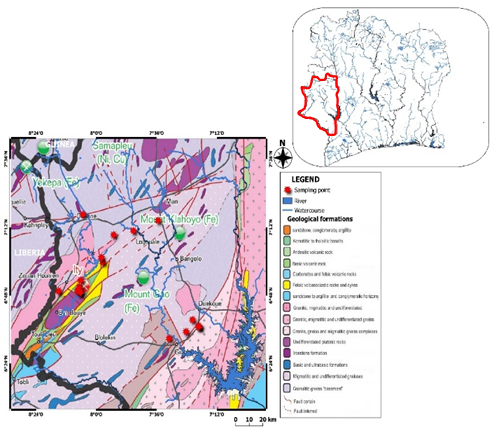
The Mountain District is located between longitudes 7° and 8° 30’ West, and latitudes 7° and 8° North. It covers an area of 31,050 km² and is situated in the west of Côte d’Ivoire, in a generally mountainous climate. The city of Man, the regional capital, is about 600 km from Abidjan, the country's economic capital. This district is made up of ten departments: Man, Zouan-Hounien, Bangolo, Blolequin, Biankouma, Danané, Duekoué, Guiglo, Kouibly, and Toulepleu. The study area is characterized by an alternation of two major seasons: a dry season lasting four months, from November to February, and a rainy season extending from March to October. Annual rainfall ranges between 1300 mm and 3000 mm, with temperatures between 23 °C and 26 °C. Overall, it features a topography marked by a succession of low plateaus 26, 27. The hydrographic system is of the mountain type 28. A large number of rivers and streams crisscross the area, making the network very dense, dominated by the Cavally, Sassandra, Ko, N’zo, Nuon, Bafing, and Drou rivers. Agriculture is the main activity of the indigenous population 29. Indeed, the economy of the populations in this region relied exclusively on agriculture and fishing before the discovery of gold in 1940 30. From a geological perspective, this area is based on the Archean basement mainly composed of Liberian formations (2900–2500 Ma), characterized by metamorphism ranging from mesozonal to catazonal, with amphibolite and granulite facies, respectively 31, 32. This domain is notable due to the presence of a Birimian province (Paleoproterozoic) which is associated with numerous gold mineralizations in Africa.
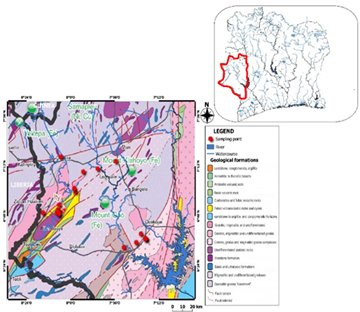
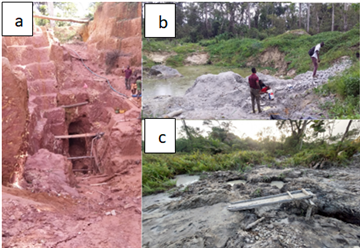
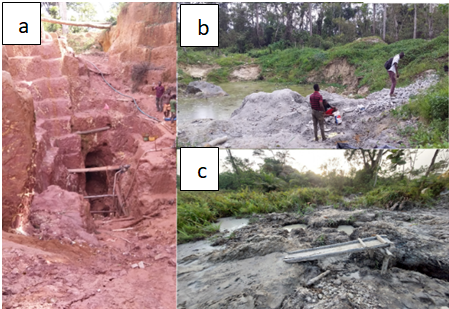
Since 1940, gold has been discovered and traditionally mined mostly by foreign-origin panners 2. This activity intensified in the area due to the opening of the Ity gold mine in 1990 and the rise in the price of gold, which reached $1,600 per ounce (31.1 g) in 2019, compared to less than $500 a few years earlier 33. Initially, the Zouan-Hounien department, and mainly the Cavally River, were the target of many artisanal miners. Over time, this activity spread to almost all the waterways (Tai, N’zo, Toulepleu, and Babahi) in the district 4 and lowlands, where it is practiced using dredging, gravity (panning), shaft, and gallery techniques (Figure 2c). Artisanal miners use floating dredges or motor pumps to extract sand from the bottom of the Cavally River. It is the gravity technique, which involves washing gold-bearing sands from alluvium, the ores already being in small particles. Since gold is heavy, it can be easily separated from other lighter minerals. The force of the watercourse promotes the concentration of the most gold-bearing masses 34. 2 revealed that in the Toulepleu-Ity formations, gold is located in the flats within outcrop areas, in quartz veins embedded in the Liberian basement or in the Nuon granites, and is also impregnated in decomposed rocks. Unlike dredging techniques, some gold prospectors dig wells and tunnels to extract ore from mineralized quartz veins, most of which are oriented North-South. Large and deep holes are dug, reaching depths of up to tens of meters (Figure 2a) to reach the mineralized quartz veins. Cyanidation takes place in cemented tanks of a few cubic meters, intended to receive the ore 13. It should be noted that this final step can lead to water or soil contamination, as the residues from these treatments are directly discharged into the environment, as shown in Figure 2b.
Sampling was carried out during three field missions between August-December 2021 and May 2024 on both former and active artisanal gold mining sites, with coordinates recorded using a Garmin GPS. This was made possible through the collaboration of local village chiefs, as well as the artisanal miners themselves, who facilitated and guided us in identifying the gold mining sites. The rocks sampled for characterization were collected from mining residues, as well as from certain rock blocks dumped by artisanal miners near the shafts and former artisanal pits. These rocks were sampled using multiple layers of paper and placed in bags to prevent possible contamination. Almost all the samples are float; a few rocks come from in-situ mineralized quartz veins and some outcrops. In total, 40 rock samples were collected from sites and former artisanal and small-scale mining locations. It should also be noted that the sampling was mainly conducted in the mining environment of Floleu-Ity and along the shores of the Cavally River. To determine the concentrations of metals and metalloids, a portion of each rock sample was taken and ground using a mechanical grinder, which was carefully cleaned with alcohol and distilled water after each sample. Once ground, the powder is dried to prevent errors that may be caused by water content exceeding 20%. The sample is then sieved through a 2 mm mesh, and the sieved material is collected and used for analysis.
3.2. Microscopic Observation and Description of SamplesThe macroscopic description of the rocks and sulfides and oxides was carried out in the field. For mineralogical and metallographic characterization, 17 polished thin sections were prepared both from the rock waste left in situ by the miners and from certain outcrops near the mining sites. These sections were prepared at Félix Houphouët-Boigny University (U-FHB) in Cocody (6 polished sections) and at the National Polytechnic Institute Houphouët Boigny in Yamoussoukro (INP-HB) (11 polished sections). Microscopic observations and descriptions aimed at characterizing the mineralogy of the rock waste were conducted at the University of Man using petrographic and metallographic microscopes in transmitted and reflected light, respectively. The objective is to determine, on the one hand, the petrographic nature of the rocky waste and outcrops, and on the other hand, the nature of the associated sulfide minerals, which are generally the primary minerals of metals and metalloids.
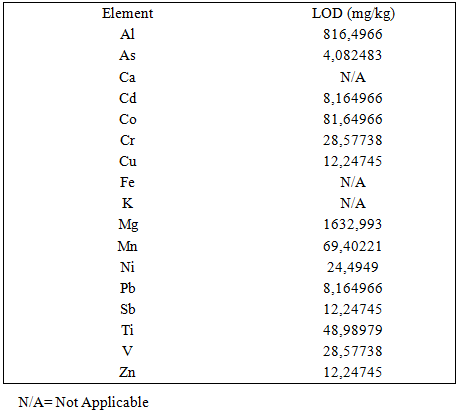
3.3. Geochemical CharacterizationX-ray fluorescence spectrometry is a chemical analysis technique that is non-destructive, qualitative, and semi-quantitative, not requiring any chemical reagents and based on a physical property of matter, namely X-ray fluorescence. Indeed, the rock powder obtained using a grinder is placed in a capsule sealed with a Mylar film. The capsule is then positioned in the analyzer, where the sample is bombarded with primary radiation emitted from an energetic excitation source. Our samples were analyzed using the Niton XL3t model. The sample is placed in the measurement window of the benchtop analyzer (Portable XRF Analyzer + Stand), which has been pre-assembled. The "Soils & Mining" mode was used, as it is better suited for the analysis of soils or rocks. The device is calibrated in the "Soils" mode to detect concentrations below 1% and trace elements, while the "Cu/Zn Mining" calibration is used to detect concentrations above 1%. The "Soils" calibration has an analysis time of 90 seconds, with results expressed in parts per million (ppm), whereas the "Cu/Zn Ores" calibration has an analysis time of 120 seconds, with results expressed as a percentage (%). The analysis time varies depending on the number of filters used; the "Soils" analysis ignores the filter for light elements (e.g., Mg, Si), making it slightly shorter. The results were subjected to statistical analysis (mean, standard deviation) and then compared with the average values of the upper continental crust 35. Although this device has allowed us to characterize our samples, its performance must be noted its performances are influenced by several factors, and this device only allows for semi-quantitative analyses. (1) Sensitivity depends on the matrix and analysis time. The reported detection limits are obtained using standard matrices (SiO₂, SRM) and can vary greatly depending on the actual composition of the samples (contents of Fe, Ca, clays, moisture, particle size). Reducing the analysis time degrades the LODs; while increasing it only improves them according to the square root of time. (2) Limited detection for light elements (Mg–S). Without helium purge, light elements exhibit reduced sensitivity and higher uncertainty. (3) Influence of sample heterogeneity. The device analyzes a very small area; mineralogical or textural heterogeneity can lead to non-representative results if the sample is not finely ground and homogenized. (4) Insufficient precision for elements present at very low concentrations. Trace levels (e.g., Au, PGEs, certain critical metals) may be under-detected or quantified with high uncertainty. (5) Dependence on pre-installed calibrations. Results may require verification or adjustment using certified reference materials, especially for complex geological matrices. (6) Necessity of laboratory validation. For environmental, regulatory, or studies requiring precise quantification at low concentrations, portable XRF measurements must be confirmed with laboratory techniques (ICP-MS, ICP-OES, AAS). Furthermore, we are planning ICP-MS analyses in the next phase of the work. See Table 1 for the detection limits.
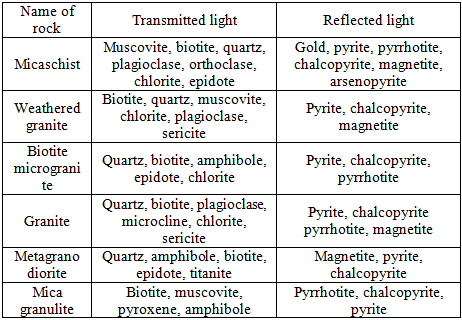
Most of the samples come from mining activity sites, with the exception that gold is associated with three main facies, namely: mineralized veins, which are generally oriented N160° with a dip of 24° toward the south; abundantly sulfide-bearing schistose rock of varying sizes (from millimeters to centimeters); and the saprolite and laterite facies. Two types of alteration were identified in this study: pervasive hydrothermal alteration, including epidotization, chloritization, sericitization, and silicification; and vein-type hydrothermal alteration, characterized by quartz veins and veinlets. The rocks observed are associated with the shafts of the small-scale mining sites at Floleu-Ity due to the eluvial and vein gold exploited in this area, unlike in certain departments (Guiglo, Tai, Duekoué) where alluvial gold is mined. Nevertheless, in these areas where gold is alluvial, rocks were collected for petro-metallographic characterization, the results of which are recorded in Table 2.
Mineralogy of waste rocks from artisanal mining activity
The rocky waste materials from the gold panning sites were of metamorphic nature, characterized by an abundance of quartz and the presence of sulfide and magnetite markings. The rocky waste materials from the gold panning sites were of metamorphic nature, characterized by an abundance of quartz and the presence of sulfide and magnetite markings.
Micaschist
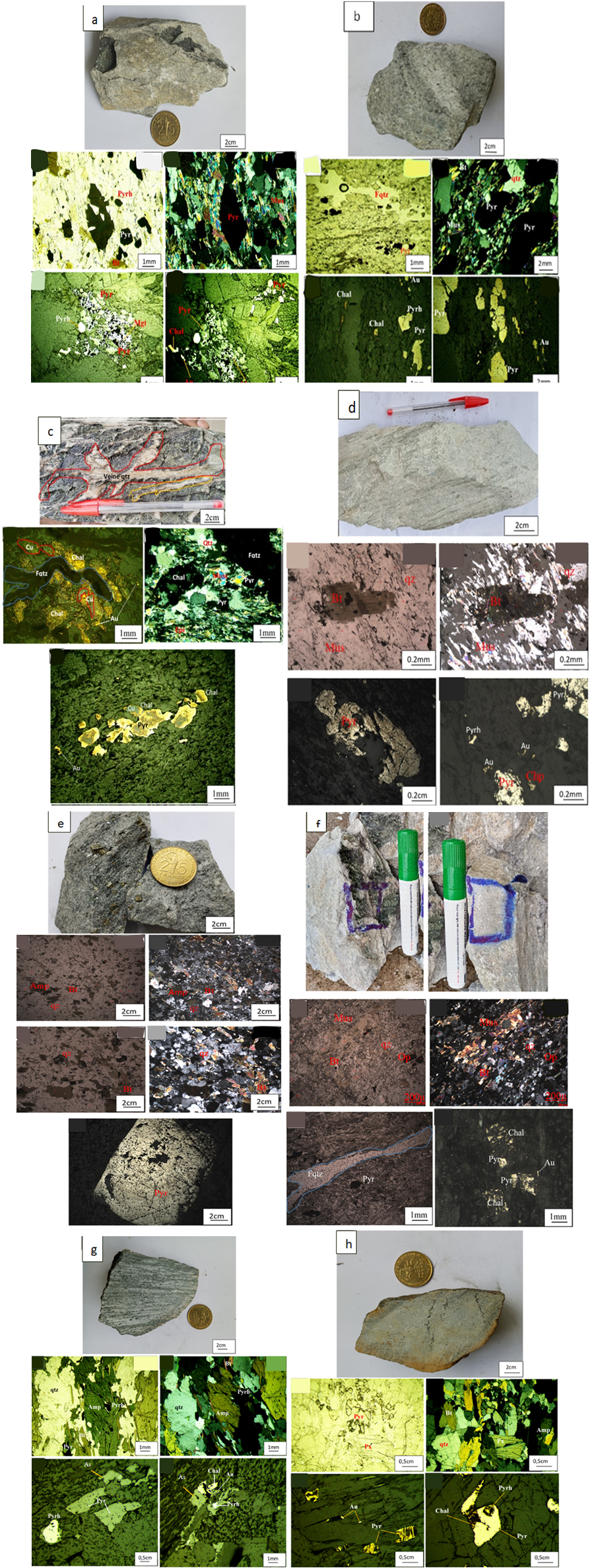
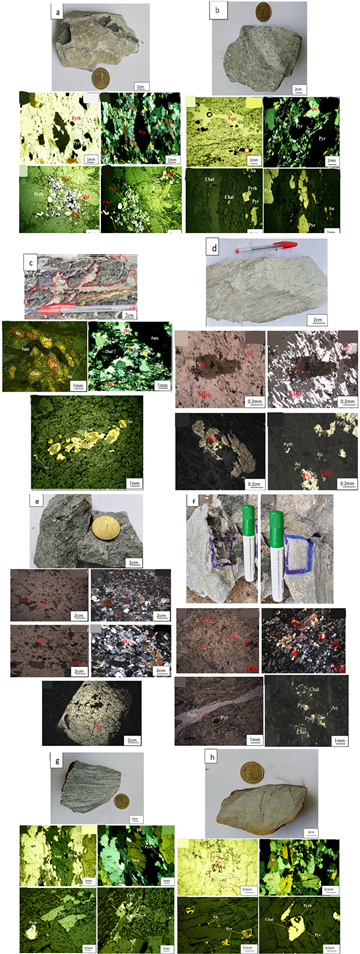
This rock shows ongoing gneissification, which makes this feature more evident under a polarizing microscope than in macroscopic observation. It is characterized by an abundance of micas forming these incipient foliations. There is also the presence of light-colored minerals such as quartz and feldspars, as well as weak magnetism. The rock is crossed by a quartz vein (Figure 3a). Under the microscope, the rock shows a granolepidoblastic texture with quartz making up about 45% of the rock. The light bands of the foliation consist of quartz and some feldspars. Muscovite (about 35%) is heavily affected by metamorphism. With its bright hues, it represents nearly 90% of the dark layers in the foliation. Biotite (about 15%) occurs in two generations: a first generation aligned with the foliation and a second generation oriented transversely to the foliation. The first group of biotites, which follows the foliation, is affected by metamorphism and is thus older than it. In contrast, the group with arbitrary orientation is younger than the metamorphism. Due to the process of chloritization, some micas have been transformed into chlorite, while others are in the process of chloritization, indicated by a dull blue color. Feldspars (plagioclase and orthoclase) and opaque minerals make up the remaining 5% of the composition. Metallography has revealed the presence of gold (Au), pyrite (FeS2), pyrrhotite (Fe1-xS), chalcopyrite (CuFeS2), and magnetite (Fe3O4) (figure. 3a).
Mica schist: Sericitic schist
Two samples from former gold panning sites share common characteristics, including a whitish appearance and a metamorphic rock nature, notably a schistosity (Figure 3b). Indeed, a late deformation is observed, marked by well-defined mineral stretching, which is accompanied by silicification and carbonation, giving the rock its whitish color. They are abundantly rich in sulfides distributed along the contacts of dark mineral bands. From a microscopic perspective, these rocks exhibit a lepidogranoblastic texture. Their mineralogical compositions are identical, dominated by quartz (approximately 45%) and muscovite (approximately 35%), which in certain areas has undergone mineral lineation. Biotites (approximately 10%) resembling primary minerals occur as phenocrysts and are affected by epidotization. Plagioclase feldspars, sulfides, and oxides complete the composition of these samples. Metallography revealed gold (Au) associated with pyrite (FeS2), pyrrhotite (Fe1-xS), chalcopyrite (CuFeS2), magnetite (Fe3O4), and arsenopyrite (FeAsS) (Figure 3b).
Volcaniclastic formation
The rock sample exhibits the appearance of a massive, melanocratic rock composed of mica layers, grayish layers, and metallic-sulfide-bearing layers, with some fractures in certain areas. This appearance indicates ongoing high-temperature and high-pressure metamorphism. In addition to the fractures, there are quartz veins that are abundantly sulfide-bearing. The magnetic pen test is negative on this sample. Under the microscope, this rock displays a lepidogranoblastic texture (Figure 3c) with abundant micas (muscovite and biotite) forming mineral lineations. These brightly colored minerals (blue, yellow-orange, violet) account for nearly 60% of the thin section, with biotites undergoing chloritization. Quartz is the second most abundant component on this thin section, accounting for approximately 35%, and exhibits a crushed appearance in some areas. A quartz veinlet traversing the sample is also noted. In addition to these two minerals, the thin section also contains some amphiboles and opaque elements, notably sulfides, which make up the remaining 5% of the section. As in most rocks, gold is in contact with pyrite and chalcopyrite, which are deformed and oriented according to the foliation.
Sericitic schist
The samples exhibit macroscopic characteristics of two types of schistosity: a first very pronounced S1, which is the main one, and a second, less pronounced S2. An abundance of disseminated sulfides of varying sizes, sometimes reaching several centimeters, is observed (Figure 3d). Some of these sulfides display strong magnetism when in contact with a magnetized pen and show signs of oxidation (rust-like appearance). Microscopic observations reveal granolepidoblastic textures with a categorized mineralogical composition, partly with phenocrysts and partly with fractured minerals. The mineralogical composition, in order of abundance, is as follows: micas account for approximately 60% of the thin section, with a clear dominance of biotites of varying sizes, while muscovite is minor. The small biotite flakes are aligned by the S1 schistosity and are therefore oriented in the same direction. Quartz accounts for approximately 25% of the thin section. Pyrite and pyrrhotite are highly abundant in this formation (around 10%) at the contact between the biotite minerals and magnetite.
Biotite microgranite
This formation is gray, weakly magnetic, with a glassy appearance; only certain sulfides, due to their metallic luster and large centimeter-scale size, are observable (Figure 3e). Some of these sulfides are magnetic, suggesting the presence of pyrrhotite. The minerals are stubby and poorly organized. Under the microscope, it appears massive and weakly foliated. The minerals exhibit a magmatic appearance with slight metamorphism. The biotite microgranite, based on its mineralogy, consists of quartz, which is very abundant, comprising about 49% of the thin section, with sizes ranging from medium to fine. Biotite is the second most abundant mineral, occurring in places as phenocrysts with direct pleochroism, showing signs of epidotization in certain areas. Amphiboles account for 25%. The amphiboles and biotites are undergoing epidotization, and others have almost completely transformed into epidote; this is manifested by the reddish hue tending towards brown. Epidote and chlorite are accessory minerals in the composition of this rock. Notable are the well-formed euhedral patches of cleaved pyrites and a few highlighted chalcopyrites (Figure 3e). Some of these sulfides are magnetic, suggesting the presence of pyrrhotite. These sulfides are in contact with the biotites that surround them, indicating that the biotites are newly formed. Oxides with low reflectivity and a grayish color have also been identified.
Weathered granite
Macroscopically, this rock sample is massive, altered, exhibiting a mesocratic color (Figure 3f) with a slight abundance of micas (biotite, muscovite), quartz, and feldspar. This lithology is in direct contact with the mineralized quartz vein, and right at the contact boundary, chlorite, a mineral characteristic of metamorphism is observable with its bottle-green color. It is a moderately sulfide-bearing formation in a disseminated manner, not identifiable to the naked eye, only noticeable by its metallic luster. Tested with a magnetized pen, the rock shows weak magnetism. The appearance of this rock suggests that it originates from a zone of high tectonic activity. Microscopic observations under transmitted and reflected light reveal a granoblastic metamorphic texture (Figure 3f). This granite contains approximately 40% quartz.
Biotite is the second most abundant mineral after quartz; it accounts for approximately 35%, with some undergoing epidotization, manifested by red-brown or reddish-orange coloration in this rock formation. The other minerals present are muscovite, chlorite, plagioclase feldspars, and sericite. As for the sulfide minerals, they make up about 5% of the rock, with pyrite being slightly more abundant than chalcopyrite and magnetite.
Metagranodiorite
The rock exhibits a weakly developed foliation with phenocrysts of feldspars and quartz. Overall, it displays a melanocratic appearance, with a predominance of minerals that react strongly to a magnetic pen. Under the microscope, the rock has a granoblastic texture with a mineralogical composition organized into different layers, namely light and dark (Figure 3g). The light layers consist of: very abundant quartz, approximately 35%, slightly rounded and worn, plagioclase, and microcline. The dark layers are composed of: a predominance of amphibole (hornblende) at around 25% of the thin section, followed by biotite present in small sizes occupying the interstices, and phenocrysts. The other minerals, namely bluish-violet epidote and automorphic sphene (diamond-shaped), are distributed across the slide. Metallographic analysis revealed an abundance of magnetite, pyrite, and chalcopyrite in contact with the ferromagnesian minerals
Mineralogy of sampled geological outcrops
Granite
This massive sample displays light phenocrystals (quartz and plagioclase feldspars) in a porphyritic form, embedded within a melanocratic matrix that exhibits strong magnetism when in contact with a magnetized pen. Microscopic observations indicate a granular texture with a mineralogical composition dominated by quartz, which occupies about 50% of the rock with varying grain sizes. More or less globular shapes are noted, with colors ranging from light gray to dark gray. Brown to green biotite represents about 20% of the rock. It appears heavily altered, with inclusions in some areas and chloritization in others. The feldspars (plagioclase and microcline) cover approximately 15% of the thin section, with some plagioclases undergoing sericitization. The metallographic study revealed the presence of sulfides and oxides occupying the remaining 5% of the sample, but no gold. Pyrite and chalcopyrite are present and partially oxidized, while pyrrhotite and magnetite were also observed.
Mica granulite
This is a massive rock with a fine-grained texture and an abundance of ferromagnesian minerals, notably micas with a pearly appearance. It is oxidized in places and exhibits magnetism when in contact with a magnetized pen. No sulfides or oxides were identified. Microscopic study revealed a granular texture. The mineralogical composition is as follows: an abundance of micas (biotite and muscovite) amounting to approximately 50% of the rock, followed by pyroxenes (around 25%), which are colorless and characterized by their cleavage. Amphibole (hornblende) represents roughly 20% of the thin section, and sulfides and oxides account for 5% of the rock's composition. Under a metallographic microscope, three types of sulfides were identified: large patches of pyrrhotite, chalcopyrite heavily oxidized in places, and pyrite (Figure 3h).
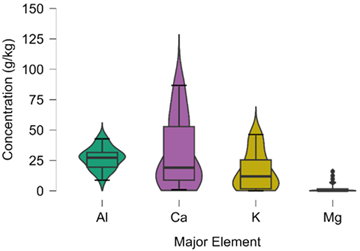
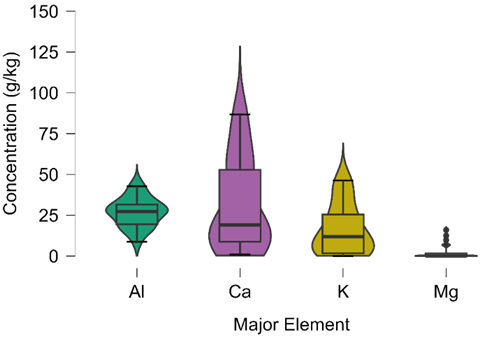
The geochemical analysis highlighted the chemical composition (major and trace elements) of the rock waste and outcrops from the various studied sites. With the exception of sodium (Na), whose concentration is below the detection limit, and calcium (Ca: 30.868 ± 28.107), which shows enrichment relative to the average concentration of the Earth's crust, aluminum (Al: 26.840 ± 8.845), potassium (K: 16.114 ± 15.326), and magnesium (Mg: 2.589 ± 4.942) exhibit values lower than the average concentrations of the Upper Continental Crust (UCC) (Figure 4).
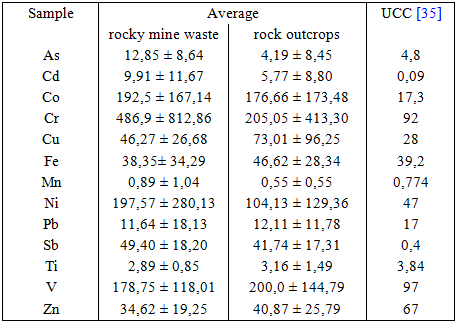
Geochemical analysis reveals the presence of trace metallic elements in the samples studied. In general, the chemical composition, particularly in metals and metalloids, varies with extreme values depending on the sampling location. Descriptive statistics on these data indicate that rocks collected from outcrops, that is, outside mining activity sites, exhibit average concentrations of As (4.19 ± 8.45), Mn (0.549 ± 0.551), Pb (12.11 ± 11.79), Ti (3.16 ± 1.49), and Zn (40.87 ± 25.79) lower than the average concentrations of the UCC (Table 3). However, other elements such as Cd (5.44 ± 8.80), Co (176.67 ± 173.48), Cr (205.05 ± 413.29), Cu (73.00 ± 96.25), Fe (46.61 ± 28.34), Ni (104.13 ± 129.36), Sb (41.73 ± 17.31), and V (200 ± 144.78) are considerably, in some cases 2 to 100 times, higher than the average values of the UCC. Regarding rock samples from sites and former mining activity areas, Fe (38.35 ± 34.29) and Mn (0.896 ± 1.04) have concentrations close to those of the UCC, unlike the concentrations of Pb (11.64 ± 18.13), Ti (2.89 ± 0.85), and Zn (34.62 ± 19.24), which show depletion. As (12.85 ± 8.64), Cd (9.90 ± 11.67), Co (192.50 ± 167.14), Cr (486.90 ± 812.87), Cu (46.27 ± 26.68), Ni (197.57 ± 280.13), Sb (49.04 ± 18.20), and V (178.75 ± 118.05) exhibit strong enrichment, ranging from 2.7 to 120 times higher than the average UCC values. Similarly, extreme values in HMs are observed in mineralized rocks from artisanal environments. For example, all these samples display metalloid concentrations (As and Sb) strictly higher than those of the continental crust. The correlation test indicates that Cd, Co, Fe, Sb, and Zn have a significance level of p=0.05 with Au. As, Cu, Pb, and Zn do not show any significant correlation with other elements. However, Cd, Co, Fe, Mn, Ni, and V are strongly correlated with each other.
From a petrographic perspective, the studied area features Archean-aged metamorphic formations such as mica schists, metagranodiorites, and altered granites, as well as biotite granulites, as revealed by the work of 31 Camil. Green rocks (volcanosedimentary) have also been identified, indicating the presence of a Birimian province (Paleoproterozoic formations). These results are consistent with those obtained by 36. According to 37, this area is affected by metamorphism ranging from mesozonal to catazonal, coupled with both ductile and brittle deformation. Furthermore, a highly mineralized quartz vein, which is the main target of artisanal miners, has been evidenced. Macroscopic examination revealed the presence of sulfides (pyrite and chalcopyrite) as well as oxides; this observation was corroborated by reflected light study. The lithologies containing the highest concentrations of ETM are the volcanosedimentary rocks and certain micaschists and gneisses located in the Birimian province of Toulepleu-Ity. 3, in his studies on the prospects of several mountains, notably that of Ity (Toulepleu-Ity unit), reported As contents below 50 mg/kg, which corroborates our results.
The significant levels of Ca in the samples could be due to the chemical composition of certain minerals such as amphibole (hornblende), plagioclase, and epidote, which are abundant in the mineralogy of the rocks and rocky wastes sampled. Thus, these minerals can contain substantial amounts of calcium through their various calcium sites. Furthermore, studies on prospects in the Zya, Ity, and Tontouo mountains, highlighted the carbonate nature of rocks in this region 3. The low levels of alkali elements (Al, K, Mg) observed in the samples can be explained by the fact that most of the rocks encountered in the study area are either granitoids or have granite as their protolith. These rocks are not alkaline but rather acidic, considering their petrography and mineralogy dominated by quartz 38, 39.
Macroscopic and microscopic observations of the samples revealed textures of metamorphic rocks (granoblastic, granonematoblastic, granolepidoblastic) and mineral compositions dominated by quartz, micas (biotite, muscovite), feldspars (plagioclase, microcline, and orthoclase), as well as some alteration minerals such as chlorite, epidote, and sericite. This microscopic examination of samples from mining sites, of schistose nature (micaschists and schist), indicates that gold in this area is found in quartz veins and volcanosedimentary formations. Metallographic characterization of these abundantly sulfide-rich solid residues revealed that gold is associated with pyrite, pyrrhotite, chalcopyrite, magnetite, and arsenopyrite. This is consistent with the work of 2, 3, 40 and 41, who respectively characterized the Toulepleu-Ity geological unit and the deposits of the Zya, Ity, and Tontouo mountains in the same area. Furthermore, 24 revealed that in West Africa, gold mineralization in volcanosedimentary shales and volcanic rocks of the Birimian formations is often associated with As-rich sulfide minerals. Additionally, pyrite and chalcopyrite are the dominant sulfide minerals in gold-bearing areas 42, 43. The sulfide minerals contained in the barren rock blocks abandoned at mining sites are likely the primary minerals of metals and metalloids. Indeed, pyrite (FeS) and pyrrhotite (Fex-1S) are Fe minerals. Thus, the high Fe concentrations obtained by fluorescence spectrometry are consistent with the abundance of pyrite and pyrrhotite in our samples. Furthermore, the average concentrations of As (12.85 mg/kg) and Cu (46.27 mg/kg), which are much higher than those of the UCC, are respectively linked to the significant presence of arsenopyrite and chalcopyrite, the primary minerals of these trace elements in the characterized samples. In these minerals, they respectively represent the reservoirs of arsenic and copper. Moreover, 13 revealed that chalcopyrite is the most abundant mineral in the schists and diorites of Liptako in Niger. The abundance of certain samples in magnetite associated with sulfides aligns with the richness in Co, Cr, Mn, Ni, and V, which are the constituent elements of this oxide. The concentrations of metals and metalloids (As, Co, Cr, Cu, Mn, Ni, and V) in the samples (rock waste and outcrops) appear to be related to their abundance in sulfides (arsenopyrite, chalcopyrite, pyrite, and pyrrhotite) and magnetite. Indeed, high concentrations of trace metal elements were observed in samples with a high abundance of sulfides. Furthermore, rock waste from former and current mining sites is more mineralized in sulfur-bearing elements compared to the outcrops collected. This abundance of sulfides at mining sites is consistent with the results of 24, which indicate that in West Africa, gold mineralization in Birimian volcano-sedimentary shales and volcanic rocks is generally associated with sulfide minerals rich in As. 21, during his work in the Val de Milini, highlighted that sulfides are the main sources of metals and metalloids. Furthermore, 25, through their research in the historically and currently active artisanal and small-scale mining area of Kokumbo in Central Côte d’Ivoire, revealed that Al, As, Co, Cr, Cu, Fe, Mn, Ni, Ti, and V are of geogenic origin. Cadmium shows average concentrations of 5.77 mg/kg and 9.90 mg/kg for outcrops and mining waste rocks, respectively, which exceed those of the UCC. As cadmium-bearing sulfides have not been identified, its concentrations are likely due to the oxidation of pyrite and chalcopyrite. Indeed, the oxidation of these sulfide minerals acidifies the environment, promoting the dissolution of other minerals, which can lead to the mobilization of Cd and many other trace metallic elements. Cd is also a chemical element that is found in trace amounts in magnetite. Contrary to the conclusions of 25, these Cd concentrations would be related to the presence of sulfides and magnetite. This could be linked to the abundance of magnetite in the samples studied. Indeed, Cd is a chemical element that occurs in trace amounts in magnetite. On the other hand, mercury (Hg) is completely absent in this study, while Pb and Zn have average contents lower than those of the upper continental crust. 44 in their work on an artisanal mining area in eastern Cameroon, highlighted Pb contamination in soils and sediments due to the association of galena (PbS) with gold. Thus, the absence of galena in this study aligns with the depletion of Pb in the rocks. Additionally, Hg, Pb, and Zn contamination is very often of exogenous origin 25.
5.2. Environmental issuesMicroscopic examination revealed an abundance of sulfides in the samples studied, which was confirmed by the high average concentrations observed through geochemical analysis. Arsenopyrite, one of the primary arsenic-bearing minerals, was identified. It should be noted that natural arsenic contamination of drinking water is a global threat affecting nearly 140 million people in 70 countries across all continents 45. This metalloid can also be found in trace amounts associated with iron and manganese oxides, which were otherwise observed in the mineralogy of most of the analyzed residues. In this regard, 46 reports that sulfide minerals contain arsenic at variable concentrations. It should be noted that this mountainous district area is a region with high rainfall, averaging between 1,200 and 3,000 mm per year. The oxidation of sulfide minerals, particularly pyrite, could therefore lead to waters with very low pH, rich in iron and sulfates, resulting in acid mine drainage. This process could facilitate the solubilization of metals (Co, Cr, Cu, Mn, Ni, and V) and metalloids (As) contained in the rock waste abandoned at artisanal mining sites, making them available to the environment, particularly surface and groundwater 47. These sites are mostly located in the immediate vicinity of rivers and marshes, primarily the Cavally River, which is used for ore washing, potentially leading to contamination of these surface water resources and infiltration into groundwater. Humans are therefore at risk of exposure to these health-hazardous elements through the consumption of contaminated water and foodstuffs, especially since the water from the Cavally River is used by local populations for vegetable farming and for their domestic needs.
This study in the mountainous West aimed to characterize rocks from mining activity areas as well as outcrops in order to determine their potential enrichment in metals and metalloids. Microscopic studies under transmitted and reflected light revealed that the mineralogy of these rocks consists of quartz, micas (biotite, muscovite), feldspars (plagioclase, microcline, orthoclase), amphibole, chlorite, epidote, and sericite. Rocks from mining sites are volcano-sedimentary formations (schists and mica schists) associated with gold mineralization. The outcrops are mostly metamorphic rocks, including metagranite, mica granulite, as well as granite and microgranite. There is a notable abundance of sulfide minerals: pyrite, chalcopyrite, pyrrhotite, and arsenopyrite, with pyrite and chalcopyrite being the most dominant, as well as magnetite in the rocky waste resulting from artisanal mining activity. The metallic trace elements identified in this study are specific to the geological and geochemical context of the area under investigation. The presence of metals and metalloids in artisanal mining residues and outcrops in the mountain district is primarily due to the geological nature of the formations in this region. These elements therefore have a geogenic source, as has been demonstrated by numerous studies in West Africa, particularly in Côte d'Ivoire. This area requires monitoring due to the risk of acid mine drainage, which can occur following the oxidation of the abundant sulfides in the confirmed artisanal mining residues.
The authors declare that there is no conflict of interest.
We thank the local leaders for their collaboration in facilitating access to artisanal gold mining sites in their communities. We also acknowledge the officials of the various gold sites for their cooperation. A special thanks to Agate Project and IRD for financially supporting our fieldwork and analyses.
| [1] | J. Elder, “Metal biogeochemistry in surface-water systems; a review of principles and concepts,” Circular, 1988. | ||
| In article | View Article | ||
| [2] | A. Papon, “Géologie et minéralisations du sud-ouest de la Côte-d’Ivoire: synthèse des travaux de l’opération SASCA 1962-1968.,” BRGM, Mémoire du BRGM, n° 80, 1973. Accessed: Nov. 11, 2025. [Online]. Available: https:// pascalfrancis.inist.fr/ vibad/index.php? action= getRecordDetail &idt= PASCALGE ODEBRGM732213702. | ||
| In article | |||
| [3] | A. Lambert, “Prospects aurifères des monts Zya, Ity et Tontouo (Côte d’Ivoire)-Interprétation des résultats d’analyses multiéléments (ICP) effectuées sur les échantillons de puits et de sondages.,” Rapport BRGM N° 1646, 1994. | ||
| In article | |||
| [4] | CNDH, “Rapport d’enquête sur la cartographie des sites d’orpaillage en côte d’ivoire,” Conseil National des Droits de l’Homme, 2022. | ||
| In article | |||
| [5] | K. S. Gbamélé, S. Konan Kouakou, L. Kouassi Kouakou, A. Brou Loukou, F. Konan Koffi, and D. Bini Kouamé, “Evaluation de la Contamination Chimique des Eaux Souterraines par les Activités Anthropiques : Cas de la Zone d’Ity-Floleu Sous-Préfecture de ZouanHounien, Ouest de la Côte d’Ivoire,” ESJ, vol. 16, no. 6, 2020. | ||
| In article | View Article | ||
| [6] | K. S. Konan, K. Kouassi, A. S. Yapo, and L. A. Brou, “Impacts de l’orpaillage sur la morphologie et la qualité des eaux du fleuve Cavally (Zouan-hounien, Côte d’Ivoire),” International Journal of Innovation and Applied Studies, vol. 28, no. 2, pp. 515–524, 2020. | ||
| In article | |||
| [7] | P. J. O. Djadé, K. N. Keuméan, A. Traoré, G. Soro, and N. Soro, “Assessment of Health Risks Related to Contamination of Groundwater by Trace Metal Elements (Hg, Pb, Cd, As and Fe) in the Department of Zouan-Hounien (West Cöte D’Ivoire),” GEP, vol. 09, no. 08, pp. 189–210, 2021. | ||
| In article | View Article | ||
| [8] | S. L. Coulıbaly, F. M. Zahui, L. C. Mangoua-Allali, A. Cherif, and L. Coulibaly, “Artisanal Mining Practice and Physical Impacts on the Environment in the Ity-Floleu Gold Region, Côte d’Ivoire,” IJECC, pp. 17–31, 2021. | ||
| In article | View Article | ||
| [9] | O. C. N’Cho, I. Ouattara, Z. Ouattara, S. J.-P. Yeo, and B. Kamagate, “Soil and environment quality in artisanal small-scale mining areas in western Côte d’Ivoire,” World J. Adv. Res. Rev., vol. 20, no. 3, pp. 774–779, Dec. 2023. | ||
| In article | View Article | ||
| [10] | Intergovernmental Forum on Mining, “Global Trends in Artisanal and Small-Scale Mining (ASM): A Review of Key Numbers and Issues,” International Institute for Sustainable Development, 2017. | ||
| In article | |||
| [11] | M. A. Ondayo, M. J. Watts, C. J. Mitchell, D. C. P. King, and O. Osano, “Review: Artisanal Gold Mining in Africa—Environmental Pollution and Human Health Implications,” Expo Health, vol. 16, no. 4, pp. 1067–1095, Aug. 2024. | ||
| In article | View Article | ||
| [12] | M. Champy and A. Dessertine, “« C’est la chaîne alimentaire, chacun prend pour lui. » Économie quotidienne de l’extraction aurifère de petite échelle dans un village de Côte d’Ivoire:” Afrique contemporaine, vol. N° 277, no. 1, pp. 79–101, 2024. | ||
| In article | View Article | ||
| [13] | O. E. F. M. Illatou, “Impacts de l’orpaillage et de l’agriculture sur la qualité des eaux du Liptako nigérien : identification des hots spots des pollutions métalliques et organiques, transferts de connaissances entre recherche et terrain,” phdthesis, IMT - MINES ALES - IMT - Mines Alès Ecole Mines - Télécom ; Université Abdou Moumouni, 2021. Accessed: Nov. 11, 2025. [Online]. Available: https://theses.hal.science/tel-03624770. | ||
| In article | |||
| [14] | S. Timsina et al., “Tropical surface gold mining: A review of ecological impacts and restoration strategies,” Land Degrad Dev, vol. 33, no. 18, pp. 3661–3674, Dec. 2022. | ||
| In article | View Article | ||
| [15] | A. Malone et al., “Transitional dynamics from mercury to cyanide-based processing in artisanal and small-scale gold mining: Social, economic, geochemical, and environmental considerations,” Science of The Total Environment, vol. 898, p. 165492, Nov.2023. | ||
| In article | View Article PubMed | ||
| [16] | L. Ramos, L. M. Hernandez, and M. J. Gonzalez, “Sequential Fractionation of Copper, Lead, Cadmium and Zinc in Soils from or near Doñana National Park,” J of Env Quality, vol. 23, no. 1, pp. 50–57, Jan. 1994. | ||
| In article | View Article | ||
| [17] | A. J. Adewumi, T. A. Laniyan, T. Xiao, Y. Liu, and Z. Ning, “Exposure of children to heavy metals from artisanal gold mining in Nigeria: evidences from bio-monitoring of hairs and nails,” Acta Geochim, vol. 39, no. 4, pp. 451–470, Aug. 2020. | ||
| In article | View Article | ||
| [18] | G. S. Plumlee et al., “Linking Geological and Health Sciences to Assess Childhood Lead Poisoning from Artisanal Gold Mining in Nigeria,” Environ Health Perspect, vol. 121, no. 6, pp. 744–750, June 2013. | ||
| In article | View Article PubMed | ||
| [19] | C. B. Tabelin et al., “Solid-phase partitioning and release-retention mechanisms of copper, lead, zinc and arsenic in soils impacted by artisanal and small-scale gold mining (ASGM) activities,” Chemosphere, vol. 260, pp. 127–574, Dec. 2020. | ||
| In article | View Article PubMed | ||
| [20] | E. Lombi, W. W. Wenzel, and D. C. Adriano, “Arsenic-contaminated soils: II. Remedial action,” in Remediation Engineering of Contaminated Soils, CRC Press, 2000, pp. 739–758. Accessed: Nov. 11, 2025. [Online]. Available: https:// www.taylorfrancis.com/ chapters/edit/10.1201/9781482289930-34/arsenic-contaminated-soils-ii-remedial-action-lombi-wenzel-adriano. | ||
| In article | |||
| [21] | M. M. S. Aranguren, “Contamination en métaux lourds des eaux de surface et des sédiments du Val de Milluni (Andes Boliviennes) par des déchets miniers <br/> Approches géochimique, minéralogique et hydrochimique.” Thèse, Université Paul Sabatier - Toulouse III, 2008. Accessed: Nov. 11, 2025. [Online]. Available: https:// theses.hal.science/ tel-00277431. | ||
| In article | |||
| [22] | K. Custer, “Cleaning Up Western Watersheds,” Environmental Impact Report, 2003. | ||
| In article | |||
| [23] | W. A. Price, “Challenges posed by metal leaching and acid rock drainage at closed mines,” in Environmental Aspects of Mine Wastes, Jambor, J.L.; Blowes, D.W.; Ritchie, A.I.M., in Short Course Series, no. 31. , Vancouver: Mineralogical Association of Canada, 2003, pp. 1–10. Accessed: Nov. 11, 2025. [Online]. Available: https:// open.library.ubc.ca/ soa/cIRcle/ collections/ 59367/items/1.0042432. | ||
| In article | |||
| [24] | D. G. Ahoulé, F. Lalanne, J. Mendret, S. Brosillon, and A. H. Maïga, “Arsenic in African Waters: A Review,” Water Air Soil Pollut, vol. 226, no. 9, p. 302, Sept. 2015. | ||
| In article | View Article | ||
| [25] | K. B. Kouadio et al., “Environmental contamination by metals, metalloids, and cyanides in the historic and active ASGM area of Kokumbo in Côte d’Ivoire,” Environ Sci Pollut Res, vol. 32, no. 23, pp. 13699–13725, 2025. | ||
| In article | View Article PubMed | ||
| [26] | S. Bakayoko, D. Soro, K. K. H. Kouadio, W. A. B. Konan, and P. Angui, “Characteristics of Tonkpi Mountain soils and plateaus soils in West Côte d’Ivoire.,” Herald Journal of Agriculture and Food Science Research, pp. 171–176, 2013. | ||
| In article | |||
| [27] | C. B. Tiesse, E. N. Wandan, and H. D. N’da, “Apport De La Teledetection Pour Le Suivi SpatioTemporel De L’occupation Du Sol Dans La Region Montagneuse Du Tonkpi (Cote D’ivoire),” ESJ, vol. 13, no. 15, p. 310, May 2017. | ||
| In article | View Article | ||
| [28] | J.-M. Avenard et al., Le milieu naturel de la Côte d’Ivoire, IRD Editions. 1971. | ||
| In article | |||
| [29] | D. Z. Ettien, “Exploitation industrielle des gisements d’or et dynamique spatiale du terroir d’Ity dans l’Ouest de la Côte d’Ivoire. Une étude à base de la télédétection,” Revue de Géographie et de Lutte contre la désertification, pp. 1–15, 2010. | ||
| In article | |||
| [30] | A. S. Kouadio, “Étude d’impact sur l’environnement, fondements théoriques et pratiques,” Université Abobo-Adjamé, Abidjan, Côte d’Ivoire, Rapport de séminaire sur les études d’impact sur l’environnement 4–6, 2001. | ||
| In article | |||
| [31] | J. Camil, “Pétrographie, chronologie des ensembles archéens et formations associées de la région de Man (Côte d’Ivoire). Implications pour l’histoire géologique du craton ouest africain.,” Université de Cocody, Abidan, Côte d’Ivoire, 1984. | ||
| In article | |||
| [32] | A.-N. Kouamelan, “Géochronologie et Géochimie des Formations Archéennes et Protérozoïques de la Dorsale de Man en Côte d’Ivoire. Implications pour la Transition Archéen-Protéozoïque,” phdthesis, Université Rennes 1, 1996. Accessed: Nov. 11, 2025. [Online]. Available: https://theses.hal.science/tel-00653760. | ||
| In article | |||
| [33] | World Gold Council, “Gold demand trends data tables from 2010 to 2024.,” Goldhub – Research. Accessed: Sept. 11, 2025. [Online]. Available: https:// www.gold.org/ goldhub/ research/ gold-demand-trends. | ||
| In article | |||
| [34] | SMI, “Projet de mise en valeur du gisement d’or d’Ity. Tome 1, descriptif technique,” SMI, Abidjan, Côte d’Ivoire, 1989. | ||
| In article | |||
| [35] | R. L. Rudnick and S. Gao, “Composition of the Continental Crust,” in Treatise on Geochemistry, Elsevier, 2014, pp. 1–51. | ||
| In article | View Article | ||
| [36] | A. N. Kouamelan, J.-J. Peucat, and C. Delor, “Reliques archéennes (3, 15 Ga) au sein du magmatisme birimien (2, 1 Ga) de Côte d’Ivoire, craton ouest-africain,” Comptes rendus de l’Académie des sciences. Série 2. Sciences de la terre et des planètes, vol. 324, no. 9, pp. 719–727, 1997. | ||
| In article | |||
| [37] | S. C. Djro, “Evolution tectono-métamorphiques des gneiss granulitiques archéens du secteur de Biankouma,” Doct. ès Sci. Nat., Univ. Abidjan, p. 171, 1998. | ||
| In article | |||
| [38] | M. Wilson, Ed., Igneous Petrogenesis: a global tectonic approach. Dordrecht: Springer Netherlands, 1989. | ||
| In article | View Article | ||
| [39] | J. D. N. Winter, Principles of igneous and metamorphic petrology, 2nd ed., vol. 2. Pearson education Harlow, UK, 2014. Accessed: Nov. 11, 2025. [Online]. Available: http:// dni.dali.dartmouth.edu/ 1wiu2y7zem4f/12-eloise-jacobs-3/read-0321592573-principles-of-igneous-and-metamorphic- petrology--1.pdf. | ||
| In article | |||
| [40] | J. P. Milési and J. L. Feybesse, “Gisement d’Ity (Côte d’Ivoire). Calage lithologique et structural,” BRGM Technical Note DMM/ DEX/ UR/93/029, 1993. | ||
| In article | |||
| [41] | A.-S. Tabaud, P. Trap, D. Marquer, C. Durand, J.-L. Lescuyer, and R. Furic, “New insight on the magmatic and tectono-metamorphic evolution of the Paleoproterozoic gold-bearing Toulépleu-ity district (SW Ivory Coast),” in 13th SGA Biennial Meeting, Nancy, 2015. Accessed: Nov. 11, 2025. https:// www.researchgate.net/profile/Didier-Marquer/ publication/ 282334815_ New_ Insight_ on_the_ Magmatic_and_ TectonoMetamorphic_ Evolution_of_the_Paleoproterozoic_ GoldBearing_ToulepleuIty_ district_SW_ Ivory_Coast/links/ 5628f41208ae518e347c6bf0/New-Insight-on-the -Magmatic-and-Tectono-Metamorphic- Evolution-of-the- Paleoproterozoic-Gold- Bearing-Toulepleu-Ity -district-SW-Ivory-Coast.pdf. | ||
| In article | |||
| [42] | P. L. Smedley, J. Knudsen, and D. Maiga, “Arsenic in groundwater from mineralised Proterozoic basement rocks of Burkina Faso,” Applied Geochemistry, vol. 22, no. 5, pp. 1074–1092, May 2007. | ||
| In article | View Article | ||
| [43] | D. Béziat, M. Dubois, P. Debat, S. Nikiéma, S. Salvi, and F. Tollon, “Gold metallogeny in the Birimian craton of Burkina Faso (West Africa),” Journal of African Earth Sciences, vol. 50, no. 2–4, pp. 215–233, Feb. 2008. | ||
| In article | View Article | ||
| [44] | M. M. Fonshiynwa et al., “Environmental impacts of artisanal and small-scale gold mining within Kambele and Pater gold mining sites, East Cameroon,” GeoJournal, vol. 89, no. 3, p. 100, 2024. | ||
| In article | View Article | ||
| [45] | UNESCO, “La pollution naturelle à l’arsenic de l’eau potable est maintenant considérée comme une menace globale affectant près de 140 millions de personnes dans 70 pays sur tous les continents.,” UNESCO-WWAP (World Water Assessment Programme). Accessed: Sept. 11, 2025. [Online].: http:// www.unesco.org/ new/fr/natural:sciences/environment/water/wwap/facts-and-figures/all-factswwdr3/fact 41-natural-arsenic-pollution/. | ||
| In article | |||
| [46] | V. Matera, “Etude de la mobilité et de la spéciation de l’arsenic dans les sols de sites industriels pollués: Estimation du risque induit,” PhD Thesis, Pau, 2001. Accessed: Nov. 11, 2025. [Online]. Available: https://theses.fr/2001PAUU3017. | ||
| In article | |||
| [47] | V. Laperche, F. Bodénan, M. C. Dictor, and P. Baranger, “Guide méthodologique de l’arsenic, appliqué à la gestion des sites et sols pollués,” Rapport BRGM RP-52066-FR, 2003. | ||
| In article | |||
Published with license by Science and Education Publishing, Copyright © 2025 Soungari Jean Paul YEO, Zié OUATTARA, Wilfried DIGBEU, Ismaïla OUATTARA, Abou Junior DIABY, Ismaël SYLLA and Bamory KAMAGATE
 This work is licensed under a Creative Commons Attribution 4.0 International License. To view a copy of this license, visit
http://creativecommons.org/licenses/by/4.0/
This work is licensed under a Creative Commons Attribution 4.0 International License. To view a copy of this license, visit
http://creativecommons.org/licenses/by/4.0/
| [1] | J. Elder, “Metal biogeochemistry in surface-water systems; a review of principles and concepts,” Circular, 1988. | ||
| In article | View Article | ||
| [2] | A. Papon, “Géologie et minéralisations du sud-ouest de la Côte-d’Ivoire: synthèse des travaux de l’opération SASCA 1962-1968.,” BRGM, Mémoire du BRGM, n° 80, 1973. Accessed: Nov. 11, 2025. [Online]. Available: https:// pascalfrancis.inist.fr/ vibad/index.php? action= getRecordDetail &idt= PASCALGE ODEBRGM732213702. | ||
| In article | |||
| [3] | A. Lambert, “Prospects aurifères des monts Zya, Ity et Tontouo (Côte d’Ivoire)-Interprétation des résultats d’analyses multiéléments (ICP) effectuées sur les échantillons de puits et de sondages.,” Rapport BRGM N° 1646, 1994. | ||
| In article | |||
| [4] | CNDH, “Rapport d’enquête sur la cartographie des sites d’orpaillage en côte d’ivoire,” Conseil National des Droits de l’Homme, 2022. | ||
| In article | |||
| [5] | K. S. Gbamélé, S. Konan Kouakou, L. Kouassi Kouakou, A. Brou Loukou, F. Konan Koffi, and D. Bini Kouamé, “Evaluation de la Contamination Chimique des Eaux Souterraines par les Activités Anthropiques : Cas de la Zone d’Ity-Floleu Sous-Préfecture de ZouanHounien, Ouest de la Côte d’Ivoire,” ESJ, vol. 16, no. 6, 2020. | ||
| In article | View Article | ||
| [6] | K. S. Konan, K. Kouassi, A. S. Yapo, and L. A. Brou, “Impacts de l’orpaillage sur la morphologie et la qualité des eaux du fleuve Cavally (Zouan-hounien, Côte d’Ivoire),” International Journal of Innovation and Applied Studies, vol. 28, no. 2, pp. 515–524, 2020. | ||
| In article | |||
| [7] | P. J. O. Djadé, K. N. Keuméan, A. Traoré, G. Soro, and N. Soro, “Assessment of Health Risks Related to Contamination of Groundwater by Trace Metal Elements (Hg, Pb, Cd, As and Fe) in the Department of Zouan-Hounien (West Cöte D’Ivoire),” GEP, vol. 09, no. 08, pp. 189–210, 2021. | ||
| In article | View Article | ||
| [8] | S. L. Coulıbaly, F. M. Zahui, L. C. Mangoua-Allali, A. Cherif, and L. Coulibaly, “Artisanal Mining Practice and Physical Impacts on the Environment in the Ity-Floleu Gold Region, Côte d’Ivoire,” IJECC, pp. 17–31, 2021. | ||
| In article | View Article | ||
| [9] | O. C. N’Cho, I. Ouattara, Z. Ouattara, S. J.-P. Yeo, and B. Kamagate, “Soil and environment quality in artisanal small-scale mining areas in western Côte d’Ivoire,” World J. Adv. Res. Rev., vol. 20, no. 3, pp. 774–779, Dec. 2023. | ||
| In article | View Article | ||
| [10] | Intergovernmental Forum on Mining, “Global Trends in Artisanal and Small-Scale Mining (ASM): A Review of Key Numbers and Issues,” International Institute for Sustainable Development, 2017. | ||
| In article | |||
| [11] | M. A. Ondayo, M. J. Watts, C. J. Mitchell, D. C. P. King, and O. Osano, “Review: Artisanal Gold Mining in Africa—Environmental Pollution and Human Health Implications,” Expo Health, vol. 16, no. 4, pp. 1067–1095, Aug. 2024. | ||
| In article | View Article | ||
| [12] | M. Champy and A. Dessertine, “« C’est la chaîne alimentaire, chacun prend pour lui. » Économie quotidienne de l’extraction aurifère de petite échelle dans un village de Côte d’Ivoire:” Afrique contemporaine, vol. N° 277, no. 1, pp. 79–101, 2024. | ||
| In article | View Article | ||
| [13] | O. E. F. M. Illatou, “Impacts de l’orpaillage et de l’agriculture sur la qualité des eaux du Liptako nigérien : identification des hots spots des pollutions métalliques et organiques, transferts de connaissances entre recherche et terrain,” phdthesis, IMT - MINES ALES - IMT - Mines Alès Ecole Mines - Télécom ; Université Abdou Moumouni, 2021. Accessed: Nov. 11, 2025. [Online]. Available: https://theses.hal.science/tel-03624770. | ||
| In article | |||
| [14] | S. Timsina et al., “Tropical surface gold mining: A review of ecological impacts and restoration strategies,” Land Degrad Dev, vol. 33, no. 18, pp. 3661–3674, Dec. 2022. | ||
| In article | View Article | ||
| [15] | A. Malone et al., “Transitional dynamics from mercury to cyanide-based processing in artisanal and small-scale gold mining: Social, economic, geochemical, and environmental considerations,” Science of The Total Environment, vol. 898, p. 165492, Nov.2023. | ||
| In article | View Article PubMed | ||
| [16] | L. Ramos, L. M. Hernandez, and M. J. Gonzalez, “Sequential Fractionation of Copper, Lead, Cadmium and Zinc in Soils from or near Doñana National Park,” J of Env Quality, vol. 23, no. 1, pp. 50–57, Jan. 1994. | ||
| In article | View Article | ||
| [17] | A. J. Adewumi, T. A. Laniyan, T. Xiao, Y. Liu, and Z. Ning, “Exposure of children to heavy metals from artisanal gold mining in Nigeria: evidences from bio-monitoring of hairs and nails,” Acta Geochim, vol. 39, no. 4, pp. 451–470, Aug. 2020. | ||
| In article | View Article | ||
| [18] | G. S. Plumlee et al., “Linking Geological and Health Sciences to Assess Childhood Lead Poisoning from Artisanal Gold Mining in Nigeria,” Environ Health Perspect, vol. 121, no. 6, pp. 744–750, June 2013. | ||
| In article | View Article PubMed | ||
| [19] | C. B. Tabelin et al., “Solid-phase partitioning and release-retention mechanisms of copper, lead, zinc and arsenic in soils impacted by artisanal and small-scale gold mining (ASGM) activities,” Chemosphere, vol. 260, pp. 127–574, Dec. 2020. | ||
| In article | View Article PubMed | ||
| [20] | E. Lombi, W. W. Wenzel, and D. C. Adriano, “Arsenic-contaminated soils: II. Remedial action,” in Remediation Engineering of Contaminated Soils, CRC Press, 2000, pp. 739–758. Accessed: Nov. 11, 2025. [Online]. Available: https:// www.taylorfrancis.com/ chapters/edit/10.1201/9781482289930-34/arsenic-contaminated-soils-ii-remedial-action-lombi-wenzel-adriano. | ||
| In article | |||
| [21] | M. M. S. Aranguren, “Contamination en métaux lourds des eaux de surface et des sédiments du Val de Milluni (Andes Boliviennes) par des déchets miniers <br/> Approches géochimique, minéralogique et hydrochimique.” Thèse, Université Paul Sabatier - Toulouse III, 2008. Accessed: Nov. 11, 2025. [Online]. Available: https:// theses.hal.science/ tel-00277431. | ||
| In article | |||
| [22] | K. Custer, “Cleaning Up Western Watersheds,” Environmental Impact Report, 2003. | ||
| In article | |||
| [23] | W. A. Price, “Challenges posed by metal leaching and acid rock drainage at closed mines,” in Environmental Aspects of Mine Wastes, Jambor, J.L.; Blowes, D.W.; Ritchie, A.I.M., in Short Course Series, no. 31. , Vancouver: Mineralogical Association of Canada, 2003, pp. 1–10. Accessed: Nov. 11, 2025. [Online]. Available: https:// open.library.ubc.ca/ soa/cIRcle/ collections/ 59367/items/1.0042432. | ||
| In article | |||
| [24] | D. G. Ahoulé, F. Lalanne, J. Mendret, S. Brosillon, and A. H. Maïga, “Arsenic in African Waters: A Review,” Water Air Soil Pollut, vol. 226, no. 9, p. 302, Sept. 2015. | ||
| In article | View Article | ||
| [25] | K. B. Kouadio et al., “Environmental contamination by metals, metalloids, and cyanides in the historic and active ASGM area of Kokumbo in Côte d’Ivoire,” Environ Sci Pollut Res, vol. 32, no. 23, pp. 13699–13725, 2025. | ||
| In article | View Article PubMed | ||
| [26] | S. Bakayoko, D. Soro, K. K. H. Kouadio, W. A. B. Konan, and P. Angui, “Characteristics of Tonkpi Mountain soils and plateaus soils in West Côte d’Ivoire.,” Herald Journal of Agriculture and Food Science Research, pp. 171–176, 2013. | ||
| In article | |||
| [27] | C. B. Tiesse, E. N. Wandan, and H. D. N’da, “Apport De La Teledetection Pour Le Suivi SpatioTemporel De L’occupation Du Sol Dans La Region Montagneuse Du Tonkpi (Cote D’ivoire),” ESJ, vol. 13, no. 15, p. 310, May 2017. | ||
| In article | View Article | ||
| [28] | J.-M. Avenard et al., Le milieu naturel de la Côte d’Ivoire, IRD Editions. 1971. | ||
| In article | |||
| [29] | D. Z. Ettien, “Exploitation industrielle des gisements d’or et dynamique spatiale du terroir d’Ity dans l’Ouest de la Côte d’Ivoire. Une étude à base de la télédétection,” Revue de Géographie et de Lutte contre la désertification, pp. 1–15, 2010. | ||
| In article | |||
| [30] | A. S. Kouadio, “Étude d’impact sur l’environnement, fondements théoriques et pratiques,” Université Abobo-Adjamé, Abidjan, Côte d’Ivoire, Rapport de séminaire sur les études d’impact sur l’environnement 4–6, 2001. | ||
| In article | |||
| [31] | J. Camil, “Pétrographie, chronologie des ensembles archéens et formations associées de la région de Man (Côte d’Ivoire). Implications pour l’histoire géologique du craton ouest africain.,” Université de Cocody, Abidan, Côte d’Ivoire, 1984. | ||
| In article | |||
| [32] | A.-N. Kouamelan, “Géochronologie et Géochimie des Formations Archéennes et Protérozoïques de la Dorsale de Man en Côte d’Ivoire. Implications pour la Transition Archéen-Protéozoïque,” phdthesis, Université Rennes 1, 1996. Accessed: Nov. 11, 2025. [Online]. Available: https://theses.hal.science/tel-00653760. | ||
| In article | |||
| [33] | World Gold Council, “Gold demand trends data tables from 2010 to 2024.,” Goldhub – Research. Accessed: Sept. 11, 2025. [Online]. Available: https:// www.gold.org/ goldhub/ research/ gold-demand-trends. | ||
| In article | |||
| [34] | SMI, “Projet de mise en valeur du gisement d’or d’Ity. Tome 1, descriptif technique,” SMI, Abidjan, Côte d’Ivoire, 1989. | ||
| In article | |||
| [35] | R. L. Rudnick and S. Gao, “Composition of the Continental Crust,” in Treatise on Geochemistry, Elsevier, 2014, pp. 1–51. | ||
| In article | View Article | ||
| [36] | A. N. Kouamelan, J.-J. Peucat, and C. Delor, “Reliques archéennes (3, 15 Ga) au sein du magmatisme birimien (2, 1 Ga) de Côte d’Ivoire, craton ouest-africain,” Comptes rendus de l’Académie des sciences. Série 2. Sciences de la terre et des planètes, vol. 324, no. 9, pp. 719–727, 1997. | ||
| In article | |||
| [37] | S. C. Djro, “Evolution tectono-métamorphiques des gneiss granulitiques archéens du secteur de Biankouma,” Doct. ès Sci. Nat., Univ. Abidjan, p. 171, 1998. | ||
| In article | |||
| [38] | M. Wilson, Ed., Igneous Petrogenesis: a global tectonic approach. Dordrecht: Springer Netherlands, 1989. | ||
| In article | View Article | ||
| [39] | J. D. N. Winter, Principles of igneous and metamorphic petrology, 2nd ed., vol. 2. Pearson education Harlow, UK, 2014. Accessed: Nov. 11, 2025. [Online]. Available: http:// dni.dali.dartmouth.edu/ 1wiu2y7zem4f/12-eloise-jacobs-3/read-0321592573-principles-of-igneous-and-metamorphic- petrology--1.pdf. | ||
| In article | |||
| [40] | J. P. Milési and J. L. Feybesse, “Gisement d’Ity (Côte d’Ivoire). Calage lithologique et structural,” BRGM Technical Note DMM/ DEX/ UR/93/029, 1993. | ||
| In article | |||
| [41] | A.-S. Tabaud, P. Trap, D. Marquer, C. Durand, J.-L. Lescuyer, and R. Furic, “New insight on the magmatic and tectono-metamorphic evolution of the Paleoproterozoic gold-bearing Toulépleu-ity district (SW Ivory Coast),” in 13th SGA Biennial Meeting, Nancy, 2015. Accessed: Nov. 11, 2025. https:// www.researchgate.net/profile/Didier-Marquer/ publication/ 282334815_ New_ Insight_ on_the_ Magmatic_and_ TectonoMetamorphic_ Evolution_of_the_Paleoproterozoic_ GoldBearing_ToulepleuIty_ district_SW_ Ivory_Coast/links/ 5628f41208ae518e347c6bf0/New-Insight-on-the -Magmatic-and-Tectono-Metamorphic- Evolution-of-the- Paleoproterozoic-Gold- Bearing-Toulepleu-Ity -district-SW-Ivory-Coast.pdf. | ||
| In article | |||
| [42] | P. L. Smedley, J. Knudsen, and D. Maiga, “Arsenic in groundwater from mineralised Proterozoic basement rocks of Burkina Faso,” Applied Geochemistry, vol. 22, no. 5, pp. 1074–1092, May 2007. | ||
| In article | View Article | ||
| [43] | D. Béziat, M. Dubois, P. Debat, S. Nikiéma, S. Salvi, and F. Tollon, “Gold metallogeny in the Birimian craton of Burkina Faso (West Africa),” Journal of African Earth Sciences, vol. 50, no. 2–4, pp. 215–233, Feb. 2008. | ||
| In article | View Article | ||
| [44] | M. M. Fonshiynwa et al., “Environmental impacts of artisanal and small-scale gold mining within Kambele and Pater gold mining sites, East Cameroon,” GeoJournal, vol. 89, no. 3, p. 100, 2024. | ||
| In article | View Article | ||
| [45] | UNESCO, “La pollution naturelle à l’arsenic de l’eau potable est maintenant considérée comme une menace globale affectant près de 140 millions de personnes dans 70 pays sur tous les continents.,” UNESCO-WWAP (World Water Assessment Programme). Accessed: Sept. 11, 2025. [Online].: http:// www.unesco.org/ new/fr/natural:sciences/environment/water/wwap/facts-and-figures/all-factswwdr3/fact 41-natural-arsenic-pollution/. | ||
| In article | |||
| [46] | V. Matera, “Etude de la mobilité et de la spéciation de l’arsenic dans les sols de sites industriels pollués: Estimation du risque induit,” PhD Thesis, Pau, 2001. Accessed: Nov. 11, 2025. [Online]. Available: https://theses.fr/2001PAUU3017. | ||
| In article | |||
| [47] | V. Laperche, F. Bodénan, M. C. Dictor, and P. Baranger, “Guide méthodologique de l’arsenic, appliqué à la gestion des sites et sols pollués,” Rapport BRGM RP-52066-FR, 2003. | ||
| In article | |||