sciepub.com
 Quick Submission

Analysis of Stress and Deformation States in Bolted Joints with Prestress
Jozef Bocko1, Peter Čarák1, , Martin Čajka1
1Department of Applied Mechanics and Mechanical Engineering, Technical University of Košice, Faculty of Mechanical Engineering, Letná 9, Košice, 042 00, Slovakia
Abstract
The paper deals with the analysis of stress and deformation conditions that occur in bolted joints with prestress. The stress and deformation states are significantly influenced by the grooves made in nuts. The grooves affect stress distribution in the nut – bolt connection and accordingly the shape of groove is very important for the knowledge of stress conditions in threads as well as in the whole bolted joint. In the paper is described a parametric study of grooves and corresponding stress states in bolted connections. Several types of grooves of different dimensions are studied. The grooves and corresponding results of computations can serve as material for better understanding of stress states inside joint assembly and consequently for better design of bolted joints. The computations of parametric studies were accomplished by the finite element method.
Keywords: bolt joint, optimization, nut with groove, analysis
Copyright © 2016 Science and Education Publishing. All Rights Reserved.Cite this article:
- Jozef Bocko, Peter Čarák, Martin Čajka. Analysis of Stress and Deformation States in Bolted Joints with Prestress. American Journal of Mechanical Engineering. Vol. 4, No. 7, 2016, pp 241-246. http://pubs.sciepub.com/ajme/4/7/2
- Bocko, Jozef, Peter Čarák, and Martin Čajka. "Analysis of Stress and Deformation States in Bolted Joints with Prestress." American Journal of Mechanical Engineering 4.7 (2016): 241-246.
- Bocko, J. , Čarák, P. , & Čajka, M. (2016). Analysis of Stress and Deformation States in Bolted Joints with Prestress. American Journal of Mechanical Engineering, 4(7), 241-246.
- Bocko, Jozef, Peter Čarák, and Martin Čajka. "Analysis of Stress and Deformation States in Bolted Joints with Prestress." American Journal of Mechanical Engineering 4, no. 7 (2016): 241-246.
| Import into BibTeX | Import into EndNote | Import into RefMan | Import into RefWorks |
At a glance: Figures
1. Introduction
This paper deals with optimization of the groove depth, made in nut, that was designed for connections subjected to high prestress. By analysing and further change in the design of the groove we want to gain better distribution of stresses along the nut threads, which will consequently improve both functionality and durability of nut – bolt connection. For solving this issue by the methods of numerical mechanics we used Abaqus/CAE 6.14 [3, 4]. Abaqus is using finite elements method as a solving method. Geometrical models of nut – bolt connection were created in SolidWorks [5] and afterward, they were imported to Abaqus [3, 4]. The importance of solving this case resides in elimination, or at least decreasing, of defective conditions in structures where this kind of connection is used, and we expect there a high reliability and durability.
2. Theoretical Introduction into the Prestress Screw Connections
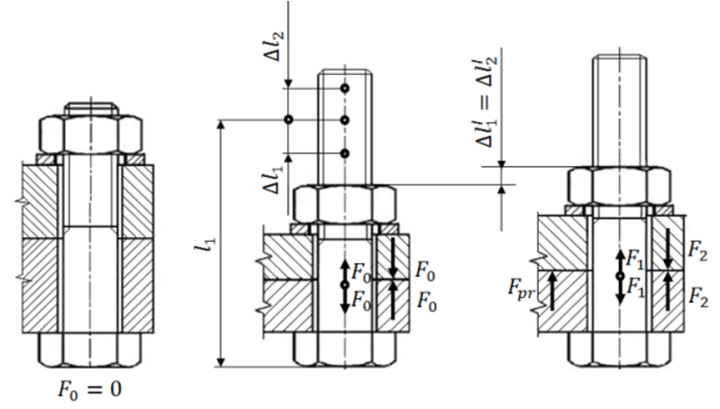
2.1. Prestressed Screw ConnectionThis kind of screw connections is causing elongation of bolt by increasing of axial force acting on the bolt. They are used everytime when there is demand for high resistance against fatigue stress, increase in stiffness and tightness of connection and restriction of shocks during dynamic loading. On Figure 1 is shown prestressed screw connection where  is an elongation of a screw and
  is a compression of connected parts. These elongations and compressions are calculated by following relations
 | (1) |
where  and
and  are compliance constants.

 Download as

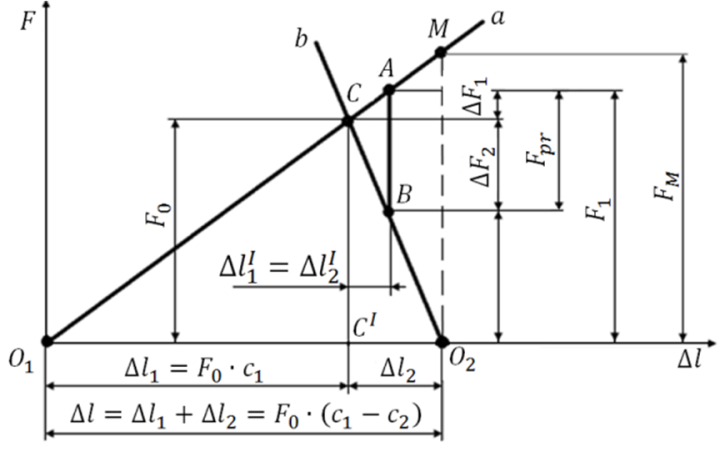
On Figure 2 is depicted deformation of screw and connected parts, whereby forces are expressed by following relations [7]
 | (2) |
 | (3) |
 | (4) |
 | (5) |
 Download as
To prevent decreasing of pressure force, the force  , parameters of pressure force
  are set according to magnitude of force
 acting on connection during processes, while required tightness is in scope of
  - 1 Pressure force is calculated using following relation
 | (6) |
Magnitude of prestress for selected tightness is calculated using equation (7) resulting from Figure 2, whereby force in a screw can be expressed with relation (8) [7]
 | (7) |
 | (8) |
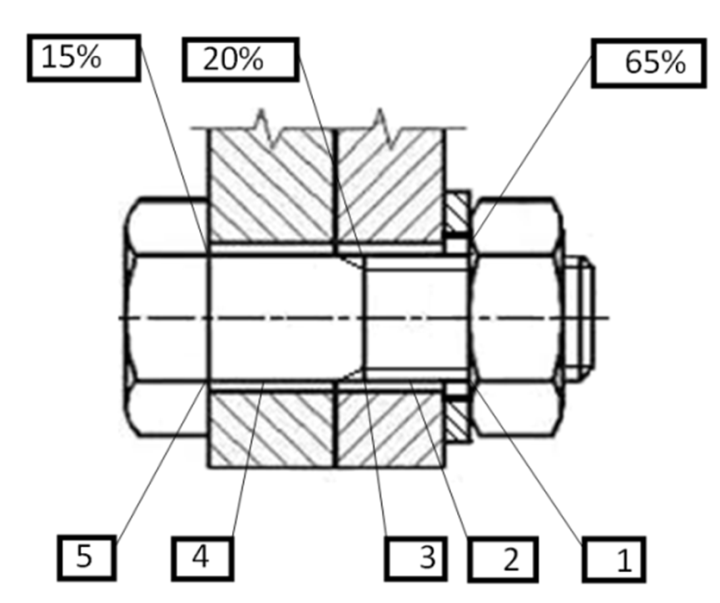
On Fig 3 are shown locations on screw connection with percentual probability of appearance of fatigue failure in case of dynamic loading [7].
 Download as
In Table 1 there is a value of shape coefficient and notch coefficient
  at highlighted positions of screw connection.


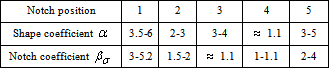


According Figure 3 and Table 1 the largest notch effect is visible at first thread of screw which carries the load, and that can be visible also on the first thread of nut. This condition is caused by non-uniform distribution of loading at each thread [7]. According to Peterson [2] the percentual distribution of ruptures along screw connection is as following: approximately 15% ruptures happen under the head of bolt, 20% in part between the head and threads, 65% at the place of first thread of nut [6].
2.3. Use of Prestressed Screw ConnectionsNowadays, constructions are more and more complex and demand for perfection of screw connection play an important role for providing safeness and reliability of constructions, machines, under static or dynamic loading, without any damage or destruction of individual parts, or whole assembly. Screw connections are under tensile loading, bending and torque or shear stress. For transferring of shear loading we use thread-match screws. Friction force acts between connected parts. This is the reason why it is necessary to optimize nuts and bolts to transfer those loadings without being damaged [1].
3. Numerical Methods for Solving of Screw Connections
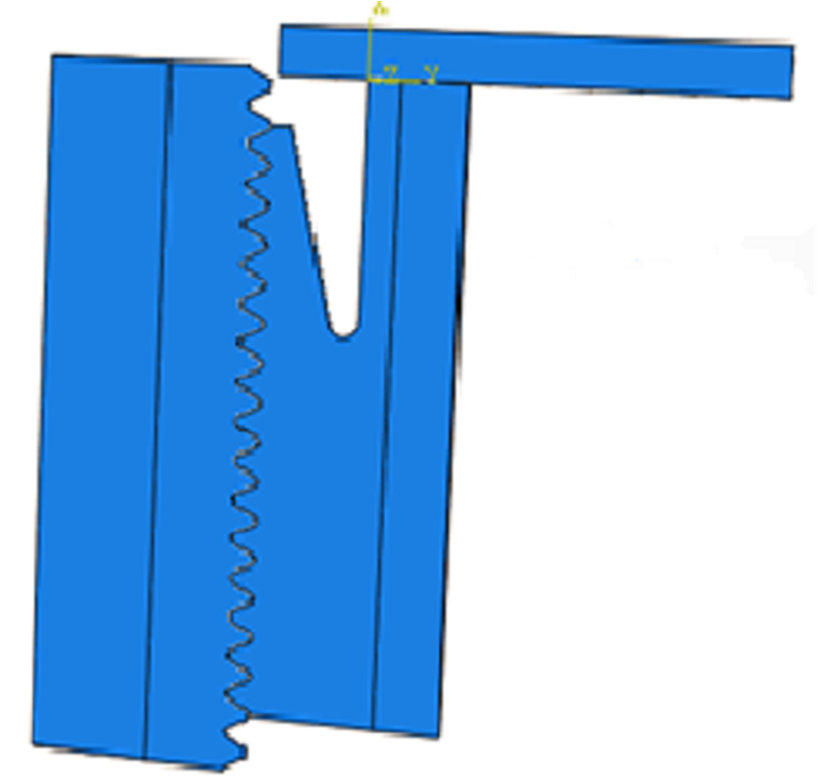
3.1. Modelling of Screw ConnectionFor modelling of individual parts of screw connection (nut, bolt, washer) we used SolidWorks and then we imported the geometry into Abaqus environment [5]. Analysis was accomplished on the model which was created as 1 degree segment in circumferential direction of nut – bolt connection (Figure 4), because its rotational symmetry. Using 1 degree segment with small volume leaded to lower number of elements, and so to lower computational cost.
 Download as
Nut inner dimensions were normalised according to dimensions of screw. The outer dimensions of nut were increased in such a manner that for tightening of nut we can use wrench with normalised dimensions. Into this nut we created groove for reduction of stresses.
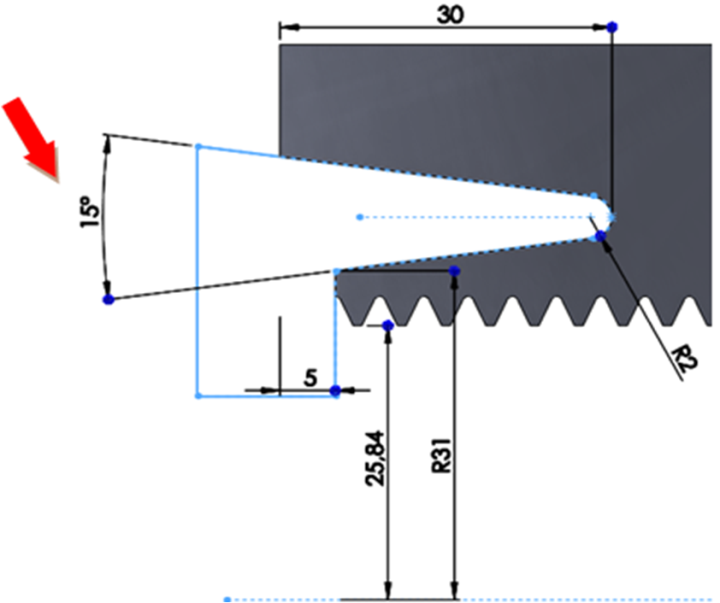
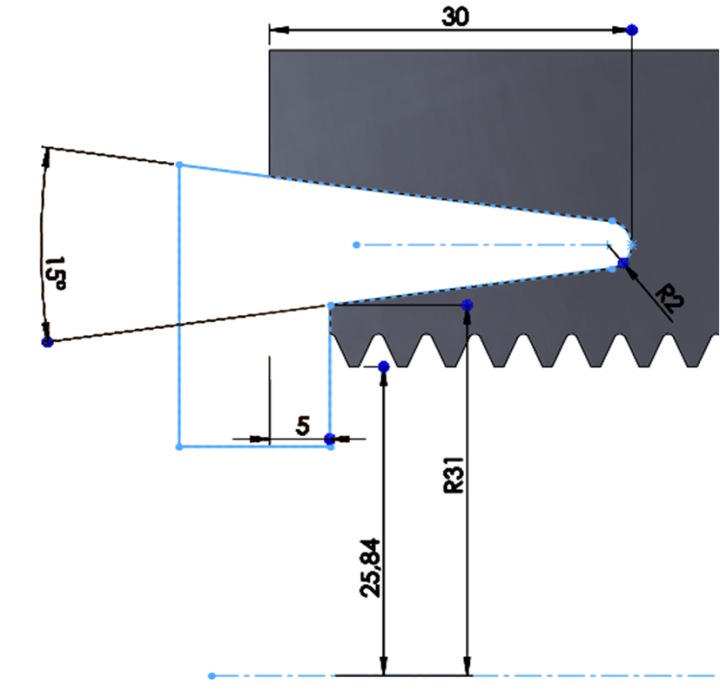
Optimization of groove shape in reference nut was done by modification of opening angle and other parameters (Figure 5).
 Download as
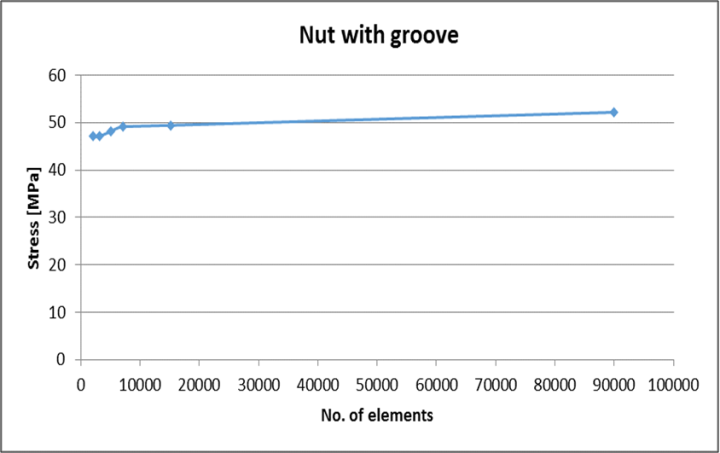
For imported geometry we defined material properties in Abaqus. We created an assembly of screw connection in Abaqus/Implicit and set up step (initial 1e-005, minimum 1e-008, maximum 1). After setting of boundary conditions, we realised mesh sensitivity analysis for finding the best value of mesh density while keeping reasonable accuracy of results (Figure 6).
 Download as
Global number of elements was approximately 7000, with element size of 1, in the area of threads, and of 3 in all the other parts of nut. The C3D8R elements were used. The screw connection was loaded by pressure 5 MPa.
We were interested in values of stresses on the threads and in the groove, and those values were compared among themselves in order to get the best groove shape.
3.2.1. Nut without groove
This model was created for comparison of stresses in the threads in nut without groove and with groove. On the Figure 7 we can see that whole loading is transferred by the first 4 threads, which is in highly stressed connections not enough.
 Download as
On Figure 8 there is a graph which depicts stress distribution on each thread of nut without the groove.
 Download as
3.2.2. Nut with Groove, with 15° Angle – Reference Model
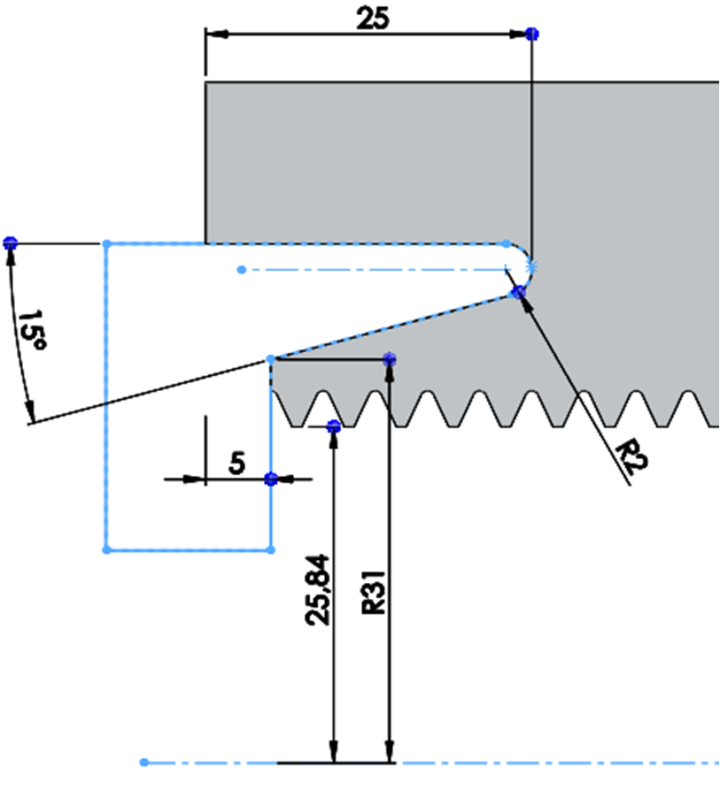
At first, we modelled nut with groove with dimensions depicted on the Figure 9. Magnitude of stresses is given on the Figure 12.
 Download as
In the Figure 10 is shown loaded nut with groove.
 Download as
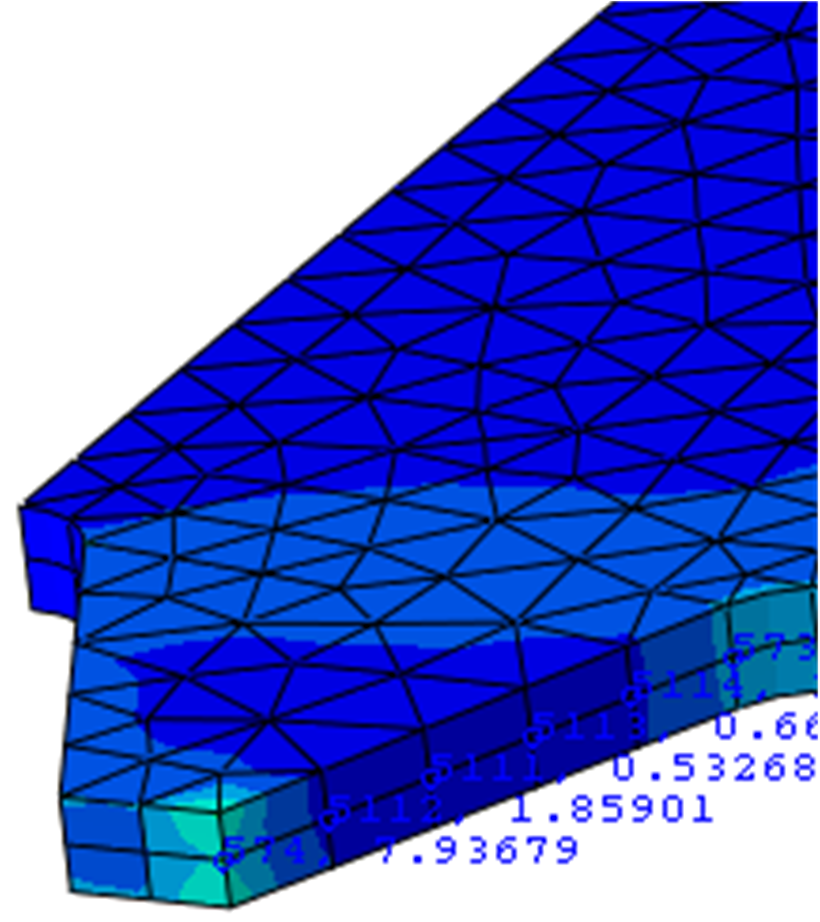
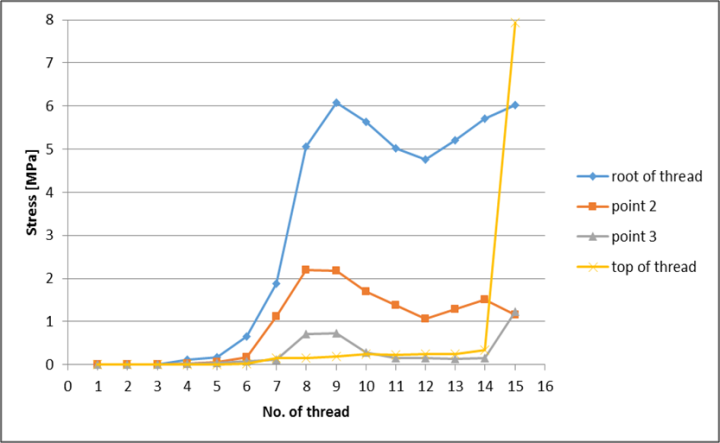
In the Figure 11 we can see all the points on the thread at which we measured magnitude of von Mises stress and then inserted into the graph in the Figure 12.
 Download as
 Download as
Maximum von Mises stress on the edge of last thread was 7.94 MPa. Maximum stress was at the root of ninth thread (6.07 MPa). Maximum stress in the groove was 29.95 MPa.
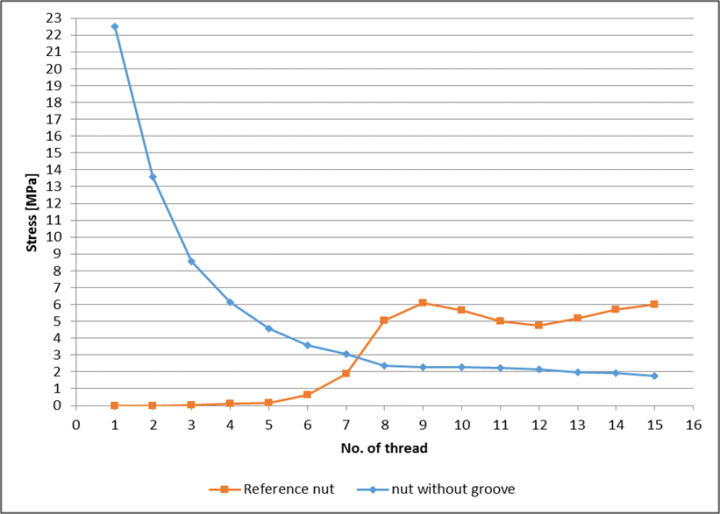
On the Figure 13 there is a graph which compares stress on the threads of nut with and without groove.
 Download as
It is obvious that groove of the reference nut reduced stress at first five threads and distributed stress more uniformly along the threads, causing that transfer of load is now done by all threads from the end of the groove up to the free edge of nut.
3.3. Effect of Changing Opening Angle of Groove on Stress DistributionIn following models the change of the groove was made by opening an angle of groove on both sides and by varying depth of groove on 30 mm as we can see on Figure 14. The angle has been changed in scope from 0° to 15°, all the other parameters remained the same with comparison to reference model.
 Download as
3.3.1. Nut with Groove with Opening Angle 15°
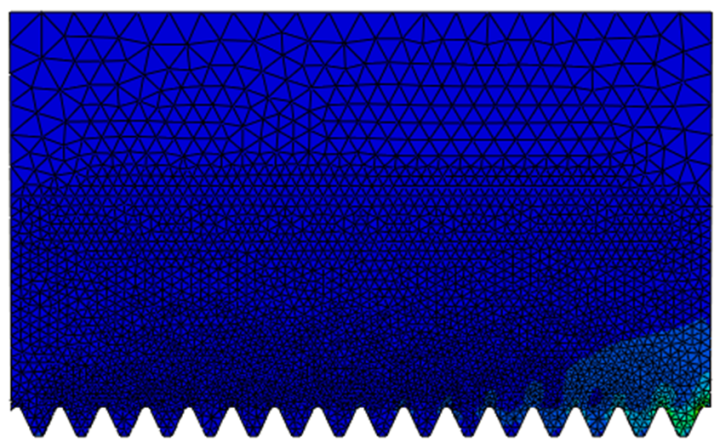
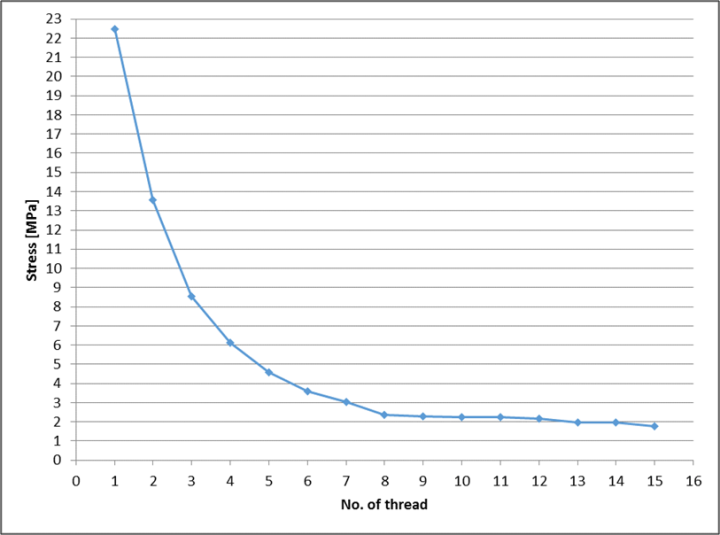
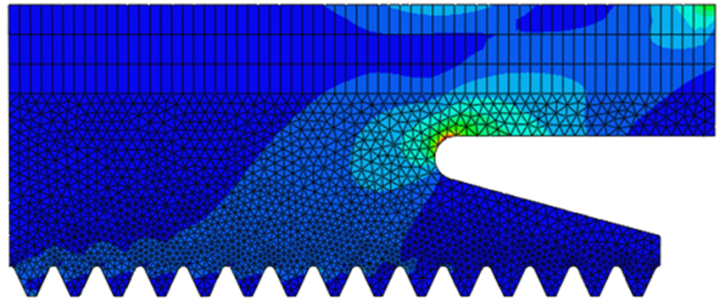
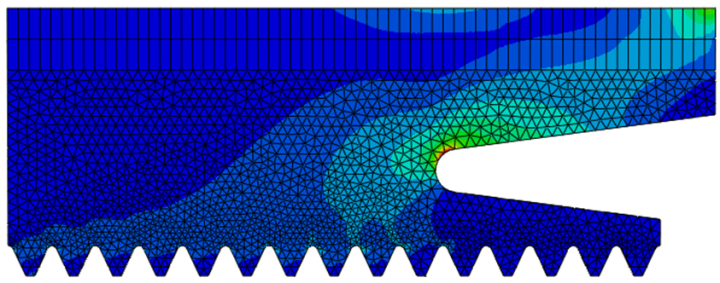
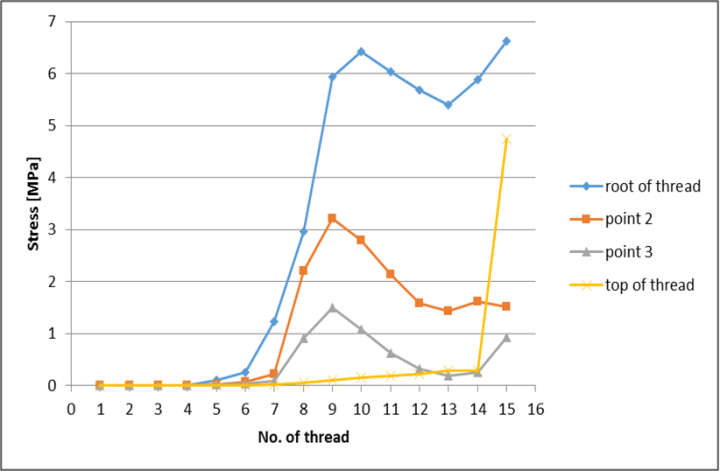
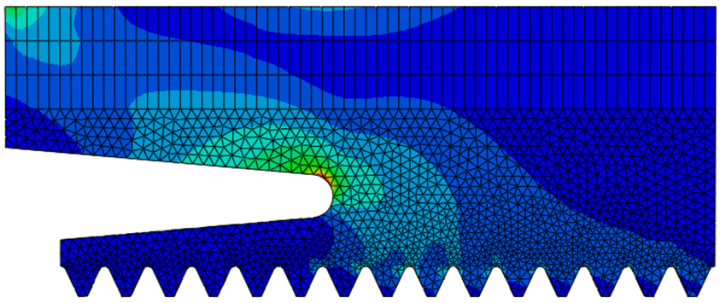
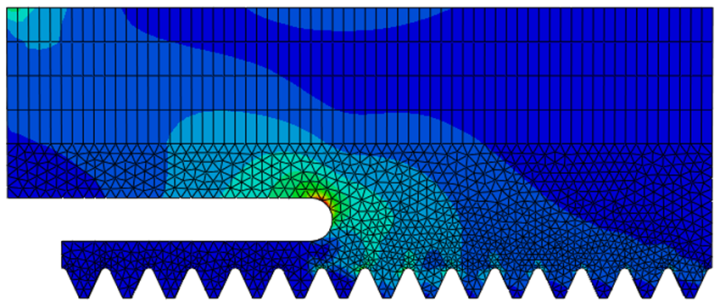
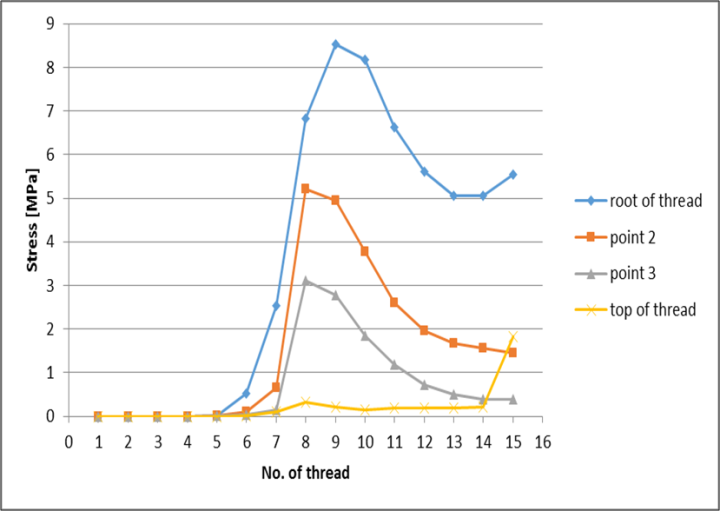
Stress distribution and mesh density is depicted on Figure 15 and stress distribution at each thread of modified nut is given in the graph on Figure 16.
 Download as
 Download as
Selected depth of the groove was 30 mm and this caused that from first up to fourth thread, those threads did not participate on stress transfer. Stress on the eighth thread was 6.8 MPa. When we compare this value to the stress level in of the last thread of the reference model which was 7.49 MPa, we can see decreasing of values. In the modified groove maximum stress was 25.47 MPa, that is also less than in reference nut where maximum von Mises stress in the groove was 29.95 MPa.
3.3.2. Nut with Groove with Opening Angle of 10°
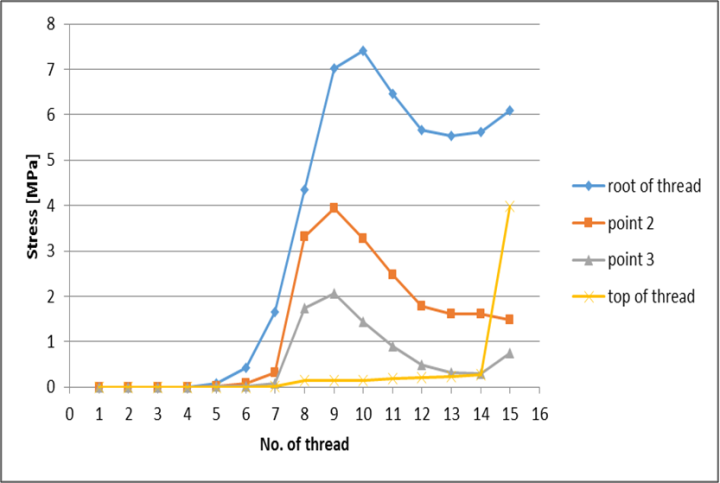
Model of this nut is given on the Figure 17, where we can see stress distribution and mesh density. The graph in Fig. 18 shows stress distribution at each thread.
 Download as
 Download as
By changing opening angle to 10° maximum stress value increased up to 7.42 MPa at the tenth thread, while the maximum stress on the edge of the last thread in reference model was 7.49 MPa. Stress in the groove in this case was 23.99 MPa.
3.3.3. Nut with Groove with Opening Angle of 5°
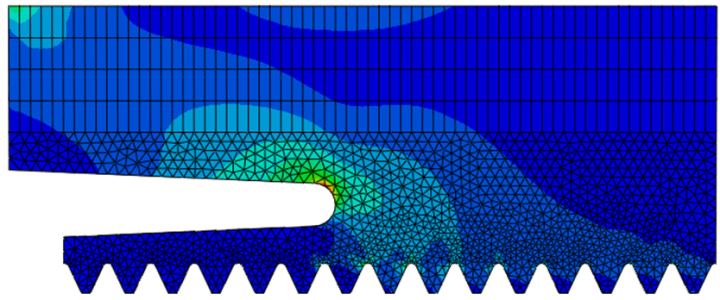
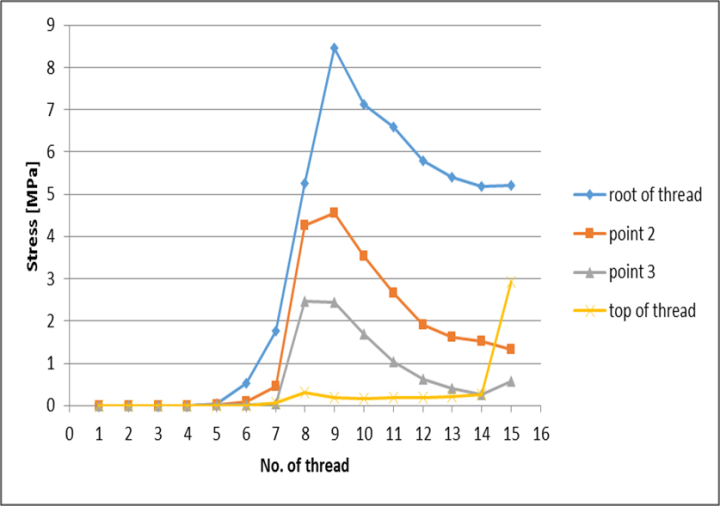
Loaded model is depicted on the Figure 19 and stress distribution at each thread is on the Figure 20.
 Download as
 Download as
By this change of opening angle to the value of 5° the stress has increased up to the value of 8.47 MPa at the ninth thread, but at the other thread it decreased continuously to the value of 5.18 MPa at the last thread. Maximum stress in the groove was 24.05 MPa.
3.3.4. Nut with groove with opening angle of 0°
Distribution of stress in this case is depicted on the Figure 21. Stress distribution at each thread is given on the Figure 22.
 Download as
 Download as
For the nut with opening angle of the groove 0°, the maximum stress at ninth thread increased to the value of 8.53 MPa that is higher in comparison with maximum value in the reference nut which was 7.49 MPa, but at the other threads stress value decreased to the value of 5.05 MPa. Maximum stress in the groove was the smallest one from all other cases in this study, with value of 22.03 MPa.
3.3.5. Effect of Changing Opening Angle of Groove on Stress Distribution in the Groove and at the Threads of Nut
Decreasing the opening angle caused increase of stress at the threads placed directly behind the groove, but at the other threads, the stress was continuously decreasing. Decrease of the opening angle, also decreased stress in the groove from 26 to 22 MPa.
As changing of the opening angle did not bring significant decrease of stress values at the threads and in the groove we run 30 more simulation where we were changing other parameters of the groove, which lead to even more significant decreasing of stresses in the groove and at the threads of nut.
3.3.6. Nut with Groove Parameters: Depth 10 mm, Radius 5 mm, Opening Angle 10° a 30°, R31
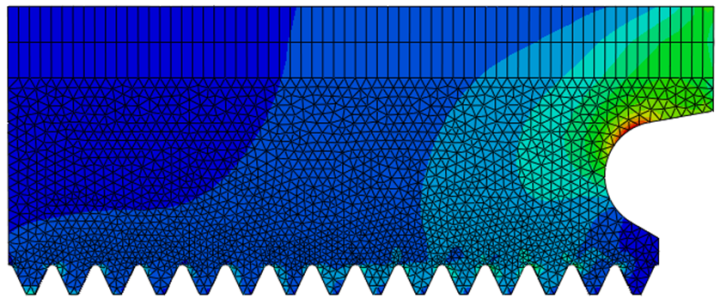
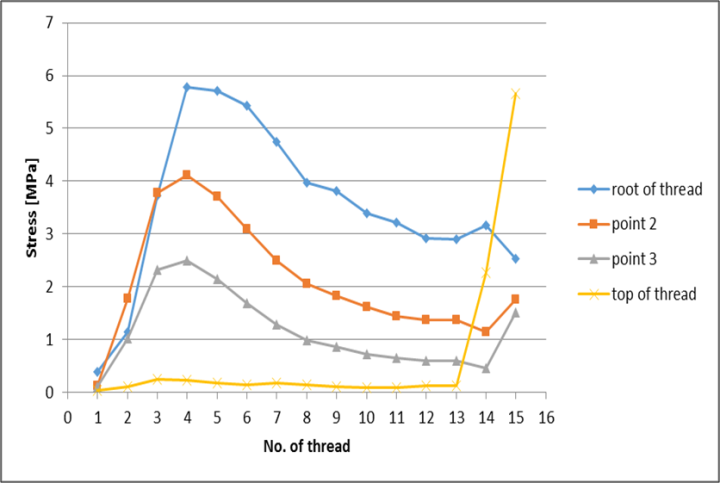
In this model the depth of the groove was 10 mm, radius of fillet was 5 mm, opening angle was 10° from the outside (further from threads) and 30° on the inside (closer to the threads). Distance of the groove from the nut axis was 31 mm. Stress distribution and mesh density is depicted on the Figure 23. Stress distribution at each thread is on the Figure 24.
 Download as
 Download as
In this modification the loading was transferred by all the threads and maximum value reached at the fourth thread (5.78 MPa), and that was 1.71 MPa lower than maximum value at the edge of the last thread of the reference nut, where stress value was 7.49 MPa. Stress on the other threads decreased continuously to the value 2.52 MPa, at the root of the last thread. Maximum von Mises stress in the groove was 12.88 MPa, that is lower than the stress in the groove of the reference nut (29.95 MPa).
4. Conclusion
Whole process of optimization of nut parameters was based on influence of change in one or more parameters at the same time. Before modification of groove parameters, stresses at the threads of nut without the groove and reference nut with groove, were compared. In the reference nut with not-modified groove we could observe decrease of stresses at the first threads transferring loading and its more uniform distribution with comparison to nut without groove, where only first four threads participated on the stress transfer. On the other side, fillet at the bottom of the groove acted as stress concentrator. After optimization of all the parameters we succeeded to decrease stresses at the threads and in the groove even more, with comparison to the reference nut
Acknowledgements
This research was supported by a grant from Slovak Grant Agency VEGA No. 1/0731/16 – Development of Modern Numerical and Experimental Methods of Mechanical System Analysis.
References
| [1] | Wang, W., Marshek, K.M., Determination of load distribution in a threaded connector with yielding threads, Mechanism and Machine Theory, vol. 31, 1996, pp. 229-244. | ||
 In article In article | View Article | ||
| [2] | Pilkey, W.D., Peterson’s Stress Concentration Factors, 2. Edition, John Wiley & Sons, New York, 1997, pp. 387. | ||
| In article | View Article | ||
| [3] | Abaqus/CAE 6.14 [Online] Available: <https://www.civ.cvut.cz/info/info.php?did=103> [Accesed: 03. 04 2016.]. | ||
| In article | |||
| [4] | Abaqus/CAE 6.14 [Online] Available: <http://sdeleni.idnes.cz/abaqus-software-na-proverovani-funkcnosti-konstrukcnich-reseni-ph6-/tec_sdeleni.aspx?c=A130419_164804_tec_sdeleni_ahr> [Accesed: Apr. 3, 2016]. | ||
| In article | |||
| [5] | SolidWorks 2012 [Online] Available: <http://www.schiertechnik.sk/solidworks/> [Accesed: Apr. 3, 2016]. | ||
| In article | |||
| [6] | Shigley, J.E., Mischke, CH.R., Budynas, R.G., Konstruování strojních součastí, Nakladatelství VUTIUM, 2010, pp. 431-462. (in Czech). | ||
| In article | |||
| [7] | Málik, L., Medvecký, Š., Chrzová, J., Hrček, S., Lukáč, M., Konštruovanie 2, Žilinská univerzita in Žilina, EDIS, 2009, pp. 43-53. (in Slovak). | ||
| In article | |||
 CiteULike
 Mendeley
 StumbleUpon
 Delicious
 Facebook
 Twitter
 LinkedIn