The harsh environmental factors like temperature, rainfall and humidity usually affect the performance of solar power systems and, accordingly, the overall systems reliability. An outdoor power station is an example of the systems dramatically affected by such harsh environmental factors. The objective of this research is to explore the effects of the environmental factors on the overall maintenance performance of an outdoor solar power station system and the system overall design. Maintenance performance is measured by some indicators such as the failure rate (FR) and mean time to repair (MTTR) for some selected outdoor solar power station subsystems. An analytical regression model based on a set of collected field data is developed. The insignificant affecting variables are cancelled based on the regression coefficients P-value. A mean time between failures MTBF-based comparison for some sub-systems that could be installed either indoor or outdoor is conducted. A new mathematical model is introduced to describe the relationship between the sub-systems failure modes due to environmental factors and the system configuration. The verified model may guide the maintenance planners. Also, the results can be used to distinguish between indoor and outdoor system maintenance and why the system is promoted to be installed indoor or outdoor.
Power systems have many design parameters like system configuration, either to be installed completely indoor/outdoor or partially indoor/outdoor. Different configurations may affect the system performance measures such as the failure rate and mean time to repair and so the overall system maintenance performance. Jiang et al. 1 studied the climate condition of a wind farm on the reliability of wind turbines. They developed a relationship between the MTBF and the climate variables which becomes critical in considering the system maintenance schedule. Many of researchers such as Juang 2 have studied the effect of manufacturing system configuration as series, parallel or complex system on system performance but few researchers studied the effect of production system configuration as indoor or outdoor system. Jiang also studied the impact of climate conditions on vehicles field reliability. The monthly average MTBF is used to measure the field reliability and the climate conditions are explored by monthly average temperature, relative humidity and rainfall. Jiang concluded for different sites, the climate conditions have a significant effect on the vehicles reliability. Different environmental stresses affect systems manufacturing and operation. These include temperatures extremes, temperature fluctuations, rain fall and high humidity. While indoor systems do not exchange such things. Indoor systems have boundaries that cannot be penetrated by environmental factors, Suresh et al. 3.
On another research for Suresh et al. 4, they studied how to identify the factors that affect the system overall availability or reliability also they studied outdoor photovoltaic PV modules reliability characteristics. They modified the reliability time based equation regarding environmental impacts like wind, snow and temperature, and rebuilt the equation with different types of statistical distributions. They found that this research work will lead to more precise prediction of life time of photovoltaic system and components and the system overall reliability.
The objective of this research is to establish a quantitative relation between the failure rate and the corresponding mean time between failures and the essential climate variables. Such a relation is useful for maintenance workload forecasting and preventive maintenance scheduling. Another objective is to make a generic model to demonstrate the effectiveness of any outdoor or indoor power sub-system design parameters on the maintenance performance. If the system could be installed indoor or outdoor, the given model can support the selection decision. A Case study is presented to illustrate the developed model.
To quantitatively analyze the influence of environmental conditions on the maintenance frequency of an outdoor power system, the monthly-average FR is considered as the measure of maintenance performance and monthly-average temperature, rainfall and humidity which are considered stochastic environmental variables. Based on the failure data, a regression model has been built for monthly-averaged FR as a function of the three environmental variables (i.e., monthly-averaged temperature, rainfall and humidity). Regression analysis is used to estimate the model parameters and based on the regression coefficient (P-value) the model the insignificant variables are gradually deleted. It is noted that by controlling the P-value, the significance of the resulting model is guaranteed.
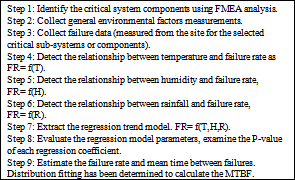
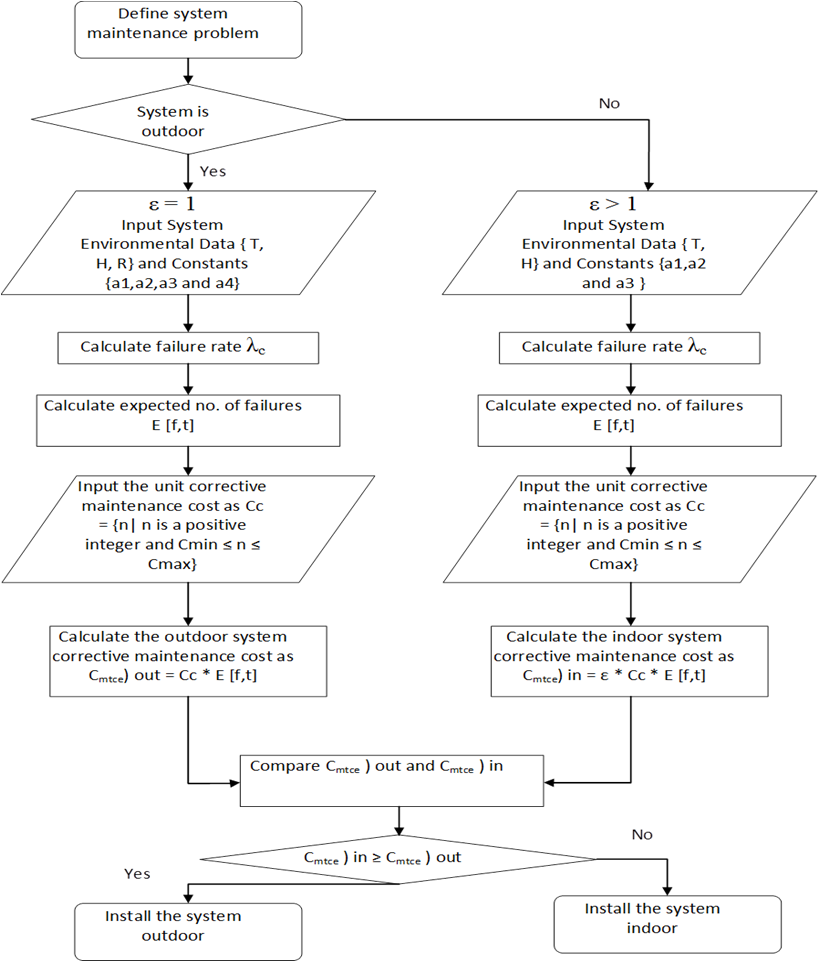
2.2. The Model algorithmThe proposed algorithm is described in the following Table 1.
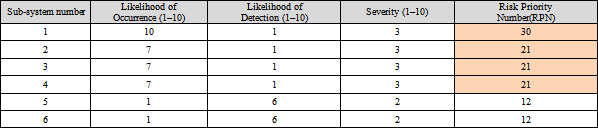
Since it’s installed outdoor with some indoor subsystems, Kurimate concentrated solar power (CSP) station (located in Egypt) has been selected as a case study to apply the proposed maintenance based design algorithm. Some critical electronic and mechanical components have been selected for the study. A failure mode and effect analysis FMEA has been carried out over such components to select the components highly affected by environmental harsh factors as shown in Table 2 and Table 3.
One of the main outdoor subsystems of this station is the motorized valve pump. The motorized valve pump contains two subsystems: the screen and electronic unit sub-system (which has the highest failure rate) and PLC monitoring panels and firefighting sub-system.
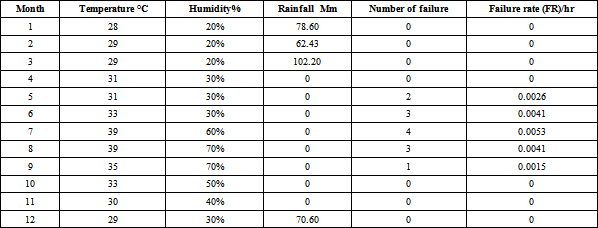
Based on the FMEA analysis carried out for the proposed CSP station subsystems, the electronic motorized valve pump monitoring screen affect the overall reliability of the station so it has been selected as a case study. Failure data has been collected from Kurimate site for the screen. The failure rate and environmental conditions are collected covering 36 months (during 2018 to 2020). The monthly averaged FR is estimated using the total number of failures of the motorized valve pump during the same months (e.g., June 2018, June 2019 and June 2020). Failure data and environmental factors such as temperature, humidity and rainfall are summarized in Table 4.
The relation between the failure rate and each condition variable can be expressed as
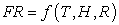 | (1) |
The correlation analysis has been used based on the average monthly temperature, humidity and rainfall to extract the average monthly failure rate relations. To measure measures the strength of linear relationship between variables, the correlation coefficient is to be measured, the results are shown in Table 5. By using the P value, the most significant environmental factors would be detected.
As extracted from the regression analysis, the relation between the screen failure rate (FR) and the three mentioned environmental factors can be expressed as:
 | (2) |
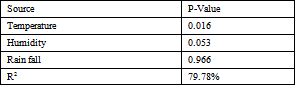
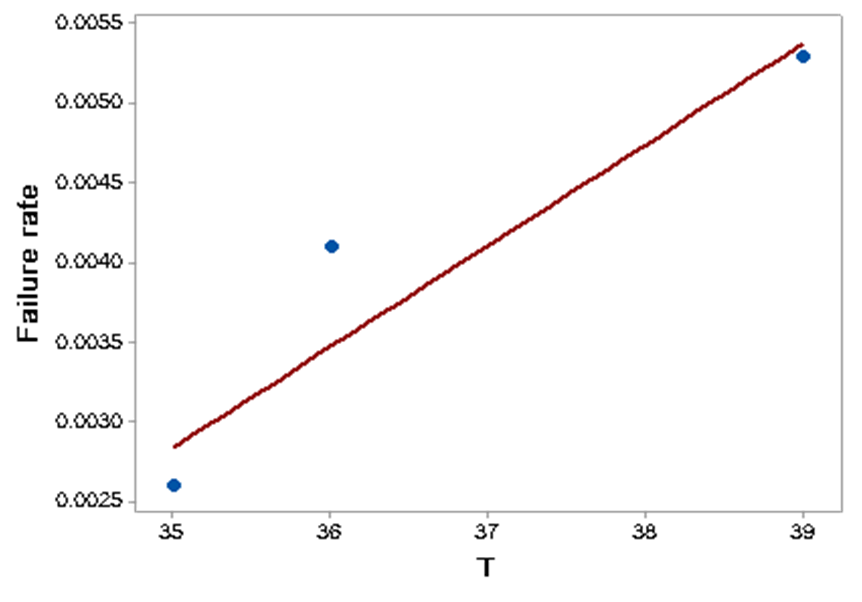
As shown in Table 4, the rainfall is not a significant factor and should be eliminated, while the temperature and humidity are the significant factors that affect the screen failure rate. The relation between the two remaining variables, temperature and humidity, and the failure rate is directly proportional with a maximum of T = 39°C and H =61%. All relations are assumed to be linear and the relation could be represented as:
 | (3) |
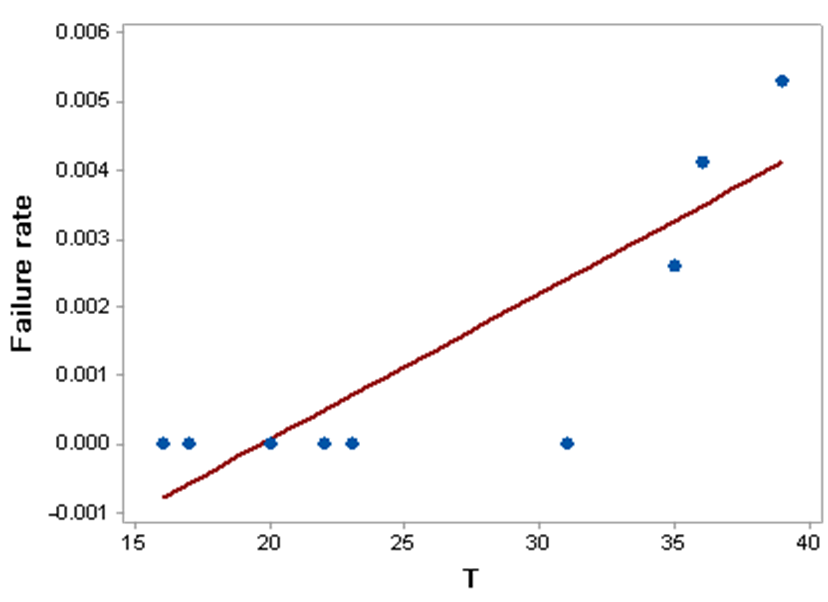
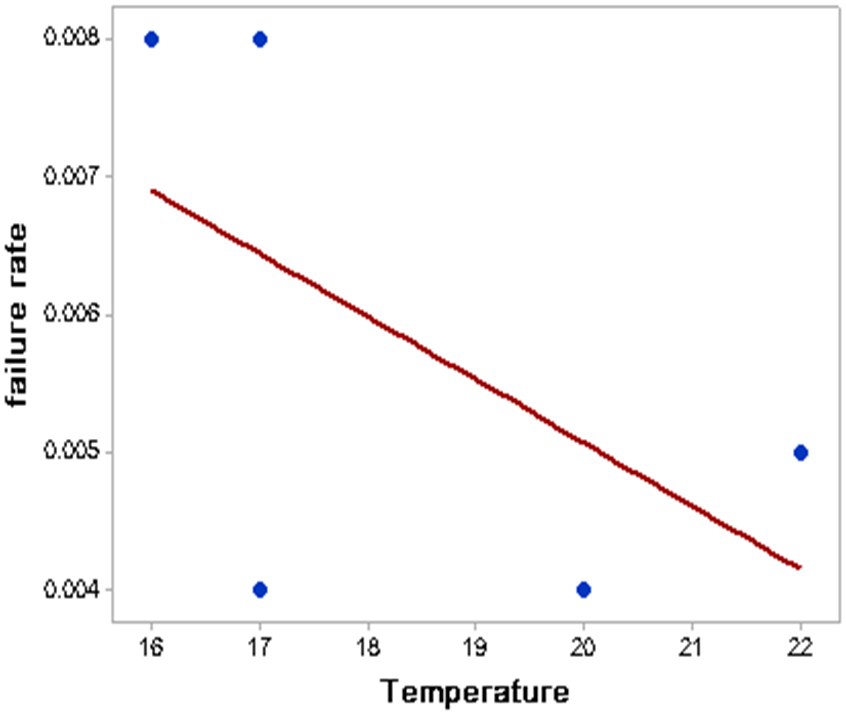
Where a1 and b1 are constants. 1 shows that there’s a positive correlation between the temperature above 30°C and failure rate with R2=77.8%. in Figure 1, it’s found that there’s no correlation between the temperature and the failure rate below 30°C and by neglecting this non-sensible region, a new figure, Figure 2, is generated with R2 =92%.
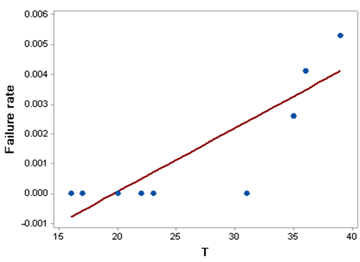
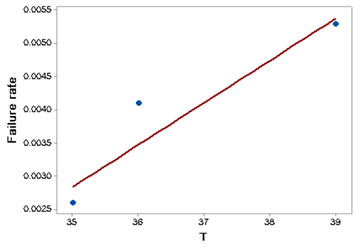
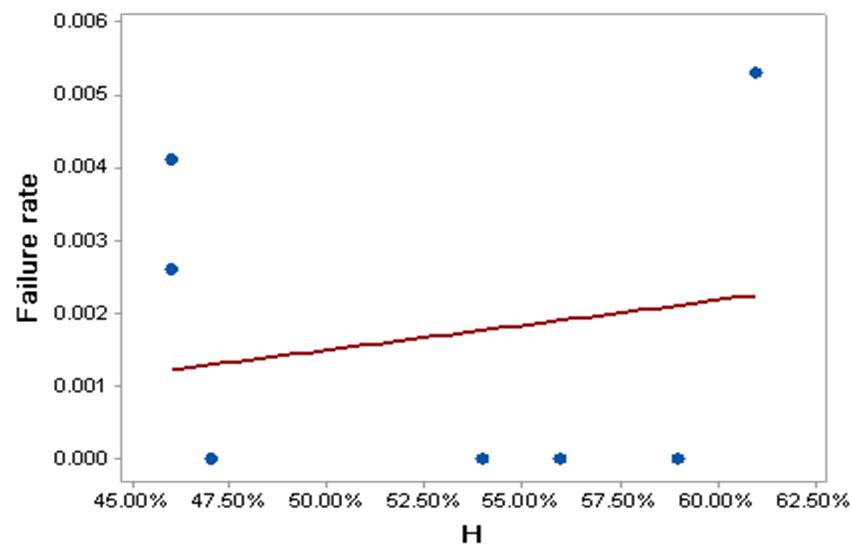
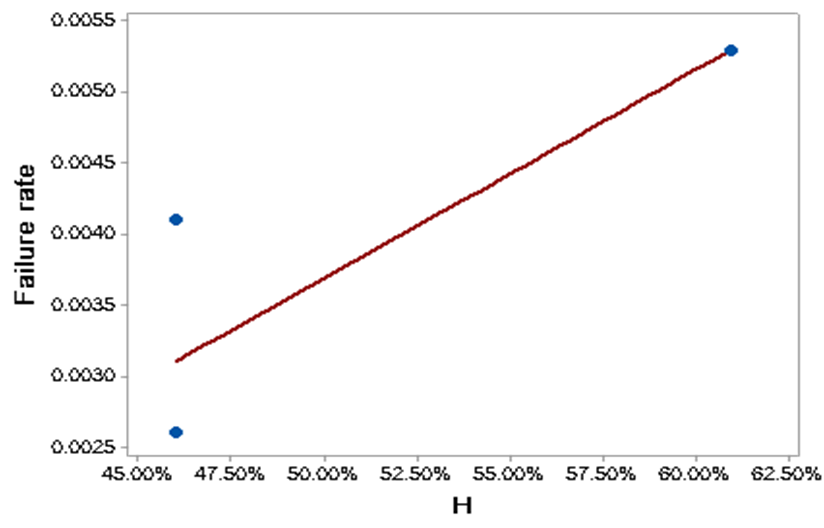
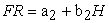
Figure 3 shows the effect of humidity on the screen failure rate. The FR is somehow positively correlated with humidity and the linear relation and could be represented as:
 | (4) |
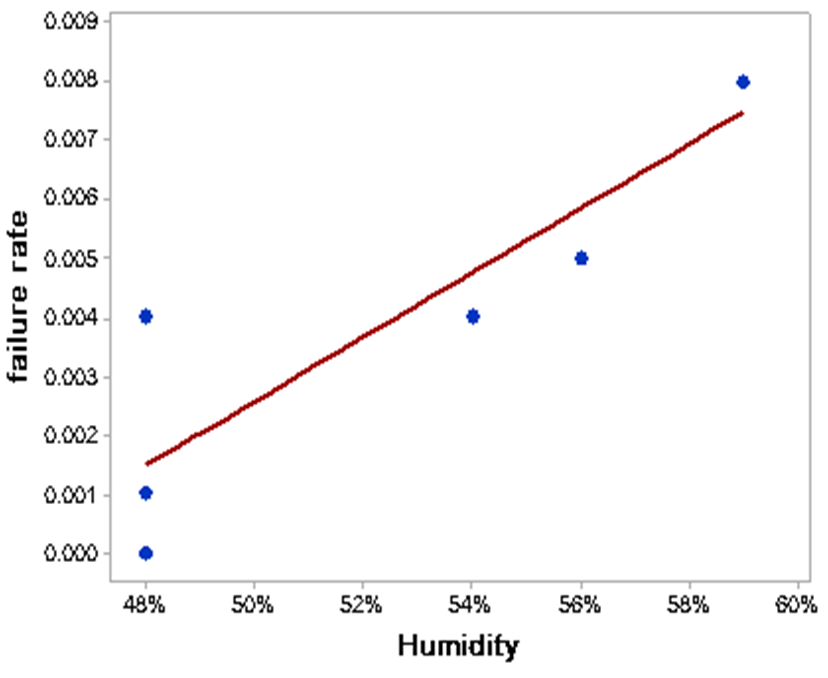
Where a2 and b2 are constants. The reduced relation between the failure rate and humidity after neglecting the no relation region (from 47% to 60% humidity) is shown in Figure 4 with R2 value =79%.
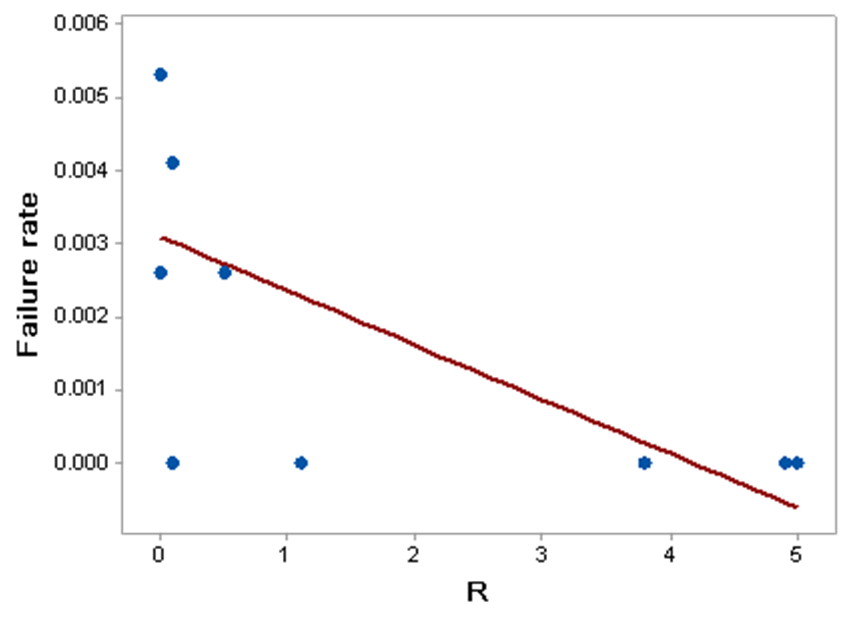
Figure 5 shows rainfall effect on FR. The FR is almost negatively correlated with rainfall and could be represented as:
 | (5) |
Where a3 and b3 are constants.
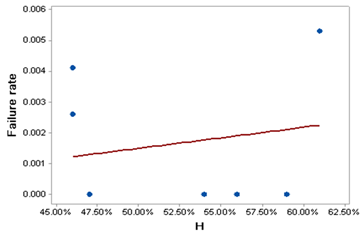

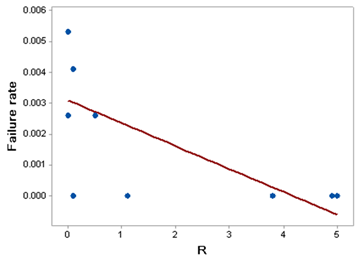
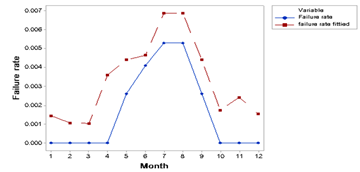
Figure 6 shows there is no correlation between the rainfall and the FR. According to the regression analysis approach outlined above;
 | (6) |
The parameter estimation process is shown in Table 6.
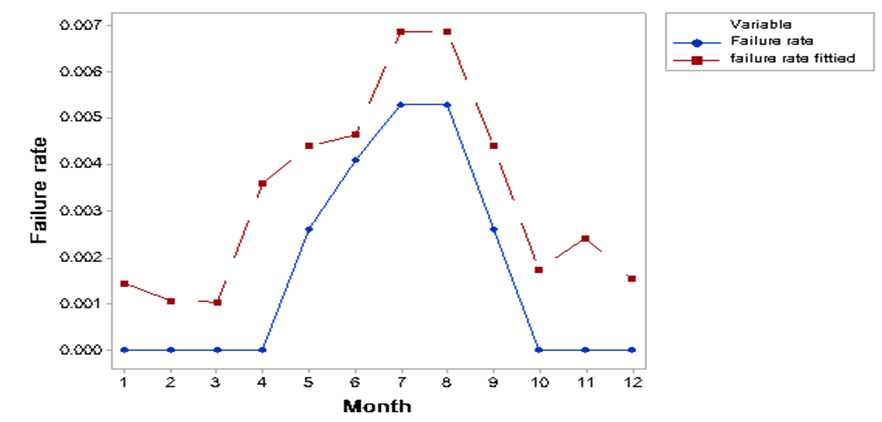
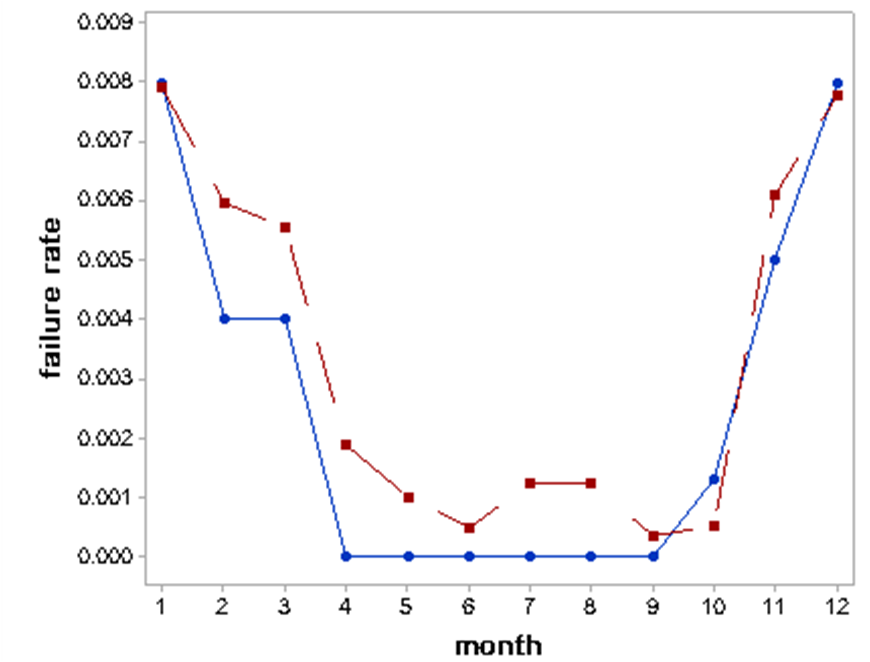
The resulting reduced model contains only two variables: temperature and humidity. Figure 6 shows the observed and fitted FR curves which are close to each other to a great extent.
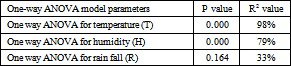
Figure 6 shows that the fitted failure rate is over estimating the observed failure rate. In order to verify the regression model results, a one-way ANOVA analysis has been carried out. The relation between the screen failure rates and the temperature, the humidity and the rainfall is estimated as shown in Table 7.
From the mentioned one-way ANOVA analysis results, it is found that the temperature and the humidity are significant factors that affect the failure rate and rainfall is not significant. The ANOVA result is identical with regression analysis result.
Upon the valve electronic control unit fails to work, the overall valve system cannot be controlled. The failure data has been collected, and the results are shown in Table 7.
As extracted from the regression analysis, the relation between the control unit failure rate and the mentioned environmental factors can be expressed as:
 | (7) |
As shown in Table 8, regression model estimate for P-value, it is found that the rainfall and humidity are significant factors that affect the failure rate, the temperature is not significant and it should be eliminated.
To eventually specify the function form of Eq. (7) all relations are assumed to be linear.
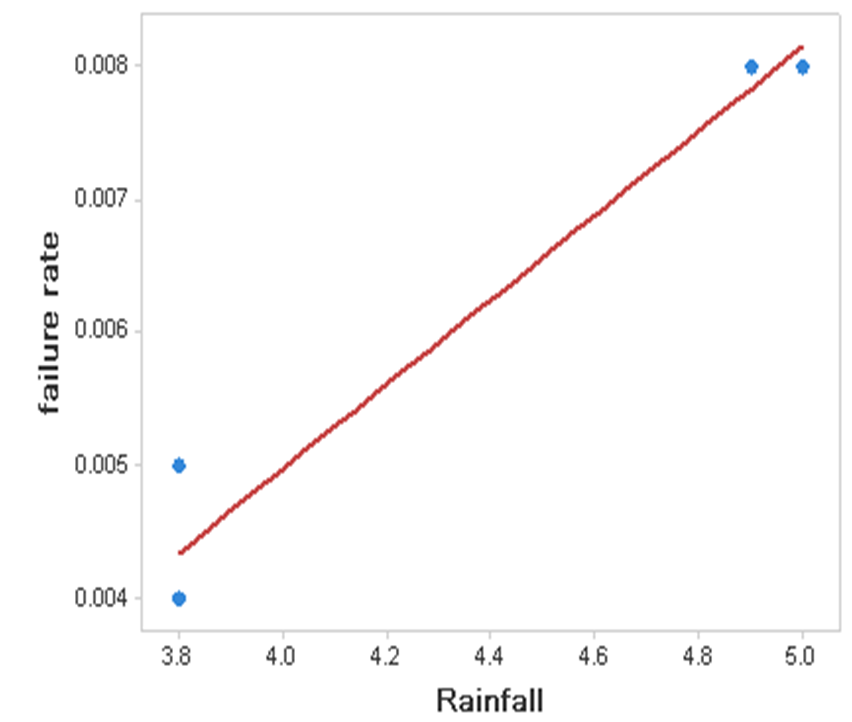
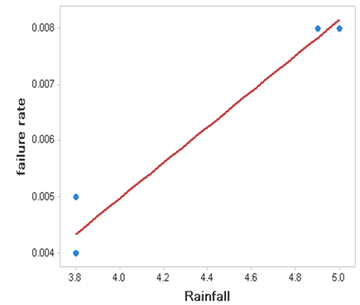
There’s a positive correlation between the rainfall and failure rate with R2=91.2%. Below 3mm, it’s found that there’s no correlation between the rainfall and the failure rate and by neglecting this non-sensible region, a new figure, Figure 7, is generated with R2 =95.7%.
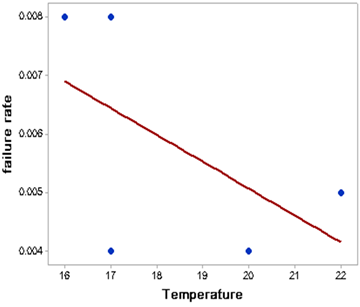
The FR is somehow negatively correlated with temperature with R2=78%. Below 30°C, it’s found that there’s no correlation between the temperature and the failure rate and by neglecting this non-sensible region, a new figure, Figure 8, is generated with R2 =31.878% that mean the temperature non-significant factor and could be eliminated.
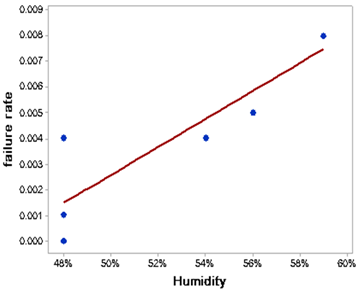
The reduced relation between the failure rate and humidity after neglecting the no relation region (less than 48% humidity and above 59%) is shown in Figure 9 with R2 value =98%.
According to the correlation coefficients outlined above the results R2 and P-values, it is found that the rainfall and humidity are the significant factors affecting the failure rate as shown in Table 9 and the temperature term is eliminated.
 | (7) |
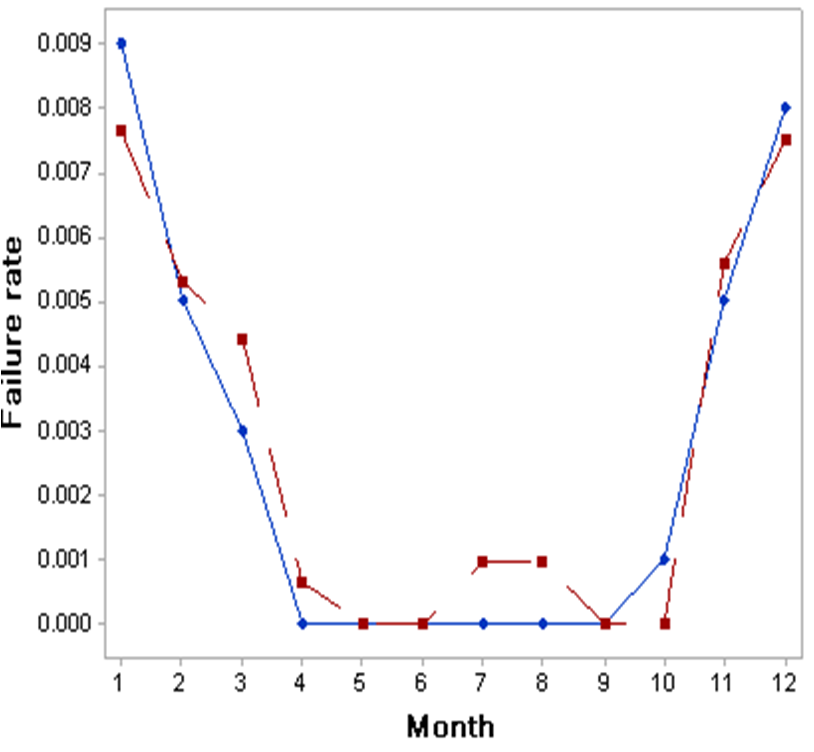
The observed and fitted FR curve shows in Figure 10. They are fairly close to each other and the fitted failure rate relation is over estimating the observed failure rate.
The same failure rate estimation methodology has been applied to the PLC control unit and firefighting unit. When a PLC control unit is subjected to a failure it stops sending or receiving signs. As shown in Table 10, failure records and analysis show that the rainfall and humidity are the more significant factors that affect the PLC failure rate and the temperature is not significant and it should be eliminated. Also, the failure records and analysis for the firefighting unit are shown in Table 11.
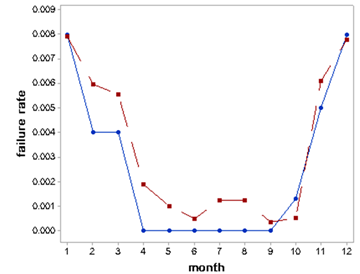
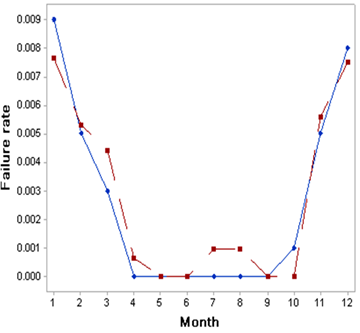
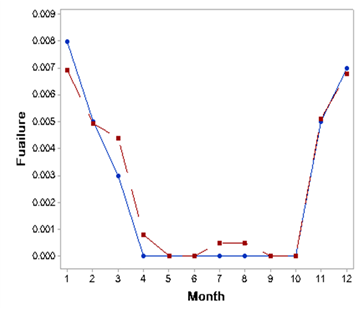
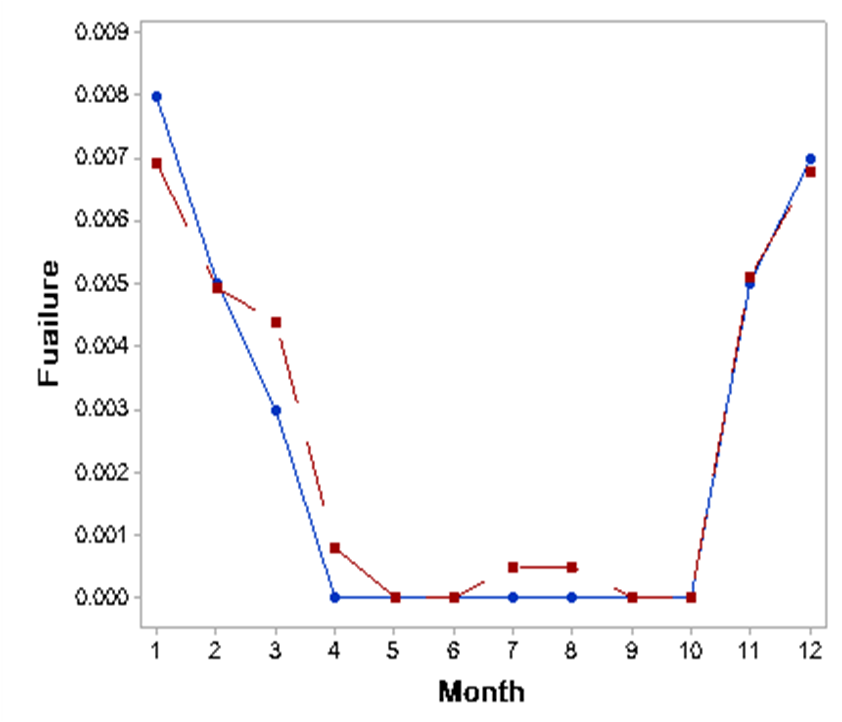
Figure 11 and Figure 12 show the observed and fitted FR curves. The two components are fairly close to each other. The fitted failure rate is by somehow over or under estimating the observed failure rate.
Model validation examines the fit of the model by comparing its results with some empirical data. After the research investigation, it is found that most of researchers in the field of effect of maintenance performance on system design investigated the effect of harsh environmental condition on the overall system design without taking into consideration the study of the sub-systems or the components which can be installed indoor or outdoor. The effect of the temperature, rainfall and humidity for the introduced model results is then compared with another real life system model results and the following remarks have been recorded:
1. The temperature has a significant effect on CSP solar sub-system failure rate (FR). For some subsystems, the temperature-failure rate relation is directly proportional while the relation is inversely proportional for other subsystems.
2. The humidity and the rainfall have a significant effect on the sub-system failure rate.
These model results are very close to those in benchmark 1, 3, 4, 5, 8. The first one studied the effect of climate condition on wind turbine reliability. The benchmark results have been listed as:
1. The resulting model contained two variables which effect on wind turbine mean time between failures (MTBF): temperature and wind speed.
2. The humidity and rainfall have not significant effect on the wind turbine MTBF.
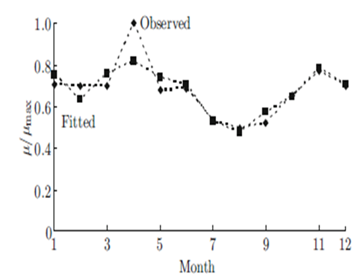
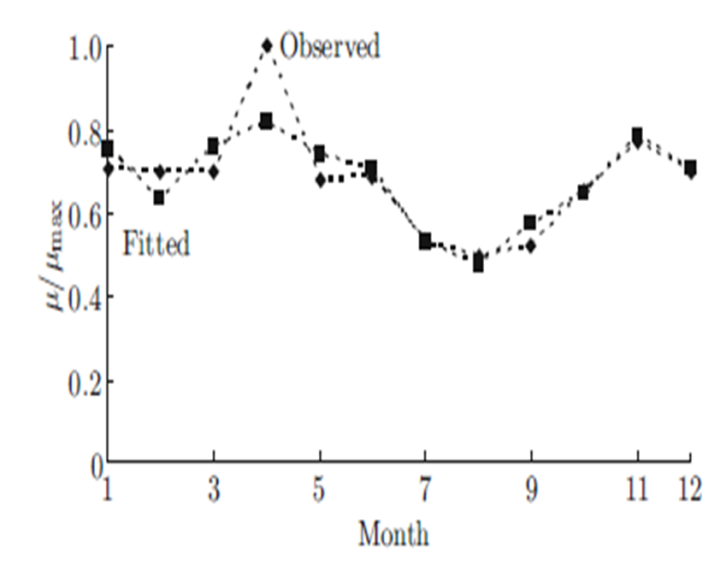
Figure 13 shows the 13 benchmark observed and fitted MTBF curves. They are fairly close to each other and close to the conclusion of Figure 11 and Figure 12.
A- Model statement
Failures related to the environmental factors have to be taken into consideration during the design of any outdoor power production systems. The scope of this model is to provide a quantitative analytical model to study the difference between indoor and outdoor system maintenance affecting the overall system reliability so the system designer can decide to install such sub-systems either indoor or outdoor.
B- Maintenance Effort Factor Based Mathematical Model
In order to efficiently enable the maintenance tasks execution, a sufficient space should be available around the maintenance points. The location of the maintenance points should be accessible, allowing the technician to reach them. Also, in case of an emergency, the technicians should be able to get away quickly. Also, a sufficient space should be available around the maintenance points themselves so that maintenance can be executed with good posture 6, 7. The equipment of the indoor system with limited or confined spaces available for the maintenance staff and equipment cannot easily repaired or replaced and usually required more time for the maintenance operations while the outdoor equipment has a sufficient space for installing maintenance equipment required so it can be easily repaired or replaced. The indoor systems usually are not affected to a great extent by direct sun light and other environmental factors so the failure rate is reduced but in case of failure it requires more maintenance efforts and time while the outdoor systems are directly affected by the environmental conditions which increase the number of failures but those failures require less maintenance efforts and repair time.
To compare between both cases (indoor versus outdoor), a system with a suggested components fail exponentially with a constant failure rate λ is introduced where the probability density function of the failure for each component is:
 |
The reliability function can be then defined as:
 |
Introducing a new system design maintenance efficiency factor εi as unit i maintenance effort factor where:
εi =1 if the same maintenance effort would be done in both cases indoor system and outdoor system.
εi > 1 if the maintenance effort as well as maintenance time would be higher than the normal outdoor case.
εi < 1 if the maintenance effort as well as the maintenance time would be lower than the normal outdoor system which is not assumed here as the minimum corrective maintenance effort is related to the outdoor system where εi = 1.
Now, the corrective maintenance cost can be expressed as
 |
Where:
 : unit i corrective maintenance cost
 = {n| n is a positive integer, and Cmin ≤ n ≤ Cmax}
Cmin and Cmax are the minimum and maximum unit corrective maintenance cost.
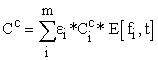
E [fi,t] = n λi: unit i expected number of failures during a time interval t
m: total number of units
For a system with components have identical failure rates, λi during an interval t
 |
Where
T: Temperature
H: Humidity
R: Rainfall
a1, a2, a3 and a4 are constants. The mathematical model is as following:
The objective function is to
Min 
 |
Subject to
εi >= 1
 >= 1
>= 1
 = {n| n is a positive integer, and Cmin ≤ n ≤ Cmax}
E [f,t] = n λi
If the system components are not identical then E[fi,t] = Ʃ λi.
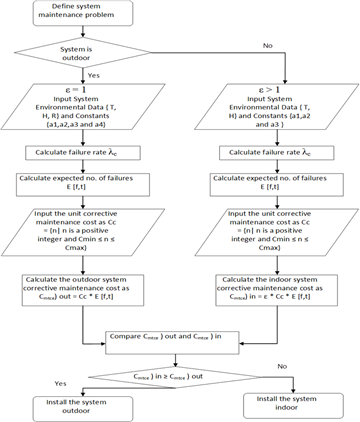
Figure 14 shows the proposed mathematical model algorithm.
C- A Proposed Solution Algorithm for the Maintenance Effort Factor Based Mathematical Model
The proposed algorithm methodology as shown in Figure 14 starts with studying the selected outdoor system components; first step aim to identify system design configuration as outdoor or indoor, second step is to collect environmental factors measurements, constant and system configuration maintenance performance factor (ε). The solution then go further for collecting failure data which leads to determine the maintenance cost of the outdoor or indoor installed system. The resulting model algorithm is useful for providing decision-makers the guidance and theoretical support for installing the sub-system either indoor or outdoor.
In this paper, the influence of outdoor power system design configurations with environmental factors on the failure rate and maintenance performance has been studied. This study determine the impact of outdoor solar power system environmental conditions such as temperature, rainfall and humidity on the failure rate (FR) and mean time between failures (MTBF). The results can be indices for maintenance performance measurement by comparing with mean time between failures for indoor power station sub-system. A regression model is introduced to describe the relationship between failure modes and environmental factors and based on the P-value of the regression coefficients the insignificant variables have been deleted. A mathematical model is developed to detect the best system design configuration for the subsystems which can be switched indoor or outdoor according to the maintenance effort factor (ε). The main findings are:
1. There is a significant influence of the climate conditions on failure rate and the mean time between failures. For example, the MTBF for the indoor systems could be 2 times the MTBF for same system installed outdoor.
2. The environment factors can differ for different sites. Also, the effect of these environmental conditions could be different for different components located at the same site.
3. The design parameters have a significant effect on failure rate and maintenance performance i.e. the maintenance program change according to system design (outdoor or indoor) i.e. the failure rate is higher, where the system is installed outdoor.
4. The presented approach would be useful for building an empiric model, which can be used for failures prediction and maintenance load forecasting based on few available climate information. Also, it can be used for production planning and inventory management.
| [1] | Jiang, R., Liao, Y., Fei, C., “Impact of climate conditions on field reliability of vehicles” Applied Mechanics and Materials, 2012, Vol. 121-126, pp 3335-3339. | ||
| In article | View Article | ||
| [2] | Juang, Y.S., “A knowledge management system for series-parallel availability optimization”. Expert Systems with Applications, 2008; Vol.34, PP.181-193. | ||
| In article | View Article | ||
| [3] | Sarkar K.E.S.B., “Improved Modeling of Failure Rate of Photovoltaic Modules Due to Operational Environment” International Conference on Circuits, Power and Computing Technologies, IEEE, 2013, Vol.2(13). | ||
| In article | |||
| [4] | Kumar, E.S., Sarkar, B., “Proportional Hazards Modeling of Environmental Impacts on Reliability of Photovoltaic Modules” International Journal of Engineering and Advanced Technology (IJEAT), 2012, Vol.2 (2), PP.2249-8958. | ||
| In article | |||
| [5] | Renyan, J., Ruizhi, H., 2.5 cmH. “Modeling the Effect of Environmental Conditions on Reliability of Wind Turbines”. (Sci.), 2016, Vol.21 (4), PP. 462-466. | ||
| In article | View Article | ||
| [6] | Health and Safety Executive “Safe work in confined spaces, Confined Spaces Regulations 1997” Third edition 2014,, https://www.hse.gov.uk/pubns/books/l101.htm. | ||
| In article | |||
| [7] | Ye, Y., “Modeling for Reliability Optimization of System Design and Maintenance Based on Markov Chain Theory”. Business and Supply Chain Optimization, NY 14150, (2018) | ||
| In article | |||
| [8] | Pujara, K., “The Effect Of Temperature And Relative Humidity On The Corrosion Rates Of Copper And Silver In Electronic Equipment In The Presence Of Sulfur” Environment master degree at The University of Texas at Arlington, 2015. | ||
| In article | |||
Published with license by Science and Education Publishing, Copyright © 2022 A. A. Elfar, A. F. Elngar, K. Cipri and M. H. Hassan
 This work is licensed under a Creative Commons Attribution 4.0 International License. To view a copy of this license, visit
http://creativecommons.org/licenses/by/4.0/
This work is licensed under a Creative Commons Attribution 4.0 International License. To view a copy of this license, visit
http://creativecommons.org/licenses/by/4.0/
| [1] | Jiang, R., Liao, Y., Fei, C., “Impact of climate conditions on field reliability of vehicles” Applied Mechanics and Materials, 2012, Vol. 121-126, pp 3335-3339. | ||
| In article | View Article | ||
| [2] | Juang, Y.S., “A knowledge management system for series-parallel availability optimization”. Expert Systems with Applications, 2008; Vol.34, PP.181-193. | ||
| In article | View Article | ||
| [3] | Sarkar K.E.S.B., “Improved Modeling of Failure Rate of Photovoltaic Modules Due to Operational Environment” International Conference on Circuits, Power and Computing Technologies, IEEE, 2013, Vol.2(13). | ||
| In article | |||
| [4] | Kumar, E.S., Sarkar, B., “Proportional Hazards Modeling of Environmental Impacts on Reliability of Photovoltaic Modules” International Journal of Engineering and Advanced Technology (IJEAT), 2012, Vol.2 (2), PP.2249-8958. | ||
| In article | |||
| [5] | Renyan, J., Ruizhi, H., 2.5 cmH. “Modeling the Effect of Environmental Conditions on Reliability of Wind Turbines”. (Sci.), 2016, Vol.21 (4), PP. 462-466. | ||
| In article | View Article | ||
| [6] | Health and Safety Executive “Safe work in confined spaces, Confined Spaces Regulations 1997” Third edition 2014,, https://www.hse.gov.uk/pubns/books/l101.htm. | ||
| In article | |||
| [7] | Ye, Y., “Modeling for Reliability Optimization of System Design and Maintenance Based on Markov Chain Theory”. Business and Supply Chain Optimization, NY 14150, (2018) | ||
| In article | |||
| [8] | Pujara, K., “The Effect Of Temperature And Relative Humidity On The Corrosion Rates Of Copper And Silver In Electronic Equipment In The Presence Of Sulfur” Environment master degree at The University of Texas at Arlington, 2015. | ||
| In article | |||