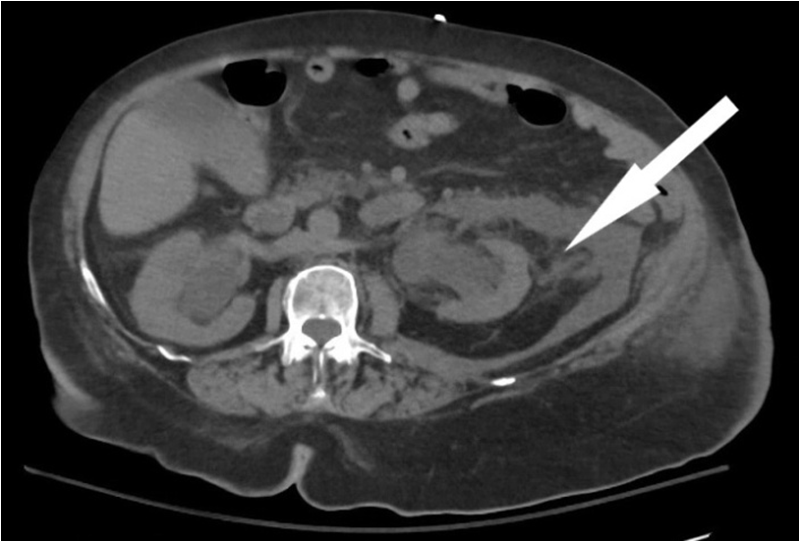
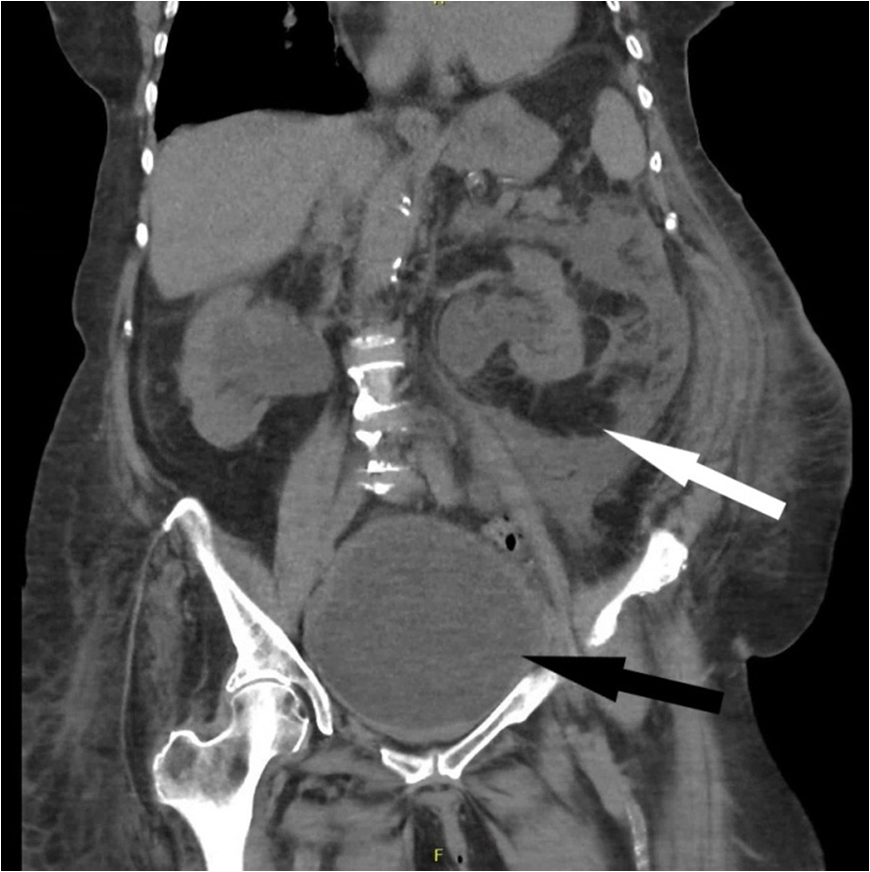
A 78-year-old female presented with chief complaints of nausea and vomiting for three days associated with generalized weakness and altered mental status. On examination, she was tachycardic and tachypneic with suprapubic distension and generalized tenderness with guarding. Urinalysis revealed urinary tract infection picture. Initial blood work showed leukocytosis, hyperkalemia, lactic acidosis, and acute kidney injury. CT Abdomen without contrast showed marked fluids surrounding the left kidney, bilateral hydronephrosis, and distended urinary bladder. She was treated with intravenous antibiotics and fluids for urosepsis secondary to complicated urinary tract infection with acute kidney injury due to obstructive uropathy. Follow-up renal ultrasound later revealed resolution of left perinephric fluids 3 days after alleviation of obstructive uropathy, thus suggesting a likely diagnosis of spontaneous left renal calyceal rupture.
Spontaneous rupture of renal calyces is an uncommon but known complication of obstructive uropathy. It occurs due to a downstream urinary tract obstruction leading to backflow of urine and increased in pressure on the intra-renal collecting system. Ultimately, resulting in the rupture of renal calyceal system followed by urine extravasation into the perinephric and retroperitoneal space. Clinical manifestations are non-specific and often cause a delay in diagnosis. Hereby, we described a case of spontaneous rupture of renal calyces secondary to bladder outlet obstruction.
A 78-year-old female with a past medical history of asthma, paroxysmal atrial fibrillation, and psoriasis presented with chief complaints of nausea and vomiting for three days. It was associated with generalized weakness and altered mental status. She lives alone and was found down at home by her daughter who brought her to our hospital. History was limited due to the patient’s altered mentation on presentation.
Upon presentation, her vital signs were: blood pressure 118/90 mmHg, heart rate 131 beats per minute, respiratory rate 30 breaths per minute, SpO2 100% on room air, and temperature 37 degrees Celsius. Physical examination was notable for Glasgow coma scale of 11 with dry oral mucosa. Abdominal examination revealed suprapubic distension and generalized tenderness with guarding but no rigidity. Urinary catheter was successfully placed after multiple attempts due to difficulty in insertion. This was followed by drainage of 1.5L of brown-colored urine.
Initial laboratory tests were significant for white cell count 28.7 x 10*3/uL, serum sodium 125 mmol/L, potassium 6.2 mmol/L, blood urea nitrogen 42.84 mmol/L, creatinine 784 µmol/L, bicarbonate 17 mmol/L and lactate 3.0 mmol/L. Urinalysis showed positive leukocyte esterase, 51-75 WBC per high power field (HPF), 21-30 RBC per HPF, and many bacteria per HPF. CT Abdomen without contrast revealed moderate to severe dilatation of bilateral collecting system with marked fluids surrounding the left kidney as well as distended urinary bladder (Figure 1 and Figure 2). Further workup was notable for positive urine culture and blood culture which both grew similar strains of Escherichia Coli. Follow-up renal ultrasound on day 3 of hospitalization showed resolution of bilateral hydronephrosis and left perinephric fluids.


Our patient presented with nausea and vomiting associated with generalized weakness, confusion and was found to be in severe sepsis with significant acute kidney injury. Initial urinalysis showed urinary tract infection picture. Our initial differential diagnosis include severe sepsis secondary to complicated urinary tract infection, left pyelonephritis, left renal calyceal rupture with urinoma, and left perinephric abscess. We were unable to confirm our diagnosis based on the initial non-contrasted CT Abdomen findings as left pyelonephritis, left renal calyceal rupture with urinoma, and left perinephric abscess may share similar radiological findings. The causes of acute kidney injury is most likely secondary to severe sepsis and bladder outlet obstruction, supported by the distended urinary bladder with bilateral hydronephrosis and difficulty in urinary catheter insertion. With aggressive intravenous antibiotic therapy and relief of obstructive uropathy, the patient’s condition improved drastically. Subsequently, follow-up renal ultrasound on day 3 of stay showed resolution of bilateral hydronephrosis and left perinephric fluids. With this, we were able to rule out left pyelonephritis and left perinephric abscess as one would expect the radiological changes to take a longer duration to resolve for these pathologies. Eventually, we were able to make our final diagnosis of urosepsis complicated with bladder outlet obstruction with likely left renal calyceal rupture.
On initial presentation, our patient was initially treated with aggressive intravenous (IV) fluids, started on IV Cefepime and urinary catheter was placed to relieve bladder outlet obstruction as well as for close monitoring of urine output. She improved clinically with her mentation recovered to baseline as well as evidence of laboratory improvement of her acute kidney injury. IV Cefepime was de-escalated to IV Ceftriaxone according to microbiology sensitivity from urine and blood cultures. Subsequently, she was discharged to a nursing home with oral Amoxicillin-Clavulanic acid to complete a total course of 14 days duration. She was discharged with a urinary catheter in place with plan to follow up with Urology for further workup of bladder outlet obstruction as outpatient.
Non-traumatic rupture of renal calyces also known as spontaneous rupture of renal calyces is an uncommon but known complication of obstructive uropathy. Common etiologies of obstructive uropathy include ureteric calculi, stricture, or malignancies. 1 Less common causes reported include extrinsic compression of ureter, posterior urethral valve, pelvic-ureteric junction obstruction, vascular extrinsic compression, iatrogenic and intravenous fluid administration, and pregnancy. 2 Pathogenesis involved an obstruction downstream which results in the build-up of urine upstream causing backflow and an increase in intra-renal collecting pressure. This ultimately leads to subsequent calyceal rupture and urine extravasations into the perinephric and retroperitoneal space.
The clinical presentation is rather non-specific with symptoms ranging from flank pain to acute abdominal pain, which is indistinguishable from renal colic. 3 Some patients may even have significant gastrointestinal symptoms like nausea and vomiting as seen in our patient. Due to the non-specific symptoms and rare incidence, it is often diagnosed later than usual. Abdominal X-Ray may reveal presence of calculi while abdominal ultrasound is useful to evaluate for the site of obstructive uropathy, hydronephrosis, hydroureter, and presence of fluids extravasation in the perinephric areas. CT Abdomen and Pelvis with contrast and delayed-phase images is the recommended diagnostic imaging modality as it can demonstrate contrast medium extravasation in the perinephric or retroperitoneal regions and at the same time rule out other differential diagnoses. 4 Our patient did not undergo CT imaging with contrast due to acute kidney injury in order to prevent further insult to the kidneys.
Management varies depending on etiologies, but conservative treatment is recommended for small urinomas with antibiotics use to prevent infection. In cases with large renal or ureteric calculi, ureteral stenting or lithotripsy may be required to relieve the obstruction. Patients with large urinomas may need to be percutaneously drained with a nephrostomy tube placement. 5
In conclusion, clinicians should always consider spontaneous urinary tract rupture as a differential diagnosis in cases of obstructive uropathy which presented with non-specific symptoms and the presence of perinephric or retroperitoneal fluids.
1. Spontaneous rupture of renal calyces should be considered as a differential diagnosis in patients who demonstrated presence of fluids in the perinephric area.
2. The diagnostic imaging modality of choice is CT Abdomen and Pelvis with contrast and delayed phase images.
3. Management mainly consists of conservative treatment with antibiotics or minimally invasive procedures to relieve the underlying obstruction.
The authors have no conflicts of interest to disclose.
No funding was sought in writing this case report.
| [1] | Pampana E, Altobelli S, Morini M, et al. Spontaneous ureteral rupture diagnosis and treatment. Case Rep Radiol. 2013; 2013: 851859. | ||
| In article | View Article PubMed | ||
| [2] | Gershman B, Kulkarni N, Sahani DV, et al. Causes of renal forniceal rupture. BJU Int. 2011; 108(11): 1909-1912. | ||
| In article | View Article PubMed | ||
| [3] | Zahra SM H, Alaa A, Ahmet A, et al. Unusual Spontaneous Renal Calyceal Rupture Secondary to Ureteric Stricture - Literature Review and Case Report. Int J Rediaol Imaging Technol. 2021; 7(2). | ||
| In article | View Article | ||
| [4] | Titton RL, Gervais DA, Hahn PF, Harisinghani MG, Arellano RS, Mueller PR. Urine leaks and urinomas: diagnosis and imaging-guided intervention. Radiographics. 2003; 23(5): 1133-1147. | ||
| In article | View Article PubMed | ||
| [5] | Quinn AD, Kusuda L, Amar AD, Das S. Percutaneous nephrostomy for treatment of hydronephrosis of pregnancy. J Urol. 1988; 139(5): 1037-1038. | ||
| In article | View Article | ||
Published with license by Science and Education Publishing, Copyright © 2022 Si Yuan Khor, Bo Ren Zhang, Sara AlAttal, Amira Kamboj and Richa Tikaria
 This work is licensed under a Creative Commons Attribution 4.0 International License. To view a copy of this license, visit
http://creativecommons.org/licenses/by/4.0/
This work is licensed under a Creative Commons Attribution 4.0 International License. To view a copy of this license, visit
http://creativecommons.org/licenses/by/4.0/
| [1] | Pampana E, Altobelli S, Morini M, et al. Spontaneous ureteral rupture diagnosis and treatment. Case Rep Radiol. 2013; 2013: 851859. | ||
| In article | View Article PubMed | ||
| [2] | Gershman B, Kulkarni N, Sahani DV, et al. Causes of renal forniceal rupture. BJU Int. 2011; 108(11): 1909-1912. | ||
| In article | View Article PubMed | ||
| [3] | Zahra SM H, Alaa A, Ahmet A, et al. Unusual Spontaneous Renal Calyceal Rupture Secondary to Ureteric Stricture - Literature Review and Case Report. Int J Rediaol Imaging Technol. 2021; 7(2). | ||
| In article | View Article | ||
| [4] | Titton RL, Gervais DA, Hahn PF, Harisinghani MG, Arellano RS, Mueller PR. Urine leaks and urinomas: diagnosis and imaging-guided intervention. Radiographics. 2003; 23(5): 1133-1147. | ||
| In article | View Article PubMed | ||
| [5] | Quinn AD, Kusuda L, Amar AD, Das S. Percutaneous nephrostomy for treatment of hydronephrosis of pregnancy. J Urol. 1988; 139(5): 1037-1038. | ||
| In article | View Article | ||