The involvement of serosas is a pathological condition shared by various diseases among which is systemic lupus erythematosus as an example of immunological condition. Polyserositis involves damage to various organs, thus overshadowing the prognosis of patients. We present the report of a case of a 49-year-old female patient with pericardial and pleural effusion of approximately 5 months of evolution, accompanied by clinical situations that justified the presence of such serositis which distracted the diagnostic process of lupus, in addition to an inconsistent elevation of antinuclear antibodies that caused a delay in treatment supported by the current criteria for diagnosis of systemic lupus erythematosus, favoring the fatal outcome of the patient. We suggest that these new diagnostic criteria for systemic lupus erythematosus prioritize greater value for clinical manifestations, since initiating the diagnostic algorithm based on laboratory criteria can lead to significant delays in the therapeutic approach with disastrous results for patients suffering from this disease.
Systemic lupus erythematosus (SLE) is a complex chronic autoimmune disease with variable and in some cases imprecise clinical manifestations 1, 2. The disease presents several phenotypes, with clinical presentations ranging from mild mucocutaneous manifestations to multi-organ involvement with severe involvement of the hematological, serous and central nervous system, which in many cases, leads to the death of those affected 3.
It is estimated that in the world there are more than five million people with some form of SLE, of which one and a half million are diagnosed in the United States alone. SLE has a predilection for women of childbearing age, with a ratio of women to men of 9 to 1, and a smaller ratio of 2 to 1 after menopause in women 3, 4.
The etiology of SLE is unknown and the understanding of pathogenesis is constantly evolving. Multiple factors associated with disease development are considered, including genetic, epigenetic, ethnic, immunoregulatory, hormonal, and environmental factors 5, 6.
Exposures to various factors lead to loss of immune tolerance in genetically susceptible individuals, causing the activation of autoimmunity. These abnormal immune responses lead to the formation of autoantibodies that target their own cellular and nuclear antigens, especially those that bind to dsDNA and extractable nuclear antigens (Ro, La, Sm, RNP). Environmental, infectious, neoplastic and other factors produce cellular damage exposing the antigens themselves to the immune system allowing the chronic activation of T and B cells. The release of cytokines, the activation of complement and the production of autoantibodies cause organ damage. C3 and C4 levels are often reduced, especially when the disease is active 3, 5.
The involvement of serous is a manifestation of the autoimmune pathological process in the development of systemic lupus erythematosus up to 12% of patients, which progressively affects each organ, producing a systemic failure that leads to the death of patients. However, this condition is not exclusive to lupus, and can occur in various pathologies, with relevant differences in the characteristics of the fluid in question. 1, 5
Polyserositis is defined as inflammation plus the presence of interstitial fluid in more than one serosa such as pleural, pericardial, peritoneal. Due to the pathophysiology for the presence of fluid in serous, this has been associated with different pathologies such as infectious or metabolic, and particularly autoimmune pathologies. In fact, it is part of the diagnostic criteria for suspicion of autoimmune diseases, which gives it high clinical relevance 9.
Patients suffering from polyserositis may present a variable clinical, from oligosymptomatic, such as dyspnea, cough or fatigue; until multi-organ failure and death, so it is vitally important to always maintain clinical suspicion, for an adequate diagnostic and therapeutic approach. There are several case reports that have found this association between polyserositis and lupus, so it is important to raise the suspicion of the presence of systemic lupus erythematosus in patients with polyserositis 10, 11.
A 49-year-old woman, with diagnoses of: hyperthyroidism since 2015, without treatment in the last year; Poorly Differentiated Cervical Malignancy stage IIB-FIGO (2018) so she received from May to July, chemotherapy with CDDP/PACLITAXEL III cycles scheme, in August she received radiotherapy 25 sessions and in November of the same year Brachytherapy; in addition, post-traumatic stress (January 2021) in treatment with sertraline 50mg 1TB VO c/24H and clonazepam 0.5 mg 1TB VO c/24H.
Since August 2021, she presents non-productive cough, dysphonia and pain in the right hemithorax type puncture, of moderate intensity so she was admitted several times to emergency receiving symptomatic treatment without improvement. She was attended by a pulmonologist who diagnosed her with bronchial asthma indicating treatment with Adrenergic B2 and inhaled corticosteroids achieving partial improvement. In addition, from the persistence of dry cough and chest pain, progressive dyspnea and edema in the lower limbs were added.
In October 2021, she was evaluated in the pulmonology consulting room of our institution, finding her with 95% saturation in ambient air and spirometric results without alterations; in the Multicortical Helical Tomography (THEM) of October 2021, images suggestive of covid-19 infection, severity of 11/25 in progressive stage, multiple inflammatory mediastinal ganglia, aortosclerosis and pericardial effusion are observed.
On November 4, 2021, patient went to the outpatient office with results of their requested auxiliary examinations: leukocytes 4940, Hemoglobin: 14.2, platelets: 376000, creatinine: 0.55mg/dL, urea: 18mg/dL, glucose: 90mg/dL, total proteins in 5.97, albumin: 3.63, negative ANA and complement C4: 57.58 and C3: 163.4, in normal range. PCR for SARS-CoV-2: negative. IgG for SARS-CoV-2: positive. Also, the Ca-125 dosage is obtained at: 167.9 IU and in the sputum smear A.A.R.B. is not observed.
On November 23, she was admitted to our hospital by the emergency service presenting abdominal pain in the right upper quadrant, of moderate intensity, oppressive type, not irradiated, associated with nausea without vomiting and constipation, with oxygen saturation of 91% to the environment. On physical examination she presented a decrease in vesicular murmur (VM) in the right hemithorax (HT) and edema of the lower limbs +/+++; in the abdomen, pain on deep palpation in the right hypochondrium, without peritoneal signs. Abdominal ultrasound reported suggestive signs of alithiasic cholecystitis associated with bile sediment and vesicular polyp, signs of hepatomegaly, low-volume ascites, and right pleural effusion. She received symptomatic medication for abdominal pain and was referred to a general surgery office for biliary process management, in the same way THEM chest was scheduled for the next day, on an outpatient basis.
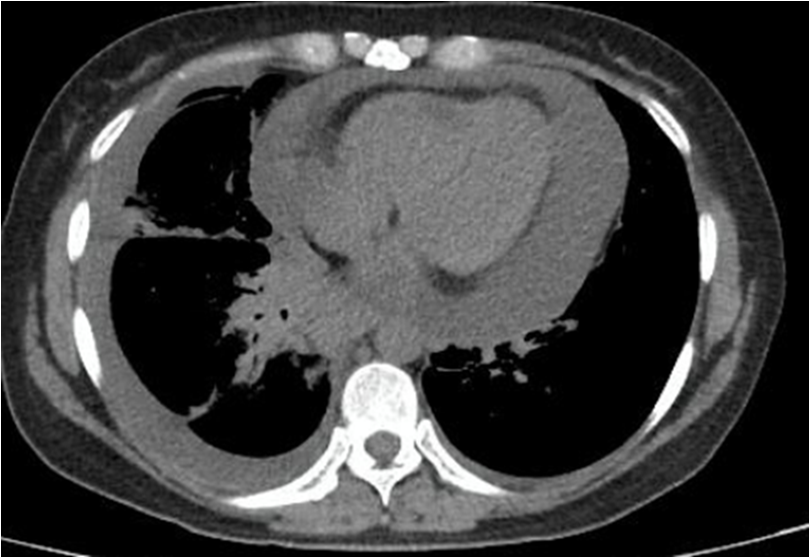
On November 24, the chest THEM with contrast reports signs in relation to right perihilar pneumonic process with pulmonary parenchyma with interstitial changes, right mild pleural effusion, moderate pericardial effusion (Figure 1) and mediastinal adenopathies.

On November 25, the patient presented blood pressure (BP) of 90/50 mmHg., HR 102, absence of vesicular murmur in the lower half of right HT and few diffuse wheezing in both lungs; hypophonetic heart sounds, presence of jugular engorgement (JE) and hepatojugular reflux (HYR), not murmurs. It was carried out an evacuation thoracentesis (700 cc non-coagulable serohematic fluid), and pericardiocentesis (yellow cetrine fluid 100cc) evidencing decompression of the right cavities and improvement of intracavitary pressures. After the acute process, cardiac function studies were performed with electrocardiogram and echocardiography with almost normal results. Ejection fraction: 54%. After 9 days, on December 4, she is discharged. Control was scheduled by external oncology and cardiology consultation for the second half of December.
Given the persistence of edema and dyspnea at moderate efforts, she was again hospitalized from December 13 to 19, in the oncological medicine service for re-staging and verification of recurrence of disease at the pulmonary level. In THEM thorax there is evidence of a right perihilar pneumonic process, bilateral pleural effusion to left predominance, mild pericardial effusion, impressive nodules in the right lobe and pleural involvement. Diagnostic thoracentesis was performed with a negative result for neoplasia and an ADA test with results of 10.4 u/l; in addition, both percutaneous pleural biopsy and fibrobronchoscopy biopsy with negative results for malignant disease.
Finally, she is hospitalized on February 19 in our internal medicine service for edema in the lower limbs ++/+++, dyspnea to small efforts with abolition of MV in the lower 2/3 of right HT. Right chest drainage tube was placed with daily productions of 700 cc. The liquid study demonstrated transudate fluid, and culture for fungi and bacteria negative. In the serum analysis glucose, urea, creatinine, rheumatoid factor, sedimentation rate, thyroid profile, leukocytes, hemoglobin and platelets, in normal ranges. C-reactive protein at 152 U/l, lactate dehydrogenase at 1128 U/l, 24-hour urine protein at 420 mg, ANA negative. On March 5, 2022, product of the hospital stays, the patient developed a clinical picture of severe sepsis with a urinary starting point, which required the use of vasopressors and antibiotic coverage with meropenem. On March 7, a new ANA result is obtained: 1/80, and patient developed respiratory insufficiency. On March 8, the patient died and after that, the result of the dosage of C3 and C4 was received, both decreased.
The diagnosis of systemic lupus erythematosus entails a great clinical challenge, due to the various manifestations that it may present. It requires an exhaustive search for data in the clinical history and a thorough physical examination, but above all the clinician must have the suspicion of the diagnosis to be able to guide their search and not delay the treatment, which in many cases can be decisive for the survival of patients 2, 3.
Extensive serous involvement is a possible manifestation of systemic lupus erythematosus. It can affect one or more cavities, and can lead to generalized edema. The symptomatology that the patient may present is in relation to the speed of filling and affection of a certain serosa. Pericardial effusion is a possible manifestation of clinical pictures of systemic lupus erythematosus, of low incidence. Approximately 1-2% of cases present with pericardial effusion, and less than 1% present as pericardial tamponade. This is because the most important factor in the development of pericardial tamponade is the filling speed of the pericardial space, and not the volume 9.
Pleural effusion, on the other hand, is one of the most frequent clinical expressions of systemic lupus erythematosus. Up to 30 – 50% of cases present with pleural involvement, either bilateral or unilateral. The study of liquid reveals an exudate with polymorphonuclear or lymphocyte infiltrate dependent on the chronicity of the case, they are usually of low volume, and only in exceptional cases can they become massive 10.
Our patient presented a history of approximately 5 months of evolution in which the serosas condition was always present, initially with general symptoms that could be explained by other diseases, such as SARS-CoV-2 infection in October 2021. At each time that the patient was evaluated, there was always some pathology that justified the presence of fluid in serous, with which the clinical suspicion of lupus was always relegated to the end of the differential diagnosis.
The abdominal pain that the patient presented in November was attributed only to biliary pathology, however, the patient presented since then hepatomegaly that could also be another manifestation of lupus in the process of evolution.
The appearance of pericardial involvement was what initially aroused suspicion about an immune cause to justify its existence, but the negative result of the antinuclear antibodies dispelled the suspicion, taking into account that it was a patient diagnosed with advanced cancer. The negative result of ANA, which according to current diagnostic criteria suggests ruling out lupus 1, was the reason why further studies such as anti-DNA antibodies were not completed, which probably, at that point in the development of the disease, could have changed the course that the patient took.
Cardiac function studies were carried out that ruled out a primary problem and given the improvement of the patient after the cardiac tamponade was resolved and the latent idea that everything could be due to the progression of the oncological disease, the medical discharge was provided.
During the last admission of the patient to our service, the possibility of lupus was always present as the cause of all the isolated manifestations that the patient had presented until that moment, however, once again the negative result of the antinuclear antibodies delayed the treatment. Due to the prolonged stay in hospitalization, the patient developed urinary sepsis which led to septic shock that led to death. The elevated values of C-reactive protein and LDH suggest an active inflammatory process that could correspond to the evolution of lupus with lung and liver disease, but in the same way they can respond to latent infection, which only led to a greater delay in proper treatment.
The wide range of signs and symptoms complicates the diagnostic plan in each patient who presents a sign or symptom compatible with this entity. Because of this, there have historically been diagnostic criteria to support clinical suspicion. These, in turn, have changed in recent years, until obtaining those mentioned in Table 1. These updated diagnostic criteria require as a first step the positive result of an antinuclear antibody before the clinical manifestations, which, in many cases, as in ours, could delay the diagnosis and the consequent treatment 10, 11.
In our patient, dry cough and pleuritic pain were the first manifestations of a long-standing disease. She also had pericardial effusion with signs of tamponade. The history of neoplastic disease was considered to be primarily responsible for all clinical manifestations. In addition, the presence of infection and sepsis at the urinary starting point could be responsible for the variation in laboratory results that contributed to the diagnosis being confirmed, according to the criteria, after the death of the patient 9.
This case report highlights how complicated the diagnosis of systemic lupus erythematosus disease can be, but it should also be a call for the review of current diagnostic criteria, which puts a specific laboratory result above the clinical evaluation of the patient.
The old lupus diagnostic criteria considered the ANA result as another criterion, however, the current ones consider them extremely necessary to initiate the suspicion of lupus, which only entails delay for the diagnostic process, so they should be reviewed in order to improve the opportunities of patients suffering from this disease. 1
Original draft: Yépez Florián Juan de Dios.
Writing, proofreading and editing: Cabanillas López José Guillermo.
| [1] | Aringer, M., Costenbader, K., Daikh, D., Brinks, R., Mosca, M., Ramsey-Goldman, R., Smolen, J. S., Wofsy, D., Boumpas, D. T., Kamen, D. L., Jayne, D., Cervera, R., Costedoat-Chalumeau, N., Diamond, B., Gladman, D. D., Hahn, B., Hiepe, F., Jacobsen, S., Khanna, D., … Johnson, S. R. (2019). 2019 European League Against Rheumatism/American College of Rheumatology classification criteria for systemic lupus erythematosus. Arthritis & Rheumatology, 71(9), 1400-1412. | ||
| In article | View Article PubMed | ||
| [2] | Fava A, Petri M. Systemic lupus erythematosus: Diagnosis and clinical management. J Autoimmun. 2019 Jan; 96: 1-13. | ||
| In article | |||
| [3] | Fanouriakis A, Bertsias G. Changing paradigms in the treatment of systemic lupus erythematosus. Lupus Sci Med. 2019 Feb 8; 6(1): e000310. | ||
| In article | |||
| [4] | González Jiménez, D., Mejía Bonilla, S., & Cruz Fallas, M. (2021). Lupus eritematoso sistémico: enfoque general de la enfermedad. Revista Medica Sinergia, 6(1), e630. | ||
| In article | View Article | ||
| [5] | Bertsias, G., Fanouriakis, A., & Boumpas, D. T. (2017). Treatment of systemic lupus erythematosus. In G. S. Firestein, R. C. Budd, S. E. Gabriel, I. B. McInnes, & J. R. O’Dell (Eds.), Kelley and Firestein’s Textbook of Rheumatology (pp. 1368-1388.e5). Elsevier. | ||
| In article | View Article | ||
| [6] | Systemic lupus erythematosus (SLE) clinical presentation. (2022, June 21). Medscape.com. https://emedicine.medscape.com/article/332244-clinical. | ||
| In article | |||
| [7] | Ferretti, C., & La Cava, A. (2016). Overview of the pathogenesis of systemic lupus erythematosus. In G. C. Tsokos (Ed.), Systemic Lupus Erythematosus (pp. 55-62). Elsevier. | ||
| In article | View Article | ||
| [8] | Rind, A., & Isenberg, D. A. (2022). Systemic Lupus Erythematosus. In T. Kenakin (Ed.), Comprehensive Pharmacology (pp. 447-460). Elsevier. | ||
| In article | View Article | ||
| [9] | Losada I, González-Moreno J, Roda N, Ventayol L, Borjas Y, Domínguez FJ, Fernández-Baca V, García-Gasalla M, Payeras A. Polyserositis: a diagnostic challenge. Intern Med J. 2018 Aug; 48(8): 982-987. | ||
| In article | |||
| [10] | Granja Romero, E., Trinidad Sanjosé, J. C., González Rivero, C., & Del Río Romero, D. (2010). Serositis pleuroperitoneal como manifestación de un lupus inducido por pirazolonas (metamizol). Reumatologia clinica, 6(2), 117-118. | ||
| In article | View Article PubMed | ||
| [11] | Zampeli, E., Skopouli, F. N., & Moutsopoulos, H. M. (2018). Polyserositis in a patient with active systemic lupus erythematosus: A case of pseudo-pseudo Meigs syndrome. The Journal of Rheumatology, 45(6), 877-878. | ||
| In article | View Article PubMed | ||
Published with license by Science and Education Publishing, Copyright © 2022 José Guillermo Cabanillas López and Juan De Dios Yépez Florian
 This work is licensed under a Creative Commons Attribution 4.0 International License. To view a copy of this license, visit
http://creativecommons.org/licenses/by/4.0/
This work is licensed under a Creative Commons Attribution 4.0 International License. To view a copy of this license, visit
http://creativecommons.org/licenses/by/4.0/
| [1] | Aringer, M., Costenbader, K., Daikh, D., Brinks, R., Mosca, M., Ramsey-Goldman, R., Smolen, J. S., Wofsy, D., Boumpas, D. T., Kamen, D. L., Jayne, D., Cervera, R., Costedoat-Chalumeau, N., Diamond, B., Gladman, D. D., Hahn, B., Hiepe, F., Jacobsen, S., Khanna, D., … Johnson, S. R. (2019). 2019 European League Against Rheumatism/American College of Rheumatology classification criteria for systemic lupus erythematosus. Arthritis & Rheumatology, 71(9), 1400-1412. | ||
| In article | View Article PubMed | ||
| [2] | Fava A, Petri M. Systemic lupus erythematosus: Diagnosis and clinical management. J Autoimmun. 2019 Jan; 96: 1-13. | ||
| In article | |||
| [3] | Fanouriakis A, Bertsias G. Changing paradigms in the treatment of systemic lupus erythematosus. Lupus Sci Med. 2019 Feb 8; 6(1): e000310. | ||
| In article | |||
| [4] | González Jiménez, D., Mejía Bonilla, S., & Cruz Fallas, M. (2021). Lupus eritematoso sistémico: enfoque general de la enfermedad. Revista Medica Sinergia, 6(1), e630. | ||
| In article | View Article | ||
| [5] | Bertsias, G., Fanouriakis, A., & Boumpas, D. T. (2017). Treatment of systemic lupus erythematosus. In G. S. Firestein, R. C. Budd, S. E. Gabriel, I. B. McInnes, & J. R. O’Dell (Eds.), Kelley and Firestein’s Textbook of Rheumatology (pp. 1368-1388.e5). Elsevier. | ||
| In article | View Article | ||
| [6] | Systemic lupus erythematosus (SLE) clinical presentation. (2022, June 21). Medscape.com. https://emedicine.medscape.com/article/332244-clinical. | ||
| In article | |||
| [7] | Ferretti, C., & La Cava, A. (2016). Overview of the pathogenesis of systemic lupus erythematosus. In G. C. Tsokos (Ed.), Systemic Lupus Erythematosus (pp. 55-62). Elsevier. | ||
| In article | View Article | ||
| [8] | Rind, A., & Isenberg, D. A. (2022). Systemic Lupus Erythematosus. In T. Kenakin (Ed.), Comprehensive Pharmacology (pp. 447-460). Elsevier. | ||
| In article | View Article | ||
| [9] | Losada I, González-Moreno J, Roda N, Ventayol L, Borjas Y, Domínguez FJ, Fernández-Baca V, García-Gasalla M, Payeras A. Polyserositis: a diagnostic challenge. Intern Med J. 2018 Aug; 48(8): 982-987. | ||
| In article | |||
| [10] | Granja Romero, E., Trinidad Sanjosé, J. C., González Rivero, C., & Del Río Romero, D. (2010). Serositis pleuroperitoneal como manifestación de un lupus inducido por pirazolonas (metamizol). Reumatologia clinica, 6(2), 117-118. | ||
| In article | View Article PubMed | ||
| [11] | Zampeli, E., Skopouli, F. N., & Moutsopoulos, H. M. (2018). Polyserositis in a patient with active systemic lupus erythematosus: A case of pseudo-pseudo Meigs syndrome. The Journal of Rheumatology, 45(6), 877-878. | ||
| In article | View Article PubMed | ||