Urinary tract infection (UTI) is one of the most common bacterial infections, affecting up to 150 million people worldwide, and certain host conditions predispose urinary tract infection to be considered complicated and therefore warrant broad-spectrum empirical treatment, in the elderly, complicated urinary tract infection should always be considered within the range of diagnoses, as the symptoms and signs for which they consult the emergency department are often very nonspecific, although this leads to overdiagnosis and overtreatment of this condition. Should not be limited to suspicion, especially if the patient has clinical conditions that assert the risk of a complicated UTI, as happened in the case of our index patient: An 83 year old adult with a history of Alzheimer's disease and urinary incontinence, admitted because he showed fever of 2 days of evolution and foul-smelling urine. A urine sample was taken for urinalysis which was suggestive of urinary tract infection and a urine culture showed infection by Citrobacter koserii. Knowing the susceptibility profile, it was decided to rotate to ciprofloxacin and continued new antibiotic treatment until completing 10 days counting as effective the days in which he received Piperacillin/tazobactam, presenting good evolution until medical discharge.
Urinary tract infection (UTI) is one of the most common bacterial infections, affecting about 150 million people worldwide 1. This is defined as the inflammatory response of the urothelium to pathogenic microorganisms within the urinary tract; anatomically it can be divided into urinary infections of the lower urinary tract, where we find those that affect the urethra and bladder (urethritis) and (cystitis) respectively, and urinary infections of the upper urinary tract that involve the kidneys and collecting system and are called pyelonephritis 2. Another classification of UTI depends on the presence or absence of complications, which occur in some special conditions; Uncomplicated UTI affects the lower urinary tract and occurs in young, healthy, non-pregnant women with normal genitourinary anatomy, while complicated UTI is associated with upper urinary tract involvement in men, pregnant women, anatomical malformations, urolithiasis, bladder catheterization, catheters, cancer, chemotherapy, immunosuppression, hospital stay, and antibiotic treatment failure 3. The importance of classifying UTI according to the absence or presence of complications revolves around the risk of finding drug-resistant microorganisms as causal agents and that this leads to therapeutic failure, which is more likely to happen in a complicated UTI, so knowing this, an optimal initial evaluation would be estimated in order to indicate the pertinent antimicrobial with an adequate duration 4.
The etiology of UTI varies according to host conditions such as those listed above, however it is generally known that the most common organism of UTI is E. coli, which is responsible for more than 80% of acute uncomplicated community-acquired infections, followed by Staphylococcus saprophyticus, which accounts for 10% to 15% of UTIs 5. Other pathogens, such as Proteus, Klebsiella and Escherichia faecalis, are responsible for the rest of community-acquired UTI, while E. coli, Klebsiella, Enterobacter, Citrobacter, Serratia, Pseudomonas, E. faecalis, Staphylococcus and Candida. has been described as causal agents of nosocomial UTI in diabetic patients, patients with bladder catheterization, patients with cancer, among other factors that confer certain susceptibility 2. For its part, the species Citrobacter Koserii reported as saprophytic flora in humans has been related to complicated UTI in patients with a certain degree of immunological susceptibility 6, 7. However, infection by this species has been described more frequently in immusuppressed patients, neonates and infants in whom it causes involvement of the central nervous system causing meningitis and brain abscesses 8.
An age group with susceptibility to urinary tract infections in general and also by Citrobacter koserii are the elderly, especially the frail elderly with some condition of disability such as incontinence, immobility, cognitive impairment, which predisposes them to present a high risk of developing complicated UTI generating general compromise, requiring hospitalization, systemic antibiotic treatment, urosepsis or even death 9.
Dealing with elderly patients in the context of UTI is a real challenge due to the absence of typical UTI symptoms and rather the presence of non-specific symptoms such as general malaise, eating disorders, asthenia or adynamia. This leads to overdiagnosis and overtreatment in this population 9. Despite this, the risk of complicated UTI in this population is always latent and should not be overlooked, especially if the affected elderly person has clinical conditions that assert this risk, as in the case of our index patient:
The patient was an 83-year-old man with a history of Alzheimer's disease and urinary incontinence who consulted the emergency department of a second level hospital located in northern Colombia, due to a clinical picture of 3 days of evolution consisting of fever up to 38.9º, asthenia, adynamia, general malaise and diuresis with cloudy urine and bad odor. On physical examination on admission, the patient was uncooperative, in fair general condition, with hemodynamic stability, fever of 38.8º, with no positive findings on physical examination. Due to the age group and clinical conditions, urinary tract infection was suspected, and laboratory tests were indicated (blood count, BUN, creatinine, glycemia, ionogram, urinalysis). The urine sample was collected by bladder catheterization after asepsis and antisepsis with iodine solution due to the patient's neurological deterioration and urinary incontinence.
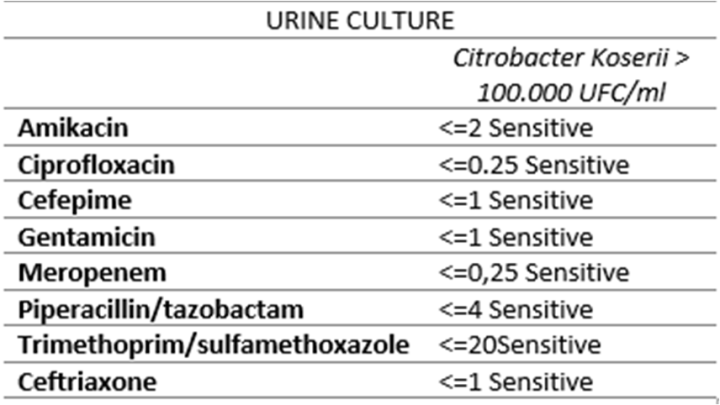
Uroanalysis reported: uncountable leukocytes, bacteria +++, red blood cells 35-40/c. Fresh red blood cells 100%; hemogram with leukocytes 3800/uL, neutrophils 1751/uL HB: 12 g/dL PLAQ: 230000, creatinine: 1.0, potassium: calcium: phosphorus, magnesium: sodium, glycemia. Within normal limits, it was considered a suspicion of complicated urinary tract infection, since this was a male patient, frail elderly, with neurological impairment and urinary incontinence. Urine culture was reported at 72 hours with growth of Citrobacter koserii > 100,000 CFU/ml (Figure 1).
With the urine culture report, it was decided to rotate the antibiotic therapy to Ciprofloxacin, which was indicated for 7 days with favorable evolution of the clinical picture, achieving complete improvement of the patient, after which discharge was indicated.
Urinary tract infection (UTI) affects a significant number of people in the world, especially the elderly population, in which it is considered to be the second cause of bacterial infection after respiratory infections 10. The prevalence of UTI has been described as higher in elderly women 9, however, in recent years the rates of UTI in men have been increasing. This seems to be related to age, the higher the age, the higher the rate of attention in emergency rooms of male patients, so much so that the rates of UTI in male patients between 85 and 94 years double the rate of patients younger than this age 11, our index patient is an 85 year old male who is at this age susceptible to a higher frequency of UTI. In the male population, as in the case presented, the presentation of a UTI is considered complicated by itself; factors such as advanced age, cognitive impairment, urinary incontinence and immunosuppression, which our patient had, further increase the risk of UTI 9, 12.
Diseases that lead to cognitive impairment have been related in several studies with the predisposition of the elderly to suffer UTI 13, 14, in Alzheimer's disease, a condition that our patient suffered from, the ability to communicate urinary symptoms is limited, delaying the consultation and therefore the diagnosis, 9 fortunately our patient had a good family support network that allowed a consultation in the first days of the onset of his illness and at the time of initial care provided key data in the anamnesis that allowed suspicion of UTI.
Urinary incontinence, another risk factor in our patient, seems to be an important risk factor for UTI in the frail elderly population 9. Cajawl and collaborators conducted a prospective follow-up study and determined that at least 86 year olds who reported urinary incontinence were the strongest predictor of UTI, with this situation it is believed that the accumulation of urine in the lower urinary tract is a breeding ground that allows bacteria to infect ascending pathways 13. The loss of sphincter control at the time of examination, in addition to being a predisposition, complicates the collection of urine for sampling in the clinical setting, therefore it was necessary to catheterize our patient to obtain the sample, this explains the red blood cells in partial urine that were probably caused by the urethral trauma due to catheterization.
On the other hand, our patient's hemogram showed a decreased leukocyte count, which is related to his advanced age, since it has been determined that the immune response decreases with age, with a low humoral and cellular immune reactivity 15. This situation leads to immune senescence and acquired immunodeficiency in the elderly, which are factors that increase the risk of suffering UTI 1.
In the index patient of the case, complicated urinary tract infection was considered to be a male patient, in a state of immunosuppression with urinary incontinence, this situation of suspected complicated UTI required empirical treatment with multidrug-resistant germs. 16 For this reason, treatment was started with Piperacillin/tazobactam, which is widely recommended for empirical antibiotic therapy in this condition 17.
The urine culture reported isolation of Citrobacter Kosseri, a microorganism belonging to the genus Citrobacter belonging to the family of Enterobacteriaceae, are facultative anaerobic bacilli, motile, non-spore-forming, oxidase negative, which use citrate as the only source of carbon. Citrobacter spp. are commonly found in water, soil and food and as occasional colonizing strains of the gastrointestinal tract of animals and humans, the latter are considered to have low virulence but can be causative agents of different types of infections such as urinary tract, respiratory, intra-abdominal, skin and soft tissue, ocular, bone, bloodstream and CNS infections 18. Resistance of Citrobacter spp. has been increasing over time, registering greater resistance in species with Citrobacter freundii vs. Citrobacter Koserii, likewise mortality by these species is below 10% but can increase up to 56% in case of bacteremia. Mortality is more related to antimicrobial resistance than to Citrobacter spp. These species encode inducible chromosomal genes of b-lactamase ampC, which can be constitutively expressed at high levels due to mutational changes, conferring resistance to multiple antibiotics, and other plasmid-mediated resistance mechanisms can also coexist 19.
Facing this group of microorganisms is a challenge for the clinician given their antimicrobial resistance. In the case presented, empirical antibiotic therapy was started with Piperacillin/tazobactam, recommended for complicated UTI, patient evolved towards improvement, once the urine culture result was obtained with isolation of Citrobacter Koserii, knowing the susceptibility profiles, it was decided to rotate antibiotic therapy to a quinolone (ciprofloxacin). Quinolones inhibit the enzymatic activity of bacterial DNA gyrase and topoisomerase IV, essential for bacterial DNA replication, and have a broad antibacterial spectrum (gram-negative bacilli, especially enterobacteriaceae, Gram-negative cocci and staphylococcus) 20. They have been used safely and effectively in different infections caused by Citrobacter Koserii and no therapeutic failure has been reported. However, plasmid-mediated resistance mechanisms of C. Koserii to quinolones have recently been described 18. However, in the case presented, after rotation to Ciprofloxacin, the patient continued to evolve towards improvement, it was decided to continue antibiotic treatment until completing 10 days, for discharge, counting as effective the days in which piperacillin/tazobactam was administered.
Urinary tract infection requires for its approach the classification of its anatomical location and the factors that determine it as complicated or uncomplicated. Taking into account the factors that define a complicated urinary tract infection provides the necessary criteria to establish the appropriate empirical antibiotic treatment, preventing the possibility of being faced with multiresistant microorganisms and also with a possible therapeutic failure. This case demonstrates that this type of UTI should be approached with broad-spectrum antibiotics since, despite the fact that the index patient came from the community, C. Koserii was isolated in his urine culture, a bacterium with a variety of resistance mechanisms, with all the potential to generate therapeutic failure and complications. Fortunately, the clinical team made an adequate approach leading to the patient's successful recovery.
The authors declare that they have no conflicts of interest in the conduct of this clinical case.
| [1] | Flores-Mireles AL, Walker JN, Caparon M, Hultgren SJ. Urinary tract infections: epidemiology, mechanisms of infection and treatment options. Nat Rev Microbiol. mayo de 2015; 13(5): 269-84. | ||
| In article | View Article PubMed | ||
| [2] | Dubbs SB, Sommerkamp SK. Evaluation and Management of Urinary Tract Infection in the Emergency Department. Emergency Medicine Clinics of North America. noviembre de 2019; 37(4): 707-23. | ||
| In article | View Article PubMed | ||
| [3] | Long B, Koyfman A. The Emergency Department Diagnosis and Management of Urinary Tract Infection. Emergency Medicine Clinics of North America. 1 de noviembre de 2018; 36(4): 685-710. | ||
| In article | View Article PubMed | ||
| [4] | Takhar SS, Moran GJ. Diagnosis and Management of Urinary Tract Infection in the Emergency Department and Outpatient Settings. Infectious Disease Clinics of North America. marzo de 2014; 28(1): 33-48. | ||
| In article | View Article PubMed | ||
| [5] | Ronald A. The etiology of urinary tract infection: traditional and emerging pathogens. The American Journal of Medicine. 8 de julio de 2002; 113 (1, Supplement 1): 14-9. | ||
| In article | View Article PubMed | ||
| [6] | Hernández ALD, Escalante SA, Escobar GAB. Identificación de Citrobacter koseri como nuevo patógeno en pacientes con rinitis crónica. Otorrinolaringología. 2014; 59(1): 1-10. | ||
| In article | View Article | ||
| [7] | Samonis G, Karageorgopoulos DE, Kofteridis DP, Matthaiou DK, Sidiropoulou V, Maraki S, et al. Citrobacter infections in a general hospital: characteristics and outcomes. Eur J Clin Microbiol Infect Dis. 6 de agosto de 2008; 28(1): 61. | ||
| In article | View Article PubMed | ||
| [8] | Doran TI. The Role of Citrobacter in Clinical Disease of Children: Review. 11. | ||
| In article | |||
| [9] | Zeng G, Zhu W, Lam W, Bayramgil A. Treatment of urinary tract infections in the old and fragile. World J Urol. noviembre de 2020; 38(11): 2709-20. | ||
| In article | View Article PubMed | ||
| [10] | Curns AT, Holman RC, Sejvar JJ, Owings MF, Schonberger LB. Infectious disease hospitalizations among older adults in the United States from 1990 through 2002. Arch Intern Med. 28 de noviembre de 2005; 165(21): 2514-20. | ||
| In article | View Article PubMed | ||
| [11] | Griebling TL. Urologic diseases in america project: trends in resource use for urinary tract infections in men. J Urol. abril de 2005; 173(4): 1288-94. | ||
| In article | View Article PubMed | ||
| [12] | EAU-Guidelines-on-Urological-Infections-2022.pdf [Internet]. [citado 16 de julio de 2022]. Disponible en: https://d56bochluxqnz.cloudfront.net/documents/full-guideline/EAU-Guidelines-on-Urological-Infections-2022.pdf | ||
| In article | |||
| [13] | Caljouw MAA, den Elzen WPJ, Cools HJM, Gussekloo J. Predictive factors of urinary tract infections among the oldest old in the general population. A population-based prospective follow-up study. BMC Med. 16 de mayo de 2011; 9: 57. | ||
| In article | View Article PubMed | ||
| [14] | High KP, Bradley S, Loeb M, Palmer R, Quagliarello V, Yoshikawa T. A new paradigm for clinical investigation of infectious syndromes in older adults: assessment of functional status as a risk factor and outcome measure. Clin Infect Dis. 1 de enero de 2005; 40(1): 114-22. | ||
| In article | View Article PubMed | ||
| [15] | Richards CL. Urinary tract infections in the frail elderly: Issues for diagnosis, treatment and prevention. Int Urol Nephrol. 1 de septiembre de 2004; 36(3): 457-63. | ||
| In article | View Article PubMed | ||
| [16] | GPC-infeccion-de-vias-urinarias.pdf [Internet]. [citado 26 de septiembre de 2022]. Disponible en: https://www.revistamedicaclcountry.com/app/default/files-module/local/documents/GPC-infeccion-de-vias-urinarias.pdf. | ||
| In article | |||
| [17] | Guzmán N, García-Perdomo HA. Novedades en el diagnóstico y tratamiento de la infección de tracto urinario en adultos. 79: 14. | ||
| In article | |||
| [18] | Deveci A, Coban AY. Optimum management of Citrobacter koseri infection. Expert Review of Anti-infective Therapy. 1 de septiembre de 2014; 12(9): 1137-42. | ||
| In article | View Article PubMed | ||
| [19] | Clinical and molecular epidemiology of multidrug-resistant Citrobacter spp. infections in a French university hospital | SpringerLink [Internet]. [citado 26 de septiembre de 2022]. Disponible en: https://link.springer.com/article/10.1007/s10096-007-0315-3. | ||
| In article | |||
| [20] | Fàbrega A, Madurga S, Giralt E, Vila J. Mechanism of action of and resistance to quinolones. Microb Biotechnol. enero de 2009; 2(1): 40-61. | ||
| In article | View Article PubMed | ||
Published with license by Science and Education Publishing, Copyright © 2022 Camargo Camargo Edgar David, Obeid Angulo Emil José, Olmos Tovio Leisy Sandrid, Robles Bolivar Carlos Steven, Monroy López Lina María, Ladino Gil Karla Juliana and Córdoba Imbachi Alejandro
 This work is licensed under a Creative Commons Attribution 4.0 International License. To view a copy of this license, visit
http://creativecommons.org/licenses/by/4.0/
This work is licensed under a Creative Commons Attribution 4.0 International License. To view a copy of this license, visit
http://creativecommons.org/licenses/by/4.0/
| [1] | Flores-Mireles AL, Walker JN, Caparon M, Hultgren SJ. Urinary tract infections: epidemiology, mechanisms of infection and treatment options. Nat Rev Microbiol. mayo de 2015; 13(5): 269-84. | ||
| In article | View Article PubMed | ||
| [2] | Dubbs SB, Sommerkamp SK. Evaluation and Management of Urinary Tract Infection in the Emergency Department. Emergency Medicine Clinics of North America. noviembre de 2019; 37(4): 707-23. | ||
| In article | View Article PubMed | ||
| [3] | Long B, Koyfman A. The Emergency Department Diagnosis and Management of Urinary Tract Infection. Emergency Medicine Clinics of North America. 1 de noviembre de 2018; 36(4): 685-710. | ||
| In article | View Article PubMed | ||
| [4] | Takhar SS, Moran GJ. Diagnosis and Management of Urinary Tract Infection in the Emergency Department and Outpatient Settings. Infectious Disease Clinics of North America. marzo de 2014; 28(1): 33-48. | ||
| In article | View Article PubMed | ||
| [5] | Ronald A. The etiology of urinary tract infection: traditional and emerging pathogens. The American Journal of Medicine. 8 de julio de 2002; 113 (1, Supplement 1): 14-9. | ||
| In article | View Article PubMed | ||
| [6] | Hernández ALD, Escalante SA, Escobar GAB. Identificación de Citrobacter koseri como nuevo patógeno en pacientes con rinitis crónica. Otorrinolaringología. 2014; 59(1): 1-10. | ||
| In article | View Article | ||
| [7] | Samonis G, Karageorgopoulos DE, Kofteridis DP, Matthaiou DK, Sidiropoulou V, Maraki S, et al. Citrobacter infections in a general hospital: characteristics and outcomes. Eur J Clin Microbiol Infect Dis. 6 de agosto de 2008; 28(1): 61. | ||
| In article | View Article PubMed | ||
| [8] | Doran TI. The Role of Citrobacter in Clinical Disease of Children: Review. 11. | ||
| In article | |||
| [9] | Zeng G, Zhu W, Lam W, Bayramgil A. Treatment of urinary tract infections in the old and fragile. World J Urol. noviembre de 2020; 38(11): 2709-20. | ||
| In article | View Article PubMed | ||
| [10] | Curns AT, Holman RC, Sejvar JJ, Owings MF, Schonberger LB. Infectious disease hospitalizations among older adults in the United States from 1990 through 2002. Arch Intern Med. 28 de noviembre de 2005; 165(21): 2514-20. | ||
| In article | View Article PubMed | ||
| [11] | Griebling TL. Urologic diseases in america project: trends in resource use for urinary tract infections in men. J Urol. abril de 2005; 173(4): 1288-94. | ||
| In article | View Article PubMed | ||
| [12] | EAU-Guidelines-on-Urological-Infections-2022.pdf [Internet]. [citado 16 de julio de 2022]. Disponible en: https://d56bochluxqnz.cloudfront.net/documents/full-guideline/EAU-Guidelines-on-Urological-Infections-2022.pdf | ||
| In article | |||
| [13] | Caljouw MAA, den Elzen WPJ, Cools HJM, Gussekloo J. Predictive factors of urinary tract infections among the oldest old in the general population. A population-based prospective follow-up study. BMC Med. 16 de mayo de 2011; 9: 57. | ||
| In article | View Article PubMed | ||
| [14] | High KP, Bradley S, Loeb M, Palmer R, Quagliarello V, Yoshikawa T. A new paradigm for clinical investigation of infectious syndromes in older adults: assessment of functional status as a risk factor and outcome measure. Clin Infect Dis. 1 de enero de 2005; 40(1): 114-22. | ||
| In article | View Article PubMed | ||
| [15] | Richards CL. Urinary tract infections in the frail elderly: Issues for diagnosis, treatment and prevention. Int Urol Nephrol. 1 de septiembre de 2004; 36(3): 457-63. | ||
| In article | View Article PubMed | ||
| [16] | GPC-infeccion-de-vias-urinarias.pdf [Internet]. [citado 26 de septiembre de 2022]. Disponible en: https://www.revistamedicaclcountry.com/app/default/files-module/local/documents/GPC-infeccion-de-vias-urinarias.pdf. | ||
| In article | |||
| [17] | Guzmán N, García-Perdomo HA. Novedades en el diagnóstico y tratamiento de la infección de tracto urinario en adultos. 79: 14. | ||
| In article | |||
| [18] | Deveci A, Coban AY. Optimum management of Citrobacter koseri infection. Expert Review of Anti-infective Therapy. 1 de septiembre de 2014; 12(9): 1137-42. | ||
| In article | View Article PubMed | ||
| [19] | Clinical and molecular epidemiology of multidrug-resistant Citrobacter spp. infections in a French university hospital | SpringerLink [Internet]. [citado 26 de septiembre de 2022]. Disponible en: https://link.springer.com/article/10.1007/s10096-007-0315-3. | ||
| In article | |||
| [20] | Fàbrega A, Madurga S, Giralt E, Vila J. Mechanism of action of and resistance to quinolones. Microb Biotechnol. enero de 2009; 2(1): 40-61. | ||
| In article | View Article PubMed | ||