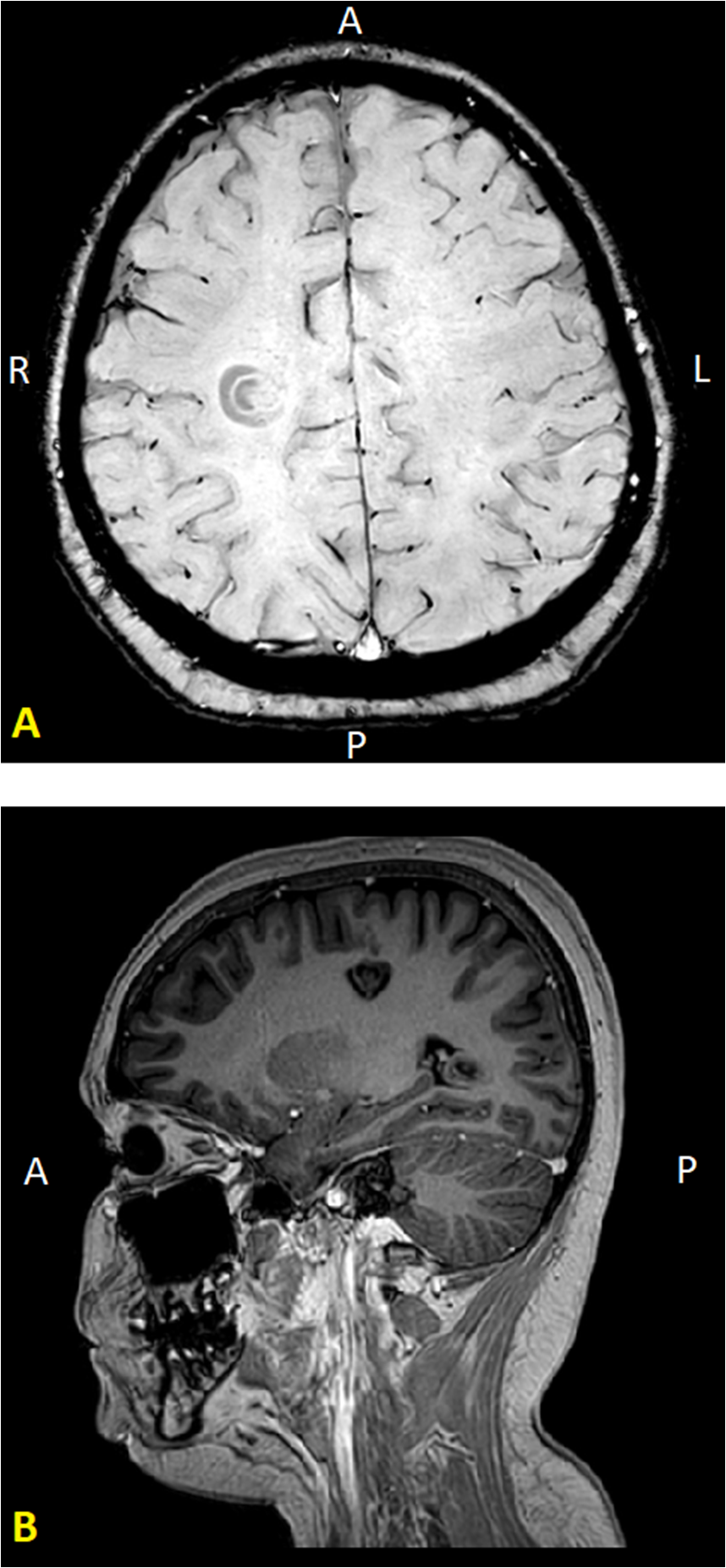
Baló’s concentric sclerosis is a rare and progressive demyelinating disease of the central nervous system. It is considered to be a variant of multiple sclerosis. The lesion is characterized by the alternation of concentric demyelinated and myelinated rings in the white matter while leaving the gray matter preserved. Herein we present the case of a 14-year-old female with this condition.
Baló’s concentric sclerosis (BCS) is a progressive inflammatory condition in the spectrum of demyelinating diseases of the central nervous system (CNS) which is often considered to be an uncommon, atypical variant of multiple sclerosis (MS) 1, 2. The distinctive “onion-like” Baló’s lesion is characterized by the alternation of concentric myelinated and demyelinated rings in the white matter in different parts of the CNS while leaving the gray matter intact 3, 4. The lesions typically occur around a perivenular zone as a result of an unknown stimulus that causes macrophages and activated microglia to release chemotactic agents that trigger demyelination; the outward propagation of these mediators in waves from a single point causes the concentric rings. Hypoxia-ischemia is thought to be a stimulus 2. Neurological presentation of BCS varies on the location, number, and size of white matter lesions. Its prevalence is not known, but according to prior research, it is twice as frequent in females as in males, with a mean age of onset of 34 years (range 3-62 years) 5.
A 14-year-old girl was admitted to our service one year ago with a 3-day history of acute onset of headache, pain in the right ear, weakness, and numbness in both upper limbs, complaints that were eventually reduced to headache, numbness, tickling, and difficulty in moving the left forearm and hand only. She was referred from a regional hospital with a reported irregular hypodense lesion of unknown nature with dimensions 15x20 mm in the left frontal lobe and another suspected hypodense lesion with right frontoparietal location in cranial computed tomography (CT) scan. The parents reported a 3-week history of viral infection of unknown origin one month before, with the following complaints: subfebrile temperature (37.7°C, 99.86°F), headache, general weakness, and lethargy, as well as oral, and genital lesions for which she received local treatment. The girl had always been overweight. No family history of autoimmune diseases was reported.
On admission, the vital signs of the patient were within normal ranges. Physical examination revealed paresthesia and paresis of the left arm with no other abnormal findings. Cranial magnetic resonance imaging (MRI) reported multiple lesions of the white matter suggestive of a demyelinating pathologic process. Electroencephalogram (EEG) findings were unremarkable. Blood screening tests reported as follows: complete blood count within normal ranges, elevated erythrocyte sedimentation rate (ESR) 16mm/h (normal range: 0-10 mm/h), biochemical and electrolyte panels within normal ranges, normal fibrinogen and C-reactive protein (CRP), low 25-hydroxyvitamin D [25(OH)D] level 13.63 ng/ml (normal range: 20 and 40 ng/ml), normal leukocyte immunophenotyping and protein electrophoresis. Serological investigation was performed; it reported a negative extractable nuclear antigen (ENA) panel, negative anti-Epstein-Barr virus-capsid antigen (EBV-CA) IgM, and positive anti-EBV-CA IgG 159.5 U/ml (normal range: <20 U/ml). Routine cerebrospinal fluid (CSF) examination after taking a sample through lumbar puncture was normal. Under a presumptive diagnosis of multiple sclerosis, treatment with intravenous methylprednisolone 1 g/day for 5 days with consecutive tapering, and intravenous acyclovir 400 mg, 3 times per day was administered; clinical improvement was evidenced and the girl was discharged after one week of hospitalization. Treatment with oral prednisone 5 mg, 2 x 5 tablets per day with consecutive tapering every five days as well as vitamin D3 2000 IU, 1 capsule/day for 25(OH)D insufficiency was prescribed.

Four weeks later, the girl was admitted again to our service with the following complaints: headache and numbness in the left upper limb. A control MRI with contrast enhancement displayed multiple supratentorial white matter lesions with periventricular localization in the subcortical corpus callosum which presented signal restriction in diffusion-weighted imaging (DWI). One of the lesions with right parietal periventricular localization was characterized by concentric semi-ring lines in the periphery (Figure 1). Routine CSF examination was normal. A multiple sclerosis panel was performed to detect CSF oligoclonal bands and quantitate intrathecal immunologic activity by measuring in situ CSF immunoglobulin G (IgG) synthesis, and CSF to serum albumin quotient (Q albumin) to evaluate the blood-brain barrier integrity; the outcome was as follows: IgG in serum 709 mg/dl (normal range: 500-1330 mg/dl), IgG in CSF 1.17 mg/dl (normal range: 1-4 mg/dl), albumin in serum 4.28 g/dl (normal range: 3.4 to 5.4 g/dl), albumin in CSF 11.3 mg/dl (normal range: <50 mg/dl), Q albumin 2.640 (normal range: <9.0), IgG index 0.625 (normal range: <0.7), CSF IgG synthesis rate 3.02 mg/day (normal range: <3.3 mg/day). Oligoclonal bands were absent. Intravenous methylprednisolone was prescribed for 5 days to which she was responsive, and approximately one week later she was discharged.
Currently, the girl is being treated abroad with subcutaneous interferon-beta (IFN-β) and is in a stable condition, as reported by her father.
After evaluating this clinical case and succeeding in the differential diagnosis with acute demyelinating encephalomyelitis (ADEM), the classical form of multiple sclerosis (MS), and its other variants, the definitive diagnosis of Baló’s concentric sclerosis was made.
BCS is a very rare disease in pediatric patients. It was formerly reported to have a mortality rate of 100%, but improved diagnostic criteria, advances in laboratory and imaging examinations as well as novel therapies have provided significant benefits; consequently, not only ante-mortem cases but also cases with an unthreatening course have been reported 4, 6, 7, 8, 9.
BCS patients can present classic focal symptoms similar to MS, including focal weakness, ataxia, sensory disturbance, or diplopia, but frequently reported symptoms are similar to those of an intracerebral mass such as headache, hemiparesis, cognitive difficulty, behavioral changes, aphasia, muteness, seizures, and urinary incontinence 1, 2. Our patient is an example of a benign form of BCS, with mild symptoms, nonsignificant laboratory test changes, intact blood-brain barrier (normal Q albumin), normal IgG index, normal intrathecal IgG synthesis rate, and absent oligoclonal bands. What grabbed our interest was the presence of anti-EBV-CA IgG in the serum. As far as our knowledge is concerned, there is no case of BCS associated directly with Epstein-Barr virus (EBV) but studies suggest that infection with EBV is likely to contribute to the development of multiple sclerosis 10, 11. Therefore, we believe that the past infection of EBV is an antecedent event of BCS in our case. Similarly, low vitamin D levels and obesity are stated to play a part in MS occurrence 10, 11, conditions which were both present in our patient.
Immunotherapy with corticosteroids is the recommended first-line treatment during the acute phase of BCS. Plasmapheresis (plasma exchange), intravenous immunoglobulin, cyclophosphamide, and immunoadsorption combined with long-term azathioprine or mitoxantrone are considered second-line treatment. In refractory cases, third-line immunotherapy with monoclonal antibody therapy like alemtuzumab or natalizumab may be effective, although data regarding their effectiveness is scarce 2, 5.
Numerous long-term follow-up studies testify to the significant contribution of interferon-beta (IFN-β) as a disease-modifying therapy. Results indicate that exposure to IFN-β over a long period of time improves outcomes by controlling MS symptoms, accelerating recovery from attacks, and delaying disease progression 12.
Due to its infrequent nature, only a few children with Baló’s concentric sclerosis are hitherto reported; hence, we believe this case report is a valuable contribution to the scientific literature. Considering the whole spectrum of demyelinating diseases, a precise differential diagnosis is crucial and imaging test findings, in particular, are of significant value to confirm the diagnosis. Regardless of the advances in understanding the disorder, some gaps still persist, making the clinical experience challenging, therefore awareness concerning the matter and collaboration among health professionals are necessary.
Informed consent was obtained from the parent of our patient for the publication of this report.
No conflict of interest is declared.
| [1] | Xie JS, Jeeva-Patel T, Margolin E. Baló's concentric sclerosis–A rare entity within the spectrum of demyelinating diseases. Journal of the Neurological Sciences. 2021; 428: 117570. | ||
| In article | View Article PubMed | ||
| [2] | Hardy TA, Miller DH. Baló's concentric sclerosis. The Lancet Neurology. 2014; 13(7): 740-6. | ||
| In article | View Article | ||
| [3] | Ng SH, Ko SF, Cheung YC, Wong HF, Wan YL. MRI features of Balo's concentric sclerosis. The British Journal of Radiology. 1999; 72(856): 400-3. | ||
| In article | View Article PubMed | ||
| [4] | Jurkiewicz E, Opyrchał P, Sławińska D, Puzio-Bochen I, Pytlewska A, Roszkowski M, Kotulska K. Magnetic Resonance Characteristics of Baló Concentric Sclerosis in Children. Pediatric Neurology. 2021; 121: 3-10. | ||
| In article | View Article PubMed | ||
| [5] | Amini Harandi A, Esfandani A, Pakdaman H, Abbasi M, Sahraian M. Balo’s concentric sclerosis: an update and comprehensive literature review. Reviews in the Neurosciences. 2018; 29(8): 873-882. | ||
| In article | View Article PubMed | ||
| [6] | Karaarslan E, Altintas A, Senol U, Yeni N, Dincer A, Bayindir C, Karaagac N, Siva A. Balo's concentric sclerosis: clinical and radiologic features of five cases. American journal of neuroradiology. 2001; 22(7): 1362-7. | ||
| In article | |||
| [7] | Linnoila J, Chitnis T. Balo concentric sclerosis in children: a case series. Journal of Child Neurology. 2014; 29(5): 603-7. | ||
| In article | View Article PubMed | ||
| [8] | Bhoi SK, Naik S, Kalita J, Misra UK. Multifocal Balo's concentric sclerosis in children: Report of a case and review of literature. Journal of Neurosciences in Rural Practice. 2017; 8(S01): S136-8. | ||
| In article | View Article PubMed | ||
| [9] | Dreha-Kulaczewski SF, Helms G, Dechent P, Hofer S, Gärtner J, Frahm J. Serial proton MR spectroscopy and diffusion tensor imaging in infantile Balo’s concentric sclerosis. Neuroradiology. 2009 Feb; 51(2): 113-21. | ||
| In article | View Article PubMed | ||
| [10] | Dobson R, Giovannoni G. Multiple sclerosis–a review. European journal of neurology. 2019; 26(1): 27-40. | ||
| In article | View Article PubMed | ||
| [11] | Houen G, Trier NH, Frederiksen JL. Epstein-Barr virus and multiple sclerosis. Frontiers in immunology. 2020; 11: 587078. | ||
| In article | View Article PubMed | ||
| [12] | Freedman MS. Long-term follow-up of clinical trials of multiple sclerosis therapies. Neurology. 2011; 76(1 Supplement 1): S26-34. | ||
| In article | View Article PubMed | ||
Published with license by Science and Education Publishing, Copyright © 2022 Armand Shehu, Kristi Aleksi, Afërdita Tako Kumaraku and Aida Bushati
 This work is licensed under a Creative Commons Attribution 4.0 International License. To view a copy of this license, visit
http://creativecommons.org/licenses/by/4.0/
This work is licensed under a Creative Commons Attribution 4.0 International License. To view a copy of this license, visit
http://creativecommons.org/licenses/by/4.0/
| [1] | Xie JS, Jeeva-Patel T, Margolin E. Baló's concentric sclerosis–A rare entity within the spectrum of demyelinating diseases. Journal of the Neurological Sciences. 2021; 428: 117570. | ||
| In article | View Article PubMed | ||
| [2] | Hardy TA, Miller DH. Baló's concentric sclerosis. The Lancet Neurology. 2014; 13(7): 740-6. | ||
| In article | View Article | ||
| [3] | Ng SH, Ko SF, Cheung YC, Wong HF, Wan YL. MRI features of Balo's concentric sclerosis. The British Journal of Radiology. 1999; 72(856): 400-3. | ||
| In article | View Article PubMed | ||
| [4] | Jurkiewicz E, Opyrchał P, Sławińska D, Puzio-Bochen I, Pytlewska A, Roszkowski M, Kotulska K. Magnetic Resonance Characteristics of Baló Concentric Sclerosis in Children. Pediatric Neurology. 2021; 121: 3-10. | ||
| In article | View Article PubMed | ||
| [5] | Amini Harandi A, Esfandani A, Pakdaman H, Abbasi M, Sahraian M. Balo’s concentric sclerosis: an update and comprehensive literature review. Reviews in the Neurosciences. 2018; 29(8): 873-882. | ||
| In article | View Article PubMed | ||
| [6] | Karaarslan E, Altintas A, Senol U, Yeni N, Dincer A, Bayindir C, Karaagac N, Siva A. Balo's concentric sclerosis: clinical and radiologic features of five cases. American journal of neuroradiology. 2001; 22(7): 1362-7. | ||
| In article | |||
| [7] | Linnoila J, Chitnis T. Balo concentric sclerosis in children: a case series. Journal of Child Neurology. 2014; 29(5): 603-7. | ||
| In article | View Article PubMed | ||
| [8] | Bhoi SK, Naik S, Kalita J, Misra UK. Multifocal Balo's concentric sclerosis in children: Report of a case and review of literature. Journal of Neurosciences in Rural Practice. 2017; 8(S01): S136-8. | ||
| In article | View Article PubMed | ||
| [9] | Dreha-Kulaczewski SF, Helms G, Dechent P, Hofer S, Gärtner J, Frahm J. Serial proton MR spectroscopy and diffusion tensor imaging in infantile Balo’s concentric sclerosis. Neuroradiology. 2009 Feb; 51(2): 113-21. | ||
| In article | View Article PubMed | ||
| [10] | Dobson R, Giovannoni G. Multiple sclerosis–a review. European journal of neurology. 2019; 26(1): 27-40. | ||
| In article | View Article PubMed | ||
| [11] | Houen G, Trier NH, Frederiksen JL. Epstein-Barr virus and multiple sclerosis. Frontiers in immunology. 2020; 11: 587078. | ||
| In article | View Article PubMed | ||
| [12] | Freedman MS. Long-term follow-up of clinical trials of multiple sclerosis therapies. Neurology. 2011; 76(1 Supplement 1): S26-34. | ||
| In article | View Article PubMed | ||