 OPEN ACCESS
 PEER-REVIEWED
He-Laplace Method for the Solution of Two-point Boundary Value Problems
Hradyesh Kumar Mishra
Abstract
The boundary value problems of ordinary differential equations play an important role in many fields. Here, we implement the He-Laplace method for the solution of linear and nonlinear two-point boundary value problems. The aim of this paper is to compare the performance of the He-Laplace method with shooting method. As a result, for the same number of terms, our method provides relatively more accurate results with rapid convergence than other methods.
Keywords: two-point boundary value problems, laplace transform, homotopy perturbation method, shooting method
American Journal of Mathematical Analysis, 2014 2 (3),
pp 45-49.
DOI: 10.12691/ajma-2-3-3
Received June 04, 2014; Revised June 30, 2014; Accepted July 04, 2014
Copyright © 2013 Science and Education Publishing. All Rights Reserved.Cite this article:
- Mishra, Hradyesh Kumar. "He-Laplace Method for the Solution of Two-point Boundary Value Problems." American Journal of Mathematical Analysis 2.3 (2014): 45-49.
- Mishra, H. K. (2014). He-Laplace Method for the Solution of Two-point Boundary Value Problems. American Journal of Mathematical Analysis, 2(3), 45-49.
- Mishra, Hradyesh Kumar. "He-Laplace Method for the Solution of Two-point Boundary Value Problems." American Journal of Mathematical Analysis 2, no. 3 (2014): 45-49.
| Import into BibTeX | Import into EndNote | Import into RefMan | Import into RefWorks |
1. Introduction
There are many new analytical approximate methods to solve two-point boundary value and initial value problems in the literature. These problems generally arise frequently in many areas of science and engineering, for example, fluid mechanics, quantum mechanics, optimal control, chemical-reactor theory, aero-dynamics, reaction-diffusion process, geophysics etc. Different numerical methods have been proposed by various researchers. Among these are the Adomian decomposition method (ADM) [1, 2, 3, 23, 35, 36, 37], Homotopy perturbation method HPM [7-17,19,20,32,33,39], He-Laplace method [21, 22, 23, 26, 27, 28, 29, 30]. There are many techniques available for the numerical solution of two-point boundary value problems for ordinary differential equations [18, 25] and references therein. However there is no unified method to handle all types of nonlinear problems. Mohsen and El-Gamel [31] studied the performance of the collocation and Galerkin methods using Sinc basis functions for solving linear and nonlinear second-order two-point boundary value problems. The Sinc-collocation method is used to solve a system of second-order boundary value problems [5].
In this paper, we implement the He-Laplace method for solving the two-point boundary value problem of the form:
 | (1) |
with boundary conditions
 | (2) |
where f is continuous on the set 
 are constants. The nonlinear shooting method [22] and He-Laplace method are used to find the solutions of the nonlinear two-point boundary value problems (1)-(2). In this paper, we present some numerical examples including linear as well as nonlinear boundary value problems. The main purpose of this paper is to compare the solutions obtained by He-Laplace method with Extended Adomian decomposition method (EADM) and Shooting method.
This paper contains basic idea of homotopy perturbation method and He-Laplace method in section 2, Numerical examples in section 3 and conclusion in section 4 respectively.
2. Basic Idea of Homotopy Perturbation Method
Consider the following nonlinear differential equation
 | (3) |
with the boundary conditions of
 | (4) |
where A, B, and
 are a general differential operator, a boundary operator, a known analytic function and the boundary of the domain
 , respectively.
The operator A can generally be divided into a linear part L and a nonlinear part N. Eq. (3) may therefore be written as:
 | (5) |
By the homotopy technique, we construct a homotopy  which satisfies:
 |
or
 |
where  is an embedding parameter, while
 is an initial approximation of Eq.(1), which satisfies the boundary conditions. Obviously, from above equations,
we will have:
 | (6) |
 | (7) |
The changing process of  from zero to unity is just that of
 from
 to
 . In topology, this is called deformation, while
 and
 are called homotopy. If the embedding parameter
 is considered as a small parameter, applying the classical perturbation technique, we can assume that the solution of Eqs.(6) and (7) can be written as a power series in
 :
 | (8) |
Setting  in Eq.(8), we have
 | (9) |
The combination of the perturbation method and the homotopy method is called the HPM, which eliminates the drawbacks of the traditional perturbation methods while keeping all its advantages. The series (9) is convergent for most cases. However, the convergent rate depends on the nonlinear operator . Moreover, He [35] made the following suggestions:
(1) The second derivative of  with respect to
 must be small because the parameter may be relatively large, i.e.
 .
(2) The norm of  must be smaller than one so that the series converges.
3. He-Laplace Method
Consider the following nonlinear differential equation (IVP):
 | (10) |
 | (11) |
where  are constants. f(y) is a nonlinear function and f(x) is the source term. Taking Laplace transformation (denoted throughout this paper by L) on both side of Eq.(10), we have
 | (12) |
By using linearity of Laplace transformation, the result is
 | (13) |
Applying the formula on Laplace transform, we obtain
 | (14) |
Using initial conditions in Eq.(14), we have
 | (15) |
Or
 | (16) |
Taking inverse Laplace transform, we have
 | (17) |
where  represents the term arising from the source term and the prescribed initial conditions.
Now, we apply homotopy perturbation method [35],
 | (18) |
where the term  are to recursively calculated and the nonlinear term
 can be decomposed as
 | (19) |
for some He’s polynomial  (see [[21, 22] and their referencein]) that are given by
 |
Substituting Eqs.(18) and (19) in (17), we get
 | (20) |
which is the coupling of the Laplace transformation and the homotopy perturbation method using He’s polynomials. Comparing the coefficient of like powers of p, the following approximations are obtained:
 | (21) |
4. Numerical Examples
In this section, two examples are used to illustrate performance of the He-Laplace method. For the sake of comparison with other methods, we consider the same examples as in [6, 24, 34]. In the process of Computation, all the symbolic and numerical computations are performed by using Mathematica.
Example 4.1. Consider the linear two-point boundary value problem of the form [24, 34]
 | (22) |
Subject to the boundary conditions
 | (23) |
The exact solution of the problem is
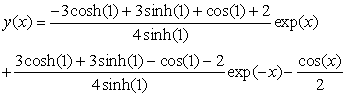 | (24) |
By applying the aforesaid method subject to the initial condition, we have
 | (25) |
where  .
The inverse of the Laplace transform implies that
 | (26) |
Now, we apply the homotopy perturbation method, we have
 | (27) |
Comparing the coefficient of like powers of p, we have
 | (28) |
Proceeding in a similar manner, we have
 |
So that the solution  is given by
 | (29) |
The approximation must satisfy the boundary conditions. Imposing the boundary condition of Eq.(23) at x = 1 on Eq.(29), we can obtain the value of the parameter 


 PowerPoint Slide
 Larger image(png format)

 View current table in a new window

Table 1 shows the comparison between exact solution and the series solution obtained by the exponential fitting method (EFM) in [34] and the HLHPM. We compare only five iterations of both the methods. It is found that for the same number of terms, the HLHPM yields relatively more accurate results than other methods. It is obvious that evaluation of more components of u(x) will reasonably improve the accuracy of series solution by using the HLHPM.
Example 4.2. Consider the nonlinear two-point boundary value problem of the form [17, 22]
 | (30) |
with the boundary conditions
 | (31) |
The exact solution of the problem is
 |
By applying the aforesaid method subject to the initial condition, we have
 | (32) |
where  .
Taking inverse Laplace transform, we have
 |
 | (33) |
Now, we apply homotopy perturbation method [35],
 | (34) |
where the term  are to recursively calculated and the nonlinear term f(y) can be decomposed as
 | (35) |
For some He’s polynomial  that are given by
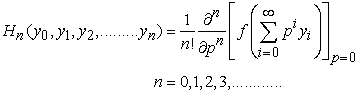 | (36) |
 | (37) |
 |
Preceding the steps as in the previous example, we can obtain the value of  and consequently determine the approximate solution with seven iterations
 .The absolute errors between the exact solution and the results obtained by the shooting method [6], EADM and the HLHPM are compared in Table 2. It is worth to mention that shooting method requires several numerical procedures in obtaining approximations. It is noted that
 give much better numerical approximations than the results by the EADM. It is interesting to point out that He’s polynomial plays an important role in handling nonlinear terms and making the solution procedure in a systematic way.

 PowerPoint Slide
 Larger image(png format)
 View current table in a new window

5. Conclusion
In this paper, we have applied He-Laplace method for obtaining approximate solutions of linear and nonlinear second-order two-point boundary value problems. Further, we have compared the performance of the He-Laplace method with extended adomian decomposition method. Numerical examples are presented. On the basis of these examples, for the same number of terms, He-Laplace method yields much better results than the other methods.
References
| [1] | G.Adomian, A revieal of the decomposition method and some recent results for nonlinear equation, Mathematical and Computer Modeling 13(7)(1992) 17-43. | ||
 In article | CrossRef | ||
| [2] | G.Adomian, A revieal of the decomposition method in applied mathematics, Journal of Mathematical Analysis and application 135(1988) 501-544. | ||
| In article | |||
| [3] | G.Adomian, Solution frontier Problems of Physics: The Decomposition method, Kluwer Dordrecht, 1994. | ||
| In article | |||
| [4] | C.Chun, R.Sakthivel, Homotopy perturbation technique for solving two point boundary value problems- comparison with other methods, Computer physics communications, 181(2010) 1021-1024. | ||
| In article | CrossRef | ||
| [5] | M.Dehghan, A Saadatmandi, the numerical solution of a nonlinear system of second order boundary value problems using the Sinc-Collocation method, Mathematical and Computer Modeling 46(2007) 1434-1441. | ||
| In article | CrossRef | ||
| [6] | S.N. Ha, A nonlinear shooting method for two-point boundary value problems, Computers and Mathematics with Applications 42(2001) 1411-1420. | ||
| In article | CrossRef | ||
| [7] | J.H.He, Homotopy perturbation method: A new nonlinear analytical technique, Applied Mathematics and Computation, Vol. 135, 2003, pp.73-79. | ||
| In article | CrossRef | ||
| [8] | J.H.He, Homotopy, Comparion of homotopy perturbation method and homotopy analysis method, Applied Mathematics and Computation, Vol. 156, 2004, pp. 527-539. | ||
| In article | CrossRef | ||
| [9] | J.H.He, Homotopy, The homotopy perturbation method for nonlinear oscillators with discontinueties, Applied Mathematics and Computation, Vol. 151, 2004, pp. 287-292. | ||
| In article | CrossRef | ||
| [10] | J.H.He, Recent developments of the homotopy perturbation method, Topological methods in Non-linear Analysis, Vol. 31, 2008, pp. 205-209. | ||
| In article | |||
| [11] | J.H.He, New Interpretation of homotopy perturbation method, International Journal of Modern Physics, Vol. 20, 2006, pp. 2561-2568. | ||
| In article | CrossRef | ||
| [12] | J.H.He, A coupling method of homotopy technique and a perturbation technique for nonlinear problems, International Journal of Nonlinear Mechanics, Vol. 35, 2000, pp. 37-43. | ||
| In article | CrossRef | ||
| [13] | J.H.He, Variational iteration method for autonomous ordinary differential systems, Applied Mathematics and Computation, Vol. 114, 2000, pp. 115-123. | ||
| In article | CrossRef | ||
| [14] | J.H.He, Homotopy perturbation technique, Computer methods in Applied Mechanics and Engineering, Vol. 178, 1999, pp. 257-262. | ||
| In article | CrossRef | ||
| [15] | J.H.He, A simple perturbation approach to Blasius equation, Applied Mathematics and Computation, Vol.140, 2003, pp. 217-222. | ||
| In article | CrossRef | ||
| [16] | J.H.He, Application of homotopy perturbation method to nonlinear wave equation, Chaos, Solitons, Fractals, Vol. 26, 2005, pp. 295-300. | ||
| In article | CrossRef | ||
| [17] | J.H.He, Homotopy perturbation method for solving boundary value problem, Physics Letter A, Vol. 350, 2006, pp. 87-88. | ||
| In article | CrossRef | ||
| [18] | M.T.Heath, Scientific Computing; An Introductory Survey, McGraw-Hill, New York 2002. | ||
| In article | |||
| [19] | E. Hesameddini, H. Latifizadeh, An optimal choice of initial solutions in the homotopy perturbation method, International Journal of Nonlinear Sciences and Numerical Simulation, Vol. 10, 2009, pp.1389-1398. | ||
| In article | |||
| [20] | E. Hesameddini, H. Latifizadeh, A new vision of the He’s homotopy perturbation method, International Journal of Nonlinear Sciences and Numerical Simulation, Vol.10, 2009, pp.1415-1424. | ||
| In article | |||
| [21] | H.K. Mishra, A.K. Nagar, He-Laplace method for linear and nonlinear partial differential equations, Journal of Applied Mathematics Vol. 2012,2012, pp.1-16. | ||
| In article | CrossRef | ||
| [22] | H.K. Mishra, He-Laplace Method for Special Nonlinear Partial Differential Equations, Mathematical Theory and Modeling Vol.3 (6), 2013, pp. 113-117. | ||
| In article | |||
| [23] | S. Islam, Y. Khan, N. Faraz, F. Austin, Numerical solution of logistic differential equations by using the Laplace decomposition method, World Applied Sciences Journal, Vol. 8, 2010, pp. 1100-1105. | ||
| In article | |||
| [24] | B.Jang, Two point boundary value problems by the extended Adomian decomposition method, Journal of Computational and Applied Mathematics 219(2008)253-262. | ||
| In article | CrossRef | ||
| [25] | K.Keller, Numerical solution of two-point boundary value problems, SIAM, Philadelphia, 1976. | ||
| In article | CrossRef | ||
| [26] | Y.Khan, F.Austin, Application of the Laplace decomposition method to nonlinear homogeneous and non-homogeneous advection equations, Zeitschrift fuer Naturforschung, Vol. 65 a, 2010, pp.1-5. | ||
| In article | |||
| [27] | Yasir Khan, Qingbiao Wu, Homotopy perturbation transform method for nonlinear equations using He’s polynomials, Computers and Mathematics with Applications, Vol.61, 2011, pp.1963-1967. | ||
| In article | CrossRef | ||
| [28] | Yasir khan, An effective modification of the Laplace decomposition method for nonlinear equations, International Journal of Nonlinear Sciences and Numerical Simulation, Vol. 10, 2009, pp. 1373-1376. | ||
| In article | |||
| [29] | S.A.Khuri, A Laplace decomposition algorithm applied to a class of nonlinear differential equations, Journal of Applied Mathematics,Vol.1, 2001, pp.141-155. | ||
| In article | CrossRef | ||
| [30] | M.Madani, M.Fathizadeh, Homotopy perturbation algorithm using Laplace transformation, Nonlinear Science Letters A, Vol. 1, 2010, pp.263-267. | ||
| In article | |||
| [31] | A.Mohsen, M.El-Gamel, On the Galerkin and Collocation methods for two-point boundary value problems using Sinc bases, Computers and Mathematics with applications 56(2008)930-941. | ||
| In article | CrossRef | ||
| [32] | M.Rafei,D.D.Ganji, Explicit solutions of helmhotz equation and fifth-order KdV equation using homotopy perturbation method, International Journal of Nonlinear Sciences and Numerical Simulation, vol. 7, 2006, pp. 321-328. | ||
| In article | |||
| [33] | A.M.Siddiqui, R.Mohmood,Q.K.Ghori,Thin film flow of a third grade fluid on a moving belt by He’s homotopy perturbation method, International Journal of Nonlinear Sciences and Numerical Simulation, vol. 7, 2006, pp. 7-14. | ||
| In article | |||
| [34] | O.A. Taiwo, Exponential fitting for the solution of two-point boundary value problems with cubic spline collocation tau method International Journal of Computer Mathematics, 79(2002)299-306. | ||
| In article | CrossRef | ||
| [35] | A.M. Waz Waz, A reliable modification of Adomian’s decomposition method, Applied Mathematics and computation 92(1998)1-3. | ||
| In article | |||
| [36] | A.M.Waz Waz, A composition between Adomian’s decomposition method and Taylor series method in the series solution, Applied Mathematics and computation 79(1998)37-44. | ||
| In article | CrossRef | ||
| [37] | A.M.Waz Waz, Adomian decomposition method for a reliable treatment of the Bratu type equations, Applied Mathematics and computation 166(2005)652-663. | ||
| In article | CrossRef | ||
| [38] | A.M.Waz Waz, Partial Differential Equations; Methods and Applications, Balkema Publishers, The Netherland, 2002. | ||
| In article | |||
| [39] | L.Xu, He’s homotopy perturbation method for a boundary layer equation in unbounded domain, Computers and Mathematics with Applications, vol. 54, 2007, pp. 1067-1070. | ||
| In article | CrossRef | ||

 CiteULike
 Mendeley
 StumbleUpon
 Delicious
 Facebook
 Twitter
 LinkedIn
 Print