Fish is an important source of nutrition for millions of people around the world. However, improper handling and processing can cause food poisoning in consumers. This study aimed to assess the microbiological quality of grilled fish, Kanda (Local fish, sesame and vegetable mixed balls), and fish rice sold in street restaurants in the city of N’Djamena, as well as contamination by bacteria resistant to common antibiotics. Thirty (30) samples were analyzed for anti-microbial resistance (AMR), total and fecal coliforms, Staphylococcus aureus, and Salmonella spp. using standardized methods during the period from March to September 2016. Antibiotic sensitivity was determined using the agar diffusion method. The total mesophilic aerobic flora ranged from 3.65,105 to 3.68,106 CFU/g. Total coliform ranged from less than 10 to 4.44,103 CFU/g, while fecal coliform ranged from less than 10 to 3.91,103 CFU/g. As for Staphylococcus aureus, the loads ranged from 1.20,102 CFU/g to 2.34,103 CFU/g. No salmonella colonies were detected. Microbiological analyses showed that 36.70% of samples were unsatisfactory for TAMF bacteria, 46.70% were unsatisfactory for fecal coliforms, 76.70% were unsatisfactory for total coliforms, and 6.66% were unsatisfactory for Staphylococcus aureus. Research into antibiotic-resistant bacteria showed that all Pseudomonas aeruginosa were resistant to nalidixic acid, amoxicillin-clavulanic acid, ceftriaxone, and tetracycline, and 50% were resistant to trimethoprim-sulfamethoxazole. About Staphylococcus aureus, all isolated strains showed intermediate or absolute resistance to nalidixic acid, amoxicillin-clavulanic acid, ceftriaxone, and trimethoprim-sulfamethoxazole, while 75% were resistant to tetracycline. All strains of Escherichia coli and Enterobacter cloacae were resistant to amoxicillin-clavulanic acid, while 50% showed intermediate or absolute resistance to nalidixic acid and tetracycline. All strains of Enterobacter cloacae showed intermediate or absolute resistance to ceftriaxone. These results show that grills fish, Kanda, and fish rice are mostly contaminated and harbor antibiotic-resistant bacteria that can be transmitted to humans through food.
There are two types of collective catering: commercial catering, provided by hotel restaurants or individual restaurants, and social collective catering, provided by school, company, and university restaurants. Like other developing countries, Chad is experiencing rapid population growth, with an annual growth rate of 3.4% compared to an average of 2.4% for the continent as a whole 1. The increasing distance between homes and workplaces is leading to a dramatic rise in collective catering, with ordinary meals being taken outside the family setting 2. Despite its socio-economic importance, the issue of hygiene in the collective catering system is a major concern for consumers 3. When good hygiene and manufacturing practices are not followed, food can pose a risk and cause food poisoning for consumers. In general, breaches of hygiene rules are thought to be due to the large number of meals prepared daily, low levels of education, and a lack of ongoing training for restaurant owners 4.
The risk is increased with fish, which is a highly perishable commodity and a good medium for the development of microorganisms, whether pathogenic or indicative of poor hygiene 5. Fish is one of the most widely consumed foods in the city of N’Djamena and in Chad in general, with an estimated annual consumption of 7.7 kg per person in 2016 6. Its consumption has been implicated in numerous cases of food poisoning among consumers 7, 8. In particular, the contamination of fish by antibiotic-resistant bacteria of fecal origin has been documented 9, 10, 11. Fish used in institutional catering, therefore, presents a risk of transmission of antibiotic-resistant bacteria to humans.
Antibiotic resistance is a global problem for both human and animal health. Food in the human food chain, particularly contaminated fish, acts as a vector for the transmission of antibiotic-resistant bacteria and genes 12, 13. However, very few studies have focused on the transmission of antibiotic-resistant germs through fish used in grilled fish and in many street foods in Chad. The aim of this study was therefore to assess the microbiological quality of grilled fish, Kanda and fish rice sold in street restaurants, as well as contamination by bacteria resistant to common antibiotics in the city of N’Djamena.
The study was conducted at the Food Science and Nutrition Research Laboratory (LARSAN) at the University of N’Djamena (Faculty of Human Health Sciences), Chad, at the Laboratory of Biochemistry and Applied Immunology (LaBIA), and at the Center for Research in Biological Food and Nutritional Sciences (CRSBAN) at the University of Ouagadougou, Burkina Faso, during the period from March to September 2016.
2.2. SamplingFish samples were randomly collected from three restaurants serving grilled fish, Kanda producers, and fish rice preparers in N'Djamena. A total of 30 samples were collected, including 10 grilled fish, 12 Kanda containing processed fish, and 8 fish rice samples. The restaurants were chosen at random throughout the city of N'Djamena (the city center and four outlying areas). Each sample consisted of three sub-samples taken from three different points at the same vendor and then mixed to ensure that the sample was representative of each vendor. A total of two samples were taken from each vendor to prevent spoilage. We collected samples of grilled fish from five fish grills, samples of Kanda from six Kanda vendors, and samples of fish rice with fish from four food vendors. The sample size was justified by the fact that another preliminary survey had already shown that the majority of street food vendors worked under similar hygiene conditions and did not require a large sample size.
The samples were collected under aseptic conditions to avoid any additional contamination. The samples of grilled fish, Kanda, and fish rice prepared with fish were wrapped in aluminum foil, placed in a large sterile bag, labeled, and transported in a cooler containing ice to the laboratory.
2.3. Microbiological Quality AssessmentThe stock solutions and decimal dilutions were prepared in buffered peptone water (Liofilchem Diagnostique) in accordance with the international standard ISO 4833 14.
The determination of microorganism colonies was carried out according to standard microbiological analysis methods. Each dilution was analyzed in triplicate, and the averages were generated using Microsoft Excel 2016 software.
The total flora was determined on PCA medium in accordance with the international standard ISO 4833 14.
Total coliforms were counted on EMB medium in accordance with the international standard ISO 4832 15.
Fecal coliforms were determined according to method NF V08-060 16.
Staphylococcus aureus was counted on sterile Chapman agar medium according to the international standard ISO 6888-1 17. Suspicious colonies were subjected to catalase and coagulase tests for confirmation.
Salmonella spp. were counted according to the international standard ISO 6579 18. Colonies suspected of being Salmonella spp. were re-isolated on Muller-Hinton agar and then tested on the minimum gallery (citrate, H2S, mannitol mobility, lactose, indole) for confirmation.
The number of germs was obtained by taking into account the dilution factor and expressed in Colony Forming Units (CFU) per gram of sample according to the international standard ISO 7218 19.
2.4. Interpretation of Microbiological ResultsAll characteristic colonies were transferred to specific media, isolated, and purified. The isolated bacteria were transferred to Muller-Hinton medium and incubated at 37°C for 24 hours. After this incubation period, they were kept in brain heart infusion (BHI) broth with 15% glycerol and mineral oil added to prevent the agar from drying out. The colonies were then scraped off using a sterile Pasteur pipette and placed in cryotubes containing BHI broth. The cryotubes thus prepared were stored in a freezer at -15°C.
Gram staining was performed on a smear deposited on a microscope slide and stained successively with Gentian Violet solution, then Lugol's solution, followed by decolorization with 95% alcohol. Finally, the smear was observed under an optical microscope after final staining with Fuchsine solution and drying at room temperature.
A suspected isolated colony is taken and placed on a drop of hydrogen peroxide on a microscope slide. The presence of catalase is indicated by the release of oxygen bubbles within 5 seconds, forming a persistent foam.
A strip impregnated with dimethyl-paraphenylene diamine (PDA) is placed in contact with an isolated colony of suspected bacteria. The presence of the enzyme results in the oxidation of PDA, producing an intense purple color after 5 seconds.
An equal amount of bacterial suspension was mixed in a tube containing lyophilized rabbit plasma. The formation of a visible clot after incubation at 37°C for 24 hours results from the activity of plasma coagulation factors.
API 20E strips were also used to identify Salmonella spp., Escherichia coli, and Pseudomonas aeruginosa. The reactions produced result in characteristic color changes that occur spontaneously or are revealed by the addition of specific reagents for the different germs being identified.
2.5. Antibiotigram RealizationThe antibiogram was performed using the qualitative agar diffusion method (Kirby-Bauer), a technique recommended by the French Society's Antibiogram Committee of the French Society of Microbiology (CA-SFM) and the European Committee on Antimicrobial Susceptibility Testing (EUCAST). Discs impregnated with known doses of antibiotics were placed using sterile forceps. References strain of each tested germ was used for quality control.
After preparing the bacterial suspension in physiological saline, approximately 1 ml of the bacterial suspension of each germ was taken and inoculated into Muller-Hinton agar and spread by gently swirling the dishes. After drying the dishes in an oven for 5 minutes at 44°C, the antibiotic discs were placed on the agar.
The various discs were placed under sterile conditions in a bacteriological hood on the medium using sterile forceps, according to the reference method described above 20. After placement, each disc was pressed down slightly to strengthen its adhesion to the agar and prevent it from coming loose. The discs were placed 15 millimeters from the edge of the Petri dish (120-millimeter diameter dish) and 30 millimeters apart. The erythromycin and clindamycin discs were placed side by side with a 30-millimeter diameter gap between them. The dishes were left at room temperature for 15 minutes to allow the antibiotics to diffuse, then incubated in an oven for 18 to 24 hours at 37°C.
The antibiotic discs used in this study were made in accordance with the recommendations of the European Committee on Antimicrobial Susceptibility Testing. These were Amoxicillin-Clavulanic Acid, Nalidixic Acid, Ceftriaxone, Gentamicin, Ciprofloxacin, Tetracycline, Norfloxacin, and Trimethoprim-Sulfamethoxazole.
The results were read and interpreted by measuring the diameter of each inhibition zone in millimeters using a caliper. Based on the inhibition diameter, the strains were classified as susceptible, intermediate, or resistant according to the EUCAST critical diameter thresholds (Table 1) 21, 22.
The microbiological results were interpreted according to the interpretation criteria described in European Regulation No. 2073/2005/CE relating to fish (fishery products, derived products for grilled fish) 23. AFSSA standards were used for cooked dishes such as Kanda and fish rice prepared with fish 24. The interpretation of the count of bacteria, such as TAMF, coliforms, and staphylococci, was carried out according to a three-class interpretation plan that distinguishes between units of satisfactory quality (≤ m), units of acceptable quality (m < E < 3m), and units of unsatisfactory quality (≥ 3m), while salmonella were interpreted according to a two-class scheme.
The results of the analyses were entered into Microsoft Excel 2016 software to generate the averages. The data were compared using Xlstat 2016 software with a significance threshold set at p < 0.05.
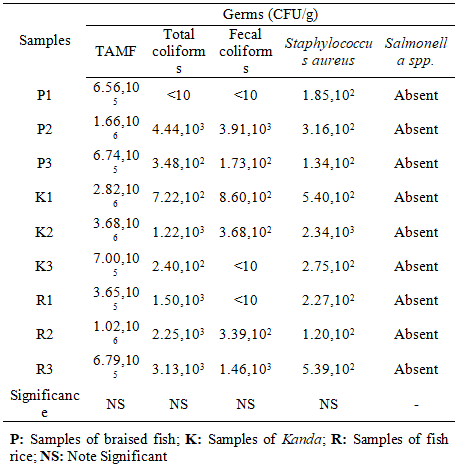
The results of the count of germs of sanitary interest presented in Table 2 show that none of the samples analyzed contained Salmonella spp. germs. All analyses showed no significant differences between the different food products.
The total mesophilic aerobic flora ranged from 6.56,105 CFU/g to 1.66,106 CFU/g in the grilled fish samples, while in the Kanda, the loads ranged from 7.00,105 to 3.68,106 CFU/g. The TAMF counts in fish rice ranged from 3.65,105 to 1.02,106 CFU/g.
Total coliform counts ranged from less than 10 to 4.44,103 CFU/g, while fecal coliform counts ranged from less than 10 to 3.91,103 CFU/g in the grilled fish samples. In the Kanda samples, the loads ranged from 2.40,102 to 1.22,103 CFU/g for total coliforms and from less than 10 to 8.60,102 CFU/g for fecal coliforms. In the fish rice samples, the loads ranged from 1.50,103 to 3.13,103 CFU/g for total coliforms and from less than 10 to 1.46,103 CFU/g for fecal coliforms.
As for Staphylococcus aureus, the loads ranged from 1.34,102 CFU/g to 3.16,102 CFU/g in grilled fish and from 2.75,102 to 2.34,103 CFU/g in Kanda, while in fish rice, its load ranged from 1.20,102 to 5.39,102 CFU/g.
The results of the microbiological quality evaluation recorded in Table 3 show that most of the bacteria of sanitary interest were present, except Salmonella spp. All samples (30/30) were deemed satisfactory for Salmonella spp. Out of a total of 30 samples analyzed, 11 samples (36.70%) were deemed unsatisfactory regarding the total mesophilic aerobic flora. About coliforms, 23 samples (76.70%) were unsatisfactory for total coliforms, compared with 14 samples (46.70%) that were unsatisfactory for fecal coliforms. In the case of Staphylococcus aureus, the results of the analyses showed that of the 30 samples analyzed, only 2 samples (6.66%) were deemed unsatisfactory.
The results of the antibiogram are shown in Table 4. Eight (8) antibiotics were tested with twelve (12) isolated strains to determine their antibiotic resistance profiles. All isolated strains were susceptible to ciprofloxacin, gentamicin, and norfloxacin. However, all Pseudomonas aeruginosa strains were resistant to nalidixic acid, amoxicillin-clavulanic acid, ceftriaxone, and tetracycline, while 50% were resistant to trimethoprim-sulfamethoxazole. About Staphylococcus aureus, all isolated strains showed intermediate or absolute resistance to nalidixic acid, amoxicillin-clavulanic acid, ceftriaxone, and trimethoprim-sulfamethoxazole, while 75% were resistant to tetracycline. All strains of Escherichia coli and Enterobacter cloacae were resistant to amoxicillin-clavulanic acid but susceptible to trimethoprim-sulfamethoxazole. However, 50% of Escherichia coli strains and 50% of Enterobacter cloacae strains showed intermediate or absolute resistance to nalidixic acid and tetracycline. While all Escherichia coli strains were susceptible to ceftriaxone, all Enterobacter cloacae strains showed intermediate or absolute resistance to this antibiotic.
The results of the analyses showed very high levels of contamination with TAMF, coliforms, and Staphylococcus aureus in the samples of grilled fish. This indicates a lack of hygiene in the preparation and unsanitary conditions at certain points of sale. The presence of insects such as flies, which are potential sources of germs, could also explain these levels of contamination. These results corroborate those of other studies conducted in Ouagadougou. Indeed, studies conducted by Barro et al. 4 in the city of Ouagadougou in Burkina Faso on the microbiological quality of street food also revealed the presence of insects and puddles of water in the environment of certain sales outlets. The technology used to prepare Kanda is believed to be the cause of this high presence of germs 7. Kanda is prepared in several stages involving various products (fish, sesame seeds), equipment (table, knife, mortar, pestle, containers) and repetitive handling by hand, which can be a source of various spoilage flora and pathogenic germs. Washing should be done with drinking water and soap. The lack of drinking water in restaurants for hand washing has been identified as a potential source of contamination by the WHO 25.
The results of the analyses show the presence of general spoilage flora (total mesophilic aerobic flora) and bacteria indicative of fecal contamination (coliforms). The presence of TAMF gives an idea of the total microbial load of the product, and coliforms indicate a breach of hygiene rules 26, 27. Overall, 33.30% had a TAMF contamination level below 105 CFU/g for fish and 3,105 CFU/g for fish-based meals, as recommended by Regulation 2073/2005/CE and AFSSA 23, 24. The results also showed that 36.70% of the samples had an TAMF load greater than 106 CFU/g and were unsatisfactory. These results show high contamination compared to the results of Abdelrahim et al. 28, who found in a study in Ouagadougou on grilled fish that 24% of samples were unsatisfactory in terms of total flora.
The count of fecal coliforms in samples of grilled fish and fish-based meals revealed moderate contamination. Fifty percent (50%) of the samples analyzed were found to be satisfactory, 3.30% acceptable, and 46.70% unsatisfactory. These results are similar to those of Micha et al. 29, who also obtained a rate of 46,7% unsatisfactory in a study conducted in N’Djamena. Although the overall contamination rate is average, adequate hygiene measures must be taken to prevent fecal contamination. Fecal coliforms are indicators of food hygiene quality, along with coliforms at 30°C and sulfite-reducing anaerobes 3, 30. Many fecal coliforms can come from the surrounding air and packaging bags 31. These bacteria can be a public health problem. They can be responsible for the production of histamine, a heat-resistant biogenic amine that is highly toxic to humans 7.
No Salmonella spp. was detected in the 30 samples. This result is better than that those of Abdoullahi et al. (2016), who found Salmonella spp. in two out of thirty (30) samples in a comparative study of dried fish sold in the markets of N’djamena and Ouagadougou 32. These germs cause numerous foodborne infections 33, 34. Regardless of the food product, their absence is a criterion for guaranteeing consumer health safety 4. Cooking should eliminate pathogenic bacteria such as Salmonella spp. and Staphylococcus aureus. However, Staphylococcus aureus germs were found despite cooking. The presence of staphylococci in food is evidence of a certain level of unsanitary conditions 35. The Staphylococcus aureus count showed that 33.33% of samples were satisfactory, 60% acceptable, and 6.66% unsatisfactory. The presence of these bacteria in food suggests contamination by food handlers who, through scratching their skin, sneezing, or wearing loose hair, can contaminate raw materials or meals with their hands, hair, bracelets, or watches 36.
The results of this study revealed numerous cases of resistance and intermediate resistance to antibiotics, particularly nalidixic acid, amoxicillin-clavulanic acid, ceftriaxone, trimethoprim-sulfamethoxazole, and tetracycline. The use of antibiotics in the agri-food sector and in the treatment of human infections contributes to the emergence of resistant bacteria 37. These are released into the environment by both humans and animals through excrement. Animals become infected by consuming human feces or contaminated food, and through the cycle of transmission, they can pass these same germs back to humans. This contamination occurs through direct contact with animals or through contaminated water and food, thereby promoting the transfer and spread of resistance genes to human bacteria 38, 39. According to Chahrazed et al. 40, the acquired resistance of most of these strains is the result of numerous mutations that affect most microorganisms. The prescription of antibiotics for the treatment of infectious diseases must therefore be monitored to prevent the spread of antibiotic-resistant bacterial strains. As part of promoting overall health, regulations must include monitoring and control of antibiotic use. It is also necessary to promote the responsible use of antibiotics in livestock farming, even though their use remains very limited in Chad, as well as good waste management, sanitation of food sales outlets and the living environment in general, and control of water and environmental pollution. It is also vital for the government to implement hygiene control measures in establishments that supply food to the population to limit the consequences of consuming such fish and other foods. Although very limited in scope with a small sample size, this study shows the need for stricter control of the hygiene of street food facilities and vendors in N'Djamena in order to prevent risks to public health. Street food is increasingly becoming the main source of nutrition for a large segment of the population and requires strict monitoring by the public health authorities. Finally, the lack of molecular identification and the limited number of antibiotics tested limit the scope of the study, which deserves to be further explored in order to better understand the spread of antibiotic-resistant bacteria in Chad.
This study enabled us to assess the microbiological quality of grilled fish, Kanda, and fish rice sold by street vendors in N'Djamena, Chad. The results showed that the microbiological quality was unsatisfactory in most of the samples analyzed. Antibiotic resistance was also observed. The high presence of bacteria such as Staphylococcus aureus, total coliforms, and fecal coliforms in grilled fish, Kanda, and fish rice indicates a lack of rigorous hygiene measures during the preparation of these dishes. These germs are responsible for serious foodborne infections and are among the main pathogens responsible for diarrheal diseases in Chad. Controls on the application of hygiene measures must be organized by the authorities to prevent the risks associated with the spread of antibiotic-resistant bacteria. It would also be wise to extend the search for other pathogenic microorganisms and other antibiotics while furthering their molecular characterization.
AHO and DA contributed to the design, data collection, analysis, interpretation of results, and writing of the manuscript. BS, ON, DA, VMB and TF contributed to the design, analysis, interpretation of results, and revision of the manuscript. SA and TA supervised the work and were primarily responsible for the data. All authors approved the final version of the manuscript.
The authors declare no conflict of interest, financial or otherwise
The authors are thankful to their institutions for providing support in carrying out the study
| [1] | World Bank. Population growth (annual %). World Development Indicators. 2022. https:// data.worldbank.org/ indicator/ SP.POP. GROW? locations=TD-ZG. | ||
| In article | |||
| [2] | Chikhi HF and Chachour Z. Contribution à l’étude du modèle alimentaire de consommation hors domicile cas de ville de Tizi-Ouzou. [Doctoral dissertation], Université Mouloud Mammeri, 2021. https:// dspace.ummto.dz/ items/ ca4a6531-530b-4035 -b796-4c498b829ae3. | ||
| In article | |||
| [3] | Ilboudo AJ, Savadogo A, Barro N, Ouedraogo M, and Traore AS. Qualité hygiénique de la viande utilise e en restauration collective dans trois restaurants universitaires de Ouagadougou (Burkina Faso). Cahiers Santé, 2005. 19(4): 195-9. | ||
| In article | View Article PubMed | ||
| [4] | Barro N, Ouattara CA, Nikiema PA, Ouattara AS, and Traoré AS. Evaluation de la qualité microbiologique de quelques aliments de rue dans la ville de Ouagadougou au Burkina Faso. Rev. Sci Tech. Sci. Santé, 2003. 12(4): 369-74. | ||
| In article | |||
| [5] | Assogba MHM, Chaffa AF, Lederroun D, and Karim IYA. Étude comparative de l’état de fraîcheur des poissons issus des poissonneries et du lac Nokoué dans la commune d’Abomey Calavi au Bénin. Revue Marocaine des Sciences Agronomiques et Vétérinaires, 2025. 13(1): 1-8. | ||
| In article | |||
| [6] | FAO. Profils des pêches et de l'aquaculture par pays, Tchad : Partie I Aperçu et principaux indicateurs, Fiches pays 2019. 2025. https:// fr/facp/tcd? lang=fr#part1statistics. | ||
| In article | |||
| [7] | Huss HH, Ababouch L, and Gram L. Assessment and management of seafood safety and quality. FAO Fisheries Technical Paper No. 334. Food and Agriculture Organization of the United Nations, 2004. https:// openknowledge.fao.org/ server/ api/core/ bitstreams/ 084ef187-5c74-48ac-b99c-a4aa 42337793/content. | ||
| In article | |||
| [8] | Bouchellouga W and Hachemi A. Etude épidémiologique sur les épisodes de toxi-infections alimentaires collectives déclarés dans la wilaya de Skikda pendant la période 2014–2019. [Doctoral dissertation], École Nationale Supérieure Vétérinaire, 2020. | ||
| In article | |||
| [9] | Aouadi ZDS and Rezig S. Isolement et Identification des bactéries provenant du carassin commun Carassius carassius peuplant les eaux du canal Messida et étude de leurs résistances aux antibiotiques. [Master], Université 8 Mai 1945 Guelma, 2015. xmlui/handle/123456789/1405. | ||
| In article | |||
| [10] | Behnas Z and Mohammedi D. Contribution à l’étude des résidus d’antibiotiques dans la chair de poisson. [Doctoral dissertation], École Nationale Supérieure Vétérinaire, 2009. | ||
| In article | |||
| [11] | Ouédraogo AS, J PH, L BA, R O, and S G. Émergence et diffusion de la résistance aux antibiotiques en Afrique de l’Ouest : facteurs favorisants et évaluation de la menace. Médecine Santé Trop, 2017. 27(2): 147–54. | ||
| In article | |||
| [12] | Doublet B, Bousquet-Mélou A, and Madec JY. Le concept « One Heath » en antibiorésistance et les flux de gènes. Innovations agronomiques, 2012. 24: 79-90. hal-02642975v1/ document. | ||
| In article | |||
| [13] | Oppliger A. Antibiorésistance: de l’animal à l’homme. Bulletin de veille scientifique : santé, environnement, travail. 2016, 49-52 pp. https:// bvs.anses.fr/sites/ default/files/ BVS-mg-028 -Oppliger.pdf. | ||
| In article | |||
| [14] | ISO 4833. Microbiologie des aliments: Méthode horizontale pour le dénombrement des microorganismes - Techniques de comptage des colonies à 30°C, 2003. p. 9. | ||
| In article | |||
| [15] | ISO 4832. Microbiologie des aliments. Méthode horizontale pour le dénombrement des coliformes par comptage des colonies, 2006, International Standardization Organization. p. 1-6. | ||
| In article | |||
| [16] | NF V08-60. Dénombrement des coliformes thermo-tolérants par comptage des colonies obtenues à 44 degrés Celsius - Méthode de routine, 1996. | ||
| In article | |||
| [17] | ISO 6888-1. Microbiologie des aliments - Méthode horizontale pour le dénombrement des staphylocoques à coagulase positive (Staphylococcus aureus et autres espèces) - Partie 1: Technique utilisant le milieu gélosé de Baird-Parker, 1999, International Standardization Organization. | ||
| In article | |||
| [18] | ISO 6579. Microbiologie des aliments. Méthode horizontale pour la recherche des Salmonella spp, 2002, International Standardization Organization. p. 1-34. | ||
| In article | |||
| [19] | ISO 7218. Microbiologie des aliments-Exigences générales et recommandations, 2007, International Standardization Organization. p. 1-79. | ||
| In article | |||
| [20] | Bauer AW, Kirby WMM, Sherris JC, and Turck M. Antibiotic susceptibility testing by a standardized single disk method. Am. J. Clin. Pathol, 1966. 45(4): 493-496. | ||
| In article | View Article PubMed | ||
| [21] | EUCAST. Breakpoint tables for interpretation of MICs and zone diameters. Version 15.0-2025, 2025, The European Committee on Antimicrobial Susceptibility. p. 1-118. https:// www.eucast.org/ fileadmin/eucast/ pdf/breakpoints/ v_15.0_Breakpoint_Tables.pdf. | ||
| In article | |||
| [22] | EUCAST. Testing Breakpoint tables for interpretation of MICs and zone diameters. Version 14.0-2024, 2024, The European Committee on Antimicrobial Susceptibility. p. 1-118. https:// www.eucast.org/ fileadmin/src/media/ PDFs/ EUCAST_files/ Breakpoint_ tables/v_14.0_ Breakpoint_Tables.pdf. | ||
| In article | |||
| [23] | RE. Règlement (CE) n° 2073/2005/CE concernant les critères microbiologiques applicables aux denrées alimentaires. Journal officiel de l’Union Européenne 2005; L338:1-26. 2005. eli/reg/ 2005/2073/oj. | ||
| In article | |||
| [24] | AFSSA. Décision relative à des critères microbiologiques applicables à certains aliments. (AFSSA 2007-SA-0174). 2007. https:// files/MIC2007sa0174.pdf. | ||
| In article | |||
| [25] | WHO. Situation de l’hygiène des mains dans le monde : appel mondial à l’action pour faire de l’hygiène des mains une priorité dans les politiques et la pratique. World Health Organization, 2022. https:// item/9789240036444. | ||
| In article | |||
| [26] | Katinan CR, Sadat AW, Chatigre KO, Bohoussou KM, and Assidjo NE. Evaluation de la qualité chimique et microbiologique des laits caillés artisanaux produits et consommés dans la ville de Yamoussoukro, Côte d’Ivoire. J. Appl. Biosci, 2012. 55: 4020-4027. https:// JABS/2012/55/8.pdf. | ||
| In article | |||
| [27] | Matallah S, Matallah F, Djedidi I, Mostefaoui KN, and Boukhris R. Qualités physico-chimique et microbiologique de laits crus de vaches élevées en extensif au Nord-Est Algérien. Livestock Research for Rural Development, 2017. 29(11). http:// www. lrrd.org/lrrd29/ 11/said29211.html. | ||
| In article | |||
| [28] | Abdelrahim AM, Tidjani A, Doutoum AA, Barro N, and Traoré AS. Evaluation de la qualité microbiologique des poissons braisés et de leurs assaisonnements vendus dans les de la ville de Ouagadougou (Burkina Faso). Revue de Microbiologie et Hygiène Alimentaire, 2012. 23(69): 47-54. | ||
| In article | |||
| [29] | Micha JC, Kaffine AG, and Tidjani A. Qualité hygiénique du poisson transformé et commercialisé au Tchad. Tropicultura, 2018. 36: 649-657. | ||
| In article | |||
| [30] | Samake S, Diarra S, Diarra O, Sissoko A, Konate A, Fofana A, and Samake F. Prévalence des coliformes totaux, staphylococcus aureus à coagulase positif et Salmonella spp. dans les aliments préparés analysés au Laboratoire National de la Santé (Mali) en 2022. 14e Symposium Malien sur les Sciences Appliquées. MSAS 2024. Société Malienne des Sciences Appliquées, 2024. file:/// C:/Users/EliteBook/Desktop/MSAS-2024_Cahier-Resumes.pdf. | ||
| In article | |||
| [31] | Chehat K, Touri A, and Bouhamed R. Contribution à l’étude de la contamination des carcasses de poulets de chair par la FAMT et les coliformes dans un abattoir avicole situé dans la wilaya de Boumerdès. [Doctoral dissertation], Ecole Nationale Supérieure Vétérinaire, 2015. https:// depot. ensv.dz:8443/ jspui/ handle/ 123456789/556. | ||
| In article | |||
| [32] | Abdoullahi HO, Zongo C, Tapsoba F, Tidjani A, and Savadogo A. Paramètres physicochimiques des poissons sèches vendus dans les villes de N’Djamena (Tchad) et de Ouagadougou (Burkina Faso). Revue de Microbiologie Industrielle, Sanitaire, et Environnementale, 2016. 10: 13-32. | ||
| In article | |||
| [33] | Lezzar A, Kaoueche O, Achat A, Laouar H, Benkhemissa M, Bentchouala C, and Benlabed K. Les toxi-infections alimentaires collectives. Journal Algérien de Médecine, 2019. 27(4): 94-98. https:// asjp.cerist.dz/ en/article/ 106981. | ||
| In article | |||
| [34] | Kouassi AK, Raphaël A, Otshudiandjeka J, Wilnique P, Ricks P, Tiembre I, and Bi JB. Investigation d’un épisode de toxi-infection alimentaire collective dans le district sanitaire de Korhogo 1, Côte d’Ivoire, juillet 2022. Revue d’Épidémiologie et de Santé Publique, 2023. 71: 101986. | ||
| In article | View Article | ||
| [35] | Djedidi R. Colonisation nasale et infections cutanées à Staphylococcus aureus. [Doctoral dissertation], Université Larbi Tébessi Tébessa, 2021. | ||
| In article | |||
| [36] | Aouchiche K, Benarfa OM, and Mezali L. Étude de l’évolution de la contamination staphylococcique du poulet de chair le long de la chaîne d’abattage. [Doctoral dissertation], École Nationale Supérieure Vétérinaire, 2023. https:// depot.ensv.dz:8443/ jspui/ bitstream/123456789/ 2794/3/%C3%89tude%20de%20l%27%C3 %A9volution%20de%20la% 20contamination% 20staphylococcique%20du%20poulet% 20de%20chair%20le%20long%20de%20la%20cha %C3%AEne%20d %27abattage.pdf. | ||
| In article | |||
| [37] | Lesne J and Baron S. La résistance bactérienne aux antibiotiques: stratégies de lutte One Health ou Global Health et normes sociales de comportement individuel. Environnement, Risques & Santé, 2022. 21(4): 303-309. | ||
| In article | View Article | ||
| [38] | Meunier O. Le “péril fécal”, un risque bien réel dans les établissements. L’Aide-Soignante, 2018. 32(193): 14-17. | ||
| In article | View Article | ||
| [39] | Poté J, Thevenon F, and Wildi W. Les indicateurs de bactéries pathogènes résistantes aux antibiotiques dans les sédiments du Léman. Archive des Sciences, 2012. 65: 165-176. https:// www. unige.ch/ sphn/Publications/ ArchivesSciences/AdS% 202004-2015/ AdS% 202012% 20Vol% 2065% 20Fasc %201/ 165-176_13_pote.pdf. | ||
| In article | |||
| [40] | Chahrazed B, M HBK, and Dhikra M. Revue De Littérature Sur Les Mécanismes De La Résistance Bactérienne Aux Antibiotiques. [Master], Université 8 Mai 1945 Guelma, 2022. http:// dspace. univ-guelma.dz/ jspui/handle/123456789/13530. | ||
| In article | |||
Published with license by Science and Education Publishing, Copyright © 2026 Abdoullahi Hissein Ousman, Bougma Sanogo, Ouédraogo Nicolas, Djimbo Adjam, Valery Mbaigolmem Beral, Tapsoba François, Savadogo Aly and Tidjani Abdelsalam
 This work is licensed under a Creative Commons Attribution 4.0 International License. To view a copy of this license, visit
http://creativecommons.org/licenses/by/4.0/
| [1] | World Bank. Population growth (annual %). World Development Indicators. 2022. https:// data.worldbank.org/ indicator/ SP.POP. GROW? locations=TD-ZG. | ||
| In article | |||
| [2] | Chikhi HF and Chachour Z. Contribution à l’étude du modèle alimentaire de consommation hors domicile cas de ville de Tizi-Ouzou. [Doctoral dissertation], Université Mouloud Mammeri, 2021. https:// dspace.ummto.dz/ items/ ca4a6531-530b-4035 -b796-4c498b829ae3. | ||
| In article | |||
| [3] | Ilboudo AJ, Savadogo A, Barro N, Ouedraogo M, and Traore AS. Qualité hygiénique de la viande utilise e en restauration collective dans trois restaurants universitaires de Ouagadougou (Burkina Faso). Cahiers Santé, 2005. 19(4): 195-9. | ||
| In article | View Article PubMed | ||
| [4] | Barro N, Ouattara CA, Nikiema PA, Ouattara AS, and Traoré AS. Evaluation de la qualité microbiologique de quelques aliments de rue dans la ville de Ouagadougou au Burkina Faso. Rev. Sci Tech. Sci. Santé, 2003. 12(4): 369-74. | ||
| In article | |||
| [5] | Assogba MHM, Chaffa AF, Lederroun D, and Karim IYA. Étude comparative de l’état de fraîcheur des poissons issus des poissonneries et du lac Nokoué dans la commune d’Abomey Calavi au Bénin. Revue Marocaine des Sciences Agronomiques et Vétérinaires, 2025. 13(1): 1-8. | ||
| In article | |||
| [6] | FAO. Profils des pêches et de l'aquaculture par pays, Tchad : Partie I Aperçu et principaux indicateurs, Fiches pays 2019. 2025. https:// fr/facp/tcd? lang=fr#part1statistics. | ||
| In article | |||
| [7] | Huss HH, Ababouch L, and Gram L. Assessment and management of seafood safety and quality. FAO Fisheries Technical Paper No. 334. Food and Agriculture Organization of the United Nations, 2004. https:// openknowledge.fao.org/ server/ api/core/ bitstreams/ 084ef187-5c74-48ac-b99c-a4aa 42337793/content. | ||
| In article | |||
| [8] | Bouchellouga W and Hachemi A. Etude épidémiologique sur les épisodes de toxi-infections alimentaires collectives déclarés dans la wilaya de Skikda pendant la période 2014–2019. [Doctoral dissertation], École Nationale Supérieure Vétérinaire, 2020. | ||
| In article | |||
| [9] | Aouadi ZDS and Rezig S. Isolement et Identification des bactéries provenant du carassin commun Carassius carassius peuplant les eaux du canal Messida et étude de leurs résistances aux antibiotiques. [Master], Université 8 Mai 1945 Guelma, 2015. xmlui/handle/123456789/1405. | ||
| In article | |||
| [10] | Behnas Z and Mohammedi D. Contribution à l’étude des résidus d’antibiotiques dans la chair de poisson. [Doctoral dissertation], École Nationale Supérieure Vétérinaire, 2009. | ||
| In article | |||
| [11] | Ouédraogo AS, J PH, L BA, R O, and S G. Émergence et diffusion de la résistance aux antibiotiques en Afrique de l’Ouest : facteurs favorisants et évaluation de la menace. Médecine Santé Trop, 2017. 27(2): 147–54. | ||
| In article | |||
| [12] | Doublet B, Bousquet-Mélou A, and Madec JY. Le concept « One Heath » en antibiorésistance et les flux de gènes. Innovations agronomiques, 2012. 24: 79-90. hal-02642975v1/ document. | ||
| In article | |||
| [13] | Oppliger A. Antibiorésistance: de l’animal à l’homme. Bulletin de veille scientifique : santé, environnement, travail. 2016, 49-52 pp. https:// bvs.anses.fr/sites/ default/files/ BVS-mg-028 -Oppliger.pdf. | ||
| In article | |||
| [14] | ISO 4833. Microbiologie des aliments: Méthode horizontale pour le dénombrement des microorganismes - Techniques de comptage des colonies à 30°C, 2003. p. 9. | ||
| In article | |||
| [15] | ISO 4832. Microbiologie des aliments. Méthode horizontale pour le dénombrement des coliformes par comptage des colonies, 2006, International Standardization Organization. p. 1-6. | ||
| In article | |||
| [16] | NF V08-60. Dénombrement des coliformes thermo-tolérants par comptage des colonies obtenues à 44 degrés Celsius - Méthode de routine, 1996. | ||
| In article | |||
| [17] | ISO 6888-1. Microbiologie des aliments - Méthode horizontale pour le dénombrement des staphylocoques à coagulase positive (Staphylococcus aureus et autres espèces) - Partie 1: Technique utilisant le milieu gélosé de Baird-Parker, 1999, International Standardization Organization. | ||
| In article | |||
| [18] | ISO 6579. Microbiologie des aliments. Méthode horizontale pour la recherche des Salmonella spp, 2002, International Standardization Organization. p. 1-34. | ||
| In article | |||
| [19] | ISO 7218. Microbiologie des aliments-Exigences générales et recommandations, 2007, International Standardization Organization. p. 1-79. | ||
| In article | |||
| [20] | Bauer AW, Kirby WMM, Sherris JC, and Turck M. Antibiotic susceptibility testing by a standardized single disk method. Am. J. Clin. Pathol, 1966. 45(4): 493-496. | ||
| In article | View Article PubMed | ||
| [21] | EUCAST. Breakpoint tables for interpretation of MICs and zone diameters. Version 15.0-2025, 2025, The European Committee on Antimicrobial Susceptibility. p. 1-118. https:// www.eucast.org/ fileadmin/eucast/ pdf/breakpoints/ v_15.0_Breakpoint_Tables.pdf. | ||
| In article | |||
| [22] | EUCAST. Testing Breakpoint tables for interpretation of MICs and zone diameters. Version 14.0-2024, 2024, The European Committee on Antimicrobial Susceptibility. p. 1-118. https:// www.eucast.org/ fileadmin/src/media/ PDFs/ EUCAST_files/ Breakpoint_ tables/v_14.0_ Breakpoint_Tables.pdf. | ||
| In article | |||
| [23] | RE. Règlement (CE) n° 2073/2005/CE concernant les critères microbiologiques applicables aux denrées alimentaires. Journal officiel de l’Union Européenne 2005; L338:1-26. 2005. eli/reg/ 2005/2073/oj. | ||
| In article | |||
| [24] | AFSSA. Décision relative à des critères microbiologiques applicables à certains aliments. (AFSSA 2007-SA-0174). 2007. https:// files/MIC2007sa0174.pdf. | ||
| In article | |||
| [25] | WHO. Situation de l’hygiène des mains dans le monde : appel mondial à l’action pour faire de l’hygiène des mains une priorité dans les politiques et la pratique. World Health Organization, 2022. https:// item/9789240036444. | ||
| In article | |||
| [26] | Katinan CR, Sadat AW, Chatigre KO, Bohoussou KM, and Assidjo NE. Evaluation de la qualité chimique et microbiologique des laits caillés artisanaux produits et consommés dans la ville de Yamoussoukro, Côte d’Ivoire. J. Appl. Biosci, 2012. 55: 4020-4027. https:// JABS/2012/55/8.pdf. | ||
| In article | |||
| [27] | Matallah S, Matallah F, Djedidi I, Mostefaoui KN, and Boukhris R. Qualités physico-chimique et microbiologique de laits crus de vaches élevées en extensif au Nord-Est Algérien. Livestock Research for Rural Development, 2017. 29(11). http:// www. lrrd.org/lrrd29/ 11/said29211.html. | ||
| In article | |||
| [28] | Abdelrahim AM, Tidjani A, Doutoum AA, Barro N, and Traoré AS. Evaluation de la qualité microbiologique des poissons braisés et de leurs assaisonnements vendus dans les de la ville de Ouagadougou (Burkina Faso). Revue de Microbiologie et Hygiène Alimentaire, 2012. 23(69): 47-54. | ||
| In article | |||
| [29] | Micha JC, Kaffine AG, and Tidjani A. Qualité hygiénique du poisson transformé et commercialisé au Tchad. Tropicultura, 2018. 36: 649-657. | ||
| In article | |||
| [30] | Samake S, Diarra S, Diarra O, Sissoko A, Konate A, Fofana A, and Samake F. Prévalence des coliformes totaux, staphylococcus aureus à coagulase positif et Salmonella spp. dans les aliments préparés analysés au Laboratoire National de la Santé (Mali) en 2022. 14e Symposium Malien sur les Sciences Appliquées. MSAS 2024. Société Malienne des Sciences Appliquées, 2024. file:/// C:/Users/EliteBook/Desktop/MSAS-2024_Cahier-Resumes.pdf. | ||
| In article | |||
| [31] | Chehat K, Touri A, and Bouhamed R. Contribution à l’étude de la contamination des carcasses de poulets de chair par la FAMT et les coliformes dans un abattoir avicole situé dans la wilaya de Boumerdès. [Doctoral dissertation], Ecole Nationale Supérieure Vétérinaire, 2015. https:// depot. ensv.dz:8443/ jspui/ handle/ 123456789/556. | ||
| In article | |||
| [32] | Abdoullahi HO, Zongo C, Tapsoba F, Tidjani A, and Savadogo A. Paramètres physicochimiques des poissons sèches vendus dans les villes de N’Djamena (Tchad) et de Ouagadougou (Burkina Faso). Revue de Microbiologie Industrielle, Sanitaire, et Environnementale, 2016. 10: 13-32. | ||
| In article | |||
| [33] | Lezzar A, Kaoueche O, Achat A, Laouar H, Benkhemissa M, Bentchouala C, and Benlabed K. Les toxi-infections alimentaires collectives. Journal Algérien de Médecine, 2019. 27(4): 94-98. https:// asjp.cerist.dz/ en/article/ 106981. | ||
| In article | |||
| [34] | Kouassi AK, Raphaël A, Otshudiandjeka J, Wilnique P, Ricks P, Tiembre I, and Bi JB. Investigation d’un épisode de toxi-infection alimentaire collective dans le district sanitaire de Korhogo 1, Côte d’Ivoire, juillet 2022. Revue d’Épidémiologie et de Santé Publique, 2023. 71: 101986. | ||
| In article | View Article | ||
| [35] | Djedidi R. Colonisation nasale et infections cutanées à Staphylococcus aureus. [Doctoral dissertation], Université Larbi Tébessi Tébessa, 2021. | ||
| In article | |||
| [36] | Aouchiche K, Benarfa OM, and Mezali L. Étude de l’évolution de la contamination staphylococcique du poulet de chair le long de la chaîne d’abattage. [Doctoral dissertation], École Nationale Supérieure Vétérinaire, 2023. https:// depot.ensv.dz:8443/ jspui/ bitstream/123456789/ 2794/3/%C3%89tude%20de%20l%27%C3 %A9volution%20de%20la% 20contamination% 20staphylococcique%20du%20poulet% 20de%20chair%20le%20long%20de%20la%20cha %C3%AEne%20d %27abattage.pdf. | ||
| In article | |||
| [37] | Lesne J and Baron S. La résistance bactérienne aux antibiotiques: stratégies de lutte One Health ou Global Health et normes sociales de comportement individuel. Environnement, Risques & Santé, 2022. 21(4): 303-309. | ||
| In article | View Article | ||
| [38] | Meunier O. Le “péril fécal”, un risque bien réel dans les établissements. L’Aide-Soignante, 2018. 32(193): 14-17. | ||
| In article | View Article | ||
| [39] | Poté J, Thevenon F, and Wildi W. Les indicateurs de bactéries pathogènes résistantes aux antibiotiques dans les sédiments du Léman. Archive des Sciences, 2012. 65: 165-176. https:// www. unige.ch/ sphn/Publications/ ArchivesSciences/AdS% 202004-2015/ AdS% 202012% 20Vol% 2065% 20Fasc %201/ 165-176_13_pote.pdf. | ||
| In article | |||
| [40] | Chahrazed B, M HBK, and Dhikra M. Revue De Littérature Sur Les Mécanismes De La Résistance Bactérienne Aux Antibiotiques. [Master], Université 8 Mai 1945 Guelma, 2022. http:// dspace. univ-guelma.dz/ jspui/handle/123456789/13530. | ||
| In article | |||