This study presents the textural characteristics of wheat-cassava bread in terms of its response to compression, piercing and tearing forces. High Quality Cassava Flour (HQCF) has been found suitable for incorporation into wheat flour for the production of acceptable bread. Compression, piercing and tensile or tearing tests were performed with a Universal texture testing machine Testometric (M500). Results showed that there was no significant change recorded (p<0.05) in the compressive strength of the test bread samples until day 2 of storage, i.e. the third day after baking. In terms of piercing strength, the 20% cassava bread was significantly different (p<0.05) from the others and in terms of storage time, days 0 and 1 recorded lower values while days 2 and 3 had higher values, implying a harder texture in all the samples with storage. With respect to tearing force, the Control bread sample (without HQCF inclusion) had significantly higher tearing force (p<0.05) which decreased with storage days, compared with the other samples having different levels of HQCF inclusion and indicates loss of elasticity and freshness in the bread. In all the samples, there was significant variation in the values recorded on days 0 and 1 compared with those of days 2 and 3, with the 15% cassava bread sample showing higher tearing force with increasing storage time. On the whole, textural changes observed were not significant (p>0.05) until day 2, i.e. the third day after baking and though the Control with no cassava was markedly different from the others, the cassava samples were comparable in texture. Storage time was found to influence textural characteristics in terms of compression more than the level of cassava inclusion while both level of cassava inclusion and storage time seem to affect piercing as well as tearing strengths. From this study, the inclusion of up to 20% cassava does not seem to impair the texture of wheat/cassava bread.
Human beings have for long been aware of the unique physico-chemical properties of wheat flour, as a result of its constituent proteins which form a viscoelastic structure, called gluten, during mixing of the flour with water. Gluten proteins play a significant role in determining the unusual baking quality of wheat by conferring water absorption capacity, cohesiveness, viscosity and elasticity on the dough 1. Gluten-forming proteins consist of gliadins and glutenins and these provide the particular characteristics of bread and other baked, leavened products 2. Moreover, the gluten network formed in the dough gives it the ability to retain carbon dioxide gas generated during fermentation and baking, resulting in a typical aerated foam structure that is known as bread.
Bread is the most popular among all the wheat-based products. In Nigeria, bread is consumed by people in every socio-economic class and it is acceptable to both children and adults. Nutritionally it is rated as a good source of carbohydrate, minerals and vitamins. It is basically made of hard wheat flour, yeast, fat, sugar, salt and water 3. There is a growing interest in using composite flour, i.e mixtures of wheat and non wheat flours, for bread making due to economic, social, and health reasons, however, this presents some technological difficulties because the proteins of non wheat flours lack the ability to form the necessary gluten network for holding the gas produced during fermentation 4. General observations are reduced loaf volume and impaired sensory qualities as the level of substitution of wheat is increased. According to 5, Nigeria is the major importer of wheat, importing over 90% from the USA for the production of bread and other confectioneries, The current annual value of wheat importation in Nigeria is about N635billion whereas the total importation from 1999 till 2010 (a period of about ten years) is N1.087trillion ($6,792,934,000) 6. This has led to the search for local replacements for the foreign wheat. Cassava (Manihot esculenta Crantz) is cultivated in the tropical regions for its starchy roots used for human consumption, animal feed and as an industrial raw material 7. It is drought tolerant, requires limited land preparation and grows well in poor soils, making it an extremely adaptable and versatile crop. Annual production of Cassava in Nigeria is about 54.4 million tons and about 90% of this is for human food while only 10% is utilized for industrial products 8.
High Quality Cassava Flour (HQCF) has been found suitable for incorporation into wheat flour for the production of acceptable and nutritious confectioneries at 15-40% levels of substitution 9. For the purpose of value addition to cassava, for indigenous product development and to conserve foreign exchange, the Nigerian government has mandated the inclusion of HQCF in wheat flour by bakers and flour confectioners.
This study, therefore, aims to investigate the textural characteristics of wheat-cassava bread in terms of its response to compression, piercing and tearing forces.
This work was carried out at the Federal Institute of Industrial Research Oshodi (FIIRO), Lagos. Nigeria.
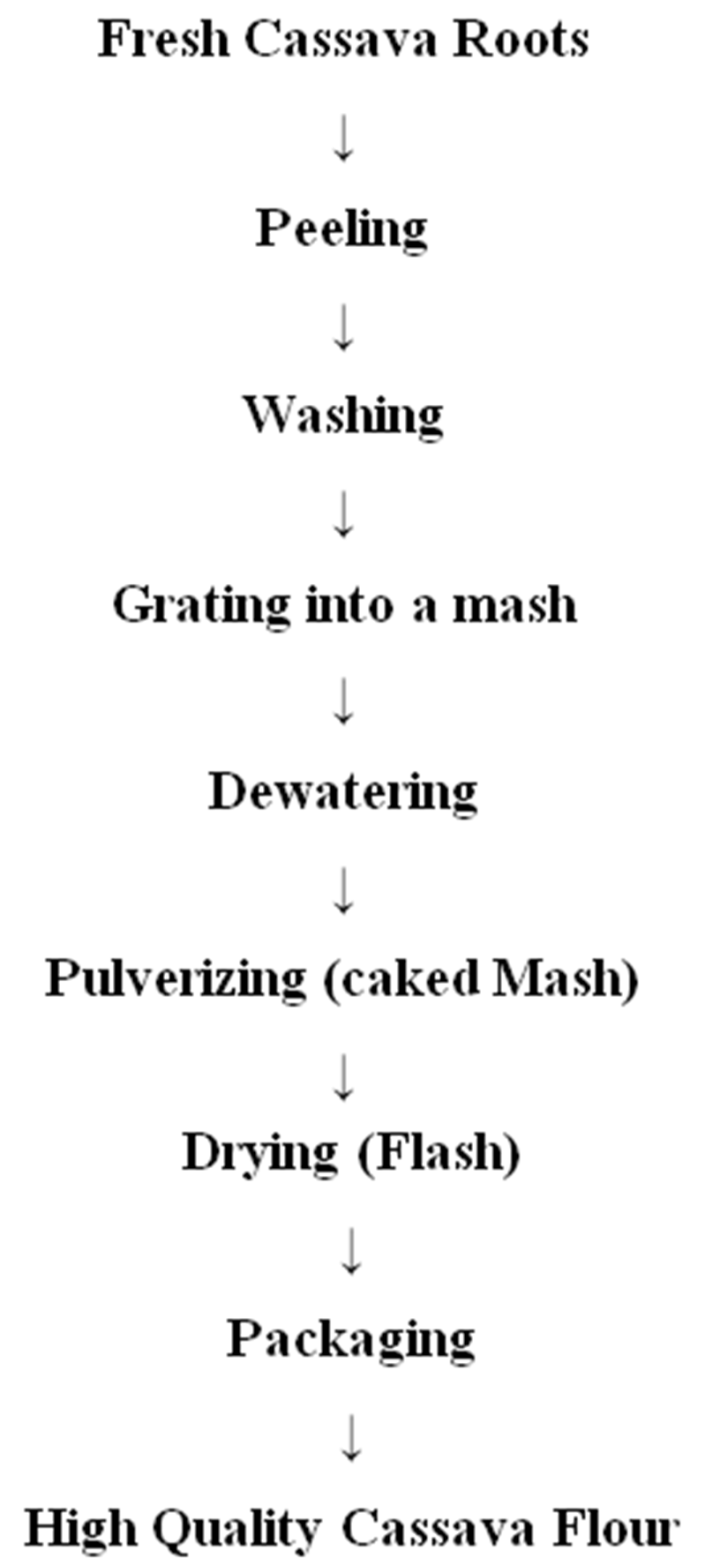
2.1. Production of Cassava FlourThe cassava tubers were processed into high quality cassava flour (HQCF) by the method of 10, as shown in Figure 1. The unit operations are harvesting, peeling, washing, grating, detoxification and dewatering, flash drying and packaging.

Other Baking materials: Wheat flour, sugar, fat, yeast and salt were purchased from a nearby local market.
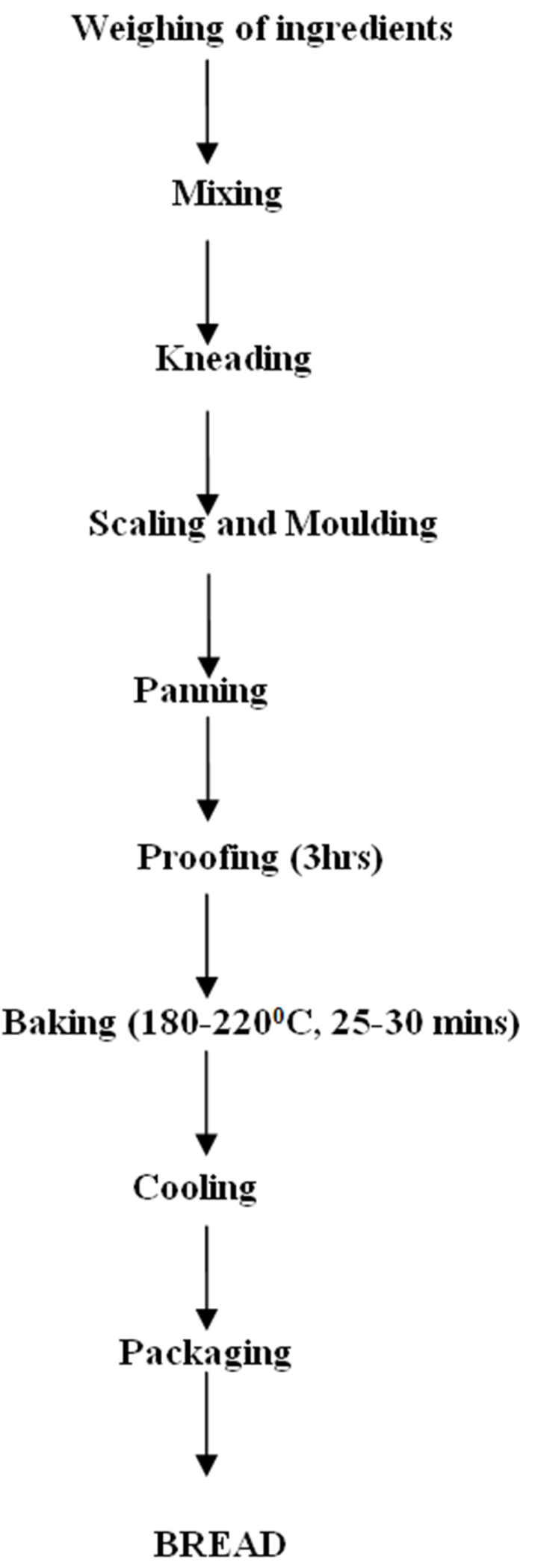
HQCF was incorporated in wheat flour for bread making at up to 20% level while the 100% wheat flour served as the control sample. Bread was produced by a straight dough method in which all the raw materials, according to the FIIRO formulation as shown in Figure 2, were mixed together with adequate quantity of water and optimally developed to form a smooth and pliable dough, followed by cutting and weighing to ensure size uniformity. The cut dough was moulded into desired shape and placed into greased baking pans to rest and ferment in a proofing chamber for about 3 hours at 30°C and 80% Relative Humidity, thereafter baking was done in a pre-heated oven at a temperature of 220°C for about 30 min, followed by cooling for about 2 hours at ambient conditions. The samples were kept on the shelf and withdrawals for texture tests made daily.

Compression, piercing and tensile or tearing tests were performed with a Universal texture testing machine (M500) by Testometric Company, UK. Each test was replicated and mean value taken.
Compression tests are suitable for determining several mechanical and rheological characteristics of different foods with respect to consumers. It is one of the most common texture assessment tests especially for food products, used to determine the effect of storage, drying, freezing, cooking and other treatments. The measurement of food firmness is generally performed by a precision penetrometer where the compression force is determined as the function of the deformation. Compression between 30 and 50 % are found to be suitable for the analysis of the elastic properties of food, on the basis of the stress-strain relationship with a compression/decompression cycle and from which the ratio of the recoverable work can be determined 11. Whole loaf of bread was placed between the attachment plates and allowed to compress to half height, i.e. 50%, at a test speed of 80mm/min. The force needed to achieve this compression (in Newton) was measured.
A flat metal strip attachment and a slice of the bread sample was used for this test. The attachment was allowed to pierce through the slice at a test speed of 30mm/min and sample surface span of 30mm and the maximum force at the point of piercing (i.e. force at peak in N) was determined.
A pulling attachment was used for this test. A rectangular strip of dimension 50×20×10mm, cut from a bread slice, was held at opposite ends of the attachment. The bread strip was thereafter pulled apart at a test speed of 50mm/min, the force needed to tear in Newton was recorded.
2.3. Statistical AnalysisThe resulting data were subjected to Analysis of Variance (ANOVA), while the means were separated using Tukey’s test. Significance was taken at p<0.05
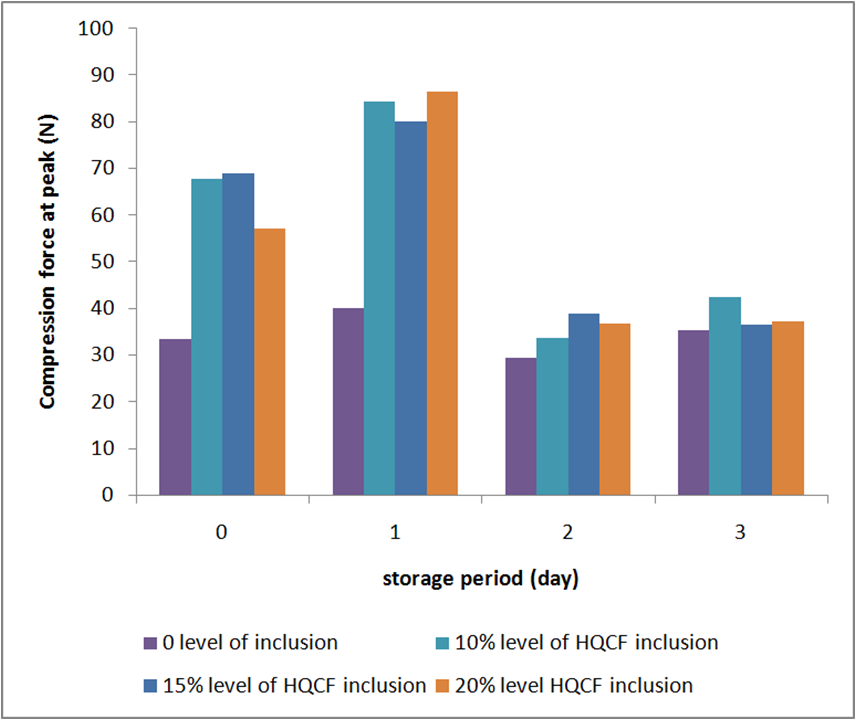
The compressive strength of cassava bread during storage is shown in Figure 3. Compression is the most important indicator of freshness of the product and involves the force required to compress the height of whole loaves to half, i.e. 50%. Compression force was found to be high on days 0 and 1 but reduced on days 2 and 3 in all the bread samples, showing that less force was required to compress the bread loaf and indicating some textural changes on days 2 and 3, however, there was not much variation with the different levels of cassava inclusion. Overall, control bread sample (having 0% cassava) had the least compression force even throughout the storage period, i.e. was softer and could easily be compressed.

The ANOVA for the compression test is presented in Table 1. The results showed no significant variation in compressive strength of bread samples with increasing level of cassava inclusion as well as during storage, from day 0 to 1 but the change were significant from day 2. This tends to suggest that storage time seems more critical to texture than the level of cassava inclusion and is responsible for the significant differences in compressive strength.
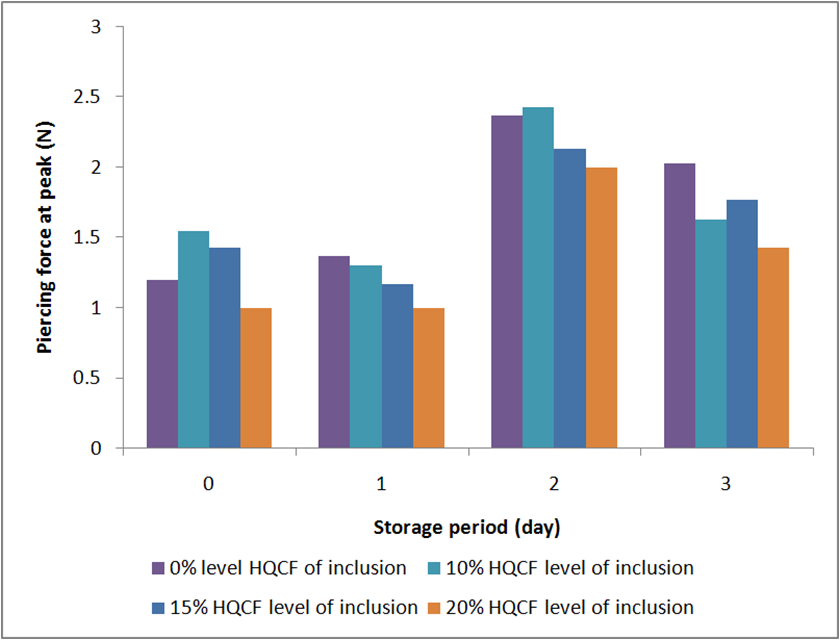
In terms of the force required to pierce through a slice of the bread sample (Figure 4) significant difference was recorded with increased cassava level as well as in time of storage. With cassava levels, 0%, 10% and 15% were not significantly different (p>0.05) but 20% was significantly different from the other samples in terms of piercing strength, while in terms of storage period, piercing strength on day 0 and day 1 showed no significant difference but day 2 and day 3 were significantly different (p<0.05) from the other days.
3.2. Piercing test of cassava breadThe ANOVA for piercing test (Table 2) showed significant difference (p<0.05) in the piercing strength of cassava bread with increased cassava inclusion at 20%. It was also observed that piercing strength of cassava bread on days 2 and 3 were significantly different from days 0 and 1. The force at peak is a measure of pressure builds up on the bread slice just before piercing through and is an indication of the sample softness or hardness. Higher piercing force figures recorded on days 2 and 3 implies a harder texture, requiring more force to pierce. It thus implies that days of storage as well as level of cassava inclusion affect piecing strength.


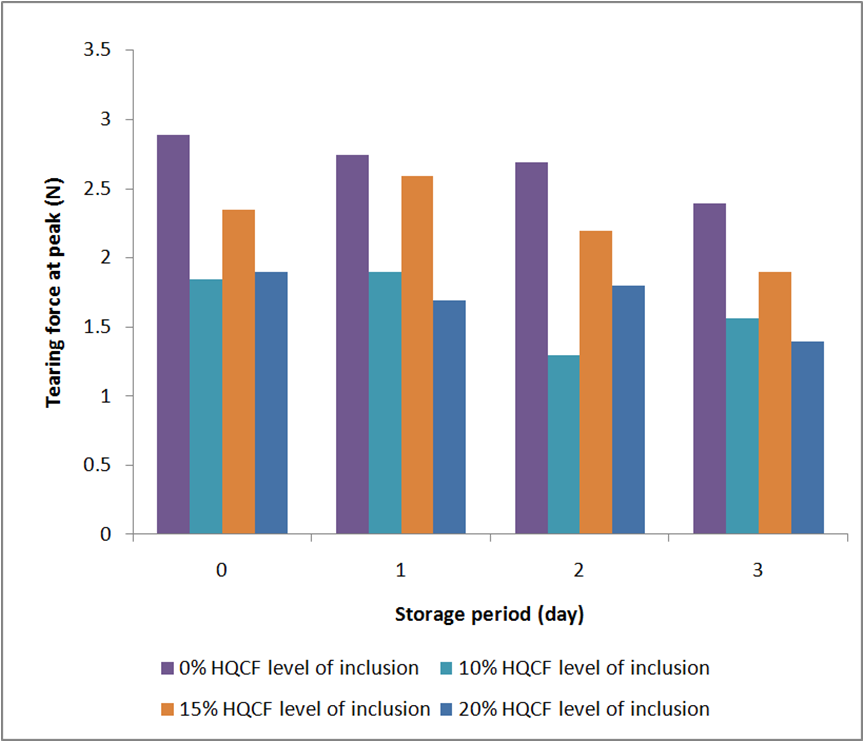
Figure 5 shows the tearing strength during storage of bread with different levels of cassava inclusion. Tearing force is used to assess the cohesiveness of components within a sample. The bread sample without HQCF inclusion had significantly higher tearing force, which decreased with storage days, compared with the other samples having different levels of HQCF inclusion. This can be attributed to the cohesiveness of the 100% wheat bread sample being enhanced by its inherent gluten strength. Decrease in tearing force is an indicator of loss of elasticity and freshness in bread. This finding is in agreement with the result of Majdi Al-Mahsaneh et al., 12.
In all the samples, there was significant variation in the values recorded on days 0 and 1 compared with those of days 2 and 3. With increase in storage time, however, bread containing 15% cassava level showed higher tearing force, implying retention of elasticity and freshness more than the 10 and 20% levels. This probably may be due to loss of intra-molecular attraction among the dough components, at those levels, since cohesiveness of bread measures the internal resistance of the food structure to external shear 13.
Comparing the F values at 0.05 for both cassava inclusion and storage time (Table 3), shows that significant difference exist in the tearing force of cassava bread with increasing levels of cassava inclusion and during the storage period. This implies that both inclusion of cassava and storage time affect tearing force.
On the whole, textural changes observed were not significant until day 2, i.e. the third day after baking and though the Control with no cassava was markedly different from the others, the cassava samples were comparable in texture. This confirms the work of Ibidapo et al, 14 and Osibanjo et al, 15 on the sensory quality of cassava bread and confectioneries having up to 20% level of inclusion who found no significant difference (p>0.05) among the test samples in terms of taste, texture, chewability, crust colour, crumb colour and overall acceptability. They reported that though the Control sample with no cassava had significantly higher scores for these attributes, the cassava samples also had high scores and were rated acceptable.
This study has been able to show that with respect to the texture characteristics of Cassava bread at up to 20% inclusion, no significant changes were recorded in compressive strength until day 2 of storage, i.e. the third day after baking and level of inclusion of cassava was not significant, i.e. the cassava samples were similar in response to compression. In terms of piercing strength, the 20% cassava bread was significantly different from the others and in terms of storage time, days 0 and 1 recorded lower values while days 2 and 3 had higher values in all the samples, implying a harder texture. With respect to tearing force, values on days 0 and 1 were similar but different from those on days 2 and 3 while 15% cassava level showed higher tearing force, implying retention of elasticity and freshness more than the 10 and 20% levels. On the whole, storage time seems more critical to texture in terms of compression than the level of cassava inclusion while both level of cassava inclusion and storage time seem to affect piercing as well as tearing strengths. Changes in texture became significant on the third day after baking; however, all the samples were still acceptable, implying that the inclusion of up to 20% cassava does not impair the texture of well packaged bread, kept for 3days under tropical ambient conditions.
| [1] | Wiesser Herbert (2007): Chemistry of gluten proteins. Food Microbiology 24(2): 115-119. | ||
| In article | View Article PubMed | ||
| [2] | Shewry P.R, D’Ovidio R, Lafiandra D, Jenkins J.A, Mills E.N.C, Bek´ es F. (2009). Wheat grain proteins. See Khan & Shewry 2009, pp. 223-98. | ||
| In article | View Article | ||
| [3] | Badifu G.I.O., C.E. Chima, Y.I. Ajayi, and A.F. Ogbori, (2005). Influence of mango mesocarp flour supplementation to micronutrient, physical and organoleptic qualities of wheat based bread. Nigerian Food Journal 23, 59-68. | ||
| In article | View Article | ||
| [4] | Mariotti M., Lucisano M., and Ambrogina Pagani M.,( 2006): Development of a baking procedure for the production of oat-supplemented wheat bread. International Journal of Food Science and Technology, vol. 41, no. 2, pp. 151-157. | ||
| In article | View Article | ||
| [5] | Australian Export Grain Innovation Centre (AEGIC), 2015. Global Grain Market Report Series. | ||
| In article | |||
| [6] | FAOSTAT. (2014): Food and Agriculture Organization of the United Nations. Retrieved August 5, 2014. | ||
| In article | |||
| [7] | Vimala Bai, Remadevi Thushara, Bala Nambisan and Janard Jaanardhanen Skumar (2010): Effect of processing on the retention of carotenoids in yellow fleshed cassava (Maniholt esculanta, Crantz) roots. Int. J. of Food Science and Technology, 46, 166-169. | ||
| In article | View Article | ||
| [8] | Food and Agricultural Organization Statistics (FAOSTAT) (2015): Consumption and Trade in Cassava Products. Trend of Cassava Production in Nigeria, from 1980- 2013. http://www.fao.org/faostat/en/#data/QC. | ||
| In article | |||
| [9] | Sanni L.O, Maziya-Dixo B, Akanya C.I, Alaya Y, Egwuonwu C.V, Okechukwu R.U, Ezedinma C, Akoroda M, Lemchi J, Ogbe F, Okoro E, Tarawali G,Mkumbira J, Patino M, Ssemakula G, Dixon A. (2005). Value addition to cassava in Africa: Challenges and Opportunities. Afr. Crop Sci. Conf. Proceed. 583-590. | ||
| In article | |||
| [10] | FIIRO (2008). Federal Institute of Industrial Research, Oshodi. Activities on Cassava Processing. pp. 2-43. | ||
| In article | |||
| [11] | Nussinovitch, A., M. S. Steffens and P. Chinachoti.: Elastic properties of bread crumb. Cereal Chemistry, 69, 578-681, 1992 | ||
| In article | |||
| [12] | Majdi Al-Mahsaneh , Mohannad Aljarrah, Taha Rababah, and Muhammad Alu’datt: Using MR-FTIR and Texture Profile to Track the Effect of Storage Time and Temperature on Pita Bread Staling. Journal of Food Quality Volume 2018, Article ID 8252570, 9 pages. | ||
| In article | View Article | ||
| [13] | Oliete B, Gomez, M. Pando, V. Fernandez-Fernandez, E. Caballero P.A. and Ronda F. (2008): Effect of Nut Paste Enrichment on Physical Characteristics and Consumer Acceptability of Bread. Food Sci Tech Int1 4(3): 259-269. ISSN: 1082-0132. | ||
| In article | View Article | ||
| [14] | Ibidapo Phebean Olubunmi, Kosoko Sulaimon Babatunde, Oluwole Oluwatoyin Bolanle, Saliu Olumide Seyioba, Latona-Tella Taiwo, Oloruntumise Ayodele Olukayode, Elemo Gloria Nwankego. (2015) Quality Evaluation of Fibre- Enriched Bread. Int. J of Nutri and Food Sci. Vol. 4, No. 4, pp. 503-508. | ||
| In article | View Article | ||
| [15] | Osibanjo A; Ibidapo P; Akpa C., Asiru B. and Elemo G. (2018). Production and Sensory Acceptability of Cassava - Based Confectionery Products. 1Vth International GCP21-IV Cassava Conference, 11th – 15th June, 2018, Cotonou Benin Republic. Poster presentation. | ||
| In article | |||
Published with license by Science and Education Publishing, Copyright © 2020 Osibanjo Adetokunbo. A, Ibidapo Phebean. O. and Elemo Gloria. N
 This work is licensed under a Creative Commons Attribution 4.0 International License. To view a copy of this license, visit
http://creativecommons.org/licenses/by/4.0/
This work is licensed under a Creative Commons Attribution 4.0 International License. To view a copy of this license, visit
http://creativecommons.org/licenses/by/4.0/
| [1] | Wiesser Herbert (2007): Chemistry of gluten proteins. Food Microbiology 24(2): 115-119. | ||
| In article | View Article PubMed | ||
| [2] | Shewry P.R, D’Ovidio R, Lafiandra D, Jenkins J.A, Mills E.N.C, Bek´ es F. (2009). Wheat grain proteins. See Khan & Shewry 2009, pp. 223-98. | ||
| In article | View Article | ||
| [3] | Badifu G.I.O., C.E. Chima, Y.I. Ajayi, and A.F. Ogbori, (2005). Influence of mango mesocarp flour supplementation to micronutrient, physical and organoleptic qualities of wheat based bread. Nigerian Food Journal 23, 59-68. | ||
| In article | View Article | ||
| [4] | Mariotti M., Lucisano M., and Ambrogina Pagani M.,( 2006): Development of a baking procedure for the production of oat-supplemented wheat bread. International Journal of Food Science and Technology, vol. 41, no. 2, pp. 151-157. | ||
| In article | View Article | ||
| [5] | Australian Export Grain Innovation Centre (AEGIC), 2015. Global Grain Market Report Series. | ||
| In article | |||
| [6] | FAOSTAT. (2014): Food and Agriculture Organization of the United Nations. Retrieved August 5, 2014. | ||
| In article | |||
| [7] | Vimala Bai, Remadevi Thushara, Bala Nambisan and Janard Jaanardhanen Skumar (2010): Effect of processing on the retention of carotenoids in yellow fleshed cassava (Maniholt esculanta, Crantz) roots. Int. J. of Food Science and Technology, 46, 166-169. | ||
| In article | View Article | ||
| [8] | Food and Agricultural Organization Statistics (FAOSTAT) (2015): Consumption and Trade in Cassava Products. Trend of Cassava Production in Nigeria, from 1980- 2013. http://www.fao.org/faostat/en/#data/QC. | ||
| In article | |||
| [9] | Sanni L.O, Maziya-Dixo B, Akanya C.I, Alaya Y, Egwuonwu C.V, Okechukwu R.U, Ezedinma C, Akoroda M, Lemchi J, Ogbe F, Okoro E, Tarawali G,Mkumbira J, Patino M, Ssemakula G, Dixon A. (2005). Value addition to cassava in Africa: Challenges and Opportunities. Afr. Crop Sci. Conf. Proceed. 583-590. | ||
| In article | |||
| [10] | FIIRO (2008). Federal Institute of Industrial Research, Oshodi. Activities on Cassava Processing. pp. 2-43. | ||
| In article | |||
| [11] | Nussinovitch, A., M. S. Steffens and P. Chinachoti.: Elastic properties of bread crumb. Cereal Chemistry, 69, 578-681, 1992 | ||
| In article | |||
| [12] | Majdi Al-Mahsaneh , Mohannad Aljarrah, Taha Rababah, and Muhammad Alu’datt: Using MR-FTIR and Texture Profile to Track the Effect of Storage Time and Temperature on Pita Bread Staling. Journal of Food Quality Volume 2018, Article ID 8252570, 9 pages. | ||
| In article | View Article | ||
| [13] | Oliete B, Gomez, M. Pando, V. Fernandez-Fernandez, E. Caballero P.A. and Ronda F. (2008): Effect of Nut Paste Enrichment on Physical Characteristics and Consumer Acceptability of Bread. Food Sci Tech Int1 4(3): 259-269. ISSN: 1082-0132. | ||
| In article | View Article | ||
| [14] | Ibidapo Phebean Olubunmi, Kosoko Sulaimon Babatunde, Oluwole Oluwatoyin Bolanle, Saliu Olumide Seyioba, Latona-Tella Taiwo, Oloruntumise Ayodele Olukayode, Elemo Gloria Nwankego. (2015) Quality Evaluation of Fibre- Enriched Bread. Int. J of Nutri and Food Sci. Vol. 4, No. 4, pp. 503-508. | ||
| In article | View Article | ||
| [15] | Osibanjo A; Ibidapo P; Akpa C., Asiru B. and Elemo G. (2018). Production and Sensory Acceptability of Cassava - Based Confectionery Products. 1Vth International GCP21-IV Cassava Conference, 11th – 15th June, 2018, Cotonou Benin Republic. Poster presentation. | ||
| In article | |||