Fruit juice production sector has been booming in Benin for a decade. The juice production enterprises seem to have both organisational and technical shortcomings. The objective of this study was to evaluate the manufacturing processes of the main fruit juices in South Benin in order to provide corrective measures for hygienic and technical shortcomings. The methodological approach consisted in a semi-structured survey coupled with direct observations of fifty (50) fruit juice producing enterprises. The assessed parameters were mainly related to good hygiene and production practices. These enterprises are located in the municipalities of Cotonou and Abomey-Calavi. At the end of this study, it was found that pure pineapple juice and pure ginger, tamarind and baobab nectars are the most produced mono-fruity juices. The production process for each of these juices is almost identical, except for the temperature/time pairing, which varies from one enterprise to another. On the other hand, the manufacturing process of poly-fruity juices is kept secret by the enterprises. Several technical and hygienic shortcomings relating to the five (05) potential sources of food contamination (raw material, environment, work method, labour and equipment) were noted. These deficiencies compromise the safety and salubrity of fruit juices produced in South Benin. Consumers of these juices are therefore permanently exposed to food poisoning and toxi-infection risks. The training of actors in fruit juice sector on hygienic and production practices is becoming urgent.
Fruits are food products with a high nutritional value. They are rich in vitamins, minerals, dietary fibers and other important natural molecules. For a healthy diet and better overall health, the Food and Agriculture Organization of the United Nations recommends a daily consumption of at least 400 grams of fruits 1. World fruit production in 2018 was estimated at 868 million tons (11 million tons in Africa) 2. Unfortunately, post-harvest losses reach up to 60% of fruit production in some african countries 3. To bypass this difficulty, the processing of fruit into juice is the best alternative used in West Africa.
In Benin, the fruit juice production sector is booming, particularly in the large districts. Thus, 4 showed that more than half of the fruit juice enterprises were created about five years ago in southern Benin. These fruit juice enterprises are mostly artisanal and have the same overall characteristics as those in West Africa. Indeed, the sub-Saharan agri-food sector is mostly composed of informal and artisanal micro and small enterprises that contribute to the development of local products and to poverty reduction 5. However, these fruit juice enterprises seem to have enormous organisational, technical and hygienic shortcomings due to their artisanal nature. In the food industry, non-respect of hygienic practices relating to raw materials, equipment, staff, methods and environment exposes foodstuffs to contamination by micro-organisms responsible for altering the marketable and sanitary quality of foodstuffs 6. Fruit juices produced under these conditions can therefore cause foodborne illness in consumers.
It is therefore imperative to reform the fruit juice production sector in Benin. To achieve this objective, reliable and recent data on the actors of fruit juice sector and the manufacturing process conditions are needed. It is in this context that the present study was carried out. Its objective was to (i) elaborate the manufacturing process of the major fruit juices produced in Southern Benin, (ii) identify the hygienic and technical shortcomings related to fruit juices production and finally (iii) propose corrective measures.
The present study was carried out in southern Benin, particularly in the municipalities of Abomey-Calavi (6˚26'9112 “N; 2˚21'3396 “E) and Cotonou (6˚21'9216 “N; 2˚25'0998 “E). These two municipalities contain the majority of fruit juice producing enterprises in southern Benin. Indeed, they are very close to Allada municipality, an area of large fruit production, particularly pineapple (Ananas cosmosus) in Benin 7.
2.2. Questionnaire DesignThis study was conducted from november 2020 to february 2021. It follows on from the work carried out by 4 in the same study area. Fifty fruit juice enterprises previously identified by 4 were involved in the present study. These included semi-industrial (05) and artisanal (45) enterprises. Different fruit juices census and their manufacturing processes evaluation was carried out by a semi-structured survey coupled with direct observations. All aspects of production were evaluated taking into account the five major sources of food contamination (raw material, equipment, method, hands and environment).
2.3. Data ManagementData from the survey forms and microbiological analysis were encoded using the Microsoft Excel 2013 spreadsheet for descriptive statistics (mean and Frequency and Percentage).
The types of juice encountered during our surveys are very diverse. Indeed, among the most common mono-fruity juices, we note pineapple (Ananas cosmosus) juice produced by almost all the enterprises surveyed (98%), baobab (Adansonia digitata) juice (56%), tamarind (Tamarindus indica) juice (44%) and ginger (Zingiber officinale) (38%) juice (Figure 1).

The manufacturing process of mono-fruit juices remains almost identical within all the enterprises surveyed, apart from the temperature/time pair, which varies from one producer to another. The main production stages of the different fruit juices are as follows:
Most of the producers met during this study do not have well-established specifications for the supply of their various raw materials. For pineapple speculation, a minority (28%) of juice producers have specifications drawn up with their suppliers/farmers. Those who do not have one go to the localities producing pineapples (Municipalities of Allada and Zè) or to the large markets of Cotonou and/or Abomey-Calavi. As for the other major raw materials (ginger rhizomes, baobab powder and tamarind pulp), the supply is also made in these markets.
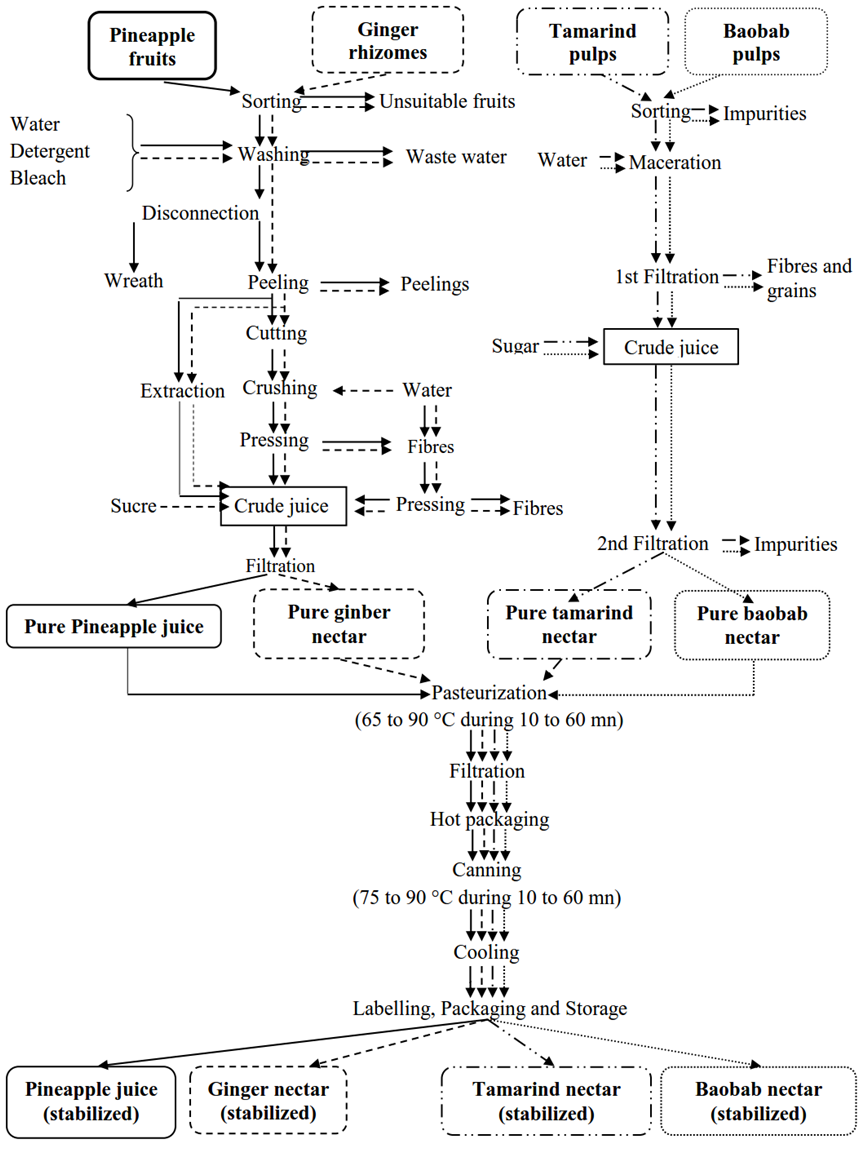
Figure 2 presents the different stages of production of the most produced mono-fruit juices in the study area, which are: pineapple, ginger, tamarind and baobab juices. The raw materials received (fruits, rhizomes and pulp) are sorted in order to remove unsuitable fruits (damaged fruits, not or too ripe) and other physical contaminants. The pineapple fruits and ginger rhizomes are then washed, uncrowned (pineapple) and peeled.

This is followed by cutting, grinding (with the addition of water in the case of ginger) and pressing, which are done either manually or mechanically depending on the size of the enterprises. Note that these steps are optional for enterprises with an extractor. The raw juice thus obtained is filtered through muslin cloths (after adding sugar in the case of ginger); we thus obtained pure pineapple juice and ginger nectar. As for tamarind and baobab, their pulp after sorting is macerated in water (cold infusion) then filtered to remove fibers and grains. Raw juice obtained are filtered a second time after adding sugar. Pure tamarind and baobab nectars are thus obtained. These four different juices or nectars obtained above then undergo the same unit operations, namely: pasteurization, hot packaging, canning, cooling, labeling, packaging and storage. Stabilized pineapple juice and stabilized nectars of ginger, tamarind and baobab are obtained and ready for sale. It should be noted that the production of poly-fruity juices calls for special knowledge generally kept secret by the producers. We were therefore unable to obtain convincing and detailed information on the production of cocktails during this study.
Upon arrival at the production unit, fruits with a high-water content ( pineapple), assumed to be picked at good maturity (M2 in most cases) are directly treated to avoid fermentation. This is not the case for fruits with a low water content (ginger rhizomes, tamarind and baobab pulp) which can be stored at room temperature for a few days or weeks.
In addition, the temperature and time of pasteurization and canning differ from one producer to another. However, professional secrecy obliges our respondents to remain silent, especially for the production of poly-fruit juices. This is because they are in the race for a possible product patent or professional secrecy in order to avoid an identical reproduction.
Waste from production is managed in different ways by establishments producing fruit juices (Table 1). In fact, 72% of these establishments subscribe to the Waste Management and Sanitation Company of Grand-Nokoue (SGDS-GN), a state-owned company. The rest of these establishments (24%) exclusively use solid waste consisting mainly of peelings, fibers, crowns, grains, etc., for pig feed and/or composting. The nature and management of garbage cans by establishments is incompletely done. Less than half of the surveyed enterprises have a sewer network allowing the evacuation of waste water and only 44% have a warehouse for finished products, most of which are poorly managed.
The juices thus produced are stored either in a corner of the production hall or in another compartment on the floor before another production without taking into account that exposure to light and temperature fluctuations during storage may have drawbacks on the nutritional quality of the juices; which will lead to reduced product life 8.
3.2. Points of Hygienic Dissatisfaction and Proposal of Corrective MeasuresCompliance with hygiene rules and mastery of the various processing operations in the food industry are very important factors in the prevention of foodborne diseases. Failure to comply with these rules exposes consumers to the risk of food poisoning. On the one hand, to the production diagrams used by fruit juice producers in the study area (Cotonou and Abomey-Calavi), and on the basis of our own observations, certain shortcomings on a hygienic and technical level have been noted. These shortcomings are grouped into five categories relating to the five major sources of food contamination (5M) which are: equipment, environment, workforce, raw material and production method are presented as follows:
This study revealed that the equipment used by the producing enterprises is only intended for the production of fruit juices despite the fact that these enterprises are mainly installed at home. However, the most important point of dissatisfaction at this level is the unsuitability of the production equipment from a hygienic and technical point of view. Indeed, most enterprises that do not have a stainless-steel worktop for peeling and cutting fruit, use wooden tables, iron tables painted with oil paint or tiled benches. The crumbling of these work surfaces constitutes a permanent source of physical, chemical and microbiological contamination of fruit juices during production. In addition, the embedding of production residues, water and other waste in the crevices generated by the crumbling of materials creates an environment favorable to the proliferation of pathogenic microorganisms that can affect the healthiness and safety of the finished product. In artisanal businesses, grinding is mainly done using mortar and wooden pestle or bottles. Some enterprises use basins or pots in the absence of mortar. These practices are a source of contamination because the use of wooden materials is not recommended. Also, the crushers, presses and extractors available in some enterprises, although they can be dismantled, do not benefit from an adequate cleaning and maintenance program; their cleaning is done before and after each production often by simple rinsing or by the use of cleaning products. However, well-designed hygiene requires effective and regular cleaning and disinfection of facilities and equipment to eliminate food residues that could contain microorganisms capable of causing food poisoning and product deterioration.
Therefore, in order to guarantee the healthiness and safety of the fruit juices produced, these enterprises are required to use adequate equipment in order to considerably reduce the risk of contamination. They must use stainless steel equipment suitable for the production of fruit juices as well as machines that can be dismantled and easily cleaned. These enterprises must also have a regular maintenance program for production materials and equipment. The products used for cleaning and disinfection must be authorized in the food industry and their use must be controlled in order to avoid any risk of chemical contamination
The design of the building and the premises as well as their maintenance have a considerable impact on the management of good hygiene practices in the food industry. In principle, production units should be designed in such a way as to avoid any risk of contamination as much as possible while respecting forward movement. However, most of the businesses involved in this study being home-based do not meet building design standards. The surfaces of the premises such as the walls, floors, openings and ceilings as well as the junctions of these enterprises are not in line with the standards relating to the design and layout of premises in the food industry. This makes cleaning/disinfection operations difficult or even impossible. Also, some enterprises do not have a specific framework that can serve as a processing unit. All fruit juice production operations are therefore carried out in the courtyard in the open air or under straw huts.
Faced with these shortcomings, these enterprises are required to install their production units far from sources of contamination. The design of the premises must respect the principle of forward motion to avoid any risk of cross-contamination. The walls, floors, ceilings and others must also be designed in such a way as to facilitate their cleaning.
The staff is the most important link in the hygiene control program in the food industry insofar as food contamination comes mainly from contact with fecal matter or micro-organisms transmitted by contact with hands, surfaces contaminated cookware and utensils, soil on the floor, or poorly cleaned crockery and cutlery 9.
Personal hygiene takes into account personal hygiene, hand hygiene, cleanliness and suitability of production clothing. However, in this study, only a minority of enterprises have staff hygiene that meets the standards. In most enterprises, the availability of changing rooms and the wearing of a coat with a long sleeve, mouth-nose masks, caps, shoes and gloves during production is not respected. In addition, hand washing is not done frequently due to the unavailability of hand washing stations within the processing units. While frequent hand washing with soap before handling food, after using the toilet, after blowing your nose, after contact with raw food and after handling waste is the surest way to prevent spread of pathogenic germs.
As corrective measures, we suggest that enterprises have hand washing stations within processing units for washing and disinfecting hands and gloves, then for cleaning hands following unclean operations. Also, anyone having direct or indirect contact with food and production equipment must have appropriate clothing.
The majority of fruit juice producers do not have fixed suppliers of raw materials. They do not have specifications relating to the different raw materials they use. Indeed, the specification is a contractual document between the producer and its supplier which defines the quantitative and qualitative criteria in relation to the raw material as well as the delivery conditions. Having a specification has the advantage of allowing the producer to precisely obtain a raw material that meets his requirements and expectations. Producers who do not have specifications find themselves faced with a number of inconveniences. Thus, when the fruits delivered are overripe, the producers are forced to start a new production to prevent them from rotting, thus disrupting their production program. Conversely, when the fruits delivered do not reach the desired maturity, production is delayed by a few days. Some producers, who cannot afford to modify their production program in view of market demand and the delivery commitments made, are forced to start production with the insufficient quality raw material delivered to them. One of the consequences of this situation is the variation in the organoleptic characteristics of the juices produced by the same company; which can lead to customer dissatisfaction and, in the long term, to poor sales with all these corollaries. The fact that there are no pre-established specifications forces the producer to accept the raw material delivered to him. In this case, they are often required to change suppliers regularly. Also, for the raw material purchased on the market, under the pressure of orders, producers find themselves forced to buy what is available on the market. The transport of the raw material from the place of supply to the place of production is done, within the majority of the enterprises surveyed, by means of public vehicles (city taxi). This practice constitutes a source of microbial contamination due to the presence of microorganisms in these vehicles and their ambient environment 10. In addition, these vehicles being means of public transport, are also potential sources of physical and chemical contamination because they are ready to transport all kinds of products. The establishment of specifications with suppliers is therefore very important because it is up to the producer to receive the raw material in good conditions.
Compliance with the rules of good manufacturing practices is based on compliance with the various production parameters, because any technological operation involved in the food production chain presents a risk of contamination. The different stages of fruit juice production in the study area have many shortcomings. We found that in most of the surveyed enterprises, the fruits received are stored on the floor or on mats made from jute bags where they undergo the sorting operation. This operation consists in selecting the appropriate fruits suitable for processing. This operation can be a source of physical contamination (debris, stones and various impurities) of the raw material with the origin of the means of transport or the storage conditions. Thus, the importance of the specifications also comes into play at this stage because the raw material obtained without specifications carries a greater risk of being contaminated. The selected fruits then go to the washing stage which aims to considerably reduce the microbial load and to rid the fruits of all impurities. In the majority of surveyed enterprises, the washing operation is done with water from drilling or wells with or without sodium hypochlorite and/or powder or liquid detergents whose concentrations are not respected. The fruits, after washing, are not properly rinsed. These practices have a negative impact on the sanitary quality of the produced juices because the use of sodium hypochlorite and detergents for washing fruits can lead to the presence of toxic residues in the manufactured product. Indeed, apart from the use of pesticides, insecticides or rodenticides in the fields, which can be the basis of the presence of toxic residues in food, failure to master the various transformation processes can also lead to presence of toxic residues in the food due 11. Some fruit juice producers believe that the use of sodium hypochlorite, being authorized for washing fruit in the food industry, does not present any risk of poisoning while ignoring that a non-quantified use of these products and a bad rinsing can lead to the presence of residues in the fruit juice. Note that the ingestion of sodium hypochlorite can cause irritation in the digestive tract 12. The point of hygienic dissatisfaction noted with respect to the use of water from boreholes or wells used for washing fruits by our respondents is the absence of an adequate treatment program for these types of water before use. According to the French Food Safety Agency (AFSSA), when the water used in a processing unit comes from a resource specific to the establishment (well, borehole, surface water), it is necessary to have a treatment program and the implementation of measures to control the dangers inherent in its manufacture and its distribution within the establishment. This is not the case in these enterprises which do not provide any adequate treatment to the water before its use on the pretext that the juices extracted from the fruits will undergo heat treatments which will allow the complete elimination of the potential present pathogenic germs.
The peeling/cutting, grinding and pressing/filtration operations in the majority of the surveyed enterprises also contain shortcomings in terms of hygiene. In fact, in small-scale businesses, the crushing of pineapple is mainly done using a mortar and wooden pestle or bottle. The fruits slices are inverted in small quantities in a mortar and crushed using a pestle before being pressed and filtered. Some enterprises use basins or pots in the absence of mortar. These practices are a source of contamination because, throughout the grinding process, the slices of fruit are exposed to the open air and could be contaminated by dust, flies and other parasites. These enterprises, given their size, do not have the possibility of processing in large quantities. Thus, the cut fruits are stored in basins or plastic buckets while waiting to be crushed. Prolonged contact of fruit with these containers increases the risk of chemical contamination due to residues of cleaning products, and microbiological due to the fact that these same containers are used at all levels of the production chain.
After filtration, the juices obtained undergo the stages of pasteurization and canning after being packaged. Indeed, pasteurization is a heat treatment intended to destroy non-spore forming pathogenic flora and the majority of non-pathogenic food spoilage flora at a temperature below 100°C for 15 to 20 minutes 13. Canning, on the other hand, is a heat treatment that consists of destroying most of the microorganisms, spores and possible toxins initially present in a food at a temperature above 100°C 14. However, non-compliance with the temperature/time couple is the main danger of these unit operations because this couple varies from one producer to another. Indeed, the lack of mastery of the temperatures and times of the heat treatments observed at the level of the craft enterprises especially, results in the lack of knowledge of the actors of these enterprises in the field of the production of fruit juices. These shortcomings have serious consequences on the health quality of fruit juices and, indirectly, on the consumers health . The actors of these enterprises claim to have followed additional training in the production of fruit juices which, in reality, are uncertified training, followed on the job. Although canning destroys most spores, some have the ability to withstand canning heat treatments. Spores surviving these treatments are highly heat resistant and are usually produced by thermophilic bacteria 14. Therefore, molds that have contaminated pasteurized fruit juice have the ability to resist against heat treatment, and can survive at room temperature during storage. It should be noted that more than half of the enterprises surveyed are to be congratulated for respecting the principle of forward motion. However, the real problem is non-compliance with hygiene rules.
Another crucial point of hygienic insufficiency remains the effective cleaning of recycled beer bottles which are used by almost all enterprises. By the way, access to new bottles is a real problem in our country; because these bottles, in addition to their high cost, are not available in sufficient quantity to satisfy demand. This forces fruit juice producers to turn to the use of recycled bottles from Nigeria, Burkina Faso and some local bars and restaurants. However, given their level of insalubrity which does not offer enough guarantee, these bottles must be properly washed. This is not always the case in some enterprises taken into account in our study.
As corrective measures, we suggest that enterprises avoid storing raw materials directly on the ground. Borehole or well water must be treated before use. Recycled bottles used for packaging juices must be properly washed and sterilized; producers must opt for the use of new bottles. During production, the temperature/time couple must be respected.
This study on fruit juice production in southern Benin provides important data for restructuring the sector. This study revealed that a pure pineapple juice and ginger, tamarind and baobab nectars are the most produced mono-fruity juices. The production process for each of these juices is almost identical, except for the temperature and time, which varies from one enterprise to another. The manufacturing process of poly-fruity juices is kept secret by the enterprises. Several technical and hygienic shortcomings relating to the five potential sources of food contamination (raw material, environment, work method, labour and equipment) were noted. These deficiencies compromise the safety and healthiness of fruit juices produced in South Benin. Consumers of these juices are therefore permanently exposed to food poisoning and toxi-infection risks. The training of actors in fruit juice sector on hygienic and production practices is becoming urgent.
The authors thank the fruit juice enterprises involved in this study and researchers of Laboratory of Microbiology and Food Technology (Abomey-Calavi University) for their assistance.
The authors have not declared any conflict of interests.
This study was funded by the authors.
| [1] | Food and Agriculture Organisation (FAO), L’État de la sécurité alimentaire et de la nutrition dans le monde 2020, Transformer les systèmes alimentaires pour une alimentation saine et abordable. Rome, 2020, 352p. | ||
| In article | |||
| [2] | Food and Agriculture Organisation (FAO), Fruits et legumes éléments essentiels de ton alimentation. Année internationale des fruits et des legumes. Note d’information, Rome, 2021, 94p. | ||
| In article | |||
| [3] | Comité de Liaison Europe-Afrique-Caraïbes-Pacifique (COLEACP), L’industrie des fruits et légumes : Tendances et perspectives d’un secteur dynamique. Union Européenne-ACP, 2021, 9p. | ||
| In article | |||
| [4] | Noumavo, A.P., Ohin, M.A.B., Dognon, A.Y., Houessou, S.K., Aide, E.S. and Baba-Moussa, F., “Fruit Juice Production in Abomey-Calavi and Cotonou Municipalities (Benin): Socio-Professional Profile of Actors and Adoption Level of Hygienic Practices of Enterprises”, Food and Nutrition Sciences, 13, 649-668. 2022. | ||
| In article | View Article | ||
| [5] | Mutarushwa, J.S., “Analyse du secteur agroalimentaire et perception du climat des affaires des micro et petites entreprises au Sud-Kivu”, Thèse de Doctorat, Université de Liège, Belgique, 264p, 2022. | ||
| In article | |||
| [6] | Fetiti, A., Foumdi, B., Kadir, A. and Khaoua, H., “Qualité microbiologique des épices commercialisées dans la Wilaya d’el-Oued”, Mémoire de Master, Université Echahid Hamma Lakhdar EL-OUED, Algérie, 54p, 2022. | ||
| In article | |||
| [7] | Institut National de la Statistique et de l’Analyse Économique (INSAE), “Monographie de la filiere de l’ananas au Bénin”, Ministère du plan et du développement, Benin, 45p, 2020. | ||
| In article | |||
| [8] | Kirati, N., “Influence des conditions de stockage sur la qualité physicochimique et microbiologique des jus de fruits frais non pasteurises”, Mémoire de Master, Université 8 Mai 1945, Guelma. Algérie, 62p, 2019. | ||
| In article | |||
| [9] | Bigson, K., Essuman, K.E. and Lotse, C.W., “Food Hygiene Practices at the Ghana School Feeding Programme in Wa and Cape Coast Cities”, Journal of Environmental and Public Health, 7p, 2020. | ||
| In article | View Article PubMed | ||
| [10] | Nemer, A.Z.C., Benseghir, R.I., “Analyse physico-chimiques et microbiologiques d’un jus IFRUIT, commercialisé au niveau de la Wilaya”, Mémoire de Master, Centre Universitaire Belhadj Bouchaib d’Aïn-Témouchent, Algérie, 53p, 2019. | ||
| In article | |||
| [11] | Bonne, R., La gestion globale de l’hygiène dans les IAA : une méthode de facilitation pour la mise en œuvre des prescriptions d’hygiène du codex alimentarius. Académie Vétérinaire de France, 101-108, Tome 166, n°2, 2013. | ||
| In article | View Article | ||
| [12] | Camus, D., Gehanno, J.F., Pozzetto, B., Aho-Glele, S., Lepelletier, D., Hartemann, P., Roubaty, J.L., Squinazi, F., Eterradossi, N., Salvat G. and Berger-Carbonne A., “Avis relatif à l’opportunité d’un nettoyage spécifique ou d’une désinfection de l’espace public”, Haut Conseil de la santé Publique, 12p, 2020. | ||
| In article | |||
| [13] | Petruzzi, L., Campaniello, D., Speranza, B., Corbo, M.R., Sinigaglia, M. and Bevilacqua, A., “Thermal Treatments for Fruit and Vegetable Juices and Beverages: A Literature Overview”, Comprehensive Reviews in Food Science and Food Safety, 16, 668-691, 2017. | ||
| In article | View Article PubMed | ||
| [14] | Malleck, T., “Mécanismes d’adaptation de Moorella thermoacetica/thermoautotrophica sur les lignes de production de produits alimentaires appertisés”, Thèse de doctorat. Université d’Avignon, France.247p d’Ain Témouchent. Mémoire de master, Centre Universitaire Belhadj Bouchaib d’Aïn-Témouchent, Algérie, 53p, 2017. | ||
| In article | |||
Published with license by Science and Education Publishing, Copyright © 2022 Agossou D. P. Noumavo, Haziz Sina, Noel Tovide, D’Avila Y. Dognon, Stéphane K. Houessou, Christian T. R. Konfo, Epiphane Hossou, Fatiou Toukourou and Farid Baba-Moussa
 This work is licensed under a Creative Commons Attribution 4.0 International License. To view a copy of this license, visit
http://creativecommons.org/licenses/by/4.0/
This work is licensed under a Creative Commons Attribution 4.0 International License. To view a copy of this license, visit
http://creativecommons.org/licenses/by/4.0/
| [1] | Food and Agriculture Organisation (FAO), L’État de la sécurité alimentaire et de la nutrition dans le monde 2020, Transformer les systèmes alimentaires pour une alimentation saine et abordable. Rome, 2020, 352p. | ||
| In article | |||
| [2] | Food and Agriculture Organisation (FAO), Fruits et legumes éléments essentiels de ton alimentation. Année internationale des fruits et des legumes. Note d’information, Rome, 2021, 94p. | ||
| In article | |||
| [3] | Comité de Liaison Europe-Afrique-Caraïbes-Pacifique (COLEACP), L’industrie des fruits et légumes : Tendances et perspectives d’un secteur dynamique. Union Européenne-ACP, 2021, 9p. | ||
| In article | |||
| [4] | Noumavo, A.P., Ohin, M.A.B., Dognon, A.Y., Houessou, S.K., Aide, E.S. and Baba-Moussa, F., “Fruit Juice Production in Abomey-Calavi and Cotonou Municipalities (Benin): Socio-Professional Profile of Actors and Adoption Level of Hygienic Practices of Enterprises”, Food and Nutrition Sciences, 13, 649-668. 2022. | ||
| In article | View Article | ||
| [5] | Mutarushwa, J.S., “Analyse du secteur agroalimentaire et perception du climat des affaires des micro et petites entreprises au Sud-Kivu”, Thèse de Doctorat, Université de Liège, Belgique, 264p, 2022. | ||
| In article | |||
| [6] | Fetiti, A., Foumdi, B., Kadir, A. and Khaoua, H., “Qualité microbiologique des épices commercialisées dans la Wilaya d’el-Oued”, Mémoire de Master, Université Echahid Hamma Lakhdar EL-OUED, Algérie, 54p, 2022. | ||
| In article | |||
| [7] | Institut National de la Statistique et de l’Analyse Économique (INSAE), “Monographie de la filiere de l’ananas au Bénin”, Ministère du plan et du développement, Benin, 45p, 2020. | ||
| In article | |||
| [8] | Kirati, N., “Influence des conditions de stockage sur la qualité physicochimique et microbiologique des jus de fruits frais non pasteurises”, Mémoire de Master, Université 8 Mai 1945, Guelma. Algérie, 62p, 2019. | ||
| In article | |||
| [9] | Bigson, K., Essuman, K.E. and Lotse, C.W., “Food Hygiene Practices at the Ghana School Feeding Programme in Wa and Cape Coast Cities”, Journal of Environmental and Public Health, 7p, 2020. | ||
| In article | View Article PubMed | ||
| [10] | Nemer, A.Z.C., Benseghir, R.I., “Analyse physico-chimiques et microbiologiques d’un jus IFRUIT, commercialisé au niveau de la Wilaya”, Mémoire de Master, Centre Universitaire Belhadj Bouchaib d’Aïn-Témouchent, Algérie, 53p, 2019. | ||
| In article | |||
| [11] | Bonne, R., La gestion globale de l’hygiène dans les IAA : une méthode de facilitation pour la mise en œuvre des prescriptions d’hygiène du codex alimentarius. Académie Vétérinaire de France, 101-108, Tome 166, n°2, 2013. | ||
| In article | View Article | ||
| [12] | Camus, D., Gehanno, J.F., Pozzetto, B., Aho-Glele, S., Lepelletier, D., Hartemann, P., Roubaty, J.L., Squinazi, F., Eterradossi, N., Salvat G. and Berger-Carbonne A., “Avis relatif à l’opportunité d’un nettoyage spécifique ou d’une désinfection de l’espace public”, Haut Conseil de la santé Publique, 12p, 2020. | ||
| In article | |||
| [13] | Petruzzi, L., Campaniello, D., Speranza, B., Corbo, M.R., Sinigaglia, M. and Bevilacqua, A., “Thermal Treatments for Fruit and Vegetable Juices and Beverages: A Literature Overview”, Comprehensive Reviews in Food Science and Food Safety, 16, 668-691, 2017. | ||
| In article | View Article PubMed | ||
| [14] | Malleck, T., “Mécanismes d’adaptation de Moorella thermoacetica/thermoautotrophica sur les lignes de production de produits alimentaires appertisés”, Thèse de doctorat. Université d’Avignon, France.247p d’Ain Témouchent. Mémoire de master, Centre Universitaire Belhadj Bouchaib d’Aïn-Témouchent, Algérie, 53p, 2017. | ||
| In article | |||