 OPEN ACCESS
  PEER-REVIEWED
Review on the Potential Use of Near Infrared Spectroscopy (NIRS) for the Measurement of Chemical Residues in Food
Ernest Teye1, 2, , Xing-yi Huang1, Newlove Afoakwa3
1School of Food and Biological Engineering, Jiangsu University, Jiangsu, P. R. China
2School of Agriculture, Department of Agricultural Engineering, University of Cape Coast, Cape Coast, Ghana
3School of Applied Science and Arts, Bolgatanga Polytechnic, Sumbrungu, Upper East Region, Ghana
Abstract
Near infrared spectroscopy (NIRS) technique as an advance innovative technology has come to stay in food, chemical, pharmaceutical, petrochemical industries. This technology coupled with the development of chemometric techniques has become a powerful, fast, reliable and non-destructive analytical tool for the measurement of qualitative and quantitative properties in organic materials. This review paper focuses on the potential application of NIRS as an advance analytical tool for the determination of harmful chemical residues in food materials. The results of rich studies conducted previously revealed that the application of NIRS technique was successful in detecting and to some extent measure harmful chemical residues such as Agro-chemicals and Mycotoxins in foods. It was however observed that, NIR spectroscopy had poor sensitivity in quantifying chemical residues in food materials. It can therefore be concluded that there is the need to work towards the advancement of this tool for accurate measurement of chemical residues in food. This tool has a far reaching merit as an initial tool for detecting and sorting of food product with and without harmful chemical residues. NIRS advance analytical tool was found to be quick, non-destructive & semi-destructive, low cost and environmentally friendly in relation to the reference antecedent methods such as HPLC, HTLC, GC-MS and ELISA in the classification of food commodities with and without harmful chemical residue.
At a glance: Figures
Keywords: non-destructive, chemical residue, NIRS, agro-chemicals, mycotoxins
American Journal of Food Science and Technology, 2013 1 (1),
pp 1-8.
DOI: 10.12691/ajfst-1-1-1
Received January 09, 2013; Revised April 29, 2013; Accepted May 01, 2013
Copyright © 2013 Science and Education Publishing. All Rights Reserved.Cite this article:
- Teye, Ernest, Xing-yi Huang, and Newlove Afoakwa. "Review on the Potential Use of Near Infrared Spectroscopy (NIRS) for the Measurement of Chemical Residues in Food." American Journal of Food Science and Technology 1.1 (2013): 1-8.
- Teye, E. , Huang, X. , & Afoakwa, N. (2013). Review on the Potential Use of Near Infrared Spectroscopy (NIRS) for the Measurement of Chemical Residues in Food. American Journal of Food Science and Technology, 1(1), 1-8.
- Teye, Ernest, Xing-yi Huang, and Newlove Afoakwa. "Review on the Potential Use of Near Infrared Spectroscopy (NIRS) for the Measurement of Chemical Residues in Food." American Journal of Food Science and Technology 1, no. 1 (2013): 1-8.
| Import into BibTeX | Import into EndNote | Import into RefMan | Import into RefWorks |
1. Introduction
The ever changing world with increasing population is researching into quick, reliable and accurate techniques for the determination of food quality. NIR as a non-destructive technology has come to provide the solution. Various studies revealed that non-destructive methods have come to stay with promising results and its application runs through all fields of science.
Near Infrared spectroscopy has taken its place among other proven spectroscopic tools, especially for determining chemical and physical properties of foods and food products [1]. The technique has shown continuous growth after its first introduction with a short history from 1905. NIR spectroscopy is currently known and used in many fields such as Medicine, Agriculture, Textiles, Pharmaceuticals and Cosmetics, with a promising success. NIR spectra are obtained as a result of relatively weak, broad overtones and combination bands of fundamental vibrational transitions associated basically with C-H, N-H, and O-H functional groups [2]. Also according to Roggo et al. [3] NIR spectroscopy covers the transition from the visible spectral range (800-2500nm) to the mid infrared region (12821-4000 cm-1). Countless number of publications have described and stated that NIRS coupled with chemometrics provide an effective means of qualitative and quantitative determination or analysis of various properties in many fields. This technique is quick, reliable, accurate and low cost. It has the potential for the determination of other compounds [4]. Other researchers used NIRS to determine other important compounds some of which are; antioxidant activity [5] adulterants in raw milk ([6], ochratoxin producers and non producers [7], low concentration of preservatives [8], kernel rot & mycotoxins [9] etc. All these therefore revealed that NIRS has the potential for the determination of harmful chemical residues in foods hence this review set out to investigate further.
Currently, harmful chemical residues in foods have been of great concern for researchers, consumers, industries and policymakers. These chemical residues mostly found in foods and food materials are Agro-chemicals namely; herbicides, fungicides, pesticides, nematicides and insecticides. Also veterinary drugs and mycotoxins are also harmful residues because they also leave chemical residues in foods. All these chemicals have their maximum residual limit (MRL) beyond which it is known to be lethal. Many studies have shown that these chemical residues have various consequences such as; carcinogenic, mutagenic [10] also may exert genotoxic, and endocrine effects on consumers [11]. There is no need of eating if the food will kill you slowly or immediately. Hence the need to use the best analytical method to predict accurately food quality by taking into consideration all aspects of food such as nutrient content and the level of harmful chemical residue. Non-destructive measurement of food quality is no doubt an excellent piece of innovation that has far reaching advantages compared to the normal traditional way of the determination of food quality..
Many research papers on the analysis of chemical residues in foods and food materials have been reported with classical detection results but these are all destructive with the accompanying disadvantages such as: very expensive (chemical involved), time consuming, environmentally unfriendly and require well trained personnel and advance laboratory. To overcome these bottlenecks, various nondestructive procedures have been used for other food quality parameters with anticipation that, they can also have the potential for determining harmful residues in foods and food materials. Therefore this review critically seeks to find out the potential application of non-destructive technique using Near Infrared spectroscopy (NIRS) for quick, reliable and accurate analysis of harmful chemical residues in food materials.
2. Chemical Residue Mostly Identified in Foods
2.1. Agro-ChemicalsAlmost every industry in the world depends directly or indirectly on agriculture, therefore the need to increase production. Nearly after the World War II, the use of chemicals for food production increased as a result of high food demand. This approach happened to solve the problem by resulting in an increase in food production; however it also led to the rising of other problems such as environmental pollution with its diverse consequences, and occurrence of harmful chemical residues in soil, water bodies and food materials. The main threat to food safety is the chemical residues that contaminate food through the various channels then to consumers. These chemicals include; veterinary drugs, pesticides, hormones, herbicides, fungicides, toxins, overuse of food additives and contamination of heavy metals; trace elements.
The residues when ingested are known to cause harmful effect to humans such as teratogenic, carcinogenic, mutagenic effects, allergic reaction and sometimes death [12, 13]. In the food production process, raw materials are subjected to a series of procedures such as mechanical handling, processing, packaging and transportation before finally being sold to the customers [13]. It is therefore easy for chemical contamination to occur if any part of this process uses unscientific or unsuitable method. Consumers want and need to eat food devoid of chemical residues or feel safe when food is eaten therefore there have been various maximum residual limit permitted in food materials. However, how to determine these chemical residues quickly and with less cost has become a mirage. Specific chemical residue mostly identified in foods which are of agricultural origin includes; tetracycline found in milk [14], penicillin and cloxacillin in raw milk [15], Carbendazim, malathion, iprodione, quincloracand tricyclazole are found in rice whiles buprofezin, hexaconazole and edifenphos also in paddy rice [16]. Also, other fertilizers found in mostly vegetables cannot be left out.
To overcome these problems of ingesting harmful chemicals by humans and animals, Maximum Residual Limit (MRL) has been set by International Organization to reduce its effect while other chemicals such as DDT, Penicillin, Tetracycline, Pyrimethamine have been banned.
2.2. MycotoxinsChemical residues are not only from synthetic chemicals used by man to rather improve production but also can be produced by micro-organisms which find their way to food materials. Notable among them are Mycotoxins, these toxins are natural contaminant produced by various species of ubiquitous fungi and present the most serious problem involving agricultural products [17, 18]. These mycotoxins are very difficult to deal with, it can only be reduced but not entirely removed because of the complex interaction of temperature, precipitation, relative humidity, moisture content of the product and the materials susceptibility to fungal contamination [17]. The secondary metabolites produced by the fungi are living organism. It is often found in food materials such as; corn, rice, maize, coffee & cocoa bean, wheat, barley, nuts, cheese, peanuts, cottonseed, milk, pork, beef, and almost all agricultural products because of the ability of the mycotoxins to be transferred from one production line to another. One other important thing is that, these toxins produced by the mycotoxins found in food materials are very low, mostly in parts per million (ppm)
The major mycotoxins found in the contamination of food and food materials normally recognized includes; Aflatoxin, Ochratoxin, Fumonisins, deoxynivalenol, T-2 toxin, HT-2 toxin, and Zeralenone. Generally, these filamentous fungi cause toxin response (mycotoxicosis) when ingested by animals and humans. Specifically, the most abundantly found mycotoxin is Aflatoxin B1 & M1 and are known to be carcinogenic, mutagenic, hepatotoxic and immunosuppressive [19, 20], while next sought after is Ochatoxin which is also known to be a potent renal toxin in all animal species tested, though there is still no adequate evidence for its renal carcinogenity [21]. Furthermore, Ochratoxin (OTA) is believed to be the most important, based on the observed teratogenic, embryotoxic, genotoxic, neurotoxic, immunosuppressive, nephrotoxic and carcinogenic effects [22, 23] Experimentally, OTA has shown to be an enzyme inhibitor and has effect on lipid peroxidation, also it has been implicated in Balkan nephropathy in humans [24]. With all these effect currently known, high standards are observed during production and processing however these mycotoxins still find their way into food materials, therefore most countries like USA, UK, Japan, France, Germany and others have set maximum residual levels to prevent its harmful effect on human and animals.
3. Concerns of Chemical Residues in Food Materials
Chemical residues find their way into food materials in numerous ways because of the high demand for food due to the ever increasing population. However, it is well established that these residues cause adverse toxic effects on consumers’ health. Various international organizations and other developed countries have set up regulations on the administration and monitoring of harmful chemical residue in food and food materials.
China’s Administration for Quality Supervision Inspection and Quarantine (AQSIQ) in 2007 stated 85% as the average up-to-standard rate for food product whiles the average qualification rate of all export food was above 99% [13]. On the other hand, Chinese Ministry of Health (MOH) bulletin in the first quarter of 2007 recorded 16 serious chemical food poisoning incidents with 306 persons poisoned and 13 deaths. However, it is a reduction compared with the same quarter in 2006 [13]. According to ‘Report on Food Safety, which was stated in Wang et al [13] chemical contamination is the main factor affecting China’s food safety. [25]revealed that, chemical contamination made up 38.56% of all polluted products in a random test of raw meat, cooked meat, milk, everyday products, seafood, fruits and vegetables in various regions of China from 2000 to 2002.
More so in Portugal, the consumption of intoxicated lamb and bovine meat with residues of clenbuterol resulted in 50 persons with symptoms described as gross tremors of the extremities, tachycardia, nausa, headaches and dizziness [26, 27]. Furthermore, various international organizations such as Food Safety Authority in Europe has published views on the effect of hormonal residue in meat and have reflected that epidemiological data provided evidence for an association between some forms of hormone-dependent cancer and red meat consumptions [28]. All these suggest that chemical residue is a great concern to all.
In regard of these, the presence of chemical residues and its related harmful health consequences on human and animals make the quick and simple determination of these as an important issue for ensuring consumer safety and confidence. This will go a long way to enhance the quick monitoring of anabolic chemical residues.
4. Rationale and Procedure for Evaluation of Foods by NIR Spectroscopy
Near infrared (NIR) spectroscopy was discovered by Friedrich Wilhelm Herschel in 1800 [29, 30]. However, it was earlier used in measuring the moisture content of grains [31]. The advantages includes; it is fast, accurate and a non-destructive analytical tool. [32]. Its radiation covers the range of the electromagnetic spectrum of 700nm to 2500nm [30]. As a product is scanned with NIR spectroscopy, it penetrates the products and visible spectra diagram with peaks. The near infrared spectrum is located around the infrared and the visible region which is known as the overtone region. In the NIR spectroscopy, the absorption of polymers originates from the overtones of O-H, N-H, C-H, and S-H stretching vibrations as well as from stretching-bending combination involving these groups [1, 5]. Because the vibrations in the NIRS involves these groups in the spectrum region, overtones and combination vibrational modes emits chemical and physical information. These overtone and combination bands in the NIRS region are normally broad and overlapping leading to complex spectra. For example, when a food material is exposed to NIR radiation, the radiant energy is transmitted, absorbed or reflected. These specific patterns exhibited by the materials in the NIR region can reveal the physical and chemical composition of the material being studied, therefore, making NIR spectroscopy a good tool for the determination of specific properties in organic or biological materials.
More specifically, the general trend of the chemical residue measurement by NIR spectroscopy is briefly summarized in this review. This was similar to the procedure used by [33, 34]. The procedure or process includes: (1) Spectral data acquisitions of sample by NIR spectrometer; (2) Data pretreatment or pre-processing of the spectra with the aim of eliminating noises and baseline shift from the background and instrument; (3) Chemical analysis of the same sample from which the spectra was measured. In this process a suitable reference method is employed to detect the concentration of the chemical residue in question. It is the most sensitive and important process, because the reliability of the NIRS depend on the sensitivity of the reference method; (4) Divide the entire acquired reference data set (known/obtained concentration) into two set namely, calibration set and prediction set by a well defined order and build the calibration model(s); and finally (5) Transfer the model to test it with the prediction set. It was mostly observed that, chemometrics analysis from which various models are used facilitated data pre-processing and building of calibration models, however its discussion is beyond the scope of this review. It is evidently clear that NIRS coupled with chemometrics has provided rapid, simple, accurate and reliable tool for measurement of food quality and safety.
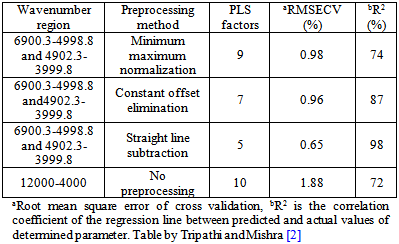
Table 1. Analytical features of the different regions and preprocessing techniques evaluated for PLS-FTNIR determination of aflatoxins B content in red chili powder samples for best calibration models


 PowerPoint Slide
 Larger image(png format)
 View current table in a new window
Figure 1 show an attempt of using NIR spectroscopy for the determination of different mycotoxins in food material. It could be observed that, differences exist and with the aid of chemometric techniques the component of interest could be measured. Figure 2 also showed how tetracycline residue in milk was determined by NIR spectroscopy. The major peaks revealed chemical properties that could be used to measure the residue. In Figure 3 satisfactory model was achieved with correlation above 90% showing a very good responds between actual and predicted. NIR spectroscopy was used to predict accurately the actual concentrations of aflatoxins in chili powder. The equation of the straight line for the cross validation plot of the calibration data set with the r2 was reasonably high and this revealed that; NIR could be used to predict aflatoxins content in chili pepper.
Table 1 show that, different regions of the spectra have unique feature for the determination of chemical residue of interest. It also revealed that with the recent increase in mathematical pretreatment or preprocessing methods, NIR could become very sensitive and accurate.

 non-contaminated with all five mycotoxins and (c) highly contaminated with aflatoxin B1 and ochratoxin A and; the difference spectra in the most suitable mathematical treatment that enables calibration of aflatoxin B1, ochratoxin A and total aflatoxins) PowerPoint Slide
PowerPoint Slide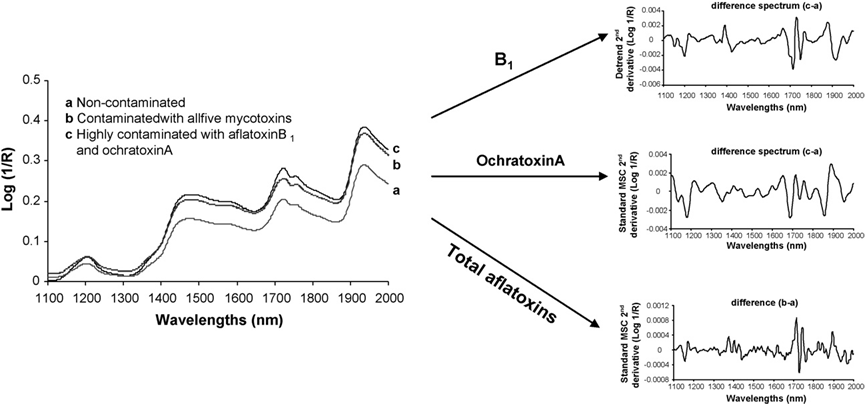 Larger image(png format)


 FT-NIR spectrum of pure milk; (b) FT-NIR spectra of milk with different concentrations of tetracycline hydrochloride) PowerPoint Slide
PowerPoint Slide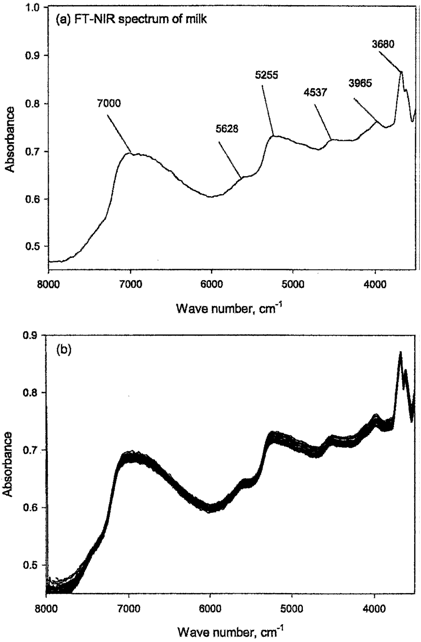 Larger image(png format)

 tetracycline hydrochloride range in milk (4-500 ppb); (b) tetracycline hydrochloride range in milk (520-2000 ppb)) PowerPoint Slide
PowerPoint Slide Larger image(png format)
 Comparative Chili powder FT-NIR absorption spectra: (1) spiked; (2) unspiked and (3) aflatoxin B standard (A). Linear regression plot of measured versus predicted aflatoxin B1 content of the calibration (B) and validation (C) data set by Tripathin and Mishra) PowerPoint Slide
PowerPoint Slide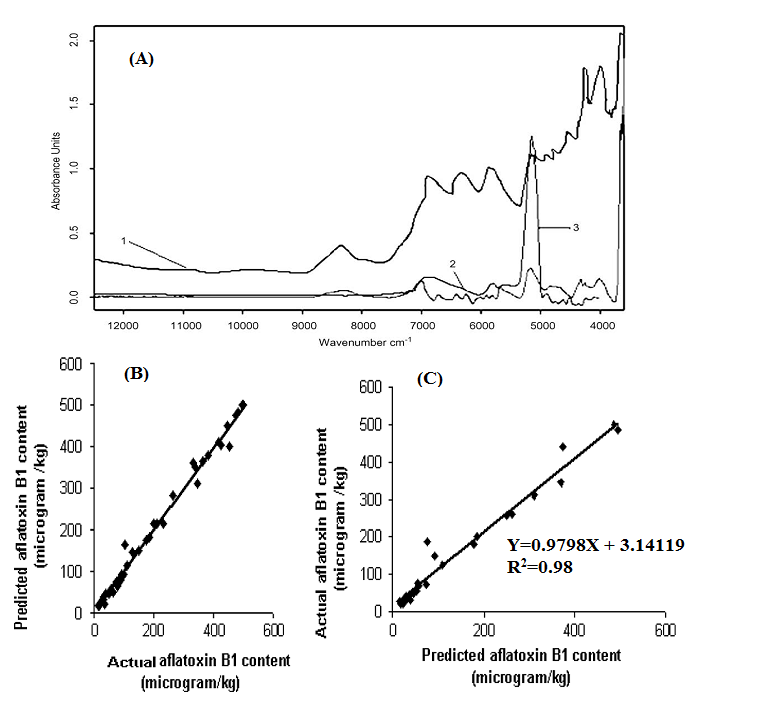 Larger image(png format)
5. Application of NIR Spectroscopy in the Measurement of Chemical Residue in Foods
Numerous authors have stated that NIRS tool is a rapid, simple, and cost effective and an environmentally friendly analytical tool. After its initial use in 1964 for grains quality, NIT spectroscopy is now used for the quick prediction in a wide range of food materials. Below are a few, recent application of NIR spectroscopy which includes; detection and quantification of sunflower oil adulteration in extra virgin oil [35], internal damage [36], assessment of fat, water, protein content of meat [37, 38], [39, 40], the measuring of sensory properties [41], tea quality assessment, [42], sorting of stone fruits [43] determination of total volatile basic nitrogen [44], catechin content in tea [45] and antioxidant activity in tea [5] and determination of 27 chemical constituents in tobacco [46].
However, more specifically NIRS has found it use in the determination of chemical residue in food materials and various studies are still ongoing. Sivakesava and Irudayaraj [14] investigated the feasibility of measuring tetracycline hydrochloride residues at ppb (4-520 and 520-2000) levels in milk by FT-MIR and FT-NIR spectroscopic techniques. It was concluded that maximum correlation coefficient (R2) value was about 0.89 and also FT-MIR spectroscopy could be used for rapid detection of tetracycline hydrochloride residues in Milk.
More so, Pettersson and Aberg [4] used NIR spectroscopy for the determination of mycotoxins deoxynivalenol (DON) in wheat kernel and had a correlation coefficient of 0.984 and concluded that it may be possible in the future to develop a calibration model, which can be used to screen for DON in wheat. Berardo et al [9] also demonstrated / studied the rapid detection of kernel rots and mycotoxins in maize by NIR reflectance spectroscopy and found out that NIR predicted values in maize kernel samples (R2 = 0.80), hence concluded that NIR methodology can be applied for monitoring mold contamination in postharvest maize, particularly the presence of Fusarium verticilliodes and fumonism with their metabolite (ergosterol and FBI). Studies, further conducted by Hernandez-Hierro et al. [21], supported the fact that NIR spectroscopy tool seems to have an excellent potential for quick and reasonable inexpensive analysis for Aflatoxin B1, Ochratoxin A and total Aflatoxin in naturally contaminated red paprika and offers an alternative for the determination of mycotoxins to that of chemical method.
Recently, Sanchez et al. [47] conducted studies on the measurement of pesticide residues in peppers by NIR reflectance spectroscopy and his result further confirmed that NIRS tool may be used for swift, non-destructive preliminary screening for pesticides residues in suspected food samples. A rapid FT-NIR method for estimation of aflatoxin B1 in chili powder has also been developed by [2] with a maximum correlation coefficient for validation plots (R2=96.7) though the limit of detection is slightly above that approved by European union, however, it could be very useful for bulk sorting of infected ones from healthy ones. Also, Fernandez-Ibanez et al. [19], study on assessing the utility of NIRS for rapid detection of mycotoxigenic fungi in cereals and the results demonstrated that NIRS technology is an excellent alternative tool for fast AFB1 detection in cereals. Not forgetting, [15] studied the possibility of the use of FT-NIR spectroscopy for determining residues of selected antibiotics (Penicillin G and Cloxacillin) in milk. They revealed that; correlation coefficients (R) and standard errors of calibration (SEC) for Penicillin G and Cloxacillin in milk were R=0.951 & SEC =0.004 for Penicillin G and R=0.871 & SEC=0.007 for Cloxacillin. They then concluded that the maximum residue limit of Cloxacillin in milk can be determined but it is not a suitable method for accurate determination of Penicillin G.
In addition, Saranwong and Kawano [48] developed a system for rapid fungicide residue determination using NIR spectroscopy with dry-extract system for infrared technique and they obtained a satisfactory result (SEP= 7.89 ppm). They further tested the reliability of pesticides determinations using near infrared spectroscopy and the dry-extract system for infrared (DESIR) technique and concluded that based on the Japanese pesticide control level, the developed system could be used for the monitoring of some pesticides in fruits and vegetables
In summary NIRS tool has been used to estimate chemical residues such as tetracycline hydrochloride in milk, various types of mycotoxins in (wheat, maize, red chili powder, barley, paprika etc), pesticide in peppers and penicillin G & cloxacillin in raw cow milk. However it was revealed that this tool is most useful for distinguishing, sorting, screening and monitoring. Therefore, with the recent advancement of chemometric, further studies should be conducted to increase the sensitivity. However, in a whole, the result of different researchers revealed that NIR spectroscopy was a suitable replacement of the reference method (wet analytical antecedent methods) used in the analysis of chemical residues in foods. But its strength is in the identification of the presence of chemical residue which could be used as an initial protocol for sorting. Hence, it is expected that, in the very near future, NIRS techniques will be applied to evaluate chemical residue in food materials other than the standard reference method (wet chemistry) such as: HPLC, TLC, GC-MS and ELISA.
6. Why NIR Spectroscopy Tool for Determining Chemical Residue
Everybody demands quality and it should be provided because it is the best money can buy. However, most at times, quality demanded are not given or fall short of the standard required and some are even contaminated with harmful anabolic chemical residue which are transferred from production through processing and even to the consumers’ table.
There is therefore the need to check and cross-check food quality parameters in food materials by an accurate, reliable and rapid technique for easy onward transfer of information to the consumer. Food quality analysis is mostly determined by traditional methods/ reference methods which are found to exhibit good precision, reliability and accuracy however, these methods are destructive, time consuming, expensive (because of the equipment and trained personnel required), environmentally unfriendly (because of the chemicals involved) and are unsuitable for in-situ or on site determination [49].
Furthermore, there is a high demand for quality food and almost everything in the world is moving faster with little waste. This calls for techniques that are quicker to perform as well as being nondestructive (to avoid excessive wastage). To overcome these short comings and solve the problem in the ever increasing population, non-destructive tool, more specifically Near Infrared spectroscopy has emerged as a savior for the determination of food quality and safety attributes. This tool is quick, reliable and comfortable procedure coupled with a very promising result in its evaluation. As the name sound, it is nondestructive and can be used in a wide range of food quality and safety analysis. Also, among the nondestructive methods, NIR spectroscopy provides the needed advantage for the determination of chemical residues in foods with high sensitivity. According to Cen and He [33] with the development of computer science and chemometrics, the available application of NIRS techniques has become more popular and has attracted more attention from food researchers. NIRS tool provides wide information for simultaneous determination of various food quality and safety parameters of interest and it is also very versatile.
7. Future Trends and Conclusions
The potential of near infrared spectroscopy (NIRS) to determine harmful chemical (both Agro-chemicals and Mycotoxins) residues in food materials have been reviewed with the following observations; NIRS is very promising tool to detect chemical residues in foods because, it is fast, nondestructive, accurate and reliable. Furthermore, with environmental pollution issues on the rise, it is the best solution because there is no chemical involved compared with reference method such as HPLC, HPTLC, ELISA and GC-MS. It also requires no sophisticated laboratory and well trained personnel to perform the analysis except the initial cost of the NIR spectroscopy. Finally, it could be perceived that, in the near future NIRS will be an excellent alternative to the standard reference method to classify, identify and predict harmful chemical residue in foods.
Acknowledgements
The authors are highly grateful to the following for their financial support: Jiangsu University, Zhenjiang, P. R. China, and University of Cape Coast, Cape Coast, Ghana. Not forgetting; Mr. Peter Osei Boamah and Mr. Prince Osei Bonsu for their kindest encouragement. Also indebted to Mrs. Winifred Teye for her proof reading assistance
References
| [1] | Ozaki, Y., W.F. McClure, and A.A. Christy, Near-infrared spectroscopy in food science and technology2006: Wiley-Interscience. | ||
 In article In article | CrossRef | ||
| [2] | Tripathi, S. and H. Mishra, A rapid FT-NIR method for estimation of aflatoxin B1 in red chili powder. Food Control, 2009. 20(9): p. 840-846. | ||
| In article | CrossRef | ||
| [3] | Roggo, Y., et al., A review of near infrared spectroscopy and chemometrics in pharmaceutical technologies. Journal of pharmaceutical and biomedical analysis, 2007. 44(3): p. 683-700. | ||
| In article | CrossRef PubMed | ||
| [4] | Pettersson, H. and L. Åberg, Near infrared spectroscopy for determination of mycotoxins in cereals. Food Control, 2003. 14(4): p. 229-232. | ||
| In article | CrossRef | ||
| [5] | Chen, Q., et al., Comparisons of different regressions tools in measurement of antioxidant activity in green tea using near infrared spectroscopy. Journal of pharmaceutical and biomedical analysis, 2012. 60(0): p. 92-97. | ||
| In article | CrossRef PubMed | ||
| [6] | Cassoli, L.D., B. Sartori, and P.F. Machado, The use of the Fourier Transform Infrared spectroscopy to determine adulterants in raw milk. Revista Brasileira de Zootecnia, 2011. 40(11): p. 2591-2596. | ||
| In article | CrossRef | ||
| [7] | Leggieri, M.C., et al., Detection and discrimination between ochratoxin producer and non-producer strains of Penicillium nordicum on a ham-based medium using an electronic nose. Mycotoxin research, 2011. 27(1): p. 29-35. | ||
| In article | CrossRef PubMed | ||
| [8] | Blanco, M., M. Alcala, and M. Bautista, Pharmaceutical gel analysis by NIR spectroscopy: Determination of the active principle and low concentration of preservatives. European Journal of Pharmaceutical Sciences, 2008. 33(4): p. 409-414. | ||
| In article | CrossRef PubMed | ||
| [9] | Berardo, N., et al., Rapid detection of kernel rots and mycotoxins in maize by near-infrared reflectance spectroscopy. Journal of Agricultural and Food Chemistry, 2005. 53(21): p. 8128-8134. | ||
| In article | CrossRef PubMed | ||
| [10] | Govaris, A., N. Solomakos, and N. Pexara, Ochratoxin A in foods of animal origin. Journal of Hell Vet. Med. Soc, 2007. 58: p. 313-320. | ||
| In article | |||
| [11] | Toldrá, F. and M. Reig, Methods for rapid detection of chemical and veterinary drug residues in animal foods. Trends in Food Science & Technology, 2006. 17(9): p. 482-489. | ||
| In article | CrossRef | ||
| [12] | Bai, S., et al., Noninvasive determination of protein conformation in the solid state using near infrared (NIR) spectroscopy. Journal of pharmaceutical sciences, 2005. 94(9): p. 2030-2038. | ||
| In article | CrossRef PubMed | ||
| [13] | Wang, S., et al., Current status and management of chemical residues in food and ingredients in China. Trends in Food Science & Technology, 2009. 20(9): p. 425-434. | ||
| In article | CrossRef | ||
| [14] | Sivakesava, S. and J. Irudayaraj, Rapid determination of tetracycline in milk by FT-MIR and FT-NIR spectroscopy. Journal of dairy science, 2002. 85(3): p. 487-493. | ||
| In article | CrossRef | ||
| [15] | Dračková, M., et al., Determination Residues of Penicillin G and Cloxacillin in Raw Cow Milk Using Fourier Transform Near Infrared Spectroscopy. Acta Veterinaria Brno, 2009. 78(4): p. 685-690. | ||
| In article | CrossRef | ||
| [16] | Pareja, L., et al., Analytical methods for pesticide residues in rice. TrAC Trends in Analytical Chemistry, 2011. 30(2): p. 270-291. | ||
| In article | CrossRef | ||
| [17] | Lattanzio, V.M.T., et al., Simultaneous determination of aflatoxins, ochratoxin A and Fusarium toxins in maize by liquid chromatography/tandem mass spectrometry after multitoxin immunoaffinity cleanup. Rapid Communications in Mass Spectrometry, 2007. 21(20): p. 3253-3261. | ||
| In article | CrossRef PubMed | ||
| [18] | Jalili, M. and S. Jinap, Natural occurrence of aflatoxins and ochratoxin A in commercial dried chili. Food Control, 2011. | ||
| In article | |||
| [19] | Fernández-Ibañez, V., et al., Application of near infrared spectroscopy for rapid detection of aflatoxin B1 in maize and barley as analytical quality assessment. Food Chemistry, 2009. 113(2): p. 629-634. | ||
| In article | CrossRef | ||
| [20] | Binder, E.M., Managing the risk of mycotoxins in modern feed production. Animal feed science and technology, 2007. 133(1): p. 149-166. | ||
| In article | CrossRef | ||
| [21] | Hernández-Hierro, J., R. García-Villanova, and I. González-Martín, Potential of near infrared spectroscopy for the analysis of mycotoxins applied to naturally contaminated red paprika found in the Spanish market. Analytica chimica acta, 2008. 622(1): p. 189-194. | ||
| In article | CrossRef PubMed | ||
| [22] | Duarte, S., A. Pena, and C. Lino, A review on ochratoxin A occurrence and effects of processing of cereal and cereal derived food products. Food microbiology, 2010. 27(2): p. 187-198. | ||
| In article | CrossRef PubMed | ||
| [23] | JECFA, Safety evaluation of certain mycotoxins in food. WHO Food Additives Series 47; FAO Food and Nutrition paper 74, (Joint FAO/WHO Expert Committee on Food Additives) 2001. | ||
| In article | |||
| [24] | Blesa, J., et al., Rapid determination of ochratoxin A in cereals and cereal products by liquid chromatography. Journal of Chromatography A, 2004. 1046(1): p. 127-131. | ||
| In article | PubMed | ||
| [25] | Jun, H., Report on food safety in China. Beijing. Social Sciences Academic Press (China), 2007. | ||
| In article | |||
| [26] | Reig, M. and F. Toldrá, Veterinary drug residues in meat: Concerns and rapid methods for detection. Meat science, 2008. 78(1): p. 60-67. | ||
| In article | CrossRef PubMed | ||
| [27] | Barbosa, J., et al., Food poisoning by clenbuterol in Portugal. Food additives and Contaminants, 2005. 22(6): p. 563-566. | ||
| In article | CrossRef PubMed | ||
| [28] | EFSA, Opinion of the scientific panel on contaminants in the food chain on a request from the European Commission related hormone residue in bovine meat and meat products. The EFSA Journal, (European Food Safety Authority) 2007. 510: p. 1-62. | ||
| In article | |||
| [29] | Davies, A.M.C., William Herschel and the discovery of near infrared. 2000. | ||
| In article | |||
| [30] | Nicolaï, B.M., et al., Nondestructive measurement of fruit and vegetable quality by means of NIR spectroscopy: A review. Postharvest Biology and Technology, 2007. 46(2): p. 99-118. | ||
| In article | CrossRef | ||
| [31] | Norris, K.H., Simple spectroradiometer for 0.4-1.2 micron region. Trans. ASAE 1964. 7: p. 240-242. | ||
| In article | |||
| [32] | Lin, H., et al., Determination of free amino acid content in Radix Pseudostellariae using near infrared (NIR) spectroscopy and different multivariate calibrations. Journal of pharmaceutical and biomedical analysis, 2009. 50(5): p. 803-808. | ||
| In article | CrossRef PubMed | ||
| [33] | Cen, H. and Y. He, Theory and application of near infrared reflectance spectroscopy in determination of food quality. Trends in Food Science & Technology, 2007. 18(2): p. 72-83. | ||
| In article | CrossRef | ||
| [34] | Alishahi, A., et al., Identification of transgenic foods using NIR spectroscopy: a review. Spectrochimica Acta Part A: Molecular and Biomolecular Spectroscopy, 2010. 75(1): p. 1-7. | ||
| In article | CrossRef PubMed | ||
| [35] | Downey, G., P. McIntyre, and A.N. Davies, Detecting and quantifying sunflower oil adulteration in extra virgin olive oils from the Eastern Mediterranean by visible and near-infrared spectroscopy. Journal of Agricultural and Food Chemistry, 2002. 50(20): p. 5520-5525. | ||
| In article | CrossRef PubMed | ||
| [36] | Clark, C., et al., Dry matter determination in ‘Hass’ avocado by NIR spectroscopy. Postharvest Biology and Technology, 2003. 29(3): p. 301-308. | ||
| In article | CrossRef | ||
| [37] | Alomar, D., et al., Chemical and discriminant analysis of bovine meat by near infrared reflectance spectroscopy (NIRS). Meat science, 2003. 63(4): p. 441-450. | ||
| In article | CrossRef | ||
| [38] | Geesink, G., et al., Prediction of pork quality attributes from near infrared reflectance spectra. Meat science, 2003. 65(1): p. 661-668. | ||
| In article | CrossRef | ||
| [39] | Prevolnik, M., et al., Predicting intramuscular fat content in pork and beef by near infrared spectroscopy. Journal of Near Infrared Spectroscopy, 2005. 13(2): p. 77-85. | ||
| In article | CrossRef | ||
| [40] | Savenije, B., et al., Prediction of pork quality using visible/near-infrared reflectance spectroscopy. Meat science, 2006. 73(1): p. 181-184. | ||
| In article | CrossRef PubMed | ||
| [41] | Mehinagic, E., et al., Prediction of the sensory quality of apples by physical measurements. Postharvest Biology and Technology, 2004. 34(3): p. 257-269. | ||
| In article | CrossRef | ||
| [42] | Chen, Q., et al., Feasibility study on qualitative and quantitative analysis in tea by near infrared spectroscopy with multivariate calibration. Analytica Chimica Acta, 2006. 572(1): p. 77-84. | ||
| In article | CrossRef PubMed | ||
| [43] | Golic, M. and K.B. Walsh, Robustness of calibration models based on near infrared spectroscopy for the in-line grading of stonefruit for total soluble solids content. Analytica chimica acta, 2006. 555(2): p. 286-291. | ||
| In article | CrossRef | ||
| [44] | Cai, J., et al., Determination of total volatile basic nitrogen (TVB-N) content and Warner–Bratzler shear force (WBSF) in pork using Fourier transform near infrared (FT-NIR) spectroscopy. Food Chemistry, 2011. 126(3): p. 1354-1360. | ||
| In article | CrossRef | ||
| [45] | Chen, Q., et al., Simultaneous analysis of main catechins contents in green tea (< i> Camellia sinensis</i>(L.)) by Fourier transform near infrared reflectance (FT-NIR) spectroscopy. Food Chemistry, 2009. 113(4): p. 1272-1277. | ||
| In article | CrossRef | ||
| [46] | Duan, J., et al., Determination of 27 chemical constituents in Chinese southwest tobacco by FT-NIR spectroscopy. Industrial Crops and Products, 2012. 40: p. 21-26. | ||
| In article | CrossRef | ||
| [47] | Sánchez, M.T., et al., Measurement of pesticide residues in peppers by near‐infrared reflectance spectroscopy. Pest Management Science, 2010. 66(6): p. 580-586. | ||
| In article | CrossRef PubMed | ||
| [48] | Saranwong, S. and S. Kawano, The reliability of pesticide determinations using near infrared spectroscopy and the dry-extract system for infrared (DESIR) technique. Journal of Near Infrared Spectroscopy, 2007. 15: p. 227. | ||
| In article | CrossRef | ||
| [49] | Escuder-Gilabert, L. and M. Peris, Review: Highlights in recent applications of electronic tongues in food analysis. Analytica Chimica Acta, 2010. 665(1): p. 15-25. | ||
| In article | CrossRef PubMed | ||

 CiteULike
 Mendeley
 StumbleUpon
 Delicious
 Facebook
 Twitter
 LinkedIn
 Print
Print