Nowadays, throughout the world, the sector of import, manufacture and use of cookers is governed by regulations. These regulations set criteria for counttry’s import, manufacture and use of cookers. These regulations aim to reduce the anthropic pressure exerted by cooking stoves on forests due to the high consumption of wood energy as fuel for some of them. They also aim to reduce the footprint of cooking stoves on the climate and the well-being of users by limiting the emission factors of these stoves. Most Asian countries such as China and India are more advanced than West African countries in the field of cookers. These Asian countries have in most cases regulations governing the cooking equipment sector. In West Africa, only a few countries have such regulations. On the one hand, this article aims to list the standards of cooking equipment available in West Africa and test to assess a cooking stove following the test protocols provided for by these standards. On the other hand, the article aims to show the footprint of cooking stoves with regard to the well-being of users but also the environment. The adapted approach consists of carrying out in-depth documentary research through databases, personal exchanges with laboratories and research centers that work in the domestic energy sector. It appears that only 2/16 West African countries have standards on biomass cookers. These include the FDNIS 1000 standard of Nigeria and the GS ISO 19867-1 standard of Ghana. The thermal performances of the tested stove are : 11.48%; 0.64 kW for the GS ISO 19867-1 standard and 10.66% in HP, 9.33% in BP; 9.52 kW in HP 7.871 kW in BP for the FDNIS 1000 standard. Statistics show that countries which have standards are sometimes at the intermediate level and sometimes at the lower level in terms of exposure to problems related to the wood energy sector.
The Around 18,600,000,000 m3 of fuelwood, charcoal and other wood based energy sources are consumed each year around the world to meet the need for cooking energy 1. Around 6,696 million m3 volume are burned in Africa in poor-quality cooking stoves 1. In Africa, forecasts have shown that, by 2030 if no measures are taken, the annual demand for wood energy will have to double 2. In Africa and more particularly in West Africa, 50 to over 95% of households burn wood energy to meet their domestic energy needs. This has serious consequences on the well-being of these households, forests and the environment. The global cooking equipment industry is growing. Thus, the transaction of cooking equipment between countries continues to grow overnight. Therefore, it is imperative that cooking appliances from different countries are regulated by standards. Establishing standards is essential for developing and promoting high quality cook stoves within a country. Most Asian countries such as China, India, Mangolia have experienced significant progress in the field of cookers compared to West African countries. Each of these countries has individually developed and established its own regulations on the manufacture, use and importation of cooking stoves. However, in West Africa, only a few countries have such regulations.
Faced with the problems posed above, research is increasingly being conducted by pairs in order to develop standards and technologies of cooking equipment. Zhang et al. 3, examined systematic and conceptual errors in thermal performance standards and protocols for biomass stoves. They suggested that experts from less developed countries could actively participate in the development of international standards. The technical committee of the International Organization for Standardization has developed the ISO 19867-1 standard on cooking stoves 4. Zhang et al. 5 used the water boiling protocol, the south African standard protocol (heterogeneous test), the Chinese standard protocol and the Indian standard protocol to highlight the influence of the lid and the amount of water for the test on the thermal efficiency of the cook stove. Arora et al. 6 tested two models of cook stoves using the Indian standard protocol and the water boiling protocol version 4.2.3. Francis Okafar 7 evaluated the thermal and emission performance of stoves using the Nigerian Standard protocol. Maman Nazifi et al. 8 used the water boiling protocol version 4.2.3 to demonstrate the effect of thermal mass on fuel consumption of solid biomass stoves. Lombardi et al. 9 proposed guidelines for the publication and analysis of laboratory test results of biomass cook stoves. SU Yunusa et al. 10 have developed a review of the progress of research on cook stove technologies. On the one hand, this study aims to list the standards of cooking equipment available in West Africa, test to assess a model of cooking stove following test protocols provided for by these standards. On the other hand, it aims to show the impact of cooking stoves on the well-being of users but also on the environment in West Africa.
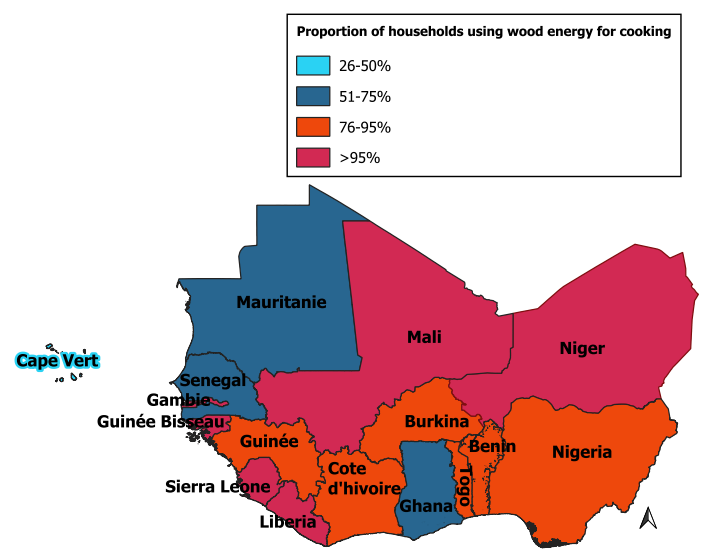
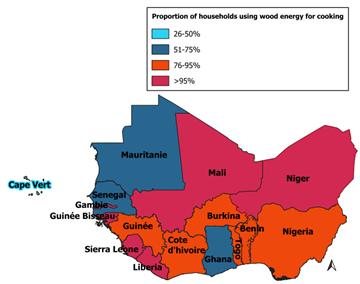
West African forest cover is estimated at around 72 million hectares, or 14% of the land area 11. This forest resource is threatened by a combination of factors including increased demand for wood energy 11. In fact, in each of the countries, the fraction of households that use wood energy as cooking fuel largely exceeds 50% with the exception of Cape Verde. Countries such as: Niger, Mali, Burkina Faso, Benin are those with the highest proportion (≥ 95%). The map below, drawn using QGIS version 3.36.0, shows the fractions of households that use wood and charcoal as cooking fuel in West Africa. The data used to develop this map come from a report by the World Health Organization (WHO) 12.
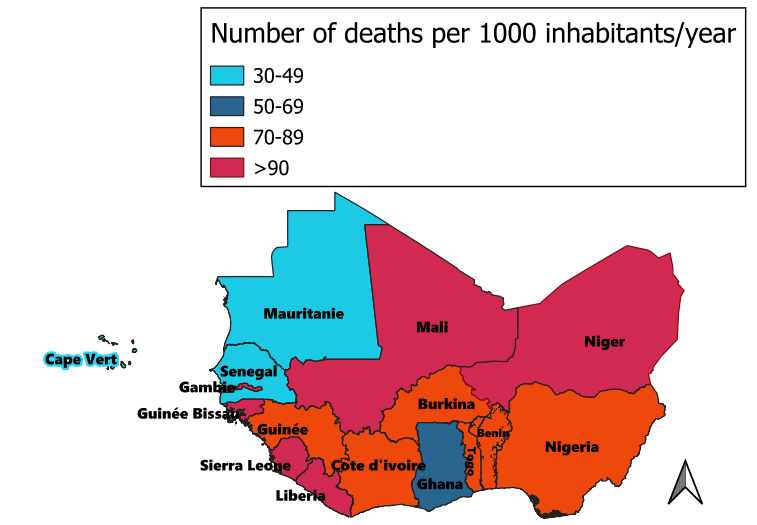
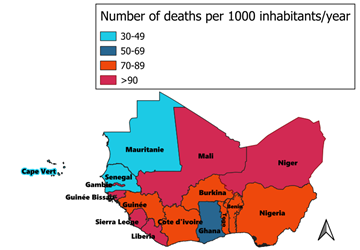
As shown in the previous section, in West Africa, cooking fuel is mainly provided by wood and charcoal in most households. To cook, these households burn these fuels in inefficient cooking equipment that releases harmful particles during their operation, including carbon monoxide, carbon dioxide, nitrogen oxides, etc. There is strong evidence that exposure to these substances in the short and long term has health consequences including respiratory, eye, heart infections, cancer, etc., 13. The distribution of deaths related to air pollution caused by the cooking sector in West Africa is presented in the map below that we have drawn with the QGIS software version 3.36.0. The data used to draw this map were taken from a report by the World Health Organization (WHO) 12.
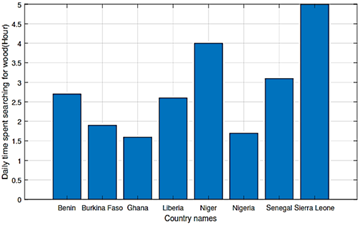
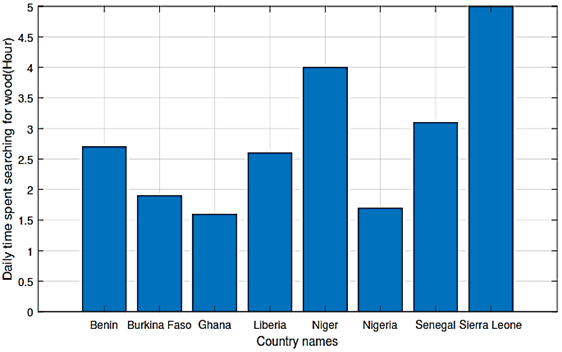
The heavy burden of West African households' reliance on solid biomass for cooking fuel falls on children and women. Indeed, apart from the indoor air pollution to which they are exposed, in most West African countries, wood collection is often entrusted to women accompanied by their children. The latter spend hours of the day looking for firewood to the detriment of schooling and other more productive activities for children and women respectively. Worse still, in these situations, women can suffer serious physical harm in the long term due to this hard work without sufficient recovery. Added to this damage is the risk of falls, dead wood branches or attacks by wild animals. These risks are all the greater the further women and children move away from their homes. During this wood collection, women can also be victims of physical or sexual violence. Reducing this burden will probably allow women and children to have more time to rest, take care of other more productive activities and/or take care of their schooling. The figure below illustrates the number of hours per day devoted to wood collection in some West African countries 14.
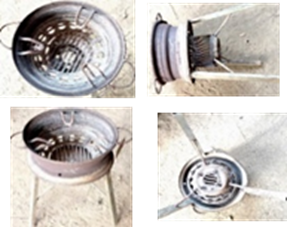
The cooker on which the protocols of the listed standards have been carried out is a traditional stove used in Benin called a rim stove 15, 16. Its physical structure as well as its characteristics are presented respectively in the figure and table below.

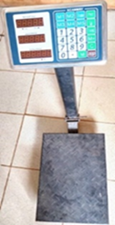
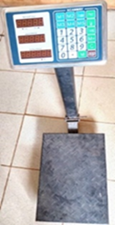
A KC AMMRY brand electronic balance with a precision of 20g and a capacity of 100kg is used to weigh the mass of: fuel, water at the beginning and at the end of the tests.
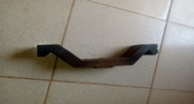
A wooden board is used to hold the thermometer probe 5 cm from the bottom of the pot.
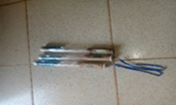
Digital liquid immersion probe thermometers with an ac-curacy of 0.5°C and a range of -50 to 300°C are used for water temperature measurement during the test.

A stopwatch is used for time measurement during the test.

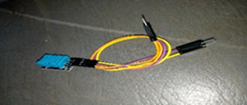
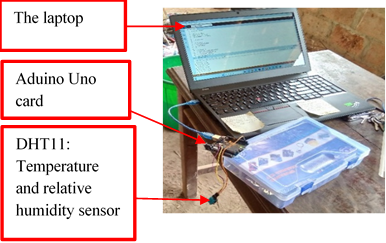
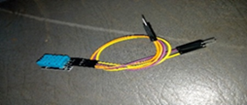
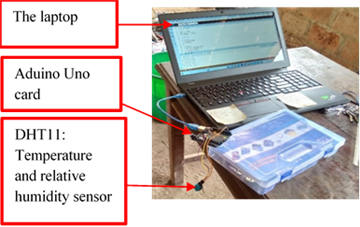
For the Ghanaian standard, the testing protocol requires that the temperature and relative humidity be within a given range. The DHT11 is used to evaluate the evolution of these parameters in the test room.
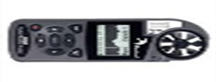
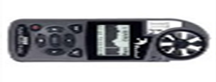
According to the requirements of some of the protocols including the Ghanaian standard protocol, during testing, the wind speed within the test laboratory enclosure must be controlled. The KESTRE 4000 type anemometer is used to measure and control the wind speed.
In accordance with the test protocols of the listed standards (FDNIS 1000, ISO 19867), personal protective equipment must be used during the tests. These include: respiratory mask, safety glasses and heat resistant gloves.

This study began with an in-depth documentary research in order to retrieve the available information and draw up a global vision of the problem. For this we conducted a documentary research through databases such as: Scopus, Chemical Abstracts Service (CAS), Google scholar, etc. The types of documents taken into account are: articles available in newspapers, West African and international standards on the performance of cooking stoves, conference proceedings, web pages and reports of research centers on cooking stoves. Personal exchanges with peers were also carried out in order to collect other complementary information. Geographic information system tools (QGIS software version 3.36.0) were used for: the materialization of the study area, the distribution of research institutions, the distribution of the need for wood energy, the number of deaths linked to the use of poor quality cooking equipment in the study area. These tools also made it possible to distribute the countries that have a standard in the study area. As for the test method used, these are those provided for by each of the listed standards.
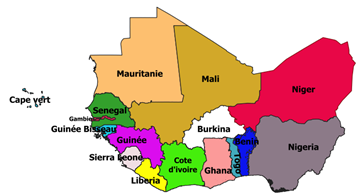
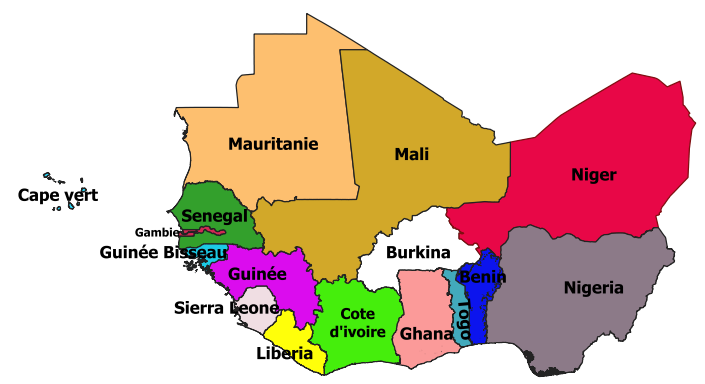
West Africa covers approximately 17% of the total sur-face area of the African continent (6.14 million m2) 11. It has 16 countries, which are: Benin, Burkina Faso, Ivory Coast, Cape Verde, Gambia, Ghana, Guinea, Guinea-Bissau, Liberia, Mali, Mauritania, Niger, Nigeria, Senegal, Sierra Leone and Togo 11. Estimated at approximately 72 million hectares, West African forests are threatened by a combination of factors including the supply of wood energy 11.
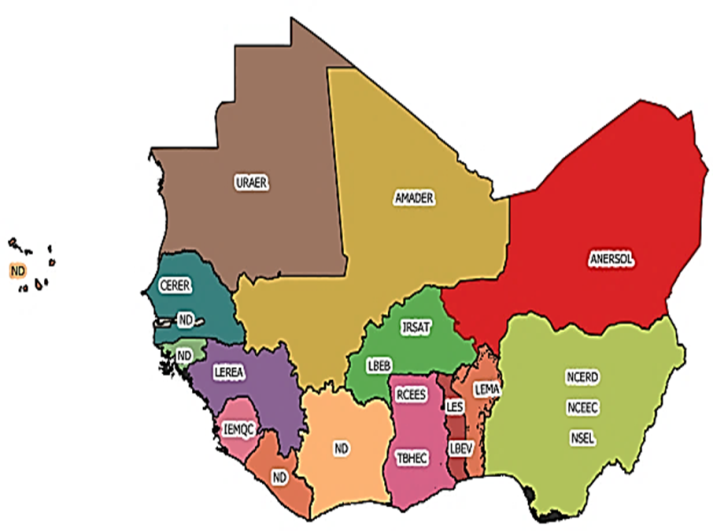
The domestic energy issue described in sections 2.2.1, 2.2.2 and 2.2.3 remains one of the greatest concerns of West African countries. This is why laboratories and research institutions working on cooking equipment, are increasingly being implemented in most West African countries. The map below was drawn with QGIS software (version 3.36.0), provides a list of laboratories and research institutions across West African countries. This list is not exhaustive; it only contains the research institutions that we were able to collect from the literature.
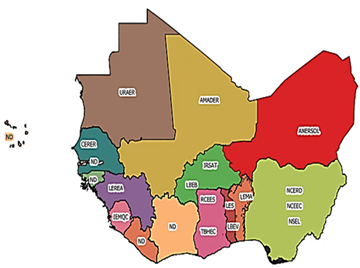
The table above presents the address, the country of affiliation as well as some publications of the laboratories and research centers which work in the cooking equipment sector in the West African zone.
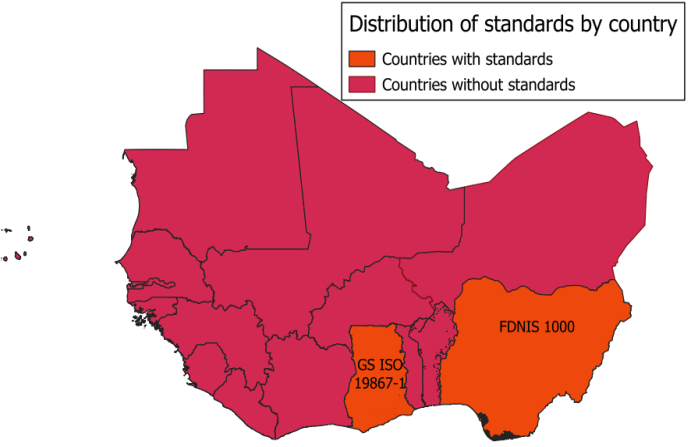
A standard is "a document that is developed and then validated by consensus by an institution recognized as competent in a specific field. It provides common and repeated use, rules, guidelines or characteristics for activities or their results, aimed at achieving an optimal level of order in a given context. Standards should be based on the consolidated results of science, technology and experience, and aim to promote optimal benefits for the community 27. In principle, the development processes as well as the strict application of a standard are supported by a state. In a standard, the rules of characterization or assessment are set by a protocol. The latter can be defined as a set of sequential instructions allowing a scientific experiment to be carried out. Regarding the specific case of the domestic energy sector for cooking in West Africa, despite the research efforts of laboratories and research centers, only 2/16 countries have a standard governing the cooking sector. Domestic energy for cooking. Indeed, to the author's knowledge to date, only Ghana and Nigeria have a standard that governs the manufacture, importation and use of cooking stoves. For the case of Ghana, this is the GS ISO 19867-1 standard 28 while for the case of Nigeria, it is the FDNIS 1000 standard 29 as can be seen in the figure below:
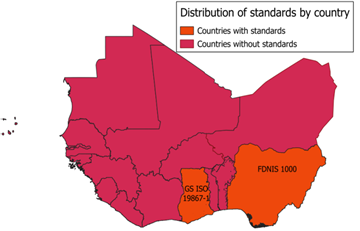
Table 3 above provides some information concerning: the title, the institution in charge of development, the year of publication, the scope and the test protocol for each of these standard.
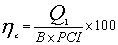
The Ghanaian standard (GS 19867-1) uses the protocol of ISO 19867-1 which involves heating the water in two phases. The first consists of bringing or not bringing a quantity of water to a boil for a period of 30 or 60 minutes, respectively in the case of forced draft fireplaces and natural draft fireplaces. While the second consists of reducing the hot water from the first phase to less than 5 degrees compared to its final temperature. The test sequence is carried out with a pot without its lid. During the test, the water temperature is recorded every minute. In the test room, the following atmospheric parameters must be monitored: ambient temperature, wind speed and relative air humidity. The performance of the tested stove can be evaluated based on the parameters defined as follows 28:
Useful energy :
 | (1) |
Thermal efficiency:
 | (2) |
Thermal power :
 | (3) |
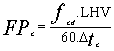
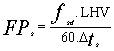
The Nigerian FDNIS 1000 standard uses version 4.2.3 of the water boiling test protocol which consists of heating to boiling a quantity of water contained in a pot. The test is carried out in two main phases. The first, called the high power phase, consists of rapidly bringing the water initially introduced into the pot from its initial temperature to the boiling temperature (100°C). The second, called the low power phase, consists of simmering (maintaining at between 95 and 99.5°C) the hot water from the high power phase for a time interval of 45 minutes. The high power phase is itself subdivided into two sub-phases: cold start (bringing the water to the boil) when the burner is at room temperature and hot start (bringing the water to the boil) when the burner is still hot. However, the hot start sub-phase is optional. In this work, the latter is also not taken into account. The entire test procedure is carried out with the pot without its lid. During the entire test period, the water temperature is recorded every five (5) minutes. The performance of the tested stove is evaluated based on the parameters defined as follows: 24:
High-power energy efficiency :
 | (4) |
Low-power energy efficiency :
 | (5) |
Thermal power in the high-power phase :
 | (6) |
Thermal power in the low-power phase :
 | (7) |
Table 4 and Table 5 show some of the steps involved in running the protocols. Figure 15 shows the humidity and temperature measurement setup.
The following table illustrates some of the steps involved in implementing the Ghana standard protocol.
The following table illustrates some of the steps involved in implementing the Nigeria standard protocol.
The following assembly composed of a temperature and humidity sensor, an Arduino card and a computer made it possible to control the evolution of the temperature and humidity in the room where the test.
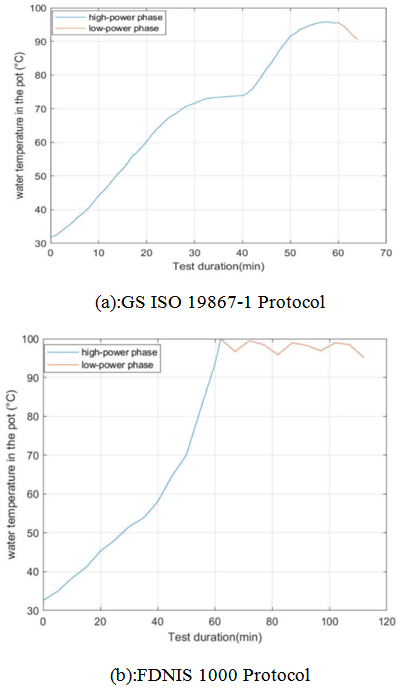
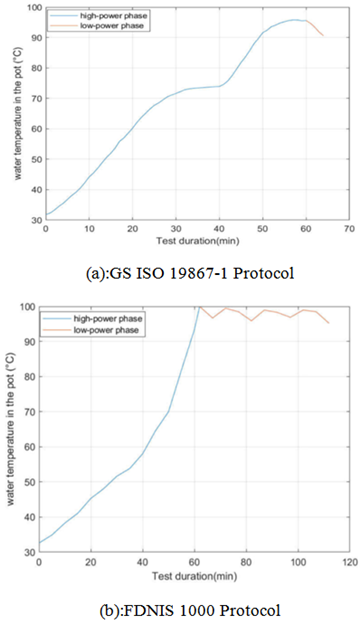
The execution of different test protocols of the listed standards allowed to obtain the results recorded in Table 6 and Table 7 below. These results are expressed in terms of a performance indicator allowing to evaluate and/or compare the assessment received by the household tested according to each of the protocols. Each protocol was run three times in a row. Figure 16.a and Figure 16.b show the evolution of the water temperature in the pot during the different phases of the two protocols test.
It has been stipulated in the manuscript of each of the listed standards that any biomass cooking stove manufactured or imported into the territory of one or other of the standards in question, before any use, this stove must be subjected to a test following a very specific test method. Thus, for the use of this cooker to be legal, at the end of the test, the tested cooker must meet minimum performances. These minimum performances relate to energy performance, the safety score and/or the emission factor. In the context of this work, we are interested in the minimum energy performances only, which we present in Table 8 below.
In this section, the minimum energy performances provided by the two standards will be applied to the tested fireplace in order to see if it complies with both standards and if this fireplace is authorized to be used or not. To do this, we will compare in the table below, the minimum energy performances with the energy efficiency values of the fireplace obtained through the test protocol of each of the standards. From this table, it is clear that the tested fireplace does not meet any of the minimum energy performances of the listed standards. As a result, its use is prohibited in accordance with the GS ISO 19867-1 standard of Ghana and the FDNIS 1000 standard of Nigeria.
In order to guide users when choosing a fireplace model among the models available on the market, the standards have provided for a classification by level according to the energy efficiency obtained at the end of the stove test. The classification system facilitates policy makers and non-governmental organizations in choosing the type of cooking stove technology to popularize or subsidize in a country. The transaction of cooking equipment between countries can also be facilitated by the classification systems provided by the standards. The classification criteria provided by the listed standards are listed in Table 8 below. Thus, according to these classification criteria, the tested stove is at level zero (0) in both (2) cases.
To start, the hearth on which the protocols of the standards were carried out is a traditional hearth. According to the literature, the thermal efficiency of the latter must therefore be between 8 and 13% 23. This aspect emerged in our results. On the one hand, the stove that we tested in this work was studied by Ekouedjen 15 who tested it following the protocol of the ISO 19867-1 standard (the protocol of the Ghanaian standard in our case). Ekouedjen et al. found 10.58 ±0.013% and 0.43 ±0.027 kW respectively the efficiency and thermal power. While for the case of this study, following the GS ISO 19867-1 protocol, the efficiency and thermal power are respectively: 11.48% and 0.64 kW. It appears that apart from a slight difference, our results are very close to those obtained by Ekouedjen et al. This small difference is probably induced by the difference in the shapes of the pots used during the tests as well as the difference in mass of the hearths. Indeed, during the tests a pot with a rounded bottom was used in this study while Ekouedjen et al. used a pot with a flat bottom. Regarding the difference in mass, for the case of this study, the mass of the hearth is 8.35 kg while in the case of the works it is 12 kg. Figure 16.a shows that during the tests following the protocol of the GS ISO 19867-1 standard, the water could not reach boiling point, the same observation was made in the work of Ekouedjen et al. On the other hand, the tested hearth was studied by Anjorin et al. 16, who tested it following a version of the water boiling protocol (FDNIS 1000 standard protocol in our case). Anjorin et al., found 12.00% and 10.20 kW respectively the efficiency and the thermal power for the high power phase. While for the case of this study, in high power the efficiency and the thermal power are respectively equal to: 10.66% and 9.52 Kw. Although Anjorin et al., did not specify the version of the water boiling protocol that they used while in this study it is version 4.2.3 which is used, the results obtained are close to those obtained by Anjorin et al.
The results of the various tests show that the efficiencies of the hearth following the protocol of the GS ISO 19867-1 standard and the FDNIS 1000 standard are closer during the 1st phase of two protocols. This translates, on the one hand, into an identity between the equations (sum of sensible and latent heat of water divided by the heat released by the combustion of the fuel) of the calculation of the efficiency for these two protocols. On the other hand, this translates into the fact that the test procedure is more or less similar during the 1st phase for both protocols. This similarity can also be noticed in Figure 16.a and Figure 16.b which shows the evolution of the water temperature during the tests. However, regarding the thermal power, that calculated according to the FDNIS 1000 standard is 12.29 to 14.87 times higher (respectively BP and HP) than that calculated according to the GS ISO 19867-1 standard. This difference can be explained by the divergence of the equations used for the calculation of this power by each of the protocols. In fact, the equation for calculating the power of the FDNIS 1000 standard quantifies the thermal power released by the combustion of the fuel, while that of the GS ISO19867-1 standard quantifies the thermal power actually received by the water.
Figure 1, Figure 2 and Figure 3 presenting respectively: the proportions of households using wood energy for cooking, the death rate linked to pollution caused by cooking equipment and the time spent collecting firewood, show that Nigeria and Ghana, which have standards, are among the countries least affected by the problems linked to the use of poor quality cooking stoves. This state of affairs cannot be without cause and effect. Although the data that allowed us to develop these Figure 1, Figure 2 and Figure 3 come from an older source than the standards listed, these trends are probably the fruits of the efforts of these countries in the process of developing standards. In any case, it is easy to see from sections 4.1.6.1 and 4.1.6.2 that the establishment of a standard and strict compliance with its application will allow users to make a judicious choice of cooking equipment. Also, through the application of these standards, decision-makers in the energy sector can only authorize the use of cooking equipment with a given level of performance. All this will undoubtedly reduce the footprint of cooking stoves on the environment, the climate, but also improve the well-being of users.
The results of this study may encourage non-governmental organizations and policy makers in West Africa to adopt and subsidize more efficient cooking equipment. These results may also draw the attention of policy makers, international organizations and all stakeholders in the domestic energy sector to the need for other West African countries to establish standards in order to promote the said sector. The establishment of a standard in any country will force designers and importers to take into account the aspects of energy efficiency in their respective sectors of activity.
In this work, a review of the available standards on biomass cookers in West Africa was presented. Research institutions working in the domestic energy sector were also listed in this work. Despite these research efforts, only Ghana and Nigeria have standards on the performance of biomass cookers. While it is clearly demonstrated that the cookers that are in use in this West African zone have a significant negative impact on the environment, the climate but also on the well-being of users. It is therefore urgent that each country has a standard for cooking equipment. If possible, these standards should use a more or less similar test protocol and more identical performance indicators. This will harmonize and facilitate the comparison of the performance of stoves on the market at the sub-regional level.
In addition, the global market for cooking equipment is growing. In order for West African cooking stoves to be exported to other countries where the cooking equipment sector is regulated, these West African cooking stoves must meet a certain minimum performance. This involves the establishment of a standard by each of the countries in the said region.
 : High power
 : Low power
 : Useful energy
 : Specific heat of water
 : Initial water mass
 : Initial water temperature
 : Final water temperature
 : Mass of water at the end of the fuel combustion period
 : Latent heat of vaporization
 : Mass of the main fuel
 : Mass of the main fuel for the Ghanaian standard protocol
 : Thermal power
 : Thermal efficiency (efficiency) of the boiling phase
 : Water temperature at the end of the boiling phase
 : Water temperature at the start of the phase
 : Mass of the pot and water at the start of the phase (initial mass of pot+water)
 : Dry mass (empty) of the pot
 : Mass of water evaporated during the Boiling phase
 : Equivalent of fuel consumed during the Boiling phase
 : Net lower heating value of fuel (coal)
 : Thermal yield (efficiency) of the simmering phase
 : Water temperature at the end of the simmering phase (final temperature)
 : Water temperature at the start of the simmering phase (initial temperature)
 : Mass of the pot and water at the start of the simmering phase
 : Dry mass (empty) of the pot
 : Mass of water evaporated during the simmering phase
 : Equivalent of fuel consumed during the simmering phase
 : Power of boiling phase
 : Duration of boiling phase
 : Power for simmering phase
 : Duration of simmering phase
 : Power for boiling phase
 : Effective mass of simmered water (exact mass of water remaining at the end of the phase)
The authors thank Zhang Yixiang, PHD in Repubique of China, Moustapha of CERER of Senegal, Segbefia of LBEV in Togo and Eldred Taylor for their contribution to this work.
| [1] | FAO (United Nations Agricultural Organization), FAOSTAT.Rome:FAO.AVAILABLEfrom:http://www.fao.org/fao.org/faostat/en/#home. 2017. | ||
| In article | |||
| [2] | S. M. Maishanu, A. S. Sambo, and M. M. Garba, Sustainable bioenergy development in africa: Issues, challenges, and the way forward. Elsevier Inc., 2019. | ||
| In article | View Article | ||
| [3] | Z. Zhang et al., “Systematic and conceptual errors in standards and protocols for thermal performance of biomass stoves,” Renew. Sustain. Energy Rev., vol. 72, no. September, pp. 1343–1354, 2017. | ||
| In article | View Article | ||
| [4] | International standards organization, '' Clean cookstoves and clean cooking solutions — Harmonized laboratory test protocols —Part 1: Standard test sequence for emissions and performance, safety and durability,ISO19867-1, 2018. | ||
| In article | |||
| [5] | Zhang, Y., Pemberton-pigott, C., Zhang, Z., Ding, H., Zhou, Y., & Dong, R. (2014). key differences of performance test protocols for household biomass cookstoves. | ||
| In article | View Article | ||
| [6] | Arora, P. et al. (2014) 'A laboratory based comparative study of Indian biomass cookstove testing protocol and water boiling test', Energy for Sustainable Development, 21(1), pp. 81–88. | ||
| In article | View Article | ||
| [7] | Francis Okafor, I. (2019). Energy Efficient Biomass Cookstoves: Performance Evaluation, Quality Assurance and Certification. Science Journal of Energy Engineering, 7(4), 54. | ||
| In article | View Article | ||
| [8] | Maman Nazifi Garba Irro, Coffi Wilfrid Adihou, Hassane Ousseyni Ibrahim, Abouzeidi Dan Maza, Comlan Aristide Houngan, and Malahimi Anjorin. 2024. “Effect of Thermal Mass on Fuel Consumption of Solid Biomass Cooking Stoves.” Science Journal of Energy Engineering 12 (3): 48–58. | ||
| In article | View Article | ||
| [9] | Lombardi, F., Riva, F., Colombo, E., & Inzoli, F. (2017a). Guidelines for reporting and analyzing laboratory test results for biomass cooking stoves. January. | ||
| In article | |||
| [10] | Yunusa, SU et al. (2023) 'Biomass cookstoves: A review of technical aspects and recent advances', Energy Nexus, 11. | ||
| In article | View Article | ||
| [11] | FAO (organisation des nations unies pour l’agriculture).(2009) ‘Rapport D’etude Relative Au Dialogue Sur Les Forets En Afrique De L’ouest’, pp.88. | ||
| In article | |||
| [12] | WHO, “Burning Opportunity : Burning Opportunity :,” Clean Househ. Energy, pp. 1–113, 2016, [Online]. Available: https://www.afro.who.int/sites/default/files/2017-06/9789241565233_eng.pdf. | ||
| In article | |||
| [13] | G. B. Diette et al., “Obstructive lung disease and exposure to burning biomass fuel in the indoor environment,” Glob. Heart, vol. 7, no. 3, pp. 265–270, 2012. | ||
| In article | View Article PubMed | ||
| [14] | F. Lambe, M. Jürisoo, H. Wanjiru, and J. Senyagwa, “Bringing clean , safe , affordable cooking energy to households across Africa : an agenda for action,” pp. 1–32, 2015. | ||
| In article | |||
| [15] | E. K. Ekouedjen, L. A. Fagbemi, S. J. Zannou-Tchoko, and J. Bakounoure, “Energy performance, safety and durability of charcoal cooking stoves commonly used in West Africa: Benin case study,” AIMS Energy, vol. 9, no. 1, pp. 68–95, 2021. | ||
| In article | View Article | ||
| [16] | M. Anjorin, C. Awanto, L. Fagbemi, A. C. Houngan, and M. Feidt, “Détermination des performances techniques des fourneaux utilisés au Bénin par la technique d’ébullition de l’eau,” Journée Société Française Therm. 2009, p. 6, 2009, [Online]. Available: http:// www.sft.asso.fr/Local/sft/dir/user-3775/ documents/ actes/ congres_2009/Communications/49.pdf. | ||
| In article | |||
| [17] | Fanny Joubert and Milena Begovic, '' Mise en œuvre opérationnelle d’un projet de compensation carbone de foyers améliorés au Niger '' la revue electronique en science de l'environnement, 2012. | ||
| In article | View Article | ||
| [18] | Isehunwa, S O. 2022. “Oil and Gas Industry in Nigeria and the Quest for Energy Transition.” | ||
| In article | |||
| [19] | S. B. Muhammad, M. U. Kaisan, O. U. Cyprian, F. Sani, and M. Abdulkadir, “Performance Evaluation of a Save 80 Wood Stove using Controlled Cooking Test Method,” JoEECC, vol. 4, no. 2, pp. 25–30, 2014, [Online]. Available: www.stmjournals.com. | ||
| In article | |||
| [20] | C. A. Houngan, C. Awanto, M. Anjorin, B. A. M. Lawani, and M. Feidt, “Determination of the Performance of Cookstoves Using the Controlled Cooking Test :,” 2014 Int. Conf. Util. Exhib. Green Energy Sustain. Dev., no. March, pp. 1–8, 2014. | ||
| In article | |||
| [21] | D. Namoano, A. Compaoré, O. Ouédraogo, G. L. Sawadogo, D. Ouedraogo, and S. W. Igo, “Modeling Heat Transfers in a Typical Roasting Oven of Burkina Faso,” Phys. Sci. Int. J., vol. 25, no. 11, pp. 21–33, 2021. | ||
| In article | View Article | ||
| [22] | M. Sawadogo, “É tude de l ’ i nfluence de la taille de la marmite sur l ’ efficacité énergétique d ’ un foyer amélioré de type ménage” Afrique Science 13 (2) (2017), pp. 284 - 291, 2017. | ||
| In article | |||
| [23] | E. Kafui, M. Segbefia, K. Wala, and W. Atakpama, “Comparaison de la performance de deux types de foyers améliorés traditionnels: foyer à argile du Togo et foyer Malgache,” J. Rech. Sci. Univ. Lomé, vol. 20, no. 1, p. 11, 2019. | ||
| In article | |||
| [24] | U. M. Lahai, E. A. Ofosu, S. Gyamfi, F. A. Diawuo, and H. A. Patrick Kallon, “Technical Considerations for the Design and Selection of Improved Cookstoves: A Review,” Int. J. Eng. Trends Technol., vol. 70, no. 12, pp. 439–449, 2022. | ||
| In article | View Article | ||
| [25] | G. Boafo-mensah, K. M. Darkwa, and G. Laryea, “Effect of combustion chamber material on the performance of an improved biomass cookstove,” Case Stud. Therm. Eng., p. 100688, 2020. | ||
| In article | View Article | ||
| [26] | E. T. Taylor and S. Nakai, “Prevalence of acute respiratory infections in women and children in western sierra leone due to smoke from wood and charcoal stoves,” Int. J. Environ. Res. Public Health, vol. 9, no. 6, pp. 2252–2265, 2012. | ||
| In article | View Article PubMed | ||
| [27] | I. Electrotechnical Commission, “Directives ISO/IEC, Partie 2 Principes et règles de structure et de rédaction des documents ISO et IEC,” 2018, [Online]. Available: www.iso.org. | ||
| In article | |||
| [28] | G. I. (Ghana S. Authority), “Energy performance standards and labeling (improved biomass cookstoves) regulations,” 2019. | ||
| In article | |||
| [29] | F. (Nigerian I. Standard), “Standard for Clean Cookstoves Part 1: Biomass Type,” 2017. | ||
| In article | |||
Published with license by Science and Education Publishing, Copyright © 2025 Maman Nazifi Garba Irro, Coffi Wilfrid Adihou, Comlan Aristide Houngan, Abouzeidi Dan Maza, Hassane Ousseyni Ibrahim and Malahimi Anjorin
 This work is licensed under a Creative Commons Attribution 4.0 International License. To view a copy of this license, visit
http://creativecommons.org/licenses/by/4.0/
This work is licensed under a Creative Commons Attribution 4.0 International License. To view a copy of this license, visit
http://creativecommons.org/licenses/by/4.0/
| [1] | FAO (United Nations Agricultural Organization), FAOSTAT.Rome:FAO.AVAILABLEfrom:http://www.fao.org/fao.org/faostat/en/#home. 2017. | ||
| In article | |||
| [2] | S. M. Maishanu, A. S. Sambo, and M. M. Garba, Sustainable bioenergy development in africa: Issues, challenges, and the way forward. Elsevier Inc., 2019. | ||
| In article | View Article | ||
| [3] | Z. Zhang et al., “Systematic and conceptual errors in standards and protocols for thermal performance of biomass stoves,” Renew. Sustain. Energy Rev., vol. 72, no. September, pp. 1343–1354, 2017. | ||
| In article | View Article | ||
| [4] | International standards organization, '' Clean cookstoves and clean cooking solutions — Harmonized laboratory test protocols —Part 1: Standard test sequence for emissions and performance, safety and durability,ISO19867-1, 2018. | ||
| In article | |||
| [5] | Zhang, Y., Pemberton-pigott, C., Zhang, Z., Ding, H., Zhou, Y., & Dong, R. (2014). key differences of performance test protocols for household biomass cookstoves. | ||
| In article | View Article | ||
| [6] | Arora, P. et al. (2014) 'A laboratory based comparative study of Indian biomass cookstove testing protocol and water boiling test', Energy for Sustainable Development, 21(1), pp. 81–88. | ||
| In article | View Article | ||
| [7] | Francis Okafor, I. (2019). Energy Efficient Biomass Cookstoves: Performance Evaluation, Quality Assurance and Certification. Science Journal of Energy Engineering, 7(4), 54. | ||
| In article | View Article | ||
| [8] | Maman Nazifi Garba Irro, Coffi Wilfrid Adihou, Hassane Ousseyni Ibrahim, Abouzeidi Dan Maza, Comlan Aristide Houngan, and Malahimi Anjorin. 2024. “Effect of Thermal Mass on Fuel Consumption of Solid Biomass Cooking Stoves.” Science Journal of Energy Engineering 12 (3): 48–58. | ||
| In article | View Article | ||
| [9] | Lombardi, F., Riva, F., Colombo, E., & Inzoli, F. (2017a). Guidelines for reporting and analyzing laboratory test results for biomass cooking stoves. January. | ||
| In article | |||
| [10] | Yunusa, SU et al. (2023) 'Biomass cookstoves: A review of technical aspects and recent advances', Energy Nexus, 11. | ||
| In article | View Article | ||
| [11] | FAO (organisation des nations unies pour l’agriculture).(2009) ‘Rapport D’etude Relative Au Dialogue Sur Les Forets En Afrique De L’ouest’, pp.88. | ||
| In article | |||
| [12] | WHO, “Burning Opportunity : Burning Opportunity :,” Clean Househ. Energy, pp. 1–113, 2016, [Online]. Available: https://www.afro.who.int/sites/default/files/2017-06/9789241565233_eng.pdf. | ||
| In article | |||
| [13] | G. B. Diette et al., “Obstructive lung disease and exposure to burning biomass fuel in the indoor environment,” Glob. Heart, vol. 7, no. 3, pp. 265–270, 2012. | ||
| In article | View Article PubMed | ||
| [14] | F. Lambe, M. Jürisoo, H. Wanjiru, and J. Senyagwa, “Bringing clean , safe , affordable cooking energy to households across Africa : an agenda for action,” pp. 1–32, 2015. | ||
| In article | |||
| [15] | E. K. Ekouedjen, L. A. Fagbemi, S. J. Zannou-Tchoko, and J. Bakounoure, “Energy performance, safety and durability of charcoal cooking stoves commonly used in West Africa: Benin case study,” AIMS Energy, vol. 9, no. 1, pp. 68–95, 2021. | ||
| In article | View Article | ||
| [16] | M. Anjorin, C. Awanto, L. Fagbemi, A. C. Houngan, and M. Feidt, “Détermination des performances techniques des fourneaux utilisés au Bénin par la technique d’ébullition de l’eau,” Journée Société Française Therm. 2009, p. 6, 2009, [Online]. Available: http:// www.sft.asso.fr/Local/sft/dir/user-3775/ documents/ actes/ congres_2009/Communications/49.pdf. | ||
| In article | |||
| [17] | Fanny Joubert and Milena Begovic, '' Mise en œuvre opérationnelle d’un projet de compensation carbone de foyers améliorés au Niger '' la revue electronique en science de l'environnement, 2012. | ||
| In article | View Article | ||
| [18] | Isehunwa, S O. 2022. “Oil and Gas Industry in Nigeria and the Quest for Energy Transition.” | ||
| In article | |||
| [19] | S. B. Muhammad, M. U. Kaisan, O. U. Cyprian, F. Sani, and M. Abdulkadir, “Performance Evaluation of a Save 80 Wood Stove using Controlled Cooking Test Method,” JoEECC, vol. 4, no. 2, pp. 25–30, 2014, [Online]. Available: www.stmjournals.com. | ||
| In article | |||
| [20] | C. A. Houngan, C. Awanto, M. Anjorin, B. A. M. Lawani, and M. Feidt, “Determination of the Performance of Cookstoves Using the Controlled Cooking Test :,” 2014 Int. Conf. Util. Exhib. Green Energy Sustain. Dev., no. March, pp. 1–8, 2014. | ||
| In article | |||
| [21] | D. Namoano, A. Compaoré, O. Ouédraogo, G. L. Sawadogo, D. Ouedraogo, and S. W. Igo, “Modeling Heat Transfers in a Typical Roasting Oven of Burkina Faso,” Phys. Sci. Int. J., vol. 25, no. 11, pp. 21–33, 2021. | ||
| In article | View Article | ||
| [22] | M. Sawadogo, “É tude de l ’ i nfluence de la taille de la marmite sur l ’ efficacité énergétique d ’ un foyer amélioré de type ménage” Afrique Science 13 (2) (2017), pp. 284 - 291, 2017. | ||
| In article | |||
| [23] | E. Kafui, M. Segbefia, K. Wala, and W. Atakpama, “Comparaison de la performance de deux types de foyers améliorés traditionnels: foyer à argile du Togo et foyer Malgache,” J. Rech. Sci. Univ. Lomé, vol. 20, no. 1, p. 11, 2019. | ||
| In article | |||
| [24] | U. M. Lahai, E. A. Ofosu, S. Gyamfi, F. A. Diawuo, and H. A. Patrick Kallon, “Technical Considerations for the Design and Selection of Improved Cookstoves: A Review,” Int. J. Eng. Trends Technol., vol. 70, no. 12, pp. 439–449, 2022. | ||
| In article | View Article | ||
| [25] | G. Boafo-mensah, K. M. Darkwa, and G. Laryea, “Effect of combustion chamber material on the performance of an improved biomass cookstove,” Case Stud. Therm. Eng., p. 100688, 2020. | ||
| In article | View Article | ||
| [26] | E. T. Taylor and S. Nakai, “Prevalence of acute respiratory infections in women and children in western sierra leone due to smoke from wood and charcoal stoves,” Int. J. Environ. Res. Public Health, vol. 9, no. 6, pp. 2252–2265, 2012. | ||
| In article | View Article PubMed | ||
| [27] | I. Electrotechnical Commission, “Directives ISO/IEC, Partie 2 Principes et règles de structure et de rédaction des documents ISO et IEC,” 2018, [Online]. Available: www.iso.org. | ||
| In article | |||
| [28] | G. I. (Ghana S. Authority), “Energy performance standards and labeling (improved biomass cookstoves) regulations,” 2019. | ||
| In article | |||
| [29] | F. (Nigerian I. Standard), “Standard for Clean Cookstoves Part 1: Biomass Type,” 2017. | ||
| In article | |||