The Saudi Arabia intends to promote solar power generation as a discipline in most of the country's universities, as well as large solar projects and renewable energy in general. To achieve solar energy goals, the academic community of engineers and professors is now conducting a variety of facilities, research projects and analytical studies for all regions of the country to provide clean energy in the future. As a result, the country's latest solar improvements are undergoing a period of development for scientific research and analytical studies. This paper is presenting the study of the means to facilitate the work of projects in the field of solar energy, which is to complete the calculation of the total cost of both stations based on our previously published study. The (PVsyst 7.1) simulation software is used to simulate the installation of photovoltaic cells on Saudi Arabia different regions including as the eastern western coast and the center region. Also, the tracker system may be used to track the sun and create more electricity from PV systems.
Saudi Arabia is the Middle East's and Northern Africa's largest electrical provider. In 2018, overall electricity generating capacity reached 76.9 GW, with total load peaking at 61.7 GW 1, 2. The electrical power consumption in Saudi Arabia is increasing on a yearly basis, resulting in the burning of more barrels of carbon-based fuel and oil to generate electricity, which has a negative impact on the Saudi economy, as oil is the backbone of the economy. Furthermore, the public health will be harmed because of the CO2 gaseous emissions 2, 3. The percentage of renewable energy to global power output climbed to 28% in the first quarter of 2020, up from 26% in the first quarter of 2019. The proportions of renewable energy by technology are shown 4, 5.
Saudi Arabia's economic growth has been fueled primarily by its abundant and low-cost oil and gas resources over the last three decades. Because Saudi Arabia has the largest economy in the Gulf Cooperation Council. It must develop large alternative energy sources. Nonrenewable are critical to the GCC's economic growth. According to experts Saudi Arabia could become they could become the most cost-effective solar PV production location.
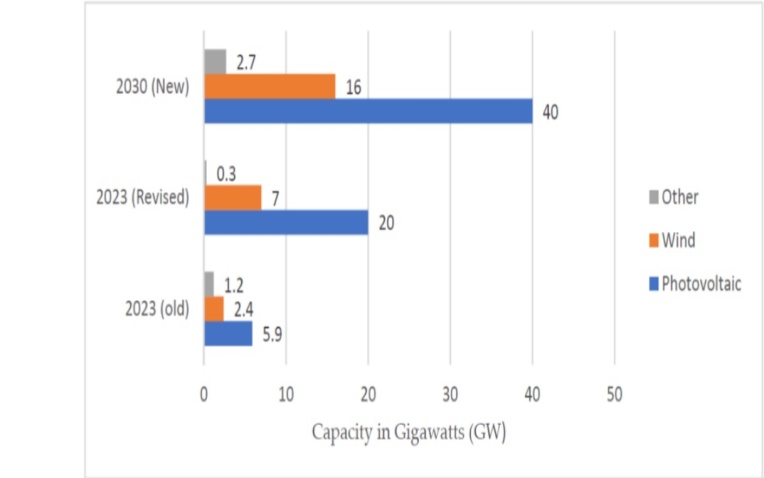
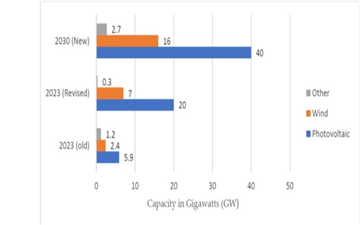
1.1. History Solar Energy Projects IN Saudi ArabiaSaudi Arabia is in the Sun Belt with a vast desert and open skies all year round and that will help the government to investment in solar PV 4, 5. Saudi Arabia has an average sunlight energy of 2200 kWh/m2, which means that it is worth attempting to produce clean energy via direct sunlight through PV cells in Saudi Arabia 4. Since 1960, Saudi Arabia started to use the PV systems. With huge amounts of sun and open land, Saudi Arabia has been blessed. It has one of the highest sunlight levels in the world 4. Saudi Arabia has developed state-of-the-art, cost-effective technology to ensure a high request for solar energy measurement at 46 stations throughout Saudi Arabia, to meet the rising demand for electricity, maintain economic growth and diversify its domestic energy mix 4, 5. For development of solar energy in Saudi Arabia there was initiatives such as an atlas projects in 1994 4. It was a joint Research and development company for calculating solar radiation between KASCT's Energy Research Institute (ERI) and the National Energy Laboratory (NREL) in the United States 6. Riyadh, Qassim, Al-Ahsa, Al-Jouf, Tabuk, Al-Madinah, Jeddah, Qaisumah, Wadi Al-Dawasir, Sharura, Abha, and Jizan are among the cities where records have been kept 7. Saudi Renewable Energy Project Development Office (REPDO) amended the Vision 2030 goals for the second time in January 2019. The updated plans include a significant increase in RE targets, from 9.5 GW to 27.3 GW in 2023, with an overall target of 58.7 GW in 2030, as indicated in Figure 3, of this 58.7 GW, 40 GW will be solar PV, 16 GW will be wind, and 2.7 GW will be other RE sources by 2030 8.

The main aim of this study is to provide an in-depth and analytical understanding of the ability to build power plants to support the Shuaiba power plant and the Al-Shuaiba steam plant to the insider and reader. Engineers and professionals will gain the knowledge they need to deliver network connectivity concepts to renewable solar power plants if the goal of adding 200 MW solar power plants per region is met. It also contains the most up-to-date information on high-efficiency solar panel technologies. Implement a Positive analysis of the long-term impact of these stations due to long-age techniques. Calculating the cost of establishing, operating, managing, and maintaining the system, improving power generation, and the use of renewable power plants in modern power grids for the abundance of solar energy wasted in Saudi Arabia.
Solar PV systems could harness the energy of the sun to provide high-quality electricity that is both healthy for your home and good for the environment. Global solar markets stood at 11.8 billion dollars in 2005 and were 55 percent higher in 2004. The provision of solar systems in 2010 was estimated to be 15 GW versus 2.7 GW in 2006. Projected sales of solar energy equipment in April 2007 by Photon Consulting for 2010 were estimated to be 90 billion dollars, up from 20 billion dollars in 2006. The silicon demand for solar cells was predicted to expand in 2010 from 41,000 tons to 400,000 tons in 2015 9, 10, 11. The production and use of renewable energy is growing rapidly worldwide. The world's renewable energy potential at the end of 2012 was over 1500 GW and renewable energy is predictable to meet approximately 13% of world's demand for energy by 2020 12, 13, 14, 15, 16. In the Middle East countries (MECs), the highest solar capacity is present, with annual solar irradiation of the countries above 2100 KWh/m2, as shown in Figure 2 15, 16, 17, 18, 19, 20.
In most of the high-potential solar regions In the Middle East, the annual average amount of sun light is about 250 W/m2. Since solar energy is a significant source of renewable energy, many organizations and countries have prioritized solar research and investment as a viable alternative to burning fossil fuels. Table 1 shows projected solar PV power production and installation in the US, Europe, Japan and around the world by 2030 20, 21, 22, 23, 24, 25.
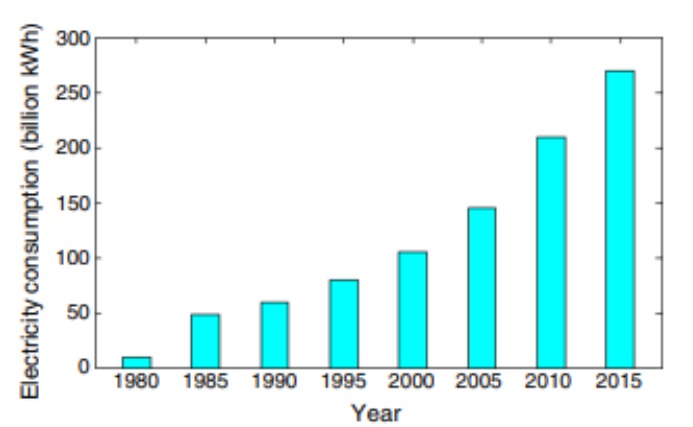
In the next ten year, the Saudi country power consumption will rise to around four hundred billion kWh which is written in study’s 26, 27, 28, 29, 30. Saudi Arabia relies heavily on fossil fuels for its electricity supply 27, 28, 29. In Saudi Arabia, electricity is mainly used in the domestic and industrial sectors 27. In the last decades, because of the increasing demand for electricity, Saudi Arabia's electricity consumption has increased significantly, secondary to the big change from rural to urban areas and the growth of major industries 28. Half of all energy is used by the housing and air conditioning industries. However, the industrial sectors consume 21% of the electricity. Almost 27% of electrical power consumption for trading sector and government [23-29] 23. According to the numbers, Saudi Arabia supports the Saudi Electricity Company by fuel which is equal 150,000,000 Saudi Riyals 30. Domestic oil use has risen steadily to 3,000,000 barrels daily. During the high consumption of oil, it is more than oil sales with average thirty-seven percent 31. The electricity power generator wants to increase generating capacity to 120 GW by 2032 because of the country's rapid economic expansion during the previous decade. To fulfill the Saudi's growing need for electric power while reducing oil use, a strategy is being devised to provide consumption from clean resources 26, 27, 32. By 2032, the greatest electricity consumption is expected to reach between Fifty-five Giga watts and one hundred twenty-two Giga watts with a difference of sixty-one Giga watts between the output of the project and the rate of demand 32, 33. According to high consumption oil in Saudi Arabia, the government should decrease it, so that sufficient oil remains for exports. Figure 3 shows the Saudi Arabia electricity usage.

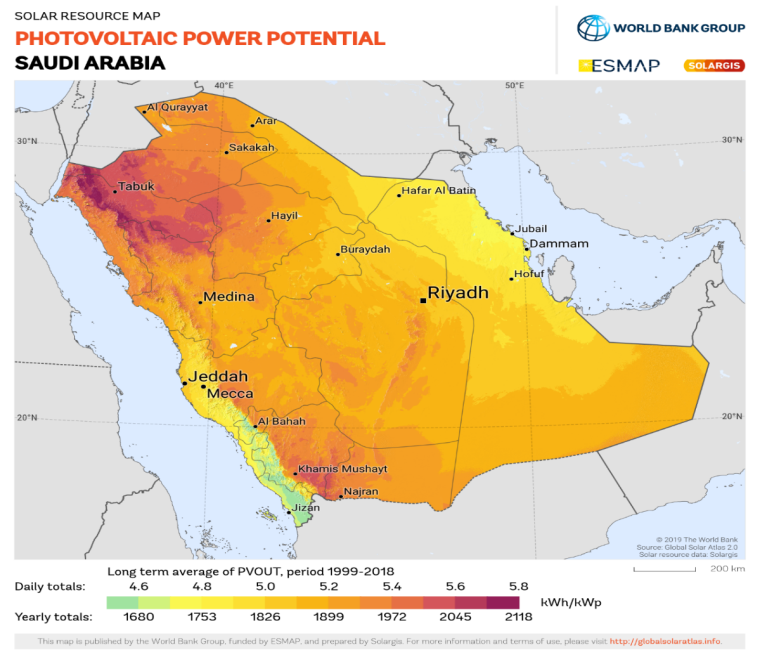
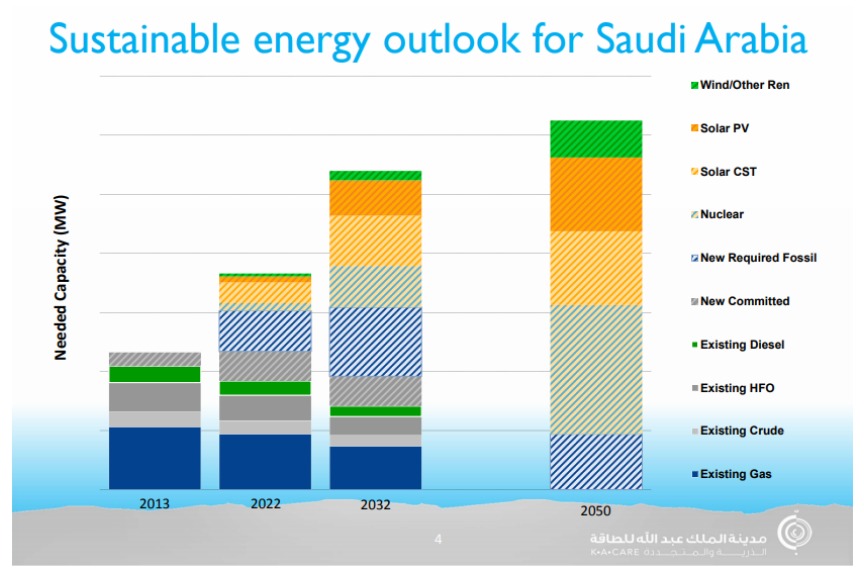
This gap is filled by resources from Saudi Arabia. The Sunbelt is the area between 40°N and 40°S latitudes that is known across the world, and it is during this belt. Saudi Arabia is strategically located on the globe (latitudes 16° and 33°N) and (longitudes 34° and 56°E), allowing it to produce power from the sun. Because it is sun powered at around 5-9 kWh/ m2/day, in this location, the solar power potential is enormous. 28. Indeed, the Arab Peninsula receives about 2200 kWh/m2 of solar radiation each year on average 29. To supply the predicted demand for power by 2050, just around 0.1 percent of the land will be required. As a result, KACARE, the organization in charge of promoting renewable energy in the country, has set a goal of producing 54 GW of RE by 2032. By 2020, 24 GW is projected in the medium term 31, 32. More than 108,900,000 dollars will be spent on PV&CSP particularly. for Forty-one Giga watts by 2030, which is one 3ed of the national consumption. In 2032, a proposed energy mix (in GW) is proposed. Saudi Arabia has a wide range of renewable energy production, transmission, and development capabilities. With a surface size of 2,150,000 square kilometers, it connects Africa with Asia. Saudi Arabia has a large land area, particularly in the Gulf Cooperation Council, and it ranks second in the Arab world in terms of land area 24. Saudi Arabia's economy is growing at a rate of roughly 5.31 percent, with an average change in real GDP. As a result, regardless of geo-economic situations, Saudi Arabia will be able to engage in renewable energy projects. Saudi Arabia plans to introduce 11 GW of solar energy production in 2022, with a goal of reaching 40 GW of renewable energy by 2030. The capacity of projects involving renewable energy sources has been increased 26, 33. Saudi Arabia may possibly emerge as the most cost-effective solar PV power manufacturing location, according to experts. According to the European Commission's Institute for Energy, 1/3 percent of light from the GCC deserts is sufficient for Europe as a whole. Figure 4 shows the Sustainable energy outlook in Saudi Arabia.

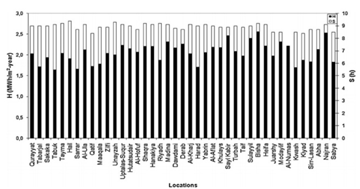
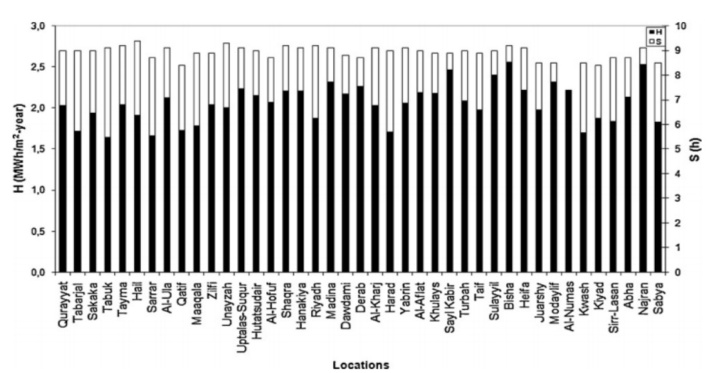
The range of global solar radiation on surface of Saudi Arabia is around two-megawatt hour per meter square in a year as shown in Figure 7. The time of sunlight is different (not equal) in 41 locations of Saudi Arabia 5, 6, 7, 8, 9, 10. In the case of Tabuk and Bisha the average annual minimum and maximum GSR values, according to these geographical locations, vary between 1,63-megawatt hour per meter square and 2,56-megawatt hour per meter square. In Figure 7, it's clear that in the areas of Nejran, Bisha, Al-Sulayyil, etc. In south of most Saudi Arabia higher GSR values are observed while in the Northern region comparatively lower values are as in those areas, like: Hail, Sakaka, and Tabarjal. By comparison, smallest values in Western and European countries are much higher, creating an incentive to exploit the power of the sun for electricity generation. Saudi Arabia's east and west regions are also experiencing higher global solar radiation intensities and should therefore be explored. Figure 5 indicates global solar radiation's seasonal variation values obtained at 41 sites shown in Figure8 using mean-monthly values. The winter season has a smaller period of solar radiation, while in the summer months the higher radiation values are observed, with a maximum and minimum daily value of 3.82 kWh/m2, 7.09 kWh/m2 respectively in the December and June months 12. In the automated sunlight and meteorological monitoring stations of Dhahran in Saudi Arabia, Shaahid and Elhadidy 33 also analyzed hourly wind-speed data reported to identify wind power monthly. Wind power was also comparable with the monthly mean solar radiation energy from 1987 to 1990, and the daily solar radiation values were between 3.46 and 7.43 Kilowatt hours per square meter and total solar possibility per meter square were 2.03 Megawatt hours per square meter.
3.2. Exegetic Solar Radiation Estimation in Some Regions of Saudi ArabiaThe conversion of solar energy into useable energy has yet to play a significant part in most countries' energy budgets. However, because of its ecologically friendly status, energy conversion will become more important in the future, and thermodynamic equipment will be necessary as demand rises. Furthermore, this is critical [1-10] 1. In a fixed environment, exergy is a portion of input energy that is completely convertible to another sort of energy, such as electricity [1-10] 1. They are entirely exergy, mechanical, and electrical energy, and they may be converted into any other form of energy. Due to its entropy value, solar energy is not fully converted, hence its exergy content is less than 100 percent. Even if the ideal, entirely reversible converting is possible, a solar conversion device's energy conversion efficiency is not the same. Depending on the weather, between 50 and 80 percent of the exergy content of solar radiation reaches the earth's surface 10.
In this respect, the two illustrated cases, which were used and contrasted by several solar energy models, were thoroughly evaluated in a variety of solar energy models for use with solar energy applications, and solar energy values for specific Saudi Arabian locations were determined. The experimental values collected through the Gulf of Arabia in North-Eastern Saudi Arabia close to Dhahran. The findings were used for analysis of Saudi Arabia. Solar radiation energy ratios were obtained at outdoor temperatures of between (16.18 and 33.01)°C in northeastern Saudi Arabia at an average of 0.933. In Northeast Saudi Arabia, the sunlight irradiance values range from 153.72 to 306.29 W/m2 for both Petela and Spanner approaches, and from (156.37 to 311.86) for the Jefer approach, with outside air temperatures ranging from 16.18 to 33.01°C for both approaches. These values were determined for the above-mentioned approaches between 286.24-91,62W/m2 10.
3.3. Barriers and Constraints in Saudi ArabiaOver the last several decades, Saudi Arabia has witnessed tremendous population, economic, and industrial growth, resulting in rising energy consumption and the need for more power to satisfy. The continual growth in power consumption is expected to begin in 2023 as the number of residential and industrial customers connected to the grid expands 33. Many power projects have been launched in Saudi Arabia to achieve the anticipated expansion of the power industry in anticipation for the projected rise in demand 33. Existing power plants have been rebuilt and enlarged on a regular basis, and new power plants, including power generation and desalination facilities, have been constructed. Private enterprises, which built two major types of plants: Independent Producers of Power and Independent Water and Power Producers, played a significant role in the development of the energy industry 33. Saudi Arabia looks to have a lot of potential for solar power generation from the sun. Officials in Saudi Arabia have declared a desire to see the country become a significant exporter of solar energy by filling the desert with solar energy plants over the next 30-50 years, as the Desertec project would 32, 33. This is a long-term goal that has now become unfeasible due to technological limitations. So yet, only a limited off-grid use of PV technology has been the focus of Saudi Arabia's solar initiatives. On the other side, Saudi Arabia is now attempting to develop its own renewable energy center 32, 33. The biggest economic impediment was the lack of a low-cost, heavily subsidized energy source (i.e., fossil fuels) in that oil-producing country. It also relates to the development of solar energy, in which political backing is required for renewable energy to prosper 32, 33. Solar energy can deliver both social and financial benefits, such as job and investment opportunities 32, 33. The rise in usage of solar energy is logically also reported, In the cloudless desert, solar electricity is boundless and extremely stable, resulting in price stability on solar energy markets. Most analysts, however, believe it will take at least another decade to recover the estimated value. Saudi Arabia has several renewable energy possibilities. Have been proposed and developed by Al-Saleh using the Delphi technique 32, 33. It was decided that the recent spike in oil prices has greatly aided many of the Middle East's oil-rich nations. Saudi Arabia has reaped substantial profits as a major oil producer, which was inconceivable only a few years ago. One of the issues facing oil-dependent economies is figuring out how to better employ such obvious wealth on the road to sustainable growth 33. Almost all energy models for achieving global sustainability show a substantial rise in the proportion of primary energy derived from renewable resources. There is a definite worldwide interest in renewable energy alternatives in light of current energy and environmental issues. As a large oil producer, Saudi Arabia should not be regarded an exception in this regard 33. It is thought that now is the greatest moment to invest in renewable energy capacity to secure the stability and quick growth of the country's future energy economy 33. Saudi Arabia's effort for renewable energy should not be seen as a luxury, but as an indication of excellent governance, environmental awareness, and prudent oil production policy 33.
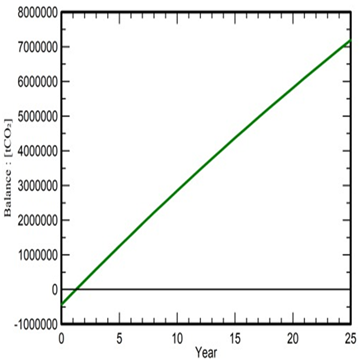
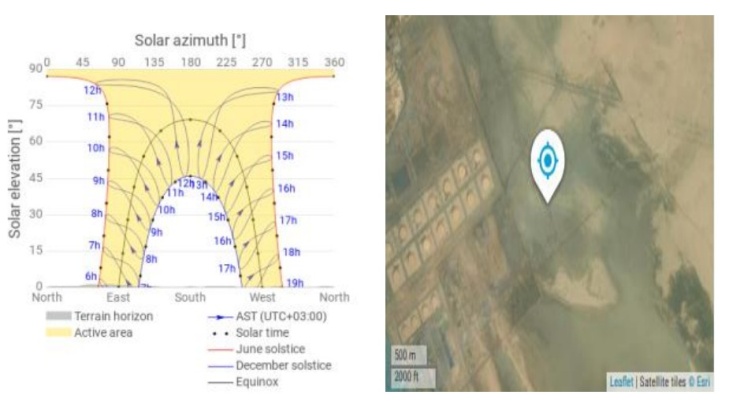
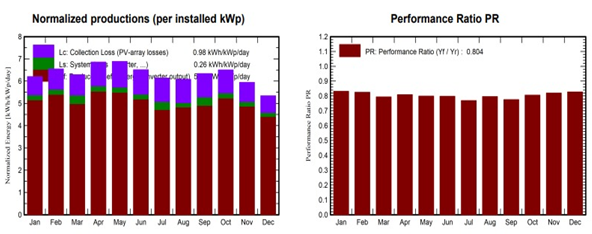
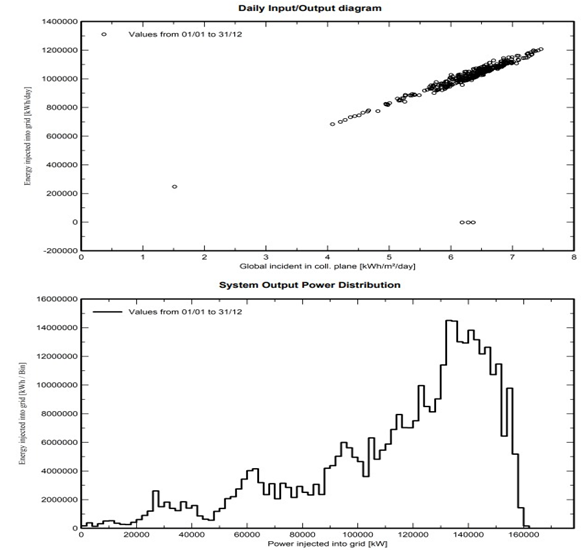
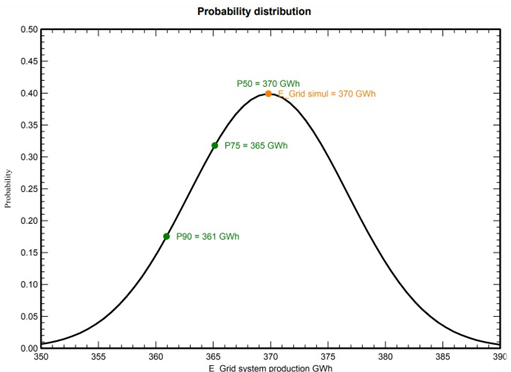
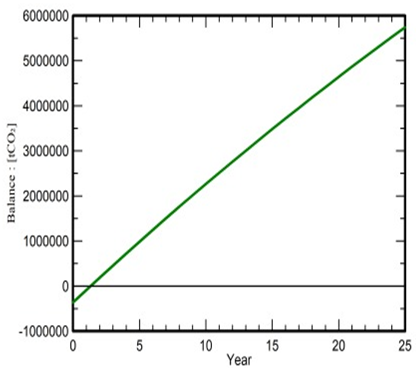
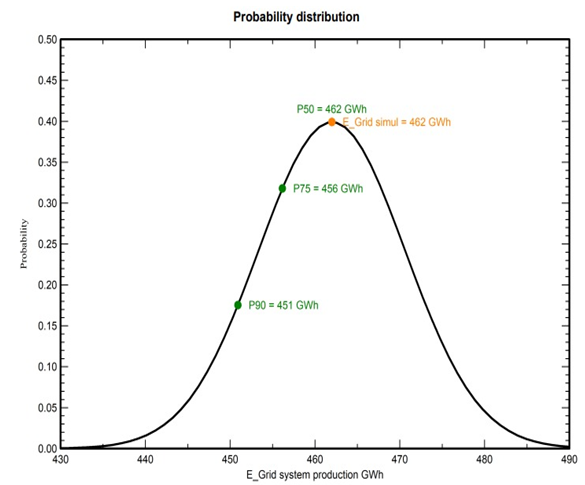
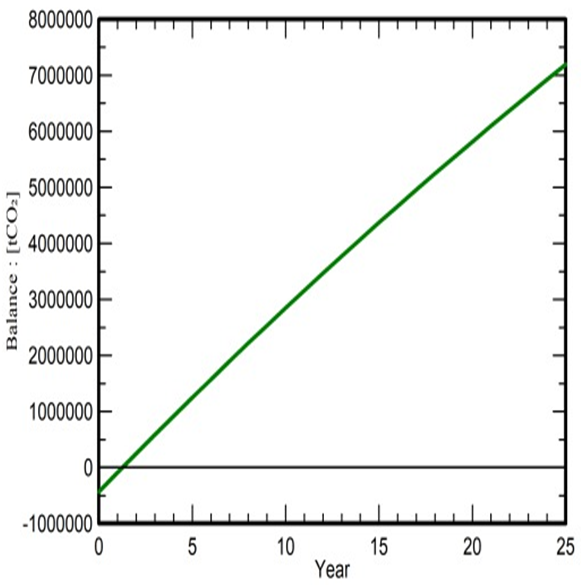
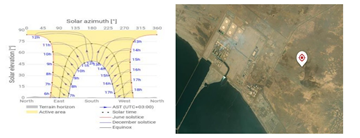
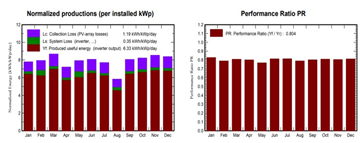
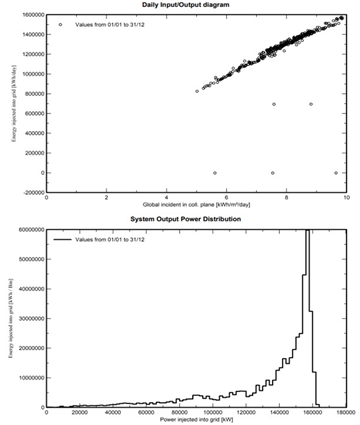
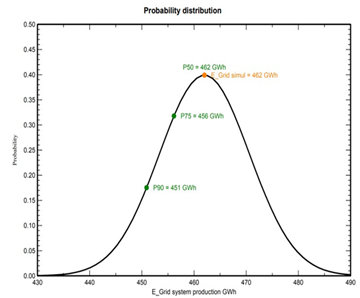
This section will go through how to install PV systems for a location near a Saudi Electricity Company power plant where PV systems can be connected directly to the grid. PVsyst 7.1 program and GLOBAL SOLAR ATLAS were used to perform all calculations and simulations. and calculate how much CO2 emissions will be reduced. Each location is expected to generate 200 MWp of electricity. The first research site is Al-Shuaybah, which is located at (Latitude 20.63°N, Longitude 39.58°E) and has an altitude of 8 meters. Figure 6 shows the Solar path at Al-Shuaybah from JAN to DEC & location map. The optimal tilt and azimuth angle for the Al-Shuaybah site is 21.2 degrees with a zero-degree azimuth to maximize power from PV panels; the best tilt angle is 21.2 degrees with a zero-degree azimuth to maximize electricity from PV panels. The sun path statistics come from the Meteonorm software, which provides an unmatched mix of precise data and sophisticated mathematical materials. This information may be utilized to get accurate historical statistics and information at any time. The PV system's lifetime is anticipated to be between 25 and 30 years, and the project will save 298136.843 tons of CO2 per year. The project can save roughly 7.45 million tons of CO2 emissions over its lifetime of 25 years. Figure 7 shows the results of simulation for Al-Shuaybah site. Figure 8 shows special graphs daily input/output diagram, system output power distribution. Figure 9 shows the probability distribution for Al-Shuaybah. Figure 10 shows the CO2 Emission balance.
Figure 11 shows the 3D image of the PV station near the plant, a plan was made to intercept the placement of panels near the distribution station for Al-Shuaybah. Figure 12 (a,b,c,d,e,f,g,h) shows the 3D photo for Al-Shuaybah. Table 1 shows the total cost of the plant.
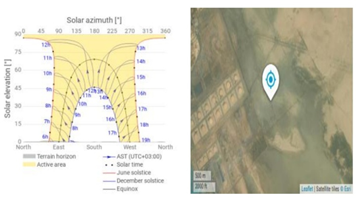
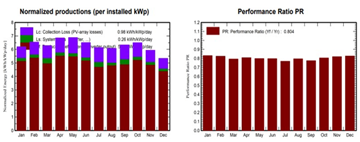
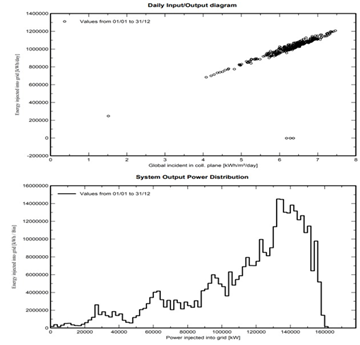
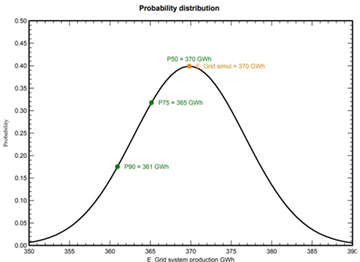
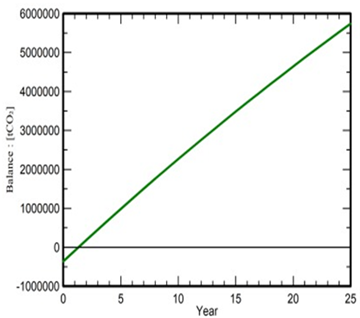
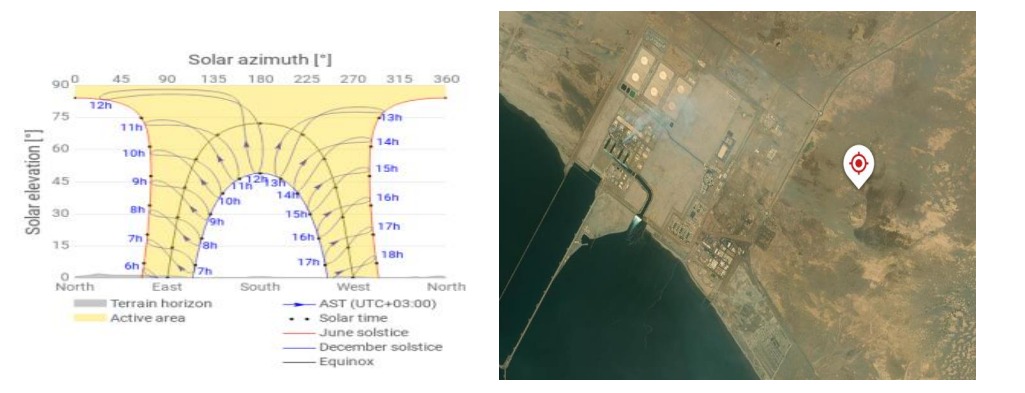
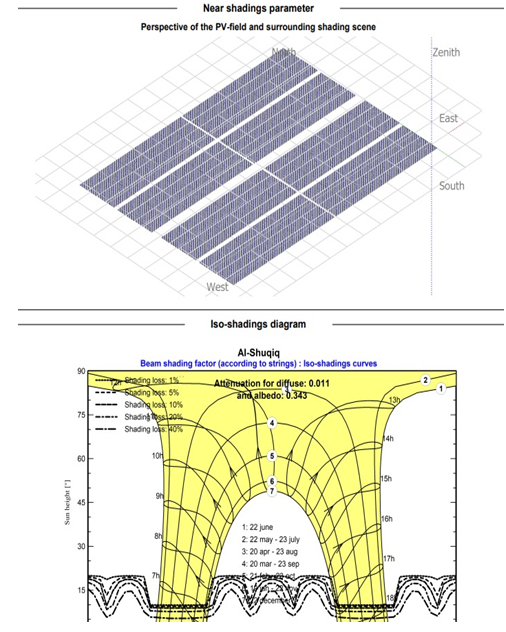
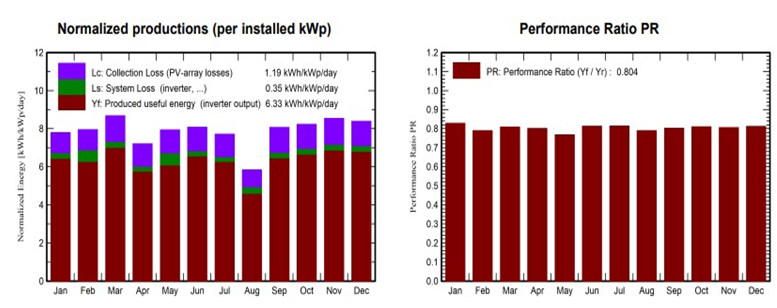
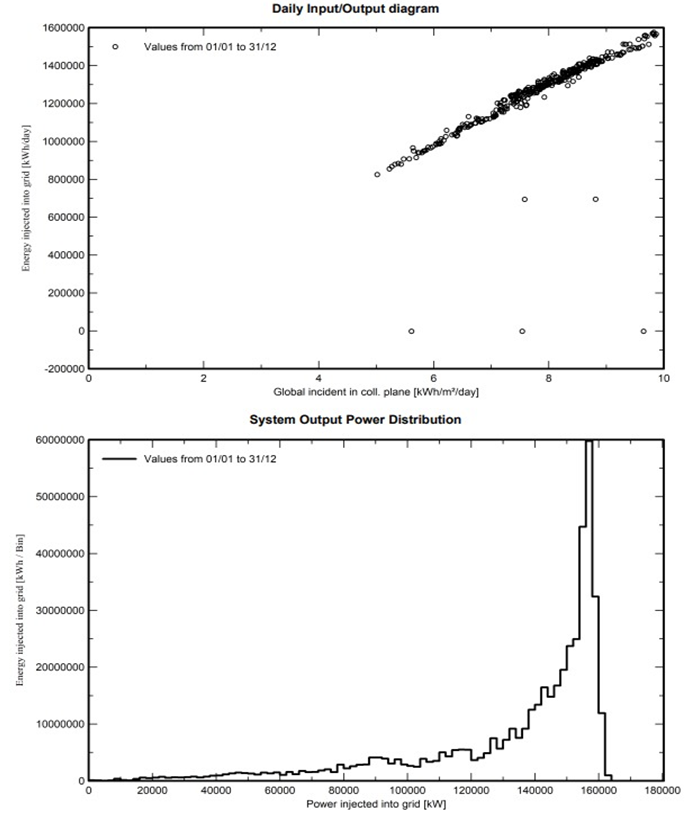
The installation of PV systems is constructed in a location near a Saudi Electricity Company power plant where PV systems can be connected directly to the grid. PVsyst 7.1 program and GLOBAL SOLAR ATLAS were used to perform all calculations and simulations. and calculate how much CO2 emissions will be reduced. Each location is expected to generate 200 MWp of electricity. The last location on the western coast is in the Jizan region. The Coordinates are (Latitude 17.6339 °N, Longitude, 42.1382 °E) and Altitude is 8 meters. Figure 12 shows the Solar path at Al-Shuqiq from JAN to DEC & location map. The ideal tilt and Azimuth angle for Al-Shuqiq location is 21 degrees with a zero-degree Azimuth that gives maximum power from PV panels. The sun path data is gathered using the Meteonorm application, which offers an unrivaled mix of dependable data and powerful computation materials. Access to accurate historical and information for any period of year may be obtained from this data. Figure 13 shows the near shadings parameter perspective of the PV field and surrounding shading scene, Iso-shadings diagram. Figure 14 shows Simulation results for Al-Shuqiq. Figure 15 shows the special graphs daily input/output diagram, system output power for Al-Shuqiq. Figure 16 shows the probability distribution for Al-Shuqiq. Figure 17 shows the CO2 Emission balance for Al-Shuqiq. Table 2 shows the total cost for Al-Shuqiq.

Saudi Arabia has significant natural solar energy potential as well as an economic opportunity to expand renewable energy to fulfill local energy demand. Solar energy technology has advanced at a dizzying pace in recent years, and so represents the most potential alternative to conventional energy systems. While experimental initiatives to expand solar energy production were initiated in the 1980s, Saudi Arabia has chosen a much more aggressive approach to solar energy production. This research project presents the results of an analytical study that was conducted on the use of PV systems in two locations within Saudi Arabia. A feasibility study for a project to establish a solar power plant with a capacity of 200 megawatts in the regions of Al-Shuaybah. and Al-Shuqiq The study includes the design of a photovoltaic system using PVsyst and SketchUp programs and a feasibility work on quantities for all components required and total costs for the construction of the station. The cost of implementing both stations was studied and analyzed.
| [1] | K. Althobiti, Ahmed M. Nahhas, Recent Advances of Hydropower Energy in Saudi Arabia, American Journal of Energy Research, Vol. 8, No. 1, 1-6, 2020. | ||
| In article | |||
| [2] | Q. Alabdali, A. Bajawi, Ahmed M. Nahhas, Review of Recent Advances of Shading Effect on PV Solar Cells Generation, Sustainable Energy, Vol. 8, No. 1, 1-5, 2020. | ||
| In article | |||
| [3] | G. Alzahrani, F. Alzahrani, Ahmed M. Nahhas, Study of the Specific Factors Effecting the PV Solar Cell’s Efficiency in Saudi Arabia, Sustainable Energy, Vol. 8, No. 1, 6-11, 2020. | ||
| In article | |||
| [4] | Q. Alabdali, A. Bajawi, Ahmed M. Fatani, Ahmed M. Nahhas, Review of Recent Advances of Wind Energy Sustainable Energy, Vol. 8, No. 1, 12-19, 2020. | ||
| In article | |||
| [5] | A. Bajawi, Ahmed M. Nahhas, Analytical Study of Power Generation Using PV System for Al-Shuaiba and Al-Shuqiq Regions in Saudi Arabia, American Journal of Energy Research, Vol. 9, No. 1, 21-29, 2021. | ||
| In article | View Article | ||
| [6] | Q. Alabdali, Ahmed M. Nahhas, Simulation Study of Grid Connected Photovoltaic System Using PVsyst Software: Analytical Study for Yanbu and Rabigh Regions in Saudi Arabia, American Journal of Energy Research, Vol. 9, No. 1, 30-44, 2021. | ||
| In article | View Article | ||
| [7] | G. Alzahrani, Ahmed M. Nahhas, Analytical Study of Power Generation by Photovoltaic System for Al-Riyadh and Al-Jubail Regions in Saudi Arabia, American Journal of Energy Research, Vol. 9, No. 1, 45-55, 2021. | ||
| In article | View Article | ||
| [8] | A. Jee, J. Alsluimani, A. Alqurashi, A. Akkur, Ahmed M. Nahhas, Review of Recent Advances of Supercapacitors Energy Storage Systems, Sustainable Energy, Vol. 10, No. 1, 29-42, 2022. | ||
| In article | View Article | ||
| [9] | A. Albarrak, A. Alshareef, A. Alshareef, Ahmed M. Nahhas, Review of Hydrogen Based Fuel Cells Energy Storage Systems, Sustainable Energy, Vol. 10, No. 1, 1-20, 2022. | ||
| In article | View Article | ||
| [10] | A. Shendi, Ahmad M. Nahha𝑠, Power generation by using Photovoltaic systems for Yanbu and Rabigh regions in Saudi Arabia: a cost-effective study, The Islamic University Journal of Applied Sciences (JESC) Vol. 5, No. 1, 2023. | ||
| In article | |||
| [11] | M. Mohandes, S. Rehman, Estimation of global solar radiation using artificial neural networks. Renewable energy, Vol., No.1, 179-184, 1998. | ||
| In article | View Article | ||
| [12] | A. Salam, A. Khan, Transition towards sustainable energy production–A review of the progress for solar energy in Saudi Arabia. Energy Exploration & Exploitation, Vol. 36, No. 1, 3-27, 2018. | ||
| In article | View Article | ||
| [13] | W. Alnaser, N. Alnaser, The status of renewable energy in the GCC countries. Renew Sustain Energy Rev, Vol. 15, No. 6, 3074-98, 2011. | ||
| In article | View Article | ||
| [14] | R. Pazheri, M. Othman, N. Malik., A review on global renewable electricity scenario, Renewable and Sustainable Energy Reviews, Vol. 31, 835-845, 2014. | ||
| In article | View Article | ||
| [15] | R. Saidur, M. Islam, N. Rahim, K. Solangi. A review on global wind energy policy. Renewable Sustainable Energy Rev, Vol. 14, No. 7, 1744-62, 2010. | ||
| In article | View Article | ||
| [16] | H. Liming, E. Haque, S. Barg. Public policy discourse, planning and measures toward sustainable energy strategies in Canada. Renewable Sustainable Energy Rev, Vol. 12, No. 1, 91-115, 2008. | ||
| In article | View Article | ||
| [17] | R. Bhandari, I. Stadler, Grid parity analysis of solar photovoltaic systems in Germany using experience curves. Solar Energy, Vol. 83, No. 9, 1634-44, 2009. | ||
| In article | View Article | ||
| [18] | D. Luigi, T. Enrico, Economic analysis of different supporting policies for the production of electrical energy by solar photovoltaics in western European Union countries. Energy Policy, Vol. 38, No. 7, 3297-308, 2010. | ||
| In article | View Article | ||
| [19] | A. Campoccia, L. Dusonchet, E. Telaretti, G. Zizzo, Comparative analysis of different supporting measures for the production of electrical energy by solar PV and Wind systems: four representative European cases. Solar Energy, Vol. 83, No. 3, 287-97, 2009. | ||
| In article | View Article | ||
| [20] | L. Dusonchet, E. Telaretti., Economic analysis of different supporting policies for the production of electrical energy by solar photovoltaics in western European Union countries. Energy Policy, Vol. 38, No. 7, 3297-308, 2010. | ||
| In article | View Article | ||
| [21] | Q. Wang, Effective policies for renewable energy – the example of China’s wind power – lessons for China’s photovoltaic power. Renewable Sustainable Energy Rev, Vol. 14, No. 2, 702-12, 2010. | ||
| In article | View Article | ||
| [22] | A. Aghahosseini, D. Bogdanov, C. Breyer, Towards sustainable development in the MENA region: Analyzing the feasibility of a 100% renewable electricity system in 2030. Energy Strategy Reviews, Vol. 28, 100466, 2020. | ||
| In article | View Article | ||
| [23] | D. Gately, N. Al-Yousef, H. Al-Sheikh, The rapid growth of domestic oil consumption in Saudi Arabia and the opportunity cost of oil export surgeon. Energy Policy, Vol. 47, 57-68, 2012. | ||
| In article | View Article | ||
| [24] | O. Alnatheer, The potential contribution of renewable energy to electricity supply in Saudi Arabia. Energy policy, Vol. 33, No. 18, 2298-312, 2005. | ||
| In article | View Article | ||
| [25] | F. Rahman, S. Rehman, M. Abdul-Majeed, Overview of energy storage systems for storing electricity from renewable energy sources in Saudi Arabia. Renewable and Sustainable Energy Reviews, Vol. 16, No. 1, 274-83, 2012. | ||
| In article | View Article | ||
| [26] | W. Matar, F. Murphy, A. Pierru, B. Rioux, D. Wogan, Efficient industrial energy use: The first step in transitioning Saudi Arabia's energy mix. Energy Policy, Vol. 105, 80-92, 2017. | ||
| In article | View Article | ||
| [27] | S. Alawaji, Evaluation of solar energy research and its applications in Saudi Arabia 20 years of experience. Renew Sustain Energy Rev, Vol. 5, 59-77, 2001. | ||
| In article | View Article | ||
| [28] | S. Al-Awaji, S. Hasnain, The role of solar energy research in transferring of technology to Saudi Arabia. Energy Sources, Vol. 21, No. 10, 923-934, 1999. | ||
| In article | View Article | ||
| [29] | A. Bhutto, A. Bazmi, G. Zahedi, J. Jiri, A review of progress in renewable energy implementation in the Gulf Cooperation Council countries. J Clean Prod, Vol. 71, 1-13, 2014. | ||
| In article | View Article | ||
| [30] | A. Alshehry, M. Belloumi, Energy consumption, carbon dioxide emissions and economic growth: The case of Saudi Arabia. Renewable and Sustainable Energy Reviews, Vol. 41, 237-247, 2015. | ||
| In article | View Article | ||
| [31] | I. Tlili, Renewable energy in Saudi Arabia: current status and future potentials. Environment, development and sustainability, Vol. 17, No. 4, 859-886, 2015. | ||
| In article | View Article | ||
| [32] | F. Pazheri, N. Malik, A. Al-Arainy, S. Ottukulotk, M. Othman, E. Al-Ammar, Use of renewable energy sources in Saudi Arabia through smart grid. Journal of energy and power engineering, Vol. 6, No. 7, 1065-1070, 2012. | ||
| In article | |||
| [33] | V. Fthenakis, A. Atia, O. Morin, R. Bkayrat, P. Sinha, New prospects for PV powered water desalination plants: case studies in Saudi Arabia. Progress in Photovoltaics: Research and Applications, Vol. 24, No. 4, 543-50, 2016. | ||
| In article | View Article | ||
Published with license by Science and Education Publishing, Copyright © 2024 Abdulaziz Alqurashi and Ahmed M. Nahhas
 This work is licensed under a Creative Commons Attribution 4.0 International License. To view a copy of this license, visit
http://creativecommons.org/licenses/by/4.0/
This work is licensed under a Creative Commons Attribution 4.0 International License. To view a copy of this license, visit
http://creativecommons.org/licenses/by/4.0/
| [1] | K. Althobiti, Ahmed M. Nahhas, Recent Advances of Hydropower Energy in Saudi Arabia, American Journal of Energy Research, Vol. 8, No. 1, 1-6, 2020. | ||
| In article | |||
| [2] | Q. Alabdali, A. Bajawi, Ahmed M. Nahhas, Review of Recent Advances of Shading Effect on PV Solar Cells Generation, Sustainable Energy, Vol. 8, No. 1, 1-5, 2020. | ||
| In article | |||
| [3] | G. Alzahrani, F. Alzahrani, Ahmed M. Nahhas, Study of the Specific Factors Effecting the PV Solar Cell’s Efficiency in Saudi Arabia, Sustainable Energy, Vol. 8, No. 1, 6-11, 2020. | ||
| In article | |||
| [4] | Q. Alabdali, A. Bajawi, Ahmed M. Fatani, Ahmed M. Nahhas, Review of Recent Advances of Wind Energy Sustainable Energy, Vol. 8, No. 1, 12-19, 2020. | ||
| In article | |||
| [5] | A. Bajawi, Ahmed M. Nahhas, Analytical Study of Power Generation Using PV System for Al-Shuaiba and Al-Shuqiq Regions in Saudi Arabia, American Journal of Energy Research, Vol. 9, No. 1, 21-29, 2021. | ||
| In article | View Article | ||
| [6] | Q. Alabdali, Ahmed M. Nahhas, Simulation Study of Grid Connected Photovoltaic System Using PVsyst Software: Analytical Study for Yanbu and Rabigh Regions in Saudi Arabia, American Journal of Energy Research, Vol. 9, No. 1, 30-44, 2021. | ||
| In article | View Article | ||
| [7] | G. Alzahrani, Ahmed M. Nahhas, Analytical Study of Power Generation by Photovoltaic System for Al-Riyadh and Al-Jubail Regions in Saudi Arabia, American Journal of Energy Research, Vol. 9, No. 1, 45-55, 2021. | ||
| In article | View Article | ||
| [8] | A. Jee, J. Alsluimani, A. Alqurashi, A. Akkur, Ahmed M. Nahhas, Review of Recent Advances of Supercapacitors Energy Storage Systems, Sustainable Energy, Vol. 10, No. 1, 29-42, 2022. | ||
| In article | View Article | ||
| [9] | A. Albarrak, A. Alshareef, A. Alshareef, Ahmed M. Nahhas, Review of Hydrogen Based Fuel Cells Energy Storage Systems, Sustainable Energy, Vol. 10, No. 1, 1-20, 2022. | ||
| In article | View Article | ||
| [10] | A. Shendi, Ahmad M. Nahha𝑠, Power generation by using Photovoltaic systems for Yanbu and Rabigh regions in Saudi Arabia: a cost-effective study, The Islamic University Journal of Applied Sciences (JESC) Vol. 5, No. 1, 2023. | ||
| In article | |||
| [11] | M. Mohandes, S. Rehman, Estimation of global solar radiation using artificial neural networks. Renewable energy, Vol., No.1, 179-184, 1998. | ||
| In article | View Article | ||
| [12] | A. Salam, A. Khan, Transition towards sustainable energy production–A review of the progress for solar energy in Saudi Arabia. Energy Exploration & Exploitation, Vol. 36, No. 1, 3-27, 2018. | ||
| In article | View Article | ||
| [13] | W. Alnaser, N. Alnaser, The status of renewable energy in the GCC countries. Renew Sustain Energy Rev, Vol. 15, No. 6, 3074-98, 2011. | ||
| In article | View Article | ||
| [14] | R. Pazheri, M. Othman, N. Malik., A review on global renewable electricity scenario, Renewable and Sustainable Energy Reviews, Vol. 31, 835-845, 2014. | ||
| In article | View Article | ||
| [15] | R. Saidur, M. Islam, N. Rahim, K. Solangi. A review on global wind energy policy. Renewable Sustainable Energy Rev, Vol. 14, No. 7, 1744-62, 2010. | ||
| In article | View Article | ||
| [16] | H. Liming, E. Haque, S. Barg. Public policy discourse, planning and measures toward sustainable energy strategies in Canada. Renewable Sustainable Energy Rev, Vol. 12, No. 1, 91-115, 2008. | ||
| In article | View Article | ||
| [17] | R. Bhandari, I. Stadler, Grid parity analysis of solar photovoltaic systems in Germany using experience curves. Solar Energy, Vol. 83, No. 9, 1634-44, 2009. | ||
| In article | View Article | ||
| [18] | D. Luigi, T. Enrico, Economic analysis of different supporting policies for the production of electrical energy by solar photovoltaics in western European Union countries. Energy Policy, Vol. 38, No. 7, 3297-308, 2010. | ||
| In article | View Article | ||
| [19] | A. Campoccia, L. Dusonchet, E. Telaretti, G. Zizzo, Comparative analysis of different supporting measures for the production of electrical energy by solar PV and Wind systems: four representative European cases. Solar Energy, Vol. 83, No. 3, 287-97, 2009. | ||
| In article | View Article | ||
| [20] | L. Dusonchet, E. Telaretti., Economic analysis of different supporting policies for the production of electrical energy by solar photovoltaics in western European Union countries. Energy Policy, Vol. 38, No. 7, 3297-308, 2010. | ||
| In article | View Article | ||
| [21] | Q. Wang, Effective policies for renewable energy – the example of China’s wind power – lessons for China’s photovoltaic power. Renewable Sustainable Energy Rev, Vol. 14, No. 2, 702-12, 2010. | ||
| In article | View Article | ||
| [22] | A. Aghahosseini, D. Bogdanov, C. Breyer, Towards sustainable development in the MENA region: Analyzing the feasibility of a 100% renewable electricity system in 2030. Energy Strategy Reviews, Vol. 28, 100466, 2020. | ||
| In article | View Article | ||
| [23] | D. Gately, N. Al-Yousef, H. Al-Sheikh, The rapid growth of domestic oil consumption in Saudi Arabia and the opportunity cost of oil export surgeon. Energy Policy, Vol. 47, 57-68, 2012. | ||
| In article | View Article | ||
| [24] | O. Alnatheer, The potential contribution of renewable energy to electricity supply in Saudi Arabia. Energy policy, Vol. 33, No. 18, 2298-312, 2005. | ||
| In article | View Article | ||
| [25] | F. Rahman, S. Rehman, M. Abdul-Majeed, Overview of energy storage systems for storing electricity from renewable energy sources in Saudi Arabia. Renewable and Sustainable Energy Reviews, Vol. 16, No. 1, 274-83, 2012. | ||
| In article | View Article | ||
| [26] | W. Matar, F. Murphy, A. Pierru, B. Rioux, D. Wogan, Efficient industrial energy use: The first step in transitioning Saudi Arabia's energy mix. Energy Policy, Vol. 105, 80-92, 2017. | ||
| In article | View Article | ||
| [27] | S. Alawaji, Evaluation of solar energy research and its applications in Saudi Arabia 20 years of experience. Renew Sustain Energy Rev, Vol. 5, 59-77, 2001. | ||
| In article | View Article | ||
| [28] | S. Al-Awaji, S. Hasnain, The role of solar energy research in transferring of technology to Saudi Arabia. Energy Sources, Vol. 21, No. 10, 923-934, 1999. | ||
| In article | View Article | ||
| [29] | A. Bhutto, A. Bazmi, G. Zahedi, J. Jiri, A review of progress in renewable energy implementation in the Gulf Cooperation Council countries. J Clean Prod, Vol. 71, 1-13, 2014. | ||
| In article | View Article | ||
| [30] | A. Alshehry, M. Belloumi, Energy consumption, carbon dioxide emissions and economic growth: The case of Saudi Arabia. Renewable and Sustainable Energy Reviews, Vol. 41, 237-247, 2015. | ||
| In article | View Article | ||
| [31] | I. Tlili, Renewable energy in Saudi Arabia: current status and future potentials. Environment, development and sustainability, Vol. 17, No. 4, 859-886, 2015. | ||
| In article | View Article | ||
| [32] | F. Pazheri, N. Malik, A. Al-Arainy, S. Ottukulotk, M. Othman, E. Al-Ammar, Use of renewable energy sources in Saudi Arabia through smart grid. Journal of energy and power engineering, Vol. 6, No. 7, 1065-1070, 2012. | ||
| In article | |||
| [33] | V. Fthenakis, A. Atia, O. Morin, R. Bkayrat, P. Sinha, New prospects for PV powered water desalination plants: case studies in Saudi Arabia. Progress in Photovoltaics: Research and Applications, Vol. 24, No. 4, 543-50, 2016. | ||
| In article | View Article | ||