Background: Immunization remains one of the most important public health interventions and cost-effective strategies to reduce child mortality and morbidity. In Cameroon, five confirmed cases of the wild polio species were reported in 2014 with one case from the North-West Region. Thus the complete eradication of poliomyelitis remains a major public health concern especially in areas where coverage, knowledge and perceptions about vaccination is low. This study assessed health determinants of caregivers on vaccination activities in the polio eradication process in the Kumbo-East and Nkambe Health Districts. Methods: This was a community-based cross-sectional study. A two-stage cluster sampling method was used to select participants from the study area. Fifteen (68.2%) health areas studied were randomly selected from Kumbo-East and Nkambe Health Districts. Within the health areas (based on probability proportionate to size method), households were randomly selected. Caregivers (15 to 70 years) of children between the ages of 0-59 months who signed a consent form and whose assents were obtained were administered a structured questionnaire through an interview. The questionnaires collected information on knowledge and practices from 1544 caregivers residing in 30 health areas, randomly selected from the Kumbo-East and Nkambe Health Districts. Ethical approval and administrative clearance were obtained for this study. Data was analyzed using stata 13. Descriptive and binary logistic regression was used to analyze the data. A P-value of < 0.05 was set to indicate statistical significance and a 95% confidence interval was considered. Results: The proportion of caregivers with a good knowledge and practices on vaccination activities in the polio eradication process were 53.0%, 49.2% and 74.2% respectively. Independent predictors of good knowledge were being 37 years or older (AOR = 1.3; 95% CI: 1.01 – 2.68) and having an educational level above primary (AOR = 6.42; 95% CI: 3.16 – 13.25). Independent predictors of good practices were being older (≥ 37 years) (AOR = 3.88; 95%CI: 1.44-10.43), being married (AOR = 2.15; 95%CI: 1.34-3.52), having an educational level above primary (AOR = 5.97; 95%CI: 1.69-21.48), antenatal care follow-up (AOR = 7.19; 95%CI: 2.25-22.5), residing less than 5km away from the vaccination site (AOR = 2.01; 95%CI: 1.05 - 4.97), having sufficient knowledge on vaccination (AOR = 3.78; 95%CI: 2.05-6.54) and having positive practices on vaccination (AOR = 2.15; 95%CI: 1.26-3.71). Conclusion: The knowledge and practices of caregivers on vaccination activities in the polio eradication process were not good. Many caregivers and health system-related factors still hinder caregivers from having good knowledge and practices on vaccination activities in the polio eradication process. Our results could help health planners to improve on the perception and coverage rates of immunization services.
The fight against polio has been one of the world’s big public health success stories of the humankind with the number of reported wild polio cases dropping from 350,000 in 1988 to 416 confirmed cases in 2013 1, 2. However, with the recent resurfacing of notified cases in the past years, poliomyelitis remains one of the major world public health concerns as it affects 1% of the world’s population, with an estimated disability adjusted life years (DALYS) of 25% 3. In November 2014, areas affected included Asia and Central Africa and the Middle East, with Pakistan leading with 246 cases while Syria and Ethiopia reported 1 case each 4. In November 2017, 19 cases were already recorded.
Cameroon notified eight confirmed cases of both the wild and circulatory polio species in October 2013 and five cases of wild polio virus were still confirmed in August 2014 5, 6. Considering the location of Cameroon in an endemic zone and the notification of cases from Cameroon, we felt it important to conduct this study. The aim of was to assess the knowledge and practices of caregivers in vaccination activities in the polio eradication process in Kumbo-East and Nkambe Health Districts of the North West Region of Cameroon.
The study employed a community-based cross-sectional design.
2.2. Study Area and SettingThe study took place in the Kumbo-East and Nkambe Health Districts which are situated at about 145 and 290 kms respectively from Bamenda, the capital city of the North West Region. The Kumbo-East Health District has a total population of 157,162 inhabitantswith 23,827 children of 0-59 months. The Health District has 22 Health Areas on a very difficult terrain with most of the health facilities inaccessible. Languages spoken are the native Lamnso (the most used), pidgin English and English language by few literate persons 8, 9. The Nkambe Health District has a total population of 145, 750 inhabitants with 23,320 children aged 0-59 months and 15 health areas, alsoon very difficult and inaccessible terrain. Languages spoken are the native Limbum, pidgin English and English Language 8, 9.
2.3. Study SitesWe collected data from the Kumbo East and Nkambe Health Districts.The target population was made up of caregivers of children less than five year old residing in Kumbo-East and Nkambe Health Districts.
2.5. Inclusion CriteriaAny caregiver of a child less than five year old residing in Kumbo East and Nkambe Health Districts.
2.6. Exclusion CriteriaAny caregiver who was bed-ridden or mentally challenged was excluded.
2.7. Sample SizeThe sample size for this study was determined by using the formula for cross sectional studies. An estimated prevalence of 50% was used, with a 10 % precision, a 95% level of confidence and a design effect of 2 10
 |
We considered a design effect of 2, given the many clusters to be used.
Thus; n =  *2 (correction factor) =768 was our minimum sample size
We however recruited 772 participants.
2.8. Sampling MethodA two-stage cluster sampling method was used to select participants from the study area. Fifteen (68.2%) health areas studied were randomly selected from Kumbo-East and Nkambe Health Districts. Within the health areas, the appropriate numbers of households (based on probability proportionate to size method) were randomly selected as shown in Table 1 above.
2.9. Study ProceduresEthical approval (Reference number: 2018/823-03UB/SG/IRB/FHS) was obtained from the Faculty of Health Sciences Institutional Review Board (FHSIRB), University of Buea. Administrative clearances were then obtained from the Dean of the Faculty of Health Sciences, the Regional Delegate of Public Health for North-West Region and the District Medical Officers of Kumbo-East and Nkambe Health Districts. Participation in the study was voluntary. Participants were assigned codes and all their information keyed in a computer with a pass word to ensure confidentiality.
Interviewers administered structured questionnaires on participants to collect information on socio-demographic characteristics and knowledge and practices towards polio vaccination activities.
We pre-tested the questionnaire on 20 participants in the Tadu community of Oku health district not involved in the study. This exercise helped to readjust some of the questions in order to increase validity of the data collection tool. For example, question 22 which previously read: ‘Do you know the complications of poliomyelitis?’ was reformulated to: ‘List some of the complications of poliomyelitis that you know.’
Data was collected over 2 weeks by trained research assistants under supervision to ensure quality. Participants in the study were selected from the 15 health areas of each district. At the level of the health districts, the study population was determined by calculating the number of participants with respect to the size of the health area. At the level of the health area, we targeted households using Epi bottle spinning method and got all eligible members of the household until the target number of participants. The consent and assent of participants was sought and those who gave their written consent were interviewed in a convenient location in the participant’s home. This process continued until the sample size was reached. A structured questionnaire (interviewer-administered), was used to collect socio-demographic data and the knowledge and practices of the participants on polio vaccination activities.
2.10. Data ManagementData collected were entered into an electronic template created in Epi Info version 7. During the data entry process, 10% of data entered at the beginning was checked to ensure correct entry. The data were then cleaned or edited. The computer in which the data were stored was password protected and the information was accessible only to the researchers. The hard copies of the questionnaire were locked in a cupboard with the key accessible only to the researcher.
2.11. Knowledge and Practices ScoringFor analysis, a total of 14 items were included in the knowledge section. with a maximum attainable score of ‘14’ and minimum score of ‘0’. In the same manner, the items in the practices category were coded. The combined level of knowledge and practice was classified according to each respondent’s score. Poor knowledge, attitudes and practice corresponded to a score of less than the average knowledge, attitudes and practice scores.
2.12. Data AnalysisData analysis was done using stata 13. The knowledge and practices of caregivers on polio vaccination activities were computed using descriptive statistics. Binary and multivariate logistic regression analysis and ANOVA were used to determine the association between sociodemographic characteristics and KAP of caregivers on polio vaccination activities.
Table 2 shows the sociodemographic characteristics of caregivers of children below 5 years who participated in the study. Majority (98.1%) of the caregivers were females. The mean age of the caregivers was 27.4 (SD = 6.9) years and ranged from 15 – 55 years. Most of the caregivers were married (72.5 %), practized farming (64.3%) as their main occupation, had attained primary school (51.4%), had less than 5 children (87.9%) and were Catholic Christians (40.9 %) by faith. Majority (86.6%) of the caregivers resided less than 5km from the site of vaccination or health facility. Most (72.7%) caregivers went to the vaccination site on foot. Caregivers took on average 27.7 minutes (SD =5.3) to get to the vaccination sites. Majority (98.8%) of the caregivers attended Antenatal Clinic (ANC) at least once during their pregnancy.
3.2. Knowledge of Caregivers on Poliomyelitis Vaccination ActivitiesAll the caregivers had heard about vaccination. Nine hundred and eighty (63.5%) caregivers could list at least one vaccine given to their children during IWC or outreach sessions. Majority (93.5%) of the caregivers knew the benefits of vaccination. Eight percent of the caregivers had never heard of poliomyelitis. About half (46.6%) of the caregivers did not know the cause of poliomyelitis. Only slightly above half (57.7%) of the caregivers knew how polio could be prevented. Only 59.2% of the caregivers knew the correct number of doses of polio vaccine their child had to take before the age of 5 years. Majority (62.2%) of the caregivers could correctly list the signs and symptoms of polio. Most (41.4%) of the caregivers did not know the complications of poliomyelitis. More than one-third (36.3%) of the caregivers had never heard of poliomyelitis eradication and 56.3% of them gave the correct meaning of poliomyelitis eradication (Table 3).
3.3. Sociodemographic Factors Influencing Caregivers’ Knowledge on Polio Vaccination ActivitiesAfter controlling for possible confounders in a multivariate binary logistic regression; age, occupation, education and health district were the only significant factors associated with good knowledge on polio vaccination activities (Table 3). In relation to age, older caregivers had higher odds of having good knowledge on polio vaccination activities compared to younger caregivers (AOR = 1.31; 95%CI: 1.01-2.68). With respect to occupation, civil servants were 1.8 times more likely to be knowledgeable on polo vaccination activities than their farmer counterparts (AOR = 1.81; 95%CI: 1.05-3.09). Equally students had a lower odds of having good knowledge on polio vaccination activities compared to farmers (AOR = 0.47; 95%CI: 0.35-0.63). Concerning education, caregivers with tertiary education were 6 times more likely to have good knowledge on polio vaccination activities compared to their counterparts with no formal education (AOR = 1.81; 95%CI: 1.05-3.09).
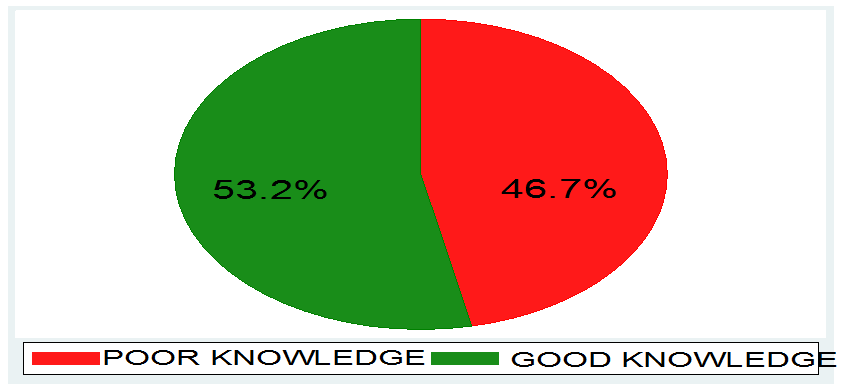
Overall, the mean knowledge score was 9.26 (SD = 3.94) on a scale of 14. The proportion of caregivers with sufficient knowledge on polio vaccination activities was 53.2% (Figure 1).

Table 4 shows sociodemographic factors influencing caregivers’ knowledge of vaccination determinants.
Table 5 shows the analysis of variance (ANOVA) of the correct knowledge score of caregivers on polio vaccination activities in Kumbo-East and Nkambe Health Districts. The correct knowledge score in Kumbo-East HD was significantly higher than that in Nkambe HD (9.98 versus 8.55, P=0.000).
Table 6 shows the analysis of variance (ANOVA) of the wrong knowledge score of caregivers on polio vaccination activities in Kumbo-East and Nkambe Health Districts. The wrong knowledge score in Kumbo-East HD was significantly lower than that in Nkambe HD (4.02 versus 5.45, P= 0.000).
3.5. Practices of Caregivers on Poliomyelitis Vaccination Activities
Majority (90.7%) of the caregivers were encouraged to take their children for vaccination by the fact that vaccination services are free. About 13.7% of the caregivers said they will not take their child for vaccination if they had to pay for the vaccines. A few (1.7%) of the caregivers said they would take their children to Tradi-practitioners or treat-at-home if they suspected poliomyelitis or AFP. Majority (96.1%) of the caregivers said mothers are in charge of the children’s vaccination (Table 7).
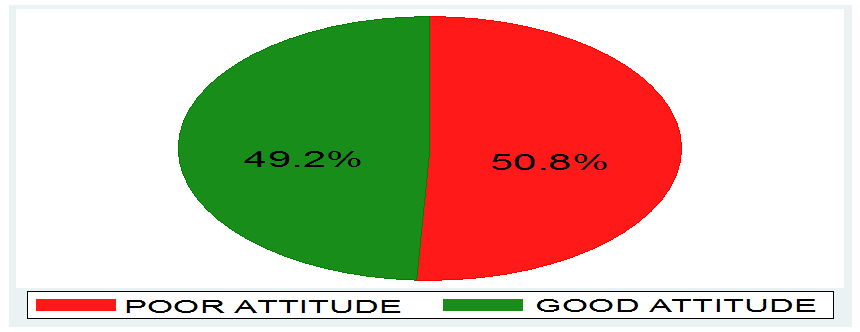
3.6. Overall Practices of Caregivers on Poliomyelitis Vaccination ActivitiesOverall, the mean practices score was 4.32 (SD = 1.02). The proportion of caregivers with sufficient knowledge on polio vaccination determinants was 49.2% (Figure 2).

After controlling for possible confounders in a multivariate logistic regression model, education, ANC attendance and knowledge on vaccination were the only significant factors associated with good practices towards polio vaccination activities (Table 5). In relation to ANC attendance, caregivers who had attended ANC sessions were about 5 times more likely to have a good practices towards polio vaccination activities compared to those who had not (AOR = 4.9; 95%CI: 1.44-16.88). Concerning knowledge on polio vaccination activities, caregivers with a good knowledge on vaccination were 5.71 times more likely to have positive attitude towards polio vaccination activities compared to their counterparts with poor knowledge on vaccination (AOR = 5.71; 95%CI: 4.53-7.29).
Table 9 shows the analysis of variance (ANOVA) of the good practices score of caregivers on polio vaccination activities in Kumbo-East and Nkambe Health Districts. The good practices score in Kumbo-East HD was higher than that in Nkambe HD though this did not reach statistically significant levels (4.44 versus 4.34, p = 0.854).
Table 10 shows the analysis of variance (ANOVA) of the bad practices score of caregivers on polio vaccination activities in Kumbo-East and Nkambe Health Districts. The bad practices score in Kumbo-East HD was lower than that in Nkambe HD though this did not reach statistically significant levels (0.56 versus 0.65, p = 0.854).
3.8. Practices of Caregivers on Poliomyelitis Vaccination ActivitiesMajority (96.6%) of the caregivers had vaccinated their children before. Fifty nine (3.8%) of the caregivers did not respect vaccination schedules of poliomyelitis as planned by the health care provider. Five hundred and thirty six (34.7%) of the caregivers did not respect National Immunization Days (NIDs) against polio (Table 11).
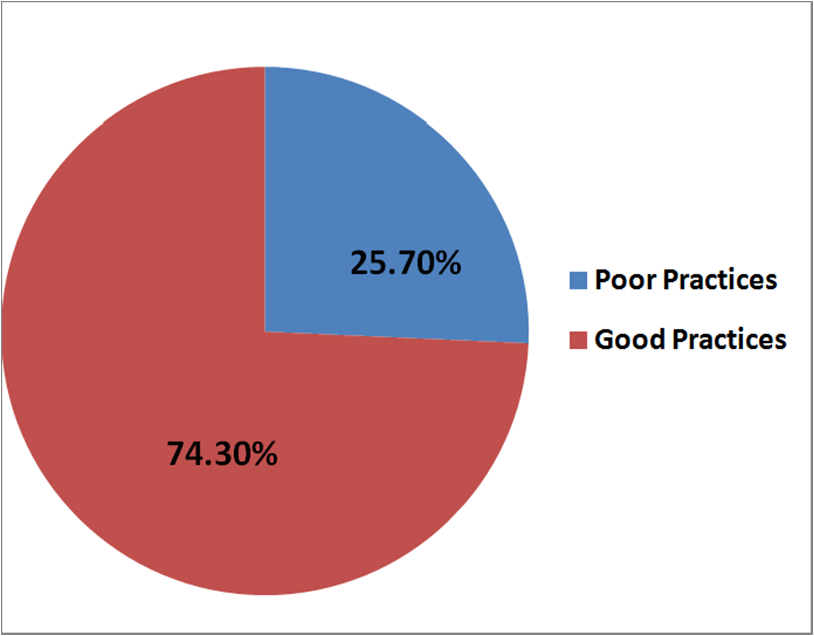
3.9. Overall Practices of Caregivers on Poliomyelitis Vaccination ActivitiesThe proportion of caregivers with good practices on polio vaccination activities was 74.3% (Figure 3).

After controlling for possible confounders in a multivariate logistic regression; age, marital status, education, distance from vaccination site, means of transportation, ANC attendance and knowledge on vaccination were the only significant factors associated with good practices on polio vaccination activities (Table 7). In relation to age, older (ractices on polio vaccination activities (gression; age, marital status, o vaccination activities compared to younger (15-25 years) caregivers (AOR = 3.88; 95%CI: 1.44-10.43). With respect to marital status, married caregivers were 2.15 times more likely to have good practices on polo vaccination activities than their single counterparts (AOR = 2.15; 95%CI: 1.34-3.52). Concerning education, caregivers with tertiary education were 5.9 times more likely to have better practices on polio vaccination activities compared to their counterparts with no formal education (AOR = 5.97; 95%CI: 1.69-21.48). In relation to ANC attendance, caregivers who had attended ANC sessions were about 7 times more likely to have good practices on polio vaccination activities compared to those who did not (AOR = 7.19; 95% CI: 2.25-22.5). In relation to distance from the vaccination site, caregivers who resided more than 5km away from the vaccination site were 0.53 times less likely to have good practices on polio vaccination activities compared to those who resided less than 5km from the vaccination site (AOR = 0.53; 95%CI: 0.26-0.97). Concerning knowledge on polio vaccination activities, caregivers with a good knowledge on vaccination were 3.78 times more likely to have good practices on polio vaccination activities compared to their counterparts with poor knowledge on vaccination (AOR = 3.78; 95%CI: 2.05-6.54). With respect to practices on polio vaccination activities, caregivers with a good practices on vaccination were 2.15 times more likely to have good practices on polio vaccination activities compared to their counterparts with poor practices on vaccination (AOR = 2.15; 95%CI: 1.26-3.71)
Table 13 shows the analysis of variance (ANOVA) of the good practice score of caregivers on polio vaccination activities in Kumbo-East and Nkambe Health Districts. The good practice score in Kumbo-East HD was higher than that in Nkambe HD though this did not reach statistically significant levels (1.83 versus 1.74, p = 0.924).
Table 14 shows the analysis of variance (ANOVA) of the poor practice score of caregivers on polio vaccination activities in Kumbo-East and Nkambe Health Districts. The poor practice score in Kumbo-East HD was lower than that in Nkambe HD though this did not reach statistically significant levels (0.17 versus 0.26, p = 0.924).
This is the first study in our knowledge on the determinants of caregivers’ knowledge, attitudes and practices on vaccination in the context of polio eradication in rural parts of Cameroon.
4.1. Caregivers’ Knowledge on Polio Vaccination ActivitiesThe overall proportion of caregivers with a good knowledge on polio vaccination activities was average (53.2%). The knowledge on the number of doses of polio vaccine to be taken by children was poor compared to the other questions related to the knowledge on polio vaccination activities. The level of appropriate knowledge on polio vaccination in this study was similar to that reported in Pakistan (53.8%) and the urban slums of India (52.0%); 11 but not as good as those reported in other studies conducted in different parts of the world 12, 13. Kumbo-East health district is a rural health district where the literacy level of caregivers is relatively low and some of its health areas are highly enclaved. This makes it difficult for the correct information on polio vaccination to get to the caregivers. The Cameroon health system does not adequately use the media to inform and encourage people to vaccinate their children against polio. The media is a primary source of information and is mentioned by other studies as well 14. Therefore, the general public gets only limited information from social mobilizers about polio and its risk factors. Only the nursing mothers who attend ANC or Infant Welfare Clinic (IWC) had sufficient knowledge on polio vaccination. For the protection of children’s health, different governmental and non-governmental organizations play a great role in polio immunization campaigns 15. They engage community members, community leaders and social workers to ensure polio immunization among the population 16. Social media constitute important communication tools to which youngsters of every population are mostly exposed. For this reason, they were less knowledgeable than older people as this source of knowledge is usually flooded with myths and misconceptions on polio vaccines 12, 13.
This study revealed that caregivers of age greater than 37 years have relatively good knowledge about polio and vaccination as compared to the participants younger than 37 years. This may be due to repeated antenatal care visits. Knowledge of younger caregivers on polio vaccination should be considered and mobile health emphasized to correct the myths and misconceptions on polio vaccination. Caregivers having low income, low literacy rate and living in rural areas would need to be educated on polio vaccination activities to help in the eradication of polio 12, 13. The study results also revealed the significant association of good knowledge with the educational level of the caregivers. Besides education and age, occupation was also statistically associated with good knowledge about polio vaccination activities. Farmers were less likely to be knowledgeable on polio vaccination compared to housewives. This is in line with studies carried out in Nigeria 9. This could be explained by the fact that farmers are mostly inaccessible during the farming season and cannot be reached by social mobilizers who give the right information on polio vaccination.
4.2. Practices of Caregivers’ towards Polio Vaccination ActivitiesThe proportion of caregivers with a good practices on polio vaccination activities was below average (49.2%). This is well below that reported in Pakistan (71.6%) and Nigeria (70.5%) 12. This observation is probably due to the unexplained repeated vaccination of children on the local immunization days which has scared most caregivers from taking their children for polio vaccination. The sociopolitical crisis in the North-West and South-West Regions may have caused many caregivers to have bad practices towards polio vaccination. Many studies have reported bad practices of caregivers towards the overdosing of polio vaccines during synchronized national immunization days 12. The effectiveness and safety of the polio vaccines were closely related to its maintenance due to the problem of electricity load shedding as other studies also notifying this problem 12. The bad practices of caregivers in this study was also as a result of low community involvement in the polio vaccination activities. This was illustrated by the observation that most of the polio vaccination campaigns were carried out without the full participation of the community in the sensitization, planning and evaluation. The social media has helped to reduce the practices of caregivers towards polio vaccination through its propagation of myths and misconception on polio vaccination. The use of mobile health in informing the public on polio vaccination could help reduce the myth and misconception on polio vaccination.
Educational level was significantly associated with good practices towards polio vaccination and this is in line with other studies 2, 7, 8. In this particular study, besides education, antenatal cares follow-up and knowledge on vaccination were also related to good practices towards polio vaccination. Education and antenatal care follow-up among caregivers could contribute in improving their polio vaccination practices.
4.3. Practices of Caregivers Influencing Polio Vaccination ActivitiesIn this study, the practice of the caregivers was relatively good (74.3%). This is in line with studies carried out in India, Pakistan and Nigeria 9. The relative good practices can be explained by the fact that most of the health facilities were functional and outreach activities to inaccessible areas was improved.
A major determinant of bad practices of caregivers towards polio vaccination was knowledge towards the polio vaccination. The misconception that repeated doses of the Oral Polio Vaccine (OPV) in a single or two months leads to over dosage and this could cause polio outbreak in older ages was the major reason behind the missed opportunities 14, 15. For the health and care of a child, mothers play a major role in completing the immunization schedules of different life threatening diseases after birth especially in rural areas of under developed countries 16, 17, 18. Maternal age, marital status, educational level and knowledge played a vital role in caregivers’ adherence to polio vaccination 19. This study also explored that the lack of knowledge is a major reason of non-vaccination or vaccine hesitance. Security threats (in the context of the sociopolitical crisis in the North-West region) to polio workers and people of tribal areas was also a key issue that contributed to bad practices on polio vaccination. Non-compliant persons in a family and religious misconception were also a major concern as mentioned in other studies 1, 2, 20, 21. The belief of some Pentecostal churches that only prayers and faith can protect a child from any disease including polio. health system factors such as inaccessibility of the health facility, antenatal care follow-up and health personnel knowledge on polio vaccination activities were significant predictors of good practices on vaccination in the context of polio eradication.
Most caregivers think that their non-respect of vaccination appointment is due to forgetfulness, and that if there are reminded through SMS, their rate of respect of polio vaccination appointment will improve. Masaharu et al. showed this in their study in Vientiane in 2007, where 64.7% (P-value <0.05) of parents did not vaccinate their children because they forgot and had nobody to remind them 22. This is also confirmed by a documentary on Health Promotion and Education of the Ugandan Ministry Of Health entitled, “Promotion of routine immunization in Uganda-What National and District Leaders need to do” 23.
Others parents probably blamed their non -respect of the polio vaccination schedules to the bad practices of health care providers towards them, the parents and therefore advocated that if health personnel can be more receptive, vaccination respect rate will increase 24.
The strength of this study lies in the fact that a multistage cluster sampling technique was used to randomly select caregivers. This is the first knowledge and practices study on polio vaccination in the context of eradication in the Kumbo-East and Nkambe Health Districts of the North West Region of Cameroon. However, the study had as a limitation, the cross-sectional design which could not allow for the establishment of causality .
The knowledge of caregivers on polio vaccination activities in our study population was average. Myths and misconceptions on the exact number of doses of polio vaccine were common. Age and educational level were important predictors of knowledge. The proportion of caregivers with good practices on polio vaccination was below average. ANC follow-up and knowledge on polio vaccination were the independent predictors of good practices. The practices of caregivers was relatively good and was associated to age, educational level, marital status, ANC follow-up, knowledge and attitudes on polio vaccination.
The health district should scale up sensitization on polio vaccination through active community involvement and the use of local and social media to transmit the right information on polio vaccination. The government should lay more emphasis on educating the community to a level above secondary school. Active community involvement at all the levels of polio vaccination could improve on the attitude towards polio vaccination. Health facilities should bring vaccination sites closest to the caregivers to help improve on polio vaccine uptake.
Our study revealed that there exist gaps between knowledge and practices in polio vaccination activities by the caregivers. We intend to carry out an intervention study in these localities on health education to address the gaps identified.
Tatah Eunice Kisifen, Nsagha Dickson Shey, Njamnshi Alfred Kongnyu, Sama Martyn designed and executed the study. Tatah Eunice Kisifen and Nsagha Dickson Shey performed the data analysis. Nsagha Dickson Shey was involved in data integration and project management. Tatah Eunice Kisifen, Nsagha Dickson Shey, wrote the manuscript. Tatah Eunice Kisifen, Nsagha Dickson Shey, Njamnshi Alfred Kongnyu, Sama Martyn, Verla Vincent Siysi, Egbe Obinchemti Thomas, Farnyu William Tantoh reviewed the manuscript. All authors read and approved the final manuscript.
There was no funding for the study.
This is part of a Ph.D. thesis by TEK conducted on “Community involvement in vaccination activities in the polio eradication process in the North West Region of Cameroon: A community Intervention” at the Faculty of Health Sciences, University of Buea Cameroon. We are grateful to the North West Regional Delegate of Public Health, the District Chiefs of services and staff of Nkambe and Kumbo East Health Districts. We are equally grateful to all our participants for their collaboration in data collection.
The authors declare that they have no competing interests.
| [1] | Progress towards Polio Eradication-Worldwide, 2013-2014. Available from: https://www.cdc.gov/MMWr/preview/mmwrhtml/mm6321a4.htm. Accessed on 15th August 2017. | ||
| In article | |||
| [2] | Why polio is back. Available from: http://www.vox.com/2014/5/7/5688112/why-polio-is-on-the-rise-again. Accessed on 02nd September 2017. | ||
| In article | |||
| [3] | How many people have polio today worldwide? Available from: http://www.answers.com/Q/How_many_people_have_polio_today_worldwide. Accessed on 05th September 2017. | ||
| In article | |||
| [4] | GPEI, Eradicating the Last 1% of Polio Is Deadly but Essential, Available from: http://www.newsweek.com/2014/12/05/last-stand-against-polio-287862.html. Accessed on 10th September 2017. | ||
| In article | |||
| [5] | WHO, Current Status of routine immunization and polio eradication in the African Region: Challenges and recommendations. 2010 Aug. Report No.: 60. | ||
| In article | |||
| [6] | CDC Global Health - Polio - Updates on CDC’s Polio Eradication Efforts - October 17, 2014. Available from: http://www.cdc.gov/polio/updates/index.htm. Accessed on 10th September 2017. | ||
| In article | |||
| [7] | Northwest Region (Cameroon), Available from: https://en.wikipedia.org/w/index.php?title=Northwest_Region_(Ca meroon)&oldid=781496771. Accessed on 15th September 2017WHO, HOH. Active surveillance of Acute Flaccid Paralysis in Cameroon 2001. | ||
| In article | |||
| [8] | Kumbo East Health District, District Validation Data Management Tool (DVDMT). Kumbo East Health District Service; 2015. Available at the Kumbo East District Health Service. Accessed on 10th August 2017. | ||
| In article | |||
| [9] | Mbuh R, polio eradication, Update on situation in Cameroon. MINSANTE; 2014. | ||
| In article | |||
| [10] | Qualit_res__smpl_size_consid.doc. Available from: https://my.laureate.net/Faculty/docs/Faculty%20Documents/qualit_res__smpl_size_consid.doc. Accessed on 18th May 2017 | ||
| In article | |||
| [11] | Saeed, H., Azhar, S., Syed, Akash. and Khalid, S, Polio and its vaccination: A cross Sectional study of knowledge, attitude and perception of general public in district Abbottabad and Mansehra Khyber, Pakistan. Anti-infective Agents, 2018, 16 (7): 22-31. | ||
| In article | View Article | ||
| [12] | Khan, M.U., Ahmad, A., Aqeel, T., Salman, S., Ibrahim, Q., Idrees, J. and Khan, M.U, “Knowledge, attitudes and perceptions towards polio immunization among residents of two highly affected regions of Pakistan”, BMC Public Health, 2015, 15(1): 1. | ||
| In article | View Article PubMed | ||
| [13] | Ogwumike, O.O., Kaka, B. and Adeniyi, A.F, “Children with paralytic poliomyelitis: A cross-sectional study of knowledge, attitudes and beliefs of parents in Zamfara state, Nigeria”, BMC Public Health, 2012, 12(1): 1. | ||
| In article | View Article PubMed | ||
| [14] | Dehli, N.A, Critical leap to polio eradication in India, United Nations children’s fund, Regional office for South Asia, 2003. | ||
| In article | |||
| [15] | Aj Jabbar A, Religious leaders as partners in polio eradication (NWFP/FATA). In Technical Advisory group in poliomyelitis eradication in Afghanistan and Pakistan, Cairo 2008. | ||
| In article | |||
| [16] | WHO, Poliomyelitis: intensification of the global eradication initiative. Geneva, Switzerland; 2013. | ||
| In article | |||
| [17] | Alina g.,Emmon R., Abeer S.,Mohammed U.A., Sobia N.,Arslan M., Umar h., Marvi B., and Saad S, Knowledge ,attitudes and Practices regarding the Oral polio vaccine in Slum area of Karachi. | ||
| In article | |||
| [18] | Center for Diseases Control and Prevention, Progress towards Poliomyelitis Eradication-Afgahnistan and Pakistan, 2011-2012. | ||
| In article | |||
| [19] | Center for Diseases Control and Prevention, Polio in Somalia, Kenya, Ethiopia, 2014. | ||
| In article | |||
| [20] | Joseph, N., Subba, S.H., Nelliyanil, M., Kotian, S.M, and Haridath, A.C.A, “Study of knowledge and attitude towards pulse polio immunization in semi urban areas of South India, Australas”, Med. J.,2011,4(2): 81. | ||
| In article | View Article PubMed | ||
| [21] | Sparrow A, Syria’s Polio Epidemic: The Suppressed Truth, New York; 2014. | ||
| In article | |||
| [22] | Masaharu M., Somthana D., Kayako S., Kencoh T., Outavong P., Anonh X, and Chushi K, “Factors affecting routine immunization coverage among children aged 12-59 months in Lao PDR after regional polio eradication in Western Pacific Region”, http://www.biosciencetrends.com 2007. | ||
| In article | |||
| [23] | UNICEF, Promotion of routine immunization in Uganda-What National and District Leaders need to do, 2012. | ||
| In article | |||
| [24] | WHO, Current Status of Routine Immunization and Polio Eradication in the African Region; Challenges and Recommendations, Regional Committee for Africa, 2010. [Sixtieth Session]. | ||
| In article | |||
Published with license by Science and Education Publishing, Copyright © 2020 Dickson SheyNsagha, Eunice Kisifen Tatah, Alfred Kongnyu Njamnshi, Martyn Sama, Vincent Siysi Verla, Obinchemti Thomas Egbe and William Tantoh Farnyu
 This work is licensed under a Creative Commons Attribution 4.0 International License. To view a copy of this license, visit
http://creativecommons.org/licenses/by/4.0/
This work is licensed under a Creative Commons Attribution 4.0 International License. To view a copy of this license, visit
http://creativecommons.org/licenses/by/4.0/
| [1] | Progress towards Polio Eradication-Worldwide, 2013-2014. Available from: https://www.cdc.gov/MMWr/preview/mmwrhtml/mm6321a4.htm. Accessed on 15th August 2017. | ||
| In article | |||
| [2] | Why polio is back. Available from: http://www.vox.com/2014/5/7/5688112/why-polio-is-on-the-rise-again. Accessed on 02nd September 2017. | ||
| In article | |||
| [3] | How many people have polio today worldwide? Available from: http://www.answers.com/Q/How_many_people_have_polio_today_worldwide. Accessed on 05th September 2017. | ||
| In article | |||
| [4] | GPEI, Eradicating the Last 1% of Polio Is Deadly but Essential, Available from: http://www.newsweek.com/2014/12/05/last-stand-against-polio-287862.html. Accessed on 10th September 2017. | ||
| In article | |||
| [5] | WHO, Current Status of routine immunization and polio eradication in the African Region: Challenges and recommendations. 2010 Aug. Report No.: 60. | ||
| In article | |||
| [6] | CDC Global Health - Polio - Updates on CDC’s Polio Eradication Efforts - October 17, 2014. Available from: http://www.cdc.gov/polio/updates/index.htm. Accessed on 10th September 2017. | ||
| In article | |||
| [7] | Northwest Region (Cameroon), Available from: https://en.wikipedia.org/w/index.php?title=Northwest_Region_(Ca meroon)&oldid=781496771. Accessed on 15th September 2017WHO, HOH. Active surveillance of Acute Flaccid Paralysis in Cameroon 2001. | ||
| In article | |||
| [8] | Kumbo East Health District, District Validation Data Management Tool (DVDMT). Kumbo East Health District Service; 2015. Available at the Kumbo East District Health Service. Accessed on 10th August 2017. | ||
| In article | |||
| [9] | Mbuh R, polio eradication, Update on situation in Cameroon. MINSANTE; 2014. | ||
| In article | |||
| [10] | Qualit_res__smpl_size_consid.doc. Available from: https://my.laureate.net/Faculty/docs/Faculty%20Documents/qualit_res__smpl_size_consid.doc. Accessed on 18th May 2017 | ||
| In article | |||
| [11] | Saeed, H., Azhar, S., Syed, Akash. and Khalid, S, Polio and its vaccination: A cross Sectional study of knowledge, attitude and perception of general public in district Abbottabad and Mansehra Khyber, Pakistan. Anti-infective Agents, 2018, 16 (7): 22-31. | ||
| In article | View Article | ||
| [12] | Khan, M.U., Ahmad, A., Aqeel, T., Salman, S., Ibrahim, Q., Idrees, J. and Khan, M.U, “Knowledge, attitudes and perceptions towards polio immunization among residents of two highly affected regions of Pakistan”, BMC Public Health, 2015, 15(1): 1. | ||
| In article | View Article PubMed | ||
| [13] | Ogwumike, O.O., Kaka, B. and Adeniyi, A.F, “Children with paralytic poliomyelitis: A cross-sectional study of knowledge, attitudes and beliefs of parents in Zamfara state, Nigeria”, BMC Public Health, 2012, 12(1): 1. | ||
| In article | View Article PubMed | ||
| [14] | Dehli, N.A, Critical leap to polio eradication in India, United Nations children’s fund, Regional office for South Asia, 2003. | ||
| In article | |||
| [15] | Aj Jabbar A, Religious leaders as partners in polio eradication (NWFP/FATA). In Technical Advisory group in poliomyelitis eradication in Afghanistan and Pakistan, Cairo 2008. | ||
| In article | |||
| [16] | WHO, Poliomyelitis: intensification of the global eradication initiative. Geneva, Switzerland; 2013. | ||
| In article | |||
| [17] | Alina g.,Emmon R., Abeer S.,Mohammed U.A., Sobia N.,Arslan M., Umar h., Marvi B., and Saad S, Knowledge ,attitudes and Practices regarding the Oral polio vaccine in Slum area of Karachi. | ||
| In article | |||
| [18] | Center for Diseases Control and Prevention, Progress towards Poliomyelitis Eradication-Afgahnistan and Pakistan, 2011-2012. | ||
| In article | |||
| [19] | Center for Diseases Control and Prevention, Polio in Somalia, Kenya, Ethiopia, 2014. | ||
| In article | |||
| [20] | Joseph, N., Subba, S.H., Nelliyanil, M., Kotian, S.M, and Haridath, A.C.A, “Study of knowledge and attitude towards pulse polio immunization in semi urban areas of South India, Australas”, Med. J.,2011,4(2): 81. | ||
| In article | View Article PubMed | ||
| [21] | Sparrow A, Syria’s Polio Epidemic: The Suppressed Truth, New York; 2014. | ||
| In article | |||
| [22] | Masaharu M., Somthana D., Kayako S., Kencoh T., Outavong P., Anonh X, and Chushi K, “Factors affecting routine immunization coverage among children aged 12-59 months in Lao PDR after regional polio eradication in Western Pacific Region”, http://www.biosciencetrends.com 2007. | ||
| In article | |||
| [23] | UNICEF, Promotion of routine immunization in Uganda-What National and District Leaders need to do, 2012. | ||
| In article | |||
| [24] | WHO, Current Status of Routine Immunization and Polio Eradication in the African Region; Challenges and Recommendations, Regional Committee for Africa, 2010. [Sixtieth Session]. | ||
| In article | |||