 sciepub.com
 Quick Submission

Prevalence of Moderate Malnutrition in School-age Children and Its Association with Hypertension and Microalbuminuria
Ranti Astria Hannah1, , Nanan Sekarwana1, Sjarief H Effendi1
1Department of Child Health, Faculty of Medicine Universitas Padjadjaran/Dr.Hasan Sadikin General Hospital Bandung, Indonesia
Abstract
Background. Previous studies has linked childhood severe malnutrition with hypertension; also association between hypertension and microalbuminuria. Currently there is no study on blood pressure and microalbuminuria in moderately malnourished school-age children. Methodology/Principal Findings. A cross-sectional study on children aged 6‒12 years from 3 public elementary schools in Bandung, Indonesia between July to September 2016. Weight, height and blood pressure of subjects were measured. Nutritional status were determined using WHO Child Growth Standards. Blood pressure levels were classified, and microalbuminuria were measured using Advia 1800 Analyzer (Siemens, Germany). Sample size was calculated with 18% estimated prevalence, 95% confidence, and 5% precision. Prevalence data were presented as percentage. Differences of blood pressure and microalbuminuria in moderately malnourished and well-nourished subjects were analyzed using Mann Whitney dan Chi-square tests, statistical significance was represented by p<0,05. Out of 235 subjects, 74 were moderately malnourished (prevalence 31,5%) and 161 were well-nourished. The median of systolic blood pressure, diastolic blood pressure and microalbuminuria in the moderately malnourished group were 95 mmHg; 62,5 mmHg; and 5,5 mcg/mg respectively, compared to 95 mmHg; 60 mmHg; and 4 mcg/mg respectively (p=0,741; 0,495; 0,217). Conclusions. The prevalence of moderate malnutrition in Indonesian school-age children is quite high. There were no significant differences of blood pressure and microalbuminuria between moderately malnourished and well-nourished children.
Keywords: moderate malnutrtion, children, hypertension, microalbuminuria
Copyright © 2017 Science and Education Publishing. All Rights Reserved.Cite this article:
- Ranti Astria Hannah, Nanan Sekarwana, Sjarief H Effendi. Prevalence of Moderate Malnutrition in School-age Children and Its Association with Hypertension and Microalbuminuria. American Journal of Clinical Medicine Research. Vol. 5, No. 1, 2017, pp 6-9. http://pubs.sciepub.com/ajcmr/5/1/2
- Hannah, Ranti Astria, Nanan Sekarwana, and Sjarief H Effendi. "Prevalence of Moderate Malnutrition in School-age Children and Its Association with Hypertension and Microalbuminuria." American Journal of Clinical Medicine Research 5.1 (2017): 6-9.
- Hannah, R. A. , Sekarwana, N. , & Effendi, S. H. (2017). Prevalence of Moderate Malnutrition in School-age Children and Its Association with Hypertension and Microalbuminuria. American Journal of Clinical Medicine Research, 5(1), 6-9.
- Hannah, Ranti Astria, Nanan Sekarwana, and Sjarief H Effendi. "Prevalence of Moderate Malnutrition in School-age Children and Its Association with Hypertension and Microalbuminuria." American Journal of Clinical Medicine Research 5, no. 1 (2017): 6-9.
| Import into BibTeX | Import into EndNote | Import into RefMan | Import into RefWorks |
1. Introduction
School-age malnutrition in developing countries is a global health burden, the prevalence ranges from 34‒62% [1, 2, 3, 4, 5]. In Indonesia, 18,2% children aged 5‒12 years old were malnourished in 2013 [6]. Undernutrition in school age‒a period of important physical and mental development‒could lead to growth impairment, slower cognitive developments, and other health impairments such as high blood pressure [3, 4]. Increased blood pressure in childhood and adolescents often leads to hypertension in adulthood, which is a major risk factor for cardiovascular, cerebrovascular and kidney diseases and a leading cause of death in adults worldwide [7, 8].
Earlier studies have shown association between severe malnutrition in children and high blood pressure [9, 10, 11, 12] A study in Brazil included moderately malnourished subjects and showed that diastolic blood pressure is significantly higher in those groups than in normal controls [13, 14]. Previous studies found significant association between hypertension and microalbuminuria, a marker of endothelial damage [15].
Data of blood pressure and microalbuminuria in school-age children are lacking, especially in the moderately malnourished population in developing countries. The objective of this study is to determine the prevalence of moderate malnutrition in school-age children, and the association among moderate malnutrition with hypertension and microalbuminuria in a developing country.
2. Materials and Methods
This cross-sectional study was performed from June to September 2016 in three elementary schools consisting of students from middle-low income socioeconomic families in Bandung, Indonesia. Subjects were otherwise healthy students aged 6‒12 years with parental consent. Subjects who were overweight, obese or severely malnourished and subjects with known history of kidney disease, heart disease or diabetes mellitus were excluded.
Prevalence was calculated and presented as percentage. Weight was measured using an electronic scale (Seca W60094[1009152], USA) with 10 g precision. Height was measured using a mobile stadiometer accurate to the nearest 0,1 cm (Seca 217[CE0123], USA). Body mass index were calculated as weight/height2 (kg/m2), then plotted into WHO Growth Chart and interpreted as z-scores. Subjects were divided into two groups based on nutritional status, moderately malnourished (BMI/U <-2 SD and BMI/U ≥ 3 SD) and well-nourished (BMI/U ≥ -2 SD and BMI/U ≤ 2 SD).
Blood pressure was measured with a mercury sphygmomanometer in the sitting position using the right arm with an appropriate cuff size and after resting for at least 10 minutes. Three measurements were made at 2 minutes interval and the mean was used in the analysis. All measurements were made by the same physician. Systolic and diastolic BP were based on the first and fifth Korotkoff sounds, respectively. Blood pressure values were compared the chart in The Fourth Report on the Diagnosis, Evaluation, and Treatment of High Blood Pressure in Children and Adolescent, 2005 based on gender, age, and stature percentiles. Blood pressure values below 90th percentile were defined as normal, values between 90th-95th percentile were prehypertension, values 95th-99th percentile were hypertension stage 1, and values above 99th percentile were hypertension stage 2 [7]. From each subjects, 10 ml urine specimens were collected, sent to Prodia laboratory within 6 hours of collection in a sterile container and tested for microalbuminuria using Advia 1800 Analyzer (Siemens Healthcare GmbH, Erlangen, Germany). Microalbuminuria is defined as urinary albumin excretion of 20-200 µg/mg, presented as the ratio of urinary albumin:creatinine [16].
Sample size was calculated using the formula to determine prevalence, with 95% level of confidence, 18% estimated prevalence and 5% precision, yielding a minimal sample size of 227 subjects. Prevalence was calculated and presented as medians and percentages. Statistical analysis using Mann Whitney and Chi-square tests was conducted, with statistical significance represented by p<0,05. Calculations were done using SPSS version 17. The study was conducted after obtaining the approval of the Ethics Committee Faculty of Medicine, Universitas Padjadjaran Bandung, Indonesia. Consent for participating in the study were signed by parents.
3. Results
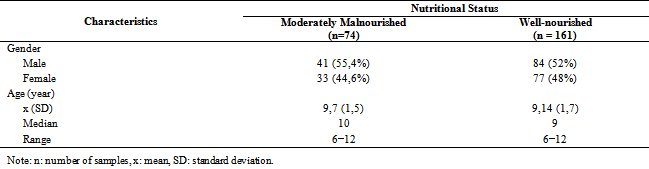
There were 281 students from 3 elementary schools, 272 fulfilled the inclusion criteria. Among those 35 were excluded due to overweight, obese and severely malnourished. From 237 subjects, 2 dropped out due to macroalbuminuria, leaving 235 subjects included in the study. Overweight, obese and severely malnourished children were referred to Pediatric Nutrition Clinic, dr. Hasan Sadikin Hospital Bandung; and two subjects with macroalbuminuria were referred to Pediatric Nephrology Clinic, dr.Hasan Sadikin Hsopital Bandung. Subjects were divided into malnourished group (n=74) and well-nourished group (n=161), with similar characteristis of gender and age as shown in Table 1.




Systolic and diastolic blood pressure and microalbuminuria of both groups are presented in Table 2.
Table 2. Difference of Blood Pressure and Microalbuminuria Between Moderately Malnourished and Well-Nourished Study Subjects


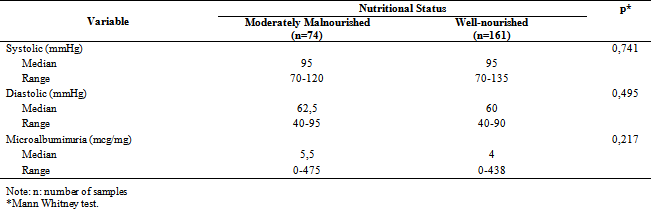


There were no differences in systolic, diastolic blood pressure and microalbuminuria between the moderately malnourished and well-nourished group. Further analysis using covariance analysis with age, gender, and height as covariates showed that there were no significant difference in systolic blood pressure, diastolic blood pressure, and microalbuminuria between malnourished an well-nourished group (p=0,418; p=0,684; p=0,858 respectively).
Difference in systolic and diastolic blood pressure levels between the two groups are presented in Table 3.
Table 3. Comparison of Systolic and Diastolic Blood Pressure Level Proportion between Moderately Malnourished and Well-nourished Study Subjects


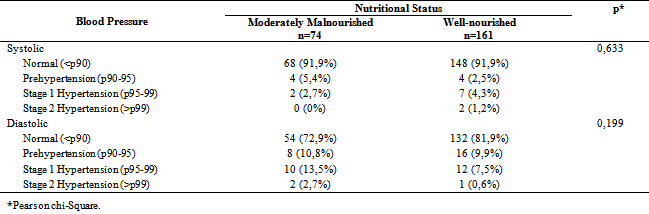

There were no significant differences of systolic and diastolic prehypertension or hypertension between the two groups. The overall prevalence of systolic and diastolic hypertension were 4,7% and 10,6% respectively, while the prevalence of systolic and diastolic prehypertension were 3,4% and 10,2% respectively.
The difference of microalbuminuria proportion between moderately malnourished and well-nourished group is presented in Table 4.




There were no difference in the prevalence of microalbuminuria both in malnourished and well-nourished groups as shown in Table 4. The overall prevalence of microalbuminuria this study was 11,5%. In the moderately malnourished group, microalbuminuria occured in 6 (8,1%) subjects with normal blood pressure, 1 (1,4%) in prehypertensive subject, and 1 (1,4%) in hypertensive patient; whereas subjects with microalbuminuria in the well-nourished group 14 (8,7%) had normal blood pressure, 2 (1,2%) were prehypertensive and 3 (1,9%) were hypertensive. There was no significant difference between the two nutritional groups (p=0,352).
4. Discussions
Our study revealed that the prevalence of moderately malnourished children aged 6‒12 years old were 31,5%. This number is quite high compared to 21% in China and 26,7% in Nigeria, but lower than Bangladesh’s 84% [11, 17, 18]. According to public health significance, prevalence ≥ 30% is very high, reaching critical importance [19]. Considering the harm of undernutrition in a developing age, this underlines the importance of growth monitoring in school-aged children, and not only in the under-five group.
The prevalence of systolic and diastolic prehypertension in our study were 3,4% and 10,2% respectively. The prevalence is higher than Iran, which is 4,13% and 4,33%, but less than 31,4% in California [20, 21]. The high prevalence of prehypertension in American children was thought to be due to the increasing prevalence of overweight and obesity [21]. Although these subjects cannot be considered hypertensive yet, they are more prone to have hypertension, cardiovascular and renal diseases later in life, thus routine follow up is warranted. The prevalence of systolic and diastolic hypertension in school-age children of this study were 4,6% and 10,6% respectively, compared to 3,7% in Thailand, 12,2% in Malaysia, and 3,6% globally [22, 23, 24].
We found no significant differences in systolic and diastolic blood pressure or the prevalence of systolic and diastolic hypertension between moderately malnourished and well-nourished subjects. Earlier studies suggested that severe malnutrition could cause vascular endothelial damage which increases the risk of high blood pressure [25]. In this study, where the subjects were moderately malnourished rather than severely malnourished, we assume that the damage to the vascular endothelials has not led to increased blood pressure.
In this study, the prevalence of microalbuminuria was 11,5% irrespective of nutritional status. The prevalence of microalbuminuria in the United States according to National Health and Nutrition Examination Survey, was 15% in 6-9 year olds [26]. As far as the author know, currently there is no study on microalbuminuria in Indonesian school-age children yet. We found no difference in the prevalence of microalbuminuria between moderately malnourished and well-nourished gropus, consistent with no difference in the prevalence of hypertension between the two groups in this study. These findings strengthen the suggestion of association between microalbuminuria and hypertension previously stated by other studies. [15, 27]. This is the first study regarding microalbuminuria in the malnourished school-age population.
We did not find any substantial differences between male or female subjects in all the variables, thus gender was not used as a parameter in this study.
There were few limitations in this study. First, due to limited resources, measurements of blood pressure and microalbuminuria were only conducted in one specific time frame, instead of serially to avoid variation. Second, confounding factors such as low birth weight, family history of hypertension, and diet consisting added sugar and sodium were not explored. Further study with multivariate analysis is needed to determine the factors contributing to hypertension and microalbuminuria such as low birth weight, diet, and family history of hypertension.
5. Conclusions
The prevalence of moderate malnutrition in Indonesian school-age children is quite high, warranting the need to growth monitoring and nutritional intervention in school-age population. There were no significant differences of blood pressure and microalbuminuria between moderately malnourished and well-nourished children.
Acknowledgements
This research did not receive any specific grant from funding agencies in the public, commercial, or non-profit sectors. We thanked Professor Abdurachman Sukadi and Professor Herry Garna for initial manuscript preparation counseling.
Conflict of Interest
There is no conflict of interest in conducting and publishing this research.
Disclaimers
This study has not been published previously, not under consideration for publication elsewhere, and its publication is approved by all authors. If accepted, it will not be published elsewhere in the same form, in English or in any other language, including electronically without the written consent of the copyright-holder.
References
| [1] | Onis MD, Brown D, Blössner M, Borghi E. Levels & Trends in Child Malnutrition UNICEF-WHO-The World Bank Joint Child Malnutrition Estimates. 2012. | ||
 In article In article | |||
| [2] | World Health Organization. Joint Child Malnutrition Estimates – Levels and Trends (2016 edition). Retrieved from www.who.int/nutgrowthdb/estimates2015/en. | ||
| In article | |||
| [3] | Partnership for Child Development. The anthropometric status of school children in five countries in th Partnership for Child Development. Proceedings of the Nutrition Society. 1998; 57: 149-58. | ||
| In article | View Article | ||
| [4] | Drake L, Maier C, Jukes M, Patrikios A. School-Age Children: Their Nutrition and Health. London: SCN Working Group on Nutrition of School-Age Children; 2002. | ||
| In article | |||
| [5] | Srivastava A, Mahmood SE, Srivastava PM, Shrotriya VP, Kumar B. Nutritional status of school-age children - A scenario of urban slums in India. Archives of Public Health. 2012; 70(8): 1-8. | ||
| In article | View Article | ||
| [6] | Badan Penelitian dan Pengembangan Kesehatan Kementerian Kesehatan Republik Indonesia. Riset Kesehatan Dasar 2013. Retrieved from www.depkes.go.id. | ||
| In article | |||
| [7] | US Departement of Health and Human Services, National Institutes of Health, National Heart, Lung, and Blood Institute. The fourth report on the diagnosis, evaluation, and treatment of high blood pressure in children and adolescents. 2005. | ||
| In article | |||
| [8] | Xu H, Huang X, Risérus U, Cederholm T, Lindholm B, Ärnlöv J, et al. Urinary albumin excretion, blood pressure changes and hypertension incidence in the community:effect modification by kidney function. Nephrol Dial Transplant 2014 0: 1-8. | ||
| In article | |||
| [9] | Luyckx VA, Bertram JF, Brenner BM, Fall C, Hoy WE, Ozanne SE, et al. Fetal and child health-impact on kidney development and long-term risk of hypertension and kidney disease. Lancet. 2013; 382(9888): 273-83. | ||
| In article | View Article | ||
| [10] | Genovesi S AL, Gallieni M, Aiello A, Mandal SK, Doneda A, dkk. High prevalence of hypertension in normal and underweight Indian children. J Hypertens. 2011; 29(2): 217-21. | ||
| In article | View Article PubMed | ||
| [11] | Adekanmbi AF, Obadina OO, Fetuga MB, Adejumo AO. Prevalence of malnutrition and high blood pressure amongst adolescents in semi-urban area of Ogun State south- western Nigeria. AJOL. 2016; 69(6). | ||
| In article | |||
| [12] | Ramoshaba NE, Zatu MC, Hay L, Mabata LR. The Relationship between Blood Pressure and Anthropometric Indicators in Rural South African Children: Ellisras Longitudinal Study. J Obes Weight Loss Ther. 2015; 5(1). | ||
| In article | |||
| [13] | Sesso R, Barreto GP, Neves J, Sawaya AL. Malnutrition is associated with increased blood pressure in childhood. Nephron Clin Pract.2004; 97: c61-6. | ||
| In article | |||
| [14] | Koroshi A. Microalbuminuria, is it so important? Hippokratia 2007; 11(3): 105-7. | ||
| In article | |||
| [15] | Knight EL, Kramer HM, Curhan GC. High-normal blood pressure and microalbuminuria Am J Kidney Dis. 2003; 41: 588-95. | ||
| In article | |||
| [16] | Ide LEY, Akani NA. Microalbuminuria: It's significance, risk factors and methods of detection. Niger Health J. 2011; 11(1). | ||
| In article | |||
| [17] | Piernas C, Wang D, Du S, Zhang B, Wang Z, Su C, et al. The double burden of under- and overnutrition and nutrient adequacy among Chinese preschool and school-aged children in 2009-2011. Eur J Clin Nutr. 2015;69(12):1323-9. | ||
| In article | View Article PubMed PubMed | ||
| [18] | Yeasmin S, Islam K. Prevalence and determinants of undernutrition among school age slum children in Dhaka City, Bangladesh. J Nutr Health Sci. 2016;3(2):201. | ||
| In article | |||
| [19] | WHO. Physical status: the use and interpretation of anthropometry. Report of a WHO Expert Committee. Technical Report Series No. 854. Geneva, World Health Organization, 1995 | ||
| In article | |||
| [20] | Fallah Z, Qorbani M, Motlagh ME, Heshmat R, Ardalan G, Kelishadi R. Prevalence of prehypertension and hypertension in a nationally representative sample of Iranian children and adolescents: The caspian-iv study. Int J Prev Med. 2014; 5 (Suppl 1): S57-64. | ||
| In article | |||
| [21] | Koebnick C, Black MH, Wu J, Martinez MP, Smith N, Kuizon BD, et al. The prevalence of primary pediatric prehypertension and hypertension in a real-world managed care system. J Clin Hypertens (Greenwich). 2013; 15(11): 784-92. | ||
| In article | View Article PubMed PubMed | ||
| [22] | Riley M, Bluhm B. High blood pressure in children and adolescents. Am Fam Physician. 2012; 85(7): 693-700. | ||
| In article | |||
| [23] | Manopunya S, Khositseth S. Hypertension in Thai children: a report from a hospital in suburban area. J Med Assoc Thai. 2010; 93(Suppl)(7): S99-108. | ||
| In article | |||
| [24] | Chandrashekhar T, Sreeramareddy, Chew WF, Yap SF. Blood pressure and its associated factors among primary school children in suburban Selangor, Malaysia: A cross-sectional survey. J Family Community Med. 2013; 0(2): 90-7. | ||
| In article | |||
| [25] | Lauer RM, Clarke WR. Childhood risk factors for high adult blood pressure: the Muscatine Study. Pediatrics. 1989; 84: 633-41. | ||
| In article | |||
| [26] | Jones CA FM, Eberhardt MS, Chavers B, Coresh J, Engelgau M, et al. Microalbuminuria in the US population: third National Health and Nutrition Examination Survey. Am J Kidney Dis 2002; 39: 445-59. | ||
| In article | View Article PubMed | ||
| [27] | Flynn JT. Microalbuminuria in children with primary hypertension. J Clin Hypertens. 2011: 1-4. | ||
| In article | |||
 CiteULike
 Mendeley
 StumbleUpon
 Delicious
 Facebook
 Twitter
 LinkedIn