sciepub.com
 Quick Submission

Adoption of the Building Information Modeling (BIM) for Construction Project Effectiveness: The Review of BIM Benefits
Lancine Doumbouya1, Guoping Gao1, Changsheng Guan1,
1School of Civil Engineering and Architecture, Wuhan University of Technology, Wuhan 430074, PR China
Abstract
Building Information Modeling (BIM) has recently attracted extensive attention in the Architectural, Engineering and Construction (AEC) industry with an increase in the use of information technology, all the while increasing productivity, efficiency, infrastructure value, quality, and sustainability, rendering a purer image of constructability issues that are dealt with at the beginning of the construction process. The purpose of this study is to better comprehend the BIM benefits and to analyze BIM adoption, thus providing better understanding of BIM and its usefulness in various stages of the construction projects. Our review concludes that BIM fulfills its purpose through all the stages of the construction project delivering benefits in terms of improved design quality, easiness to implement, information sharing ability, reduction of construction costs and design errors, faster work and shortening the construction time, enhancing energy efficiency, supporting construction and project management, and enabling its owners more operational efficiency in the building lifecycle. The current research identifies relevant factors and outcomes of BIM, and sets up a framework for a future study. The critical review of BIM benefits contributes to the existing body of literature on AEC and BIM.
Keywords: Building information modeling, BIM, BIM Adoption, Building information modeling benefits, Construction project effectiveness
Copyright © 2016 Science and Education Publishing. All Rights Reserved.Cite this article:
- Lancine Doumbouya, Guoping Gao, Changsheng Guan. Adoption of the Building Information Modeling (BIM) for Construction Project Effectiveness: The Review of BIM Benefits. American Journal of Civil Engineering and Architecture. Vol. 4, No. 3, 2016, pp 74-79. http://pubs.sciepub.com/ajcea/4/3/1
- Doumbouya, Lancine, Guoping Gao, and Changsheng Guan. "Adoption of the Building Information Modeling (BIM) for Construction Project Effectiveness: The Review of BIM Benefits." American Journal of Civil Engineering and Architecture 4.3 (2016): 74-79.
- Doumbouya, L. , Gao, G. , & Guan, C. (2016). Adoption of the Building Information Modeling (BIM) for Construction Project Effectiveness: The Review of BIM Benefits. American Journal of Civil Engineering and Architecture, 4(3), 74-79.
- Doumbouya, Lancine, Guoping Gao, and Changsheng Guan. "Adoption of the Building Information Modeling (BIM) for Construction Project Effectiveness: The Review of BIM Benefits." American Journal of Civil Engineering and Architecture 4, no. 3 (2016): 74-79.
| Import into BibTeX | Import into EndNote | Import into RefMan | Import into RefWorks |
At a glance: Figures
1. Introduction
There is an increasing use of information technology in construction project management. Computer-aided designs (CAD) are widely used in the process of creation, modification, analysis, and optimization of construction designs [1]. Building information modeling (BIM) is a kind of CAD system, based on parametric technology that stores the information on the building and designs in an integrated database and enables more effective conceptualization and construction of infrastructure by using 3D design information representation [2]. The information stored in the graphic design and the system including detailed knowledge on materials used, form, technical standards, etc. helps increase the overall efficiency of the building and enables meeting the performance standards. Their usefulness is especially evident in the pre-construction and construction stages given that the information stored helps minimize the adverse effects of the decisions made in the post construction stage that lead to expensive modifications of the design [3].
BIM assists in attaining construction industry goals such as; Improving productivity and efficiency, increasing infrastructure value and quality. At the same time it reduces; lead times, lifecycle costs and duplications. Even though BIM has been in use for more than 20 years, only recently the awareness regarding BIM benefits, such as more efficient and effective building construction, design and operation, has developed among project owners [4]. Consequently, owners are strongly arguing for knowledge and adoption of BIM by architects, designers, construction firms [5] in all the stages of architecture and construction projects. It is used in cost estimation, property management, equipment management building and structural design. For instance, in Korea 74 percent of architects report that they used BIM during their design work [4]. Moreover, the U.S. General Services Administration (GSA) requires the use of BIM on all significant projects [6]. However there are certain drawbacks to BIM implementation, as the traditional style of “projecting” is still dominant especially in the developing countries and the transitions to new instruments is always difficult. The utilization in the newly build houses has been prevalent whereas its application in already built in construction has been lagging behind. Furthermore, in some types of construction and architecture projects, and work contexts acceptance of BIM has been hindered. Therefore in our conceptual study we review BIMs utilization in all stages of the project to illustrate how BIM contributes to project success. We argue for the use of BIM in construction and aim to explore all the positive consequences of BIM usage for different stages of project life cycle. We do so by firstly explaining the role of BIM in various stages of the construction projects, and the benefits it brings. Next, the barriers to BIMs implementation are reviewed. Finally, a conceptual framework is modeled and suggestions, with possible implications and recommendations for the future are made.
2. Understanding the Role of BIM in Various Stages of the Constructions
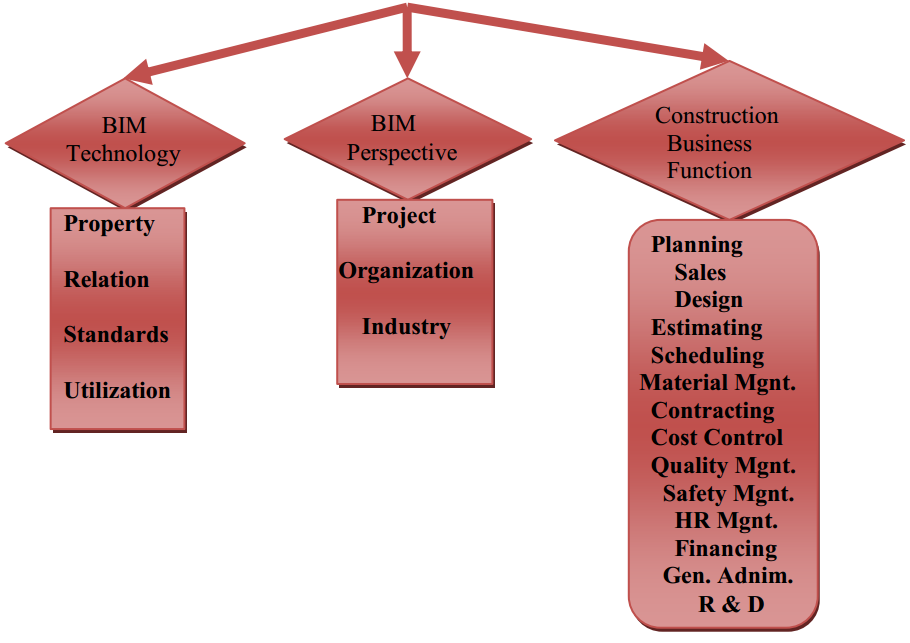
Since BIM has been recognized as a relevant collaboration process a large number of construction firms have invested in it in order to reap the benefits. They utilize these newly acquired BIM technologies in various stages, including, concept building and design, bidding, construction, operation and maintenance. As stated by a BIM utilization survey BIM is used in the design phase (55%), the detail design and tender stage (52%), construction stage (35%), feasibility stage (27%), and operation and maintenance stage (9%) [7]. BIM fulfills its purpose through all the stages of the project delivering benefits in terms of improved design quality, easiness to implement, information sharing ability, reduction of construction costs and design errors, faster work and shortening the construction time, enhancing energy efficiency and supporting construction and project managements [8].

 Download as

The scope of BIM’s usage is wide; it can serve as a useful tool for different building and infrastructure projects and at the same time it can be utilized for architecture, engineering and construction (AEC) projects. By using BIM, the process of creation of more intelligent and advanced objects becomes achievable and possible. Thus, BIM has implications for constructing more sustainable buildings, by using sustainable methods [19]. The data that is stored in BIM maintains the accuracy and consistency even when the changes occur within the system reflecting the changes in the project. Despite the volatility of project, the software’s purpose to improve efficiency and productivity of construction, maintenance and operation processes rarely remains unfulfilled.
General productivity can be enhanced in light of the fact that BIM simplifies sharing of the centralized model. All the project stakeholders, namely managers, designers, manufacturers, and contractors share information regarding community, coordination, tasks and design processes and updates, thus ensuring the project is under control by all the relevant stakeholders. The involvement in sharing of project information by all the members of the project requires effective cooperation between them. However, responsibility assignment of project parties becomes a challenge as BIM permits numerous project members to participate in modeling process at the same time [10]. Additional challenges encompass BIM standards, interoperability, collaboration, and change management.
According to the ISO standard, the lifecycle building stages encompass inception, brief, design, production, maintenance and deconstruction. Each of these stages benefit from utilization of BIM.
3. Review of BIM Benefits in Projects
The technology of BIM empowers the collaboration of project participants. Changes, performed by building designers, are updated in real-time and are made evident to all participants. Utilization in the design part of the project cycle leads to reduced document errors and omissions, reduced rework, and reduced cycle time of the design process. The study by Sacks found that three-dimensional (3D) parametric modeling results in a cost reduction of drafting of approximately 80–84%. Another study by Sacks and Barak reported that the potential productivity gain from 3D modeling is estimated to be in the range of 15–41% of the hours required for drawing production [12]. Moreover, according to Bernstein and Pittman, the effective execution of BIM can result in efficiency change in construction, operation and support stages.
During the construction phase of projects, BIM provides powerful media for progress monitoring, which can be used for quick and remote analysis construction performance (Figure 2). Additionally, integration of as-planned and as-built models enables the identification and isolation of elements deviating from the accepted tolerances. Finally, a digital 3D model shows building and different schemes to the building owner, thus aiding operation and maintenance [3, 13].
 Download as
Then again, there are a few difficulties in actualizing BIM in construction practice, such as mastering the imperviousness to change, and inspiring individuals to comprehend the true value and possibilities of BIM, as well as training individuals in BIM [18] or discovering workers with the comprehension of BIM [14].
In the stage of tender BIM is useful as the model holds information about work details and specifications of products. This accelerates and simplifies the process of preparation of the tender documents. More benefits are attained in the construction phase as BIM helps to plan precisely and to regulate the construction process. This blocks errors, decreases construction time and enables to quickly change materials. Building modifications, retrofits and deconstruction of existing structures, especially in industrialized nations with low new construction rates, are the most prevalent activities of construction companies [15]. Additionally, modifications in technical systems, exteriors and interiors are reported in the BIM model, which permits to update all business calculations and to keep information concerning installed materials and products in one central database [16]. Since BIM allows obtaining information of all engineering systems, it qualitatively modifies the Facility Management and the building operation.
The benefits of BIM for the building owner, developer, and other stakeholders are also plentiful. BIM allows better understanding of energy consumption, scenario simulations and also provides the visual aspects of a building, as it contains energy parameters which under various operating conditions, specify the cost indicators. This may result in decrease of the financial risks regarding the design, operation and construction process [28]. Moreover, it also expedites the possibility of issuing various documentation packages for the examination of building parameters, which simplifies the preparation process of various approvals.
Another significant benefit of BIM lies in its ability to impact the processes by minimizing process-related risks [20]. For instance use of BIM may prevent information loss, and, consequently, the wasting of resources and time, e.g. for transferring documents from one company to another and for the transition from one construction stage to the next one. However, the usage of the common platform can increase the chances of stealing of created construction project information and intellectual properties. [19].
4. BIM Adoption
Though the overall economic benefits of BIM on a theoretical level are comprehensible, its implementation in the field of construction has been dealt with in slightly different ways. Already many examples are known of what a properly applied BIM method can ideally add to the construction process in matters of economic gain.
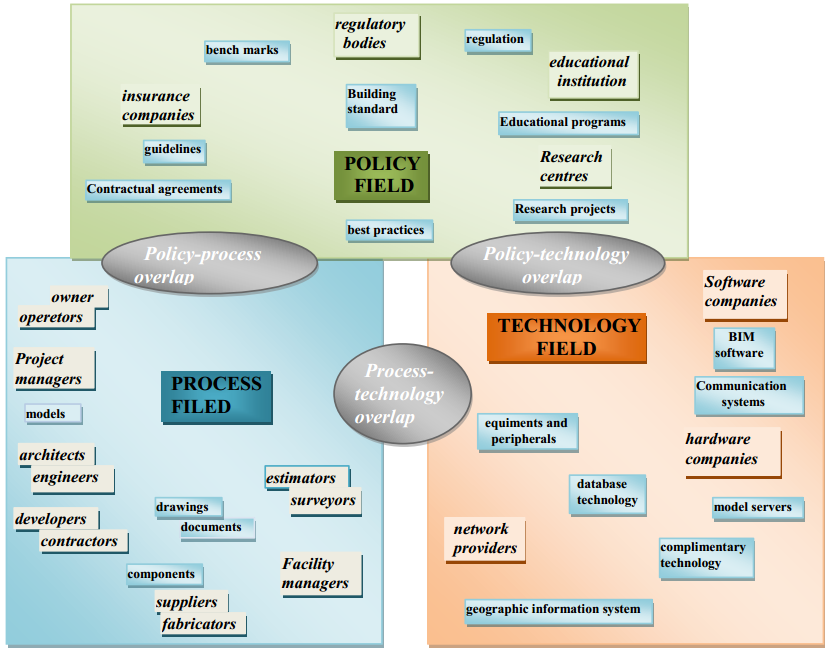
In order to enable the adoption and implementation of BIM by organizations, designers and managers, an understanding of factors that lead and hinder BIM utilization has to be achieved. The factors leading to BIM adoption can be examined on the individual, organizational and institutional levels.
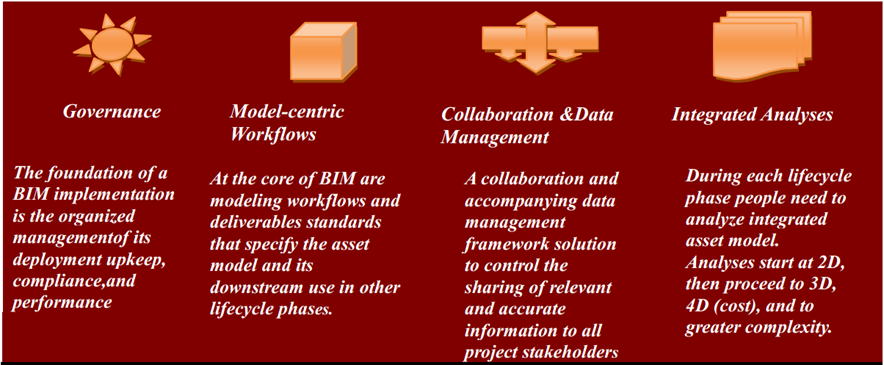
These high-level implementation areas are strategies and policies, methods and approaches for adopting BIM that correspond to the overall company objectives for competitive positioning, operational excellence, and efficient delivery. BIM processes and model management tools are combined with enterprise systems to produce information in a collaborative setting across the organization and project teams [23]. In order to make BIM adoption more effective the whole process should be divided into stages, [21] with the targets of each stage depending on the project type [22].
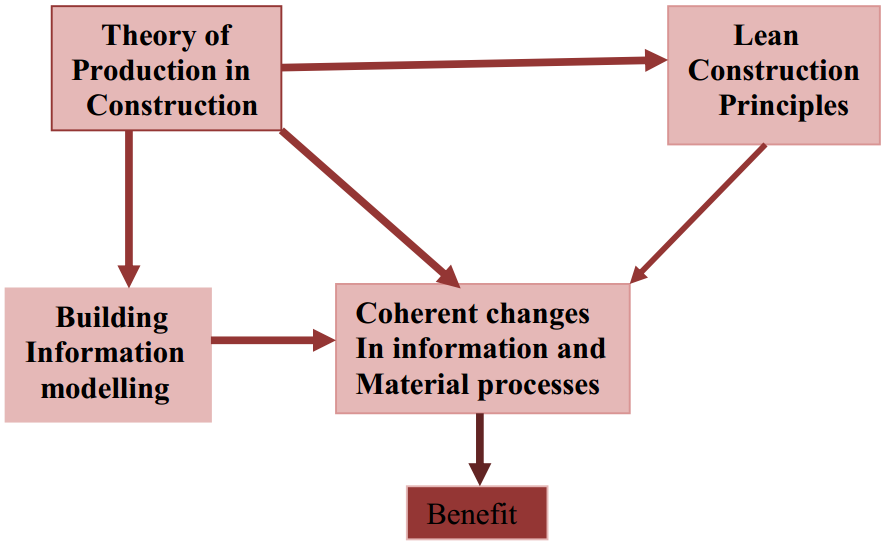
4.1. Factors Influencing the Adoption of BIMAmong factors impacting BIM adoption top management support, subjective norm, compatibility, and computer self-efficacy have been identified by prior studies as key determinants that impact architects' behavioral intentions to embrace BIM (Figure 3). Theory of reasoned action and planned behavior are therefore useful when it comes to explaining BIM adoption. Antecedent factors-behavioral intentions relationships are mediated by recognized usefulness and/or ease of use [24]. Understanding BIM adoption behavior should have implications for BIM utilization rates, leading to increasing number of architects adopting BIM.
 Download as
On the other hand, technical complexity, scheduling, and financing present hindrances when it comes to BIM implementation in the construction industry. For the various and complex companies that perform these projects, the successful implementation of BIM is a different test at each level and demands a structured and meticulous approach method taking into consideration numerous combined segments of an organization's business. According to Davis, organizations are choosing to implement BIM due to various benefits offered by this approach.
Hence, implementing BIM efficiently requires significant changes in the way construction businesses work at almost every level within the building process [25]. This requires to reinvent the overall workflow, train staff and distribute responsibilities and alter the way of construction modeling [6, 10]. From this set of guidelines outlining an effective strategy and methodology of implementing BIM, the industry could benefit at an organizational level [26].
Technology acceptance model (TAM) is utilized as a foundation of the research on architects' BIM adopting behavior (Fig. 4). Also building on the Theory of planned behavior, adoption of a system will stem from the intention to use the system, which can be predicted by perceived ease of use and perceived usefulness.
 Download as
5. Discussion and Implications
Given the various positive outcomes for each stage of the project lifecycle when BIM is implemented, we strongly recommend the implementation of BIM in all stages of construction projects. The existing theory has identified various benefits that are produced for inception, brief, design, production, maintenance and decomposition stage of the AEC projects. We emphasize one most significant benefit for each stage of the project. In the inception part BIM is used as a conceptual tool [10].
Therefore constructing 3D models and capturing all the relevant data leads to various positive outcomes in all stages of the project lifecycle and for all the stakeholders. To achieve the benefits of BIM, a transition, as well as specific technical mindset is obligatory. The absence of direction for this development and the reduced amount of studies rooted in reality to support firms in their adoption represent a significant drawback and barrier to the extensive use among the AEC industry [13]. Project managers trained in BIM should therefore be assigned as project leaders more often, as they are likely to implement BIM in a project, and build awareness.
It is also vital to comprehend how the notification process operates with the model to guarantee that any alterations to the overall design have been fully understood, tested and affirmed by other parties to the contract. One possible answer to this problem is for the project team to acquire a particular single project insurance policy. This could solve contractual matters between the parties and remove the difficulty in setting the consultants' relevant responsibilities. BIM utilization will probably raise significantly due to a push for public projects to use such technologies, which may affect the way project teams agree to deal with insurance requirements [29].
In addition to improving technology BIM facilitates more effective decision-making in the project design and project production stages. BIM use cuts cost of design and can speed up the market entry, all the while reducing the ambiguity and integrating multiple disciplines, which includes data, design and documentation. BIM benefits architects as it eliminates manual checking work and as it facilitates quick decision-making and execution on various project tasks. In the operation stage, the informational output of BIM encompasses parameters of project performance, both on project operations and the economic aspect of it. These parameters enable informed decision-making and help ensure positive outcomes of the project. When utilized effectively BIM could also lessen the construction time, reduce overhead costs, support digital project documentation and even make sure relationships between key stakeholders are respectable.
A detailed plan and well-defined objectives regarding BIM which would allow for more effective adoption and implementation should be constructed by project owners and managers.
The current research identifies relevant factors and outcomes of BIM, and sets up a framework for a future study. The critical review of BIM benefits contributes to the existing body of literature on AEC and BIM. Based on the review of factors a conceptual model testing the relationship between various BIM outcomes, and factors impacting implementation should be constructed and empirically tested. These types of qualitative studies would help fill the gap as the prevalent research in BIM is mostly of qualitative nature [23].
6. Conclusion
The use of BIM and its benefits have demonstrated to be invaluable to construction projects. Advantages are attained trough effective collaboration of team members during construction projects and the usage of BIM technologies. Notwithstanding, these tools have their disadvantages that require further consideration both by BIM theorists and practitioners. New knowledge and innovations need to be attained by project managers, designers, architects and other stakeholders which are a part of the construction projects. Particularly, BIM and its tools are turning out to be generally well received in the construction. Parametric values and economic indicators available in BIM throughout the process of design, construction, operation and maintenance enable factual decision-making, which results in various benefits. The configuration and coordination through BIM utilization minimizes the risks occurring during the construction stage of the project.
Our study has demonstrated how BIM is beneficial to the construction projects. BIM yields better quality construction outputs and increases the efficiency of processes during all stages of the project. Different BIM technologies can be utilized to actualize BIM in projects. Be that as it may, BIM technologies still have their drawbacks and challenges and require further improvement. By and large, BIM is a revolutionary concept in ACE industry, however it has not yet reached sufficient levels of adoption.
References
| [1] | Saracar, M., Rao, K. M., & Narayan, K. L. (2008). Computer aided design and manufacturing. PHI Learning Pvt. Ltd. | ||
 In article In article | |||
| [2] | Weygant, R. S. (2011). BIM content development: standards, strategies, and best practices. John Wiley & Sons. | ||
| In article | |||
| [3] | Schlueter, A., & Thesseling, F. (2009). Building information model based energy/exergy performance assessment in early design stages. Automation in Construction, 18(2), 153-163. | ||
| In article | View Article | ||
| [4] | Coates, P., Arayici, Y., Koskela, L. J., Kagioglou, M., Usher, C., & O’Reilly, K. (2010). The limitations of BIM in the architectural process. | ||
| In article | |||
| [5] | Mihindu, S., & Arayici, Y. (2008, July). Digital construction through BIM systems will drive the re-engineering of construction business practices. In Visualisation, 2008 International Conference (pp. 29-34). IEEE. | ||
| In article | View Article | ||
| [6] | Lee, G., Lee, J., & Jones, S. A. (2012). The business value of BIM in South Korea. SmartMarket Rep. | ||
| In article | |||
| [7] | Eadie, R., Browne, M., Odeyinka, H., McKeown, C., & McNiff, S. (2013). BIM implementation throughout the UK construction project lifecycle: An analysis. Automation in Construction, 36, 145-151. | ||
| In article | View Article | ||
| [8] | Blanco, F. G. B., & Chen, H. (2014). The Implementation of Building Information Modeling in the United Kingdom by the Transport Industry. Procedia-Social and Behavioral Sciences, 138, 510-520. | ||
| In article | View Article | ||
| [9] | Olofsson, T., Lee, G., & Eastman, C. (2008). Editorial-Case studies of BIM in use. IT in construction-Special Issue Case studies of BIM use, 13, 244-245. | ||
| In article | |||
| [10] | Azhar, S., Nadeem, A., Mok, J. Y., & Leung, B. H. (2008, August). Building Information Modeling (BIM): A new paradigm for visual interactive modeling and simulation for construction projects. In Proc., First International Conference on Construction in Developing Countries (pp. 435-446). | ||
| In article | |||
| [11] | Jung, Y., & Gibson, G. E. (1999). Planning for computer integrated construction. Journal of computing in civil engineering. | ||
| In article | View Article | ||
| [12] | Arayici, Y., Khosrowshahi, F., Ponting, A. M., & Mihindu, S. (2009). Towards implementation of building information modeling in the construction industry. | ||
| In article | |||
| [13] | Azhar, S. (2011). Building information modeling (BIM): Trends, benefits, risks, and challenges for the AEC industry. Leadership and Management in Engineering. | ||
| In article | View Article | ||
| [14] | Golparvar-Fard, M., Peña-Mora, F., & Savarese, S. (2011). Integrated sequential as-built and as-planned representation with D4AR tools in support of decision-making tasks in the AEC/FM industry. Journal of Construction Engineering and Management. | ||
| In article | View Article | ||
| [15] | Eastman, C., Eastman, C. M., Teicholz, P., & Sacks, R. (2011). BIM handbook: A guide to building information modeling for owners, managers, designers, engineers and contractors. John Wiley & Sons. | ||
| In article | |||
| [16] | Olbina, S. (2015). Building Information Modeling. | ||
| In article | |||
| [17] | Bernstein, P. G., & Pittman, J. H. (2004). Barriers to the adoption of building information modeling in the building industry. Autodesk building solutions. | ||
| In article | |||
| [18] | Yan, H., & Damian, P. (2008, October). Benefits and barriers of building information modelling. In 12th International conference on computing in civil and building engineering (Vol. 161). | ||
| In article | |||
| [19] | Bryde, D., Broquetas, M., & Volm, J. M. (2013). The project benefits of building information modelling (BIM). International journal of project management, 31(7), 971-980. | ||
| In article | View Article | ||
| [20] | Schade, J., Olofsson, T., & Schreyer, M. (2011). Decision‐making in a model‐based design process. Construction management and Economics, 29(4), 371-382. | ||
| In article | View Article | ||
| [21] | Kaner, I., Sacks, R., Kassian, W., & Quitt, T. (2008). Case studies of BIM adoption for precast concrete design by mid-sized structural engineering firms. | ||
| In article | |||
| [22] | Gu, N., & London, K. (2010). Understanding and facilitating BIM adoption in the AEC industry. Automation in construction, 19(8), 988-999. | ||
| In article | View Article | ||
| [23] | Son, H., Lee, S., & Kim, C. (2015). What drives the adoption of building information modeling in design organizations? An empirical investigation of the antecedents affecting architects' behavioral intentions. Automation in Construction, 49, 92-99. | ||
| In article | View Article | ||
| [24] | Becerik-Gerber, B., & Rice, S. (2010). The perceived value of building information modeling in the US building industry. Journal of information technology in Construction, 15(2), 185-201. | ||
| In article | |||
| [25] | Arayici, P. Coates, L. Koskela.(2011).BIM Adoption and Implementation for Architectural Practices. & M. Kagioglou. | ||
| In article | View Article | ||
| [26] | Volk, R., Stengel, J., & Schultmann, F. (2014). Building Information Modeling (BIM) for existing buildings—Literature review and future needs. Automation in Construction, 38, 109-127. | ||
| In article | View Article | ||
| [27] | Ashcraft, H. W. (2008). Building information modeling: A framework for collaboration. Constr. Law., 28, 5. | ||
| In article | |||
| [28] | Zhang, S., Teizer, J., Lee, J. K., Eastman, C. M., & Venugopal, M. (2013). Building information modeling (BIM) and safety: Automatic safety checking of construction models and schedules. Automation in Construction, 29, 183-195. Krygiel, E., & Nies, B. (2008). Green BIM: successful sustainable design with building information modeling. John Wiley & Sons. | ||
| In article | View Article | ||
| [29] | Sabol, L. (2008). Building information modeling & facility management. IFMA World Workplace, Dallas, Tex., USA. | ||
| In article | |||
 CiteULike
 Mendeley
 StumbleUpon
 Delicious
 Facebook
 Twitter
 LinkedIn
)
)