The built environment must be universally accessible to help create inclusive, equitable, and sustainable cities so that persons with disabilities, older adults, and those with mobility impairments can fully participate. Even with existing standards and universal design principles aimed at removing barriers, empirical research indicates that implementation gaps persist across diverse urban settings. This paper provides a systematic review of 30 peer-reviewed empirical studies published between 2007 and 2026. By using universal accessibility audits, systematic checklists that are consistent with national and international guidelines, field observations, user interviews, participatory assessments, and spatial analysis methods, the studies in this paper analyzed public buildings, walking paths, transport, and parks, and other urban areas in places across Asia, Europe, North America, and others. Results indicate that compliance is consistently low to medium, with universal accessibility scores often ranging from 14% to 45% in shopping malls, old buildings, sidewalks, and open spaces. The prevailing physical barriers include poor ramps, uneven or blocked routes, a lack of curb cuts, insufficient signage, and discontinuous pedestrian networks. Systemic factors such as lack of awareness among professionals, variability in regulatory application, financial constraints, policy-practice linkages, and the disposition to reduce universal accessibility to a retrofit instead of a design factor are underlying factors. The review concludes that effective improvements require active, combined efforts: integrating universal design as a key part of early planning; strengthening enforcement and observation; enhancing stakeholder training and education; prioritizing participative user-centered approaches; and utilizing standardized yet flexible measurement tools and data-based analyses. Addressing these gaps is essential to promote social equity, community inclusion, and sustainable urban development.
The built environment has become a significant concern in the planning and design of cities, as well as in government policies, as more and more cities strive to open up their spaces and environments so that everyone can enjoy access. Universal accessibility refers to the ability of people to use environments, infrastructure, and services regardless of their physical, sensory, or cognitive capabilities. In this regard, the concept of universal design has been identified as a major model for creating inclusive environments that accommodate diverse users without requiring specialized adaptation. Universal design also focuses on creating spaces that are naturally open to the widest possible range of users, including people with disabilities, older adults, and individuals temporarily restricted in mobility 1. Its use in the built environment aims to reduce physical barriers and maximize usability in buildings, the city, and transportation networks 2. Universal accessibility is a significant issue closely related to the broader developments in disability rights and inclusive urban development. Modern approaches to disability focus on the fact that social exclusion is often caused by physical environmental factors and not personal defects. Environmental universal accessibility may also severely limit people with disabilities' social, economic, and civic engagement 3. Consequently, the concept of universal accessibility is becoming a necessary feature of equitable urban design, in which universal design principles are incorporated into the mainstream of architectural and planning practices 4, 5. The concept of universal accessibility is closely related to city mobility and transportation systems. The availability of transport networks helps people access jobs, education, health services, and other important services. Research on transport disadvantage also identifies that the majority of people in vulnerable groups (the elderly and those with disabilities) are disproportionately impacted by poorly designed infrastructure and restricted mobility choices 6. As a result, the universal accessibility analysis has gained relevance in urban and transport planning, as it is one of the tools used to assess the impacts of spatial organization and infrastructure on individuals' universal accessibility to important destinations 7. Mobility systems are typically evaluated using universal accessibility indicators to assess transit-oriented development and inform infrastructure investments that enhance urban connectivity 8, 9. Over the last few years, the scope of universal accessibility research has been broadened to encompass a wider set of built environments, including not only transportation systems but also public buildings, parks, streets, and community facilities. Universal accessibility audits and compliance assessments are often used in empirical studies to assess the level of conformance of current environments with universal accessibility design standards and guidelines. Such techniques help detect common obstacles, such as the lack of ramps, poorly constructed pedestrian routes, insufficient signage, and the absence of universal accessibility at building entrances 10. These obstacles may greatly impair the use of common areas and deny the freedom of movement. Policies and regulatory processes also play a great role in enhancing universal accessibility within cities. Universal accessibility requirements have also been included in building codes and planning policies by many governments. Nonetheless, studies show that implementation issues persist due to a lack of awareness among professionals, ineffective enforcement policies, and inadequate resources for development initiatives 11. Consequently, there is often a disconnect between universal accessibility standards and their application. Recent studies stress evidence-based assessments as a means of gauging universal accessibility conditions in the built environment. Empirical analyses may give useful rates of compliance, possible obstacles, and the efficiency of universal accessibility regulations 12, 13. Although the available literature in this domain is extensive, research is usually conducted in a single setting, making it hard to determine broader trends in universal accessibility measurement and the challenges of implementation. Thus, a systematic synthesis of existing empirical studies on universal accessibility in the built environment is required. This study contributes to defining the general strategy for universal accessibility assessment by comparing investigations that evaluate universal accessibility through audits, field surveys, and compliance assessments.
1.1. Gaps in the LiteratureAlthough research on universal accessibility and universal design is growing, there are still gaps in the literature. A large part of the research literature concerns conceptual and theoretical aspects of inclusive design, whereas less literature offers systematic empirical assessments of universal accessibility in the actual built environments 1, 14. Also, numerous research projects investigate specific parts of urban infrastructure, e.g., transport systems or community buildings, without synthesizing results at the wider urban scale 6, 4, 10. The discrepancy between the policies on universal accessibility and their implementation is another significant concern, likely due to poor enforcement, lack of awareness, and insufficient monitoring systems 11. Moreover, approaches to universal accessibility assessment employ various methodologies, such as spatial analyses, audits, and surveys, and it is challenging to compare study results 7, 9. These shortcomings indicate the need for a systematic review of empirical research to provide a clearer picture of universal accessibility assessment approaches and the obstacles that hinder inclusive urban living.
1.2. Rationale and SignificanceThe built environment must be made accessible to promote inclusive and sustainable urban development. Accessible environments help people with disabilities, older adults, and other vulnerable populations fully engage in social, economic, and community life 3, 5. Nevertheless, even today, despite the development of universal accessibility standards and universal design guidelines, many urban settings still present serious obstacles, such as a lack of pedestrian facilities, inaccessible building entrances, and limited adherence to universal accessibility policies 11, 12. Empirical, systematically reviewed universal accessibility assessments can help consolidate current evidence, identify widespread obstacles, develop methodological strategies, and offer suggestions for advancing universal accessibility planning and implementation in urban contexts.
1.3. ObjectiveThis study aims to conduct a systematic review of empirical studies evaluating universal accessibility in the built environment through audits, compliance testing, and other field tests. The research aims to generalize findings on universal accessibility conditions across various urban infrastructures, assess widely applied assessment approaches, investigate the level of compliance with universal accessibility requirements, and outline barriers to the application of the universal design concept.
The research questions to be used to attain the objectives of this study include:
1.What are the most common built environments that are assessed in empirical universal accessibility research?
2.How does universal accessibility in the built environment get assessed, and what methodological and assessment tools are employed?
3.What are the rates of universal accessibility compliance that are reported in various built environments?
4.What are the main obstacles and difficulties in implementing universal accessibility analysis of urban infrastructure?
5.What suggestions in the literature can be made to enhance universal accessibility to the built environment?
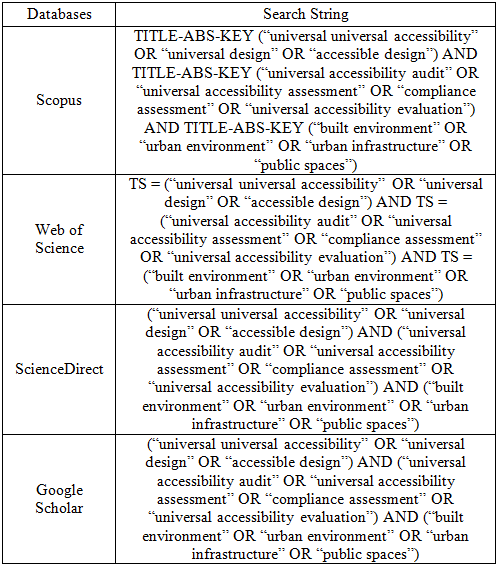
A literature review is conducted to identify empirical studies on universal accessibility in the built environment. Several international scientific databases are searched to cover the relevant peer-reviewed literature. The databases used are Google Scholar, Scopus, Web of Science, and ScienceDirect, which index publications across architecture, urban planning, environmental design, and universal accessibility research (Table 1).
The search is conducted across publications from 2000 to 2026, as this period enables the review to capture changes in universal accessibility standards, universal design practices, and built-environment evaluation over the last 20 years. Articles written only in English are used to ensure consistency in interpretation and analysis.
Clear inclusion and exclusion criteria are outlined to ensure that only relevant, high-quality studies are included in the review. The studies incorporated are empirical investigations that evaluate universal accessibility in the built environment and use methods such as universal accessibility audits, compliance tests, field tests, questionnaires, and structured evaluation instruments. Eligible studies examined access in urban built environments, such as public buildings, transport facilities, pedestrian walkways, parks, and other public spaces. In addition, only articles published in peer-reviewed academic journals and those written in English are included.
Research is ruled out when it is based solely on conceptual or theoretical discourse, without empirical data or field-based measurement. Studies based solely on digital universal accessibility, such as website or software accessibility, are also excluded because this review targets physical environments. Also, studies focusing primarily on residential settings were not included in the review because this study is about the universal accessibility of the built environment in public and semi-public settings, such as transportation, public buildings, pedestrian infrastructure, and urban public spaces. The non-peer-reviewed publications, such as conference abstracts, editorials, commentaries, etc., are also avoided to ensure academic relevance. Lastly, research articles that fail to provide quantifiable results of universal accessibility or evaluation are not included in the analysis.
2.3. Data ExtractionA standardized data extraction process systematically collects and synthesizes data from the selected studies. Within each study, data are recorded on the author and the year of publication, the geographical area or nation in which the study took place, and the type of built environment or urban setting investigated, i.e., public buildings, streets, transportation infrastructure, or public spaces.
Further information was obtained on the study design and methods for assessing universal accessibility, including audit tools, questionnaires, and observational techniques. The studies documented universal accessibility standards, guidelines, and assessment tools. In addition, the extraction process identified key findings related to compliance with universal accessibility, barriers or restrictions encountered in introducing universal accessibility measures, and the authors' recommendations as key to enhancing universal accessibility in the built environment. The retrieved data are synthesized into an organized summary table that enables comparison between studies and assists in synthesizing findings, as reported in the further sections of the review.
2.4. Quality AppraisalThe quality of the methodology in the 30 included studies was assessed using the Mixed Methods Appraisal Tool (MMAT) 2018 version. This rigorous assessment instrument permitted the evaluation of Qualitative, Quantitative Descriptive, and Quantitative Non-Randomized research designs with a high-quality standard of 4-5 stars (29 studies out of 30) (Supplementary Table S1). In qualitative research studies, there was high internal coherence in user-centric design, including guided walks and in-depth interviews (n=16). Quantitative descriptive research studies (n=9) were effective in using standardized audit checklists relying on set standards of national or international universal accessibility. Lastly, the technical rigor of the quantitative non-randomized studies (n=5) was high, as they used advanced GIS-based network analysis and fuzzy-logic modeling. Only a few studies were classified as moderate quality due to their reliance on mostly descriptive measurement methods and limited analytical validation. This uniform quality across varying settings ensures that the findings the review identifies regarding implementation gaps are based on robust, reliable data.
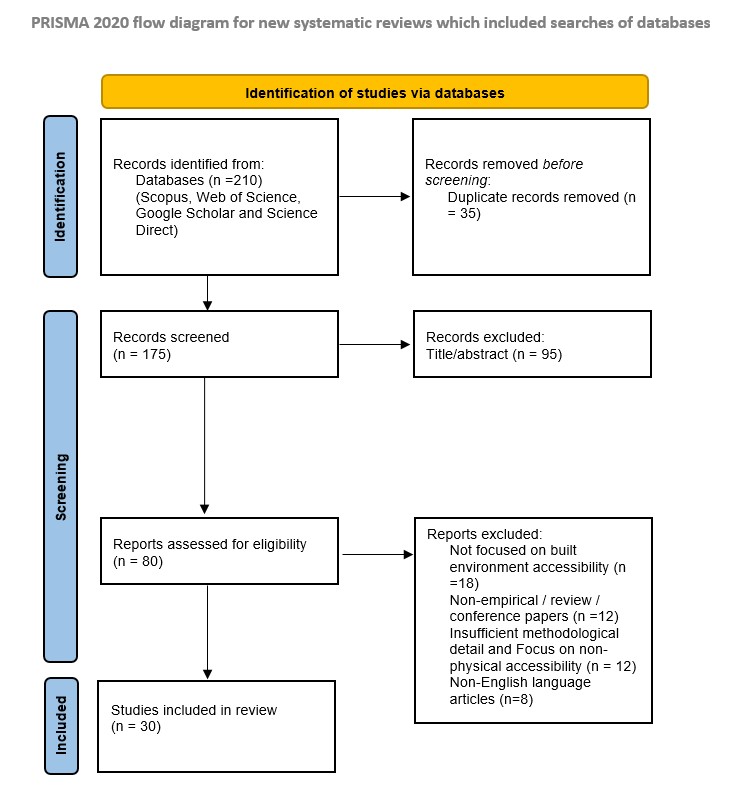
The selection of the study was based on PRISMA requirements to achieve transparency and rigor. Predefined keywords in Scopus, Web of Science, and Google Scholar were systematically searched using keywords linked to universal accessibility, universal design, and the built environment.
A total of 210 records were identified, of which 35 were duplicates; thus, 175 were screened. Following title and abstract screening, 95 records were removed, and 80 articles were subject to eligibility screening by reading the full text. Inclusion criteria were peer-reviewed English-language studies that addressed universal accessibility and universal design of the built environment, including buildings, sidewalks, transportation, and public spaces. There were quantitative and qualitative empirical studies and case studies with clear methodologies and quantifiable results. Rejected studies failed to meet the following criteria: they addressed non-physical universal accessibility, were non-empirical, and were methodologically ambiguous. After full-text evaluation, 50 studies were excluded, leaving 30 studies in the final sample [15-44] 15. The PRISMA flow diagram (Figure 1) shows the selection process.
This systematic review included 30 articles in total, all published between 2007 and 2026, indicating increased interest in research on universal accessibility and universal design in the built environment (Supplementary Table S2). The studies show a wide geographical distribution, with substantial contributions in Asia (Malaysia, China, Saudi Arabia, India, Pakistan, and Iran), as well as in Europe, North America, and Australia, indicating that the problem of universal accessibility is global.
The included studies represent a wide variety of built environment settings, most of which fall into the following categories: public buildings, pedestrian infrastructure (sidewalks and streets), public spaces (parks and urban areas), and transportation facilities (e.g., metro stations). The most common areas of assessment were public buildings and pedestrian areas because they are the most crucial elements that can allow inclusive access to the city.
Regarding methodological interventions, most studies used universal accessibility audits, field observations, and case study analysis, which were often supported by structured checklists and national or international universal accessibility standards (e.g., MS1184, UD guidelines). The qualitative approach, including interviews and surveys of user perception (mainly of persons with disabilities), was also used in several studies. Further sophisticated methods included GIS-based spatial analysis, multi-criteria decision-making models, and fuzzy logic, reflecting the growing sophistication in methodologies in recent studies.
In the literature, compliance with universal accessibility was generally deemed low, with the vast majority of environments unable to meet the established requirements. Poorly designed/missing ramps, uneven/blocked paths, a lack of signage, poor building entry points, and disruptions to pedestrian networks were commonly reported barriers. Also, non-physical obstacles, including ignorance, inadequate enforcement of regulations, financial limitations, and gaps between policies and their implementation, were often mentioned.
In general, the analyzed literature highlights the lack of continuity in implementing universal design, despite the availability of standards and guidelines. The results are a consistent reminder of the necessity of enhancing regulatory compliance, stakeholder awareness, and incorporating universal accessibility issues during the initial planning and design phases.
3.3. Synthesis of FindingsThe synthesis of the included studies shows that full universal accessibility is not achieved in the various types of built environments, with the majority of cases showing partial adherence to the universal accessibility standards. Empirical evidence shows that levels of universal accessibility may be extremely low, with reported values ranging from 14.4% to 44.8% in places such as shopping malls and historic buildings 15. In more controlled spaces like public buildings and parks, universal accessibility is not complete, and common gaps in basic design features, e.g., ramps, entrances, and circulation spaces, exist 16, 17. This implies that the existence of guidelines does not necessarily imply good implementation.
The apparent regularity that has emerged from the research is the pivotal role of pedestrian infrastructure in determining universal accessibility. The lack of curb ramps, uneven surfaces, obstructions, discontinuities, and poor curb ramps are some of the reasons why sidewalks and walking routes are consistently reported as problematic 18, 19. These are not only physical but also functional problems, as they directly affect mobility, safety, and independence. Further analysis shows that universal accessibility depends on route length, gradient, and user fatigue, indicating that it largely depends on users' capabilities and environmental conditions 20. Moreover, perception-based studies identify concerns about inadequate pedestrian connectivity and inconsistent sidewalk conditions, suggesting that environments that meet technical universal accessibility requirements may also face usability challenges in practice. 21.
The issue of universal accessibility is also apparent in the transport systems, where continuity of movement has been a significant problem. Narrow pathways, steep ramps, and poor transitions between spaces in the metro disrupt chains of movement and universal accessibility, and lower the total universal accessibility of the space 22. Spatial analyses also indicate that universal accessibility is not evenly distributed, and some stations or areas are doing much worse because they lack integration with surrounding land-use and access systems 23. This means that universal accessibility must not be viewed in isolation at the facility level, but rather in the wider network and spatial environment.
Contextual constraints, such as urban density, land-use patterns, and historical constraints, tend to complicate the universal accessibility limits in public spaces and the urban environment. Research demonstrates that concerns about safety, comfort, and inclusiveness influence universal accessibility in parks and open spaces, especially among vulnerable groups 17, 24. The unequal spatial provision of services and inadequate access to last-mile connectivity in fast-growing cities also contribute to the universal accessibility issue 25, 26. Furthermore, recent studies indicate the need to pay attention to sensory and cognitive universal accessibility, as noisy, crowded, and visually cluttered environments can be exclusionary for neurodivergent users 27. These discoveries broaden the concept of universal accessibility beyond just physical design to include experiential and perceptual concepts.
Regarding assessment methods, the results show that the majority of studies use audit- and checklist-based methods, often grounded in national standards and universal design models. Although these methods offer a structured approach to investigation, they tend to focus on physical compliance and can ignore the end-user experience. Various studies have used user-centered techniques, including interviews and participatory tests, to overcome this limitation and identify differences in satisfaction and universal accessibility across user groups 28, 29. Simultaneously, there are increasingly powerful methods of analysis, such as spatial analysis (GIS) and multi-criteria decision models, allowing for more comprehensive and context-dependent analysis 23, 25. Nonetheless, inconsistencies across these approaches make them less comparable and underscore the need for more comprehensive assessment systems 30.
In all research work, physical obstacles are the most reported challenges, especially those connected to movement and orientation. The main problems are ineffective entrance design, lack of ramps, narrow routes, weak signs, and discontinuity in the pedestrian network 17, 31. Environmental factors, including poor maintenance, traffic conditions, and weather-related limitations, are often added to these, resulting in decreased usability and safety 29. Besides these material obstacles, institutional and socio-economic ones are also important. Poor knowledge among stakeholders, insufficient financial resources, and inadequate or inefficient enforcement of regulations are repeatedly cited as the root causes of differences in universal accessibility 32, 33.
One particularly notable theme arising from the synthesis is the gap between universal accessibility standards and their implementation. Despite numerous studies citing the existing guidelines, compliance remains inconsistent due to inadequate enforcement, awareness, and coordination among stakeholders 16, 32. Moreover, differences in the views of designers, managers, and users lead to discrepancies in priorities and ineffective solutions 30. Mostly, universal accessibility is designed as a retrofit rather than as part of the design process, which limits its efficacy and sustainability 33.
Lastly, the studies’ recommendations underscore the need for systematic, active improvements. These involve intensifying enforcement controls, reinforcing professional training, and integrating accessibility considerations into initial planning and design. The creation of standardized, comprehensive assessment tools to enhance assessment consistency is also strongly emphasized. Notably, numerous research works emphasize the utility of user-centric and participatory methods, ensuring that solutions to the problem of universal accessibility are grounded in the experiences of people with disabilities. Moreover, the adoption of data-driven and spatial analysis approaches is now seen as the key to reducing inequalities and enhancing universal accessibility outcomes at the urban level 25, 26.
This systematic review synthesizes the broad range of universal accessibility conditions across various built settings to demonstrate a long-standing disparity between theoretical commitments to universal design and its real-world implementation. Although universal accessibility is considered a major aspect of inclusive urban development, the experimental results indicate that this concept is still fragmented and inconsistent in practice 32, 33. Instead of being a principle embedded in the design process, universal accessibility is still treated as a compliance requirement, hindering the creation of genuinely inclusive environments.
One key lesson that emerged from the review is that challenges related to universal accessibility are systemic, not context-dependent. The same type of obstacles can be seen across buildings, sidewalks, transport systems, and other areas, especially barriers to movement, navigation, and continuity of movement 18, 22. This uniformity implies that the problem is not just a matter of design flaws but rather more general flaws in planning and in the enforcement of regulations. Specifically, pedestrian infrastructure is a notable area of weakness, with inadequate sidewalks and walking paths disrupting the entire chain of universal accessibility, although individual facilities may be of satisfactory standard 19, 21. This emphasizes the need to consider universal accessibility as a networked, moving experience rather than individual design components.
Universal accessibility is another crucial discovery, as it now becomes clear that it extends beyond physical design. Although conventional methods cannot ignore building characteristics such as ramps and routes, the studies reviewed show that environmental, sensory, and perceptual aspects are also important 27, 29. Noise, crowding, lighting, and perceived safety are other factors that can significantly affect the universal accessibility of a space for different user groups. This is especially applicable to populations such as neurodivergent individuals and older adults, whose needs are often poorly represented in traditional universal accessibility models. Consequently, universal accessibility is a multidimensional construct encompassing physical, sensory, and experiential levels.
Methodologically, the review points out a shift from traditional audit-based evaluation to a more integrated, analytical evaluation. Although checklists and compliance audits are the most commonly used tools because of their simplicity and alignment with regulatory standards 16, 31, they are often insufficient to capture the intricacy of real-world universal accessibility. Conversely, new approaches, such as multi-criteria evaluation models and GIS-based analysis, provide more in-depth information on spatial inequalities and user-oriented requirements 23, 25. Nevertheless, the presence of heterogeneous, non-standardized approaches is reducing the comparability of results and impeding the creation of a coherent body of evidence 30. This highlights the need for standardized yet flexible assessment frameworks.
The policy-practice implementation gap is one of the most vital problems identified during this review. Even though the standards and guidelines for universal accessibility are widely adopted, their use remains limited in many cases due to the interplay of institutional, economic, and knowledge-related factors 32, 34. Lack of awareness among the professionals, lack of technical competence, financial limitations, and poor enforcement systems are factors that lead to suboptimal results. Moreover, ineffective communication between the stakeholders leads to the fragmentation of decision-making processes 30. The tendency to consider universal accessibility only at later stages of development also contributes to this gap, leading to retrofitted solutions that are less efficient and more expensive 33.
Another important implication of the findings, both in research and practice, is the disconnection between technical compliance and user experience. Even environments that meet the required standard might not be meaningfully accessible when they are not adjusted to users' real needs and preferences 28, 29. This supports the need for integrating user-centered and participatory strategies into both assessment and design processes.
In policy and planning terms, the findings indicate that to enhance universal accessibility, reactive, fragmented strategies need to be replaced with proactive, integrated ones. The concept of universal accessibility needs to be incorporated into more comprehensive urban development plans, alongside sustainability and equity objectives 25, 26. Stronger enforcement of the regulations is needed, though it should be complemented by efforts to enhance professional education and encourage interdisciplinary collaboration 32. Also, the use of data-driven tools and spatial analysis could facilitate more informed decision-making and address inequalities in access.
In general, this review has shown that increasing access to the built environment is more than a technical issue; it is also an institutional and cultural one. However, despite improvements in creating standards and assessment methods, meaningful change depends on how much universal accessibility is prioritized, understood, and implemented throughout the entire planning and design process 33. These issues demand a comprehensive solution that includes technical innovation, policy change, and the active involvement of stakeholders, so that universal accessibility becomes an integral and sustainable part of the built environment.
This evidence-based synthesis review included empirical data on universal accessibility in the built environment, highlighting current compliance levels, assessment methods, and implementation challenges across various urban settings. The results show that even with existing universal accessibility standards and universal design models, the majority of built environments remain not fully accessible, and major obstacles to universal accessibility persist in public buildings, walking routes, transport networks, and open spaces. The review notes that universal accessibility testing primarily relies on audit and checklist testing, which is gradually being enhanced by advanced techniques, including GIS-based testing and multi-criteria decision-making models. Nonetheless, the lack of comparisons across studies, due to inconsistent assessment instruments and procedures, prevents the development of universal evaluation models.
One of the study’s valuable contributions is identifying a long-term policy-practice gap. Although universal accessibility guidelines are well-known, their implementation is frequently hindered by enforcement challenges, insufficient stakeholder awareness, economic constraints, and ineffective integration into planning and design processes. Moreover, the results highlight that technical compliance alone does not guarantee universal accessibility, underscoring the importance of user-centered approaches that account for the lived experiences of persons with disabilities. This review emphasizes the need for more coordinated, active facilitation of universal access to the built environment. This involves enhancing regulatory frameworks, professional education and awareness, using standardized and comprehensive assessment tools, and integrating universal accessibility issues into the conceptual level of urban planning and design. Also, the increased participation of disabled people in decision-making processes is key to achieving genuinely inclusive settings.
Finally, to enhance universal accessibility in the built environment, the differing focus between reactive compliance and proactive, evidence-based planning and design practices must be ensured. The next area of study should focus on developing standardized evaluation techniques, identifying context-specific interventions, and assessing the long-term efficacy of universal accessibility in developing equitable and inclusive urban settings.
The methodological quality of the 30 included studies was assessed using the Mixed Methods Appraisal Tool (MMAT, 2018), and detailed ratings are provided in the supplementary table S1. Main summary characteristics of each study, such as country/region, built environment type, methods and tools, compliance findings and barriers, and recommendations are summarized in the Supplementary Table S2.
The author thanks all the students who helped with this study in any way.
The author declares no competing financial or personal interests related to this work.
| [1] | Steinfeld, E., & Maisel, J., Universal design: Creating inclusive environments, John Wiley & Sons, 2012. | ||
| In article | |||
| [2] | Maisel, J., & Steinfeld, E., “Universal design and the built environment,”Rehabilitation Engineering, 295–318, 2022. | ||
| In article | View Article | ||
| [3] | Zajadacz, A., “Evolution of models of disability as a basis for further policy changes in accessible tourism,”Journal of Tourism Futures, 1(3), 189–202, 2015. | ||
| In article | View Article | ||
| [4] | Imrie, R., “Universalism, universal design and equitable access to the built environment,”Disability and Rehabilitation, 34(10), 873–882, 2012. | ||
| In article | View Article PubMed | ||
| [5] | Imrie, R., & Luck, R., “Designing inclusive environments: rehabilitating the body and the relevance of universal design,”Disability and Rehabilitation, 36(16), 1315–1319, 2014. | ||
| In article | View Article PubMed | ||
| [6] | Currie, G., &Delbosc, A., “Transport disadvantage: a review,” 2011. | ||
| In article | View Article | ||
| [7] | Liu, S., & Zhu, X., “Universal accessibility analyst: an integrated GIS tool for universal accessibility analysis in urban transportation planning,”Environment and Planning B: Planning and Design, 31(1), 105–124, 2004. | ||
| In article | View Article | ||
| [8] | Papa, E., & Bertolini, L., “Universal accessibility and transit-oriented development in European metropolitan areas,”Journal of Transport Geography, 47, 70–83, 2015. | ||
| In article | View Article | ||
| [9] | Crozet, Y., Mercier, A., &Ovtracht, N., “Universal accessibility: a key indicator to assess the past and future of urban mobility,” in Universal accessibility Analysis and Transport Planning, Edward Elgar Publishing, 263–279, 2012. | ||
| In article | View Article PubMed | ||
| [10] | Saif, M. A., Zefreh, M. M., & Torok, A., “Public transport universal accessibility: A literature review,”PeriodicaPolytechnica Transportation Engineering, 47(1), 36–43, 2019. | ||
| In article | View Article | ||
| [11] | Larkin, H., Hitch, D., Watchorn, V., & Ang, S., “Working with policy and regulatory factors to implement universal design in the built environment: The Australian experience,”International Journal of Environmental Research and Public Health, 12(7), 8157–8171, 2015. | ||
| In article | View Article PubMed | ||
| [12] | Duman, Ü., &Asilsoy, B., “Developing an evidence-based framework of universal design in the context of sustainable urban planning in Northern Nicosia,”Sustainability, 14(20), 13377, 2022. | ||
| In article | View Article | ||
| [13] | Gupta, A., Yadav, M., & Nayak, B. K., “A systematic literature review on inclusive public open spaces: Universal accessibility standards and universal design principles,”Urban Science, 9(6), 181, 2025. | ||
| In article | View Article | ||
| [14] | Ostroff, E., “Universal design: an evolving paradigm,”Universal Design Handbook, 2011. | ||
| In article | |||
| [15] | Chakraborty, S., Mori, S., Nomura, R., & Das Mahapatra, G., “Quantitative Interpretation of Universal Design Features in Shopping Malls: A Case Study in Kolkata, India,”Sustainability, 16(12), 4910, 2024. | ||
| In article | View Article | ||
| [16] | Adam, N. R., Aziz, A., & Sulaiman, S., “Universal Design and Universal accessibility Performance in Public Buildings: Perspectives of Malaysia’s Public Works Department,”MAJ-Malaysia Architectural Journal, 7(3), 15–30, 2025. | ||
| In article | |||
| [17] | Hussein, S. M., Ali, E. M., & Ahmed, M. E. K., “An Analytical Study on Achieving Inclusive Parks in Light of Universal Design, Al-Salam & Al-Amal Parks in Aswan City as Case Studies,”International Design Journal, 14(1), 21–33, 2024. | ||
| In article | View Article | ||
| [18] | Rahim, C., “Sidewalk universal accessibility at Melaka’s traditional streets for people with disabilities (PWDs),”Planning Malaysia Journal, 2017. | ||
| In article | |||
| [19] | Aghaabbasi, M., Moeinaddini, M., Shah, M. Z., Asadi-Shekari, Z., & Kermani, M. A., “Evaluating the capability of walkability audit tools for assessing sidewalks,”Sustainable Cities and Society, 37, 475–484, 2018. | ||
| In article | View Article | ||
| [20] | Jahromi, M. N., Samany, N. N., Argany, M., & Mostafavi, M. A., “Enhancing sidewalk universal accessibility assessment for wheelchair users: An adaptive weighting fuzzy-based approach,”Heliyon, 11(1), 2025. | ||
| In article | View Article PubMed | ||
| [21] | Quijada-Alarcón, J., Rodríguez-Rodríguez, R., Icaza, A., González-Cancelas, N., & Bethancourt-Lasso, G., “Social perception of the connectivity and quality of sidewalks in the Metropolitan Area of Panama,”Journal of Maps, 20(1), 2349167, 2024. | ||
| In article | View Article | ||
| [22] | ENGİNÖZ, E., &Savli, H., “Examination of universal accessibility for disabled people at metro stations,”ICONARP International Journal of Architecture and Planning, (1), 2016. | ||
| In article | View Article | ||
| [23] | Wu, T., Shi, Y., Zhou, Y., & Chen, Z., “Evaluation of Metro Station Universal accessibility Based on Combined Weights and GRA-TOPSIS Method,”ISPRS International Journal of Geo-Information, 14(11), 432, 2025. | ||
| In article | View Article | ||
| [24] | Esfandfard, E., Wahab, M. H., & Amat, R. C., “Universal design in urban public spaces for people with disability. Case study of Tehran, Iran,”Planning Malaysia, 16, 2018. | ||
| In article | View Article | ||
| [25] | Bahale, S., Arora, A. S., & Schuetze, T., “Comparative Framework for Multi-Modal Universal accessibility Assessment Within the 15-Minute City Concept: Application to Parks and Playgrounds in an Indian Urban Neighborhood,”ISPRS International Journal of Geo-Information, 14(12), 479, 2025. | ||
| In article | View Article | ||
| [26] | Sun, Y., Li, X., Sun, Z., & Jia, W., “Universal accessibility evaluation of urban basic public service facilities for persons with disabilities: a case study of central Beijing,”Geospatial Health, 21(1), 2025. | ||
| In article | View Article | ||
| [27] | Deng, L., Wang, X., Lian, Q., Sun, X., Shen, Y., Wang, Y., & Qu, H., “Exploring barriers to inclusion for neurodivergent children in public spaces: Case study evidence from urbanising Wenzhou,”Cities, 172, 106819, 2026. | ||
| In article | View Article | ||
| [28] | Kadir, S. A., & Jamaludin, M., “Users’ satisfaction and perception on universal accessibility of public buildings in Putrajaya: Access audit study,”Procedia-Social and Behavioral Sciences, 50, 429–441, 2012. | ||
| In article | View Article | ||
| [29] | Rosenberg, D. E., Huang, D. L., Simonovich, S. D., & Belza, B., “Outdoor built environment barriers and facilitators to activity among midlife and older adults with mobility disabilities,”The Gerontologist, 53(2), 268–279, 2013. | ||
| In article | View Article PubMed | ||
| [30] | Watchorn, V., Hitch, D., Tucker, R., Frawley, P., Aedy, K., & Grant, C., “Evaluating universal design of built environments: an empirical study of stakeholder practice and perceptions,”Journal of Housing and the Built Environment, 38(3), 1491–1510, 2023. | ||
| In article | View Article | ||
| [31] | Andrade, I. F., & Ely, E. V. H. M. B., “Assessment method of universal accessibility conditions: how to make public buildings accessible?,”Work, 41(S1), 3774–3780, 2012. | ||
| In article | View Article PubMed | ||
| [32] | Alqahtani, F. K., Sherif, M., Abdelhafeez, M. M., Ghanem, A. M., Shafaay, M. A., &Alkahtani, B. N., “Enhancing universal accessibility for people with disabilities through upgrades in construction facilities in Saudi Arabia: A quantitative assessment,”Journal of Disability Research, 4(1), 20240114, 2025. | ||
| In article | View Article | ||
| [33] | Zallio, M., & Clarkson, P. J., “The Inclusion, Diversity, Equity and Universal accessibility audit. A post-occupancy evaluation method to help design the buildings of tomorrow,”Building and Environment, 217, 109058, 2022. | ||
| In article | View Article | ||
| [34] | Kadir, S. A., Jamaludin, M., & Rahim, A. A., “Building managers’ perception in regards to universal accessibility and universal design implementation in public buildings: Putrajaya case studies,”Procedia-Social and Behavioral Sciences, 35, 129–136, 2012. | ||
| In article | View Article | ||
| [35] | Hashim, A. E., Samikon, S. A., Ismail, F., & Kamarudin, H., “PWDs Universal accessibility Audit: Commercial complexes, Klang Valley, Malaysia,”Asian Journal of Environment-Behaviour Studies, 3(8), 177–186, 2018. | ||
| In article | View Article | ||
| [36] | Sarwar, M. T., Ghafoor, M., & Naeem, S., “An Inquiry into Universal Design and Universal accessibility for Ambulatory Disabilities in Commercial Spaces of DHA Neighborhood of Lahore,”Policy Journal of Social Science Review, 2(4), 340–356, 2024. | ||
| In article | |||
| [37] | Kadir, S. A., Jamaludin, M., & Rahim, A. A., “Building managers' views on universal accessibility and UD implementation in public buildings: Putrajaya,”Journal of Asian Behavioural Studies, 3(6), 47–54, 2018. | ||
| In article | View Article | ||
| [38] | Nykiforuk, C. I., Glenn, N. M., Hosler, I., Craig, H., Reynard, D., Molner, B., ... & Lowe, S., “Understanding urban universal accessibility: A community-engaged pilot study of entrance features,”Social Science & Medicine, 273, 113775, 2021. | ||
| In article | View Article PubMed | ||
| [39] | Kamarudin, H., Ismail, W. Z. W., Yusof, M. S. M., Aksah, H., &Narotama, M. R., “Assessing Green Roof Universal accessibility for the Disabled Community in High-Rise Residential Buildings,”Journal of Design and Built Environment, 317–330, 2025. | ||
| In article | View Article | ||
| [40] | Bromley, R. D., Matthews, D. L., & Thomas, C. J., “City centreuniversal accessibility for wheelchair users: The consumer perspective and the planning implications,”Cities, 24(3), 229–241, 2007. | ||
| In article | View Article | ||
| [41] | Alhajaj, N., & Habibullah, A., “Assessing Walking Routes for Wheelchair Universal accessibility at a Historic District in Saudi Arabia to Enhance Social Sustainability,”Sustainability, 17(8), 3636, 2025. | ||
| In article | View Article | ||
| [42] | Rahim, A. A., & Abdullah, F., “Access audit on universal design: The case of Kota Kinabalu Water Front,”The International Journal of Interdisciplinary Social Sciences, 4, 2009. | ||
| In article | View Article | ||
| [43] | Marín-Nicolás, J., & Sáez-Pérez, M. P., “An evaluation tool for physical universal accessibility of cultural heritage buildings,”Sustainability, 14(22), 15251, 2022. | ||
| In article | View Article | ||
| [44] | Kociuba, D., & Maj, M., “Walkable city and universal design in theory and practice in Poland,”Bulletin of Geography. Socio-economic Series, (50), 113–132, 2020. | ||
| In article | View Article | ||
Published with license by Science and Education Publishing, Copyright © 2026 Ahmad Ameen AlSaggaf
 This work is licensed under a Creative Commons Attribution 4.0 International License. To view a copy of this license, visit
http://creativecommons.org/licenses/by/4.0/
This work is licensed under a Creative Commons Attribution 4.0 International License. To view a copy of this license, visit
http://creativecommons.org/licenses/by/4.0/
| [1] | Steinfeld, E., & Maisel, J., Universal design: Creating inclusive environments, John Wiley & Sons, 2012. | ||
| In article | |||
| [2] | Maisel, J., & Steinfeld, E., “Universal design and the built environment,”Rehabilitation Engineering, 295–318, 2022. | ||
| In article | View Article | ||
| [3] | Zajadacz, A., “Evolution of models of disability as a basis for further policy changes in accessible tourism,”Journal of Tourism Futures, 1(3), 189–202, 2015. | ||
| In article | View Article | ||
| [4] | Imrie, R., “Universalism, universal design and equitable access to the built environment,”Disability and Rehabilitation, 34(10), 873–882, 2012. | ||
| In article | View Article PubMed | ||
| [5] | Imrie, R., & Luck, R., “Designing inclusive environments: rehabilitating the body and the relevance of universal design,”Disability and Rehabilitation, 36(16), 1315–1319, 2014. | ||
| In article | View Article PubMed | ||
| [6] | Currie, G., &Delbosc, A., “Transport disadvantage: a review,” 2011. | ||
| In article | View Article | ||
| [7] | Liu, S., & Zhu, X., “Universal accessibility analyst: an integrated GIS tool for universal accessibility analysis in urban transportation planning,”Environment and Planning B: Planning and Design, 31(1), 105–124, 2004. | ||
| In article | View Article | ||
| [8] | Papa, E., & Bertolini, L., “Universal accessibility and transit-oriented development in European metropolitan areas,”Journal of Transport Geography, 47, 70–83, 2015. | ||
| In article | View Article | ||
| [9] | Crozet, Y., Mercier, A., &Ovtracht, N., “Universal accessibility: a key indicator to assess the past and future of urban mobility,” in Universal accessibility Analysis and Transport Planning, Edward Elgar Publishing, 263–279, 2012. | ||
| In article | View Article PubMed | ||
| [10] | Saif, M. A., Zefreh, M. M., & Torok, A., “Public transport universal accessibility: A literature review,”PeriodicaPolytechnica Transportation Engineering, 47(1), 36–43, 2019. | ||
| In article | View Article | ||
| [11] | Larkin, H., Hitch, D., Watchorn, V., & Ang, S., “Working with policy and regulatory factors to implement universal design in the built environment: The Australian experience,”International Journal of Environmental Research and Public Health, 12(7), 8157–8171, 2015. | ||
| In article | View Article PubMed | ||
| [12] | Duman, Ü., &Asilsoy, B., “Developing an evidence-based framework of universal design in the context of sustainable urban planning in Northern Nicosia,”Sustainability, 14(20), 13377, 2022. | ||
| In article | View Article | ||
| [13] | Gupta, A., Yadav, M., & Nayak, B. K., “A systematic literature review on inclusive public open spaces: Universal accessibility standards and universal design principles,”Urban Science, 9(6), 181, 2025. | ||
| In article | View Article | ||
| [14] | Ostroff, E., “Universal design: an evolving paradigm,”Universal Design Handbook, 2011. | ||
| In article | |||
| [15] | Chakraborty, S., Mori, S., Nomura, R., & Das Mahapatra, G., “Quantitative Interpretation of Universal Design Features in Shopping Malls: A Case Study in Kolkata, India,”Sustainability, 16(12), 4910, 2024. | ||
| In article | View Article | ||
| [16] | Adam, N. R., Aziz, A., & Sulaiman, S., “Universal Design and Universal accessibility Performance in Public Buildings: Perspectives of Malaysia’s Public Works Department,”MAJ-Malaysia Architectural Journal, 7(3), 15–30, 2025. | ||
| In article | |||
| [17] | Hussein, S. M., Ali, E. M., & Ahmed, M. E. K., “An Analytical Study on Achieving Inclusive Parks in Light of Universal Design, Al-Salam & Al-Amal Parks in Aswan City as Case Studies,”International Design Journal, 14(1), 21–33, 2024. | ||
| In article | View Article | ||
| [18] | Rahim, C., “Sidewalk universal accessibility at Melaka’s traditional streets for people with disabilities (PWDs),”Planning Malaysia Journal, 2017. | ||
| In article | |||
| [19] | Aghaabbasi, M., Moeinaddini, M., Shah, M. Z., Asadi-Shekari, Z., & Kermani, M. A., “Evaluating the capability of walkability audit tools for assessing sidewalks,”Sustainable Cities and Society, 37, 475–484, 2018. | ||
| In article | View Article | ||
| [20] | Jahromi, M. N., Samany, N. N., Argany, M., & Mostafavi, M. A., “Enhancing sidewalk universal accessibility assessment for wheelchair users: An adaptive weighting fuzzy-based approach,”Heliyon, 11(1), 2025. | ||
| In article | View Article PubMed | ||
| [21] | Quijada-Alarcón, J., Rodríguez-Rodríguez, R., Icaza, A., González-Cancelas, N., & Bethancourt-Lasso, G., “Social perception of the connectivity and quality of sidewalks in the Metropolitan Area of Panama,”Journal of Maps, 20(1), 2349167, 2024. | ||
| In article | View Article | ||
| [22] | ENGİNÖZ, E., &Savli, H., “Examination of universal accessibility for disabled people at metro stations,”ICONARP International Journal of Architecture and Planning, (1), 2016. | ||
| In article | View Article | ||
| [23] | Wu, T., Shi, Y., Zhou, Y., & Chen, Z., “Evaluation of Metro Station Universal accessibility Based on Combined Weights and GRA-TOPSIS Method,”ISPRS International Journal of Geo-Information, 14(11), 432, 2025. | ||
| In article | View Article | ||
| [24] | Esfandfard, E., Wahab, M. H., & Amat, R. C., “Universal design in urban public spaces for people with disability. Case study of Tehran, Iran,”Planning Malaysia, 16, 2018. | ||
| In article | View Article | ||
| [25] | Bahale, S., Arora, A. S., & Schuetze, T., “Comparative Framework for Multi-Modal Universal accessibility Assessment Within the 15-Minute City Concept: Application to Parks and Playgrounds in an Indian Urban Neighborhood,”ISPRS International Journal of Geo-Information, 14(12), 479, 2025. | ||
| In article | View Article | ||
| [26] | Sun, Y., Li, X., Sun, Z., & Jia, W., “Universal accessibility evaluation of urban basic public service facilities for persons with disabilities: a case study of central Beijing,”Geospatial Health, 21(1), 2025. | ||
| In article | View Article | ||
| [27] | Deng, L., Wang, X., Lian, Q., Sun, X., Shen, Y., Wang, Y., & Qu, H., “Exploring barriers to inclusion for neurodivergent children in public spaces: Case study evidence from urbanising Wenzhou,”Cities, 172, 106819, 2026. | ||
| In article | View Article | ||
| [28] | Kadir, S. A., & Jamaludin, M., “Users’ satisfaction and perception on universal accessibility of public buildings in Putrajaya: Access audit study,”Procedia-Social and Behavioral Sciences, 50, 429–441, 2012. | ||
| In article | View Article | ||
| [29] | Rosenberg, D. E., Huang, D. L., Simonovich, S. D., & Belza, B., “Outdoor built environment barriers and facilitators to activity among midlife and older adults with mobility disabilities,”The Gerontologist, 53(2), 268–279, 2013. | ||
| In article | View Article PubMed | ||
| [30] | Watchorn, V., Hitch, D., Tucker, R., Frawley, P., Aedy, K., & Grant, C., “Evaluating universal design of built environments: an empirical study of stakeholder practice and perceptions,”Journal of Housing and the Built Environment, 38(3), 1491–1510, 2023. | ||
| In article | View Article | ||
| [31] | Andrade, I. F., & Ely, E. V. H. M. B., “Assessment method of universal accessibility conditions: how to make public buildings accessible?,”Work, 41(S1), 3774–3780, 2012. | ||
| In article | View Article PubMed | ||
| [32] | Alqahtani, F. K., Sherif, M., Abdelhafeez, M. M., Ghanem, A. M., Shafaay, M. A., &Alkahtani, B. N., “Enhancing universal accessibility for people with disabilities through upgrades in construction facilities in Saudi Arabia: A quantitative assessment,”Journal of Disability Research, 4(1), 20240114, 2025. | ||
| In article | View Article | ||
| [33] | Zallio, M., & Clarkson, P. J., “The Inclusion, Diversity, Equity and Universal accessibility audit. A post-occupancy evaluation method to help design the buildings of tomorrow,”Building and Environment, 217, 109058, 2022. | ||
| In article | View Article | ||
| [34] | Kadir, S. A., Jamaludin, M., & Rahim, A. A., “Building managers’ perception in regards to universal accessibility and universal design implementation in public buildings: Putrajaya case studies,”Procedia-Social and Behavioral Sciences, 35, 129–136, 2012. | ||
| In article | View Article | ||
| [35] | Hashim, A. E., Samikon, S. A., Ismail, F., & Kamarudin, H., “PWDs Universal accessibility Audit: Commercial complexes, Klang Valley, Malaysia,”Asian Journal of Environment-Behaviour Studies, 3(8), 177–186, 2018. | ||
| In article | View Article | ||
| [36] | Sarwar, M. T., Ghafoor, M., & Naeem, S., “An Inquiry into Universal Design and Universal accessibility for Ambulatory Disabilities in Commercial Spaces of DHA Neighborhood of Lahore,”Policy Journal of Social Science Review, 2(4), 340–356, 2024. | ||
| In article | |||
| [37] | Kadir, S. A., Jamaludin, M., & Rahim, A. A., “Building managers' views on universal accessibility and UD implementation in public buildings: Putrajaya,”Journal of Asian Behavioural Studies, 3(6), 47–54, 2018. | ||
| In article | View Article | ||
| [38] | Nykiforuk, C. I., Glenn, N. M., Hosler, I., Craig, H., Reynard, D., Molner, B., ... & Lowe, S., “Understanding urban universal accessibility: A community-engaged pilot study of entrance features,”Social Science & Medicine, 273, 113775, 2021. | ||
| In article | View Article PubMed | ||
| [39] | Kamarudin, H., Ismail, W. Z. W., Yusof, M. S. M., Aksah, H., &Narotama, M. R., “Assessing Green Roof Universal accessibility for the Disabled Community in High-Rise Residential Buildings,”Journal of Design and Built Environment, 317–330, 2025. | ||
| In article | View Article | ||
| [40] | Bromley, R. D., Matthews, D. L., & Thomas, C. J., “City centreuniversal accessibility for wheelchair users: The consumer perspective and the planning implications,”Cities, 24(3), 229–241, 2007. | ||
| In article | View Article | ||
| [41] | Alhajaj, N., & Habibullah, A., “Assessing Walking Routes for Wheelchair Universal accessibility at a Historic District in Saudi Arabia to Enhance Social Sustainability,”Sustainability, 17(8), 3636, 2025. | ||
| In article | View Article | ||
| [42] | Rahim, A. A., & Abdullah, F., “Access audit on universal design: The case of Kota Kinabalu Water Front,”The International Journal of Interdisciplinary Social Sciences, 4, 2009. | ||
| In article | View Article | ||
| [43] | Marín-Nicolás, J., & Sáez-Pérez, M. P., “An evaluation tool for physical universal accessibility of cultural heritage buildings,”Sustainability, 14(22), 15251, 2022. | ||
| In article | View Article | ||
| [44] | Kociuba, D., & Maj, M., “Walkable city and universal design in theory and practice in Poland,”Bulletin of Geography. Socio-economic Series, (50), 113–132, 2020. | ||
| In article | View Article | ||