Faced with the growing shortage of conventional materials in road construction in South Benin, this study explores the valorization of the silty sand of Tohouè, an abundant local resource but unsuitable for the raw state because of its low lift and its sensitivity to water. The general objective is to evaluate the effectiveness of mechanical stabilization by adding Dan's 0/31.5 granite crusher to allow its use in road construction. The methodology consisted in formulating eight mixtures with crushed contents ranging from 10% to 45%, characterized by standardized geotechnical tests: particle size analysis, Atterberg limits, methylene blue value, modified Proctor and CBR index after immersion. The results demonstrate a gradual improvement in mechanical properties. The mixture with 20% crushed material already shows a marked improvement with a CBR of 58.4% and a density of 1.99 g/cm³, meeting the CEBTP standard. However, it is the 25% blend that constitutes the technical optimum, achieving a CBR of 63.65% and a density of 1.995 g/cm³, fully meeting the requirements of international standards for foundation layers. Therefore, stabilization with 25% granite crushed represents the optimal formulation, offering the best compromise between mechanical performance and economic viability. This solution allows a 75% saving on the use of noble materials while valuing an abundant local resource, thus constituting a sustainable alternative for road construction in Benin.
Materials traditionally used in road construction in Benin, such as lateritic gravel, silty sands and crushed granite 1 2 3 4 5, are becoming increasingly scarce, especially in the south-eastern region of the country. This shortage leads to an interest in locally abundant alternative resources, such as silt sands. However, these materials present major challenges for use as a form or foundation layer because of their low cohesion and their high sensitivity to water. It must be noted that pavements incorporating these sands without appropriate treatment prematurely develop disorders such as rutting, differential compaction and accelerated erosion of the shoulders.
The main causes of these pathologies are intrinsically linked to the unsuitable nature of the raw material, a problem exacerbated by traffic, climatic conditions and implementation techniques. In order to reduce the construction costs and the environmental impact of transporting materials over long distances, the development of local resources becomes an imperative necessity. This approach is only viable if preceded by rigorous geotechnical studies 1 6 7. It has also been shown that some local materials, although not in accordance with international standards, can be effective after improvement, while structures that strictly comply with these same standards can deteriorate early 1 4 5 6. It is therefore crucial to develop technical guides adapted to the Beninese geological and climatic context 8.
In the south-east of Benin, and more specifically in the commune of Sèmè-Kpodji, the abundance of silty sand deposits in the village Tohouè, represents an underexploited resource. Its immediate proximity to future road routes makes it a prime candidate from a logistical and economic point of view. However, its intrinsic mechanical characteristics, low lift and plasticity, do not allow its direct use in road construction. This technical inadequacy, coupled with the scarcity of noble materials, makes it essential to seek solutions to improve it 1 2 4 9.
Several stabilization techniques, proven in the literature, can be envisaged to give this type of material the required properties: chemical stabilization using binders such as cement or lime, or mechanical stabilization by addition of aggregates having high technical characteristics 1 4 10 11.
Faced with this observation, the present study aims to stabilize the silty sand of Tohouè with the crushed granite of Dan for its use in road construction. Thus, this work, which is part of a logic of valorization of local resources for the realization of economic and sustainable infrastructure.
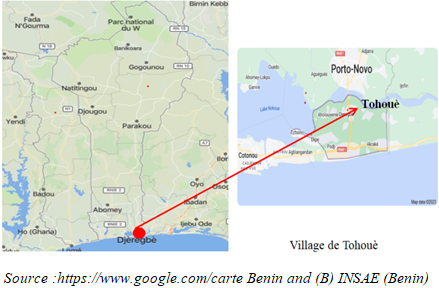
The silty sand, object of this study, comes from the quarry of Tohoué in the district of Tohouè, Commune of Sèmè-Kpodji. It is located 2.5 km from the bus station of Djèrègbé more precisely 35.7km from Cotonou. The commune of Sèmè-Kpodji is located between the parallel 6°22' and 6°28' North latitude and the meridians 2°28' and 2°43' East longitude. The location of the quarry is completed by the following Figure 1.
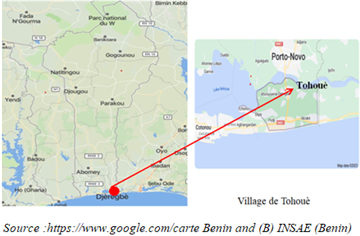
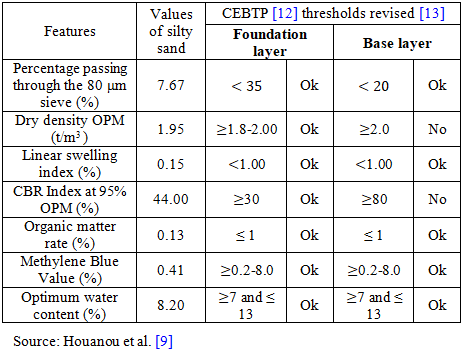
Table 1 summarizes the geotechnical characteristics of the silty sand of Tohouè. These values from Houanou et al. 9 show that the raw material can only be used directly as a foundation layer.
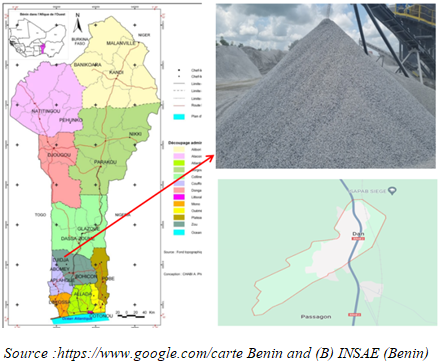
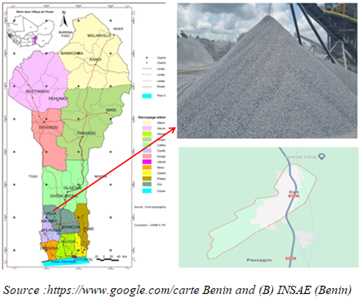
In this study, the granite crushers used come from a quarry located in the village Dan, commune of Djidja (department of Zou) in Benin. The municipality of Djidja lies to the north between latitudes 7°10' and 7°40' North, and to the east between longitudes 1°04' and 2°10' East. Dan's crushed granite quarry is precisely located at latitude 7°21'44'' North and longitude 2°6'38'' East.
In this quarry, the crushed material is sorted and stored by granular class 14. The materials are directly extracted from massive granite rocks and crushing is carried out in a traditional way. Figure 2 shows the map of Benin and the quarry area and also the material under study.
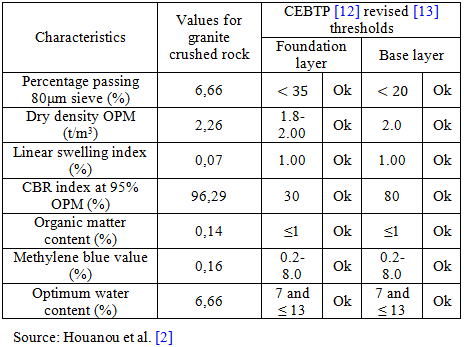
Table 2 summarizes the geotechnical characteristics of Dan's granite crusher. These values from Houanou et al. 2 show that the material can be used directly in the different pavement layers.
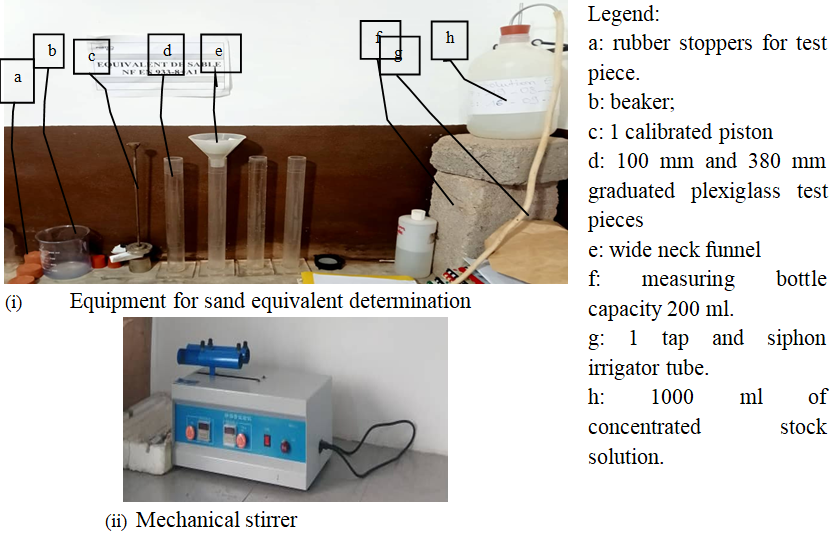
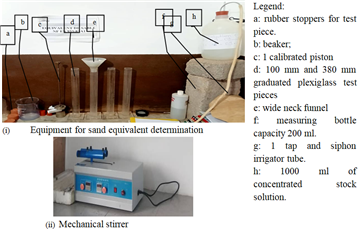
The sand equivalent material was produced in accordance with standard NF EN 933-8 15. In addition to the elements shown in Figure 3, a 5 mm screen, a scale, a graduated scale, a chronometer and a pin are required.
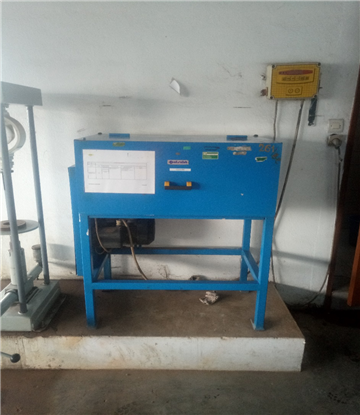
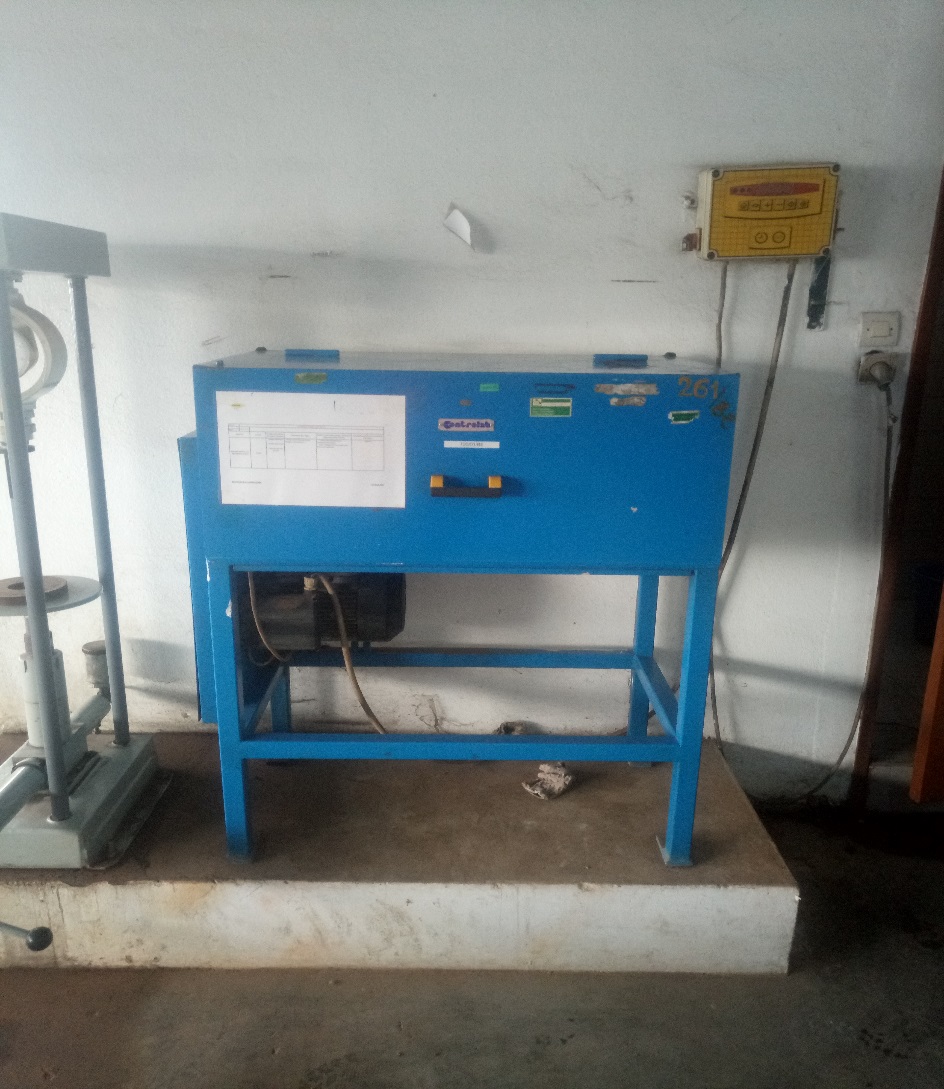
The abrasion test was carried out according to the protocol of standard NF EN 1097-1 16. The core of the experimental device was a Micro-Deval machine (Figure 4), a set of control sieves. A precision scale and drying oven, bins and trowels.
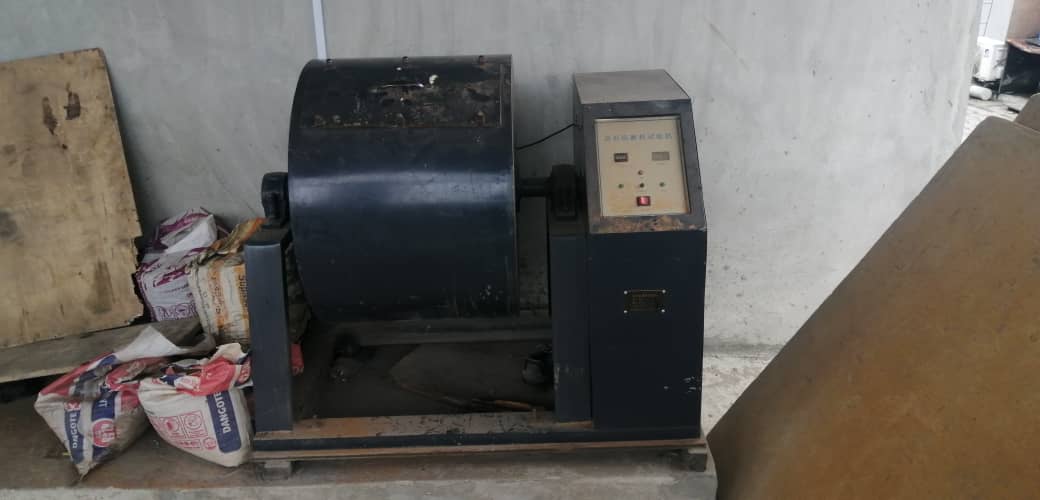
The experimental device for the impact fragmentation test was carried out according to standard NF EN 1097-2 17 18. Figure 5 shows the standardized Los Angeles machine. As with the Micro-Deval test, it is important to add a specific set of sieves, a scale, a drying oven, bins and trowels.
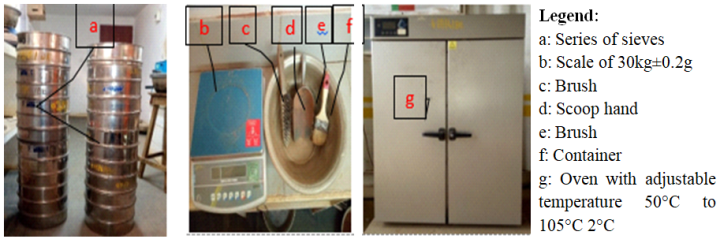
All the equipment for carrying out the particle size analysis by sieving was selected in accordance with standard NF P 94-056 19. Thus, Figure 6 shows said equipment.
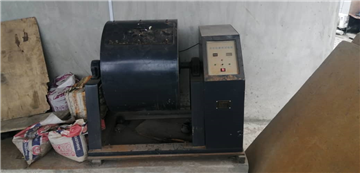
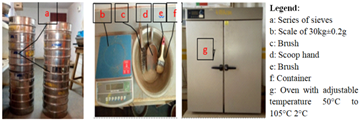
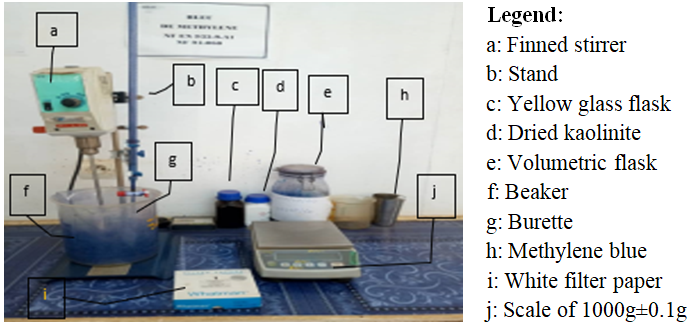
Figure 7 shows the methylene blue value test equipment according to the rigorous protocol of standard NF P 94-068 20. In addition, mesh screens (80 µm, 5 mm and 50 mm), a thermometer, a chronometer, an oven at 90°C, a desiccator and a precision burette must be added.
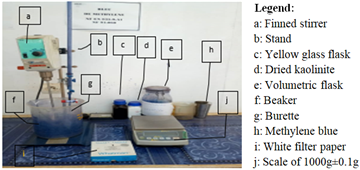
Figure 8 shows the experimental device for producing the water content according to the reference method described in the standard NF P 94-050 21. It is important to add a scale with a capacity of 30 kg and an accuracy of ± 1 g, dishes and Petri dishes or vases.
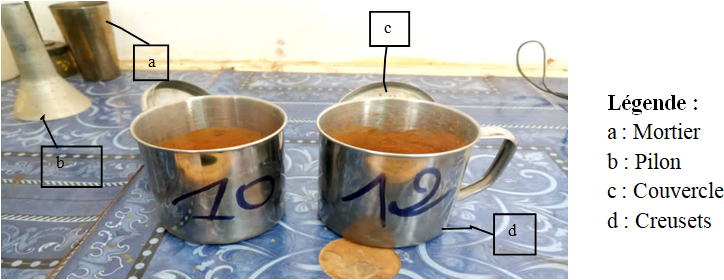
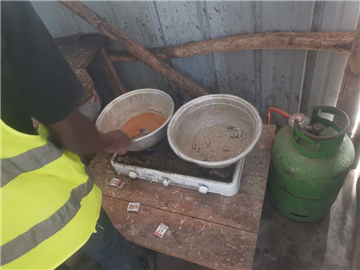
The test device for the organic matter content was carried out in accordance with Annex B to standard NF P 94-051 22. Figure 9 provides an overview of some of the test materials. To this must also be added a muffle oven set at a constant temperature of 500°C, a precision balance (30,000 g ± l g), a 2 mm sieve and a desiccator.
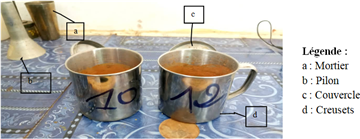
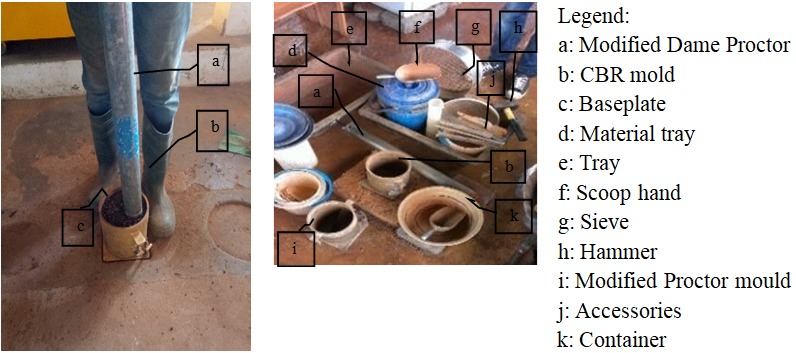
The experimental equipment for determining compaction references (OPM) was determined in accordance with standard NF P 94-093 23. Figure 10 provides an overview of some of the test materials. A lady weighing 4,535 kg (± 5 g) and a height of 457 mm (± 2 mm) must also be added, with a straight ruler at the base, a 20 mm sieve, an oven and thus a laboratory scale (30,000 g ± 1 g).
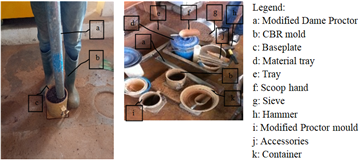
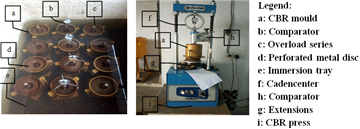
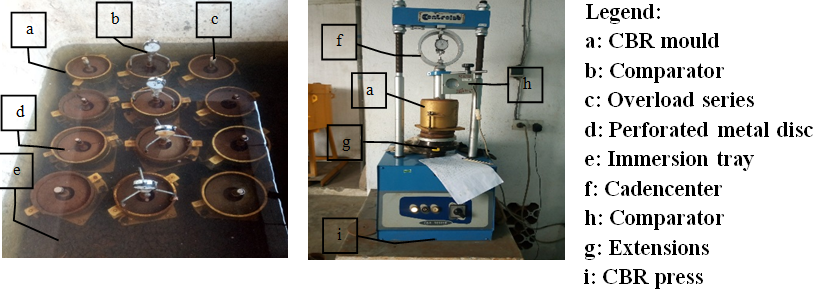
The experimental equipment for the California bearing index (CBR) test complies with standard NF P 94-078 24. Figure 11 shows some of the material from this test. A lady weighing 4,535 kg (± 5 g) and a height of 457 mm (± 2 mm) must also be added, with a straight ruler at the base, a 20 mm sieve, an oven and thus a laboratory scale (30,000 g ± 1 g).
2.3. MethodsThe samples are taken according to standard XP P94-202 25. The silty sand and crushed granite samples were dried in the open air before the various tests were carried out; because the pretreatment method in the oven reduces the liquidity limit and increases the dry weight per unit volume of the material to the modified Proctor optimum 1 4 26 27.
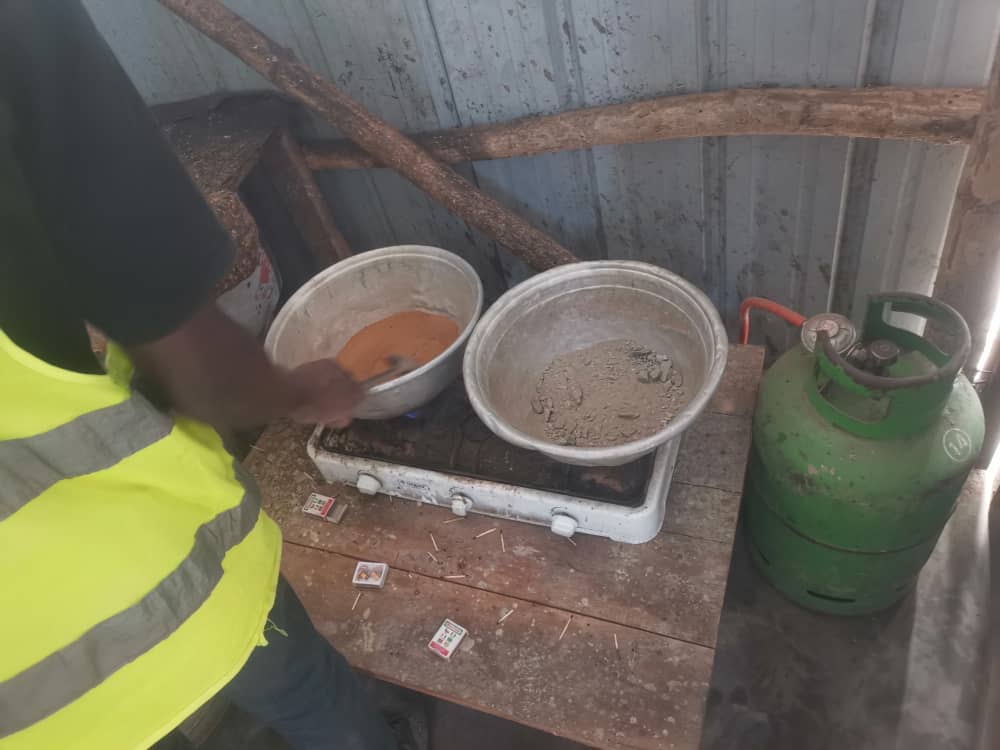
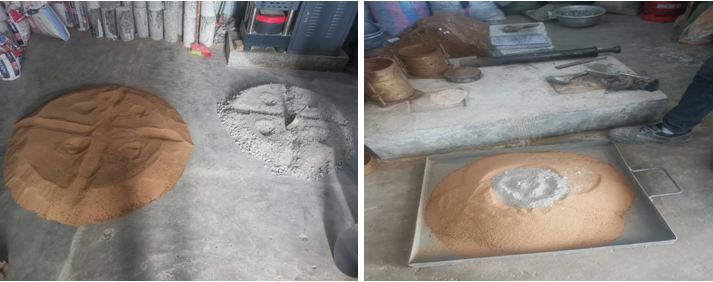
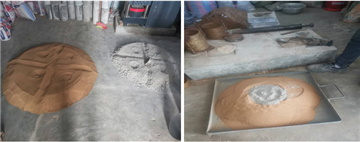
It should be recalled that geotechnical tests carried out on the silty sand of the Tohouè quarry show that this material can only be used as a foundation layer for flexible roadways according to the specifications of the modified CEBTP 12 revised 13. For the majority of authors who worked on litho-stabilization, the percentage of granitic crushed varies between 10 and 45%. Thus, the silty sand of Tohouè is improved by adding 10%, 15%, 20%, 25%, 30%, 35%, 40% and 45% of the granitic crushed material of class 0/31.5. Figure 12 shows the preparation of mixtures of silty and crushed granite sand.
Six steps are required for the formulation of silty sand/crushed granite mixtures. They are listed below ( 1 4 10):
Step 1: Dry the samples of silty sand and crushed granite in an oven at 50°C for 2 hours or in air for a suitable time at room temperature.
Step 2: Define the different proportions of the granite crushed empirically, for example: from 10%, 15%, 20%, 25%, 30%, 35%, 40% and 45%.
Step 3: Calculate the quantities of each mixture (silty sand and crushed granite) according to the type of test.
Step 4: Determine the water content of each mixture.
Step 5: Mix manually to prevent grain size change in a short time.
Step 6: Pack the quantities of material collected in airtight plastic bags or self-closing polyethylene bags to keep the water content constant.
The various geotechnical and mechanical test methods are carried out in accordance with the standards mentioned in § 2.2.2.
Test method on formulated materials
The particle size analysis is carried out according to standard NF P 94-056 19 while the determination of the water content by weight is carried out according to the specifications of standard NF P 94-049-2 28 .As for the natural water content, it was carried out according to standard NF P94-050 21. The methylene blue value is determined according to the recommendations of standard NF P 94-068 20. In addition, the organic matter content shall be determined in accordance with standard XP P94-047 29. The tests for determining the compacting references are carried out according to the standard NF P94-093 23. While that of CBR index after immersion is carried out according to standard NF P94-078 24.
The following tables present the results of the tests of the litho-stabilized mixtures at 10%, 15%, 20%, 25%, 30%, 35%, 40% and 45% of granitic crushed 0/31.5. These tests are: particle size analysis by sieving, methylene blue value, Modified Proctor and CBR.
Table 3 presents the results of the mixture of 10% Crushed+90% Silty Sand of Tohouè.
The analysis in Table 3 reveals geotechnical characteristics that are limited by the standards in force. The average CBR of 56.5% is below the requirements of the NF P 94-078 standard, which generally requires a minimum of 80% for the base layers. However, this value remains acceptable for the CEBTP standard which prescribes a minimum of 30% for the foundation layers. The methylene blue value of 0,33 indicates a persistent water sensitivity, in line with the Ndiaye observations 10 on sandy materials with low aggregate content. The dry density of 1.94 g/cm³ is comparable to the results obtained by Gidigasu ( 26) on similar materials in tropical contexts 30.
Table 4 presents the results of the mixture of 15% Crushed+85% Silty Sand of Tohouè.
The analysis of Table 4 shows that the increase to 15% of granite crushed brings an improvement; but it is insufficient to meet the standards in force in road construction. The average CBR of 55.7% remains unsuitable for the requirements of the NF P 94-093 standard for the base layers of roadways. This performance nevertheless corresponds to the specifications of certain African countries such as Senegal and Côte d'Ivoire for embankments selected as a base layer.
The results of the mixture of 20% crushed granite+80% silty sand of Tohouè are recorded in Table 5.
From the analysis of Table 5, it appears that with a substitution of 20% of granite crushed to silty sand, an improvement in the CBR index of 55.7 to 58.4% and a density of 1.955 to 2.02 g/cm³ are observed. The value of the CBR index is less than 80% to be used as a base layer while the value of the density is greater than 2.00 to be used as a base layer according to the thresholds recommended by the modified CEBTP guide 12 13 The water stability improves (VBS=0.33), which is in line with Weinert's observations 31 on the optimization of granular mixtures in subtropical zones.
The results of the mixture of 25% crushed granite+75% silty sand of Tohouè are recorded in Table 6.
From the analysis of Table 6, it appears that with a substitution of 25% of granite crushed to silty sand, an improvement in the CBR index from 58.4% to 63.65% and a density from 2.02 to 2.03 g/cm³ are observed. The value of the CBR index is less than 80% for use in the base layer. On the other hand, the density value is greater than 2.03 to be used as a base layer according to the thresholds recommended by the modified CEBTP guide 12 13. This performance fully meets the requirements of the CEBTP for foundation layers and meets the specifications of Moroccan standards ( 32).
The results of the mixture of 30% crushed granite+70% silty sand of Tohouè are recorded in Table 7.
Analysis of Table 7 shows a deterioration of the material with a drop in CBR to 35.4% despite the increase in density (2.05 g/cm³). This underperformance is explained by a grain size imbalance where excess coarse grains impair structural homogeneity. This phenomenon, documented by Riverson 33 in Africa and Molenaar 6 in various contexts, makes this mixture unacceptable according to all international standards, whether European, African or Asian.
The results of the mixture of 35% crushed granite+65% silty sand of Tohouè are recorded in Table 8.
From the analysis of Table 8, it appears that the value of the CBR index is 38% and the dry density is 2.07 g/cm3. This drop in the CBR index shows a particle size imbalance where the excess of large grains is detrimental to the homogeneity. On the other hand, the increase in density shows the presence and the quality of the coarse grains in the mixture in a high proportion. These values are unacceptable according to the standards referenced above. The increase in VBS (up to 0.38) suggests a contribution of crushed clay fines, exacerbating water sensitivity problems. These results confirm the conclusions of Winterkorn [34] on the need to respect a continuous particle size curve to optimize compactness.
The results of the mixture of 40% crushed granite+60% silty sand of Tohouè are recorded in Table 9.
From the analysis of Table 9, it appears that the value of the CBR index is 32.40% and the dry density is 2.06 g/cm3. This drop in the CBR index and the dry density show a particle size imbalance where the excess of coarse grains impairs the homogeneity and the quality of the coarse grains in the mixture in high proportion. These values are unacceptable according to the standards referenced above. The increase in VBS (up to 0.44%) suggests a contribution of crushed clay fines, exacerbating water sensitivity problems. These results confirm the conclusions of Winterkorn on the need to respect a continuous particle size curve to optimize compactness.
The results of the mixture of 45% crushed granite+55% silty sand of Tohouè are recorded in Table 10.
From the analysis of Table 10, it appears that the value of the CBR index is 39.40% and the dry density is 2.07 g/cm3. This drop in the CBR index and the dry density show a particle size imbalance where the excess of coarse ngrains impairs the homogeneity and the quality of the coarse grains in the mixture in high proportion. These values are unacceptable according to the standards referenced above. The increase in VBS (up to 0.47%) suggests a contribution of crushed clay fines, exacerbating water sensitivity problems. These results confirm the conclusions of Winterkorn on the need to respect a continuous particle size curve to optimize compactness.
Analysis of the various data shows that mixtures of 20 to 25% crushed, comply with the standards 12 13 24. These formulations allow a saving of 75 to 80% on the purchase of noble materials while guaranteeing satisfactory mechanical performance for the foundation layers. The results are consistent with similar work and offer a sustainable solution for road construction in developing countries. Thus, this formulation represents the best technical-economic compromise for the valorization of local materials.
This study shows that the silty sand of Tohouè, although unsuitable for the raw state, can be efficiently valorized in road construction thanks to a granular stabilization. The addition of 25% Dan 0/31.5 granitic crushed is the optimal formulation, achieving a CBR index of 63.65% and a dry density of 1.995 g/cm³, in accordance with the requirements of the standards in force for foundation layers. Beyond this percentage, the mechanical performance deteriorates due to a particle size imbalance. This solution offers an economical and sustainable alternative, reducing dependence on imported materials and promoting the use of local resources in Benin.
“The authors declare no conflicts of interest.”
| [1] | S. K. DOSSOU, "Valorisation en technique routière de la grave latéritique de Avlamè en République du Bénin," THESE, EPAC/UAC, Abomey-Calavi, 2023. | ||
| In article | |||
| [2] | Houanou, K. A, Danvi, K. R, Dossou, K. S. et Olodo, E. "Determination of the Mechanical Parameters of Dan Granite Crushed Rock for Use in Road Construction in Benin," Open Journal of Civil Engineering, 15(3) 478‑502, août 2025. | ||
| In article | View Article | ||
| [3] | Houanou, K. A, Danvi, K. R, Dossou, K. S. et Olodo, E. "Determination of the Geotechnical Parameters of Tohouè Silty Sand (Semè-Kpodji) for Its Use in Road Construction in Southern Benin," Open Journal of Applied Sciences, 15(7), juill. 2025. | ||
| In article | View Article | ||
| [4] | Houanou, K. A, Dossou, K. S, Prodjinonto, V, Ahouétohou, P. et Olodo, E. " Mechanical characteristics of Avlamè lateritic gravel improved with granite crushed for its use in road construction in Benin," World Journal of Advanced Research and Reviews, 15(2), 279‑292, 2022. | ||
| In article | View Article | ||
| [5] | Koubikana Pambou, C. H. "Développement d’un catalogue de conception des chaussées pour les pays Sub-Sahariens," PhD Thesis, École de technologie supérieure, 2013. https:// espace. etsmtl.ca/ id/eprint/1180/. | ||
| In article | |||
| [6] | Molenaar, A. A. A. "Durable and sustainable road constructions for developing countries," Procedia Engineering, 54, 69‑81, 2013. | ||
| In article | View Article | ||
| [7] | Ahouet, L, Ngoulou, M. O, Okina, S. N. et Dzaba, S. "Geotechnical Characterization of Termite Mound Soils of Congo," Open Journal of Civil Engineering, 12(3), juill. 2022. | ||
| In article | View Article | ||
| [8] | Autret, P. "Laterites and Lateritic Soils / Latérites et sols latéritiques," ORSTOM. in Recherches, 66. Paris: ORSTOM, 1983. | ||
| In article | |||
| [9] | O. BABALIYE, "Comportement élastique non linéaire des mélanges de graves latéritiques et du concassé granitique non liés en couche support des chaussées souples," PhD Thesis, EPAC/UAC, 2020. | ||
| In article | |||
| [10] | M. Ndiaye, "Contribution à l’étude de sols latéritiques du Sénégal et du Brésil," PhD Thesis, Université Paris-Est ; Université Cheikh Anta Diop (Dakar, Sénégal), 2013. https://theses.hal.science/tel-00977354/. | ||
| In article | |||
| [11] | CEBTP, "Guide pratique de dimensionnement des chaussées pour les pays tropicaux," 2ème Edition, in La documentation française, PARIS, 154, 1984. | ||
| In article | |||
| [12] | CEBTP, Revue du guide pratique de dimensionnement des chaussées pour les pays tropicaux, CEBTP. 2019. | ||
| In article | |||
| [13] | ZOMAHOUN, C. V, HOUANOU, A. K, et VIANOU, C. A. "Modélisation du comportement hypoélastique du mélange grave latéritique et du concassé granitique," 2020. | ||
| In article | |||
| [14] | NF EN 933-8, "Essais pour déterminer les caractéristiques géométriques des granulats - Partie 8 : évaluation des fines. Équivalent de sable," AFNOR, 7, août 1999. | ||
| In article | |||
| [15] | NF EN 1097-1, "Essais pour déterminer les caractéristiques mécaniques et physiques des granulats - Partie 1 : détermination de la résistance à l’usure (micro-Deval)" 24, déc. 2023. | ||
| In article | |||
| [16] | AASHTO T 96-22, "Standard Method of Test for Resistance to Degradation of Small-Size Coarse Aggregate by Abrasion and Impact in the Los Angeles Machine (ASTM Designation: C131-01)," 2022. | ||
| In article | |||
| [17] | NF EN 1097-2, "Essais pour déterminer les caractéristiques mécaniques et physiques de granulats - Partie 2 : méthodes pour la détermination de la résistance à la fragmentation," 34, 2010. | ||
| In article | |||
| [18] | NFP 94-056, "Sols : reconnaissance et essais-Analyse granulométrique-Méthode par tamisage à sec après lavage" Association Française de Normalisation France, 1996. | ||
| In article | |||
| [19] | NF P94-068, "Sols : Recherche et essais – Mesure de la capacité d’adsorption du bleu de méthylène d’un sol rocheux. Détermination du bleu de méthylène d’un sol par essai de déformation," AFNOR, octobre 1998. | ||
| In article | |||
| [20] | NF P94-050, "Sols : reconnaissance et essais - Détermination de la teneur en eau pondérale des sols - Méthode par étuvage," Association Française de Normalisation France, 1991. | ||
| In article | |||
| [21] | NF P94-051, "Reconnaissance et essai de détermination des limites d’Atterberg," France, AFNOR, 1993. | ||
| In article | |||
| [22] | NF P94-093, 'Sols : reconnaissance et essais - Détermination des références de compactage d’un matériau - Essai Proctor Normal - Essai Proctor modifié" AFNOR, octobre 2014. | ||
| In article | |||
| [23] | NF P94-078, "Sols : reconnaissance et essais-Indice CBR après immersion, Indice CBR immédiat. Indice Portant Immédiat-Mesure sur échantillon compacté dans le moule CBR," AFNOR, 1997. | ||
| In article | |||
| [24] | XP P94-202 "Sols : reconnaissance et essais : prélèvement des sols et des roches : méthodologie et procédures." La Plaine Saint-Denis Cedex: AFNOR, 44, 1995. | ||
| In article | |||
| [25] | M. D. Gidigasu, "Laterite Soil Engineering. Pedogenesis and Engineering Principles," 1976. | ||
| In article | |||
| [26] | M. Gidigasu, "Laterite soil engineering: pedogenesis and engineering principles, 9. Elsevier Amsterdamz,9, 554, 2012. ISBN+978-0-444-41433-2. | ||
| In article | |||
| [27] | NF P94-049-2, "Sols : reconnaissance et essais - Détermination de la teneur en eau pondérale des matériaux - Partie 2 : méthode à la plaque chauffante ou panneaux rayonnants," AFNOR, France, 9, février 1996. | ||
| In article | |||
| [28] | AFNOR XP 94-047, "Sols : reconnaissance et essais - Détermination de la teneur pondérale en matières organiques d’un matériau - Méthode par calcination," La Plaine Saint-Denis Cedex : AFNOR, 8,1998. https://fr.scribd.com/document/492030284/P94-047-teneur-en-matiere-organique-par-calcination. | ||
| In article | |||
| [29] | Sadeeq, J. A, Ochepo, J, Salahudeen, A. B. et S. T. Tijjani, "Effect of bagasse ash on lime stabilized lateritic soil," Jordan Journal of Civil Engineering, 9(2) 2015. | ||
| In article | |||
| [30] | H. H. Weinert, "Natural road construction materials of Southern Africa," 1980, https://researchspace.csir.co.za/items/b5faaac6-1e69-4d1c-ae2e-2700d6e4d929. | ||
| In article | |||
| [31] | NM 10.1.008, "Matériaux de construction - Graves et graves-bitume - Spécifications" Institut Marocain de Normalisation, Rabat, MAROC, 24, 2007. | ||
| In article | |||
| [32] | Riverson, J. Gaviria, J. et Thriscutt, S. "Rural roads in sub-Saharan Africa," World Bank Technical Paper, 41, 1991. https:// roadsforwater.org/wp-content/uploads/2013/11/rural-roads-in-SSA_lessons-from-the-WB-experience.pdf. | ||
| In article | |||
| [33] | Van R. M. et Winterkorn, H. F. "STRUCTURAL AND TEXTURAL INFLUENCES ON THERMAL CONDUCTIVITY OF SOILS," Highway Research Board Proceedings, 38, 1959. https://trid.trb.org/View/121613. | ||
| In article | |||
Published with license by Science and Education Publishing, Copyright © 2026 Kocouvi Agapi HOUANOU, Koutchika Roger DANVI, Kpomagbé Serge DOSSOU and Emmanuel OLODO
 This work is licensed under a Creative Commons Attribution 4.0 International License. To view a copy of this license, visit
http://creativecommons.org/licenses/by/4.0/
This work is licensed under a Creative Commons Attribution 4.0 International License. To view a copy of this license, visit
http://creativecommons.org/licenses/by/4.0/
| [1] | S. K. DOSSOU, "Valorisation en technique routière de la grave latéritique de Avlamè en République du Bénin," THESE, EPAC/UAC, Abomey-Calavi, 2023. | ||
| In article | |||
| [2] | Houanou, K. A, Danvi, K. R, Dossou, K. S. et Olodo, E. "Determination of the Mechanical Parameters of Dan Granite Crushed Rock for Use in Road Construction in Benin," Open Journal of Civil Engineering, 15(3) 478‑502, août 2025. | ||
| In article | View Article | ||
| [3] | Houanou, K. A, Danvi, K. R, Dossou, K. S. et Olodo, E. "Determination of the Geotechnical Parameters of Tohouè Silty Sand (Semè-Kpodji) for Its Use in Road Construction in Southern Benin," Open Journal of Applied Sciences, 15(7), juill. 2025. | ||
| In article | View Article | ||
| [4] | Houanou, K. A, Dossou, K. S, Prodjinonto, V, Ahouétohou, P. et Olodo, E. " Mechanical characteristics of Avlamè lateritic gravel improved with granite crushed for its use in road construction in Benin," World Journal of Advanced Research and Reviews, 15(2), 279‑292, 2022. | ||
| In article | View Article | ||
| [5] | Koubikana Pambou, C. H. "Développement d’un catalogue de conception des chaussées pour les pays Sub-Sahariens," PhD Thesis, École de technologie supérieure, 2013. https:// espace. etsmtl.ca/ id/eprint/1180/. | ||
| In article | |||
| [6] | Molenaar, A. A. A. "Durable and sustainable road constructions for developing countries," Procedia Engineering, 54, 69‑81, 2013. | ||
| In article | View Article | ||
| [7] | Ahouet, L, Ngoulou, M. O, Okina, S. N. et Dzaba, S. "Geotechnical Characterization of Termite Mound Soils of Congo," Open Journal of Civil Engineering, 12(3), juill. 2022. | ||
| In article | View Article | ||
| [8] | Autret, P. "Laterites and Lateritic Soils / Latérites et sols latéritiques," ORSTOM. in Recherches, 66. Paris: ORSTOM, 1983. | ||
| In article | |||
| [9] | O. BABALIYE, "Comportement élastique non linéaire des mélanges de graves latéritiques et du concassé granitique non liés en couche support des chaussées souples," PhD Thesis, EPAC/UAC, 2020. | ||
| In article | |||
| [10] | M. Ndiaye, "Contribution à l’étude de sols latéritiques du Sénégal et du Brésil," PhD Thesis, Université Paris-Est ; Université Cheikh Anta Diop (Dakar, Sénégal), 2013. https://theses.hal.science/tel-00977354/. | ||
| In article | |||
| [11] | CEBTP, "Guide pratique de dimensionnement des chaussées pour les pays tropicaux," 2ème Edition, in La documentation française, PARIS, 154, 1984. | ||
| In article | |||
| [12] | CEBTP, Revue du guide pratique de dimensionnement des chaussées pour les pays tropicaux, CEBTP. 2019. | ||
| In article | |||
| [13] | ZOMAHOUN, C. V, HOUANOU, A. K, et VIANOU, C. A. "Modélisation du comportement hypoélastique du mélange grave latéritique et du concassé granitique," 2020. | ||
| In article | |||
| [14] | NF EN 933-8, "Essais pour déterminer les caractéristiques géométriques des granulats - Partie 8 : évaluation des fines. Équivalent de sable," AFNOR, 7, août 1999. | ||
| In article | |||
| [15] | NF EN 1097-1, "Essais pour déterminer les caractéristiques mécaniques et physiques des granulats - Partie 1 : détermination de la résistance à l’usure (micro-Deval)" 24, déc. 2023. | ||
| In article | |||
| [16] | AASHTO T 96-22, "Standard Method of Test for Resistance to Degradation of Small-Size Coarse Aggregate by Abrasion and Impact in the Los Angeles Machine (ASTM Designation: C131-01)," 2022. | ||
| In article | |||
| [17] | NF EN 1097-2, "Essais pour déterminer les caractéristiques mécaniques et physiques de granulats - Partie 2 : méthodes pour la détermination de la résistance à la fragmentation," 34, 2010. | ||
| In article | |||
| [18] | NFP 94-056, "Sols : reconnaissance et essais-Analyse granulométrique-Méthode par tamisage à sec après lavage" Association Française de Normalisation France, 1996. | ||
| In article | |||
| [19] | NF P94-068, "Sols : Recherche et essais – Mesure de la capacité d’adsorption du bleu de méthylène d’un sol rocheux. Détermination du bleu de méthylène d’un sol par essai de déformation," AFNOR, octobre 1998. | ||
| In article | |||
| [20] | NF P94-050, "Sols : reconnaissance et essais - Détermination de la teneur en eau pondérale des sols - Méthode par étuvage," Association Française de Normalisation France, 1991. | ||
| In article | |||
| [21] | NF P94-051, "Reconnaissance et essai de détermination des limites d’Atterberg," France, AFNOR, 1993. | ||
| In article | |||
| [22] | NF P94-093, 'Sols : reconnaissance et essais - Détermination des références de compactage d’un matériau - Essai Proctor Normal - Essai Proctor modifié" AFNOR, octobre 2014. | ||
| In article | |||
| [23] | NF P94-078, "Sols : reconnaissance et essais-Indice CBR après immersion, Indice CBR immédiat. Indice Portant Immédiat-Mesure sur échantillon compacté dans le moule CBR," AFNOR, 1997. | ||
| In article | |||
| [24] | XP P94-202 "Sols : reconnaissance et essais : prélèvement des sols et des roches : méthodologie et procédures." La Plaine Saint-Denis Cedex: AFNOR, 44, 1995. | ||
| In article | |||
| [25] | M. D. Gidigasu, "Laterite Soil Engineering. Pedogenesis and Engineering Principles," 1976. | ||
| In article | |||
| [26] | M. Gidigasu, "Laterite soil engineering: pedogenesis and engineering principles, 9. Elsevier Amsterdamz,9, 554, 2012. ISBN+978-0-444-41433-2. | ||
| In article | |||
| [27] | NF P94-049-2, "Sols : reconnaissance et essais - Détermination de la teneur en eau pondérale des matériaux - Partie 2 : méthode à la plaque chauffante ou panneaux rayonnants," AFNOR, France, 9, février 1996. | ||
| In article | |||
| [28] | AFNOR XP 94-047, "Sols : reconnaissance et essais - Détermination de la teneur pondérale en matières organiques d’un matériau - Méthode par calcination," La Plaine Saint-Denis Cedex : AFNOR, 8,1998. https://fr.scribd.com/document/492030284/P94-047-teneur-en-matiere-organique-par-calcination. | ||
| In article | |||
| [29] | Sadeeq, J. A, Ochepo, J, Salahudeen, A. B. et S. T. Tijjani, "Effect of bagasse ash on lime stabilized lateritic soil," Jordan Journal of Civil Engineering, 9(2) 2015. | ||
| In article | |||
| [30] | H. H. Weinert, "Natural road construction materials of Southern Africa," 1980, https://researchspace.csir.co.za/items/b5faaac6-1e69-4d1c-ae2e-2700d6e4d929. | ||
| In article | |||
| [31] | NM 10.1.008, "Matériaux de construction - Graves et graves-bitume - Spécifications" Institut Marocain de Normalisation, Rabat, MAROC, 24, 2007. | ||
| In article | |||
| [32] | Riverson, J. Gaviria, J. et Thriscutt, S. "Rural roads in sub-Saharan Africa," World Bank Technical Paper, 41, 1991. https:// roadsforwater.org/wp-content/uploads/2013/11/rural-roads-in-SSA_lessons-from-the-WB-experience.pdf. | ||
| In article | |||
| [33] | Van R. M. et Winterkorn, H. F. "STRUCTURAL AND TEXTURAL INFLUENCES ON THERMAL CONDUCTIVITY OF SOILS," Highway Research Board Proceedings, 38, 1959. https://trid.trb.org/View/121613. | ||
| In article | |||